
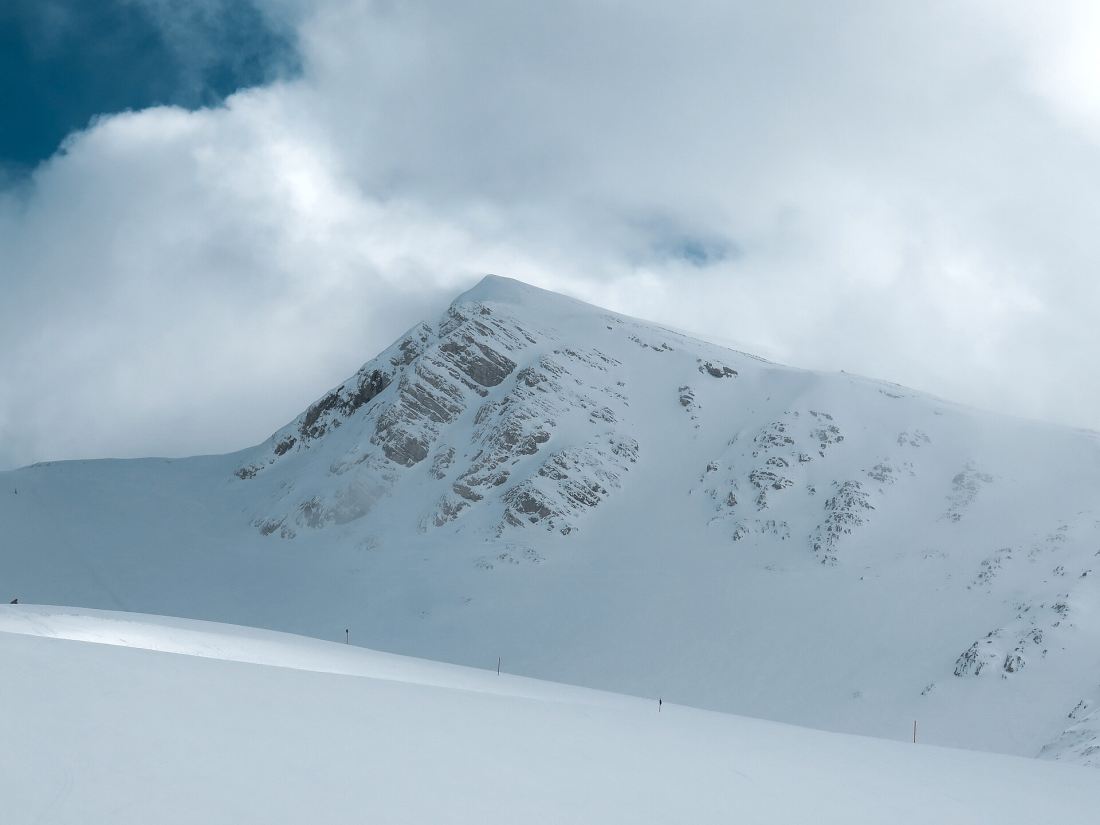
Mount Parnassus is the great limestone mountain that dominates central Greece, rising in pale, sculpted ridges above the Gulf of Corinth and the plain of Amfissa. To the ancient Greeks it was sacred ground, the mountain of Apollo and the Muses, and on its southern slopes stands Delphi, once believed to be the very centre of the world. Today Parnassus wears many faces: a wild national park of fir forest and alpine meadow, Greece’s most celebrated ski resort, and the towering backdrop to one of the country’s most visited archaeological sites. Many travellers experience the mountain and its sanctuary together on a guided tour with My Greece Tours. Plan the whole trip with Greece Tours.
Rising to more than two thousand four hundred metres, Parnassus is a mountain of layered meaning, at once mythological, natural and practical for the modern visitor. To understand how it shaped the sacred landscape below, it helps to read it alongside our Delphi travel guide. The sections below cover what and where Mount Parnassus is, why it was sacred in Greek mythology, how it frames the sanctuary of Delphi, the Parnassus National Park and its nature, and what visitors can do on the mountain today.
What and where is Mount Parnassus?
Mount Parnassus is a high limestone massif in central Greece, rising above the Gulf of Corinth between the regions of Fokida and Boeotia. Its highest peak, Liakoura, reaches over two thousand four hundred metres, making it one of the tallest mountains in southern Greece.
Parnassus forms a broad, many-ridged massif rather than a single pointed summit. Its pale grey slopes are built of limestone, carved over millennia into cliffs, gorges, sinkholes and karst plateaus. The mountain stands inland from the northern shore of the Gulf of Corinth, its southern flanks dropping toward the Pleistos valley and the coastal plain around Itea and Amfissa. From many angles the range reads as a long wall of rock closing off the horizon, its upper reaches bare and stony, its lower slopes cloaked in fir and, in places, ancient terraces of olive groves. This commanding position, visible for great distances across land and sea, helped fix Parnassus in the ancient imagination as a mountain apart.
The highest summit, known as Liakoura, and its neighbouring peaks form the core of the range, with lower foothills fanning out toward the surrounding valleys. Because it rises so abruptly from the sea and the plains, Parnassus catches winter snow that lingers well into spring, feeding springs and streams below. The mountain sits within easy reach of Athens, roughly two to three hours by road, which has long made it accessible to travellers, pilgrims and, in modern times, skiers. Its geography is inseparable from its fame, for it was precisely this dramatic, elevated setting that the ancient Greeks read as the dwelling of gods. That sense of a sacred mountain leads naturally to its rich mythology.
Why was Mount Parnassus sacred in Greek mythology?
Mount Parnassus was sacred to Apollo, god of prophecy and music, and to the nine Muses, which made its name a lasting symbol of poetry and inspiration. The mountain also held the Corycian Cave sacred to Pan and the nymphs, and figured in myths of Dionysus and the great flood.
Above all, Parnassus belonged to Apollo. The god was said to have made his home and his oracle on its southern slopes at Delphi, and the mountain became bound up with prophecy, healing, music and light. Alongside Apollo dwelt the Muses, the nine goddesses of poetry, song and the arts, and because of this the very word Parnassus came to stand for the realm of poetry itself, an association that echoed through European literature for centuries. To ‘climb Parnassus’ meant to aspire to poetic greatness. The mountain thus carried a double sacredness, at once a real, snow-capped range and a metaphor for the highest reaches of human creativity and inspiration, a meaning still felt whenever the name is invoked.
Higher up the mountain lay the Corycian Cave, a vast limestone cavern sacred to the god Pan and the nymphs, reached by an ancient path climbing from Delphi. Parnassus was also linked to Dionysus, god of wine and ecstasy, whose female followers, the maenads, were said to hold their winter revels among its peaks while Apollo wintered elsewhere. In the flood myth of Deucalion, the Greek counterpart of the biblical deluge, it was on the heights of Parnassus that Deucalion’s ark came to rest as the waters receded, so that the mountain became the place where human life began anew. These overlapping stories, of oracle, cave, wine-god and flood, gave Parnassus an unusually dense mythic weight. That weight was concentrated most powerfully in the sanctuary set into its southern face.
How does Mount Parnassus frame the sanctuary of Delphi?
Delphi sits on the steep southern slopes of Parnassus, cradled beneath the mountain’s towering cliffs. The twin Phaedriades, the ‘shining rocks’, rise directly above the sanctuary, with the Castalian spring flowing from the gorge between them, giving Delphi its awe-inspiring, theatrical setting.
The sanctuary of Delphi does not sit on flat ground but clings to the mountainside, its terraces stepping up the slope so that visitors climb the Sacred Way past treasuries and altars toward the temple above. Crowning this ascent stands the Temple of Apollo at Delphi, where the oracle delivered her prophecies, and higher still lie the theatre and the stadium, all pressed against the rising rock of Parnassus. The mountain is not merely a backdrop here but an active part of the sacred design, its height lending the sanctuary a sense of ascent toward the divine. Ancient visitors arriving from the coast looked up to see temple and cliff rising together, a single dramatic composition of architecture and living stone.
Directly above the sanctuary loom the Phaedriades, two great cliffs whose name means the ‘shining ones’ because they catch and reflect the light of the sun. Between them opens a deep cleft, and from this gorge flows the Castalian Spring at Delphi, where pilgrims and the Pythia purified themselves before consulting the oracle. The interplay of soaring rock, sacred water and the temple below created an atmosphere the ancients read as charged with divine presence. Standing at Delphi today, with the cliffs blazing overhead and the valley of olives falling away to the distant gulf, it is easy to feel why this place was chosen. Beyond the sanctuary itself, the wider mountain forms a protected natural realm.
What is the Parnassus National Park and its nature?
The Parnassus National Park is among the oldest national parks in Greece, protecting the mountain’s upper forests, alpine meadows and dramatic karst landscape. It shelters dense woods of Greek fir, seasonal wildflowers, birds of prey and other wildlife, along with the trail to the Corycian Cave.
Established to safeguard the heart of the mountain, the national park centres on the higher slopes where forests of Greek fir climb toward the treeline before giving way to open alpine terrain. In spring and early summer the meadows fill with wildflowers, including crocuses, orchids and other mountain species, while the karst plateaus hold sinkholes, seasonal pools and pockets of grassland. The park is home to birds of prey such as eagles and vultures wheeling above the ridges, along with mammals that shelter in the forest and rock. This mosaic of fir woodland, meadow and bare limestone makes Parnassus a rewarding place for naturalists, and its protection has helped preserve a landscape that has changed little in character since antiquity.
For walkers, the park offers everything from gentle forest paths to demanding ascents of the high peaks. One classic route follows an ancient trail up from Delphi to the Corycian Cave, retracing the steps of pilgrims who once climbed to the grotto of Pan and the nymphs, passing through fir woods and open plateau along the way. More ambitious hikers aim for Liakoura and the neighbouring summits, rewarded by sweeping views over central Greece and, on clear days, distant glimpses of the sea. Snow lingers on the tops well into spring, so timing matters for those heading high. Beyond its wild trails, the mountain also serves visitors in ways that are thoroughly modern.
What can visitors do on Mount Parnassus today?
Today Mount Parnassus is best known as Greece’s leading ski resort in winter and a hiking destination in the warmer months. Many travellers base themselves in the stone town of Arachova, explore the mountain’s trails and slopes, and combine the peak with a visit to Delphi below.
In winter, Parnassus becomes Greece’s most famous ski destination, its high slopes drawing skiers and snowboarders from Athens and beyond to a resort spread across the mountain’s upper bowls. The lively stone-built town of Arachova, perched on the mountainside, serves as the fashionable base for the ski season, filling with visitors who come for the slopes by day and its tavernas and mountain atmosphere by night. In the warmer months the same landscape turns green and floral, and attention shifts to hiking, mountain biking and simply breathing the cool upland air. Just downhill lies the quiet village of Delphi, a convenient and atmospheric base for those focused on the ancient sanctuary rather than the ski runs.
The great advantage of Parnassus for travellers is that mountain and monument sit side by side, so a single trip can pair alpine scenery with world-famous archaeology. Many visitors reach the area on a Delphi day trip from Athens, seeing the sanctuary beneath the Phaedriades and catching the mountain’s grandeur along the way, while those with more time linger in Arachova or Delphi to explore the national park’s trails. Dress for changeable mountain weather, allow time for the winding roads, and consider visiting in shoulder seasons when the sanctuary is calm and the slopes still hold their spring flowers. Plan your visit and tours through our Delphi travel guide.
What are the peaks and geology of Mount Parnassus?
Mount Parnassus is a massif of grey limestone karst that rises above 2,450 metres, crowned by Liakoura, its highest summit. Gerontovrachos and Tsarkos flank the central ridge, while the Livadi plateau, karst caves, and dolines define the treeless upper zone.
The bedrock of Parnassus is Mesozoic limestone, laid down as marine carbonate and later uplifted and folded into the towering block that stands between the Gulf of Corinth and the plain of Boeotia. Rainwater and snowmelt dissolve this limestone along its joints, carving the karst landscape that gives the mountain its bare, pale character. The result is a summit region of fissured rock, sinkholes, and underground drainage rather than surface streams.
The named high points form a clear hierarchy. Liakoura tops the range and carries a survey marker on its crown. Gerontovrachos rises to the south-east above the ski slopes, and Tsarkos stands along the same crest, so the three summits frame the high basin between them. The peaks list reads as follows:
- Liakoura, the highest summit of the massif, above 2,450 metres.
- Gerontovrachos, the rocky shoulder overlooking the Kelaria slopes.
- Tsarkos, a limestone horn on the northern crest.
- The plateau of Livadi, a high grassland basin ringed by the peaks.
Across the upper mountain the karst produces caves and dolines, the funnel-shaped hollows where the surface collapses into dissolved limestone below. The plateau of Livadi collects snowmelt in spring and holds pasture through the warm months, while the summits stay bare of trees above the natural treeline. Winter snow blankets the whole upper zone from autumn into spring, feeding the springs that emerge lower down the slopes and sustaining the karst hydrology that has drawn settlement to the mountain’s flanks since antiquity.
What is the Parnassos Ski Centre and winter on the mountain?
The Parnassos Ski Centre spreads across the Kelaria and Fterolakka slopes above Arachova, linking chairlifts and drag lifts to pistes on the high basins. Winter draws crowds from Athens, mountain shelters serve skiers, and the resort turns to hiking and cycling once the snow melts.
The ski centre sits on the eastern flank of the massif, with two connected areas, Kelaria and Fterolakka, sharing a network of pistes graded from beginner runs to steep upper descents. Chairlifts carry skiers from the base stations toward Gerontovrachos, and drag lifts extend the reach across the higher basins. The top stations stand above 2,250 metres, so the runs hold snow through the winter season and open long sightlines across the surrounding ranges.
Arachova, the stone town on the ridge below, functions as the resort’s base. Its tavernas, guesthouses, and the woven textiles for which it is known fill through the winter weekends, when the drive from Athens brings skiers up the mountain road for the day. Mountain shelters and refuge huts near the pistes give walkers and skiers a base at altitude, and the road that climbs from the town connects the ski centre to the archaeological sanctuary at Delphi and the modern village of Delphi further down the slope.
Once the snow retreats, the same terrain carries a summer programme. The lift-served slopes and service roads become routes for mountain biking and hill walking, and the high basins that hold pistes in winter open as pasture and trailhead ground in the warm season. The refuges stay in use for walkers crossing the range, so the resort operates across both seasons rather than closing when the ski runs bare.
What are the hiking trails and the summit routes on Parnassus?
Marked paths cross Mount Parnassus, and the E4 European long-distance route traverses the range. Hikers climb to Liakoura from trailheads at Arachova and the ski centre, rest at mountain refuges, and walk from Delphi up to the Corycian Cave on the plateau above the sanctuary.
The E4 European long-distance path threads through the massif on its route across the Greek mainland, waymarked with the yellow-and-black signs that carry it over the high ground. From the trail network branch the ascents to the named summits, and the climb to Liakoura is the principal objective, reached along the ridge that runs north from the ski area toward the highest crown of the mountain. Refuges along the way give walkers a staging point for the summit push and a shelter when snow lingers on the upper slopes.
The trailheads sit at the settlements and the resort. Arachova opens routes onto the eastern flank, the ski centre gives a high start toward Gerontovrachos and the Livadi plateau, and the village of Delphi feeds the paths that climb from the sanctuary. From these starting points the marked network connects the basins, the refuges, and the summit ridges into a set of linked circuits and out-and-back climbs.
The best-known walk from the archaeological site leads to the Corycian Cave, the cavern sacred to Pan and the Nymphs on the plateau above the ancient sanctuary. Walkers set out from Delphi on the old path that switchbacks up through the rock, gaining the high ground where the cave opens into the limestone. The route ties the mountain’s mythology to its geology, since the same karst that carved the caves of the summit zone hollowed out the cavern that the ancients dedicated on the flank of Parnassus.
What is the Corycian Cave on Mount Parnassus?
The Corycian Cave is a large limestone cavern on the plateau of Mount Parnassus, north of Delphi at about 1,360 metres above sea level, sacred to the god Pan and the Corycian nymphs and named the Korykion Antron by ancient Greek writers.
The cave opens on the high plateau of Livadi, above the tree line that rings the sanctuary. Its single chamber runs deep into the rock, with a stepped floor and stalactites that ancient visitors read as the forms of the nymphs. Pausanias walked up to it and recorded that of all the caves he had entered, the Corycian rewarded the climb; he tied its name to the nymph Corycia, a daughter of the river Pleistos that drains the valley below.
The route to the cave starts inside the sanctuary of Apollo at Delphi, climbs past the stadium set above the theatre, and joins the old paved track that switchbacks up the cliffs of the Phaedriades onto the plateau. The modern E4 long-distance path follows the same line, so walkers reach the Corycian Cave on foot from the archaeological site in a steady ascent of several hours through fir forest.
Excavations on the cave floor by the French School at Athens recovered the debris of centuries of worship: clay lamps by the thousand, terracotta figurines of Pan and the nymphs, bronze rings, iron blades, and astragaloi, the knucklebones cast as dice and dedicated in play. The finds date the cult from the Neolithic period through to Roman rule, an unbroken record of offerings left in the dark.
The cave also held the winter rites of the Thyiades, the women of Delphi and Athens who climbed Parnassus every second winter to wake Dionysus with torches and dance on the frozen plateau. Plutarch, himself a priest at Delphi, and Pausanias both name these processions, which paired the ordered oracle of Apollo below with the ecstatic worship of Dionysus on the heights.
What plants and animals live on Mount Parnassus?
Mount Parnassus carries a forest belt of the Greek fir Abies cephalonica, a plateau flora of crocus, tulip and fritillary, and birds of prey including the golden eagle and the griffon vulture, all protected within the bounds of Parnassus National Park.
The mountain rises through clear vegetation zones. Kermes oak and Aleppo pine hold the lower slopes; the Greek fir, endemic to the mountains of central and southern Greece, forms a dense belt from roughly 800 to 1,800 metres; and above the trees the ground opens into alpine meadow and bare karst limestone. Parnassus National Park, declared in the mountains around the peak of Liakoura, ranks among the first national parks established in Greece and fixes protection over the fir forest and the summit zone.
The flora of Parnassus counts hundreds of recorded species, and a set of them grow nowhere else. Spring and early summer bring wild tulips, autumn and winter crocus, snake’s-head fritillary, and the botanical namesake of the mountain, the perennial known to gardeners as Parnassus grass. The plateau of Livadi and the meadows below the Corycian Cave carry the densest of these displays once the snow retreats.
- Trees: Greek fir (Abies cephalonica), Kermes oak, Aleppo pine, and juniper on the exposed ridges.
- Wildflowers: wild tulip, autumn crocus, snake’s-head fritillary, gentian, and endemic saxifrage.
- Mammals: red fox, wild boar, roe deer, and the returning population of red deer within the park.
- Birds of prey: golden eagle, griffon vulture, short-toed eagle, and peregrine falcon along the cliffs.
The griffon vultures nest on the Phaedriades and the gorges that fall toward the Pleistos valley, riding the thermals that build over the warmed rock through the day. The park status restricts logging, grazing and building across the core zone, which holds the fir forest intact and keeps the summit meadows open for the wildflowers and the raptors that hunt above them.
What towns and villages surround Mount Parnassus?
Arachova sits on the southern flank of Mount Parnassus, the modern village of Delphi lies below it toward the sanctuary, Amfissa spreads across the olive plain to the west, and a chain of coastal towns lines the Corinthian Gulf at the foot of the mountain.
Arachova stacks its stone houses up a steep slope at about 950 metres, straddling the road from Delphi toward Livadeia. The town produces formaela, a firm cheese grilled over coals and served across the region, along with red saffron and hand-woven textiles. Its position at the gateway to the Parnassus ski centre turns it into the winter hub of the mountain, and its narrow lanes climb to the clocktower that marks the old quarter.
The village of Delphi, rebuilt west of the archaeological site after the old settlement was moved off the ruins, runs in two long streets along the mountainside above the Pleistos gorge. From its edge the road drops past the Castalian Spring and the sanctuary toward the sea, and the village serves as the base for walkers heading up to the Corycian Cave and the plateau.
Amfissa commands the western end of the range, above the Krisaean plain where the olive groves of the Sacred Land of Delphi cover the valley floor. A medieval castle crowns the town on the site of ancient Amphissa, and the plain below holds one of the oldest continuous olive cultivations in Greece, an unbroken carpet of trees from the mountain foot to the Gulf.
Below the southern slopes the Corinthian Gulf coast carries the port of Itea, the harbour town of Galaxidi with its captains’ mansions, and the ancient anchorage of Kirra that once served the sanctuary. These towns tie Mount Parnassus to the sea, and the road from Arachova through Delphi and down to Itea links the ski slopes, the ruins, and the coast in a single descent from summit to shore.
What deeper myths are set on Mount Parnassus?
Mount Parnassus carries the flood of Deucalion, the seat of Apollo and the Muses, the winter revels of Dionysus and his Thyiades, and the poetic shadow of Orpheus, binding the mountain to the oldest stories of creation, prophecy, and song in Greece.
The flood of Deucalion fixes Parnassus at the start of the human race. Zeus sent a deluge to drown a corrupt age, and Deucalion, son of Prometheus, built an ark with his wife Pyrrha. The waters rose over the plains, and the ark came to rest on the peaks of Parnassus, the one high ground left above the flood. There the couple stepped out onto dry stone, offered thanks, and received the command to cast the bones of their mother behind them. They read the riddle as the stones of the earth, threw them over their shoulders, and the stones Deucalion cast rose as men while those Pyrrha cast rose as women. The mountain thus became the cradle where the earth was repeopled.
Parnassus stands as the seat of Apollo and the nine Muses, and that ownership shapes every myth set on its slopes. Apollo held the sanctuary below at Delphi, where his priestess delivered the oracle of Delphi, and the Muses attended him on the heights as the patrons of memory, music, and verse. The Castalian spring at the foot of the cliffs and the Corycian spring higher up fed this poetic and prophetic power.
Dionysus claimed the winter half of the mountain. When Apollo left for the land of the Hyperboreans in the cold season, the god of wine ruled Parnassus, and the Thyiades, women of Delphi and Athens, climbed the icy heights to dance by torchlight in his honour. Orpheus, the singer whose lyre moved stones and beasts, belongs to the same tradition of Parnassian song, and his name deepens the mountain’s tie to poetry and the arts.
Why does “Parnassus” mean poetic inspiration?
Parnassus means poetic inspiration because the mountain housed Apollo and the Muses and fed the sacred Castalian and Corycian springs, and later European art adopted “Parnassus” as the emblem of poetry, from Renaissance paintings of the name to the very phrase for the world of poets.
The root of the idea sits in the myth itself. Apollo, god of music and prophecy, held Parnassus as his own, and the nine Muses who governed epic, lyric, history, dance, and astronomy attended him there. The Castalian spring below the twin Phaedriades cliffs and the Corycian spring on the plateau above supplied the waters that ancient writers named as the source of inspiration. A poet who drank from Castalia drew directly on the mountain’s gift, so to speak of Parnassus was to speak of the wellspring of verse. The sanctuary of Delphi on the lower slopes anchored this reputation, drawing pilgrims and poets alike to the mountain of the god.
Roman poets carried the symbol forward. Virgil, Ovid, and Persius invoked the twin peaks of Parnassus and the Castalian waters as the address of poetry, and their verse fixed the mountain in the vocabulary of European letters. Through the Middle Ages and into the Renaissance the name kept its charge, standing in for the summit of poetic achievement rather than a place on a map.
Renaissance painting turned the idea into a genre. Raphael painted “The Parnassus” in the Vatican, seating Apollo among the Muses and the great poets on the sacred mount, and Andrea Mantegna and later Nicolas Poussin produced their own versions of the scene. The image spread across galleries and libraries until “Parnassus” named the whole community of poets. A group of French poets took the title “Parnassians” for their movement, and the phrase “to climb Parnassus” entered common speech for the pursuit of poetic fame. The mountain of Apollo became the permanent symbol of the arts.
When is the best time to visit Mount Parnassus, and how do you plan a trip?
Each season opens a different Parnassus: winter brings snow and the ski centre, spring the wildflowers, summer the high trails, and autumn the clear long views. A base at Arachova or the village of Delphi puts the mountain and the archaeological site within a single trip.
The mountain changes character across the calendar, and the choice of month sets the whole visit. The four windows divide cleanly:
- Winter — deep snow on the high slopes, the Parnassos Ski Centre open at Kellaria and Fterolakka, and the stone town of Arachova busy as the mountain resort.
- Spring — meltwater on the plateau, wildflowers across the meadows, and green flanks under a clear sky.
- Summer — dry, firm trails to the summits of Liakoura and Gerontovrachos, long daylight, and cool air at altitude above the heat of the plain.
- Autumn — settled weather, sharp far views over the Gulf of Corinth, and quiet paths after the summer crowds thin.
Arachova makes the natural base on the mountain side. The village sits at roughly 950 metres on the southern slope, a short drive from both the ski centre above and the ruins below, and its tavernas, weavers, and formaela cheese give the stay its own draw. The village of Delphi, a few kilometres west, puts travellers within walking distance of the sanctuary gate and offers rooms with a view down the olive valley to the sea at Itea. Either base connects the natural mountain and the ancient site in one circuit.
Combining the mountain with the archaeological site rewards a stay of two or three days. A traveller pairs a morning at the sanctuary and the Castalian spring with an afternoon drive up to the plateau of Livadi and the Corycian Cave, then reserves a second day for a summit trail or the ski slopes by season. The road from Athens runs about 180 kilometres through Thebes and Livadeia, and the same route ties Parnassus to Osios Loukas monastery and the coast, so the mountain of Apollo sits at the centre of a wider Central Greece itinerary.
What ancient cities and refuges stood on Mount Parnassus?
Beyond Delphi, Mount Parnassus held a ring of ancient Phocian cities — Tithorea, Lilaia, Amphikleia and Drymaia — and its peaks served as the refuge where the Phocians and Delphians fled the invading army of Xerxes. The mountain fortified as well as sanctified the region.
The northern and western slopes carried a chain of cities of ancient Phocis. Tithorea, also called Neon, stood high on a defensible spur above the Kephisos valley, its walls climbing the rock; Pausanias described its steep circuit and its shrine of Isis. Lilaia rose at the very source of the Kephisos river, where the springs break from the foot of the mountain, and Amphikleia and Drymaia held the passes on the road that skirted the massif toward the plain of Boeotia.
The mountain gave shelter in war. When the army of Xerxes marched on central Greece, the people of Phocis abandoned their towns and climbed to the heights of Parnassus and to Tithorea, whose crags gave the safest refuge, while others crossed to Amfissa and the Ozolian Locrians. Herodotus records the flight, and the same peaks that hid the population also, in the tradition he preserves, turned back the Persian detachment sent against Delphi when rocks broke from the Phaedriades upon the invaders.
These sites tie the mountain into the wider landscape of central Greece:
- Tithorea (Neon), the walled city on a spur above the Kephisos.
- Lilaia, set at the source of the Kephisos river on the northern foot.
- Amphikleia and Drymaia, guarding the passes toward Boeotia.
- Delphi and its port at Kirra on the southern slope toward the gulf.
The ruins of these towns, their walls and towers still traceable on the slopes, mark Parnassus as a fortified frontier as much as a sacred summit. The mountain divided Phocis from Boeotia and Locris, its passes carried the armies and pilgrims of antiquity, and its peaks stood as the last refuge when the plains below fell to an invader. Later generations fortified the same heights again: a Byzantine and Frankish castle crowned the spur of Tithorea, and shepherds and rebels used the caves and folds of the upper mountain as hideouts through the centuries of Ottoman rule, so Parnassus kept its double character as a place of the gods above and a stronghold of the people who lived beneath it. In the war of independence and again in the mountain campaigns of the twentieth century, fighters held these same passes and summits, adding a modern chapter to the long record of Parnassus as the natural citadel of central Greece.
Frequently Asked Questions
How high is Mount Parnassus and can you climb to the top?
Mount Parnassus rises to more than two thousand four hundred metres at its highest summit, Liakoura, making it one of the tallest peaks in southern Greece. Reaching the top is a genuine mountain hike rather than a technical climb, but it demands stamina, good footwear and an early start. Well-marked trails ascend from the higher villages and from the ski area, climbing through Greek fir forest before emerging onto bare, stony alpine terrain near the summit ridge. From the top, walkers are rewarded with vast panoramas across central Greece, taking in surrounding ranges, the plains below and, on clear days, distant water. Snow can linger on the upper slopes well into spring, so the safest window for the peaks runs through the warmer months. Less experienced walkers often prefer the gentler and deeply atmospheric trail from Delphi up to the Corycian Cave, which offers a real taste of the mountain without the full ascent to the summit.
How do I get to Mount Parnassus and Delphi from Athens?
Mount Parnassus and Delphi lie roughly two to three hours northwest of Athens by road, which makes the whole area a comfortable day trip or a relaxed overnight escape from the capital. The drive climbs steadily inland, passing through the plain of Boeotia and the town of Livadeia before winding up toward the mountain, with the stone town of Arachova and then Delphi strung along the slopes. Travellers who prefer not to drive the mountain roads themselves often join an organised excursion, which handles the logistics and adds expert commentary on the myths and history of the sanctuary. Public buses also connect Athens with Delphi and Arachova for independent visitors. Because the road twists as it gains height, it is wise to allow extra time and to be prepared for cooler, changeable weather on the mountain, even when Athens is warm. Basing yourself in Arachova or the village of Delphi lets you explore both the sanctuary and the surrounding national park at an unhurried pace.
When is the best time to visit Mount Parnassus?
The best time to visit Mount Parnassus depends on what you hope to do, because the mountain offers two very different experiences across the seasons. In the colder months the high slopes fill with snow and Parnassus becomes Greece’s leading ski resort, with Arachova at its liveliest and the mountain roads busy with visitors from Athens. For skiing and a festive winter-mountain atmosphere, this is the season to choose. In the warmer half of the year the snow retreats, the meadows bloom with wildflowers and the national park opens up for hiking, from gentle forest paths to the ascent of the high peaks. Spring and autumn are especially rewarding for those combining the mountain with Delphi, as the sanctuary is quieter, the light is soft and temperatures are comfortable for walking the Sacred Way and the trail to the Corycian Cave. Whenever you come, pack layers, since conditions on the heights can differ sharply from the valleys and the coast below.