
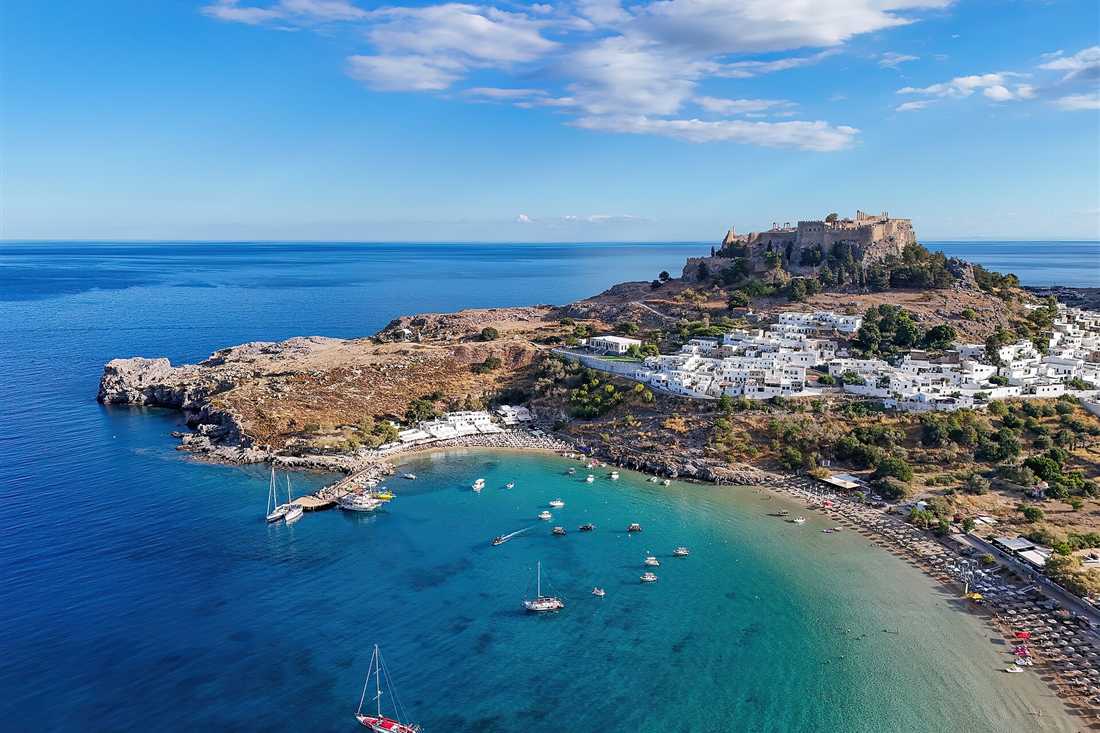
Dodecanese tours cover the island chain of the south-east Aegean, within sight of Turkey: the walled Old Town of Rhodes and the acropolis of Lindos, the Tree of Hippocrates on Kos, the pastel harbour of Symi, the volcano of Nisyros and the Cave of the Apocalypse on Patmos. Plan the rest of the trip with Greece Tours.
This page covers the Dodecanese tours you can book, from boat day trips and island hopping to island tours, the sights of each island, the history of the Knights and the Italian years, the food and outdoor trips, and how the ferries and airports shape the route.
What do Dodecanese tours cover?
Dodecanese tours cover the island chain of the south-east Aegean, off the coast of Turkey: Rhodes, Kos, Patmos, Symi, Nisyros, Kalymnos, Leros, Karpathos, Astypalaia, Tilos, Halki, Kasos, Lipsi, Kastellorizo and Agathonisi. They run as boat day trips, island hopping, island tours and cruises.
The name Dodecanese means “twelve islands”. The group counts 15 larger and about 150 smaller islands, and 26 of them are inhabited. They lie off the coast of Anatolia and form the eastern edge of the Sea of Crete. Rhodes has led the group since antiquity. Kos and Patmos follow it in historical weight. The other twelve are Agathonisi, Astypalaia, Halki, Kalymnos, Karpathos, Kasos, Lipsi, Leros, Nisyros, Symi, Tilos and Kastellorizo, officially Megisti.
The name moved to these islands in the Ottoman period. After 1522 Rhodes and Kos fell under direct Ottoman rule. The smaller islands kept tax and self-government privileges. When the Ottomans cut those privileges after 1869, the Greek press called the twelve privileged islands the Dodecanese. Dodecanese tours hear that history in every harbour town.
Which groups of islands do Dodecanese tours visit?
- Rhodes and its neighbours: Rhodes, Symi, Halki, Tilos and Kastellorizo.
- Kos and its neighbours: Kos, Nisyros, Kalymnos, Pserimos and Telendos.
- The northern islands: Leros, Patmos, Lipsi and Agathonisi.
- The southern islands: Karpathos and Kasos, between Rhodes and Crete.
- The western island: Astypalaia, on the edge of the Cyclades.
Which formats do Dodecanese tours take?
- Boat day trips from Rhodes to Symi and from Kos to Nisyros, Kalymnos and Pserimos.
- Island tours by bus, jeep or private car on Rhodes, Kos, Karpathos and Patmos.
- Catamaran and yacht cruises along the coasts of Rhodes and Kos.
- Island hopping on the ferries and catamarans that link the islands.
- Religious tours to the monastery and cave of Patmos and to Panormitis on Symi.
- Outdoor tours: climbing on Kalymnos, hiking on Kos and Karpathos, diving and kayaking.
Two sites of the Dodecanese stand on the UNESCO World Heritage list. The Medieval City of Rhodes joined in 1988. The Chora of Patmos, the Monastery of Saint John and the Cave of the Apocalypse joined in 1999. Dodecanese tours reach both.
Which island-hopping and cruise Dodecanese tours link the islands?
Island-hopping Dodecanese tours use the ferries and catamarans that run along the chain, from Rhodes to Kos, Kalymnos, Leros and Patmos. Day cruises link Rhodes with Symi and Kos with Nisyros, Kalymnos, Pserimos and Plati. Ferries from Kos and Rhodes also cross to Bodrum and Marmaris in Turkey.
The islands lie close together. Kalymnos is 12 km north of Kos and less than 2 km south of Leros. Symi lies about 24 km north of Rhodes. Halki lies 9 km west of Rhodes. Tilos sits midway between Kos and Rhodes. The catamaran Dodekanisos Express links Leros with the other Dodecanese islands. Dodecanese tours hop from one island to the next in an hour or two.
The ferry between Rhodes and Kos joins the two main islands. From Kos, “From the Port of Kos: Full-Day Boat Cruise to 3 Islands” has more than 6,000 reviews. “Kos Pirate Cruise: 3 Islands, Swimming & Lunch” has more than 3,000. These cruises stop at Kalymnos, Pserimos and the islet of Plati. Our page on the Kos 3-island cruise covers the loop.
Which day cruises leave Rhodes?
From Rhodes, the day cruises head for Symi. “From Rhodes: Cruise to Symi Island and Saint George’s Bay” has more than 3,000 reviews. “From Rhodes: Symi Island and Panormitis Monastery Day Trip” adds the monastery in the south of Symi. Fast boats reach Symi in less time and give longer stops in the harbour. “Rhodes: All-Inclusive Catamaran Cruise with Lunch and Drinks” sails the east coast and has more than 2,400 reviews. Our page on the Symi day trip from Rhodes covers the crossing.
Which Dodecanese tours cross to Turkey?
The islands lie within sight of Anatolia. Symi faces the Datça and Bozburun peninsulas. Kastellorizo lies only 2 km off the Turkish coast. Ferries link Kos with Bodrum and Rhodes with Marmaris. A same-day return ferry leaves Bodrum castle port for Kos. Travellers carry a passport on these crossings. Our pages on the Bodrum day trip from Kos and the Marmaris day trip from Rhodes cover both routes.
Longer island-hopping Dodecanese tours move north from Rhodes to Kos, then to Kalymnos, Leros and Patmos. A high-speed ferry links Leros directly with Mykonos in summer in about 4 hours. That link joins the Dodecanese to the Cyclades for a longer trip.
What do Dodecanese tours show on Rhodes?
Dodecanese tours on Rhodes show the walled Medieval City, a UNESCO site since 1988, the Palace of the Grand Master and the Street of the Knights, the acropolis of Lindos above its bay, ancient Kamiros, the Valley of the Butterflies and the Seven Springs. Rhodes is the largest island of the group.
Rhodes is the largest of the Dodecanese and their historical capital. It is the ninth largest island in the Mediterranean. Its nicknames are “the Island of the Sun”, after its patron god Helios, and “the Island of the Knights”. The Knights of Saint John ruled it from 1310 to 1522. In antiquity it was known for the Colossus, one of the Seven Wonders of the Ancient World.
The Colossus was a statue of Helios by Chares of Lindos. It stood about 33 metres high, the tallest statue of the ancient world. The Rhodians built it to mark the end of the siege by Demetrius I of Macedon. Work began in 292 BC and ended around 280 BC. An earthquake threw it down in 226 BC. Following the Oracle of Delphi, the Rhodians never rebuilt it. Our page on the Colossus of Rhodes covers the statue.
What do Dodecanese tours see in the Old Town of Rhodes?
The Medieval City of Rhodes was built between about 1309 and 1523. A wall 4 km long surrounds it. The high town in the north was built entirely by the Knights. The lower town lies to the south. The Palace of the Grand Master, the Kastello, is one of the few Gothic buildings in Greece. It began as a Byzantine citadel of the late 7th century. The Knights made it their palace after 1309.
A gunpowder store exploded in 1856 and destroyed much of the palace. The Italians rebuilt it between 1937 and 1940, to a design by Vittorio Mesturino. “Rhodes: Palace of the Grand Master E-Ticket & Audio Tour” covers the visit. Walking Dodecanese tours follow the Street of the Knights to the palace. Our pages on the Rhodes Old Town, the Street of the Knights and the Palace of the Grand Master cover the medieval city.
What do Dodecanese tours see at Lindos?
Lindos lies on the east coast, about 40 km south of the city of Rhodes. The Dorians founded it. By the 8th century BC it was a major trading centre. In the 6th century BC it was ruled by Cleobulus, one of the Seven Sages of Greece. The acropolis above the village holds the Doric Temple of Athena Lindia of about 300 BC. A Hellenistic stoa 87 metres long had 42 columns. A relief of a Rhodian warship, cut into the rock at the foot of the steps, dates from about 180 BC. The Knights built a fortress over the ancient buildings in the 14th century.
“Rhodes: Lindos & Seven Springs Bus Tour Experience” has more than 3,600 reviews. Our page on the Lindos acropolis covers the site.
Which island tours run on Rhodes?
Bus and private Dodecanese tours cross Rhodes in a day. “Best of Rhodes Tour including Lindos and Medieval City” joins the two main sites. “Rhodes: Big Island Round Tour with Wine testing” loops the whole island. Private tours with a local driver reach the villages of the interior. Ialysos lies 8 km west of the city, on the north-west coast. It stands near the ancient Doric city of Ialysus, the homeland of the boxer Diagoras of Rhodes. The hill of Filerimos rises above it. The north-west coast catches the wind and serves windsurfers. Our pages on Filerimos and the Archaeological Museum of Rhodes cover two more stops.
What else do Dodecanese tours see on Rhodes?
Kamiros stands on the north-west coast. It was a Dorian city built on three levels, with the temple of Athena Kameiras on top. A covered reservoir of 600 cubic metres served up to 400 families. Earthquakes destroyed the city in 226 BC and AD 142. The Valley of the Butterflies, Petaloudes, fills with Jersey tiger moths after late May. Oriental sweetgum trees give the scent that draws them. Our pages on ancient Kamiros, the Valley of the Butterflies and the Seven Springs cover each stop. Our page on Rhodes covers the island.
What do Dodecanese tours show on Kos?
Dodecanese tours on Kos show the Tree of Hippocrates and the Castle of the Knights in Kos town, the Asklepion, the mountain village of Zia at sunset, and the peninsula of Kefalos. Kos is the third largest island of the Dodecanese and the second most populated.
Kos measures 42.1 by 11.5 km, with 112 km of coast. It lies south of Kalymnos and Pserimos and north of Nisyros. The main villages are Kardamena, Kefalos, Tigaki, Antimachia, Mastihari, Marmari and Pyli. Zia, Zipari, Platani, Lagoudi and Asfendiou are smaller. The name Kos first appears in the Iliad. Under the Knights the island was called Lango, after its length.
Kos town is the port and the main town. The Tree of Hippocrates stands in Platia Platanou, in front of the Castle of the Knights. Legend says Hippocrates, the father of medicine, taught his pupils under it. The tree is an oriental plane about 500 years old, and its crown spans about 12 metres. The Gazi Hassan Mosque of 1776 stands beside it. Our pages on the plane tree of Hippocrates and the Castle of Nerantzia cover the town sights.
Ancient writers also called Kos Meropis, Cea and Nymphaea. Romance languages called it Stancho, and Turkish calls it Istanköy, both from the Greek phrase “eis tin Ko”, “to Kos”. A person from Kos is a “Koan”. Tourism is the main industry. Kardamena on the south coast is a resort with bars and clubs. The Alyki salt lake lies near Tigaki. In Kos town, a hammam house offers a bath ritual named after Hippocrates. Our page on Kos town covers the harbour and the old quarter.
What is the Asklepion of Kos?
The Asklepion was a healing sanctuary of Asclepius, the god of medicine. It rises on terraces on a hill above Kos town. The school of Hippocrates is linked to the island. Dodecanese tours visit the terraces, the temple foundations and the view across the strait to Turkey. Our page on the Asklepion of Kos covers the site. Casa Romana, a restored Roman house, stands in the town.
Which Dodecanese tours run on Kos?
“Kos: Zia Village Sunset Tour with Hotel Pickup” climbs the slopes of Mount Dikaios to Zia for the sunset. A moderate hiking tour climbs Dikaios itself. “Kos: Full-Day Jeep Safari with Lunch” drives the island on dirt roads. A 4×4 tour reaches Kefalos with a tavern lunch. Kefalos, the westernmost town, stands on a height 43 km from Kos town, below the windmill of Papavasilis. Its bay of Kamari holds the ruins of the Basilica of Agios Stefanos. Our pages on the Zia sunset tour, the Kos island tour and Kos cover the island.
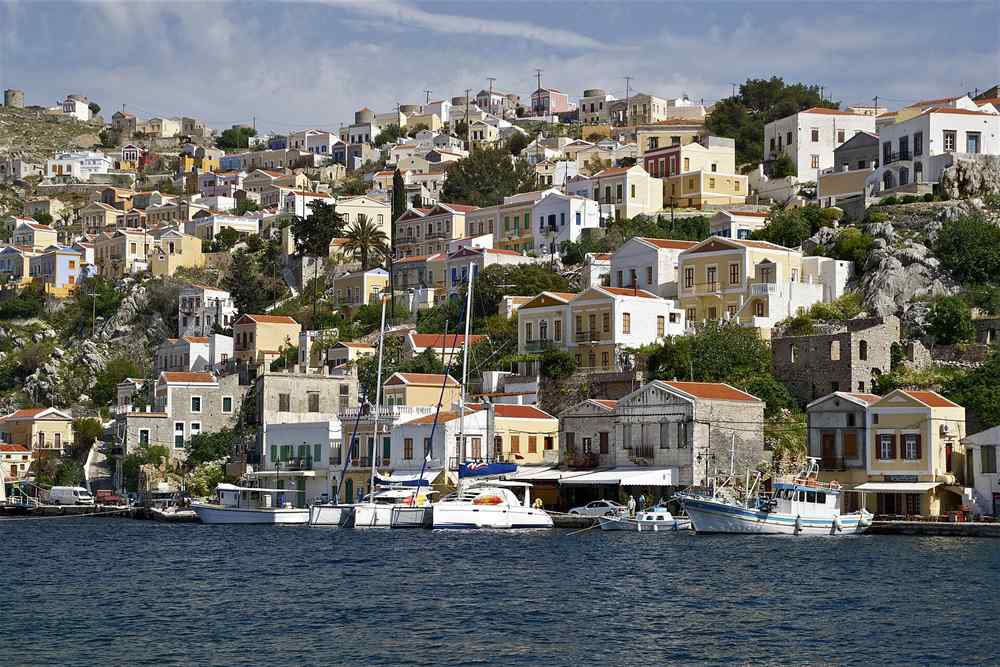
What do Dodecanese tours show on Symi, Halki and Tilos?
Dodecanese tours on Symi show the neoclassical harbour town of Gialos, Ano Symi above it and the monastery of the Archangel Michael at Panormitis. Halki, west of Rhodes, has one village, Emporio, and a castle of the Knights. Tilos keeps the cave of its Ice Age dwarf elephants.
Symi lies about 24 km north of Rhodes. It covers 58 square kilometres of mountains. Its neighbours on land are the Datça and Bozburun peninsulas of Turkey. The main town sits on the north-east coast. The lower town around the harbour is Gialos, and the upper town is Chorio or Ano Symi. Shipbuilding and sponge diving made the island rich. Its population peaked at about 22,500 in the 19th century. The pastel neoclassical houses of that time rise around the harbour.
Myth makes Symi the birthplace of the Charites, the Graces. Homer names it as the realm of King Nireus, the most handsome Greek at Troy after Achilles. Panormitis, in the south, holds the monastery of Saint Michael. Pilgrims visit it through the year. The tourist season runs from Easter to Panormitis day in early November. “Symi: Bus Excursions To Panormitis Monastery” runs from the harbour. Our pages on Symi and the Panormitis monastery cover the island.
Walking Dodecanese tours on Symi climb the Kali Strata, the stepped street from Gialos to Ano Symi. The clock tower and the Nautical Museum stand by the harbour. Boat taxis carry swimmers from Gialos to the beaches that roads do not reach. A sightseeing train runs through the town. Thucydides records a sea battle off Syme in 411 BC, in which Spartan ships beat an Athenian squadron. Our pages on the Kali Strata, the Symi clock tower and Nautical Museum and the Symi boat taxi beaches cover the harbour town.
What do Dodecanese tours see on Halki?
Halki lies about 9 km west of Rhodes. It covers 28 square kilometres. Its people live in one village, Emporio, by the harbour. The old village of Chorio stands almost empty after emigration in the 20th century. A large group of islanders moved to Tarpon Springs in Florida. A ruined castle of the Knights of Saint John stands above Chorio. There is almost no natural water, and rainwater collects in large cisterns. Our page on the Halki day trip from Rhodes covers the crossing.
What do Dodecanese tours see on Tilos?
Tilos lies midway between Kos and Rhodes. With its islets it covers 64.5 square kilometres. In the Late Pleistocene a dwarf elephant, Palaeoloxodon tiliensis, lived here. Its bones were found in the Charkadio cave, in the centre of the island. In classical times the island minted its own coins and was known for clothing and perfumes. The poet Erinna is said to have been born here. Our page on the Tilos day trip from Rhodes covers the island.
What do Dodecanese tours show on Nisyros?
Dodecanese tours on Nisyros climb down into a volcanic crater inside a caldera 3 to 4 km wide, then visit the village of Nikia on the crater rim and the harbour town of Mandraki with its monastery of Panagia Spiliani. Boats leave from Kos.
Nisyros lies between Kos and Tilos. It is almost round, about 8 km across, and covers 41.6 square kilometres. The island formed in the past 150,000 years in three stages of eruption. Its caldera measures 3 to 4 km across. The volcano is active but not erupting. Fumaroles steam in the craters. The last eruptive activity was a steam explosion in 1888, after small ash eruptions in 1871 and 1873.
“From Kos: Nisyros Island Volcano and Panagia Spiliani” has more than 3,000 reviews. The boat lands at Mandraki. A bus climbs to the caldera floor, where visitors walk into a crater and see the steaming vents. The tour then visits Mandraki and the monastery of Panagia Spiliani, built in a cave above the town. “Cruise to Nisyros: Volcano, Nikia Village & Mandraki Trip” adds the village of Nikia on the rim. Our pages on Nisyros and the Nisyros day trip from Kos cover the trip.
The volcanic complex also covers the seafloor between Nisyros and Kos, the islet of Gyali and part of Kos. Nisyros holds one of the most important geothermal fields of Greece, with fluids above 350 °C. Gyali, the largest islet nearby, has 22 residents. Dodecanese tours from Rhodes reach Nisyros on longer day trips. Our page on the Nisyros day trip from Rhodes covers that route.
What do Dodecanese tours show on Patmos, Leros and Lipsi?
Dodecanese tours on Patmos visit the Cave of the Apocalypse, where tradition says Saint John received the Book of Revelation, and the fortified Monastery of Saint John above Chora, both UNESCO sites since 1999. Leros shows its Knights’ castle and the Italian town of Lakki. Lipsi lies between them.
Patmos is one of the northernmost islands of the Dodecanese. It covers 34 square kilometres. Its highest point, Profitis Ilias, reaches 269 metres. The Book of Revelation says its author, John, received his vision on Patmos. Early Christian tradition identified him with John the Apostle. In 1999 UNESCO listed the Chora, the Monastery of Saint John the Theologian and the Cave of the Apocalypse.
The Cave of the Apocalypse lies halfway up the hill, on the road between Skala, the port, and Chora. Tradition says John heard a voice through three openings in the rock, a sign of the Trinity. His disciple Prochorus wrote down the words. The cave is now a Greek Orthodox church. The monastery stands at the highest point of Chora. Emperor Alexios I Komnenos gave the island to the monk Christodoulos in 1088. Christodoulos built most of the monastery within three years and fortified it against pirates and the Seljuks.
The main church and the refectory date from the 11th century. The library holds at least 330 manuscripts, 82 of them of the New Testament. The monastery keeps the skull of Saint Thomas the Apostle among its relics. “Patmos Religious Highlights Tour: Monastery, Cave & More” covers both sites. Our pages on Patmos and the Patmos monastery and cave cover the island.
Myth says Artemis raised Patmos from the sea with the help of Apollo and Zeus, and settlers named it Letois in her honour. In the 3rd century BC the settlement became an acropolis with a wall and towers. The Patmian School, a known Greek seminary, stands on the island. Walking tours link the monasteries of Chora with its windmills. Boats reach Patmos on day trips from Kos and Samos. Our pages on the Chora of Patmos and the Patmos day trip from Kos cover the visit.
What do Dodecanese tours see on Leros?
Leros lies 317 km from Piraeus, about nine hours by ferry or 45 minutes by air. It is about 32 km from Turkey. A castle of the Knights of Saint John crowns the island, possibly on a Byzantine fortress. The main town is Agia Marina. Lakki, known as Portolago until 1947, stands at the head of a deep bay. The Italians built it in the 1920s and 1930s as a model town and naval base. Architects Armando Bernabiti and Rodolfo Petracco designed its market, school, cinema and church. It has been called the only true rationalist town outside Italy.
The bay of Lakki is about 3.5 km long and more than 1 km wide. It was one of the best naval harbours of the eastern Mediterranean. Under Italian rule a double boom closed its entrance. The garrison counted about 6,500 men, and destroyers, torpedo boats and submarines used the base. The island airport at Partheni has flights to Athens every day, about 45 minutes each way. Leros is also known for its island music. Lerikos is its local dance, and the tsampouna, the lyra and the violin are its main instruments. Our page on Leros covers the island.
What do Dodecanese tours see on Lipsi?
Lipsi lies south of Samos and north of Leros, on the ferry route between Patmos and Leros. It covers 16 square kilometres. It heads a group of about 37 islands and islets, and only Lipsi, Arkoi and Marathos are inhabited. The island makes thyme honey, wine and touloumotyri cheese. The church of Panagia tou Harou holds an icon of the Virgin holding the crucified Christ. Our page on Lipsi covers the island.
What do Dodecanese tours show on Kalymnos, Telendos and Pserimos?
Dodecanese tours on Kalymnos show the island of sponge divers and one of the main rock-climbing areas of Europe, the harbour town of Pothia and the fertile valley of Vathys. A boat crosses 800 metres to car-free Telendos. Pserimos, between Kalymnos and Kos, is a stop on the three-island cruises.
Kalymnos lies between Kos, 12 km to the south, and Leros, less than 2 km to the north. It is 21 km long and 13 km wide at its widest. It covers 109 square kilometres. With 17,752 people it is the third most populous island of the Dodecanese. It counts among the wealthiest islands of Greece. The island is mostly mountainous, with three main ridges. Only the valleys of Vathys and Pothia are fertile, with olives, oranges and vines.
Limestone cliffs cover the island. They have made Kalymnos a centre for sport climbing. “Kalymnos: Climbing Photoshoot with a Professional!” photographs climbers on the rock. “Kalymnos: Private 6h Tour with Skipper” sails the coves of the coast. Our pages on Kalymnos and climbing on Kalymnos cover the island.
What do Dodecanese tours see on Telendos and Pserimos?
Telendos lies about 1 km off the west coast of Kalymnos. An earthquake in the 6th century AD split it from Kalymnos, and a channel about 800 metres wide now divides them. It is a single steep mountain with a flat top. Its only village stands on the southern tip. The island has no cars, and 66 people live there. It was a member of the Delian League.
Pserimos lies between Kalymnos and Kos, near the Turkish coast. It covers 11 square kilometres and has 84 residents. A daily ferry links it with Pothia on Kalymnos. Cruise boats from Kos stop at its beach. “Kos Town: Kalymnos & Pserimos Day Cruise & Optional Transfer” has more than 1,300 reviews. Our pages on the Kalymnos day trip from Kos and the Pserimos day trip from Kos cover the cruises.
What do Dodecanese tours show on Karpathos and Kasos?
Dodecanese tours on Karpathos show the mountain village of Olympos, where women still wear traditional dress and villagers keep their dialect, the port of Pigadia, the villages of the south and the northern coast by boat. Kasos, to the south-west, lies east of Crete.
Karpathos is the second largest island of the Dodecanese. With Saria to the north it forms a municipality of 325 square kilometres. Its remote position has kept old dress, customs and a dialect that resembles those of Crete and Cyprus. Homer called the island Krapathos. Myth makes it the homeland of the Titan Iapetus and the birthplace of the sea god Proteus. In the Peloponnesian War of 431 BC the Karpathians sided with Sparta. They lost their independence to Rhodes in 400 BC, and Rome took the island in 42 BC. In 1304 it passed to the Genoese corsairs Andrea and Lodovico Moresco. The Venetian Cornaro family held it from 1306 to 1538.
Olympos stands in the north, named after the mountain it is built on. Its isolation from the rest of Karpathos kept its dialect and costume alive. The ancient Dorian city of Vrykous stood near the village of Avlona. A traditional Olympos tour with a local driver runs north from the south of the island. A buggy safari runs around the village, and boats sail along the northern coast. Our pages on Karpathos and Olympos cover the island.
Which Dodecanese tours run on Karpathos?
Walking Dodecanese tours on Karpathos climb Profitis Ilias from Aperi, cross from Pini to Stes and walk to Agia Kyriaki. “Blue Lagoon Explorer North Karpathos Coastal Adventure” sails the northern coast. A private cruise visits Saria and Palatia. A clay workshop in a vineyard and a pebble mosaic workshop at Volada teach local crafts. Our page on hiking on Karpathos covers the trails.
What do Dodecanese tours see on Kasos?
Kasos lies south-west of Karpathos and east of Crete. Its capital is Fri. It covers 49 square kilometres and is 17 km long. Mount Prionas, its highest point, reaches 550 metres. A ferry links Karpathos and Kasos. “Armathia & Kasos Odyssey Private Yacht Experience” sails to the islet of Armathia. Our page on Kasos covers the island.
What do Dodecanese tours show on Astypalaia, Kastellorizo and Agathonisi?
Dodecanese tours on Astypalaia show the Venetian castle above the white Chora and boat trips to the islets of Koutsomitis and Kounoupes. Kastellorizo, the easternmost Greek island, lies 2 km off Turkey. Agathonisi is the northernmost island of the group.
Astypalaia lies at the western edge of the Dodecanese. Scholars count it as an extension of the Cyclades in culture and nature. It is 18 km long and 13 km wide and covers 97 square kilometres. A strip of land only about 126 metres wide almost cuts it in two at Steno. The capital is Chora. The Venetian noble Giovanni Querini bought the island shortly before 1334 and built a castle and a palace. His family held it until 1522 and added its name to their own, Querini Stampalia. Myth says Poseidon carried off Astypalaia, the woman who gave the island its name. Settlers came from Megara or Epidaurus. Rome granted the island the status of a free state. Its villages are Chora, Analipsi or Maltezana, Livadia and Vathy.
“Astypalea: Day Cruise to Koutsomitis & Kounoupes with Lunch” sails to two islets off the south coast. The new port stands at Agios Andreas. The airport lies near Maltezana. Our pages on Astypalaia and the Astypalaia day trip from Kos cover the island.
What do Dodecanese tours see on Kastellorizo?
Kastellorizo, officially Megisti, lies about 125 km east of Rhodes and 570 km south-east of Athens. It covers 12 square kilometres, the smallest of the main Dodecanese. It is the easternmost Greek island except for a nearby islet. The name Megisti means “biggest”, because it is the largest island of its own small group. The name Kastellorizo comes from the Italian castello, a castle. France occupied the island in 1915, and it passed to Italy in 1921. The Italians called it Castelrosso, “Red Castle”. The 1991 Oscar-winning film Mediterraneo was set on the island during the Second World War. Our page on Kastellorizo covers the island.
What do Dodecanese tours see on Agathonisi?
Agathonisi is the northernmost island of the Dodecanese. It covers 13.5 square kilometres. It has two inland villages, Megalo Chorio and Mikro Chorio, and a small harbour at Agios Georgios. Its highest point reaches 209 metres. Pericles defeated the Samians in a naval battle near the island in 440 BC. Dodecanese tours reach it by boat from Patmos and Samos.
Which history do Dodecanese tours tell?
Dodecanese tours tell the history of the Knights of Saint John, who ruled Rhodes from 1310 to 1522, the Ottoman period that followed, the Italian rule of 1912 to 1943, the Second World War, and the union with Greece under the Treaty of Paris of 1947.
The Knights Hospitaller were a Catholic military order founded in Jerusalem in the 12th century. After the fall of Acre in 1291 they moved to Cyprus, then to Rhodes in 1310. On Rhodes they ruled as a sovereign order. They built the walls of the Old Town and castles on Kos, Leros, Halki and Kastellorizo. The Ottomans took Rhodes in 1522, and the Knights moved to Malta in 1530.
Italy occupied the Dodecanese, except Kastellorizo, in the Italo-Turkish War of 1912. Turkey gave up its claims in the Treaty of Lausanne of 1923. Italy annexed the islands that year as its “Italian possessions of the Aegean”. Leros and Patmos served as bases of the Italian navy. Governor Mario Lago favoured coexistence. His successor, Cesare Maria De Vecchi, forced an Italianisation of the islands.
What did Italian rule leave on the islands?
Italian architects left whole quarters of rationalist buildings. Lakki on Leros was built from scratch as a model town. On Rhodes, Vittorio Mesturino rebuilt the Palace of the Grand Master between 1937 and 1940. The palace became a holiday residence of King Victor Emmanuel III and of Mussolini. The Italians also began the systematic excavation of Kamiros in 1928.
From 1943 to 1945 the islands were under German occupation. After the war they passed under British administration. The Treaty of Peace with Italy, signed in Paris on 10 February 1947, gave the Dodecanese to Greece. The transfer took place in 1948. Dodecanese tours in Rhodes town and Lakki point out the Italian buildings of this period.
Which food, wine and outdoor Dodecanese tours run?
Food Dodecanese tours taste wine on Rhodes and in Lindos, honey and cheese on Lipsi and lunch on the boat cruises. Outdoor Dodecanese tours climb on Kalymnos, hike on Kos, Karpathos and Patmos, kayak and snorkel on Rhodes, and sail the coves by catamaran and yacht.
“Rhodes: Big Island Round Tour with Wine testing” crosses the island to the wine villages. “Lindos by Night and Wine Tasting” pairs the lit acropolis with local wine. “Rhodes: Lindos Boat Cruise with Swimming and Wine” sails the bay of Lindos. Lipsi makes thyme honey in the traditional way, wine and touloumotyri, its local cheese. Our pages on the Rhodes food tour and the Kos food tour cover the kitchens of the two main islands.
Which sea Dodecanese tours run?
“Rhodes: Swimming Cruise to Anthony Quinn & Kallithea Springs” has nearly 1,000 reviews. “Rhodes: No License Boat Rental to Anthony Quinn & Kallithea” lets visitors steer their own boat. Private speedboats on Kos need no licence either. Kayak tours paddle the east coast of Rhodes. Divers explore the sea off Symi and Karpathos. Our pages on the Rhodes kayak tour, Anthony Quinn Bay and diving and snorkelling on Symi cover the sea trips.
Which land Dodecanese tours run?
Climbers come to Kalymnos for its limestone walls. Hikers on Kos climb Dikaios above Zia. On Karpathos, paths cross the mountain from Aperi to Profitis Ilias and from Pini to Stes. On Patmos, old paths link Chora with the monasteries and the windmills. Jeep safaris cross Kos and Rhodes, and quad bikes run on Rhodes. Our pages on hiking on Patmos and the Rhodes ATV quad tour cover these routes.
How do you plan Dodecanese tours: ferries, airports and seasons?
Plan Dodecanese tours around the airports of Rhodes and Kos, the smaller airports of Karpathos, Leros, Kalymnos, Astypalaia, Kasos and Kastellorizo, and the ferries and catamarans between the islands. Patmos has no airport and is reached by sea.
Rhodes International Airport “Diagoras” lies on the west coast, north of Paradeisi and about 14 km south-west of the city. It was the fourth busiest airport of Greece in 2019, with more than 5.5 million passengers. Its runway is 3,305 metres long and takes wide-body jets such as the Airbus A330 and the Boeing 787. A new passenger terminal opened in 2005. Kos International Airport “Ippokratis” lies near Antimachia, 24 km from Kos town. It opened on 4 April 1964. Its runway was extended to 2,400 metres in 1974, and a new terminal followed in 1980. Buses link it with Kos town, Mastichari, Kardamena and Kefalos. Our page on the Kos airport covers the transfers.
How do the ferries serve Dodecanese tours?
Ferries from Piraeus reach Rhodes, Kos, Kalymnos, Leros and Patmos. Leros lies nine hours from Piraeus by ferry. The Dodekanisos Express catamaran links Leros with the other islands of the chain. Leros also lies one to two hours by boat from Kos, Kalymnos, Rhodes and Samos. In summer a high-speed ferry links Leros with Mykonos. Kalymnos lies two to five hours by sea from Rhodes, depending on the boat. Dodecanese tours use the catamarans for day trips and the ferries for longer hops.
When do Dodecanese tours run?
- Spring: Easter opens the season on Symi, and the butterflies fill Petaloudes on Rhodes after late May.
- Summer: full ferry and cruise timetables, with the meltemi winds from June to August on Nisyros and the islands of the north.
- Autumn: warm sea and quieter harbours, with the season on Symi running to Panormitis day in early November.
- Winter: reduced boats, with Rhodes and Kos open all year.
Kos has a hot-summer Mediterranean climate. Nisyros has a hot semi-arid climate, with about 350 mm of rain a year. Our pages on the best time to visit Rhodes and the best time to visit Symi cover the seasons on two of the main islands.
Frequently Asked Questions
What does Dodecanese mean?
It means “twelve islands”. The group counts 15 larger and about 150 smaller islands, and 26 of them are inhabited.
Which is the largest island of the Dodecanese?
Rhodes, the ninth largest island in the Mediterranean and the historical capital of the group. Karpathos is second and Kos third.
Which Dodecanese tours leave Rhodes?
Day cruises to Symi and Panormitis, catamaran cruises along the east coast, bus tours to Lindos and the Seven Springs, and ferries to Kos, Halki, Tilos and Marmaris in Turkey.
Which Dodecanese tours leave Kos?
The three-island cruise to Kalymnos, Pserimos and Plati, the boat trip to the Nisyros volcano, the Zia sunset tour, jeep safaris and ferries to Bodrum in Turkey.
Can you visit Turkey on Dodecanese tours?
Yes. Ferries link Kos with Bodrum and Rhodes with Marmaris. Travellers carry a passport on these crossings.
Which UNESCO sites do Dodecanese tours visit?
The Medieval City of Rhodes, listed in 1988, and the Chora of Patmos with the Monastery of Saint John and the Cave of the Apocalypse, listed in 1999.
Is the Nisyros volcano active?
It is active but not erupting. Fumaroles steam in the craters, and the last eruptive activity was a steam explosion in 1888.
When did the Dodecanese join Greece?
The Treaty of Peace with Italy, signed in Paris on 10 February 1947, gave the islands to Greece, and the transfer took place in 1948.
Which Dodecanese island has no airport?
Patmos. Dodecanese tours reach it by ferry or catamaran from Leros, Kos, Rhodes and Piraeus.