
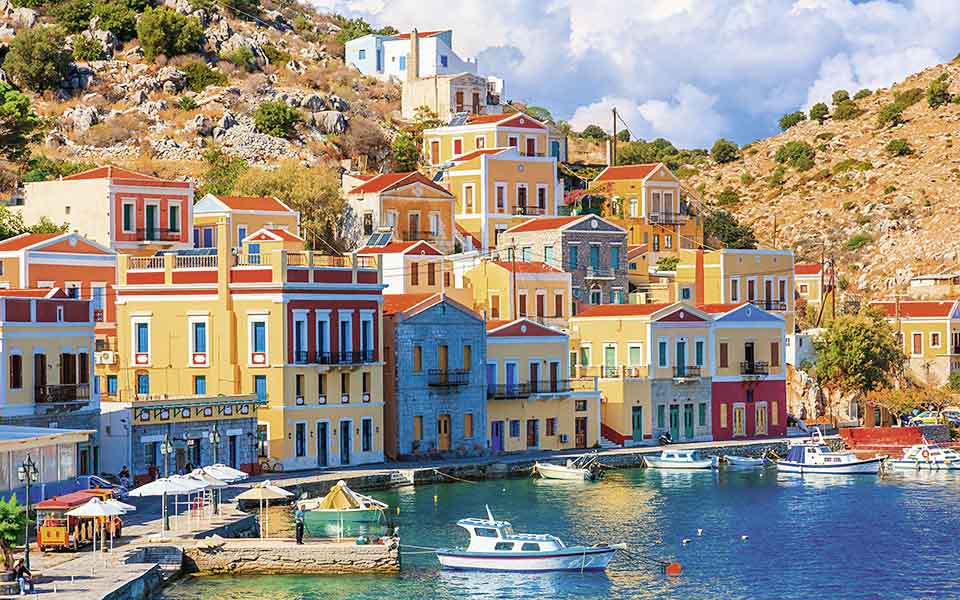
Symi is a small island in the Dodecanese, set in the South Aegean between Rhodes and the Turkish coast. The harbour of Gialos and the upper town of Chorio rise in tiers of ochre and pastel neoclassical mansions, a legacy of the island’s sponge-diving and shipbuilding wealth. This guide covers how to reach Symi, when to visit, the Kali Strata steps, Panormitis Monastery, the best boat tours and beaches, where to stay and what to eat.
Symi sits apart from the whitewashed Cyclades, with its own architecture, cuisine and seafaring history. Day visitors cross from Rhodes in about an hour, while a longer stay opens the quiet coves, the trails to hilltop chapels and the evening calm once the cruise boats leave. This overview works as the hub for the Symi vertical, linking to detailed guides on the town, the steps, the monastery, the beaches and the ferry routes.
What is Symi island and why visit it?
Symi is a small island in the Dodecanese, part of the South Aegean near Rhodes and the Turkish coast. It is not in the Cyclades. Neoclassical mansions, sponge-diving heritage, quiet beaches and Panormitis Monastery define the island.
Symi lies in the southeastern Aegean, one of the Dodecanese islands strung along the Turkish coast between Kos and Rhodes. The island covers about 58 square kilometres of rocky hills, deep bays and scattered pine. Its permanent community stays small through the year and grows across the warm months with returning families and visitors. Symi sits about 40 kilometres north of Rhodes Town, so the two islands share ferry routes and a long common history. The coastline folds into sheltered coves rather than broad sandy shores. This compact scale lets a visitor cross from the harbour to a remote chapel within an hour, and it keeps the island calm even at peak season.
Two settlements form the heart of the island. Gialos wraps around the harbour at sea level, while Chorio climbs the ridge above it. Ochre, cream and pastel neoclassical mansions rise in tiers, giving the port the look of an amphitheatre facing the water. This architecture dates from the nineteenth century, when sponge diving and shipbuilding brought the island real wealth. Captains and merchants built tall stone houses with pediments, tiled roofs and painted shutters. The Italian administration of the early twentieth century left its own mark on public buildings and the clock tower on the waterfront. Careful restoration keeps the facades intact, so the harbour front reads as a preserved record of the island’s trading past.
Visitors come to Symi for a mix of scenery, heritage and calm. The harbour offers seafood tavernas, sponge stalls and boat departures within a short walk of each other. The Kali Strata stairway links the lower and upper town for those on foot. Panormitis Monastery draws pilgrims to the southwest coast. Swimmers ride taxi-boats to coves such as Agios Georgios Dysalona and Nanou. Walkers follow old stone paths to chapels and viewpoints across the interior. The island rewards a slow pace, and a single day trip from Rhodes only samples what a longer stay reveals. The lack of large hotels and any airport keeps the crowds well below the level of the busier Cyclades.
How do you get to Symi from Rhodes and the rest of Greece?
Symi has no airport, so the nearest airport is on Rhodes. Most visitors reach the island by ferry or day-cruise from Rhodes, a crossing of about one to 1.5 hours on a fast boat. Ferries also link Piraeus, Kos and Tilos.
Planning a trip to Symi almost always starts with Rhodes, the regional gateway and the nearest airport. Flights from Athens and across Europe land at Rhodes, and travellers transfer to the port for the sea crossing. The fast passenger boat covers the route in about one hour, while a conventional catamaran takes closer to 1.5 hours. Boats leave from Rhodes Town, and some sailings call at Panormitis before reaching Gialos harbour. Working out how to get to Symi means checking the ferry timetable first, because frequency changes with the season and thins out in winter.
Ferries connect Symi to the wider Greek network beyond Rhodes. Regular sailings link the island with Piraeus, the main port of Athens, on longer overnight or daytime routes. Local lines tie Symi to neighbouring Dodecanese islands, including Kos, Tilos, Nisyros and Rhodes. These inter-island boats let travellers build a Dodecanese hopping itinerary rather than treating Symi as a single stop. Schedules run more often from late spring to early autumn and drop back over winter. Booking a cabin or a reserved seat ahead pays off on the Piraeus route, which covers a long stretch of open sea.
Day-cruises give the simplest introduction for anyone based on Rhodes. Excursion boats leave Mandraki and the commercial harbour in the morning, cross to Panormitis Monastery, then moor at Gialos for lunch and a walk. The round trip returns in the late afternoon, giving about six hours on the island. This format suits a first visit, though it limits time on the beaches and the upper town. Staying overnight lets a traveller watch the day boats leave and reclaim the quiet harbour by evening. Tickets for both cruises and scheduled ferries are sold at Rhodes port agencies and online.
When is the best time to visit Symi?
Late spring and early autumn deliver the calmest, mildest weather on Symi, with warm seas and thinner crowds. Summer runs hot and dry, and the meltemi wind rises in July and August. Winter stays quiet, with fewer ferries and most tavernas shut.
The Symi climate follows the pattern of the southeastern Aegean. Summers are hot and dry, with strong sun and little rain from June to September. The meltemi, a dry north wind, sweeps the Aegean through July and August. This wind cools the air and clears the sky, yet it can whip up short chop that delays small taxi-boats to the exposed bays. Daytime heat on the treeless slopes climbs quickly, so the harbour and the sea become the natural refuge at midday. Evenings stay warm and dry, which keeps the tavernas along Gialos busy well past sunset.
May, June, September and early October form the sweet spot for a Symi visit. Sea temperatures hold warm enough for swimming, the light softens, and the day-cruise crowds ease. These months suit the climb up the Kali Strata, the walk to Panormitis and the boat rides to Nanou and Marathounta without the peak-season heat. Rooms and boat tickets are easier to secure than in high summer. Wildflowers cover the hillsides in spring, while autumn brings still, clear water ideal for snorkelling. Temperatures stay mild into late October before the winter lull sets in.
Winter turns Symi inward and local. Ferry frequency drops, most tavernas and rooms close, and the harbour returns to the resident community. Rain falls mainly between November and February, and the hills green over. Travellers who come off-season find lower prices and empty stone lanes, though they trade away swimming weather and the full run of boat excursions. The Panormitis festival in November draws pilgrims even in the cold months. Anyone planning a swimming holiday aims for the warm shoulder seasons, while a walker seeking solitude finds the cooler months rewarding on the island’s trails.
What makes Symi Town, Gialos harbour and Chorio special?
Symi Town splits into two parts: Gialos, the harbour at sea level, and Chorio, the older town on the ridge above. Ochre and pastel neoclassical mansions rise in an amphitheatre around the port, a legacy of nineteenth-century sponge and shipping wealth.
Symi Town and Gialos harbour form the first sight for anyone arriving by sea. The waterfront curves around a deep natural inlet, lined with tavernas, cafes, bakeries and sponge stalls. Fishing boats and excursion craft tie up along the quay, and the clock tower marks the harbour mouth. Behind the front row, lanes climb between tall neoclassical houses painted in ochre, cream, blue and terracotta. Bougainvillea spills over the balconies. The harbour stays lively from the morning ferry arrivals until late in the evening, yet it never reaches the scale of the big Cycladic ports.
Chorio crowns the ridge above the harbour and holds the older core of the town. Narrow paved alleys wind past churches, small squares and stone houses, some restored and some left as romantic shells. The Kastro, the medieval castle site at the top, occupies the ancient acropolis and offers a wide view over the bay and the Turkish coast. The Church of the Panagia and a small archaeological museum sit within the old quarter. Residents still live in Chorio year-round, so laundry lines and potted herbs share the lanes with visitors climbing up from Gialos.
The two halves work as one town with distinct characters. Gialos handles arrivals, dining and shopping at the water’s edge. Chorio guards the history, the churches and the quiet residential streets above. The contrast between the busy quay and the still upper lanes gives Symi Town its texture. Evening light turns the mansion facades gold and draws diners to the harbour tables. Photographers favour the view down over the tiered rooftops from the Kali Strata. This blend of working port, preserved architecture and lived-in old town explains why the harbour ranks among the most recognised in the Dodecanese.
What are the Kali Strata steps on Symi?
The Kali Strata is the broad stone stairway of roughly 500 steps that links Gialos harbour to Chorio, the upper town. It climbs past neoclassical mansions, chapels and cafes, and remains the main pedestrian route between the two parts of Symi Town.
the Kali Strata steps form the historic spine of Symi Town. The stairway of roughly 500 broad stone treads rises from the harbour at Gialos to the heart of Chorio on the ridge. Sponge merchants and captains built grand houses along its length in the nineteenth century, and their pedimented facades still line the climb. Some mansions gleam after restoration, while others stand as open shells that hint at the island’s wartime decline. Chapels, cafes and small guesthouses break up the ascent. The wide, even treads make the route a stone street rather than a rough path, though the gradient stays steady all the way up.
The climb takes a steady walker between 15 and 25 minutes, depending on pace and stops. Early morning and the hour before sunset offer the coolest conditions and the best light for the harbour view. Sturdy shoes help on the worn, polished stone, which turns slick after rare rain. Benches and shaded landings give resting points along the way. The reward at the top is a sweeping outlook over the tiered rooftops, the harbour and the bay beyond. Carrying water matters in summer, because the stairway climbs an open, sun-exposed slope with little shade for much of its length.
The Kali Strata means the good steps in Greek, and a second, older stairway called the Kataraktis climbs a parallel line nearby. Both routes connect Gialos and Chorio on foot, since the upper town has limited road access. Walking the steps threads visitors through the everyday life of the island, past shutters, courtyards and blooming vines. The stairway also serves as the natural viewpoint for photographers at dusk. Restored mansions along the route now house boutique guesthouses and studios. Climbing the Kali Strata at least once ranks among the defining experiences of a stay on Symi.
Why is Panormitis Monastery important on Symi?
Panormitis Monastery, formally Moni Taxiarchi Michail Panormiti, is a large Orthodox pilgrimage monastery dedicated to Archangel Michael, the protector of sailors. It stands on the southwest coast of Symi, about 18 kilometres from the main harbour, and is reached by boat or road.
Panormitis Monastery anchors the spiritual life of Symi on the island’s southwest coast. The monastery honours Archangel Michael, the patron saint of sailors, and stands about 18 kilometres from Gialos in a sheltered bay. The whitewashed complex holds a large church with a carved wooden screen, a tall baroque bell tower and courtyards paved in black-and-white pebble mosaic. A monastery museum displays ship models, votive offerings and objects left by grateful seafarers. Pilgrims from across Greece arrive by sea to seek the archangel’s protection. The bay itself provides a calm anchorage, so cruise boats and yachts moor here before or after a stop at the main harbour.
The monastery serves as a working religious site and a landmark on the day-cruise route. Excursion boats from Rhodes call at Panormitis first, letting passengers visit the church and the museum before sailing on to Gialos. A road also crosses the island from Symi Town, so visitors staying overnight reach the bay by car or scheduled transport. Simple guest cells around the courtyard host pilgrims who stay for the major feast days. A shop and a small cafe serve visitors by the water. The setting stays peaceful outside the midday cruise arrivals, when the courtyard fills with day-trippers from Rhodes.
The feast of Archangel Michael in early November marks the monastery’s biggest gathering. Pilgrims travel from Rhodes, the Dodecanese and the mainland to honour the saint, filling the guest quarters and the bay with boats. Tradition holds that offerings cast into the sea in bottles drift back to Panormitis, and the museum keeps a collection of these returned votives. The site also carries a sombre wartime history from the years of occupation. Visiting Panormitis rounds out a Symi trip with the island’s deepest layer of faith and seafaring memory, well beyond the harbour cafes and the beaches.
The steep roads above the harbour are easier with a motor behind the pedals: a Symi e-bike tour climbs from Pedi and Gialos toward Chorio and the heights on pedal-assist bikes, as a guided ride or a sunset tour.
Which boat tours and routes are best around Symi?
Boat tours around Symi fall into three types: day-cruises from Rhodes, taxi-boats from Gialos to the beaches, and private charters around the coast. The classic route pairs Panormitis Monastery with the harbour, while taxi-boats reach coves that no road serves.
Day-cruises from Rhodes make up the most common way to see Symi by boat. The standard itinerary crosses in the morning, stops at Panormitis Monastery, then moors at Gialos for a few hours before returning. Larger excursion boats and smaller fast craft both run the route, and the crossing takes about one hour on a quick vessel. This trip packs the two headline sights into a single day. Booking through Rhodes port agencies or online secures a place in high summer, when the morning boats fill with visitors heading across the strait to the harbour.
Taxi-boats from Gialos open up the coast that roads cannot reach. Small local craft leave the harbour each morning on a fixed schedule and drop swimmers at coves such as Agios Georgios Dysalona, Nanou, Marathounta and Agios Nikolaos. Passengers pick a return time and ride back in the afternoon. This shuttle system turns a beach day into a short sea journey along the cliffs and inlets. Fares stay modest and are paid on board. The taxi-boats also pass caves and rock formations, giving a quick coastal tour on the way to the more distant swimming bays around the island.
Private charters and small-group sailing trips give the most flexible way around Symi. A skippered boat lets a group set its own route, linger at a favourite cove and reach quiet anchorages away from the day-cruise stops. Half-day and full-day charters leave from Gialos and Pedi. Some trips cross to nearby islets and to secluded bays on the far side of the island. Sunset cruises circle the harbour as the mansion facades catch the last light. Chartering suits families and groups who want swimming, snorkelling and lunch on the water without the timetable of the scheduled excursion boats.
What are the best beaches on Symi for swimming?
Symi beaches are mostly pebble coves in clear, deep water rather than long sandy shores. Nos sits beside the town, and Nimborio, Pedi, Agios Nikolaos, Agia Marina, Nanou, Marathounta and Agios Georgios Dysalona ring the coast, most reached by taxi-boat from Gialos.
Nos beach lies within a 10-minute walk of Gialos, past the clock tower along the shore, and offers the easiest swim near the harbour. It has pebbles, sunbeds and a beach bar, plus a diving platform off the rocks. Pedi bay sits just east of Chorio, a former fishing village with a sand-and-pebble shore, tavernas and shallow water for children. A short walk or a taxi-boat from Pedi reaches Agios Nikolaos and Agia Marina, two sheltered coves with calm, shallow swimming. These closer beaches suit families and anyone on a day trip with limited time on the island.
Nimborio beach spreads along the coast a short distance west of Gialos, reached on foot in about 40 minutes or by taxi-boat. The bay mixes pebble and concrete-lipped swimming spots with tavernas and the remains of early Christian mosaics nearby. The water stays calm and clear, and the sunset view across the strait draws diners in the evening. Nimborio works as a relaxed alternative to the busier town beaches, with room to spread out. The walk from Gialos follows the shoreline and passes small chapels, making the approach part of the outing rather than a chore.
The remote southern and eastern coves reward the taxi-boat ride from Gialos. Agios Georgios Dysalona hides beneath a sheer cliff and is reached only by sea, its shade arriving early in the afternoon. Nanou offers the longest pebble beach on that coast, with a taverna and tamarisk trees for shelter. Marathounta, a wide bay with a taverna, welcomes swimmers and passing goats. Agios Vasilios and Agios Aimilianos, with its island chapel, sit among the quieter western inlets. These bays stay clear of roads, so the morning taxi-boats are the practical way to reach the best swimming on Symi.
Where should you stay on Symi?
Symi accommodation concentrates in Symi Town, split between Gialos at the harbour and Chorio on the ridge, with a smaller cluster around Pedi bay. Restored neoclassical mansions, boutique guesthouses and studios dominate, since no large resort hotels operate on the island.
Gialos puts guests at the centre of the action around the harbour. Rooms above the waterfront offer tavernas, bakeries, boat departures and sponge stalls at the doorstep. Restored mansions along the quay and the lower steps hold studios and boutique suites with harbour views. Staying here means falling asleep to the sound of the port and waking to the ferry arrivals. The trade-off is the morning bustle when the day-cruises land. Guests who value convenience, dining choice and easy access to the swimming beaches near town favour a base in the lower harbour district around Gialos.
Chorio suits travellers who prefer quiet and views over harbour convenience. Guesthouses in the upper town occupy restored stone houses along the lanes, with terraces that look down over the tiered rooftops. The climb up the Kali Strata becomes a daily routine, so this base rewards those comfortable on foot. Nights stay calm once the day-trippers leave, and the dawn light over Chorio is a reward in itself. Pedi bay, a short distance east, offers a low-key seaside alternative with tavernas and a beach, plus rooms near the water for a slower stay beside the sea.
Booking early pays off across the warm season, because the island’s room stock is limited and no big hotels absorb the demand. Prices climb through July and August and ease in the shoulder months of May, June, September and October. Overnight guests gain the island at its best, after the day boats leave and before they return. Walkers, photographers and repeat visitors tend to stay three or more nights to reach the far beaches and the trails. Panormitis also offers simple guest cells for pilgrims. Choosing between Gialos, Chorio and Pedi comes down to the balance of harbour buzz, quiet views and seaside calm.
What food and local dishes is Symi known for?
Symi shrimp, the tiny local garides Symis eaten whole, are the island’s signature dish, served alongside fresh seafood and Dodecanese cooking. Harbour tavernas at Gialos plate grilled fish, wild greens and mezes, and sponge stalls line the same waterfront where the shrimp are landed.
Symi shrimp headline the local table. These tiny shrimp, garides Symis, come from the deep water around the island and reach only a couple of centimetres in length. Cooks flash-fry them whole and serve them with salt and lemon, and diners eat them shell and all. The flavour stays delicate and slightly sweet. Every taverna around Gialos lists them as a starter, usually with ouzo or a cold white wine. The shrimp define the island’s cuisine the way sponges define its trade, and a plate of garides Symis by the harbour ranks among the essential experiences of a visit.
Fresh seafood fills out the rest of the Symi menu. Fishing boats land octopus, calamari, red mullet and sea bream, which appear grilled or fried within hours of the catch. Tavernas serve them with ladolemono, a lemon-and-oil dressing, and horta, the boiled wild greens of the Greek table. Dodecanese cooking adds stuffed vegetables, chickpea dishes and slow-baked lamb or goat. Local cheese, capers and honey turn up in salads and desserts. Meals stretch across the evening at harbour tables, and the kitchens lean on what the sea and the island’s gardens provide rather than imported produce.
The waterfront also tells the story of the sponge trade. Stalls along Gialos sell natural sponges harvested from the sea, a direct link to the industry that built the mansions rising above the port. Traditional products such as thyme honey, herbs and local sweets fill the shop shelves beside them. Bakeries turn out fresh bread, and cafes serve strong Greek coffee under the clock tower. A meal on Symi pairs the food with the setting, since the same harbour that lands the shrimp and displays the sponges also frames the tiered neoclassical facades that define the town.
What practical tips help for a Symi day trip or island stay?
Symi visitors plan around the sea. The island has no airport, so the ferry timetable from Rhodes shapes every trip. Comfortable shoes handle the Kali Strata and the stone lanes, and taxi-boats reach the beaches that the limited road network cannot serve.
The ferry schedule governs a day trip from Rhodes. Morning boats cross in about one hour, and the last return usually leaves in the late afternoon, so a day visitor has roughly six hours ashore. Buying tickets ahead in July and August avoids sold-out sailings. A single day covers the harbour, lunch and a short climb or swim, but the beaches and the upper town reward a longer stay. Travellers who want both Panormitis and a swim often choose a cruise that includes the monastery stop rather than a scheduled ferry that lands only at Gialos harbour.
Symi rewards walkers and punishes the unprepared in the heat. The Kali Strata and the lanes of Chorio demand sturdy, grippy shoes, and the open slopes carry little shade. Carrying water, a hat and sunscreen matters from June to September, when midday temperatures climb fast. Old stone footpaths cross the interior to chapels and viewpoints, so a basic hiking map helps for the longer routes. The road network stays limited, and buses and taxis run between Gialos, Chorio, Pedi and Panormitis on set patterns. Renting scooters and small boats is possible for those who want independent range.
A handful of practical habits smooth a Symi stay. Cash covers the taxi-boats, small tavernas and the sponge stalls, since card acceptance varies away from the main harbour. Booking rooms and boat tickets early counts in high summer, when the limited stock fills quickly. The pharmacy, bakeries and mini-markets cluster around Gialos, so stocking up before heading to a remote beach avoids a wasted trip. Respecting the dress code at Panormitis Monastery means covering shoulders and knees. Packing light for the boat, keeping to the ferry times and starting the day early let a visitor get the most from the island.
Frequently Asked Questions About Symi
Is Symi in the Cyclades or the Dodecanese?
Symi belongs to the Dodecanese, the island group off the southwestern coast of Turkey in the South Aegean. It is not a Cycladic island. The nearest large island is Rhodes, about 40 kilometres to the south. Symi shares the neoclassical architecture, sponge-diving history and Italian-era influences of its Dodecanese neighbours, which sets it apart from the whitewashed cube houses of the Cyclades. Ferry routes group Symi with Kos, Tilos, Nisyros and Rhodes rather than with Mykonos or Naxos.
How long is the ferry from Rhodes to Symi?
The fast boat from Rhodes to Symi runs about one hour, and a conventional catamaran takes closer to 1.5 hours or a little longer. Boats depart from Rhodes Town, and the route continues to Panormitis on some sailings. Day-cruises leave in the morning and return in the late afternoon, giving roughly six hours ashore. Buying a ticket ahead matters in July and August, when the crossing fills with day visitors heading to the harbour at Gialos.
What is Symi shrimp?
Symi shrimp, known in Greek as garides Symis, are tiny local shrimp eaten whole, shell and all, usually flash-fried and served with a squeeze of lemon. They are the island’s signature dish and appear on almost every taverna menu around Gialos harbour. The shrimp come from the deep waters around the island and carry a delicate, slightly sweet flavour. Diners eat them as a meze alongside fresh fish, wild greens and Dodecanese specialities.
How many steps is the Kali Strata on Symi?
The Kali Strata is a broad stone stairway of roughly 500 steps that climbs from Gialos harbour up to Chorio, the older upper town. The staircase passes neoclassical mansions, small chapels and cafes, and it rewards the climb with views over the harbour and bay. Walking up in the cooler morning or evening avoids the midday heat. Sturdy shoes help, because the worn stone turns uneven in places. The Kali Strata remains the main pedestrian link between the two halves of Symi Town.
Does Symi have sandy beaches?
Symi has mostly pebble and shingle beaches set in sheltered coves rather than long sandy strands. Nos beach sits within walking distance of Gialos, while Nimborio, Pedi, Agios Nikolaos, Agia Marina, Nanou, Marathounta and Agios Georgios Dysalona ring the coast. Small taxi-boats leave Gialos each morning and ferry swimmers to the more remote bays. The clear, deep water suits snorkelling. Agios Georgios Dysalona sits below a dramatic cliff and is reached only by boat.
Why is Panormitis Monastery important on Symi?
Panormitis Monastery, formally Moni Taxiarchi Michail Panormiti, is a large Orthodox pilgrimage monastery dedicated to Archangel Michael, the patron saint of sailors. It stands on the southwest coast of Symi, about 18 kilometres from the main harbour, and is reached by boat or road. Pilgrims from across Greece visit to honour the archangel, and the complex holds a church, a bell tower, a museum and guest quarters. Day-cruises from Rhodes often stop at Panormitis before continuing to Gialos.
When is the best time to visit Symi?
Late spring and early autumn bring the calmest, mildest weather to Symi, with warm sea temperatures and thinner crowds. Summer is hot and dry, and the meltemi wind rises in July and August, cooling the air but occasionally disrupting small-boat crossings. May, June, September and early October suit walking the trails, climbing the Kali Strata and swimming without the peak-season pressure. Winter is quiet, with reduced ferry frequency and most tavernas closed.
See more tours in My Greece Tours:
- Rhodes Private Tours: Explore Rhodes Destinations & Attractions | Rhodes Greece Excursions & Tours
- Samos Dream Tours: Explore Samos Tours, Excursions & Samos Greece Experiences
- Santorini Greece Travel Guide: Best Things To Do in Santorini
- Serifos
- Sifnos Travel Guide: Your Ultimate Sifnos Guide to Visit Sifnos Island in Sifnos Greece