
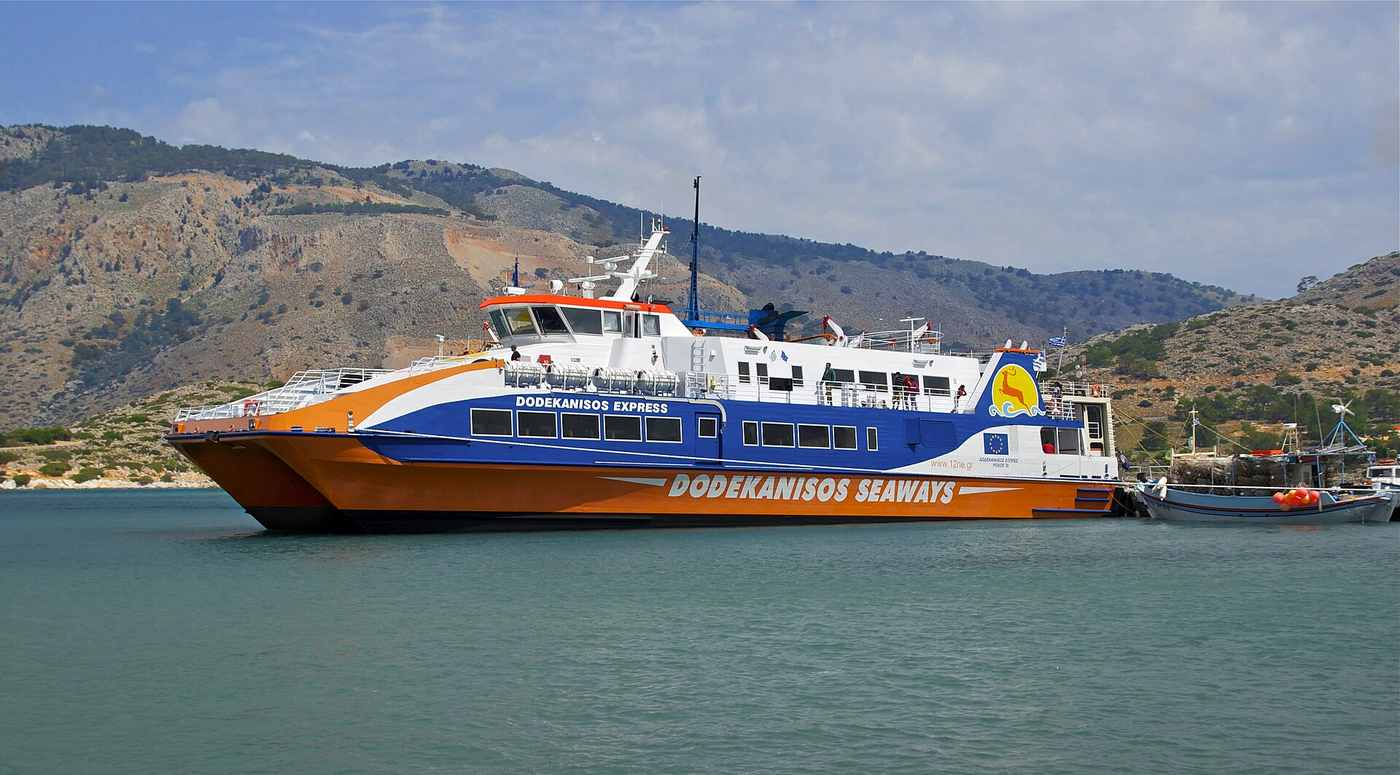
Symi sits in the southeastern Aegean, north of Rhodes, and carries no airport of its own. Reaching the harbour at Gialos means travelling first to Rhodes and then boarding a ferry or day-cruise. This guide sets out every route to Symi, from the short Rhodes crossings to the long overnight link from Piraeus.
Ferries run to Symi across the year, thinning out through winter and multiplying in summer. Fast catamarans cover the Rhodes crossing in around an hour, while day-cruises fold a swim and a monastery stop into one round trip. The sections below break down timings, harbours, Dodecanese links and island transport.
How do you get to Symi when the island has no airport?
Symi has no airport, so every arrival comes by sea. Travellers fly or sail to Rhodes, the nearest island with an airport, then cross to Gialos harbour by ferry, hydrofoil or organised day-cruise across a short strait.
Symi holds no runway, so aircraft land instead on Rhodes, the nearest island equipped with an airport. Rhodes lies about 40 kilometres to the south, and its airport receives domestic flights from Athens and direct arrivals from across Europe. Passengers collect their bags, then head to one of the Rhodes harbours for the sea leg. The transfer from the airport to Rhodes town covers roughly 15 kilometres by taxi or bus. This two-stage pattern, a flight to Rhodes and a boat to Gialos, defines the journey for travellers arriving from abroad. Planning the flight and the crossing together keeps the whole trip smooth and prevents a long wait on the Rhodes waterfront.
Three sea options carry visitors from Rhodes to Symi. Fast catamarans and hydrofoils make the direct crossing in around an hour, running as scheduled passenger services. Conventional ferries take longer and stop more often, yet cost less for the same route. Round-trip day-cruises leave Rhodes each morning, spend the middle of the day on the island, and return by evening. Each option lands at Gialos, the working harbour that wraps around Symi Town. The right choice depends on budget, timing and whether the plan is a single day or a longer stay. Checking the departure boards the night before confirms the exact times, since sailings shift with the season.
Sailing the entire way stays possible for travellers already in Greece. Long-distance ferries link Piraeus, the port of Athens, with Rhodes and the wider Dodecanese, so a visitor reaches Rhodes by boat and continues to Symi from there. Island-hoppers crossing from Kos, Tilos or Nisyros also join Symi-bound services without touching an airport. This overland-and-sea approach suits those combining Symi with a longer Aegean route. The trade-off is time, since ferry legs stretch across hours rather than the minutes a flight takes. Travellers who value the deck view and the slower rhythm often prefer the full sea journey over the quicker air-and-boat combination.
Booking ahead matters most across summer, when day-trippers and holidaymakers fill the Rhodes crossings. High-season sailings sell out on popular morning departures, and a confirmed ticket guarantees a place on the fast boat. Winter brings a thinner timetable, with fewer weekly sailings and occasional weather cancellations on the exposed strait. Travellers arriving off-season confirm the schedule directly rather than assuming a daily service. Return legs deserve the same care, since the last boat back to Rhodes leaves in the late afternoon on most routes. Reserving both directions in advance removes the risk of a missed connection and an unplanned night on the island.
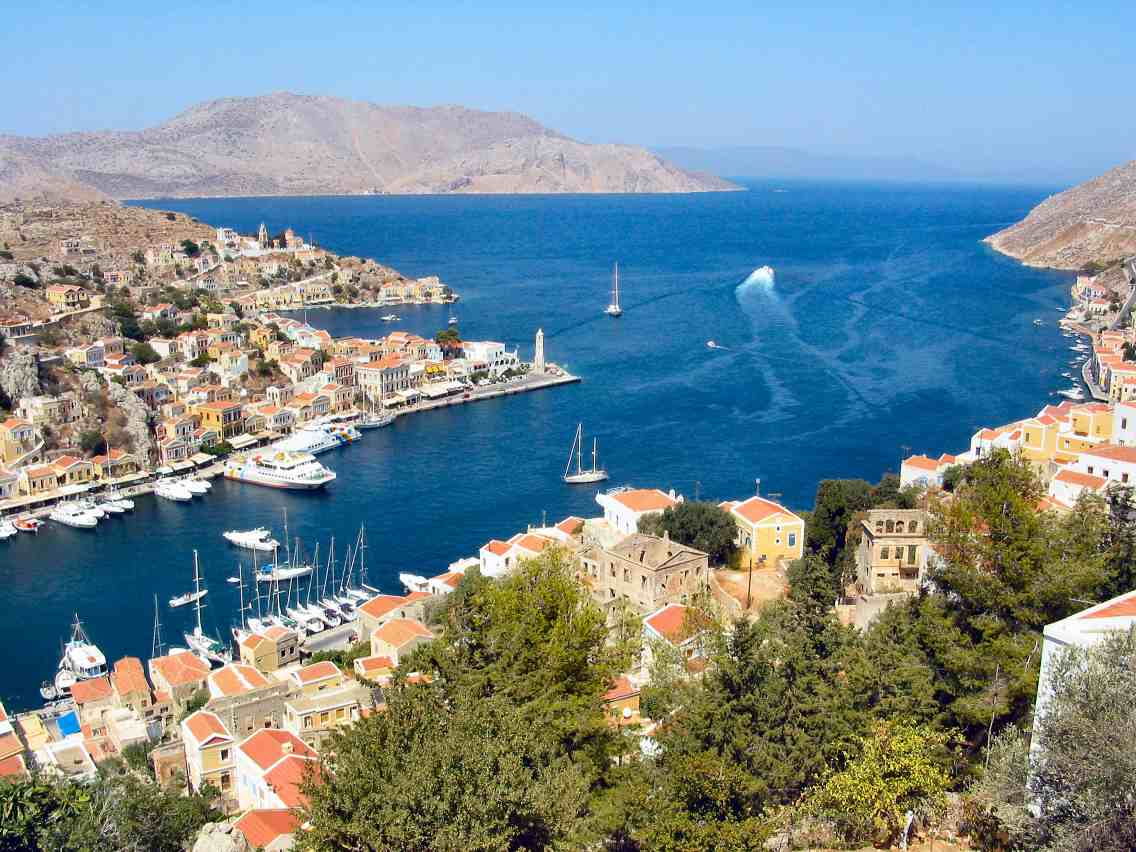
How long does the ferry from Rhodes to Symi take?
Fast catamarans and hydrofoils cross from Rhodes to Symi in about one to one and a half hours. Conventional ferries take longer, since they sail at a lower speed and call at intermediate stops along the Dodecanese chain.
Fast catamarans set the quickest pace between Rhodes and Symi, covering the strait in roughly one hour. These vessels run at high speed and carry foot passengers rather than cars, so boarding stays quick and simple. Hydrofoils post similar times on the same route, cutting across open water in a straight line to Gialos. Morning departures dominate the timetable, letting day visitors reach Symi with the full afternoon ahead. The short duration makes a single-day return realistic, even for travellers based on Rhodes for the week. Seats fill fast in peak months, so an early ticket locks in the quickest available crossing to the island.
Conventional ferries trade speed for a lower fare and a steadier deck. These larger boats sail at a gentler pace and often call at other Dodecanese ports before reaching Symi, which stretches the total time beyond the fast-boat hour. The extra minutes buy roomier cabins, open deck space and the option to carry a vehicle on certain services. Travellers with time to spare treat the slower crossing as part of the holiday rather than a chore. The lower price also suits families and longer stays, where a saving each way adds up. Timetables list the exact duration for each sailing, so a quick check sets expectations before departure.
Crossing time shifts with the vessel, the sea state and the number of stops. A direct fast-boat run posts the shortest figure, while a ferry weaving through neighbouring islands adds calls and minutes. Northerly winds churn the strait between Rhodes and Symi, and captains ease the throttle in rough conditions for comfort and safety. Summer generally delivers calm mornings and reliable timings, which is one reason day-cruises favour early starts. Winter swells occasionally delay or cancel a sailing, so the posted duration assumes settled weather. Reading the forecast alongside the timetable gives a realistic sense of how long the journey will run on a given day.
Arrival lands passengers directly at Gialos, the harbour ringed by neoclassical mansions at the foot of Symi Town. The fast boats tie up on the main quay, steps from waterfront tavernas, sponge stalls and hotel doors. Disembarking takes minutes, since foot passengers walk straight off the ramp onto the promenade. No airport transfer or long transit follows, because the port sits inside the town itself. Visitors reach most harbour-front accommodation on foot within a short stroll of the berth. This dockside setting turns the final approach into one of the highlights, with the amphitheatre of coloured houses rising straight from the water.
Which harbours in Rhodes town run boats to Symi?
Boats to Symi leave from Rhodes town, using the commercial harbour for larger ferries and Mandraki harbour for smaller excursion craft. Both sit within the town, so travellers reach either quay on foot or by a short taxi ride.
The commercial harbour handles the larger ferries and fast catamarans bound for Symi and the wider Dodecanese. This working port lies on the eastern side of Rhodes town, close to the medieval walls, and manages both passenger and freight traffic. Ticket booths and shipping agents cluster along the quay, where boarding gates open ahead of each departure. Scheduled sea services to Symi generally sail from here, so travellers holding a ferry ticket head to this harbour first. Signage points arrivals toward the correct berth, and staff direct foot passengers to the waiting vessel. Reaching the commercial harbour from the old town takes a short walk, which keeps the transfer between sights and ship straightforward.
Mandraki harbour sits at the northern tip of Rhodes town, framed by its landmark entrance columns and old windmills. Smaller excursion boats and round-trip day-cruises to Symi tend to depart from this historic basin. Operators line the quayside with boards advertising the morning sailing, the Panormitis stop and the return time. Mandraki lies within walking distance of the new-town hotels, so guests reach the boats without transport. The harbour also anchors sightseeing craft serving the Rhodes coastline, giving the waterfront a busy holiday feel. Confirming which basin a ticket uses avoids a last-minute dash, since the two harbours stand a short distance apart along the shore.
Matching the ticket to the harbour saves confusion on the morning of travel. Scheduled ferries and fast boats point travellers toward the commercial harbour, while organised day-cruises usually gather at Mandraki. The two basins stand within a 20-minute walk of each other along the Rhodes seafront, so a wrong turn costs little. Taxis wait at ranks near both ports for travellers carrying luggage from a distant hotel. City buses also run along the waterfront, linking the harbours with the airport road and outlying resorts. Reading the departure point printed on the ticket, then leaving with time in hand, keeps the connection to Symi calm and unhurried.
Rhodes works as the main gateway for the whole approach to Symi. Its airport, ferry port and excursion harbours concentrate the transport links that feed the island, which is why itineraries route through it. From either harbour the crossing ends at Symi Town and Gialos harbour, the single arrival point on the island. Travellers spending a night in Rhodes before the boat find hotels near both the old town and Mandraki. This clustering of flights and sailings in one city keeps the transfer to Symi tight and predictable. Building the trip around Rhodes, rather than a distant mainland port, shortens the sea leg to about an hour.
How do ferries from Piraeus reach Symi?
Long-distance ferries connect Piraeus, the port of Athens, with Symi on an overnight crossing that runs through the Dodecanese. These larger boats sail south-east across the Aegean, calling at intermediate islands before tying up at Gialos.
Piraeus anchors the mainland end of the long ferry route to Symi. This port, the largest in Greece, sits beside Athens and links the capital with the Aegean islands by sea. Boats bound for the Dodecanese depart in the evening and sail through the night, covering the wide stretch of water toward Rhodes and Symi. The full crossing spans a whole night, so passengers book a cabin or reclining seat for the overnight leg. This route suits travellers starting in Athens who prefer a single sea journey over a flight to Rhodes. Arriving by ferry from Piraeus also carries a vehicle to Symi, which a fast passenger catamaran cannot do.
Overnight ferries turn the crossing into a floating night’s rest between mainland and island. Cabins with berths, reclining airline-style seats and open deck space give passengers room to settle for the long haul. Onboard cafeterias and lounges serve the evening and early-morning hours, so travellers eat and relax while the boat covers the miles. Boarding happens in the evening at Piraeus, with the vessel slipping out of the harbour after dusk. Waking near the Dodecanese, passengers watch Rhodes and its neighbours rise on the horizon before the Symi call. This slow approach trades speed for comfort and lands travellers on the island rested rather than rushed.
The Piraeus service threads through the Dodecanese before it reaches Symi. Intermediate calls at islands such as Kos let passengers board or leave along the way, which shapes the timetable and the total duration. Each stop adds minutes in port, yet opens the route to island-hoppers piecing together a longer Aegean trip. The boat follows a fixed sequence of harbours, so the printed schedule shows exactly when Symi appears on the run. Travellers joining mid-route from another island slot into the same overnight or daytime sailing. This chain of ports makes the Piraeus ferry a backbone link, tying the mainland, Rhodes and the smaller Dodecanese islands into one line.
Choosing the Piraeus route rewards travellers who value the sea over the airport. Passengers starting in Athens skip the domestic flight and step straight onto a boat bound for the islands. The overnight timing also saves a night’s accommodation, since the crossing doubles as transport and lodging. Drivers bringing a car reach Symi this way, loading the vehicle at Piraeus and unloading it at Gialos. The trade-off is duration, because the mainland crossing stretches far beyond the hour-long hop from Rhodes. Weighing the extra time against the flexibility of arriving by ferry helps travellers decide whether the long sail fits the wider plan.
Which Dodecanese islands connect to Symi by ferry?
Symi links by ferry to neighbouring Dodecanese islands, including Kos, Tilos, Nisyros and Kastellorizo. These regional services run alongside the Rhodes crossings, letting island-hoppers combine Symi with a wider route through the south-eastern Aegean.
Kos ranks among the larger Dodecanese islands linked to Symi by sea. Ferries running the north-south chain call at Kos, which carries its own airport and feeds travellers into the regional network. From Kos a passenger boards a southbound sailing that threads past smaller islands toward Rhodes and Symi. This connection opens a second air gateway to the region, alongside the busier hub at Rhodes. Island-hoppers often begin on Kos, work down the chain and finish on Symi before crossing to Rhodes for a flight home. The regular sailings between these ports keep the northern approach to Symi practical throughout the main season.
Tilos and Nisyros sit close to Symi and share the same regional ferry lines. Tilos, a quiet island north-west of Symi, receives the same boats that weave through the chain, making a short hop between the two feasible. Nisyros, known for its volcanic caldera, joins the network further north and links onward toward Kos. Travellers combining these smaller islands build a route that strings quiet harbours together without returning to Rhodes each time. The sailings run less often than the Rhodes crossings, so the timetable shapes the order of the trip. Checking the weekly frequency in advance keeps an island-hopping plan across Tilos, Nisyros and Symi on track.
Kastellorizo marks the far south-eastern edge of the Dodecanese and connects to Symi through the same island line. This remote outpost lies off the Turkish coast, and the regional ferries tie it back to Rhodes and Symi across a long stretch of open water. Sailings to Kastellorizo run on a lighter schedule, reflecting its distance and small resident community. Travellers reaching for the outer islands treat Symi as a stepping stone along the route rather than the final point. The link shows how the ferry network binds even the most distant Dodecanese harbours into one connected system. Planning around the sparser timetable turns a visit to Kastellorizo and Symi into a single coherent trip.
The Dodecanese ferry network hands travellers a flexible way to reach Symi from more than one direction. Instead of routing every journey through Rhodes, a visitor enters the chain at Kos, Tilos or another island and works toward Gialos. This web of sailings supports longer itineraries that gather quiet ports rather than a single destination. Frequencies vary by island and season, with the Rhodes crossings running most often and the outer links running less. Reading the combined timetable reveals which hops connect on the same day and which demand an overnight. Building the route around these regional services widens the approach to Symi well beyond the direct hour from Rhodes.
What does a day-cruise from Rhodes to Symi include?
Round-trip day-cruises from Rhodes carry visitors to Symi for the day, usually pausing at Panormitis Monastery, allowing a swim in a quiet bay, and leaving free time in Symi Town before the evening return to Rhodes.
Day-cruises package the whole Symi visit into a single guided round trip from Rhodes. Boats leave Mandraki and the excursion quays in the morning, cross the strait, and return the same evening. Passengers buy one ticket that covers the outward sail, the island stop and the journey back. The format suits travellers based on Rhodes who want a taste of Symi without moving hotels. Onboard commentary points out the coastline and the approach to Gialos as the harbour comes into view. This all-in-one structure removes the need to plan separate ferry legs, making the excursion the simplest way to see the island in a day.
The southern stop brings the cruise to Panormitis Monastery, the great pilgrimage site on Symi’s south-west coast. Boats moor in the sheltered bay below the whitewashed complex, and passengers step ashore to visit the church and its bell tower. The monastery honours the Archangel Michael, patron of sailors, and draws pilgrims from across the Aegean. Time ashore runs short on a day-cruise, enough for the courtyard, the icon and the small museums inside the walls. The calm inlet also gives the boat a scenic anchorage before it continues to the main harbour. This stop adds a cultural anchor to a trip that otherwise centres on the port and a swim.
A swimming stop breaks the day between the monastery and the town. Boats drop anchor in a clear bay along the Symi coast, and passengers slip into the water straight from the deck or a ladder. The pause lasts long enough for a proper swim in the sheltered, deep-blue water that rings the island. Crews hand out time limits so the schedule holds, since the town visit and the return sail still lie ahead. This break turns the crossing into part of the holiday rather than mere transport between two ports. Swimmers pack a towel and suit in a day bag, because facilities on the open boat stay basic.
Free time in Symi Town forms the heart of the day-cruise. Boats berth at Gialos, and passengers spend a set window exploring the harbour front, the shops and the tavernas. The Kali Strata stairway climbs from the port to the upper village of Chorio for those with energy to spare. Sponge stalls, bakeries and waterfront cafes line the quay within steps of the mooring. The guide fixes a firm return time, so travellers watch the clock before the evening sail back to Rhodes. This closing stretch lets visitors walk the amphitheatre of mansions up close, rounding out the day before the boat casts off.
How do you travel around Symi after you arrive at Gialos?
Symi runs on a short road network and a fleet of small taxi-boats. Travellers reach Gialos hotels on foot, ride buses or taxis between Gialos, Chorio and Pedi, and catch water taxis out to the remote beaches.
Gialos rewards travellers on foot, since the harbour and its hotels crowd around one compact waterfront. The port sits inside the town, so guests walk straight from the boat to most accommodation along the quay. The Kali Strata, a broad stone stairway, climbs from Gialos to Chorio, the older settlement on the ridge above. Counting the steps runs into the hundreds, and the ascent rewards walkers with a view over the harbour and the coloured mansions. Level lanes along the waterfront stay easy, while the upper village demands stronger legs. This walkable core means arrivals need no transport for the first stretch of any Symi visit.
A short road network links Gialos with Chorio and the seaside village of Pedi in the bay below. Local buses shuttle between the harbour, the upper town and Pedi on a regular loop through the day. Taxis wait near the waterfront for travellers carrying luggage or heading beyond the bus route. The island’s paved roads stay short, reflecting its compact size and steep terrain, so no journey by road runs long. Pedi offers a sheltered beach and a cluster of tavernas minutes from the capital. This modest road system covers the inhabited core, linking the three main settlements without a hire car for most visitors.
Small taxi-boats open the coastline that the roads cannot reach. These water taxis leave Gialos and Pedi through the morning, carrying swimmers to coves scattered around the island. Beaches such as Agios Georgios Dysalona and Nanou sit under steep cliffs, accessible mainly from the sea. Passengers buy a ticket on the quay, note the pickup time, and ride the short hop to a chosen bay. The boats return in the afternoon, gathering bathers before the light fades. This sea-based transport suits Symi’s rugged shape, where deep water and sheer rock guard the finest swimming spots from the road network.
Getting around Symi blends short walks, a handful of buses and the flexible taxi-boats. Distances stay small, so a day mixes a harbour stroll, a bus to Pedi and a boat to a quiet cove without strain. The compact scale keeps transport simple, and the light traffic preserves the island’s calm. Travellers plan beach days around the water-taxi timetable, which sets the rhythm of the coast. The road fleet handles the settled core, while the boats cover the wild edges. This mix lets visitors explore the whole island from a single base at Gialos, returning each evening to the harbour front.
Frequently Asked Questions
Does Symi have an airport?
Symi has no airport. The nearest airport sits on Rhodes, about 40 kilometres to the south, which receives domestic flights from Athens and direct services from across Europe. Travellers fly into Rhodes, then complete the journey by sea to Symi’s harbour at Gialos. A fast catamaran or hydrofoil covers this final crossing in around an hour. This two-stage pattern, a flight to Rhodes followed by a boat, defines almost every arrival from abroad and shapes how visitors plan the timing of both legs.
How long is the ferry from Rhodes to Symi?
The fast catamaran or hydrofoil from Rhodes to Symi takes about one to one and a half hours. Conventional ferries run longer, since they sail slower and call at intermediate Dodecanese ports before reaching Gialos. Crossing time also shifts with the sea state, as northerly winds across the strait prompt captains to ease their speed. Morning departures dominate the timetable, letting day visitors reach the island with the full afternoon ahead. Booking early in summer secures a seat on the quickest available sailing.
Can you reach Symi directly from Athens?
Long-distance ferries connect Piraeus, the port of Athens, with Symi on an overnight crossing through the Dodecanese. These larger boats leave in the evening, sail through the night, and call at islands such as Kos before tying up at Gialos. The route carries vehicles, which a fast passenger catamaran cannot, so drivers reach Symi this way. The trade-off is duration, because the mainland crossing spans a whole night rather than the hour-long hop from Rhodes. Travellers starting in Athens weigh this long sail against a quicker flight to Rhodes.
Which Dodecanese islands connect to Symi?
Symi links by ferry to Kos, Tilos, Nisyros and Kastellorizo, alongside the frequent Rhodes crossings. Kos carries its own airport and feeds travellers into the chain from the north, while Tilos and Nisyros sit close by on the same regional lines. Kastellorizo marks the far south-eastern edge of the group and connects on a lighter schedule. These sailings run less often than the Rhodes boats, so the timetable shapes the order of an island-hopping route. Checking the weekly frequency in advance keeps a multi-island plan on track.
What does a Symi day-cruise from Rhodes include?
A round-trip day-cruise from Rhodes carries visitors to Symi for the day and returns the same evening. The boat usually pauses at Panormitis Monastery on the south-west coast, then anchors in a quiet bay for a swim. Free time in Symi Town follows, letting passengers explore the harbour front, the shops and the tavernas at Gialos. One ticket covers the outward sail, the island stops and the return leg. The format suits travellers based on Rhodes who want a full taste of Symi without changing hotels.
Do you need a car on Symi?
A car is not needed on Symi for most visitors. Gialos and its hotels cluster around one walkable harbour, and the Kali Strata stairway climbs to Chorio on foot. Local buses and taxis link Gialos, Chorio and Pedi across the short road network. Small taxi-boats reach beaches such as Agios Georgios Dysalona and Nanou that the roads cannot, leaving from the harbour through the morning. This mix of walking, buses and water taxis covers the whole island, so travellers explore comfortably from a single base at Gialos.