
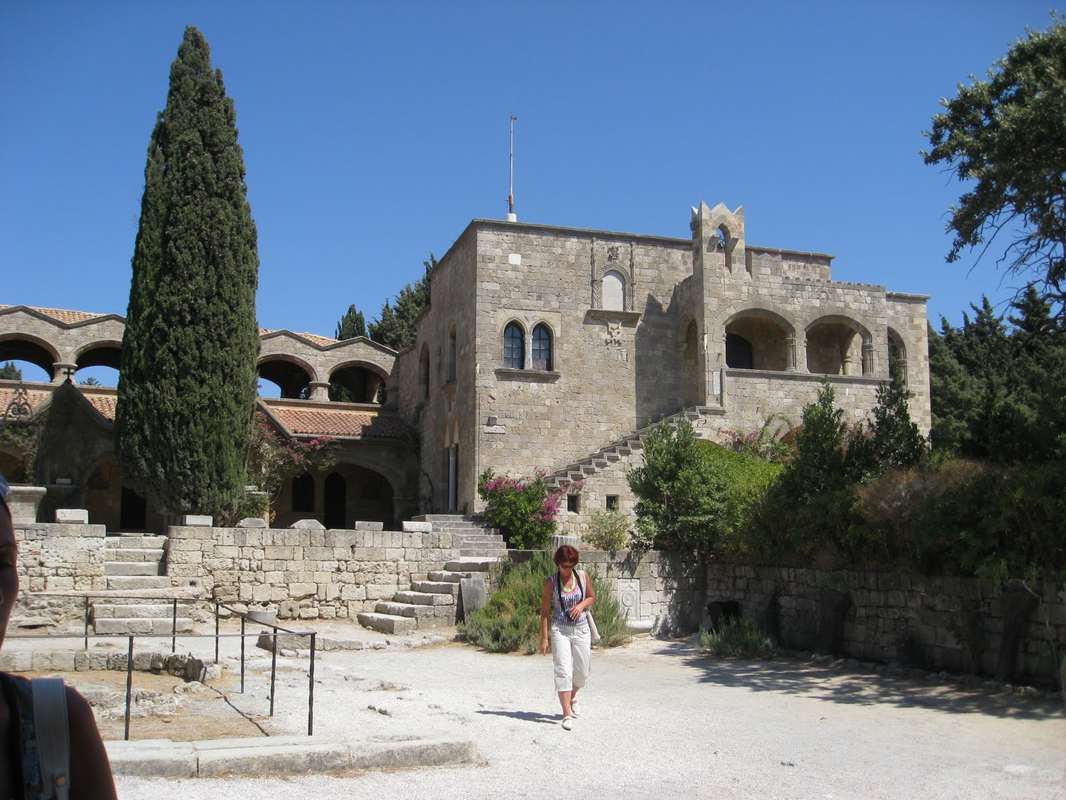
Filerimos is a flat-topped hill rising roughly 267 metres above the village of Ialysos on the north-west coast of Rhodes, and it holds one of the island’s richest concentrations of history in a single quiet site. The hill served as the acropolis of ancient Ialysos, one of the three Dorian cities that founded the city of Rhodes, and later passed through Byzantine, Knights Hospitaller and Italian hands. Today visitors climb it for the Monastery of Our Lady of Filerimos, the foundations of a Doric temple of Athena, an underground frescoed chapel and a panoramic cross. You can plan the trip with My Greece Tours.
Filerimos sits a short drive from Rhodes Town and pairs naturally with the wider Rhodes travel guide. The sections below cover what Filerimos is and its ancient Ialysos roots, the Monastery of Our Lady of Filerimos, the underground Chapel of St George and its frescoes, the Way of the Cross path leading to the giant cross viewpoint, and the practical details of reaching and visiting the hill.
What is Filerimos and why does it matter in Rhodes?
Filerimos is a forested hilltop above Ialysos in north-west Rhodes that was the acropolis of the ancient Dorian city of Ialysos. It layers Greek, Byzantine, Knights and Italian history, and now draws visitors for its monastery, temple ruins and panoramic cross.
Filerimos takes its name from a hermit monk, Gabriel, who brought an icon of the Virgin Mary to the hill and was known as the lonely one, or Filerimos. The site’s importance begins far earlier. Ancient Ialysos placed its acropolis here because the height commanded the coastal plain and the sea approaches to north-west Rhodes. The Phoenicians, then the Dorian Greeks, settled the slopes, and the city of Ialysos joined Lindos and Kamiros to found the unified Rhodian state. Layers of worship followed: a Doric temple of Athena Polias and Zeus Polieus once stood on the summit, and its foundations remain visible today beside later Christian buildings.
Strategic value kept Filerimos occupied through every era. The Byzantines fortified the hill, the Knights of St John used it as a defensive outpost guarding the western coast, and Suleiman the Magnificent reportedly camped here during the siege of Rhodes. The Italian administration of the early twentieth century excavated the ruins and rebuilt the monastery in a restrained medieval style. The result is a compact open-air museum where temple stones, fortification traces and ecclesiastical architecture sit within easy walking distance. Our guide to Ialysos covers the coastal village and its beach below the hill, and the next section covers the Monastery of Our Lady of Filerimos.
What can you see at the Monastery of Our Lady of Filerimos?
The Monastery of Our Lady of Filerimos is a restored medieval complex housing the church of Panagia Filerimos, cloistered courtyards, monks’ cells and a bell tower. The Knights venerated a famous icon of the Virgin here, and Italian-era restoration gave the buildings their present austere stone form.
The monastery centres on the church of the Virgin Mary, built over earlier Byzantine and palaeochristian foundations that themselves overlay the ancient temple. A cruciform baptismal font from the early Christian basilica survives near the entrance, carved into the floor in the shape of a cross. The Knights of St John kept the revered icon of Our Lady of Filerimos in the church, an image credited with protective powers during sieges; the original travelled with the order to Malta and onward, and copies remain venerated. The cloister, vaulted walkways and small cells give the complex the calm, enclosed feel of a working medieval monastery.
Peacocks roam the grounds freely and have become an emblem of Filerimos, strutting across the courtyards and lawns and often calling loudly among the cypress and pine trees. The monastery is a sacred site, so modest dress that covers shoulders and knees is expected inside the church. The setting rewards slow exploration: shaded paths link the church, the temple foundations and the viewpoints, and the planted gardens frame views over the Ialysos plain to the sea. Our guide to Rhodes Old Town covers the Knights’ fortified medieval city, and the next section covers the underground Chapel of St George and its frescoes.
What is the underground Chapel of St George Hostos at Filerimos?
The Chapel of St George Hostos is a small subterranean Byzantine chapel at Filerimos, carved partly into the hillside and decorated with surviving wall frescoes. The Knights are believed to have used it as a burial and prayer space, and its faded paintings depict saints and donor figures.
You reach the chapel by descending a short flight of steps below ground level, where the temperature drops and the light dims to whatever filters through the low doorway. The vaulted single-nave interior carries layers of fresco painted across the later medieval centuries, with some figures showing the kneeling knights and their patron saints. The dimness and damp have worn the colours, yet recognisable images of St George, the Virgin and ranked saints remain across the walls and ceiling, making the chapel one of the most atmospheric corners of the whole hill.
The chapel rewards a careful, quiet visit because the painting detail emerges slowly as eyes adjust to the gloom. Photography without flash protects the fragile pigments, and the cramped space means only a few visitors fit comfortably at once. The contrast with the bright, open monastery courtyards above gives the descent real drama, a shift from sunlit stone to shadowed devotion within a few metres. Our guide to Ancient Kamiros covers a sister Dorian city with its own preserved sanctuaries, and the next section covers the Way of the Cross path and the giant cross viewpoint.
What is the Way of the Cross and the giant cross at Filerimos?
The Way of the Cross at Filerimos is a tree-lined avenue of roughly 800 metres marked with relief plaques of the Stations of the Cross, leading to a tall illuminated cross. Visitors can climb internal stairs inside the cross to a viewing platform over Rhodes.
The path, sometimes called the Via Crucis or Calvary walk, runs dead straight beneath an arching canopy of cypress and pine that keeps it shaded even at midday. Bronze relief panels mounted along the route depict the successive stations of Christ’s passion, turning the stroll into a meditative pilgrimage as well as a scenic one. The avenue ends at the foot of a large concrete cross, rebuilt in the Italian era after an earlier cross stood on the spot; at night it is illuminated and is visible from far across the bay.
Inside the hollow cross a staircase climbs to platforms set within the arms, where a railed opening offers a sweeping panorama. From the top the view takes in the Ialysos plain, the airport coastline, the Aegean to the west and, on clear days, the silhouette of the Turkish coast across the strait. The climb is narrow and best avoided by anyone uneasy in tight spaces, but the reward is the finest viewpoint on this side of the island. Our guide to Valley of the Butterflies covers a shaded nature walk a short drive away, and the next section covers reaching and visiting Filerimos.
How do you reach Filerimos and what should you know before visiting?
Filerimos lies about 15 kilometres south-west of Rhodes Town, just inland from Ialysos, and is reached by car, taxi or organised tour up a winding paved road to a car park near the entrance. Allow one to two hours and wear comfortable shoes for the paths.
The drive from Rhodes Town takes around twenty to thirty minutes, climbing from the coast through pine forest to the summit car park. Many visitors combine the hill with the beach resorts of Ialysos below or fold it into a wider island circuit, since the access road branches off the main west-coast route. The site is set in fragrant gardens of pine and cypress, so the walking is pleasant but uneven in places, and sturdy footwear helps on the stone paths between the monastery, the chapel steps and the cross.
Plan for an early or late visit to avoid the midday heat and the busiest tour-bus hours, and carry water for the open stretches of the Way of the Cross. Remember that the monastery is an active religious site, so modest clothing is needed for the church interior, and the peacocks, though tame, are wild birds best admired rather than fed. The combination of ancient ruins, Byzantine frescoes, a peaceful monastery and one of the great Rhodian viewpoints makes Filerimos a half-day highlight. Plan your visit and tours through our Rhodes travel guide.
Frequently Asked Questions
Is there an entrance fee for Filerimos?
Filerimos is a managed archaeological and religious site administered by the local ephorate of antiquities, and a small admission ticket is normally required at the entrance, with reductions for certain categories of visitor and free days that follow the general Greek heritage-site calendar. Because the exact figures and opening times change between seasons, it is best to confirm current prices and hours with an official source or your tour operator before you go. The fee covers the monastery grounds, the temple foundations, the underground Chapel of St George and access to the Way of the Cross, so a single ticket gives you the entire hilltop. Visiting through an organised tour from Rhodes Town often bundles transport and entry together, which removes the need to drive the winding access road yourself and simplifies the logistics for first-time visitors.
Can you climb the giant cross at Filerimos for the views?
Yes, the large cross at the end of the Way of the Cross is hollow and contains a narrow internal staircase that climbs to viewing platforms set within its arms. From these openings the panorama spreads across the Ialysos plain, the western coastline near the airport, the open Aegean and, in clear weather, the distant Turkish shore across the strait. The climb is steep and the passage tight, so anyone uncomfortable in confined spaces or with limited mobility may prefer to enjoy the equally generous views from the terrace at the base of the cross. Access to the interior depends on the site being open and is sometimes restricted, so it is worth checking on arrival. Either way the spot ranks among the finest panoramic viewpoints anywhere on Rhodes and crowns a visit to the hill.
Why are there peacocks at Filerimos?
Peacocks have lived on the Filerimos hill for many years and have become one of its best-loved features, wandering freely through the monastery courtyards, the gardens and the wooded paths. They are not native wild birds of Rhodes but a long-established resident population that thrives in the sheltered, planted grounds around the monastery, where they nest among the trees and display their tail feathers in spring. Visitors regularly hear their loud, carrying calls echoing across the site before they spot the birds themselves. Although the peacocks are used to people and approach closely, they remain semi-wild and should be admired rather than fed or handled, both for their welfare and to keep the grounds clean. Their presence adds a memorable splash of colour and sound to an already atmospheric hilltop of ruins, chapels and forest.