
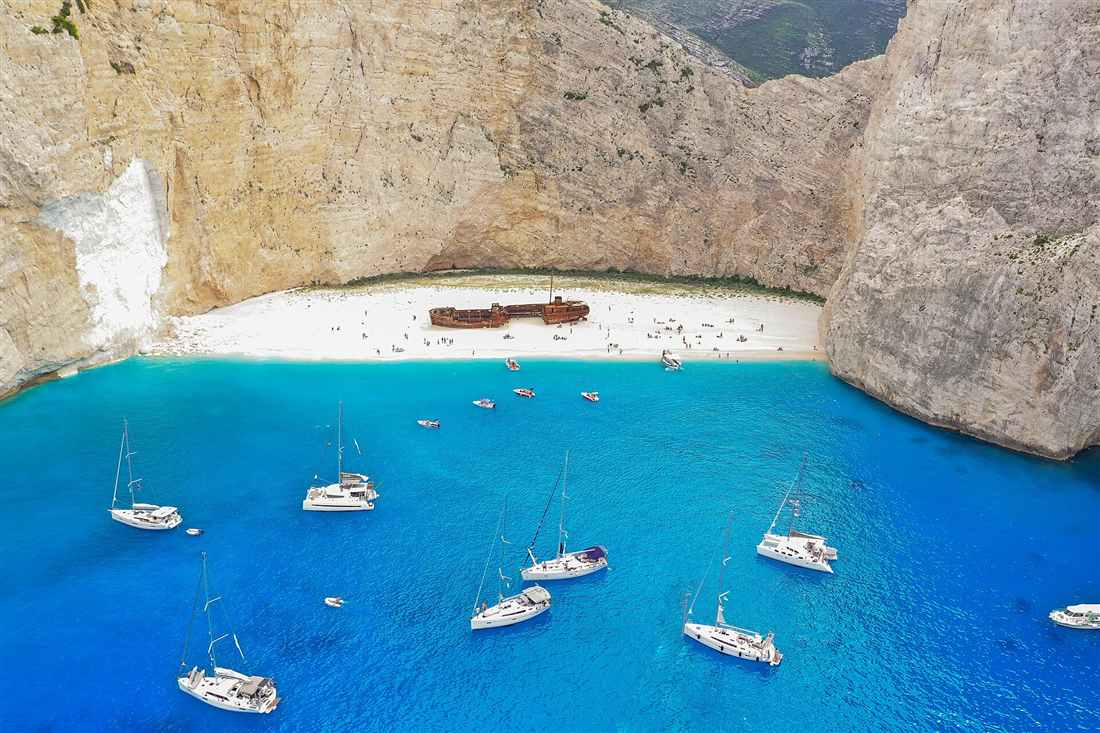
Ionian islands tours cover the seven green islands west of mainland Greece: the Venetian old town of Corfu, the blue caves of Paxos, the cliff beaches of Lefkada, the harbours of Ithaca, the underground lake of Melissani on Kefalonia, the wreck at Navagio on Zakynthos and the castle of Kythira. Plan the rest of the trip with Greece Tours.
This page covers the Ionian islands tours you can book, from island hopping and sailing to boat day trips and island drives, the sights of each island, the Venetian and British history, the food and wine, the beaches, and how the airports, ferries and seasons shape the route.
What do Ionian islands tours cover?
Ionian islands tours cover the seven islands west of mainland Greece: Corfu, Paxos, Lefkada, Ithaca, Kefalonia, Zakynthos and Kythira. They run as island-hopping trips, sailing cruises, boat day trips to caves and beaches, island tours by road, and food, wine and walking tours.
The Ionian Islands lie in the Ionian Sea, west of the Greek mainland. Greeks call them the Heptanese, the “Seven Islands”, although the group holds many smaller islands as well. Six of the seven lie off the west coast. The seventh, Kythira, lies off the southern tip of the Peloponnese. Kythira belongs to the Attica region, while the other six form the Ionian Islands Region.
Venice ruled the islands for centuries and kept them outside Ottoman control. That rule gave them a separate culture with Italian marks in the architecture, the food and the music. Ionian islands tours see it in the arcades of Corfu town, the bell towers of Kefalonia and the Venetian names: Corfù for Kerkyra, Santa Maura for Lefkada, Zante for Zakynthos, Cerigo for Kythira and Val di Compare for Ithaca. The islands joined the Greek state in 1864.
Which islands do Ionian islands tours visit?
- Corfu: the northernmost island, with a UNESCO old town and two Venetian fortresses.
- Paxos and Antipaxos: the smallest of the seven, with blue caves and white cliffs.
- Lefkada: joined to the mainland by a causeway and a floating bridge, with the west-coast beaches.
- Ithaca: the island of Odysseus, with Vathy in its deep harbour.
- Kefalonia: the largest, with Melissani, Myrtos and Mount Ainos.
- Zakynthos: with Navagio, the Blue Caves and the loggerhead turtles of Laganas bay.
- Kythira: off the Peloponnese, with Venetian Chora and Kapsali.
Which formats do Ionian islands tours take?
- Island hopping by ferry between Corfu, Paxos, Lefkada, Ithaca, Kefalonia and Zakynthos.
- Sailing cruises of a day or a week through the inner islands.
- Boat day trips to the blue caves of Paxos, the Navagio wreck and the Meganisi sea caves.
- Island tours by bus, jeep or private car to villages, castles and viewpoints.
- Nature tours: turtle spotting in Laganas bay and walks on Mount Ainos and the Corfu Trail.
- Food and wine tours with Robola on Kefalonia, kumquat on Corfu and the olive museums of Lefkada.
The islands are greener than the Aegean. They catch the rain that the Pindus mountains hold back, so their hills carry olive groves, cypress and pine. Earthquakes have shaped their towns: the quake of 12 August 1953 flattened the buildings of Kefalonia and Zakynthos and spared only Fiskardo in the north. Ionian islands tours walk through towns rebuilt after that year and through the few that survived it.
Which island-hopping and sailing Ionian islands tours link the islands?
Island-hopping Ionian islands tours link Corfu with Paxos, Lefkada with Kefalonia and Ithaca, and Kefalonia with Zakynthos. Sailing cruises of seven days leave Lefkada and circle the inner islands. Day boats cross from Nydri to Kefalonia and Ithaca and from Corfu to Paxos and Antipaxos.
The six northern islands lie close together. Paxos lies about 15 km south of Corfu and the same distance from Parga on the mainland. Ithaca lies within sight of Kefalonia, across a narrow strait. Meganisi lies minutes from Nydri on Lefkada. Ionian islands tours use that geography: the boats reach a second island before lunch and return the same evening.
“From Lefkada: 7-Day Island Hopping Sailing Boat Cruise” sails the group over a week and sleeps on board. “From Nydri: Boat to Kefalonia and Ithaki with Swim Stops” crosses to the two islands in a day. “Nydri: Porto Katsiki, Egremni, Kefalonia & Ithaka Cruise” adds the west-coast beaches of Lefkada to the same run. Flotilla sailing and bareboat charters work the same waters from the marinas of Lefkada, Gouvia on Corfu and Sami on Kefalonia.
Which ferries serve Ionian islands tours?
Ferries from Igoumenitsa reach Corfu in about an hour and a half, and smaller boats run from Igoumenitsa and Corfu to Gaios on Paxos. Lefkada needs no ferry: a causeway and a floating bridge carry the road from the mainland. Car ferries run from Nydri and Vasiliki on Lefkada to Kefalonia and Ithaca, and from Fiskardo on Kefalonia to Frikes on Ithaca and to Lefkada. Kyllini in the Peloponnese serves Zakynthos and Kefalonia. Patras links to Kefalonia and Ithaca. Kythira connects with Neapoli and Gytheio in the Peloponnese and with Piraeus.
Island-hopping Ionian islands tours plan around those lines. The northern chain runs Corfu, Paxos, Lefkada, Ithaca, Kefalonia and on to Zakynthos. Kythira sits apart, four hundred kilometres to the south-east, and joins the Peloponnese rather than the group.
How long do island-hopping Ionian islands tours last?
A day trip covers one crossing and one island. Three days pair Corfu with Paxos, or Lefkada with Meganisi. A week of sailing covers four to six islands, with a night in a different bay each evening. Two weeks add Zakynthos in the south and Kythira beyond it. Ionian islands tours by yacht follow the wind: the summer breeze here is lighter than the meltemi of the Aegean, which makes these waters a sailing ground for beginners.
Which yacht charters and flotillas sail on Ionian islands tours?
Ionian islands tours by yacht leave the marinas of Gouvia on Corfu, Lefkas on Lefkada, Sami and Argostoli on Kefalonia and Zakynthos town. Bareboat charters, skippered yachts and flotillas all work these waters, because the distances are short and the summer wind is light.
The inner Ionian holds the best-known sailing ground in Greece. Lefkada, Meganisi, Kalamos, Kastos, Ithaca and northern Kefalonia sit within a few hours of each other. A boat leaving Nydri reaches Meganisi in under an hour and Ithaca in half a day. Sheltered water lies inside the chain, so crews sail in a flat sea even when the open west coast has swell.
The wind here is the maistro, a north-westerly that builds in the afternoon and drops at night. It is lighter than the meltemi of the Aegean, which is why charter companies teach beginners in these waters. Flotillas run a lead boat with a skipper and an engineer, and the rest of the fleet follows the same route from bay to bay.
Ionian islands tours by charter also run as cabin cruises, where guests book a berth rather than the whole boat. “From Lefkada: 7-Day Island Hopping Sailing Boat Cruise” runs that way. Day boats without a licence go out from Nydri, Corfu town, Paxos and Zakynthos for small groups who want their own wheel. Our page on the Lefkada yacht charter covers the boats that leave the marina.
What do Ionian islands tours show on Corfu?
Ionian islands tours on Corfu show the UNESCO old town between its two Venetian fortresses, the Liston arcade, the Achilleion palace of Empress Elisabeth, the bay of Paleokastritsa, the Byzantine castle of Angelokastro and the islet of Pontikonisi. Corfu is the northernmost of the seven islands.
Corfu, or Kerkyra, marks the border between the Ionian Sea and the Adriatic. Its capital carries the same name and holds 23,541 residents, while the island holds 99,134. Ancient Korkyra fought the Battle of Sybota, the largest naval battle between Greek city-states up to that time, according to Thucydides. He also counted Korkyra among the three great naval powers of 5th-century Greece, with Athens and Corinth.
The island belonged to the Republic of Venice from 1204 and again from 1386 to 1797. It repelled Ottoman sieges in 1537, 1571, 1573 and 1716. Venice made it one of the most fortified places in Europe, and the writer Will Durant held that Corfu owed to Venice the fact that it was the only part of Greece the Ottomans never took. Britain ruled it from November 1815 and ceded it to Greece in 1864.
What do Ionian islands tours see in Corfu town?
The old town was inscribed on the UNESCO World Heritage List in 2007. Two castles enclose it, and the Greek state has declared it a kastropolis, a “castle city”. It is the only Greek city surrounded in that way. Multi-storey Venetian houses line its narrow lanes. A small-group walking tour of the old town covers the fortresses, the lanes and the squares. Our page on the food and wine of Corfu covers the tastes of the same streets.
The Liston arcade runs along the Spianada, the largest square in Greece, and the French built it on the model of the Rue de Rivoli in Paris. The British laid out the cricket ground on the same square, and island teams still play on it. The town holds two firsts of the modern Greek state: the Ionian Academy, its first university, and the Nobile Teatro di San Giacomo, its first theatre and opera house. Ioannis Kapodistrias, the first governor of independent Greece, was born here. Two fortresses hold the ends of the old town. The Old Fortress stands on a rocky promontory east of the centre, cut off from the land by the Contrafossa, a sea canal the Venetians dug across the neck. The New Fortress rises on the hill to the west, built after the siege of 1571 and finished under Venetian rule. Both are open, and the walls of each give the view over the roofs and the strait. The ruins of ancient Korkyra lie at Palaiopolis, around the Mon Repos palace, with the temples of Artemis, Hera and Kardaki.
What do Ionian islands tours see outside the town?
The Achilleion stands at Gastouri, about ten kilometres south of the town. Empress Elisabeth of Austria built it in 1890 as a refuge after the death of her son. The Italian architect Raffaele Caritto designed it in the style of a Phaeacian palace, and the German sculptor Ernst Herter made its Dying Achilles. It works today as a museum.
Paleokastritsa lies on the north-west coast, under cliffs and coves. Its monastery dates from 1225 and holds a museum. Tradition places the landing of Odysseus and his meeting with Nausicaa in this bay. Above it stands Angelokastro, a Byzantine castle 305 metres up on a cliff. It never fell, and from 1387 to the end of the 16th century it served as the official capital of Corfu. Pontikonisi, “Mouse Island”, lies off the airport, with a Byzantine chapel of the 11th or 12th century. Ionian islands tours by bus link these three in one day.
Which villages do Ionian islands tours visit on Corfu?
Ionian islands tours on Corfu drive to Kassiopi in the north-east, the sandstone channels of Sidari, the hill villages of Lakones and Pelekas above the west coast, the abandoned houses of Old Perithia and the summit of Mount Pantokrator at 906 metres.
Kassiopi sits on the north-east coast, opposite the Albanian shore. A castle of the Angevin period stands above its harbour, one of the three that closed the defence of the island with Angelokastro and Gardiki. The Roman emperor Nero is said to have visited its temple of Zeus Kassios. Fishing boats still tie up in the small port, and tavernas line the quay.
Sidari lies on the north coast. The sea has cut the soft sandstone there into channels and pillars, and the narrowest of them carries the name Canal d Amour. Boats leave Sidari for the Diapontia islands offshore. Peroulades, further west, stands above a cliff that catches the last light of the day.
Lakones and Makrades look down on Paleokastritsa from the ridge, and the viewpoint on that road is the one every island tour stops at. Pelekas keeps the belvedere the Kaiser used, above the west-coast beaches. Old Perithia, on the north slope of Pantokrator, is the oldest village of the island, built high for fear of pirates and left almost empty when the coast grew safe. Ionian islands tours climb from it to the summit of Pantokrator, at 906 metres, where the view runs from Albania to the south of the island.
Which day trips leave Corfu on Ionian islands tours?
Day trips from Corfu run to Paxos, Antipaxos and their blue caves, to the mainland at Parga and the blue lagoon of Sivota, to Albania at Saranda and Butrint, and east to the monasteries of Meteora. The Paxos cruise is the most booked of the Corfu day trips.
“Corfu: Luxury Cruise to Paxos, Antipaxos, & the Blue Caves” carries more than 5,800 reviews. The boat sails south along the coast, stops at the caves on the west side of Paxos, swims off Antipaxos and gives free time in Gaios. “Corfu: Paxos and Antipaxos Full-Day cruise with Captain Bill” and a high-speed catamaran run the same route in less time. A speedboat trip from Corfu reaches the blue caves of Paxos and returns in half a day.
On the mainland opposite, Parga sits under its Venetian castle and Sivota faces a scatter of islets. “From Corfu Town: Syvota Blue Lagoon Full-Day Boat Cruise” crosses to that shallow bay of blue water. Ionian islands tours from Corfu also cross to Albania. “From Corfu: Albanian Adventure Day Trip” sails to Saranda and drives to the ruins of Butrint. Passengers carry a passport for that crossing.
Which longer day trips leave Corfu?
“Corfu: Meteora Monastery Day Trip with Lunch & Ferry” crosses to Igoumenitsa and drives inland to the rock monasteries of Thessaly. It is the longest day trip from the island. Bus tours also circle Corfu itself: an island highlights tour and a panoramic tour with a private driver take in Paleokastritsa, the Achilleion and the hill villages. Our pages on Meteora tours and the Parga day trip from Corfu cover the two mainland routes.
Corfu is also a cruise port. Shore excursions run for passengers with a few hours ashore, and they cover the old town, the Achilleion and Paleokastritsa. Boat rentals without a licence leave from the town beaches for the coves nearby. Ionian islands tours from Corfu fill a week without repeating a route.
Which small islands lie off Corfu on Ionian islands tours?
Ionian islands tours from the north of Corfu reach the Diapontia islands: Othonoi, Erikoussa and Mathraki. Othonoi is the westernmost point of Greece, and a sea cave on its coast carries the name of Calypso. Boats leave Sidari and Agios Stefanos for the day.
The Diapontia islands lie north-west of Corfu, closer to Italy than any other Greek land. Othonoi is the largest and the westernmost. Tradition places the cave of Calypso on its south coast, where the Odyssey has Odysseus held for seven years. Its village, Ammos, sits above the harbour, and the hill village of Chorio stands inland.
Erikoussa lies east of it, a low island of olive and cypress with one sandy beach beside its harbour. Mathraki, the smallest of the three, has a long beach where loggerhead turtles lay. Fewer than a hundred people live on each island through the winter, and many families of the three have relatives in New York.
Day boats run from Sidari and Agios Stefanos on the north-west coast of Corfu in summer, and a small ferry serves the islands from Corfu town through the year. Ionian islands tours to the Diapontia give a few hours ashore and a swim stop on the crossing.
What do Ionian islands tours show on Paxos and Antipaxos?
Ionian islands tours on Paxos show Gaios, Lakka and Loggos, the olive groves that cover the island, and the sea caves and white cliffs of the west coast. Antipaxos, 3 km south, has the beaches of Vrika and Voutoumi and its vineyards. Paxos is the smallest of the seven main islands.
Paxos covers 25.3 square kilometres. Its municipality, with Antipaxos and the islets, covers 30.1 square kilometres and holds 2,466 people. The island is hilly, and its highest point reaches 230 metres. It is about 10 km long and up to 3 km wide. Olive groves cover much of it, and they run from Lakka in the north through Magazia to Gaios, the capital. Gaios, Lakka and Longos on the east coast are the three main settlements.
Myth says Poseidon struck Corfu with his trident and split off Paxos, to make a quiet corner for himself and Amphitrite. Tradition makes the Phoenicians the first settlers, and the name may come from their word pax, “trapezoidal”. The Battle of Paxos was fought here in 229 BC, in the First Illyrian War, and Polybius wrote its account. Venice took the island at the end of the 14th century. Paxos surrendered to a British frigate on 13 February 1814, and Britain set up the United States of the Ionian Islands the next year.
What are the blue caves of Paxos?
The west coast of Paxos is a wall of white chalky cliffs, eroded at sea level into caves. Boats enter them, and the light through the water turns the walls blue. Ypapanti, the largest, is a cave the boats can sail into. The rock arches of Tripitos stand at the southern end of the same coast. Ionian islands tours by boat spend the morning on this side of the island and the afternoon at Antipaxos.
Antipaxos covers 5 square kilometres and 21 people live on it. Vineyards cover most of the island, and its wine has a name among Greek sailors. It has one harbour, Agrapidia, and three main beaches: Vrika with white sand, Mesovrika with pebbles and Voutoumi with pebbles. A sea taxi from Gaios reaches it in about 15 minutes. Ionian islands tours anchor off Vrika and Voutoumi for the swim stop.
Boats to Paxos leave Corfu town, Gouvia, Lefkimmi in the south of Corfu, Parga and Sivota on the mainland. A ferry also links Corfu with Gaios for travellers who stay the night. Our page on the Parga to Paxos boat trip covers the crossing from Epirus.
What do Ionian islands tours show on Lefkada?
Ionian islands tours on Lefkada show the west-coast beaches of Porto Katsiki, Egremni and Kathisma, the resort of Nydri with its islets, the windsurfing bay of Vasiliki, the castle of Agia Mavra at the causeway and the mountain villages of Karya and Eglouvi. A floating bridge joins the island to the mainland.
Lefkada measures 35 km from north to south and 15 km from east to west. The island covers about 302 square kilometres, and the municipality, with Kalamos, Kastos and the islets, covers 333.6. Its highest point is Stavrota, at 1,158 metres. Aktion airport lies about 25 minutes from the town by road. The Corinthians dug a trench through its isthmus in the 7th century BC, and a causeway and floating bridge now cross that channel.
The east coast holds the small resorts of Lygia, Nikiana and Perigiali, and then Nydri, the largest resort on the island. Nydri looks across to Skorpios, Madouri, Sparti and Meganisi. Twenty kilometres south of Nydri lies Vasiliki, a windsurfing centre with ferries to Kefalonia and Ithaca. South of Vasiliki stands Cape Lefkada, where legend says Sappho leapt from cliffs 30 metres high.
Which beaches do Ionian islands tours reach on Lefkada?
Porto Katsiki lies on the west coast, 35 km from Lefkada town, near the village of Athani. Its name means “goat port”, because only goats once reached it. The beach sits at the foot of a pale concave cliff, and a stairway drops to it from the clifftop car park. Boats bring visitors from Nydri. An earthquake in 2015 damaged the beach, and geologists expect it to rebuild itself over time. Egremni and Kathisma lie along the same coast under the same white cliffs.
“Nydri: Porto Katsiki, Egremni, Kefalonia & Ithaka Cruise” reaches the beaches by sea and crosses to the two islands. Ionian islands tours by boat show this coast from the water, where the cliffs stand above the swimmers. Our page on Lefkada boat trips covers the day boats.
What else do Ionian islands tours see on Lefkada?
The German archaeologist Wilhelm Dörpfeld held that Lefkada, not Ithaca, was the Homeric island of Odysseus, and that the palace stood west of Nydri. He dug at Nydri, found Mycenaean tombs, walls and artefacts, spent his last years in the village and is buried there. Ionian islands tours to Nydri pass his grave and the waterfalls in the gorge behind the village.
Lefkada town sits at the northern tip, beside the channel. Earthquakes have shaped it: the houses carry a wooden upper floor sheathed in metal or timber over a stone ground floor, a local answer to the shaking. The castle of Agia Mavra guards the channel from the mainland side and dates from the start of the 14th century. “Lefkas in a Day: History, Culture & Coastal Highlights” covers the town, the castle and the coast. “Lefkada: Agia Mavra Castle, Monastery & Museum Tour” takes in the fortress that guards the channel. A ticket and tour of the Fabbrica olive museum show how the island pressed its oil. “Lefkada: Hike to Eglouvis Fields of Flavor” walks the lentil fields of Eglouvi, the highest village. Our page on the Lefkada sunset cruise covers the evening boats.
Which inner islands do Ionian islands tours reach from Lefkada?
Ionian islands tours from Nydri reach Meganisi with its sea caves, the private island of Skorpios, and the quiet islands of Kalamos, Kastos and Atokos. The day cruises call these the “forgotten islands”, and they swim in coves that the ferries never touch.
Meganisi lies east-south-east of Lefkada. Its municipality covers 22.4 square kilometres and includes Skorpios and Sparti. It has three villages: Katomeri in the centre and the ports of Vathy and Spartochori. A car ferry links it with Nydri. Wilhelm Dörpfeld and others held that Meganisi was the Homeric island of Krocylea, part of the kingdom of Odysseus.
The Papanikolis cave cuts into the west coast of Meganisi. It is one of the largest sea caves in Greece, and the story goes that a Greek submarine of that name sheltered inside it in the Second World War. Boats sail in through the mouth of the cave. “From Nydri: Lefkada Forgotten Islands Day Cruise with Lunch” has more than 370 reviews and covers Meganisi, Kalamos and Kastos.
What do Ionian islands tours see on Skorpios and the small islands?
Skorpios lies off Nydri. Aristotle Onassis owned it, and the Ribolovlev family owns it today. Two people live on it. Boats pass its shore without landing. Sparti and Madouri lie beside it, and Madouri keeps the house of the poet Aristotelis Valaoritis.
Kalamos and Kastos belong to the municipality of Lefkada. Kalamos rises steeply from the water, with a village above its harbour. Kastos is long and low, with one village and a windmill on the ridge. Atokos, further out, has no permanent residents and a beach the cruises use for the swim stop. “Nydri: Piggy Cruise with Seven Islands Cruises” and a VIP cruise to Atokos run this route. Ionian islands tours of this kind leave in the morning and return before the evening wind.
What do Ionian islands tours show on Ithaca?
Ionian islands tours on Ithaca show Vathy in its deep natural harbour, the fishing villages of Kioni and Frikes, the Cave of the Nymphs above Dexa bay, the hilltop site called the School of Homer and the monastery of Kathara. Homer made Ithaca the kingdom of Odysseus.
Vathy is the largest settlement and the seat of the regional unit. It stands in the south of the island, at the head of a deep bay. Pirate raids in the Middle Ages pushed people inland, and Vathy formed only in the 16th century, under late Venetian rule, when the families of Palaiochora moved down to the water. The French built a fortress on the Loutsa hill at the harbour entrance in 1807.
The dockyard at Vathy worked through the 19th century and built more than 200 ships. Under British rule the town grew to about 5,000 people. The 1953 earthquake left few buildings standing, and the town was rebuilt in its Venetian style. A law of 1978 protects that architecture and fixes the style and colour of every repair. The islet of Lazareto at the harbour mouth carries a chapel of 1668 and served from 1560 as a forty-day quarantine station.
Which Homeric sites do Ionian islands tours visit on Ithaca?
“Kefalonia: Mythical Ithaca Island Full-Day Bus Tour” crosses from Kefalonia and covers the island in a day. The Cave of the Nymphs, above Dexa bay near Vathy, is where the Odyssey has Odysseus hide the gifts of the Phaeacians. In the north, above Stavros, a site known as the School of Homer has yielded Mycenaean walls and a rock-cut stairway. The bay of Polis below it gave a cave with bronze tripods of the kind the poem describes.
The monastery of Kathara stands at about 600 metres on Mount Niritos, above Vathy, with the whole south of the island below it. Kioni and Frikes lie on the north-east coast, small harbours with tavernas along the quay and yachts at anchor. Anogi, inland, keeps a Venetian bell tower and a Byzantine church. Ionian islands tours on Ithaca drive the ridge road between the two halves of the island, with the sea on both sides.
Scholars still argue about the island. Kefalonia has been proposed as the Homeric Ithaca, and Robert Bittlestone suggested that the Paliki peninsula was a separate island in the late Bronze Age. Wilhelm Dörpfeld argued for Lefkada. Ionian islands tours hear all three claims, one on each island.
What do Ionian islands tours show on Kefalonia?
Ionian islands tours on Kefalonia show Argostoli and its De Bosset bridge, the Venetian village of Assos under its castle, the harbour of Fiskardo, Mount Ainos with its Greek firs, and the swallow holes of Katavothres. Kefalonia is the largest of the Ionian Islands and the sixth largest in Greece.
Argostoli has been the capital since 1757, when people moved down from the old capital at Agios Georgios to trade on its sheltered bay. It grew into one of the busiest ports of Greece. The De Bosset bridge crosses the lagoon at the end of the bay. Colonel Charles Philip de Bosset, a Swiss engineer in British service, built it in wood in 1813. Stone arches followed four years later, and the whole bridge was rebuilt in stone after 26 years. It carried traffic until 2005.
The Koutavos lagoon beside it is a feeding ground for loggerhead turtles and now a nature reserve. Along the coast road west of the town lie the Katavothres, the swallow holes. Sea water sinks into the ground there and comes out about fourteen days later at Karavomylos near Sami, after passing under the island through the Melissani lake. A water mill harnessed that flow in 1835. The Fanari lighthouse, built under British rule in 1829, stands further along the same road with its Doric columns.
What do Ionian islands tours see in the north of Kefalonia?
Assos lies 36 km north of Argostoli, on a neck of land under a castle. Venice commissioned the Italian engineer Marino Gentilini to build that castle between 1593 and 1595, and it is one of the largest in Greece. It was meant to shelter the people of northern Kefalonia from raids, but it lacked springs and was never used as a fortress. The village below it was founded under Venetian rule and served as the administrative capital of the north from 1593.
Fiskardo is the northernmost port of the island, a short crossing from Ithaca. It is the one place on Kefalonia that the 1953 earthquake spared, so its Venetian houses still stand. Ferries link it with Frikes on Ithaca and with Lefkada. Archaeologists found a Roman cemetery here with gold jewellery, glass and bronze, and a well-preserved theatre, from the period between 146 BC and AD 330. The village is identified with ancient Panormos. Robert Guiscard, the Norman duke, gave it his name.
“Argostoli: Explore Fiskardo, Myrtos Beach, Melissani Cave” covers the north in one day. Ionian islands tours by road cross the island from Argostoli to Sami and up the coast, with the mountains of Ithaca in view across the strait.
Which Ionian islands tours explore the south of Kefalonia and Paliki?
Ionian islands tours in the south of Kefalonia visit the Roman villa and mosaics at Skala, the turtles off Katelios, the monastery of Agios Gerasimos and the Robola vineyards of Omala, and cross the bay to Lixouri and the red sand of Xi on the Paliki peninsula.
Skala lies at the south-east corner of the island. Excavators found a Roman villa there with floor mosaics of the 3rd century AD, sheltered under a roof beside the modern village. Along the same coast, loggerhead turtles feed off Katelios and Mounda, and the beaches there carry nests in summer. Poros, further north, takes the ferry from Kyllini in the Peloponnese.
The Omala valley lies inland, under Mount Ainos. The monastery of Agios Gerasimos stands in it, and the saint is the patron of the island. The Robola co-operative works beside the monastery, in vineyards planted on limestone and volcanic gravel. Wine Ionian islands tours taste the white there and walk the rows.
What do Ionian islands tours see on Paliki?
Lixouri faces Argostoli across the bay, and a small ferry crosses between the two in about twenty minutes. It is the second town of Kefalonia and the centre of the Paliki peninsula. Xi beach south of it has red sand and shallow water. Petani, on the west side, is a deep bay of white pebbles under cliffs. Kounopetra, near Xi, was a rock that rocked with the swell until the earthquake of 1953 settled it.
Robert Bittlestone proposed that Paliki was a separate island in the late Bronze Age, and that it, not modern Ithaca, was the Ithaca of Homer. A project ran for three years to test the idea. Ionian islands tours on the peninsula pass the channel that his theory says the sea once filled. Our page on Kefalonia boat trips covers the boats that work this coast.
Which caves and beaches do Ionian islands tours visit on Kefalonia?
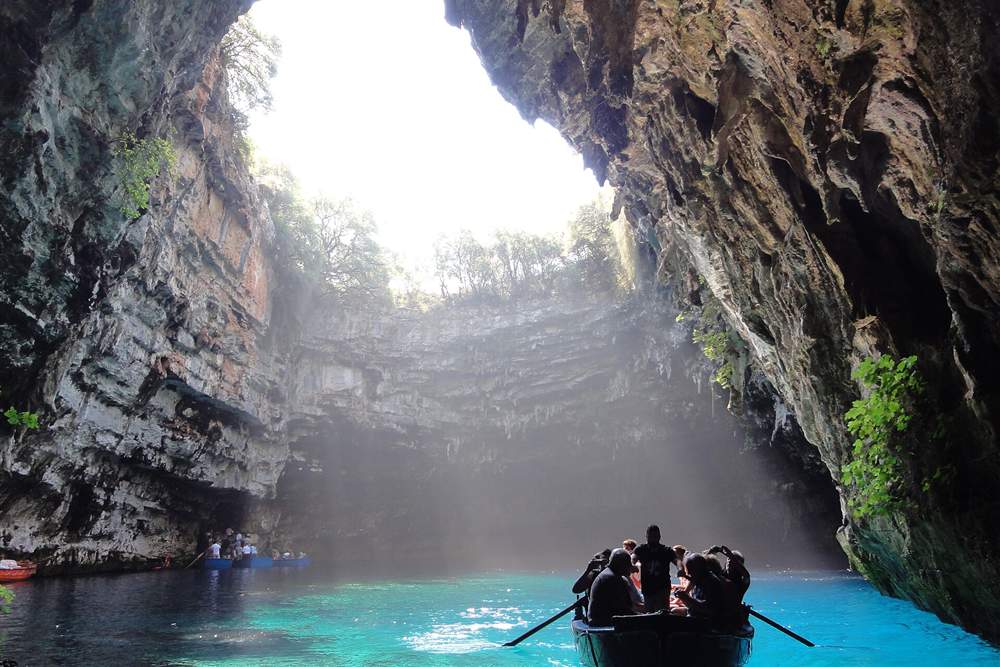
Ionian islands tours on Kefalonia row across the underground lake of Melissani, walk into the stalactite chamber of Drogarati and swim at Myrtos, a white cobble beach between two mountains. Mount Ainos, at 1,628 metres, rises behind them as a national park of Greek fir and black pine.
Melissani lies north-west of Sami. The roof of the cave collapsed and opened the groundwater to the light, which made a cenote of it. Small boats row visitors across the water, and in the middle of the day the sun drops straight through the hole and turns the lake blue. Myth called it the Cave of the Nymphs. The cave was rediscovered in 1951. Its water is brackish: it mixes fresh water from inland with sea water that entered at Katavothres, and it flows out again at the shore near Karavomylos.
“From Argostoli: Melissani Lake & Drogarati Caves Tour” has more than 670 reviews and covers both caves. Drogarati, near Sami, is a dry cave of stalactites with a chamber used for concerts. Ionian islands tours join the two in a morning and swim at Antisamos or Myrtos in the afternoon.
What is Myrtos beach?
Myrtos lies in the north-west, in the region of Pylaros, between the mountains of Agia Dynati and Kalon Oros. Its stones are round and white, ground from marble, and they grade from cobbles to pebbles at the water. The slope drops sharply at the shoreline, so the waves break hard and the drift carries fine marble dust along the curve of the bay. That dust gives the water its turquoise. A steep road of about 2 km with hairpin bends drops to it from the village of Divarata. The mine explosion scene of Captain Corelli’s Mandolin was filmed here.
What do Ionian islands tours see on Mount Ainos?
Ainos is the tallest mountain of the Ionian Islands, at 1,628 metres. Its rock is dolomite and limestone. Most of the range is a national park, covered with Greek fir and black pine, and the pine forest runs between 700 and 1,200 metres. Semi-wild ponies live in the forest. From the summit the view takes in the north-west Peloponnese, Aetolia and the islands of Zakynthos, Lefkada and Ithaca. Strabo recorded a sanctuary of Zeus Ainesios on the mountain, and Hesiod mentioned it before him.
A road climbs from the north-west to the transmitter station, and a track and steps lead from there to the top in about twenty minutes on foot. A longer marked route climbs 1,096 metres over 6.5 km from Digaleto, on the road from Sami to Poros. Walking Ionian islands tours take the second route in spring and autumn, when the fir shade keeps the path cool.
What do Ionian islands tours show on Zakynthos?
Ionian islands tours on Zakynthos show the wreck of the Panagiotis at Navagio, the Blue Caves at Cape Skinari, the turtles of the National Marine Park in Laganas bay, the Keri cliffs and the town rebuilt after the 1953 earthquake. The island covers 405.55 square kilometres.
Zakynthos, called Zante by the Venetians, is the third largest of the Ionian Islands. Its coastline runs 123 km. The Venetians ruled it from 1484 to 1797 and named it Fiore di Levante, the “flower of the East”. Myth says the island took its name from Zakynthos, son of Dardanos of Arcadia, who sailed here first. Homer names it in the Iliad and the Odyssey, and the Odyssey counts twenty nobles from Zakynthos among the suitors of Penelope.
The island supplied Athens with tar for its warships. Crews dredged it from the bottom of a lake, now Lake Keri, with leafy myrtle branches tied to poles. Tar protected ship planking better than pine pitch, so the Athenian fleet valued the source. The alliance with Athens dates from between 459 and 446 BC. In 430 BC a Spartan force under Cnemus burned the countryside but failed to take the town.
What do Ionian islands tours see in Zakynthos town?
The earthquake of 12 August 1953 left only two buildings standing in the capital. The rest of the town was rebuilt, and the Venetian arcades and bell towers were raised again in the old style. Solomos Square carries the name of Dionysios Solomos, the poet of the Greek national anthem, who was born on the island. Above the town, Bochali keeps the Venetian castle and the view over the harbour. Strani hill, where Solomos heard the guns of Messolonghi, stands beside it.
Ionian islands tours on the island drive to Keri in the south for the cliffs and the lighthouse, and to the Myzithres rocks that stand off that coast. “Zakynthos: Romantic Sunset in Keri Lake & Myzithres Viewpoint” covers that corner in the evening. Buggy and jeep tours cross the inland villages, and horse riding runs on the beaches of the east coast.
Which boat Ionian islands tours sail to Navagio and the Blue Caves?
Boat Ionian islands tours from Zakynthos sail to Navagio, the cove with the wreck of the MV Panagiotis, and to the Blue Caves at Cape Skinari in the north. Other boats run south into Laganas bay for the loggerhead turtles of the National Marine Park, founded in 1999.
Navagio, “Shipwreck Beach”, is an exposed cove on the north-west coast, reached only by sea. The cove was called Agios Georgios before the wreck. On 5 October 1980 the coaster MV Panagiotis ran aground here in stormy weather and poor visibility. Court documents and photographs support the story that she carried contraband cigarettes from Turkey towards Italy and that the crew abandoned her to escape the navy. The hull still lies in the limestone gravel that gave the beach its name.
The cliffs above the cove have shed rock more than once. The beach closed for a time in 2018 after a cliff collapsed, and another landslide followed a magnitude 5.4 earthquake a few years later. Boats now approach under restrictions. “Zakynthos: Blue Caves and Navagio Bay Swim Cruise” has nearly 700 reviews and joins the cove with the caves of the north. Ionian islands tours also view the cove from the clifftop platform above it.
What are the Blue Caves?
The Blue Caves lie at Cape Skinari, at the northern tip of the island. The sea has cut arches and chambers into the white limestone, and the light reflecting from the floor turns the water inside them blue. Small boats from Agios Nikolaos and Skinari enter the arches and stop for swimmers. Ionian islands tours combine them with Navagio on the same morning.
Which Ionian islands tours show the turtles?
The National Marine Park of Zakynthos was founded in 1999 in Laganas bay. It covers 135 square kilometres and protects the loggerhead sea turtle, Caretta caretta. It was the first national park set up for sea turtles in the Mediterranean. Six beaches in the bay hold the nests: Gerakas, Daphni, Sekania, Kalamaki, East Laganas and the islet of Marathonisi, about 5 km of sand in all. Sekania ranks among the highest concentrations of loggerhead nests in the world.
The park holds 900 to 2,000 nests a year, about eighty percent of the Mediterranean total for the species. Females come ashore at night between May and August to lay. The park also protects Keri lake, the Strofadia islands 50 km to the south, sand dunes, Posidonia beds and a resident population of monk seals on the west coast. Fishing is banned inside the marine zones.
“Zakynthos: Turtles, Marathonisi & Keri Caves Speedboat Tour” carries more than 3,600 reviews, and a glass-bottom boat version carries more than 3,100. A small-group turtle tour adds swim stops. An adult loggerhead measures about 90 cm across the shell and weighs about 135 kg. Ionian islands tours in the bay keep their distance from the animals, and the park bans speedboats off the nesting beaches.
What do Ionian islands tours show on Kythira and Antikythera?
Ionian islands tours on Kythira show the Venetian castle above Chora, the bay of Kapsali below it, the waterfalls at Mylopotamos and the beaches of the east coast. Antikythera, to the south, gave the world the Antikythera mechanism, the oldest known analogue computer.
Kythira lies opposite the south-eastern tip of the Peloponnese. It counts as one of the seven Ionian Islands, although it sits far from the others. Administratively it belongs to the Attica region. Its municipality covers 300 square kilometres and includes Antikythera. The island lay on the route between the mainland and Crete, and merchants, sailors and conquerors crossed it for centuries. Its architecture mixes Aegean and Venetian forms.
Archaeology on Kythira reaches back to the Helladic period, and finds show trade as far as Egypt and Mesopotamia. A Phoenician colony worked here in the early archaic age, because the sea snail that gives Tyrian purple lives off the island. The archaic city stood at Scandea, on Avlemonas bay, and its acropolis, now Palaiokastro, held a temple of Aphrodite Ourania. Sparta took the island from Argos early in the 6th century BC and governed it through an official called the kytherodikes. Athens occupied it three times in its wars with Sparta.
What do Ionian islands tours see on Antikythera?
Antikythera covers 20.4 square kilometres and lies 38 km south-east of Kythira. Its port and main settlement is Potamos. Cilician pirates used it as a base between the 4th and 1st centuries BC, until Pompey destroyed them, and their fort still stands on a cliff in the north-east. The Ottomans never ruled it. Venice held it until 1800, after the rest of the Ionian Islands had fallen to France in 1797. It passed to Britain in 1815 and to Greece in 1864.
In 1901 sponge divers found a Roman-era wreck off the island. Among the wreckage lay the Antikythera mechanism, a hand-powered model of the solar system built in the 2nd century BC. It is the oldest known analogue computer. It predicted the positions of the sun and moon and eclipses decades ahead, and it tracked the four-year cycle of the games. Scans show 35 meshing bronze gears, of which 30 survive. The largest gear is about 13 cm across and had 223 teeth. The fragments stand in the National Archaeological Museum in Athens.
Chora, the capital of Kythira, stands under a Venetian castle of the 13th century, with Kapsali bay and its double harbour below. Mylopotamos keeps a set of old watermills and the Neraida waterfall in a green ravine, and the abandoned village of Kato Chora holds another Venetian castle above the sea. Avlemonas, Diakofti and Agia Pelagia hold the beaches and the ferry quay. A ferry from Piraeus to Kissamos on Crete calls at Antikythera. Ionian islands tours that reach Kythira use the crossings from Neapoli and Gytheio in the Peloponnese, and the island keeps its own airport for flights from Athens.
Which museums and castles do Ionian islands tours visit?
Ionian islands tours visit the Museum of Asian Art in the Palace of Saint Michael and Saint George on Corfu, the Archaeological Museum with its Gorgon pediment, the Solomos museum on Zakynthos, the Korgialenios museum in Argostoli and the castles of Angelokastro, Assos, Agia Mavra and Bochali.
The Palace of Saint Michael and Saint George stands at the north end of the Spianada in Corfu town. The British built it for the Lord High Commissioner, and it now holds the Museum of Asian Art, the only museum in Greece devoted to the art of Asia. The Archaeological Museum of Corfu shows the Gorgon pediment from the temple of Artemis at Palaiopolis, carved in the early 6th century BC and one of the oldest large stone pediments in Greece. The Antivouniotissa church keeps the Byzantine Museum and its icons of the Cretan school.
On Zakynthos, the Museum of Dionysios Solomos and Andreas Kalvos stands on the square that carries the poet name, with the tombs of both men. The Byzantine Museum on the same square holds the icons and screens rescued from the churches that fell in 1953. In Argostoli, the Korgialenios historical and folklore museum shows the island as it looked before the earthquake, and the archaeological museum holds the Mycenaean finds of the south.
Which castles do Ionian islands tours climb?
- Angelokastro, Corfu: a Byzantine fortress 305 metres above the sea near Paleokastritsa, which never fell.
- Gardiki and Kassiopi, Corfu: the two castles that closed the defensive triangle with Angelokastro.
- Agia Mavra, Lefkada: the fortress at the channel, guarding the causeway to the mainland.
- Assos, Kefalonia: built between 1593 and 1595 by the Venetian engineer Marino Gentilini, one of the largest in Greece.
- Agios Georgios, Kefalonia: the old capital above Argostoli, abandoned for the port in 1757.
- Bochali, Zakynthos: the Venetian castle above the town, with the view over the harbour.
Ionian islands tours by road link two or three of these in a day, because each one sits on the high ground that a bus can reach. Our page on the castle of Zakynthos covers the fortress above the capital.
Which history do Ionian islands tours tell?
Ionian islands tours tell four hundred years of Venetian rule, the French and Russian years after 1797, the British protectorate from 1815, the union with Greece in 1864 and the earthquake of 1953 that rebuilt the southern islands. Venice kept the group out of Ottoman hands.
Greeks settled the islands early, possibly by 1200 BC and certainly by the 9th century BC. Venice took Corfu in 1204, after the Fourth Crusade, and held the group through the centuries when the Ottomans ruled the rest of Greece. That long rule left Italian words in the dialects, Venetian names on the maps and campanile bell towers in the villages. It also left the olive: Venice paid Corfiot farmers to plant olive trees, and their groves still cover the island.
The Treaty of Campo Formio dissolved the Republic of Venice in 1797 and the islands passed to France. In 1800 a Russo-Ottoman agreement set up the Septinsular Republic over the seven islands, the first self-governing Greek state of modern times, and it lasted until 1807. A Russo-Ottoman force drove the French out between 1798 and 1799. France took them again after the Treaty of Tilsit. Britain beat the French fleet off Zakynthos on 2 October 1809 and took Kefalonia, Kythira and Zakynthos, then Lefkada in 1810.
What did British rule leave on the islands?
The Treaty of Paris of 5 November 1815 gave Britain a protectorate over the group, the United States of the Ionian Islands. It covered the seven islands and the port of Parga on the mainland, which was sold to Ali Pasha of Ioannina in 1819. The British brought Maltese labourers as builders and artisans, and their descendants formed the Corfiot Maltese community.
British engineers left roads, aqueducts, lighthouses and bridges: the De Bosset bridge at Argostoli of 1813, the Fanari lighthouse of 1829, the cricket ground on the Spianada in Corfu town. The Party of Radicals formed in 1848 to press for union with Greece. Skirmishes broke out at Argostoli and Lixouri that year, and a rising followed on 15 August 1849. In 1850 the radical MP John Detoratos Typaldos put the union motion to the Ionian parliament. Britain ceded the islands to Greece in 1864, as a gift to the newly crowned King George I.
What did the 1953 earthquake do?
The earthquake of 12 August 1953 measured 6.8 and raised the whole island of Kefalonia by 60 cm. More than 113 shocks hit the area between Kefalonia and Zakynthos that month. Between 445 and 800 people died. Every building on Kefalonia fell except those at Fiskardo, and only two buildings survived in the capital of Zakynthos. Warships brought the first aid: the USS Salem, then HMS Gambia and HMS Bermuda, and four Israeli ships, the first aid Israel sent to a disaster abroad.
Many islanders emigrated to Canada, the United States, Australia and Britain after the quake. The towns were rebuilt in the Venetian style with modern frames, and that is the townscape Ionian islands tours walk through today in Argostoli, Lixouri, Zakynthos town and Vathy on Ithaca.
Which outdoor Ionian islands tours run on land and sea?
Outdoor Ionian islands tours kayak into the blue cave of Lefkada, walk the Corfu Trail across the island, climb Mount Ainos on Kefalonia, windsurf at Vasiliki, fly tandem paragliders over Kathisma and dive the reefs off Zakynthos and Kefalonia.
“Lefkada: Hidden Blue Cave Sea Kayak Experience” carries a rating of 5 from more than 260 reviews. The paddle follows the west coast under the cliffs and enters a cave the bigger boats cannot reach. Sea kayaks also run from Corfu, Paxos and Kefalonia. Ionian islands tours by kayak start early, before the afternoon breeze lifts the sea.
Vasiliki bay, on the south coast of Lefkada, funnels a thermal wind down the mountain each afternoon. Windsurfers have used it for decades, and schools line its beach. Kathisma, on the west coast, serves tandem paragliding flights from the ridge above the sand. Divers work the wrecks and walls off Zakynthos and around Fiskardo and Argostoli on Kefalonia, where the water stays clear into autumn.
Where do walking Ionian islands tours go?
- Corfu Trail: a marked long-distance path of about 220 km from the south of the island to the north-west.
- Mount Ainos, Kefalonia: a marked route of 6.5 km and 1,096 metres of climb from Digaleto, or a short walk from the transmitter road.
- Vikos-style gorges on Kefalonia: the paths around Assos and the Erisos peninsula above Fiskardo.
- Ithaca: the old paths between Vathy, Anogi, Stavros and Kioni, with the Homeric sites along them.
- Paxos: the olive-grove tracks between Gaios, Magazia and Lakka.
- Lefkada: the hike to the lentil fields of Eglouvi and the ridge walks above Karya.
Cyclists ride the inner coasts, where the roads follow the water. Horse riding runs on the beaches of Zakynthos. Ionian islands tours that mix walking with boats cover the coast in the morning and the hills after the heat.
What food and wine do Ionian islands tours taste?
Ionian islands tours taste Robola wine on Kefalonia, Verdea on Zakynthos, kumquat liqueur on Corfu, the olive oil of Paxos and Lefkada, and the Venetian dishes of the islands: pastitsada, sofrito and bourdeto on Corfu, and meat pie on Kefalonia.
Robola is a white grape grown mainly on Kefalonia. Its vines stand ungrafted in the limestone soil of the island. It ripens early and gives dry, medium-bodied wines with high acid and a lemon note. Venetian merchants traded it from the 13th century, and the grape was long thought to be the same as the Ribolla of Friuli, until DNA work separated the two. The co-operative winery in the Omala valley pours it beside the monastery of Agios Gerasimos.
Zakynthos makes Verdea, a white blend aged in the old island way. Corfu grows kumquats, a small citrus with a sweet skin and a sour pulp, and turns the fruit into a liqueur and a spoon sweet. The fruit is 2.5 to 5 cm across and is eaten whole. Paxos and Lefkada press olive oil from groves that Venice paid farmers to plant.
Which dishes do Ionian islands tours eat?
Corfu keeps Venetian dishes under Greek names. Pastitsada is rooster or veal in a spiced tomato sauce over thick pasta. Sofrito is veal in garlic, parsley and vinegar. Bourdeto is fish in a red pepper sauce. Kefalonia bakes kreatopita, a meat pie with rice and herbs, and Ithaca sells thyme honey. Zakynthos makes mandolato, a white nougat with almonds, and Lefkada dries a salami and grows the lentils of Eglouvi.
Food Ionian islands tours walk the markets of Corfu town and Argostoli, and cooking classes run on Corfu and Kefalonia. Our pages on the Corfu food tour, the Corfu cooking class and Kefalonia wine tasting cover the tastings. Our page on the wine of Zakynthos covers Verdea and the island vineyards.
Which wildlife do Ionian islands tours see?
Ionian islands tours see loggerhead turtles in Laganas bay and off Katelios, monk seals on the west coast of Zakynthos, semi-wild ponies in the fir forest of Mount Ainos, and the birds of the Korission lagoon on Corfu.
The loggerhead is the animal of the group. Females lay at night on the sand of Laganas bay between May and August, and the hatchlings run for the water weeks later. An adult measures about 90 cm across the shell. The species lays about four clutches and then rests for two or three years, and it reaches breeding age between 17 and 33 years. The marine park counts 900 to 2,000 nests a year in the bay.
Monk seals hold a resident population on the west coast of Zakynthos, in the sea caves under the cliffs. The species is one of the rarest seals in the world, and the caves of Kefalonia and Ithaca shelter it as well. Boat Ionian islands tours keep out of the caves where the seals pup.
Mount Ainos carries its own forest of Greek fir, a tree named after the island, with black pine on the lower slopes. Semi-wild ponies live in that forest, and the national park protects them. On Corfu, the Korission lagoon in the south holds waders and flamingos on their passage, behind a long dune beach. Gerald Durrell wrote his Corfu books from the island of his childhood, and some of his ashes were scattered on Pontikonisi.
Which festivals and traditions do Ionian islands tours meet?
Ionian islands tours meet the Easter of Corfu, when the town throws clay pots from the balconies on Holy Saturday, the philharmonic bands that march behind them, the processions of Saint Spyridon, the kantades of Zakynthos and the folklore festivals of Lefkada in August.
Corfu keeps the largest Easter in the Ionian. On Holy Saturday morning, people drop large clay pots of water from the balconies of the old town, and the bands play through the streets before and after. The philharmonic societies of the town date from the 19th century and still train the young musicians who march in every procession.
Saint Spyridon lies in a silver reliquary in his church in Corfu town. His body is carried through the streets four times a year, and the islanders credit him with saving Corfu from plague, famine and siege. Whole streets close for the procession, and the bands lead it.
Zakynthos sings kantades, songs for two or three voices with guitar and mandolin, a form the island shares with Italy. The Ionian school of music gave Greece its national anthem: Dionysios Solomos of Zakynthos wrote the words, and Nikolaos Mantzaros of Corfu set them. Lefkada holds an international folklore festival in August, and the villages of Karya keep their embroidery.
Ionian islands tours in high summer meet the panigyria, the village feasts on saints days, with tables in the square and music until morning. Kefalonia celebrates Saint Gerasimos, its patron, at the monastery in the Omala valley, next to the Robola vineyards.
Which beaches do Ionian islands tours reach?
Ionian islands tours reach Porto Katsiki, Egremni and Kathisma on Lefkada, Myrtos and Antisamos on Kefalonia, Navagio and Gerakas on Zakynthos, Paleokastritsa and Sidari on Corfu, and Vrika and Voutoumi on Antipaxos. Most of them are white cobble or fine pebble under cliffs.
The west coasts hold the dramatic beaches. Lefkada, Kefalonia and Zakynthos all drop white limestone cliffs straight into deep water, and the light off the pale stone turns the sea turquoise. The east coasts hold the sheltered bays with the harbours and the family beaches. Ionian islands tours by boat work the west in the morning, when the sea is calm, and return east in the afternoon.
Which beaches suit which island?
- Lefkada: Porto Katsiki under its concave cliff, Egremni below a long stairway, Kathisma with its beach bars, and Agios Nikitas on the north-west coast.
- Kefalonia: Myrtos between two mountains, Antisamos in its green bay near Sami, Petani on the Paliki peninsula and Xi with its red sand.
- Zakynthos: Navagio in its cove, Gerakas under the dunes of the marine park, Xigia with its sulphur springs and Porto Limnionas on the west coast.
- Corfu: the coves of Paleokastritsa, Glyfada under the cliffs, and the sandstone channels of the Canal d’Amour at Sidari.
- Paxos and Antipaxos: Vrika with white sand and Voutoumi with pebbles, both reached by sea taxi from Gaios.
- Ithaca and Kythira: Gidaki near Vathy, reached on foot or by boat, and Kaladi on the east coast of Kythira.
Blue Flag awards cover dozens of Ionian beaches each summer, from Dassia and Glyfada on Corfu to Kalamaki on Zakynthos, and the flag marks water quality, lifeguards and access. The cliff beaches carry no such services: Porto Katsiki, Egremni and Navagio have a stair or a boat and nothing else, so Ionian islands tours carry water and shade for those stops. The marine park rules bind the beaches of Laganas bay. Gerakas, Daphni, Sekania, Kalamaki, East Laganas and Marathonisi carry the loggerhead nests, and Sekania is closed to visitors. Ionian islands tours in that bay stay off the sand at night, when the females come ashore.
Which Ionian islands tours suit cruise passengers and families?
Cruise passengers take short Ionian islands tours from the ports of Corfu, Argostoli and Zakynthos: the old town and the Achilleion on Corfu, Melissani and Myrtos on Kefalonia, and the turtle boats of Laganas bay on Zakynthos. Families take the glass-bottom boats and the shorter crossings.
Corfu is the busiest cruise port of the group. Ships tie up north of the old town, and shore excursions run to the Spianada, the fortresses, the Achilleion at Gastouri and Paleokastritsa. Argostoli takes ships in its bay on Kefalonia, a short drive from Melissani, Drogarati and Myrtos. Zakynthos town takes smaller ships, and the boats to Navagio and the Blue Caves leave from the same coast.
Shore excursions fit the hours in port. A half day covers one site and one viewpoint; a full day covers a cave, a beach and a village. Ionian islands tours of this kind collect passengers at the quay and return them before the ship sails.
Which Ionian islands tours suit children?
Glass-bottom boats work Laganas bay on Zakynthos, where children see the turtles without entering the water. The row boats of Melissani take ten minutes across the lake. The crossing from Nydri to Meganisi takes under an hour. The shallow sand of Gerakas, Kathisma and Sidari suits swimming with children, and the cliff beaches with their deep water suit stronger swimmers. Ionian islands tours with children keep the boat days short and the drives shorter.
How do you plan Ionian islands tours: airports, ferries and seasons?
Plan Ionian islands tours around the airports of Corfu, Kefalonia, Zakynthos, Aktion for Lefkada and Kythira, and the ferry ports of Igoumenitsa, Kyllini, Patras and Astakos. The season runs from Easter to late October, and the islands are greener and wetter than the Aegean.
Corfu International Airport carries the name of Ioannis Kapodistrias. It lies about 2 km south of Corfu town and half a kilometre north of Pontikonisi. It was founded in 1937 and became international in April 1965. Its runway reached its present 2,373 metres in 1959. Traffic peaks between April and October.
Kefalonia Airport lies in the south-west of the island, 8 km from Argostoli. It opened in 1971, and a new runway and terminal followed in the 1980s. Zakynthos International Airport lies 4.3 km from the town, near Laganas, Tsilivi and Kalamaki. It opened in 1972. Because Kalamaki beach belongs to the marine park, flights cannot take off or land between 22:00 and 05:00. Lefkada has no airport of its own: Aktion, near Preveza, lies about 25 minutes from the town by road. Kythira keeps a small airport with flights from Athens.
Drivers reach the group by two roads. The Ionia Odos motorway runs up the west of the country to Igoumenitsa for the Corfu ferry, and the Rio-Antirrio bridge carries the traffic from the Peloponnese to the same road. Lefkada is the one island a car reaches without a boat, over the causeway and the floating bridge. Ionian islands tours that hire a car on one island leave it there, because the ferries charge for vehicles and the drop-off fees run high.
Which ferries serve Ionian islands tours?
Igoumenitsa serves Corfu and Paxos and links the group with Italy. Kyllini in the Peloponnese serves Zakynthos and Kefalonia. Patras serves Kefalonia and Ithaca, and Astakos in Aetolia serves Ithaca and Kefalonia. Lefkada needs no ferry, because the causeway and floating bridge carry the road across the channel. Within the group, boats run Nydri and Vasiliki to Kefalonia and Ithaca, Fiskardo to Frikes and Lefkada, and Pesada to Agios Nikolaos on Zakynthos.
Which mainland trips leave the islands?
The mainland lies within sight of the northern islands, so Ionian islands tours cross to it for the day. From Corfu, boats reach Parga and the blue lagoon of Sivota, and buses reach Meteora through Igoumenitsa. From Lefkada, a day trip covers Preveza, the Roman city of Nicopolis and Parga with a boat ride. From Kefalonia and Zakynthos, the ferries to Kyllini and Patras open the north-west Peloponnese, with Ancient Olympia about two hours from the quay at Kyllini. Our page on Preveza tours covers the coast opposite Lefkada.
Which season suits which Ionian islands tours?
- Spring: wildflowers on the hills, full waterfalls behind Nydri, and walking weather on the Corfu Trail and Mount Ainos.
- Summer: every boat runs, the turtles nest in Laganas bay from May to August, and the sailing flotillas fill the inner waters.
- Autumn: warm sea into October, the olive harvest starting, and quiet quays at Fiskardo and Kioni.
- Winter: rain and green hills, with Corfu town, Argostoli and Zakynthos town open all year.
The Ionian Islands catch more rain than the Aegean, and that is why they are green. Their summer wind is lighter than the meltemi, so the crossings hold to their timetables better. Ionian islands tours that start in Corfu work south, and tours that start in Zakynthos or Kefalonia work north. Our pages on how to get to Kefalonia and getting to Zakynthos cover the two southern gateways.
Frequently Asked Questions
Which are the Ionian Islands?
Corfu, Paxos, Lefkada, Ithaca, Kefalonia, Zakynthos and Kythira. Greeks call them the Heptanese, the “Seven Islands”, and the group holds many smaller islands as well.
Which is the largest Ionian island?
Kefalonia, the sixth largest island in Greece. Corfu is the most populated, and Paxos is the smallest of the seven.
Why are the Ionian Islands so green?
They lie on the windward side of the mountains and catch more rain than the Aegean. Olive groves, cypress and pine cover their hills.
Which Ionian islands tours leave Corfu?
Cruises to Paxos, Antipaxos and the blue caves, boats to Parga and the Sivota blue lagoon, day trips to Saranda and Butrint in Albania, island bus tours and a long day trip to Meteora.
Can you island hop in the Ionian?
Yes. Ferries link Corfu with Paxos, Lefkada with Kefalonia and Ithaca, and Kefalonia with Zakynthos. Sailing tours of seven days circle the inner islands from Lefkada.
What is Navagio?
A cove on the north-west coast of Zakynthos with the wreck of the MV Panagiotis, which ran aground on 5 October 1980. It is reached only by boat, and landslides have closed the beach at times.
Where do the loggerhead turtles nest?
On six beaches in Laganas bay on Zakynthos, inside the National Marine Park founded in 1999. The park holds 900 to 2,000 nests a year, and the females lay at night between May and August.
Which airports serve Ionian islands tours?
Corfu, Kefalonia, Zakynthos and Kythira have their own airports. Lefkada uses Aktion near Preveza, about 25 minutes from the town.
What happened in 1953?
An earthquake of magnitude 6.8 struck on 12 August, raised Kefalonia by 60 cm and levelled the towns of Kefalonia and Zakynthos. Only Fiskardo, in the north of Kefalonia, kept its old houses.
How long is the Corfu Trail?
About 220 km, marked from the south of the island to the north-west. Walkers cover it in eight to ten days, and Ionian islands tours walk single stages of it in a day.
Where do sailing Ionian islands tours start?
At the marinas of Lefkas on Lefkada, Gouvia on Corfu, Sami and Argostoli on Kefalonia and Zakynthos town. The inner islands around Lefkada hold the sheltered water that the flotillas use.
Which wine do Ionian islands tours taste?
Robola from Kefalonia, Verdea from Zakynthos and the kumquat liqueur of Corfu. The Robola vines grow ungrafted in the limestone soil of the island.