
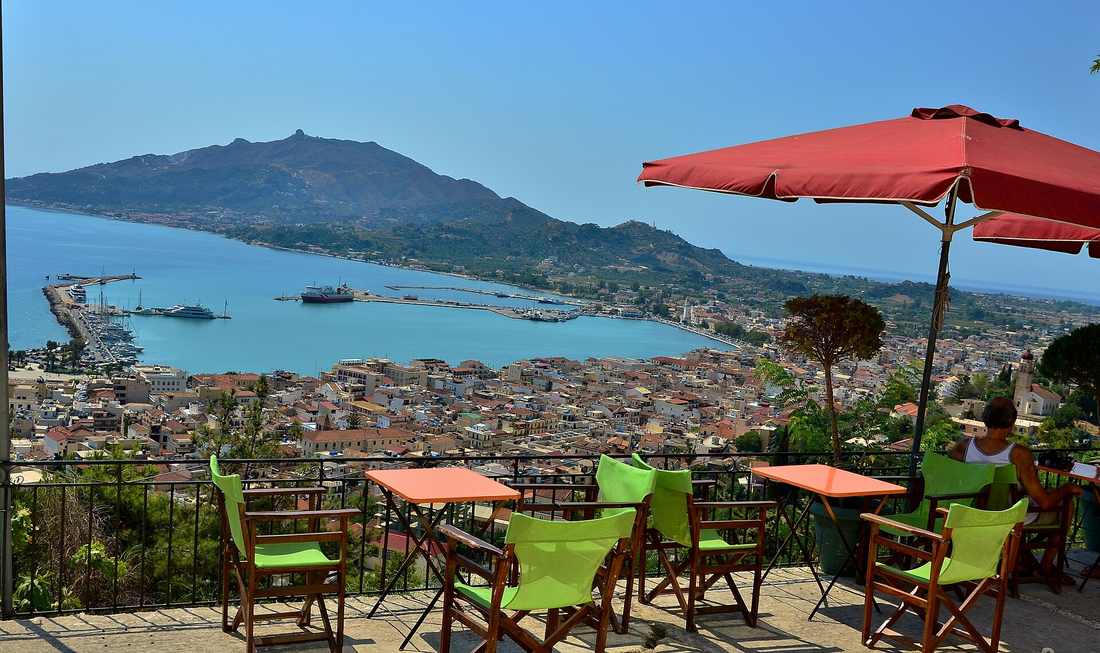
The castle of Zakynthos is the ruined Venetian fortress on the pine-clad hill of Bochali, high above the island’s capital. Its long walls and stone gates ring the flat top of the hill. Inside stand the traces of an old town, churches and barracks, now shaded by pines. The fortress guarded the harbour and the town for centuries under Venetian rule. Today the walls frame wide views over the capital, the bay and the sea. Cafes on the hill below add to the draw. Climb to the island’s old stronghold and its finest views with My Greece Tours.
The castle sets the long history of the island in stone and pine. Venetian walls, ruined gates and quiet woods crown the hill where the old town once sheltered. The views from the ramparts are among the widest on the island. The sections below cover the fortress and its story, the walk up, the ruins inside, the views, and what lies nearby. Set the castle in its wider surroundings with our Zakynthos travel guide.
What is the castle of Zakynthos?
The castle of Zakynthos is a ruined Venetian fortress on Bochali hill above the capital. Long stone walls ring the wooded summit, enclosing the ruins of gates, churches and an old town, and offering wide views over the island.
The fortress crowns the flat top of a pine-covered hill that rises behind the island’s capital. A ring of thick stone walls, built and rebuilt over the centuries, encloses the broad summit. Within lie the scattered ruins of what was once the main town of the island, sheltered inside the defences. Gates, bastions, cisterns and the shells of churches and barracks stand among the pines. The Lion of Saint Mark, the emblem of Venice, can still be seen carved on the stone. The whole site is now a green, peaceful place, its old strength softened by the woods that have grown up over the ruins.
The castle stands where the ancient acropolis of the island once rose, so the hill has been fortified since deep antiquity. The Venetians made it the heart of their island stronghold, and the old town huddled within its walls for safety. In time the people moved down to the shore and built the capital by the sea, leaving the fortress above. Earthquakes and the passing years reduced it to the ruin seen today. Yet the walls still trace the shape of the old defences, and the site keeps its long memory of the many rulers who held this key island of the Ionian Sea.
The fortress marks the highest and most defensible point of the capital area, chosen for its command of the coast. Its outer walls run in an irregular ring around the crown of the hill, following the natural edge of the summit. The builders shaped the defences to the ground rather than a fixed plan, so the line bends and turns with the slope. Angled bastions project at intervals, set to cover the approaches and the gates with fire. The main entrance faced the town, guarded by a strong gate and a stretch of thickened wall. This layout tied the castle to the settlement it protected, standing over the harbour as both shield and symbol of the island’s rulers.
Dense Aleppo pines now cover the enclosed summit and shade the ruined lanes and foundations below. Paths of packed earth and worn stone run from the entrance through the trees to the surviving gates and bastions. Wooden signs mark the ruined churches, the powder store and the line of the inner defences for walkers. Cypresses and wild shrubs grow between the fallen blocks, and the ground stays cool even in high summer. Birds nest in the pines, and the scent of resin drifts across the quiet interior of the walls. The walk over the plateau stays level and shaded for most of its length.
The fortress reads today as a woodland park set inside old military ramparts, rather than a bare ruin standing on open rock.
How do you get up to Zakynthos castle?
The castle sits on Bochali hill just above the capital of Zakynthos, reached by a short drive or a climb of about half an hour up through the streets. A small entrance fee gives access to the walled site.
The way up leads through the hillside suburb of Bochali, which climbs the slope between the capital and the summit. Drivers can follow the winding road most of the way and park near the entrance. Those on foot can climb from the town below, a walk of roughly half an hour up stepped lanes and quiet roads, shaded in places and steep in others. The route passes old churches and villas, with the view widening at every turn. At the top a gate and a small admission give entry to the walled enclosure. The climb rewards the effort, both for the fortress itself and for the sweep of the island that opens out along the way.
The hill of Bochali is a destination in its own right, with a cluster of cafes and tavernas around a small square just below the castle. Many visitors pause here for a drink with a view before or after the fortress. The square looks out over the capital and the bay, and it is a favourite spot at sunset. From here it is a short step up to the castle gate. The whole outing pairs the ruins, the woods and the views with the pleasant hillside village, making an easy half-day trip from the town or the nearby resorts.
The road up to the castle branches off the streets that climb from the waterfront toward the hill. Signs point the way to the fortress and to Bochali, and the route is easy to follow by car or on foot. Parking near the gate is limited, so an early start helps on busy summer days. Walkers should carry water and wear sturdy shoes for the steeper stretches of the climb. The paved lanes give way to rougher ground closer to the walls, where the surface turns uneven. A morning ascent avoids the heat of midday, and the light then falls well on the town below for those who enjoy the view.
What can you see inside the castle walls?
Inside the walls stand the ruins of gates, bastions, churches, barracks and cisterns, scattered among pine woods. Carvings of the Venetian lion survive on the stone, and paths wind through the green, quiet enclosure of the old town.
Passing through the main gate, you enter a wide, wooded enclosure rather than a standing castle. Pines shade the ground, and paths lead among the ruins. Here and there rise the remains of the old defences: bastions along the walls, the arches of gates, deep stone cisterns that once held water for a siege. The foundations and shells of churches can be traced, along with the sites of barracks and stores from the days when a garrison held the hill. The Lion of Saint Mark, carved above a gate, still marks the long rule of Venice. It is a place to wander slowly, reading the traces of the past in the stones among the trees.
The setting is as much a part of the visit as the ruins. The pine woods have grown up over the old town, making the summit cool and green even in high summer. Wildflowers and herbs fill the open ground in spring, and the shade draws walkers on hot days. Interpretive signs help make sense of the layout, though much is left to the imagination. The quiet is striking after the bustle of the town below. Between the trees, gaps in the walls open onto sudden views of the sea and the coast, a reminder of why this hill was chosen as the island’s stronghold in the first place.
The ruined churches inside the walls recall the time when the old town lived within the fortress. Their low foundations and broken arches mark where the people once gathered to worship. Nearby stand the remains of the barracks and stores that housed the garrison and its supplies. Deep cisterns cut into the rock kept water for the long weeks of a possible siege. A carved Lion of Saint Mark set above one of the gates records the centuries of Venetian rule over the island. These scattered stones let the visitor read the shape of a whole community that once sheltered on the hill.
The old town on the hill was known in earlier days by the name of the ancient acropolis that stood here. This first settlement grew up around the strong point that guarded the island’s harbour. Its walls and towers were raised and repaired by successive rulers who valued the height and the wide outlook. The move down to the shore came later, as the danger from raiders eased and trade drew the people to the port. The hilltop then slowly emptied, its houses and lanes left to fall into the ruin traced among the pines today.
What are the views like from Zakynthos castle?
The castle offers some of the widest views on the island. From the walls and the hill the eye takes in the whole capital, the sweep of the bay, the harbour and the sea, with the mountains of the mainland on the horizon.
The great reward of the climb is the view. From the ramparts and the open ground of the summit, the land falls away to the capital spread along the shore below. The red roofs, the churches and the long waterfront can all be picked out, with the harbour and its boats beyond. The wide bay opens out to the sea, blue and glittering, and on a clear day the mountains of the Peloponnese rise faint on the far horizon. The height gives a sense of the whole shape of the town and its setting between hill and water. Few spots on the island offer so complete a view of the capital and its coast.
The views shift through the day. In the morning the light falls full on the town and the eastern sea. Toward evening the sun sinks behind the hill, and the sky over the bay turns gold and rose, a favourite hour on the terraces of Bochali just below. The nearby castle hill and the village square are among the best places on the island to watch the sunset over the capital. Whether by day or at dusk, the outlook ties together the sights of the whole area, from the churches of the town to the beaches of the coast and the boats crossing the bay.
The best vantage points lie along the walls and at the open edges of the summit. Gaps in the ramparts frame the town, the harbour and the sea in turn, each opening onto a different part of the coast. The paths near the outer walls give the widest sweep, taking in the bay and the hills beyond. A pause on the terraces of Bochali just below adds the town rooftops in the foreground of the view. The height lets the eye follow the shore from the port around the curve of the bay. Clear mornings and the hour before sunset both reward the climb with the sharpest light over the capital and the water.
What is near Zakynthos castle?
Near the castle lie the village of Bochali with its cafes, the capital with its churches and museums, and the waterfront below. The hill sits above the heart of the island’s town and its main sights.
The castle crowns the hill directly above the island’s capital, so all the sights of the town lie within easy reach below. In the streets at the foot of the hill stand the great church of the island’s patron saint, the museums on the main square, and the long arcaded waterfront. A short way along the ridge, the suburb of Bochali offers its cafes and its sunset views. The whole cluster makes an easy day: the fortress and woods above, the churches and museums below, and a meal or a drink with a view in between. The hill ties the natural height of the island to the human heart of its capital.
Beyond the town, the wider island opens out. The Zakynthos Town waterfront is the departure point for buses and drives to the beaches and villages. The poet Dionysios Solomos and the island’s religious art in the Byzantine Museum are both remembered in the squares below. From the harbour, boats set out on a Zakynthos boat tour along the coast. The castle makes a fine first stop, giving the lie of the land before a wider exploration of the island and its Zakynthos beaches.
The square of Bochali just below the castle holds a small church and a cluster of tables under the trees. A little chapel tucked into the hillside, known for its hidden setting, stands within a short walk of the fortress gate. The lanes around the square wind past old houses and gardens that keep the feel of a hillside village. Cafes here serve drinks and light meals with the town and the bay spread out below. The spot draws visitors at the end of the day, when the light softens over the capital. A short stroll links the ruins, the chapel and the square into one easy circuit above the town.
Frequently Asked Questions
Is the castle of Zakynthos worth visiting?
The castle of Zakynthos is well worth a visit, especially for those who enjoy history, views and a quiet walk in nature. Rather than a standing castle, it is a wide walled enclosure on the wooded summit of Bochali hill, scattered with the ruins of gates, bastions, churches and cisterns among the pines. The great draws are the sense of the island’s long past, from its ancient acropolis to its centuries under Venice, and the sweeping views over the capital, the bay and the sea. The shaded pine woods make it a cool and peaceful spot even in high summer, a green escape just above the busy town.
The climb or short drive up also takes in the pleasant village of Bochali, with its cafes and famous sunset views. A visit works well as a half-day trip, combining the fortress with the churches and museums of the town below. For anyone staying in or near the capital, it is one of the most rewarding and atmospheric sights on the island.
How long should you spend at Zakynthos castle?
Most visitors spend around an hour to an hour and a half inside the castle of Zakynthos, though the time is flexible. The walled enclosure is large, and wandering the shaded paths among the ruins, tracing the old gates, bastions and churches, and pausing at the gaps in the walls for the views takes a relaxed hour or more. Those with a deeper interest in the history, or who simply want to enjoy the cool pine woods and the quiet, may linger longer. Beyond the fortress itself, it is worth allowing extra time for the village of Bochali just below, whose cafes and square make a pleasant stop for a drink with a view, particularly toward sunset.
Combined with the walk or drive up and a pause in the village, the whole outing fills a comfortable half day. Bringing water, a hat and comfortable shoes makes the visit easier, as the ground is uneven and shade, though plentiful under the pines, gives way to open sun along the walls.
What is the history of Zakynthos castle?
The castle of Zakynthos stands on a hill that has been fortified since ancient times, when the acropolis of the old island town rose on the same summit. Through the long centuries the hill guarded the harbour and the settlement below. Its most important era was under the rule of Venice, which held the island for a long period and made the fortress the heart of its stronghold in this part of the Ionian Sea. The old town of the island sheltered within the castle walls for safety, and the Lion of Saint Mark, the emblem of Venice, was carved on the gates, where it can still be seen.
Over time the population moved down to the shore and built the present capital by the sea, leaving the fortress above. Powerful earthquakes, to which the island is prone, reduced much of the castle and the old town to ruin. Today the walls still trace the shape of the defences, enclosing a peaceful wooded site that preserves the memory of the island’s many rulers and its long strategic past.
When is the best time to visit Zakynthos castle?
The morning and the late afternoon are the two best times to visit the castle of Zakynthos, each for its own reason. An early start brings cooler air for the climb and the walk among the ruins, and the ground is quiet before the day warms. The light then falls full on the town and the eastern sea, giving clear views over the capital and the bay from the walls. The hour before sunset draws the other main crowd, as the sky over the harbour turns to gold and rose and the terraces of nearby Bochali fill for the view.
Spring and autumn suit the visit well, with mild weather and wildflowers on the open ground, while high summer calls for water, a hat and the shade of the pines. The site is closed on some days of the week, so it is worth checking the current opening times before setting out. Comfortable shoes help on the uneven ground, and a relaxed pace lets the history and the outlook be enjoyed in full.