
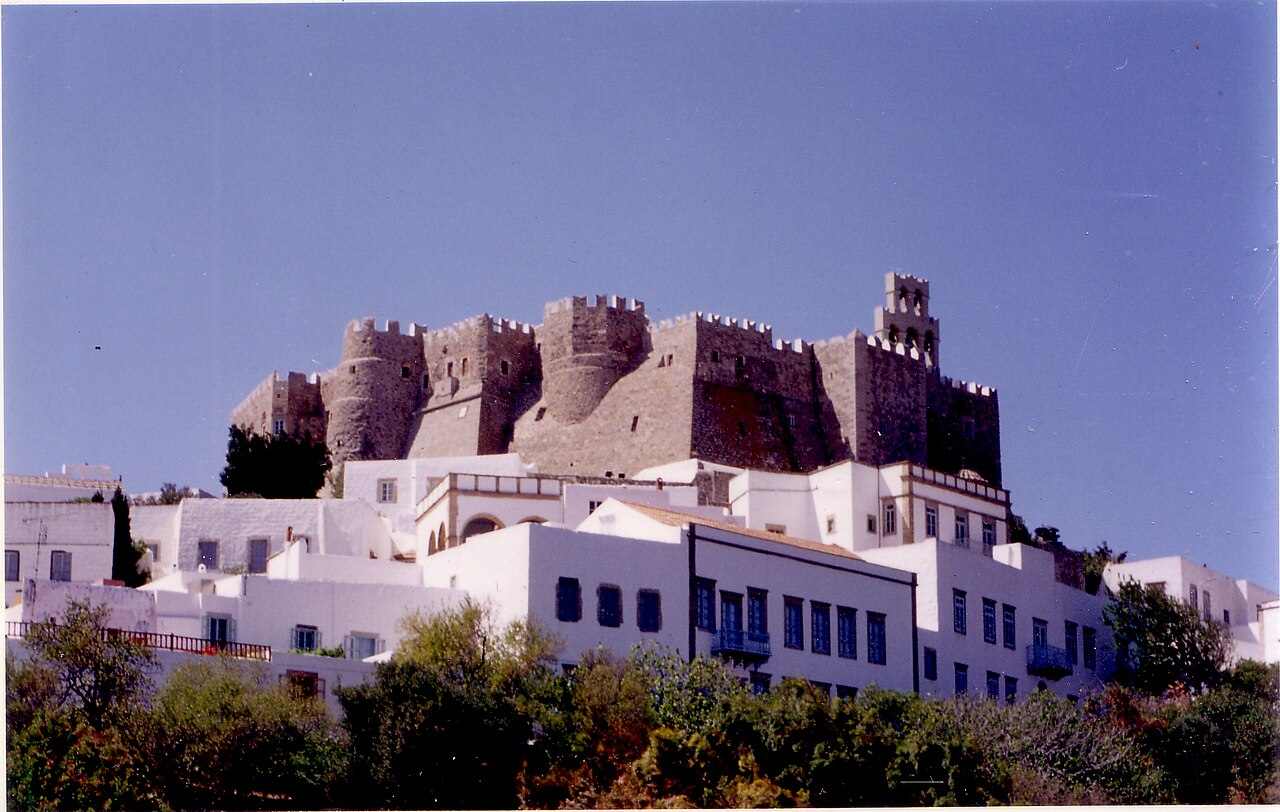
The Monastery of Saint John the Theologian and the Cave of the Apocalypse are the spiritual heart of Patmos and the reason the island is known across the Christian world. Together with the medieval town of Chora that surrounds them, they form a single UNESCO World Heritage Site. A fortress-like monastery of the 11th century rising above the holy cave where Saint John is said to have written the Book of Revelation nearly two thousand years ago. Plan the whole trip with Greece Tours.
This guide covers both monuments in detail: the history of the Monastery of Saint John from its foundation in 1088, what to see inside its churches and treasury. The story and atmosphere of the Cave of the Apocalypse. The practical details of hours, dress code, fees and access. Read it beside the full Patmos travel guide and the guide to the best things to do in Patmos.
What is the Monastery of Saint John the Theologian in Patmos?
The Monastery of Saint John the Theologian is a fortified 11th-century Orthodox monastery crowning Chora, the capital of Patmos.
Rising above the whitewashed houses of Chora, the Monastery of Saint John looks more like a castle than a church. Its tall, buttressed grey-stone walls built to withstand the pirates and raiders that once plagued the Aegean. Founded in 1088, it has functioned continuously as a monastery for more than nine centuries, making it one of the oldest and most important religious institutions in the Orthodox world. Its silhouette dominates the island from every approach by sea, and it has shaped the life, economy and identity of Patmos ever since its foundation.
Behind the fortified exterior lies a dense, fascinating warren of interconnecting courtyards, stairways, arcades. Chapels and roof terraces built up and remodelled over the centuries. That walking through it feels like moving through a small fortified village. At its core stands the main church, the Catholicon, surrounded by smaller chapels and a celebrated treasury-museum. All still cared for by the monastic community whose presence gives the place its quiet, devotional atmosphere. Sudden openings in the walls frame sweeping views over Chora’s rooftops and the surrounding sea.
The monastery dominates the island’s skyline and, together with the Cave of the Apocalypse on the slope below and the medieval town of Chora that grew up around it. Was inscribed on the UNESCO World Heritage list in . For most visitors it is the single most memorable thing to see on Patmos and the highlight of any list of things to do in Patmos, combining dramatic architecture, priceless art and a living faith in one unforgettable place.
What is the history of the Monastery of Saint John?
The Monastery of Saint John was founded in 1088, when the Byzantine emperor Alexios I Komnenos granted the island of Patmos to the monk Christodoulos, who built the fortified monastery in honour of Saint John.
The monastery’s story begins in 1088, when the Byzantine emperor Alexios I Komnenos issued a golden bull, a sealed imperial decree, granting the whole island of Patmos to the blessed Christodoulos. A monk who wished to found a monastery dedicated to Saint John the Theologian on the island so closely tied to the saint’s memory. At the time Patmos was almost deserted. The grant gave Christodoulos and his community the freedom and the resources to build on the commanding hilltop above what become the town of Chora.
Christodoulos and his monks completed the greater part of the fortress-monastery within just years. Raising the massive defensive walls that still stand today, a necessity in an age of Seljuk Turkish raids and relentless Aegean piracy. Fragments of an ancient temple of Artemis that had once occupied the same commanding site were reused in the new construction. Quite literally layering Christian Patmos over its pagan past and giving the walls a foundation of far older stone.
Through the Byzantine, Venetian and Ottoman centuries, the monastery preserved its autonomy, its wealth and its treasures, becoming a renowned centre of learning. Manuscript copying and religious art whose influence spread across the Orthodox world and whose famous theological school educated generations of scholars. It has never once ceased to function as a monastery. Today it continues both as a living community of monks and as the guardian of one of Greece’s greatest collections of ecclesiastical art and documents.
Who was Saint John and why is he connected to Patmos?
Saint John the Theologian, honoured as the author of the Fourth Gospel and the Book of Revelation, is connected to Patmos because he was exiled here from Ephesus around AD 95.
Saint John the Theologian is one of the towering figures of early Christianity. Venerated in the Orthodox tradition as the author of the Fourth Gospel, three New Testament epistles and, above all, the Book of Revelation. In Orthodox usage the title Theologian sets him apart. He is often identified with the beloved disciple of the Gospels. Giving him a place of special honour among the followers of Christ and making any site associated with him a focus of deep devotion.
His link with Patmos comes from his exile. According to tradition, in about AD 95, during a period of persecution under the Roman emperor Domitian. John was banished from Ephesus, on the coast of Asia Minor, to the small, remote island of Patmos. Revelation itself opens with the author stating that he was on the island of Patmos on account of the word of God. It was during this exile. Tradition holds, that he received his visions in the cave on the hillside.
It was only much later, in 1088, that the monk Christodoulos founded the great Monastery of Saint John the Theologian in the saint’s honour. Transforming the island into a major centre of Orthodox pilgrimage and monastic life. From that point on, Patmos and the memory of Saint John became inseparable. The whole island is sometimes called the Jerusalem of the Aegean because of its sacred associations with the writer of the Apocalypse.
What can you see inside the monastery?
Inside you can see the main church, or Catholicon, with 12th-century frescoes, the adjoining Chapel of the Theotokos, cool arcaded courtyards, and the treasury-museum, whose collection includes rare manuscripts from 1073 onward, Cretan-school icons, jewelled crosses and vestments, and a.
The heart of the complex is the Catholicon, the main church, whose walls and ceilings carry layers of fresco and whose carved wooden iconostasis. Hanging lamps and dark, incense-scented interior reflect centuries of unbroken worship. Beside it, the adjoining Chapel of the Theotokos preserves some of the monastery’s oldest and finest wall paintings, frescoes dating from the 12th century, while around the churches wind shaded courtyards, arcades and stairways that reward slow, curious exploration and open onto sudden views over Chora and the sea below.
The monastery’s greatest riches are gathered in its treasury-museum, widely regarded as one of the most important monastic collections in Greece and beyond. Here you can see rare manuscripts and illuminated codices, some dating back to 1073, including fragments of very early gospels, alongside a large array of Cretan-school icons and jewelled crosses. Chalices, mitres, embroidered gold vestments and imperial documents such as the very chrysobull with which Alexios Komnenos granted the island. Among the icons is a work widely attributed to the great painter El Greco, who was himself Cretan-trained.
To do the interior justice, allow at least an hour and a half to two hours to take in the Catholicon. The surrounding chapels and a thorough visit to the treasury. Rather longer if you join a guided tour that explains the significance of the manuscripts, the icons and the rhythms of monastic life. Photography is usually restricted or forbidden inside the museum. Churches and chapels to protect the fragile art and preserve the atmosphere of prayer. Watch for the posted signs and follow the guidance of the monastery staff throughout your visit.
What is the Cave of the Apocalypse?
The Cave of the Apocalypse is a small grotto on the hillside between Skala and Chora where, by tradition, Saint John lived around AD 95 and received the visions he dictated as the Book of Revelation.
Halfway up the road that climbs from the port of Skala to the hilltop town of Chora. The Cave of the Apocalypse is set into the hillside and largely enclosed within the small Monastery of the Apocalypse built around and above it over the centuries. It was here, tradition holds, that Saint John the Theologian sheltered during his exile from Ephesus around AD 95 to 97. Here that he received the extraordinary series of revelations he dictated to his disciple Prochoros. Which became the final book of the New Testament, the Apocalypse or Book of Revelation.
The cave itself is small, low and dim, lit by hanging silver lamps. Guides and priests point out the features long venerated by pilgrims: the hollow in the rock said to have served as the saint’s pillow. The ledge in the stone he is believed to have gripped to raise himself in prayer, and above all the triple cleft in the rock ceiling, understood by the faithful as a sign of the Holy Trinity and as the fissure through which the divine voice reached him. Icons, silver revetments and votive lamps mark each of these spots.
Visitors are asked to keep silent, dress modestly and refrain from photography inside the sacred space. The hushed, candle-lit atmosphere moves even those who come with no particular faith. Most people combine the cave with the great monastery above it in a single visit. Pausing here on the way up and then walking or driving the short remaining distance to Chora and the Monastery of Saint John afterwards.
How do you visit the Monastery of Saint John and the cave?
The Monastery of Saint John and the Cave of the Apocalypse sit on the road between Skala and Chora, a short bus, taxi or drive from the port.
The two sites lie on the same winding road that climbs the roughly 4 kilometres from the port of Skala up to the hilltop town of Chora. With the Cave of the Apocalypse set about halfway and the Monastery of Saint John at the very top. You can reach them by the local bus, which runs times a day between Skala and Chora, by taxi, by a rented car or scooter, or on foot along the old cobbled pilgrims’ path. A scenic climb of around 30 to 40 minutes from Skala that visitors find a rewarding and atmospheric way to arrive, especially in the cool of the morning.
Both monuments open in the morning and on certain afternoons, typically closing for a couple of hours around midday. The exact hours vary by season. Day of the week and religious calendar, and can be shortened on days of major services, so it pays to check locally and to arrive early. Entrance to the Cave of the Apocalypse and to the monastery’s treasury-museum each carries a small fee of euros, generally around three to five euros, while entering the churches themselves is usually free. Coming first thing means beating the coach parties and cruise groups.
A strict dress code applies at both sacred sites: shoulders and knees must be covered for men and women alike. Beachwear. Short shorts and sleeveless tops are not permitted, so carry a light shawl, wrap or long layer to slip on even in high-summer heat. Behaving respectfully, keeping your voice low, silencing your phone and observing the photography restrictions. Is expected throughout. Visiting in the early morning before the crowds gives by far the calmest and most rewarding experience of these profoundly atmospheric places.
How do the monastery, the cave and Chora form the UNESCO site?
In UNESCO inscribed the Historic Centre of Chora with the Monastery of Saint John the Theologian and the Cave of the Apocalypse as a single World Heritage Site, recognising a rare surviving ensemble where a medieval monastic town, a.
UNESCO’s World Heritage listing, granted in , covers not just the monastery in isolation but the whole historic centre of Chora together with the Cave of the Apocalypse. Treating the three as one interlinked cultural landscape. The citation recognises Patmos as an exceptional and remarkably intact example of a traditional Greek Orthodox pilgrimage centre, of outstanding architectural. Artistic and religious significance, whose monuments and town have evolved together in a way that has parallels anywhere in the Mediterranean.
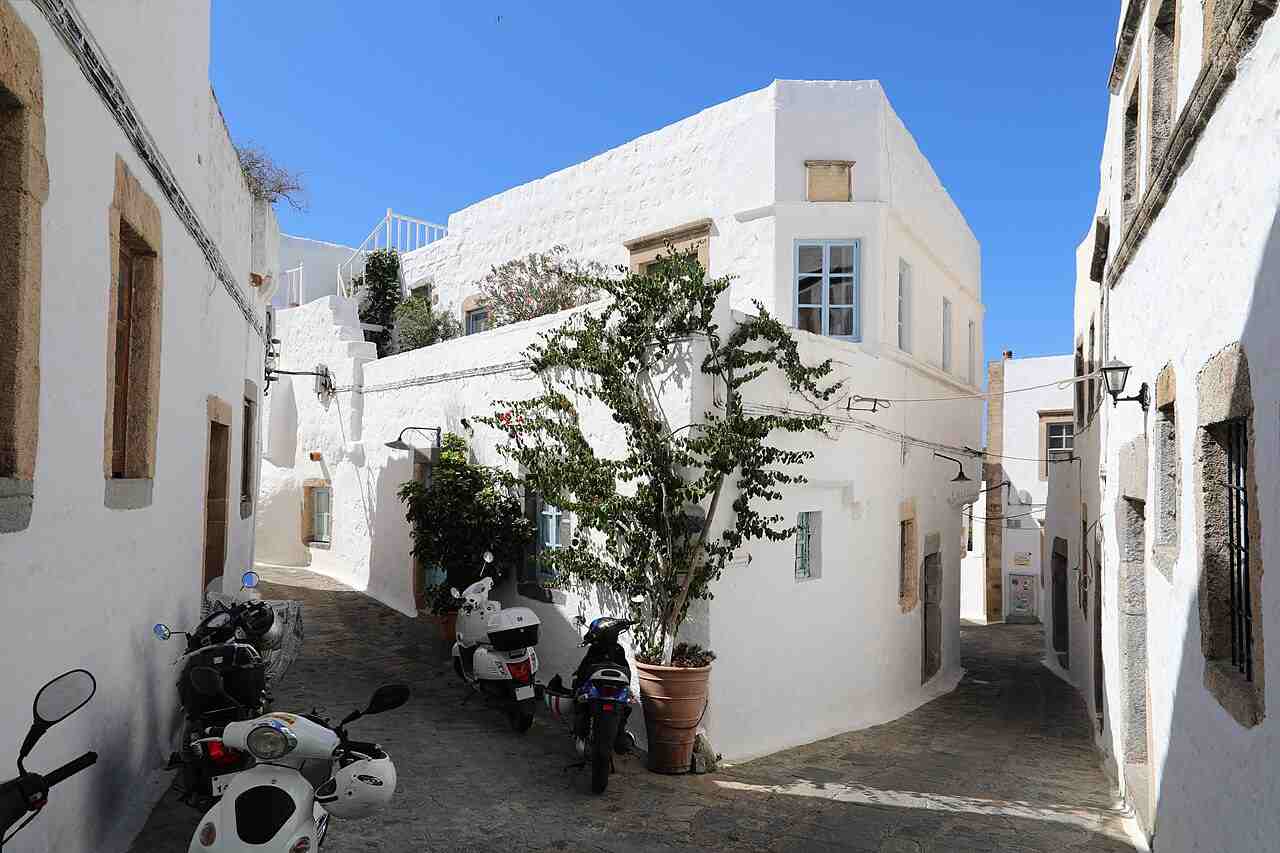
The three elements are genuinely inseparable, each explaining the others. The cave gave the island its sacred meaning and drew the first pilgrims. The monastery was founded centuries later to honour and protect that memory. And the town of Chora grew up in the monastery’s defensive shadow. Its captains’ mansions, dozens of churches and deliberately maze-like lanes reflecting centuries of accumulated monastic prestige and mercantile wealth. Walking on foot between the port, the cave and the hilltop monastery, you move through the whole story in the space of a single hillside.
This tightly woven ensemble is what makes a visit to Patmos so distinctive and so rewarding. It explains why the island has drawn pilgrims. Scholars and travellers for centuries, far out of proportion to its small size and population. Chora’s own lanes, viewpoints, mansions and windmills richly deserve unhurried time after you have seen the two great monuments, as the guide to things to do in Patmos describes in more detail.
Is the Monastery of Saint John worth visiting?
Yes.
For pilgrims, the monastery and cave are a moving. Direct encounter with the roots of their faith and with the very place where the Book of Revelation was set down. Their appeal reaches far wider than the devout. The sheer drama of the fortified monastery on its hilltop, the richness and rarity of its manuscripts and icons. The hushed. Candle-lit intensity of the cave together make this one of the most rewarding cultural and historical visits anywhere in the Aegean, whatever your beliefs or background.
The setting only adds to the reward, since the two monuments crown the loveliest town on the island. A visit flows naturally into wandering Chora’s whitewashed lanes. Pausing at a viewpoint over the sea, browsing its little shops and lingering over a meal with the whole of Patmos spread out below. Few half-days of sightseeing anywhere in Greece manage to pack in so much history. Art and beauty in so compact and walkable a space, which is exactly why the island rewards even a short stop.
To make the most of a visit, come early in the day, dress appropriately for both sacred sites. Allow a couple of unhurried hours for the monastery and its museum. Consider a guided tour to unlock the meaning and stories behind what you are seeing. Then let the rest of the island, its beaches, quiet coves, hikes and boat trips, unfold at the slow, gentle pace that suits it, exactly as the full Patmos travel guide sets out.
Frequently Asked Questions
Where did Saint John write the Book of Revelation in Patmos?
Tradition holds that Saint John the Theologian wrote, or rather dictated, the Book of Revelation in the Cave of the Apocalypse on Patmos. A small grotto on the hillside between the port of Skala and the town of Chora. During his exile from Ephesus around AD 95 to 97, he is said to have sheltered in the cave and received his visions there, dictating them to his disciple Prochoros. The cave is now enclosed within the Monastery of the Apocalypse. Pilgrims are shown the hollow in the rock said to have been his pillow. The ledge he gripped to rise, and the triple cleft in the ceiling taken as a symbol of the Holy Trinity.
What is the dress code for the Monastery of Saint John?
Both the Monastery of Saint John and the Cave of the Apocalypse enforce a modest dress code, since they are active places of worship. Visitors must cover their shoulders and knees, so sleeveless tops, short shorts, short skirts and beachwear are not allowed for either men or women. Carrying a light shawl, wrap or a long layer is the easiest way to comply in summer heat, and sites keep wraps to lend at the entrance. The same respectful behaviour applies inside throughout: keep your voice low, switch phones to silent. Remove hats in the churches. Observe the restrictions on photography that apply in the chapels and the treasury-museum.
How much time do you visit the monastery and the cave?
Allow about half a day to visit both sites properly without rushing. The Cave of the Apocalypse takes around 30 to 45 minutes to see, including the short walk up from the entrance and time to take in the sacred features, while the Monastery of Saint John deserves at least an hour and a half to two hours for the Catholicon, the surrounding chapels and a proper visit to the treasury-museum with its manuscripts and icons. Add time for the short journey up from Skala and for wandering Chora afterwards. A relaxed visit to both monuments plus the town comfortably fills a morning or a full half-day.
How do you get to the Monastery of Saint John from Skala?
The Monastery of Saint John stands at the top of Chora, on the road that climbs from the port of Skala, about 4 kilometres away. You can take the local bus, which runs times a day between Skala and Chora. Hire a taxi, or drive a rental car or scooter up in around 15 minutes. Walkers can follow the old cobbled pilgrims’ path from Skala past the Cave of the Apocalypse up to the monastery, a scenic climb of roughly 30 to 40 minutes. The cave lies about halfway up the hill, so visitors stop there first and continue on to the monastery at the top of Chora afterwards.