
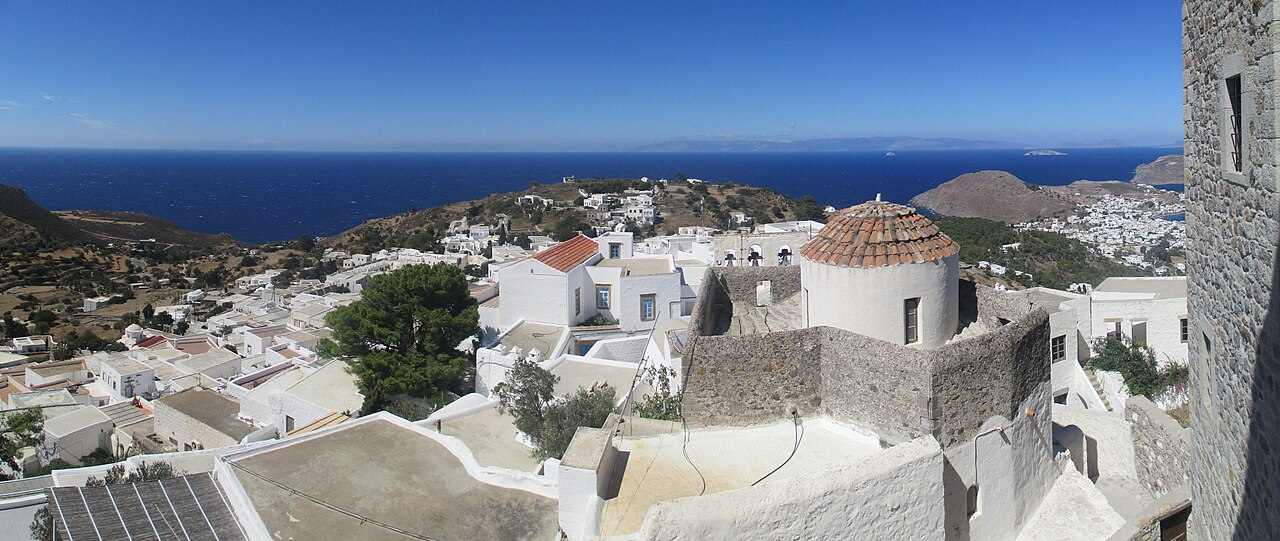
Chora is the capital of Patmos and one of the most beautiful and best-preserved medieval towns in the Aegean, a maze of dazzling white houses. Grand captains’ mansions and dozens of churches spilling down the hillside beneath the fortress-like Monastery of Saint John. Car-free, atmospheric and UNESCO-listed, it is the cultural and scenic heart of the island and a highlight of any visit. Plan the whole trip with Greece Tours.
This guide covers Chora, Patmos in full: its history and layout, the monastery and the mansions, the churches. Convents and windmills, the museums and viewpoints. Where to eat, shop, stay and how to get there. Read it beside the full Patmos travel guide, the guide to things to do in Patmos, and the deeper guide to the Monastery of Saint John and the Cave of the Apocalypse.
What is Chora, the capital of Patmos?
Chora is the hilltop capital of Patmos, a UNESCO-listed medieval town of whitewashed houses, grand mansions and dozens of churches clustered beneath the Monastery of Saint John.
Chora, sometimes spelled Hora, crowns the hill above the port of Skala and is the capital and the great set-piece of Patmos. It grew up over the centuries in the protective shadow of the Monastery of Saint John. Today it is a tight, dazzling cluster of whitewashed houses, grand old mansions. Tiny chapels and car-free stone lanes that together form one of the finest surviving medieval island towns anywhere in Greece, its skyline dominated by the grey walls of the monastery.
In , UNESCO inscribed the historic centre of Chora, together with the Monastery of Saint John and the Cave of the Apocalypse. On the World Heritage list, recognising a rare and remarkably intact ensemble of monastic and secular architecture. Wandering the town, you move constantly between the sacred and the domestic. From the great monastery to hidden convents. From humble whitewashed cottages to the painted rooms of wealthy sea-captains’ houses.
Beyond its monuments, Chora is simply a beautiful place to be, especially in the soft light of early morning and at sunset, when day-trippers have gone and the town belongs again to its residents. Quiet, atmospheric and almost entirely free of cars, it rewards slow, aimless wandering as much as focused sightseeing. It is the part of Patmos that stays longest in the memory.
Where is Chora and how is the town laid out?
Chora sits on a hill about 4 kilometres above the port of Skala, roughly a 15-minute drive up a winding road.
Chora occupies the high ground about 4 kilometres inland and uphill from Skala, the port where ferries arrive. Reached by a winding road that climbs in around fifteen minutes by car, bus or taxi, or by the old cobbled path on foot in thirty to forty minutes. From its heights the town commands sweeping views over the bays and headlands of the island and out across the sea to neighbouring islands. A position chosen for defence as much as for beauty.
The town is built as a dense, intricate labyrinth of narrow, twisting lanes and covered passages. A layout that was no accident: the confusing maze was designed to slow and disorient any pirates who breached the settlement, buying time for its people to reach the safety of the fortified monastery. Even today it is easy and rather delightful to lose your way among the whitewashed alleys, so the wandering is part of the experience.
At the highest point stands the Monastery of Saint John, around which the rest of Chora radiates and descends. Its lanes threading between tall mansions, humble houses and countless small churches. The town is almost entirely car-free, its lanes far too narrow for vehicles, so exploring Chora means exploring on foot, which is exactly what gives it its timeless, peaceful atmosphere.
What is the history of Chora, Patmos?
Chora grew up around the Monastery of Saint John after its foundation in 1088, and flourished above all in the 16th and 17th centuries, when wealthy sea-captains and merchants built the grand mansions that still line its lanes.
The story of Chora begins with the founding of the Monastery of Saint John in 1088, after which a settlement gradually formed on the hillside around it. Drawing people to live under the monastery’s protection at a time when pirate raids made the open coast dangerous. For centuries the town’s fortunes were bound up with those of the monastery, which was its landlord, its protector and the centre of its religious and intellectual life.
Chora reached its golden age in the 16th and 17th centuries, when Patmos prospered greatly through seafaring and trade across the Aegean and beyond. Wealthy ship-owners, captains and merchants poured their fortunes into building the grand stone mansions, the archontika, that still give the town so much of its character. With carved doorways, painted ceilings and courtyards, while the monastery’s famous school made Patmos a noted centre of learning in the Greek world.
Through the Ottoman centuries and beyond, Chora retained a remarkable degree of autonomy and preserved its architecture. Its churches and its traditions largely intact, which is why it survives today as such a complete medieval and post-medieval town. That continuity, secular and sacred woven tightly together on one hilltop, is exactly what the UNESCO World Heritage listing of was created to protect.
What is the Monastery of Saint John at the heart of Chora?
The Monastery of Saint John the Theologian is the fortress-like 11th-century monastery that crowns Chora and dominates its skyline.
At the very top of Chora stands the Monastery of Saint John the Theologian, the reason the town exists and the anchor of its whole plan. Founded in 1088 by the blessed Christodoulos, its high, buttressed grey walls were raised as a genuine fortress against pirates. Behind them lie interconnecting courtyards. Chapels, arcades and a treasury-museum holding Byzantine icons, jewelled crosses and rare manuscripts, some more than nine centuries old.
The monastery is not merely a backdrop but a living institution, still home to a monastic community, and it draws pilgrims and visitors from across the world to Chora. Its dark, incense-scented Catholicon, its 12th-century frescoes in the Chapel of the Theotokos. Its extraordinary collection make it the single greatest sight on the island. And a visit to Chora naturally centres on it before spreading out into the surrounding town.
Including its history, what to see inside, opening hours, dress code and how to visit alongside the nearby Cave of the Apocalypse, it is covered in full in the dedicated guide to the Monastery of Saint John and the Cave of the Apocalypse. Here it is enough to say that it is the crown of Chora and the focus of any visit.
What are the captains’ mansions and archontika of Chora?
The archontika of Chora are the grand stone mansions built by wealthy sea-captains and merchants in the 16th and 17th centuries.
Interspersed among the humble whitewashed houses of Chora stand the archontika. The grand mansions built during the town’s golden age by the ship-owners, captains and merchants who grew rich on Aegean trade. From the lane, many present only a plain, high white wall and a heavy carved doorway, giving little hint of the grandeur within. A discretion born of the pirate-haunted centuries when it was unwise to flaunt one’s wealth to the outside world.
Inside, however, these houses reveal painted and carved wooden ceilings, galleried upper rooms, stone-flagged courtyards, cisterns, ovens and the fine furnishings and imported treasures that seafaring fortunes buy. They represent the most accomplished domestic architecture of the post-Byzantine Greek world. A rare surviving record of how a prosperous island merchant class lived across centuries. They are a large part of what makes Chora so distinctive.
Wandering the lanes, you can admire the mansions’ carved marble doorways, coats of arms. Wrought ironwork and the occasional glimpse through an open gate into a shaded courtyard. A handful of the houses are open to the public as museums. Together they give Chora an architectural richness and a sense of layered history that sets it apart from the simpler whitewashed villages of the Cyclades and the other islands.
Which house-museums and mansions can you visit in Chora?
In Chora you can step inside restored captains’ mansions such as the Simantiris House and the Nikolaidis Mansion, both preserved with their original 17th-century furniture, painted ceilings and household objects, offering a rare look inside the grand archontika that line.
The finest of them are open to visitors as house-museums, giving a rare chance to step behind the plain white walls and see how the island’s wealthy families lived. These carefully preserved houses keep their original layouts, furnishings and everyday objects. A visit is like walking into a captain’s home of three or four centuries ago. Complete with painted ceilings, canopied beds, kitchens and courtyards.
The best known is the Simantiris House, a well-preserved 17th-century mansion kept by the same family for generations and opened to the public with its antique furniture. Icons, textiles, ceramics and domestic tools intact, offering an intimate portrait of traditional island life. The Nikolaidis Mansion, another restored archontiko of the same great period, is arranged as a museum showing the reception rooms, private quarters and possessions of a prosperous Chora household.
Visiting one or both of these houses adds real depth to a wander through Chora. Turning the mansions from mysterious blank walls into vivid, human interiors and illuminating the golden age that built the town. Opening hours can be limited and seasonal. It is worth checking locally, but for anyone interested in architecture and history they are among the most rewarding stops in the capital.
What churches and chapels can you see in Chora?
Chora is packed with churches and chapels, said to number in the dozens, ranging from grand old churches to tiny private family chapels tucked into the lanes.
For its size, Chora holds an astonishing number of churches and chapels, traditionally said to run into the dozens. A reflection of the town’s deep piety and of the custom by which wealthy families built and maintained their own private chapels. They range from larger parish churches to minute, single-room chapels tucked into corners of the lanes or built into the mansions themselves. Their whitewashed walls, bell-cotes and blue or red domes punctuating the town at every turn.
Among the notable churches are those of Agios Fokas and Agia Ekaterini, along with others dedicated to a great array of saints. Each with its own feast day and often opened only on that day of the year. Some preserve fine old icons, carved wooden screens and frescoes. Coming upon a tiny lit chapel down a quiet lane. Its lamp burning before a dark icon, is one of the quiet pleasures of exploring Chora.
Together with the great monastery above, these churches give Chora an intensely sacred character and make it feel like a small holy city. Which is part of why the whole town. Not just the monastery, was included in the UNESCO listing. Visitors are welcome to look into those that are open, dressing and behaving respectfully as at any place of worship on the island.
What monasteries and convents surround Chora?
Around Chora stand several smaller monasteries and convents, including the historic Zoodochos Pigi and Evangelismos convents, still home to nuns.
Beyond the towering Monastery of Saint John, Chora and its immediate surroundings hold several smaller monasteries and convents that add to the town’s deeply religious character. The most notable are the convents of Zoodochos Pigi and Evangelismos, historic foundations still inhabited by communities of nuns. Whose whitewashed buildings, chapels, courtyards and gardens offer a quieter, more intimate experience of monastic life than the great monastery above.
The Zoodochos Pigi convent, dating from the 17th century, sits within Chora itself and preserves fine old icons and a peaceful chapel, while the Evangelismos convent lies a short distance from the town amid gardens, both maintained by their nuns with obvious care. Where the communities permit visitors, these houses reward a quiet. Respectful visit with a sense of living faith and a welcome moment of calm away from even the modest bustle of the main lanes.
The convents keep their own hours and customs. Opening times are limited and a modest dress code and quiet behaviour are essential, but for those who make the effort they are a rewarding and little-visited side of Chora. Together with the churches and the great monastery, they complete the picture of the capital as one of the most concentrated religious landscapes in the Aegean.
What are the windmills of Chora?
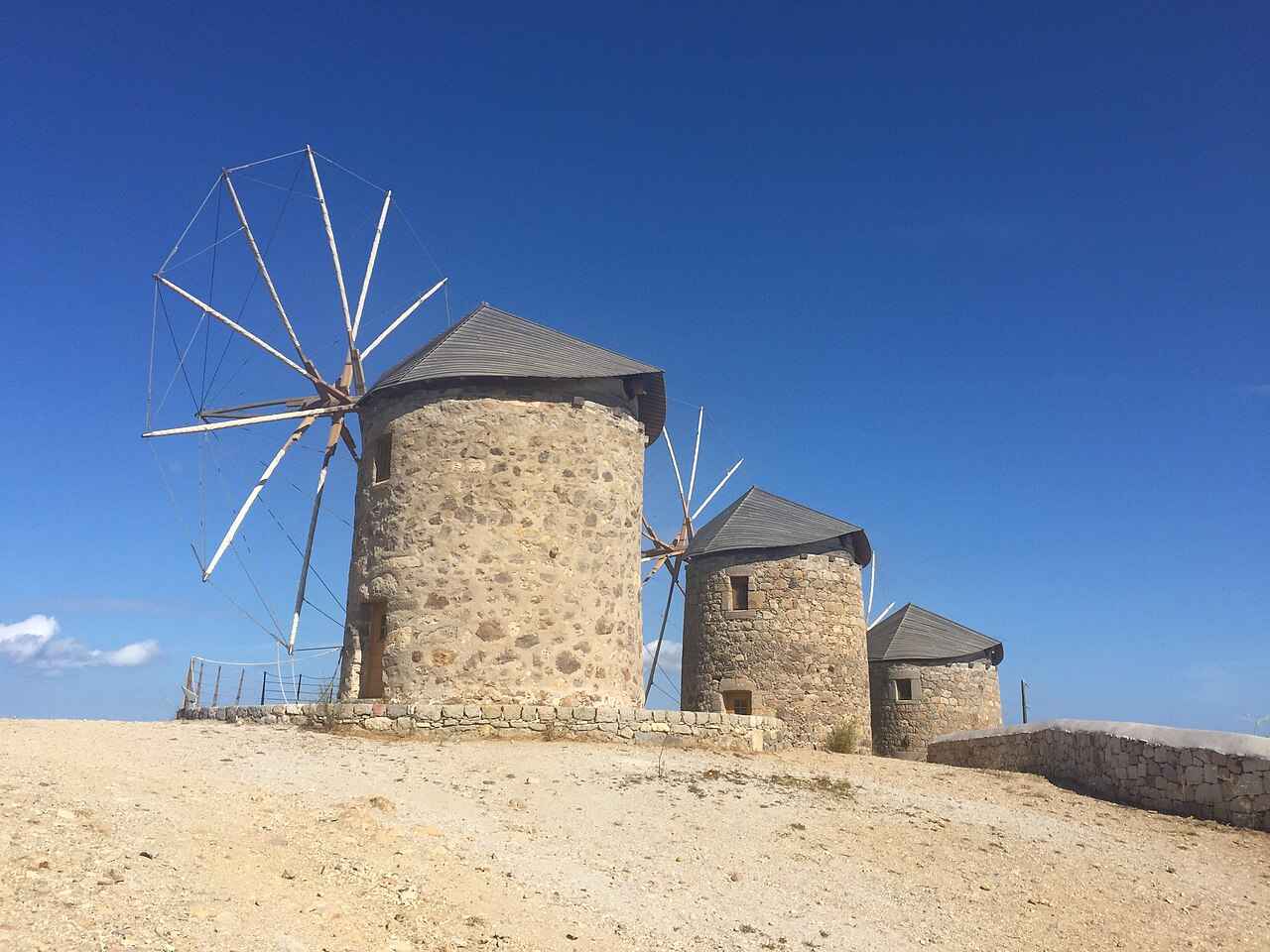
The windmills of Chora are a row of restored stone windmills on the hillside above the town, once used to grind the island’s grain.
On the open, breezy ground above Chora stand the town’s old windmills. Sturdy round stone towers that for centuries harnessed the strong Aegean winds to grind the island’s wheat and barley into flour. Long abandoned as milling gave way to modern methods, a group of them have been carefully restored in recent years. Their conical roofs and cloth-and-timber sails rebuilt. That they once again crown the ridge above the capital as they did in the past.
The windmills are an easy and rewarding short walk up from the centre of Chora. The exposed hilltop on which they stand offers the finest views on the whole island. Taking in the whitewashed town below, the great monastery, the bays and headlands of the coast and the neighbouring islands across the water. It is a popular spot for photographs, especially in the golden light of late afternoon and at sunset.
Restored and floodlit at night, the windmills have become one of the emblems of Chora and of Patmos itself. A picturesque link to the island’s agricultural past set against the backdrop of the sea. Combining a visit to them with a wander through the lanes and a sunset from the nearby viewpoints makes for one of the most memorable evenings the capital can offer.
What museums and cultural sites are in Chora?
Chora’s cultural sites include the treasury-museum of the Monastery of Saint John, with its manuscripts and icons, the folklore and ecclesiastical collections in the town, and the house-museums in the old mansions, together giving a rounded picture of the island’s.
For a small town, Chora offers a good deal to see for those interested in history and art, beginning with the treasury-museum of the Monastery of Saint John. One of the richest monastic collections in Greece, where manuscripts dating back to 1073, Cretan-school icons, jewelled crosses, vestments and imperial documents are displayed within the monastery walls. It is the cultural highlight of the town and the natural starting point for a cultural visit.
Beyond the monastery, Chora and the island preserve folklore and ecclesiastical collections that gather traditional costumes. Tools, household objects, icons and religious artefacts, illustrating everyday life and worship on Patmos across the centuries. Displayed in historic buildings, these give context to the monuments and to the way the islanders lived, worshipped and worked in the town’s long heyday and beyond.
The house-museums in the restored mansions, such as the Simantiris House and the Nikolaidis Mansion. Complete the cultural picture by showing the domestic world of the wealthy captains and merchants who built Chora. Taken together, the monastery treasury, the folklore collections and the mansion interiors let a visitor read the whole story of the town. Sacred, secular and everyday, without ever leaving its lanes.
Where are the best viewpoints and sunset spots in Chora?
The best viewpoints in Chora are the terraces and squares near the Monastery of Saint John, the windmills above the town, and the famous Loza belvedere, all offering sweeping views over the whitewashed rooftops, the sea and neighbouring islands, and.
Perched high on its hill, Chora is a town of views, and finding the best of them is one of the joys of a visit. The terraces, walls and open squares around the Monastery of Saint John look out over a sea of whitewashed cubes and blue domes to the deep blue Aegean and the shadowy shapes of neighbouring islands, while the windmills on the ridge above give an even higher, wider panorama that takes in the whole town and much of the island.
The most celebrated single viewpoint is the Loza. A belvedere near the top of the town whose stone terrace has for generations been the classic place to watch the sunset over the sea and the western hills. As the sun drops, the light turns the whitewash and the monastery walls to gold and then rose. The gathering of visitors and locals to watch the spectacle has become a gentle daily ritual of Chora.
For the finest experience, time a wander through the lanes so as to reach one of these viewpoints in the last hour before sunset. Camera or glass in hand. Then stay on for dinner on a terrace as the town’s lights come on. The combination of the view, the light and the hush that settles over Chora in the evening is, for many, the single most memorable thing about Patmos.
What squares, lanes and hidden corners you explore in Chora?
Beyond the monastery, Chora rewards aimless wandering through its maze of whitewashed lanes, past carved mansion doorways, tiny chapels and shaded courtyards, to small squares such as Agia Levia.
The real magic of Chora lies not in any single monument but in the town as a whole. The best way to experience it is simply to wander its labyrinth of lanes with no fixed plan. The narrow, whitewashed alleys twist and climb and burrow through covered passages and up worn stone stairways, opening suddenly onto a tiny square. A carved mansion doorway, a lit chapel or a glimpse of the sea between the houses. That every turn brings something new.
Small squares and widenings punctuate the maze, such as the little platia of Agia Levia and other shaded corners where a cafe table or two spill out beneath a tree. Offering a place to pause and take in the life of the town. Cats doze on warm doorsteps, bougainvillea spills over white walls, and the deep quiet, broken only by footsteps and church bells, gives Chora an atmosphere that feels almost outside time.
Getting lost carries no risk and every real reward. It is worth setting aside an unhurried hour or two to explore without a map, following whichever lane looks most inviting. This aimless wandering, as much as any museum or church, is what visitors remember most fondly about Chora, and it is entirely free.
Where you eat and drink in Chora?
In Chora you can eat at small family-run tavernas and on romantic rooftop and courtyard terraces serving classic Greek and local Patmian dishes, and drink at atmospheric cafes and bars tucked into the lanes and old mansions, several with sweeping.
Chora has a fine selection of places to eat and drink, tucked into old mansions, courtyards and rooftop terraces that make dining there a memorable experience. Family-run tavernas serve classic Greek cooking and local Patmian specialities, from fresh fish and grilled meats to cheese pies. Vegetable dishes and the island’s own cheeses, often at tables set out in a lane or a vine-shaded courtyard.
The town is especially prized for its romantic sunset dining, with restaurants and bars occupying terraces high enough to look out over the whitewashed rooftops to the sea. Where a candlelit dinner as the light fades is one of the great pleasures of a stay on Patmos. Stylish little cocktail bars and cafes, some in beautifully restored old buildings, add a touch of sophistication rare on so small and traditional an island.
By day, cafes in the small squares serve Greek coffee. Cool drinks and sweets to fuel a wander through the lanes. In the evening the town’s eating and drinking spots come quietly to life without ever becoming loud or crowded. Booking a table with a view is wise in July and August, and lingering over a long, late dinner is very much in the spirit of Chora.
What can you shop for in Chora?
In Chora you can shop for hand-painted religious icons from local workshops, the island’s thyme honey, herbs and spoon sweets, ceramics, textiles, jewellery and artwork, and traditional sweets, mostly in small family-run shops and studios tucked into the old town’s.
Shopping in Chora is a pleasure precisely because it is small-scale and distinctive, free of the mass-produced souvenirs found on busier islands. The town’s long tradition of religious art means that workshops and studios sell hand-painted Byzantine-style icons, along with crosses and other devotional pieces. Making a carefully made icon the most characteristic and lasting keepsake of a visit to this holy island, often bought directly from the artist who painted it.
For edible souvenirs, look for the island’s excellent thyme honey, gathered from the wild herbs of the hillsides, along with dried herbs. Spoon sweets and traditional pastries, all of which travel well, as well as local cheeses and bottles of Greek island wine or ouzo. Small galleries and boutiques in the lanes and old mansions also sell ceramics, textiles, jewellery and artwork by local and Greek makers, at fair prices by island standards.
The best approach is simply to browse as you wander, since the shops are scattered through the maze of lanes rather than concentrated on any single street. Tucked into the ground floors of old houses and courtyards. Buying from the makers and family businesses of Chora means your money supports the island’s own craftspeople and keeps its living traditions of iconography and food alive.
Where you stay in Chora?
In Chora you can stay in boutique hotels and guesthouses set inside restored captains’ mansions, offering atmospheric rooms with painted ceilings, courtyards and sea views.
For travellers who want atmosphere over convenience, Chora offers the most characterful places to stay on Patmos, mostly small boutique hotels and guesthouses created within beautifully restored old mansions. Behind their plain white walls you find rooms with painted or carved wooden ceilings, antique furnishings, stone courtyards. Terraces and sweeping views over the town and sea. That the accommodation itself becomes part of the experience of the historic town.
Staying up in Chora means exceptionally quiet, romantic evenings once the day-trippers have gone, easy access on foot to the monastery. The mansions and the sunset viewpoints. A chance to see the town at its most magical in the early morning and after dark. It suits couples, culture lovers and anyone drawn to the character and calm of the old capital rather than the practicalities of the port.
The trade-off is distance from the beaches and the harbour, since Chora lies about 4 kilometres uphill from Skala. Guests generally rely on a hire car. Scooter, taxi or the bus to reach the coast and the ferries. For a first visit travellers split their time. With a night or two in Chora for the atmosphere and the rest near the beaches, as the wider Patmos travel guide suggests.
What festivals and events take place in Chora?
Chora hosts the island’s most important religious events, including the solemn Holy Week and Easter ceremonies, notably the Niptiras foot-washing rite on Holy Thursday, the feast of the Dormition on 15 August, and the great feast of Saint John on.
Chora is the setting for the island’s most important festivals and ceremonies, and timing a visit to coincide with one adds a memorable dimension. The most famous is the Niptiras ceremony on Holy Thursday of Orthodox Holy Week, when, in the town’s main square. The abbot of the monastery re-enacts Christ washing the feet of his disciples before a large crowd, a solemn and unusual rite that draws visitors and pilgrims from across Greece and beyond.
The whole of Holy Week and Easter is observed in Chora with great solemnity and beauty, from candlelit processions to midnight resurrection services. Making it one of the most atmospheric places in Greece to experience Orthodox Easter. Later in the year, the feast of the Dormition of the Virgin on 15 August and, above all. The great feast of Saint John the Theologian on 26 September fill the monastery and the town with services, processions and celebration.
Smaller saints’ day festivals, panigiria, also take place through the year at the town’s churches and chapels. Each on its patron’s feast day, sometimes with music, food and a warm, communal atmosphere. If you hope to visit Chora during one of the major feasts, especially Easter or the September feast of Saint John, book accommodation well in advance, as the island fills quickly at these times.
When is the best time to visit Chora?
The best time to visit Chora is in the late afternoon and evening, especially in the shoulder months of June and September, when the day-trippers and cruise groups have left, the light is golden for the sunset viewpoints, and the.
Chora is beautiful at any hour. It is at its most magical outside the middle of the day, when cruise passengers and tour groups tend to fill the lanes around the monastery. Arriving in the later afternoon lets you tour the monastery and mansions in calmer conditions, wander the emptying lanes. Be in place at one of the viewpoints for the sunset. Which is the town’s signature experience, before staying on for dinner as the lights come up.
Across the year, the shoulder seasons of late spring and early autumn, roughly late May to June and September to early October. Are the finest times to visit, with warm but comfortable weather, long golden evenings and far fewer visitors than the peak of July and August. The height of summer is hot and at its busiest, though even then Chora quietens beautifully once the day’s cruise ships have sailed and the evening sets in.
For a different and deeply atmospheric experience, visiting during one of the great religious feasts, above all Orthodox Easter or the feast of Saint John on 26 September. Shows Chora at its most alive, though the town fills quickly at these times so accommodation must be booked well ahead. Whenever you come, staying into the evening is the key to seeing the capital at its best.
What can you see and do near Chora?
Near Chora you can walk up to the restored windmills, follow the old path down to the Cave of the Apocalypse and Skala, take in the sweeping viewpoints, and drive a short way to the beaches of Grikos and the.
Chora sits at the heart of Patmos, so it makes a natural base for exploring the surrounding area on foot and by road. The easiest and most rewarding short outing is the walk up to the windmills on the ridge above the town, which takes only a couple of minutes and opens up the finest panorama on the island, while the terraces and viewpoints around the monastery and the Loza belvedere are all within the town itself and perfect for catching the light.
On foot, the historic cobbled path that links Chora with the Cave of the Apocalypse and the port of Skala is a scenic and atmospheric walk downhill. Tracing the traditional pilgrims’ route past the holy cave. Can be done in thirty to forty minutes with the option of a bus or taxi back up. It is one of the classic short hikes on the island and connects the capital directly to its two greatest religious sites.
By car or scooter, the sheltered resort bay of Grikos, with its beach and the Kallikatsou rock. Lies only a short drive from Chora on the east coast. The other beaches, villages and viewpoints of the island are all within easy reach of the central capital. This central position, close to both the monuments and the coast, is one of the practical attractions of basing yourself in or near Chora, as the guide to beaches in Patmos describes.
Should you stay in Chora or Skala in Patmos?
Stay in Chora for atmosphere, character and sunset views close to the monastery, and in Skala for convenience, ferries, restaurants and easy access to the beaches.
The choice between Chora and Skala is the main accommodation decision on Patmos, and each has clear strengths. Chora, the hilltop capital, offers atmosphere and beauty above all, with boutique hotels in restored mansions, exceptionally quiet and romantic evenings once the day-trippers leave. Immediate access to the monastery and the sunset viewpoints. The sheer charm of staying inside a UNESCO-listed medieval town, though it lies about 4 kilometres uphill from the port and the beaches.
Skala, down at the harbour, is the practical choice, with the greatest concentration of hotels, rooms, restaurants, shops, travel agencies and car-hire on the island. The ferries and taxi-boats on the doorstep. The easiest access to the bus network and the nearby beaches of Meloi and Agriolivado. It is livelier in the evenings, if still low-key, and is especially convenient for first-time visitors and for those travelling without their own transport.
Many visitors get the best of both by splitting their stay, spending a night or two up in Chora for its atmosphere. Character and sunsets. The rest down near Skala or the beaches for convenience and swimming. If you must choose one, let your priorities decide: Chora for romance, culture and quiet, Skala for practicality, nightlife of the gentle island kind, and ease of getting around.
Is Chora suitable for families and less mobile visitors?
Chora is very safe and traffic-free, which suits children, but its steep, stepped, cobbled lanes make it challenging for pushchairs, wheelchairs and those with limited mobility.
For families, Chora has real appeal: being almost entirely car-free, it lets children explore its maze of lanes. Squares and stairways with a freedom rarely possible in a modern town, turning a simple wander into a small adventure of hidden chapels, cats and sudden sea views. The town is extremely safe, distances are short, and the sense of stepping into a living medieval world captures the imagination of many older children as much as their parents.
The same stepped, cobbled and often steep lanes that give Chora its character, however. Make it demanding for the very young in pushchairs and for wheelchair users and those with limited mobility, as there are steps and few level, smooth surfaces. A baby carrier is far more practical than a stroller here. Visitors with mobility difficulties plan their route carefully. Keep to the more level areas near the main squares, and allow plenty of time.
The monastery and certain sights involve further steps and climbs, so a visit to Chora rewards reasonable surefootedness and comfortable shoes above all. For families this is rarely a problem and is part of the fun. Travellers with serious mobility concerns be aware that the historic town. For all its beauty, is not an easy environment, and prefer to enjoy it in shorter, well-chosen sections.
What practical tips help for visiting Chora?
For visiting Chora, wear comfortable shoes for the cobbled lanes, dress modestly with shoulders and knees covered for the monastery and churches, carry cash as places are cash-only, bring water and sun protection, and time your visit for the.
A few simple preparations make a visit to Chora far more enjoyable. Comfortable, sturdy shoes are essential for the uneven, cobbled and often steep lanes and steps. A sunhat. Sunglasses and water are welcome, since much of the town is exposed and shade can be limited in the heat of the day. Because the lanes form a deliberate maze, it is best to relax and accept getting a little lost rather than fighting to follow a map, as wandering is part of the pleasure.
The monastery, churches and convents of Chora are active places of worship with a strict dress code. Carry a light layer or wrap to cover shoulders and knees. And behave quietly and respectfully inside them, observing any restrictions on photography. Modest dress and quiet behaviour are expected throughout the sacred sites that are so central to the town, and being prepared for them saves disappointment at the door.
Practically, it is wise to carry some cash, as smaller tavernas. Shops and the sites’ entrance fees be cash-only and the nearest ATMs are down in Skala. To check the sometimes limited and seasonal opening hours of the museums and mansions in advance. Above all, plan to be in Chora in the calmer, cooler late afternoon and to stay for the sunset. Which is when the town is at its most beautiful and memorable.
How do you get to Chora and get around the town?
You reach Chora from the port of Skala, about 4 kilometres away, by local bus, taxi, hire car or scooter in around 15 minutes, or on foot along the old path in 30 to 40 minutes.
Chora sits about 4 kilometres uphill from Skala, where all ferries and cruise tenders arrive, and getting up to it is straightforward. The local bus runs between Skala and Chora times a day in season. Taxis make the trip in around fifteen minutes. A hire car or scooter gives the most flexibility, particularly if you also want to reach the beaches. The winding road up offers fine views and photo stops at almost every bend.
For the more energetic and for pilgrims following tradition, the old cobbled path climbs from Skala past the Cave of the Apocalypse up to Chora in around thirty to forty minutes. A scenic and atmospheric way to arrive on foot, best tackled in the cool of the morning or the late afternoon. Sturdy shoes, water and sun protection make the walk more comfortable, and you can always take the bus or a taxi back down.
Once you have arrived, Chora itself is explored entirely on foot, since its narrow. Stepped lanes are far too tight for vehicles. Cars and scooters must be left at the edge of the town. This car-free heart is exactly what preserves the peace and beauty of the capital. Walking is not only the practical way to see it but by far the most rewarding, as every corner of the maze repays exploration on foot.
Frequently Asked Questions
Why is Chora in Patmos a UNESCO World Heritage Site?
The historic centre of Chora was inscribed on the UNESCO World Heritage list in . Together with the Monastery of Saint John the Theologian and the Cave of the Apocalypse, as a single cultural site. UNESCO recognised it as an exceptional and remarkably intact example of a traditional Greek Orthodox pilgrimage town, where a great monastery. A holy cave and a medieval settlement of whitewashed houses, grand captains’ mansions and dozens of churches have evolved together on one hilltop for over nine centuries. The tight weaving of the sacred and the secular, and the town’s outstanding preservation, are what make Chora, and not just the monastery, a monument of world significance.
Is Chora worth visiting in Patmos?
Yes, absolutely. Chora is the cultural and scenic highlight of Patmos and one of the most beautiful medieval towns in the Aegean, so it is essential on any visit to the island. Beyond the great Monastery of Saint John, it offers grand captains’ mansions and house-museums, dozens of churches and quiet convents, restored windmills. Folklore collections and the finest sunset viewpoints in Greece, all within a car-free maze of dazzling whitewashed lanes that is a pleasure simply to wander. Add romantic terrace restaurants and characterful little shops, and Chora rewards anything from a couple of hours to several unhurried days.
How do you get from Skala to Chora?
Chora lies about 4 kilometres uphill from the port of Skala. You can reach it by local bus, taxi, hire car or scooter in around fifteen minutes along a winding. Scenic road, or on foot along the old cobbled path in thirty to forty minutes, passing the Cave of the Apocalypse on the way. The bus runs times a day in season, and taxis are available though limited in number, so booking ahead is wise for evening returns after sunset. Once in Chora, the town is car-free and explored entirely on foot through its narrow lanes.
How long you spend in Chora, Patmos?
Allow at least half a day to do Chora justice, which is enough to visit the Monastery of Saint John and its treasury. Wander the lanes, look into a house-museum and a couple of churches. Enjoy a meal or a coffee. To experience the town at its best, however, it is well worth staying into the evening for sunset from the Loza viewpoint or the windmills and dinner on a terrace. Or even basing yourself in Chora for a night or two. Culture lovers and photographers can easily fill one or two full, unhurried days in the capital and its surroundings.
Those who base themselves there find the quiet mornings and evenings, when the town belongs to its residents again, the most rewarding time of all.