
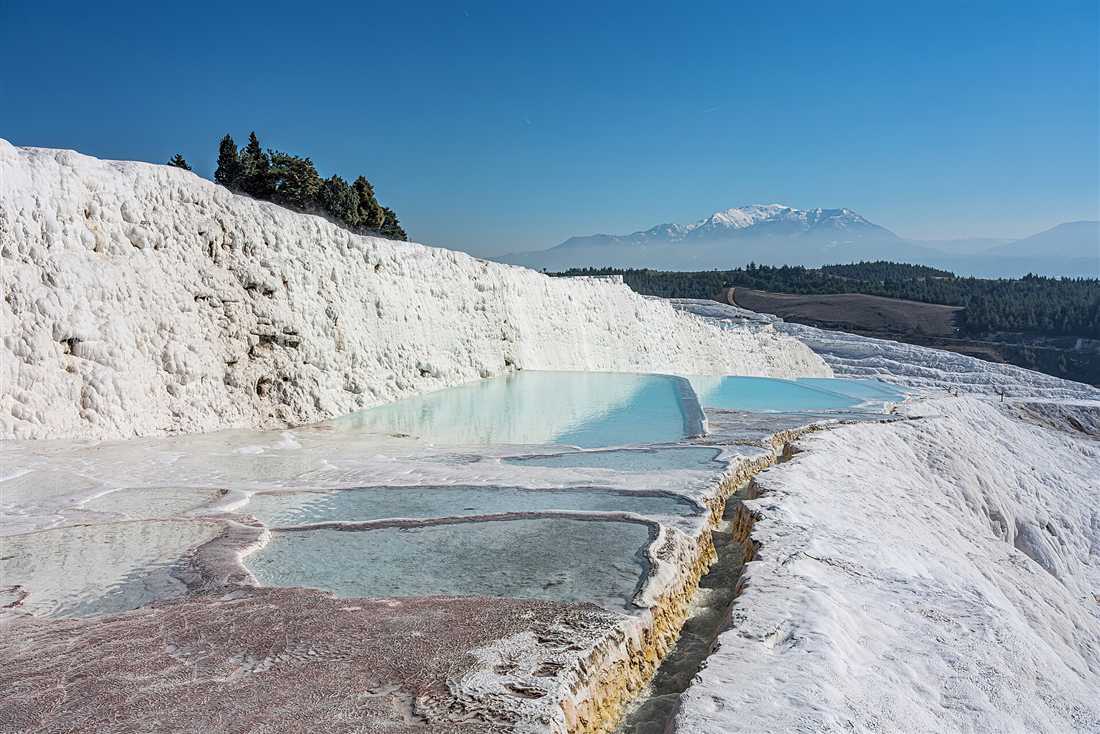
Pamukkale, the “cotton castle” of south-west Turkey, is a hillside of dazzling white travertine terraces formed by calcium-rich thermal springs, crowned by the Greco-Roman spa city of Hierapolis, together a UNESCO World Heritage Site in Denizli province. Plan the whole trip with Greece Tours.
This guide covers Pamukkale in full: what the travertines are and how they form, the thermal pools and Cleopatra’s Antique Pool, tickets, hours and the best time to visit, the ruins of ancient Hierapolis with its theatre, necropolis and Plutonium, how to get there, and how to pair Pamukkale with the coast and with Ephesus on a day trip or a two-day tour.
What is Pamukkale?
Pamukkale is a terraced hillside of brilliant white travertine in south-west Turkey, built by calcium-carbonate-laden thermal water that spills over the slope and hardens into calcite basins. The Greco-Roman city of Hierapolis crowns the ridge above, and the pair form a single UNESCO World Heritage Site.
The name Pamukkale translates from Turkish as “cotton castle”, a description drawn from the dazzling white cliffs that stack up the hillside like folded cloth. The terraces stretch roughly 2,700 metres along the ridge and climb about 160 metres above the plain of the Cürüksu River. Warm springs feed each pool from the top of the escarpment, and the mineral water cascades down through a chain of scalloped basins, coating every surface in a hard white crust of calcite.
Above the travertines sits Hierapolis, founded in the second century before the common era by the kings of Pergamon and later expanded under Rome. The ancient city holds a large theatre, a colonnaded main street, temple ruins, monumental gates and one of the most extensive necropolises in Anatolia. UNESCO inscribed Hierapolis-Pamukkale as a combined natural and cultural property, recognising both the geological spectacle of the white cliffs and the archaeological weight of the Roman spa town that grew up to exploit the springs.
Where is Pamukkale?
Pamukkale lies in Denizli province in south-west Turkey, about 19 kilometres north of Denizli city centre. It sits inland from the Aegean coast, in the fertile valley of the Cürüksu River, and the small village of Pamukkale spreads at the foot of the white terraces.
Denizli is the regional hub and the gateway for reaching the site. Denizli Çardak Airport lies about 65 kilometres east of the terraces, and the city stands on the main rail and coach network of western Anatolia. From Denizli otogar, frequent minibuses run the short route out to Pamukkale village, and drivers reach the entrance gates by a signposted road off the main highway.
The location places Pamukkale within reach of the larger Aegean resorts. The distance to Antalya on the Mediterranean coast is about 230 kilometres by road, to İzmir on the Aegean about 250 kilometres, and to the Bodrum peninsula about 260 kilometres. This inland setting, ringed by farmland and low hills, gives the white cliffs their striking contrast against the green valley floor and the dark ridge of Hierapolis behind them.
How were the Pamukkale travertines formed?
The travertines formed as thermal water rich in dissolved calcium bicarbonate emerged from deep springs at about 35 degrees Celsius, then cooled and lost carbon dioxide as it flowed downhill. That loss forces calcium carbonate out of solution, and the mineral hardens into the white calcite terraces.
The water starts underground, heated at depth and charged with carbon dioxide under pressure, which lets it hold a heavy load of dissolved calcium carbonate. When the spring reaches the surface at the top of the ridge, the pressure drops and the gas escapes into the air. Each time carbon dioxide leaves the water, the chemistry tips, and the mineral precipitates onto whatever surface the water touches. Over the centuries this deposition has laid down the thick white shelf that drapes the hillside.
The characteristic stepped pools grow because the calcite builds fastest at the lip of each basin, where the flowing film is thinnest and the gas escapes most quickly. The rims thicken, trap standing water behind them, and multiply into the scalloped terraces that give Pamukkale its shape. Geologists measure the deposit in metres of accumulated travertine, and the process continues wherever the managed water flow is directed today, keeping the newest terraces a clean, bright white.
Can you walk on the travertine terraces?
Visitors walk on the travertines barefoot only, along a marked route across the upper terraces where the site managers direct the water flow. Shoes, whether hard soles or trainers, are prohibited to protect the fragile calcite crust, and the walking corridor is rotated to spread wear.
Footwear scratches and stains the white surface and grinds grit into the soft mineral skin, so every walker removes shoes at the edge of the terrace zone and carries them across. The marked barefoot path runs down the flank of the hill, and portions of the terrace are kept flooded with a warm film of water while other sections are left to dry and recover. The submerged calcite underfoot is ridged and slightly slippery, and the pace across it is slow and deliberate.
Conservation drove these rules directly. In earlier decades hotels stood on the ridge and drew off the thermal water for pools, while cars and hard footwear damaged the terraces and left the calcite greyed. The buildings were removed, vehicle access to the top was closed, and the flow of spring water was re-engineered so that fresh mineral water is fed across selected basins on a rotating schedule. The barefoot corridor is the result: a controlled way to experience the terraces without abrading the surface that defines the site.
What are the thermal pools of Pamukkale?
The thermal pools are the warm mineral basins that step down the travertine slope, filled by the same calcium-rich spring water that builds the terraces. The water sits near 35 degrees Celsius, wading is shallow, and bathers keep to the designated pools along the marked barefoot route.
These are the pools of the terrace face itself, holding a thin sheet of warm water above the white calcite. The chemistry is the same water that deposits the travertine: heavy in calcium bicarbonate, with sulphate and traces of other minerals, and slightly milky where the calcite is freshest. Bathers stand or sit in the shallow basins rather than swim, since the depth in the terrace pools is measured in centimetres rather than metres.
Access follows the conservation regime. Only the flooded basins along the open corridor are used for wading, and the site rotates which terraces carry water so the calcite is never worn evenly bare. The warmth is gentle rather than hot, the mineral crust is smooth underfoot, and the experience is one of paddling across a warm white staircase looking out over the valley, not of a deep swimming pool.
What is Cleopatra’s Pool (the Antique Pool)?
Cleopatra’s Pool, also called the Antique Pool, is a spring-fed thermal bath at the top of the ridge inside Hierapolis, where fallen Roman marble columns and carved blocks lie submerged on the pool floor. Swimmers bathe among the ancient stonework in warm mineral water charged with carbon dioxide bubbles.
The pool occupies the site of a Roman bathing complex that collapsed in an earthquake, tipping columns of the temple portico into the water where they still rest. The water enters at around 36 degrees Celsius, fizzing with dissolved gas, and the sunken fluted drums and capitals turn the swim into a passage through a scattered ancient ruin. The setting sits within the archaeological park a short walk from the top of the terraces.
Entry to Cleopatra’s Pool carries a separate charge on top of the main Hierapolis-Pamukkale ticket, paid at the poolside entrance. Bathers change in on-site facilities, and swimming among the antiquities is the draw, distinguishing this deep, walled thermal bath from the shallow wading of the terrace pools outside. The pool has drawn spa visitors since Roman times, when the city was famed across Anatolia for its healing waters.
Are the Pamukkale thermal waters good for health?
The Pamukkale springs carry calcium, bicarbonate, sulphate and carbon dioxide, and the site has served as a thermal spa since antiquity. Hierapolis grew as a Roman balneological centre where bathers came to take the waters, and the mineral springs remain the historic foundation of that spa tradition.
The chemistry is what draws people to the water. The thermal springs deliver a warm, mineral-dense flow dominated by calcium bicarbonate, with sulphate compounds and the effervescence of dissolved carbon dioxide. That composition, combined with the constant warmth near body temperature, made the springs the centre of the Roman city’s economy and reputation across the Greek-speaking east.
Hierapolis itself was, in effect, an ancient wellness town. Roman-era writers recorded visitors travelling to the city to bathe, and the extensive necropolis outside the walls held people who came from across the region to take the waters and stayed. The balneology tradition carried through Byzantine and later centuries, and Denizli province still markets its thermal resources for spa tourism, keeping alive a use of the springs that stretches back more than two thousand years.
What are the Pamukkale opening hours and ticket prices?
The Hierapolis-Pamukkale site opens daily, with long summer hours from early morning until late evening and shorter winter hours that close near sunset. A single combined ticket covers both the travertines and the ancient city, while Cleopatra’s Pool charges a separate admission fee.
In the warm half of the year the gates open around dawn and stay open into the evening, letting visitors reach the terraces for both sunrise and sunset light. In the cold months the site closes earlier, roughly in line with the shorter daylight. Three entrance gates serve the park: the south gate near Denizli, the north gate through the necropolis, and the village gate at the foot of the terraces.
The combined Hierapolis-Pamukkale entrance ticket admits the traveller to the travertine terraces, the archaeological city, the theatre and the museum grounds under one price. Cleopatra’s Pool is ticketed separately at the poolside, and the Turkish national museum pass is accepted at the main gates. Prices are set in Turkish lira and revised periodically, so the figure is confirmed at the gate or on the official site rather than fixed in advance.
When is the best time to visit Pamukkale?
Spring and autumn are the prime seasons for Pamukkale, with mild temperatures and thinner crowds. The white terraces glow deep gold and pink at sunset, so late afternoon rewards visitors, while early morning and the shoulder seasons avoid the harsh midday heat and the peak-summer press of tour groups.
From April to June and again from September into November the valley is warm without the fierce heat of high summer, when daytime temperatures on the exposed white cliffs climb hard and the calcite reflects the sun. In these shoulder months the barefoot walk across the warm terraces is comfortable, and the surrounding farmland is green rather than parched.
Timing within the day matters as much as the season. Tour coaches from the coastal resorts arrive around the middle of the day, so an early start beats the largest crowds to the terraces. The finest light comes at the close of the day, when the low sun turns the white travertine to gold and rose and the pools mirror the colour of the sky. Sunset over the cotton castle, seen from the upper terraces with Hierapolis behind, is the moment most travellers plan their visit around.
What is ancient Hierapolis at Pamukkale?
Hierapolis is the Greco-Roman spa city built on the plateau directly above the white travertine terraces, founded in the second century before the common era by the Attalid kings of Pergamon. It stands today as a UNESCO World Heritage site shared with the terraces.
The city sits at an elevation of 350 metres on the plateau crowned by the calcite pools of Pamukkale, in the province of Denizli in south-western Turkey. Eumenes II of Pergamon established the settlement, and the Roman Empire absorbed it after the Attalid dynasty bequeathed its kingdom to Rome. The warm mineral springs that feed the terraces drew visitors from across Anatolia, who came to bathe in water measured at 35 degrees Celsius as it emerges from the ground.
Earthquakes levelled Hierapolis twice under Roman rule, and the emperors rebuilt it each time in stone and marble. The main colonnaded street, the Frontinus Street, runs 1,190 metres from the northern Domitian Gate to the southern gate, lined with the ruins of shops, latrines and monumental arches. UNESCO inscribed the combined property of Hierapolis-Pamukkale in the twentieth century, binding the archaeological city and the mineral cascade into a single protected zone that draws more than two million visitors each year.
What is the theatre of Hierapolis?
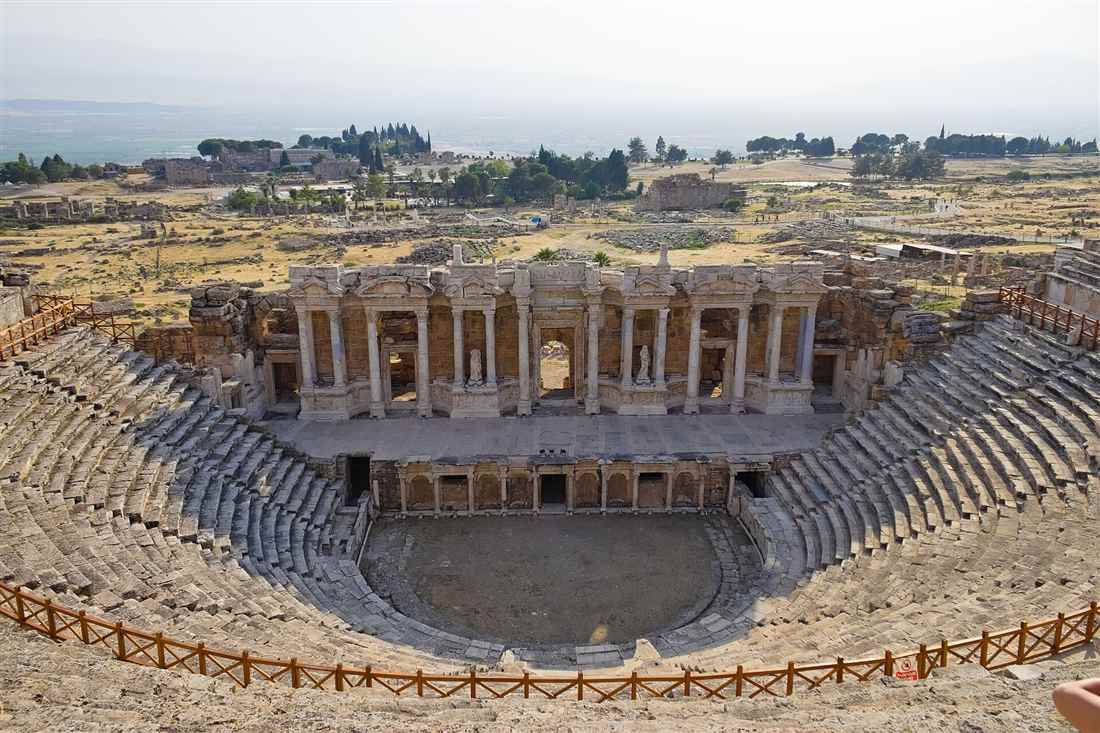
The theatre of Hierapolis is the best-preserved Roman theatre in Anatolia, cut into the hillside above the city and seating 12,000 spectators across a semicircle of 45 rows. Its stage building survives to its full height, carved with reliefs of Apollo, Artemis and Dionysus.
Emperor Hadrian ordered the theatre rebuilt in the second century of the common era, and Septimius Severus enlarged the stage front, the scaenae frons, a generation later. The seating bank, the cavea, divides into an upper and lower tier separated by a broad walkway, the diazoma, with eight staircases fanning the audience up the slope. Marble thrones in the front row seated the priests and magistrates of the city.
The stage building rises three storeys and 26 metres wide, its niches framed by Corinthian columns and friezes depicting the mythological cycle of Apollo, the patron deity of Hierapolis. Restoration teams have re-erected fallen columns and reset the carved panels of the imperial box, the pulpitum, so the reliefs read clearly against the sky. The theatre commands a view northward over the whole plateau and the shimmering white terraces below.
What is the necropolis of Hierapolis?
The necropolis of Hierapolis is one of the largest ancient cemeteries in Anatolia, stretching two kilometres along the roads north and south of the city with more than 1,200 tombs. Sarcophagi, tumuli and house-shaped mausoleums line the approach to the ruins.
People travelled to Hierapolis to treat their ailments in the thermal water, and a share of them died there, so the burial grounds grew dense with the graves of visitors from across the Roman world. The northern necropolis, the larger of the two, runs alongside the road toward the ancient city of Tripolis and holds the widest range of tomb forms: circular stone tumuli covering earlier chamber graves, rectangular sarcophagi raised on plinths, and two-storey family mausoleums built like miniature temples.
Greek inscriptions carved on the tomb fronts name the dead, record the fines levied against anyone who reused a grave, and list the trade guilds that owned collective burial plots. The marble sarcophagi carry garland reliefs, portrait medallions and funerary banquet scenes. Walking the paved road through the necropolis is the standard entry route from the northern gate, so visitors pass the tombs before reaching the theatre and the terraces.
What is the Plutonium (Pluto’s Gate)?
The Plutonium, or Pluto’s Gate, is a cave sanctuary at Hierapolis where volcanic carbon dioxide seeps from a fissure at lethal concentration. Ancient priests of Cybele led sacrificial animals to the threshold, where the gas killed them, and the sanctuary framed the vapour as the breath of the underworld.
The site lies beside the Temple of Apollo, at the head of a small stepped enclosure that channelled spectators to a viewing platform above the toxic zone. The carbon dioxide, heavier than air, pools in the low chamber and forms an invisible layer that suffocates any creature that enters at ground level. Modern gas readings inside the fissure record concentrations above 50 per cent, high enough to kill birds and small mammals within minutes at dawn before the sun disperses the layer.
The geographer Strabo described the gate in the first century before the common era, noting that the eunuch priests entered the mist unharmed by holding their breath and standing tall above the gas layer, and Cicero and Pliny both recorded the deadly cave. Archaeologists identified the exact fissure in the twenty-first century, confirming the ancient accounts against live gas measurements. A stone lion once guarded the entrance, and the inscription over the doorway dedicated the sanctuary to Pluto and Kore.
What is the Hierapolis Archaeology Museum?
The Hierapolis Archaeology Museum occupies the second-century Roman bath complex on the plateau, its three vaulted halls displaying the sarcophagi, statues and stage reliefs excavated from the city. The Sarcophagus Hall holds the carved marble tombs lifted from the necropolis.
The museum sits inside the largest surviving building of the baths, its barrel-vaulted galleries spanning stone piers that once framed the hot and cold pools. The first hall gathers the finest sarcophagi of the necropolis, including the Sidamara-type tomb dense with figural relief and the garland sarcophagi carved for the city’s wealthy families. The second hall arranges the statues and architectural fragments, among them the friezes prised from the theatre stage depicting Apollo and the procession of the gods.
The third hall presents small finds from the wider Lycus valley, drawn from Laodicea, Colossae and Tripolis as well as Hierapolis itself: glassware, coins, oil lamps, jewellery and tools that document daily life across the region. Entry to the museum sits within the archaeological zone, a short walk from the theatre and the sacred pool, so a single visit links the ruins with the objects lifted from them.
What is the Martyrium and tomb of St Philip?
The Martyrium of St Philip is an octagonal pilgrimage church on the hill east of Hierapolis, built in the fifth century of the common era to honour the apostle Philip, whom Christian tradition holds was martyred in the city. Archaeologists identified his tomb nearby in the twenty-first century.
The building rises on a square platform 20 metres to a side, with an eight-sided central hall ringed by radiating chapels and a surrounding portico, a plan devised to funnel pilgrims around the shrine. Roofed in timber and lit through arched windows, the martyrium stood at the end of a monumental stairway that climbed from the city gate, and the approach carried worshippers past a bathhouse where pilgrims washed before entering.
Excavators uncovered a first-century Roman tomb 40 metres from the martyrium and read the surrounding church and fountain as the shrine that grew around the apostle’s grave, matching the local tradition that Philip preached and died at Hierapolis. The reference to the site in the Acts of Philip and its early Byzantine pilgrimage architecture make the hilltop a fixed point of early Christian history, alongside the apostolic sites of the wider Aegean world such as those near ancient Ephesus across the sea.
How do you get to Pamukkale?
Pamukkale sits beside the city of Denizli in south-western Turkey, the gateway to the site. Denizli Cardak Airport lies 65 kilometres east, the intercity train and coach terminals stand in central Denizli, and frequent dolmus minibuses and shuttles cover the final 19 kilometres to Pamukkale village.
Denizli Cardak Airport receives daily domestic flights from Istanbul, and airport shuttles link the terminal to Denizli city centre in about one hour. Turkish State Railways runs the intercity Pamukkale Express and regional services into Denizli station, and the adjacent bus terminal, the otogar, receives coaches from Istanbul, Izmir, Antalya and Ankara. From the Denizli otogar, dolmus minibuses depart every half hour for Pamukkale, climbing to the village at the foot of the terraces in 40 minutes.
Organised day tours reach Pamukkale by coach from the Aegean and Mediterranean resorts: Kusadasi lies 190 kilometres north-west, Izmir 250 kilometres, Antalya 240 kilometres south, Fethiye 190 kilometres, and Marmaris 260 kilometres. These tours bundle the round-trip transfer, the site entry and a guide into a single day, and they start at dawn to reach the terraces before the mid-morning coach crowds arrive.
How do you visit Pamukkale from Kusadasi or Izmir?
A day trip from Kusadasi covers 190 kilometres each way, and from Izmir 250 kilometres, with the coach journey running three hours in each direction. Tours depart between 04:00 and 06:00 to place travellers on the terraces by mid-morning and return after sunset.
The route climbs inland from the Aegean coast across the fertile Buyuk Menderes valley, the ancient Maeander, following the modern motorway toward Denizli before the final approach to the plateau. The early departure is the defining feature of the trip: the six hours of round-trip driving leave a window of four to five hours on site, enough for the terraces, the sacred pool and a walk through the ruins of Hierapolis.
Pairing Pamukkale with the Aegean coast rewards the long drive, because Kusadasi and Izmir anchor a cluster of classical sites that share the same coastal base. Travellers who build a two-night stay on the coast fold Pamukkale into an itinerary that also reaches the ruins of the ancient Ionian and Carian cities, turning a single inland excursion into part of a broader tour of western Anatolia.
Can you visit Pamukkale and Ephesus together?
Pamukkale and Ephesus pair as a two-day combination from Kusadasi or Selcuk, the two UNESCO World Heritage sites lying 190 kilometres apart across western Anatolia. Day one covers the marble streets of Ephesus near the coast, and day two crosses inland to the terraces and Hierapolis.
Ephesus stands three kilometres from Selcuk and 20 kilometres from Kusadasi, so the coastal town serves as the shared base for both sites. The standard combination tour reserves the first day for Ephesus, walking the Curetes Street, the Library of Celsus and the great theatre, then transfers inland the following morning for the three-hour drive to Pamukkale. The distance between the two ancient cities makes a single-day double impractical, so the overnight structure carries the traveller between them without a punishing dawn-to-midnight coach marathon.
Both cities belonged to the Roman province of Asia and shared its road network, temples and thermal culture, so the pairing traces a coherent slice of classical history from the harbour metropolis of Ephesus to the spa city of Hierapolis. Travellers who base the trip on the Greek side of the Aegean reach Ephesus by ferry to Kusadasi, then extend inland to Pamukkale, linking the coast and the plateau in one route.
Where do you stay near Pamukkale?
Three bases serve Pamukkale: the village of Pamukkale at the foot of the terraces, the thermal resort of Karahayit five kilometres north with its red mineral springs, and the city of Denizli 19 kilometres south. The village puts the terraces within a ten-minute walk.
Pamukkale village sits directly below the white cliff, a compact grid of small hotels, guesthouses and thermal pools where the walk to the southern gate of the site takes ten minutes. Staying in the village unlocks the two best hours at Pamukkale, the dawn opening and the sunset, when the coach tours have gone and the terraces turn gold and rose in the low light.
Karahayit, five kilometres to the north, draws its name from the iron-rich springs that stain its travertine deep red and ochre rather than white, and its larger thermal hotels channel the hot mineral water into spa pools. Denizli, the provincial capital with a population above 600,000, offers the widest range of city hotels, restaurants and transport links, and its half-hourly dolmus service makes it a practical base for travellers who value urban amenities over proximity to the terraces.
How long do you need at Pamukkale?
Half a day covers the travertine terraces alone, a full day adds the ruins of Hierapolis, the museum and the sacred pool, and an overnight stay captures the sunset light and an early morning on the cliff before the coaches arrive. One night in Pamukkale village frames the site at its best.
The terraces themselves take two to three hours: the barefoot walk up the calcite cascade from the southern gate, the wade through the shallow warm pools, and the descent past the widest travertine basins. Adding Hierapolis extends the visit to a full day, because the theatre, the necropolis, the Plutonium, the martyrium and the Archaeology Museum spread across the plateau above the terraces and add three to four hours of walking through the ruins.
An overnight in the village converts a rushed excursion into a measured visit, opening the two hours the day tours miss. Entering at the dawn opening places the traveller on empty white terraces, and staying until closing catches the sunset that turns the cliff amber over the Lycus valley. A swim in the antique pool, where fluted marble columns felled by an ancient earthquake lie on the pool floor at a water temperature of 36 degrees Celsius, rewards the extra night.
Frequently Asked Questions
What is Pamukkale famous for?
Pamukkale is famous for its white travertine terraces, a cascade of calcite pools formed by mineral-rich thermal water, and for ancient Hierapolis above them, with its Roman theatre, vast necropolis and the antiquity-strewn Cleopatra Pool.
Is Pamukkale worth visiting?
Pamukkale rewards the visit twice over: the gleaming travertine terraces are a natural wonder found nowhere else at this scale, and the ruined spa city of Hierapolis on the plateau adds a full ancient site to the same ticket.
How do you get to Pamukkale from Kusadasi or Izmir?
Pamukkale sits about 190 kilometres east of Kusadasi and Izmir, a three-hour drive. A guided day tour with hotel pickup is the direct route, and the two UNESCO sites of Pamukkale and Ephesus pair on a two-day trip.
Above the terraces spreads ancient Hierapolis, the Greco-Roman spa city with its theatre, necropolis, Plutonium and the tomb of St Philip.
Travelling from the capital? See how to reach Pamukkale from Istanbul by flight to Denizli, guided day tour, bus or car.
On the Aegean coast? See how to reach Pamukkale from Kusadasi on a day trip, and pair it with Ephesus.
Swim among fallen Roman columns at Cleopatra’s Pool, the thermal Antique Pool inside Hierapolis.
Coming from the Aegean gateway city? See how to reach Pamukkale from Izmir by tour, bus, train or car.
For the finest view, take a Pamukkale hot air balloon flight at sunrise over the white terraces and Hierapolis.
Staying on the Mediterranean coast? See how to reach Pamukkale from Antalya over the Taurus mountains, with Salda Lake on the way.
Plan around the weather with the guide to the best time to visit Pamukkale — spring and autumn for mild days and thin crowds.
Before you go, check the Pamukkale tickets — the combined Hierapolis entrance, the Cleopatra Pool fee, the opening hours and which gate to enter.
Pick your base from the guide to where to stay in Pamukkale — the village, Karahayit’s red springs or Denizli city.
Pair the two great sites on an Ephesus and Pamukkale tour, the two-day trip from Istanbul, Izmir or the Kusadasi coast.
On the plateau lies the Plutonium, the ancient Pluto’s Gate that vents toxic gas beside the Temple of Apollo.
The crown of the ruins is the theatre of Hierapolis, a Roman theatre seating 12,000 with an ornate carved stage building.
On the Mediterranean coast? See how to reach Pamukkale from Fethiye over the mountains, with a Salda Lake stop on the way.
Ten kilometres away lies Laodicea, the great Greco-Roman city and one of the Seven Churches of Revelation, with the largest stadium in Anatolia.
From the resort coast, see how to reach Pamukkale from Marmaris over the mountains on a day tour.
The approach road runs through the necropolis of Hierapolis, one of the largest ancient cemeteries in Anatolia with over 1,200 tombs.
From the resort coast, see how to reach Pamukkale from Bodrum on a day tour over the mountains.
On the hill above the theatre stands the Martyrium of St Philip, the octagonal fifth-century shrine to the apostle martyred at Hierapolis.
Heading onward? See how to travel Pamukkale to Cappadocia by overnight bus or flight to the fairy chimneys.
Escape the midday sun in the Hierapolis Archaeology Museum, set in the Roman baths with the sarcophagi and theatre reliefs of the city.
Short on time? Follow the plan for one day in Pamukkale, from the morning terraces to Hierapolis, the pool and sunset.
Pair the white travertines with a whiter shore at Salda Lake, the turquoise Turkish Maldives and a NASA Mars analogue near Pamukkale.
The gateway city is Denizli, 20 km from the travertines, home of the Denizli rooster and the transport hub for the whole trip.
Go underground at Kaklik Cave, the “underground Pamukkale” of white travertine terraces and thermal water east of Denizli.
Explore the quiet ruins of Tripolis on the Meander, the ancient city with its restored colonnaded street near Buldan.
The walk begins at the Frontinus Gate, the triple-arched north gate that opens the colonnaded main street of Hierapolis.
For a hill-town detour, visit Buldan, the historic weaving town of Ottoman houses near Pamukkale.