
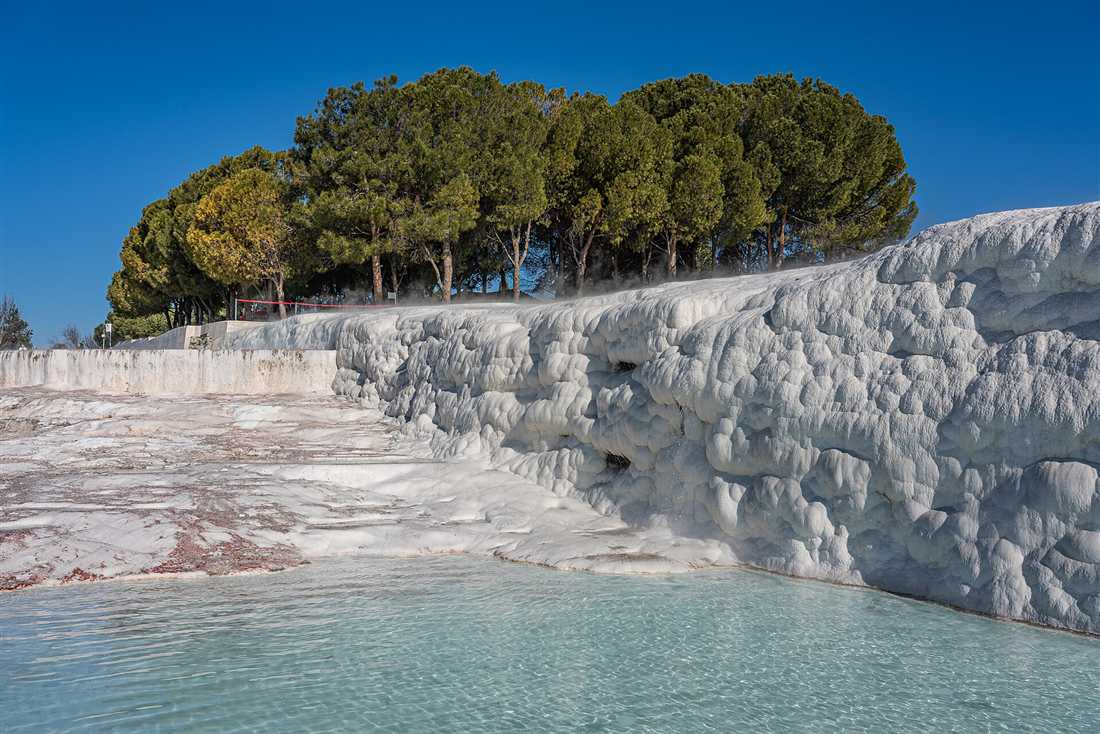
A Pamukkale ticket is a single combined entrance to the travertine terraces and the whole ancient city of Hierapolis, bought at the gate or online, with the Cleopatra Pool swim charged as a separate fee on top. Plan the whole trip with Greece Tours.
This guide covers Pamukkale tickets in full: the entrance fee and what it includes, the Cleopatra Pool charge, the museum fee, the opening hours, where and how to buy, which gate to enter, the Turkey Museum Pass, the concessions, the guided-tour package, and how to budget for a visit to Pamukkale.
How much is a Pamukkale ticket?
A single combined Hierapolis-Pamukkale entrance ticket costs roughly €25 to €35, or about 1,100 to 1,500 Turkish lira. One ticket admits you to the white travertine terraces and the entire Hierapolis archaeological site through the same gate.
Pamukkale and the ancient city of Hierapolis sit inside one protected UNESCO zone, so the authorities sell a single entrance fee rather than two separate charges. The moment you pass the ticket booth you stand on the calcium-carbonate terraces and inside the ruins at once. There is no cheaper terrace-only ticket and no ruins-only ticket; the price is the same whichever of the three gates you choose.
The lira figure moves with the exchange rate, so the euro equivalent shifts through the year while the official lira price stays fixed until the culture ministry revises it. Pay in cash at the booth or tap a card at the automated turnstiles. Keep the printed ticket, because the pool and the interior turnstiles scan the same QR code, and a lost stub forces you to buy again. For a full picture of the destination, the Pamukkale hub page maps every gate, sight and transfer around the terraces.
Children under the age listed at the booth enter free, and the price you read online is the adult full-fare rate. The ticket carries no timed slot: buy it once, and it covers a single day of continuous access from the moment of the first scan until the gate closes.
The euro band above brackets the swing of the lira against foreign currency; the official price stays a fixed lira figure set by the Ministry of Culture and Tourism, and it steps up when the ministry revises the national museum tariff. Read the current lira number on the price board at the booth rather than trusting a figure copied from an old guide, because the tariff climbs faster than most printed sources update.
The fee is per person and per day. Re-entry on a fresh day means a fresh ticket, so a visitor who plans dawn on the terraces and a return for the sunset buys within a single opening window rather than across two. A family pays one adult fare per adult and per child above the free-entry age, and the turnstile prints a stub for each paying head — count the stubs before you leave the booth, since the pool and the museum each demand a valid scan.
What does the Pamukkale entrance ticket include?
The entrance ticket includes the white travertine terraces, the thermal pools that cascade down the hillside, and the whole Hierapolis archaeological site — the theatre, the colonnaded street, the agora, the Roman baths, the temple of Apollo and the vast necropolis — all under one fee.
The travertines are the postcard image: bright-white shelves of mineral rock filled with warm turquoise water, formed over millennia by calcium-rich springs. You walk the terraces barefoot, because footwear is banned to protect the surface, and the same ticket lets you climb the slope to the ruins that crown the plateau.
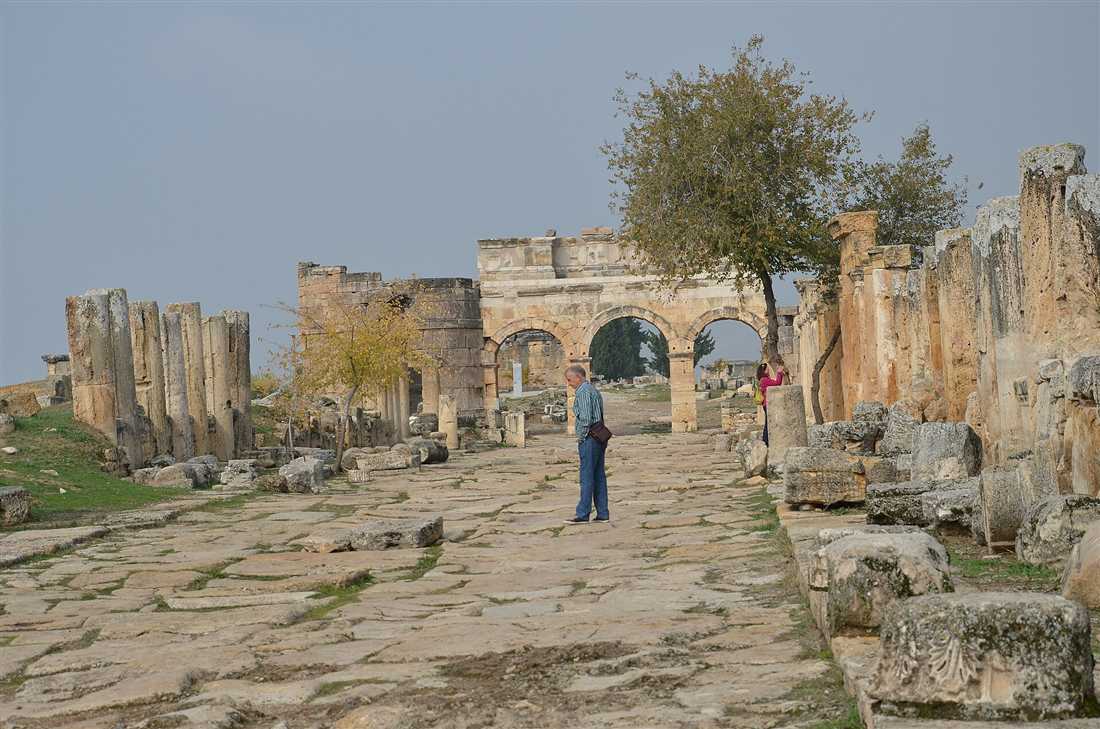
Hierapolis was a Greco-Roman spa city, and its remains spread across the hilltop above the terraces. The Roman theatre, carved into the slope with its ornate stage wall intact, holds thousands of seats. The main colonnaded street, the twin gates, the temple platform of Apollo, the Plutonium sanctuary and the sprawling northern necropolis with its stone sarcophagi all fall inside the ticket boundary. The Hierapolis guide details each monument and the walking route that links them.
Two things sit outside the base fee. Swimming in Cleopatra’s Antique Pool carries an extra charge, and the Hierapolis Archaeology Museum, housed in the restored Roman baths, sells its own separate ticket. Everything else you see on the plateau and the terraces belongs to the one combined entrance.
The terrace walkway follows a fixed barefoot route across the calcium shelves, and the ticket covers the full length of it, from the lip above the village to the pools near the plateau edge. Guards keep visitors off the dry, protected sections and onto the wet channel, so the single entrance buys access to the designated path rather than the whole hillside. The warm water runs shin-deep in the open basins, and the ticket lets you stand in them for as long as the gate stays open.
On the Hierapolis side, the one fee unlocks the Frontinus Gate and the arcaded main street, the Byzantine church ruins, the great baths, the martyrium of Saint Philip on the eastern hill, and the Plutonium — the gas-venting sanctuary the Romans dedicated to the underworld. The theatre stands as the set-piece, its stage building rebuilt to two tiers of columns and carved friezes. None of these monuments charges a separate gate fee; the combined ticket is the whole plateau in one payment.
How much does Cleopatra’s Antique Pool cost?
Swimming in Cleopatra’s Antique Pool costs an additional €10 to €15, roughly 400 to 700 Turkish lira, paid at the pool itself on top of the site entrance ticket. The extra fee buys a swimming slot among the submerged Roman columns.
The Antique Pool sits at the heart of Hierapolis, beside the museum, fed by the same thermal spring that built the terraces. An earthquake toppled a marble colonnade into the water in antiquity, and the fluted columns now rest on the pool floor, so bathers float directly above ancient stone. The mineral water holds a steady warm temperature all year.
You pay the swimming supplement at a dedicated kiosk by the pool, not at the main entrance gate, and the charge applies only to people who enter the water. Anyone who wants to look, photograph the columns or sit at the poolside café enters the pool enclosure without paying the swimming fee. Bring a towel and swimwear; changing rooms and lockers stand on site for a small extra rental.
The pool operates its own opening window inside the wider site hours, and it fills quickly in peak months, so early arrival secures a calmer swim. The Cleopatra Pool page sets out the swimming fee, the locker charge and the best time of day to reach the water before the coaches arrive.
The swimming fee stands apart from the site entrance because the pool runs as a concession inside the archaeological zone, with its own staff, changing block and lifeguard. You pay it in lira or by card at the poolside kiosk, receive a wristband or token, and enter the water through a gated turnstile. The charge covers the swim itself for a set session; the locker and towel hire add a small separate rental on top.
The mineral-rich spring feeds the pool at a warm bathing temperature through every season, and the fizzing carbonated water is the same source that laid down the white travertine below. Because the price of admission to the pool enclosure is bundled into the main site ticket, non-swimmers walk in free to photograph the sunken columns and rest at the café; the extra fee applies the instant you cross into the water. Bring flip-flops for the wet marble surround and a waterproof bag for valuables.
Is the Hierapolis Archaeology Museum a separate ticket?
Yes. The Hierapolis Archaeology Museum charges its own fee of about €5 to €10, near 200 to 400 Turkish lira, and the combined site entrance ticket does not include it. The Turkey Museum Pass, by contrast, covers museum admission in full.
The museum occupies the restored Roman bath complex on the Hierapolis plateau, a short walk from the Antique Pool. Its three main halls display marble sarcophagi from the necropolis, statues and reliefs lifted from the theatre stage, and small finds — glass, jewellery and inscriptions — recovered across the ancient city. The building itself, with its soaring vaulted brick chambers, ranks among the exhibits.
Because the museum sits behind its own turnstile, you buy a distinct ticket at its entrance after you have already passed the site gate. Holders of the Turkey Museum Pass walk straight through on the pass, since it bundles the museum with the site entrance into one product. Travellers on a single-day combined ticket pay the small museum supplement at the door.
The museum keeps hours that track the wider archaeological zone, closing earlier in winter. Its air-conditioned halls give a cool break in the summer heat, and the sculpture from the theatre stage rewards a slow look before you climb back up to the monument itself.
The museum ticket is a standalone product priced well below the site entrance, and you buy it at the museum door with cash or card. It stands as the one indoor charge on the plateau, so a visitor short on time who skips the exhibits loses nothing from the terraces or the ruins outside. The trade-off is the theatre reliefs: the finest carvings from the stage building sit inside these halls rather than on the monument, so the small extra fee buys the sharpest sculpture of the whole site.
Pass holders gain the clearest advantage here. The Turkey Museum Pass folds the museum admission into its single price, so a pass carrier walks the site, swims aside, and enters the exhibits without a second payment. A traveller on the bare combined ticket weighs the museum fee against interest in Roman statuary; the marble sarcophagi lifted from the two-kilometre necropolis line the central hall and rank among the richest funerary collections on the Anatolian plateau.
What are the Pamukkale opening hours?
Pamukkale opens daily. In summer the gates run from around 06:30 to 21:00 or later, with last entry near 20:00. In winter the site opens near 06:30 and closes about 17:00 to 18:00, with last entry an hour before. The ticket grants day-long access.
The summer season stretches across the warm months, when the long daylight lets the site stay open into the evening. Sunset over the white terraces draws crowds to the upper edge, and the late closing time makes an evening visit practical. The winter season brings shorter days and an earlier lockdown, so the closing hour pulls back to the late afternoon.
Last entry falls before the closing time — plan to reach the booth at least an hour before the gate shuts, because the walk from the terraces to the ruins and back eats the clock. Once inside, the ticket imposes no time limit: you stay until closing on the single day of your visit.
Dawn and the final hour before closing deliver the thinnest crowds and the softest light on the calcium shelves. The midday block, when tour coaches from the coast unload, packs the terraces tightest. Cleopatra’s Antique Pool and the museum keep their own slightly narrower windows inside these gate hours, so a swim or a museum stop belongs earlier in the day rather than at the last minute.
The site runs every day of the week through the whole year, with no weekly closing day, so a visit slots into any date on an itinerary. The seasonal switch between the long summer schedule and the short winter one tracks the culture ministry’s national timetable, which lifts the closing hour as the days lengthen and pulls it back as they shorten. Confirm the exact closing time on the board at the gate, because the changeover date shifts with the calendar of daylight.
Time the visit around the light and the coaches together. The white terraces glow at first light and again as the sun drops behind the plain, and both windows fall outside the midday crush when day-trip buses from Antalya, Marmaris and Kuşadası arrive together. A dawn entry through the south gate delivers the ruins in cool air and the terraces to yourself; a late-afternoon entry through the town gate puts the sunset directly over the shelves as you climb.
Where do you buy Pamukkale tickets?
You buy Pamukkale tickets at the ticket booths of the three site gates — the south (upper) gate, the north gate, and the town gate in Pamukkale village — or online in advance. Online skip-the-line tickets and guided packages let you bypass the booth queue entirely.
Each of the three entrances runs a staffed booth and, at the main gates, automated card turnstiles. At the south and north gates, coaches and cars park beside the booths, and you pay before walking down toward the terraces. At the town gate, at the foot of the hill in Pamukkale village, you buy the ticket and climb up through the terraces on foot, barefoot, from the bottom.
Cash in Turkish lira works everywhere, and the main gates accept contactless cards. Rates shift daily, so paying in lira avoids a poor on-the-spot conversion. Keep the QR-coded stub, because the interior turnstiles at the pool and the museum scan the same code.
Online sellers issue mobile tickets and combined tour vouchers that cover the entrance plus a guide, transfer and lunch. A skip-the-line voucher matters most in the peak summer weeks, when the midday booth queues at the south gate stretch long under the sun. Book ahead to lock the price and walk straight to the turnstile.
The three gates spread around the site so that arrival method decides the entrance. Drivers and coach tours head to the south (upper) gate on the plateau, where the car park sits beside the booth. Independent travellers staying in Pamukkale village walk to the town gate at the foot of the terraces. The north gate serves the necropolis end and suits a route that starts among the tombs. Every booth sells the identical combined ticket at the identical price, so the gate is a matter of logistics rather than cost.
Online purchase splits into two forms. A plain e-ticket for the state entrance loads the combined fee onto a mobile QR code you scan at the turnstile, sparing the cash queue. A packaged tour voucher bundles that entrance with a transfer, a licensed guide and a lunch into one booking, so the seller handles the gate payment on your behalf. Both routes prove their worth in high summer, when the walk-up line at the south gate lengthens through the middle of the day.
Is the Turkey Museum Pass valid at Pamukkale?
Yes. The Turkey Museum Pass covers entry to Hierapolis and Pamukkale, including the Hierapolis Archaeology Museum, on a single multi-day card. It excludes only the extra Cleopatra’s Antique Pool swimming fee, which every visitor pays separately.
The Museum Pass is a regional and national card sold by the culture ministry that bundles admission to a cluster of state museums and archaeological sites for a fixed number of days. It comes in versions — a broad country-wide pass and narrower regional cards — and the Pamukkale-Hierapolis zone falls inside the qualifying list on the wider passes.
The cost-benefit turns on the number of sites you plan to enter. A pass priced near €60 to €90 pays for itself once you combine Pamukkale with Ephesus, Aphrodisias or the Aegean coastal ruins on the same trip, because each of those charges its own steep entrance. A traveller who visits Pamukkale alone and nothing else saves nothing over the single combined ticket.
Present the pass at the gate turnstile for the site and again at the museum door, and it scans through both. It does not open the pool, so budget the swimming supplement on top if you plan to bathe among the sunken columns.
The pass runs for a set validity — a fixed span of days from first use — and covers a single entry to each participating site inside that window. Activate it at the first gate you reach, and the clock starts. A traveller pairing Pamukkale with the Aegean circuit uses the same card at Ephesus, Aphrodisias, the Ephesus museums and the coastal sites, and each of those otherwise-steep entrances draws down against the one price paid up front.
Buy the pass at the ticket office of any participating museum or through the official state sales channel, then present it at the Pamukkale turnstile and again at the museum door. It removes the daily cash handling at each gate and locks the total cost of a multi-site trip into one figure. For a visitor whose whole plan is a single day on the terraces and nothing else on the wider circuit, the standalone combined ticket stays the cheaper choice, and the pass only rewards the traveller who strings a run of paid sites together.
Which Pamukkale gate do you enter from?
Enter from the south (upper) gate to arrive by coach and walk downhill through the terraces and ruins. Use the town gate in Pamukkale village to climb up from the bottom on foot. Choose the north gate to start at the necropolis and the theatre.
The south gate sits at the top of the plateau. Coaches and cars park here, and the route runs downhill: you cross the ruins first, pass the theatre and the Apollo temple, reach the Antique Pool and the museum, then descend the travertine terraces toward the village. It suits drivers and organised tours because the walk loses altitude rather than gains it.
The town gate stands at the base of the hill in Pamukkale village, a short stroll from the hotels and bus stop. From here you climb barefoot up the wet terraces — the classic ascent that puts the white shelves and turquoise pools directly under your feet from the first step. It rewards independent travellers staying in the village.
The north gate opens beside the vast northern necropolis, so you begin among the stone sarcophagi and Roman tombs, walk the colonnaded street, then reach the terraces. Whichever gate you pick, the ticket price is identical, and the site is one continuous loop — the gate merely sets where the loop starts and which direction you walk it.
The south gate wins on effort. Starting at the top and walking down spares the legs the barefoot climb, and it lands the theatre and the ruins first, while morning air keeps the plateau cool before the sun bites. Its drawback is the distance from the village: without a car or a tour coach, reaching the upper gate means a taxi or the site shuttle up the access road.
The town gate wins on the terraces. The barefoot ascent from the village puts the white shelves and their turquoise pools under your feet at every step, and it costs nothing beyond the walk from a village hotel. It repays the uphill effort with the purest terrace experience. The north gate, quietest of the three, opens the northern necropolis and the Frontinus Gate first and thins the crowd, making it the calm choice for a visitor who wants the tombs and the colonnaded street before the pools.
Are there discounts or free entry at Pamukkale?
Children under the posted age enter free at Pamukkale. Turkish students and pensioners hold concession rights, and foreign students pay the full adult fare. The Museum Pass replaces the ticket for pass holders. Discounts apply at the booth on proof of eligibility.
Young children pass through the gate at no charge — the exact cut-off age appears at the booth and on the official price board. Present the child at the turnstile; no separate child ticket prints for those under the threshold. Above that age, children pay the adult combined fee.
Turkish nationals in full-time education and Turkish pensioners qualify for reduced or waived entry under national museum-card schemes, shown with a valid domestic ID or student card. The concession is a citizen-linked benefit, so an international student card does not unlock the Turkish student rate; overseas visitors of student age pay the standard adult price.
The timing of any concession is the moment of purchase — you claim it at the booth before the ticket prints, not as a refund afterward. Pass holders skip the discount question entirely, because the Turkey Museum Pass already carries the entrance. For a group, the per-head combined fee stays flat; the site runs no bulk discount at the public gate, so a guided package booked ahead is the route to a bundled per-person rate.
Carry proof of eligibility to the booth. A child near the free-entry threshold enters on a passport that shows the birth date, and a Turkish student or pensioner shows the national card that unlocks the concession. The staff apply the reduction before printing the stub, so raise the entitlement at the window rather than after the ticket prints, because the gate issues no retroactive refund on a full-fare purchase.
The concession structure rewards domestic visitors and the young. Foreign adults, including overseas students, pay the single adult combined fare, and the surest saving for an international traveller comes from the Turkey Museum Pass rather than a student discount, since the pass spreads across a whole circuit of paid sites. Group leaders lock a per-person rate through a pre-booked tour, where the operator negotiates the entrance into a package price rather than paying ten separate full fares at the public gate.
What is included in a Pamukkale guided tour ticket?
A Pamukkale guided tour ticket bundles the site entrance fee with return transfers, a licensed guide, and usually a lunch. The package price folds the combined Hierapolis-Pamukkale ticket into one payment and adds the transport and commentary the bare entrance leaves out.
A bare entrance ticket buys only the turnstile: you arrange your own transport, navigate the ruins unguided, and feed yourself. A guided tour ticket, sold by operators from Antalya, Marmaris, Kuşadası, İzmir and the Aegean resorts, wraps the whole day into a single booking — coach pick-up from the hotel, the drive to the plateau, a guide who walks you through the terraces and Hierapolis, and the return leg.
The guide element is the value: a licensed guide unlocks the meaning of the theatre reliefs, the Plutonium and the necropolis that the stones alone withhold, and steers you along the downhill route from the south gate so you skip the climb. Lunch at a village or on-site restaurant sits inside most full-day packages, and skip-the-line entry saves the midday booth queue.
What the tour ticket rarely covers is the Cleopatra’s Antique Pool swimming fee, which stays a personal extra paid at the pool. Read the inclusion list before booking: day trips from the far coast run long hours on the road for a short window on the terraces, while a tour from a nearer base gives more time on the white shelves themselves.
The transfer element carries the real weight of the package. From Antalya the drive crosses the mountains in around three to four hours each way, from Marmaris and the southern Aegean resorts a similar stretch, so the tour ticket buys a full day of coach travel with the entrance folded in. From Denizli, the gateway city twenty kilometres away, the transfer shrinks to half an hour, and a tour from there spends the saved time on the plateau instead of the road.
The guide turns the stones into a story. A licensed guide reads the theatre friezes, explains the deadly gas of the Plutonium, traces the water channels that built the terraces, and sequences the walk so the group descends the south-gate route without the barefoot climb. Lunch, where the package includes it, lands at a village restaurant or an on-site terrace between the ruins and the pool. Confirm whether the swimming fee, the museum ticket and hotel pick-up sit inside the quoted price before you book, since the cheapest headline package strips those extras out.
How much do you budget for a Pamukkale visit?
Budget roughly €50 to €90 per person for an independent Pamukkale day: €25 to €35 entrance, €10 to €15 for Cleopatra’s Antique Pool, €10 to €25 for transport, and €8 to €15 for lunch. A guided package from the coast runs €40 to €90 all in.
The fixed core is the combined entrance ticket, and the single largest optional add-on is the swimming fee at the Antique Pool. Skip the swim and the pool line drops from the total; add a museum ticket and it lifts the figure by a few euros unless you carry the Museum Pass.
Transport swings the widest. Reaching Pamukkale from nearby Denizli by dolmuş or bus costs a few euros each way, while a taxi or private car from a coastal resort climbs far higher, and a rental car adds fuel and the site car park. A day-trip coach from Antalya or Marmaris folds the long transfer into the tour price, which is why the packaged figure absorbs the transport cost an independent visitor pays alone.
Lunch ranges from a cheap village gözleme to a sit-down meal at a pool-side or ruins restaurant. Add water, a towel and locker hire for the pool, and any guide fee if you engage one on the spot. A frugal independent visitor who forgoes the swim lands near the low end; a traveller who swims, lunches well and hires a car reaches the top of the range. A pre-booked guided tour flattens the whole day into one predictable payment, transfers and guide included.
Break the independent day into its parts to see where the money goes. The entrance is the one unavoidable line. The pool swim is the largest discretionary add-on, and dropping it removes the single biggest optional cost. Transport is the wild swing: a bus from Denizli costs pocket change, a rented car adds fuel and parking, and a private taxi from a coastal resort dwarfs every other line on the list. Food ranges from a street gözleme to a full restaurant plate, and small extras — bottled water, locker hire, a hat against the sun — round out the tally.
Set the total against the trip shape. A backpacker basing in Denizli, skipping the swim and eating in the village, lands at the bottom of the fifty-to-ninety band. A couple who swim in the Antique Pool, lunch at a plateau restaurant and hire a car reach the top of it. A traveller starting from Antalya or Marmaris finds the packaged tour the sharper deal, because the long transfer that blows the independent budget sits already inside the tour price alongside the guide and the entrance.
Frequently Asked Questions
How much is a Pamukkale ticket?
A Pamukkale ticket is one combined entrance fee covering the travertine terraces and the whole Hierapolis site. Swimming in Cleopatra”s Antique Pool costs a separate charge paid at the pool, and the Hierapolis Museum has its own small fee.
Do you pay extra for Cleopatra”s Pool at Pamukkale?
Cleopatra”s Antique Pool costs an extra fee on top of the Pamukkale entrance ticket, paid at the pool entrance. The charge covers a timed swim among the submerged Roman columns; lockers and changing rooms sit beside the pool.
What are the Pamukkale opening hours?
Pamukkale opens daily from early morning, closing at sunset in summer and mid-to-late afternoon in winter, with last entry before closing. The long summer hours give time for the terraces, Hierapolis and the pool on one ticket.