
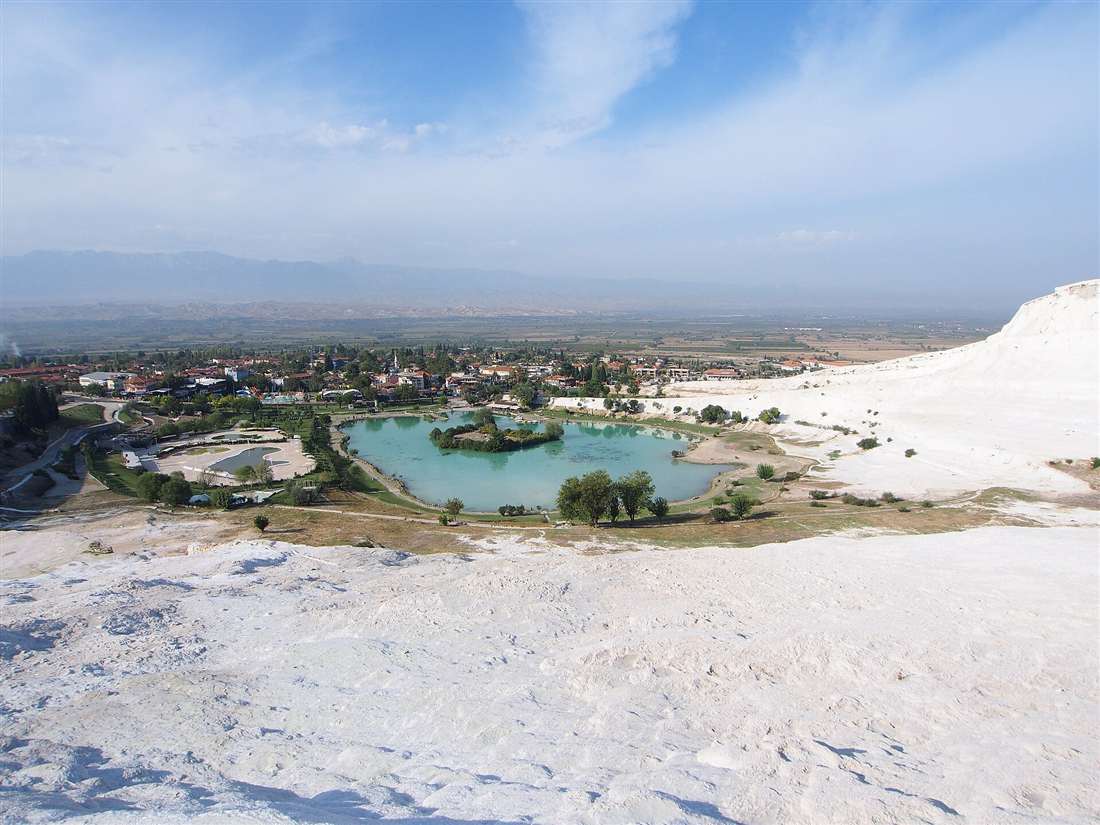
Where to stay in Pamukkale comes down to three bases: Pamukkale village at the foot of the terraces for walkability, Karahayit 5 kilometres north for its red-spring thermal resorts, and Denizli 20 kilometres away for the city and transport. Plan the whole trip with Greece Tours.
This guide covers where to stay in Pamukkale in full: the three areas and how to choose, staying in Pamukkale village, Karahayit and its red springs, Denizli city, the accommodation types and thermal hotels, the overnight-versus-day-trip choice, where to stay for a hot air balloon flight, the best base for families, and how far ahead to book.
Where is the best area to stay in Pamukkale?
The best area to stay in Pamukkale is Pamukkale village at the foot of the white travertine terraces for walkability, Karahayit 5 km north for thermal spa resorts, and Denizli city 20 km away for transport connections and a wider hotel choice.
Pamukkale village sits directly below the calcified terraces and the ancient city of Hierapolis. Guests walk to the lower south gate in under ten minutes, which puts sunrise and late-afternoon visits within reach on foot. The village clusters around a grid of small streets lined with family-run guesthouses and boutique hotels, most with rooftop terraces that face the illuminated white cliff at night.
Karahayit lies 5 km to the north and pairs the same thermal geology with a different colour and a different scale of hotel. Its springs run red and orange from dissolved iron, and the district is built around large thermal spa resorts with heated indoor and outdoor pools fed by the mineral water. Denizli, the provincial capital 20 km east, holds the train station, the intercity bus terminal and the airport transfer routes, so travellers arriving by rail or air pass through it first.
The choice narrows quickly by priority. A visitor who wants to reach the terraces on foot and catch the terraces at dawn stays in the village. A traveller who wants a full spa with thermal pools and half-board dining picks Karahayit. A guest routing through by train or plane, or one who wants city restaurants and shops, bases in Denizli and rides out to the site.
Distances between the three bases are short and the roads are direct. A dolmuş minibus links Denizli, Karahayit and Pamukkale village throughout the day, and taxis run the same routes, so a hotel in one district still keeps the other two within easy reach. The decision rests on what each morning and evening looks like rather than on being cut off from any part of the region.
Season shifts the weight between the three bases. In summer the village fills first and its terrace-view rooms clear early, so the overflow lands in Karahayit and Denizli by default. In the cooler months the balance tilts back toward the thermal resorts, since the heated mineral pools of Karahayit turn a chilly day into a warm soak, and the village empties of the coach crowds that dominate the peak. Matching the base to the time of year sharpens the choice as much as matching it to the traveller.
Why stay in Pamukkale village?
Staying in Pamukkale village puts you at the foot of the terraces with a ten-minute walk to the south gate, sunrise and sunset access without a coach transfer, and a cluster of small guesthouses and boutique hotels with rooftop terraces facing the white cliff.
The village exists because of the travertines above it. Every street ends with a view of the white terraces, and the closest hotels stand within a few hundred metres of the lower entrance. Walking replaces driving here, so a guest steps out after breakfast, climbs the barefoot path up the calcium slope and reaches the pools of Hierapolis without booking a transfer or waiting for a tour bus.
Accommodation runs mostly to guesthouses and boutique hotels held by local families. Rooms are compact, breakfast is a spread of Turkish cheeses, olives, tomatoes, eggs and bread served on a terrace, and hosts arrange balloon pickups, airport shuttles and onward bus tickets in person. Rooftop pools are a common feature, and guests swim while the setting sun turns the terraces gold and pink above the rooftops.
The timing advantage is the strongest reason to base in the village. Day-trippers arrive by coach after mid-morning and leave before dusk, so the terraces fill with crowds during the middle hours. A village guest walks up at opening for empty pools and clear morning light, then returns at sunset once the coaches depart, using the site twice in a single ticket window that overnight visitors reach and day-trippers miss. Full context on the terraces, Hierapolis and the site itself sits on the Pamukkale guide.
Evenings in the village are quiet and low-rise. Small restaurants serve gözleme, grilled meats and mezes, the streets stay walkable after dark, and the floodlit cliff hangs over the whole settlement. For a traveller who values proximity and the freedom to visit the terraces on their own clock, the village delivers what the outlying bases structurally lack.
The village also fits a car-free trip. Guests reach it by dolmuş from Denizli, drop their bags at a guesthouse on foot, and spend the stay walking to the terraces, the restaurants and the balloon shuttle without a hire car. Parking, driving and transfers drop out of the plan entirely, which turns a compact base into an advantage rather than a constraint for a traveller moving through the region by public transport.
What is Karahayit and its red springs?
Karahayit is a thermal village 5 km north of Pamukkale whose springs run red and orange from iron-rich mineral water. It holds the region’s large spa resorts, built around heated indoor and outdoor thermal pools, and pairs the geology of the area with full hotel facilities.
The red springs give Karahayit its identity. Where Pamukkale’s water deposits white calcium, Karahayit’s water carries dissolved iron that stains the rock and the channels a deep rust red. A public fountain and pool in the village centre show the coloured mineral flow, and the resorts tap the same source to feed their bathing pools at a warm, constant temperature through the year.
Hotels in Karahayit are built to a larger scale than the village guesthouses. These are thermal spa resorts with multiple pools, hammams, saunas, treatment rooms and half-board or full-board dining, designed for a guest who wants a stay-put spa break rather than a walk-up base for the terraces. The mineral water fills the pools directly, so a swim doubles as a thermal soak.
The trade-off is distance from the travertines. Karahayit sits 5 km from the Pamukkale terraces, so reaching the site means a short taxi, dolmuş or hotel shuttle rather than a walk. Guests who prioritise the spa itself accept that gap gladly, since the resorts are the reason to be in Karahayit, and the terraces become a half-day excursion rather than a doorstep attraction.
The district suits a two-part stay well. A traveller books the terraces and Hierapolis for one morning and devotes the rest of the time to the thermal pools, the hammam and the resort grounds. For couples on a spa break and families who want pool days between sightseeing, Karahayit’s combination of hot mineral water and resort scale is the draw that the smaller village hotels do not match.
Winter shows Karahayit at its strongest. The mineral springs hold their heat through the cold months, so the outdoor pools steam under a chilly sky and the indoor thermal pools stay warm regardless of the weather outside. A stay built around bathing runs year-round here, and the shoulder and winter seasons pair lower rates with near-empty terraces on the excursion morning, which rewards a traveller who bases in the resort district off-peak.
Is Denizli a better base than Pamukkale?
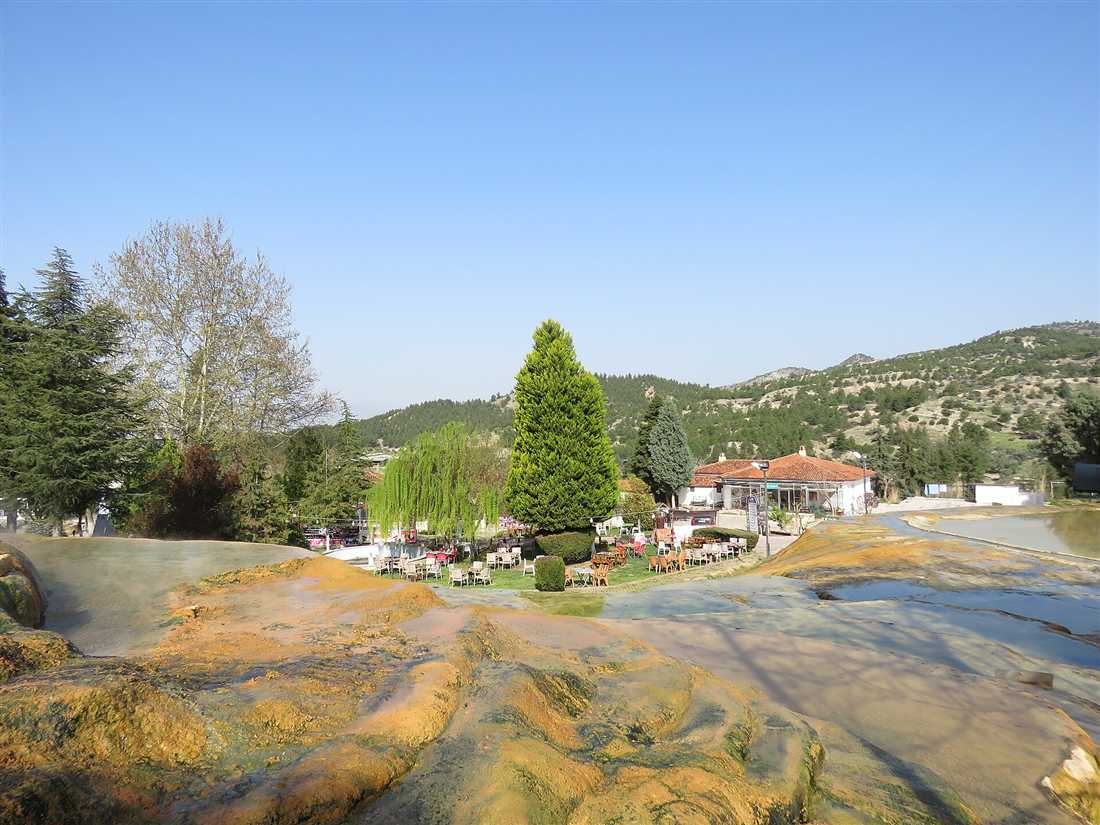
Denizli works as a base for travellers routing through by train or plane, since the city 20 km from Pamukkale holds the station, the bus terminal and the airport links, plus city hotels, restaurants and shops. The trade-off is losing the on-foot access that the village gives.
Denizli is the provincial capital and the transport hub for the whole region. The railway station receives trains from İzmir and other cities, the intercity otogar handles long-distance buses, and Çardak airport connects by shuttle to the city centre. A traveller arriving by public transport lands in Denizli first, so basing there removes the extra hop out to the village on arrival night and again on departure morning.
The city offers a different stay from the two thermal villages. Denizli holds full-service business and chain hotels, a dense grid of restaurants beyond the tourist menus, shopping streets and a local pace that continues after the day-trippers have gone home. Prices for a given standard of room run lower than the equivalent in the village, and the choice of properties is wider.
The cost of that convenience is the terraces themselves. Denizli sits 20 km from Pamukkale, so every visit to the site is a 30-minute dolmuş or taxi ride each way, and the dawn-and-dusk rhythm that village guests enjoy turns into a single planned outing. A guest in Denizli trades the doorstep view for city amenities and transit links.
The verdict on Denizli is conditional. For a one-night transit stop between trains, an arrival too late to push on to the village, or a traveller who wants city life and a cheaper room, Denizli earns its place. For a stay built around the terraces at sunrise and sunset, the 20 km gap makes it the weakest of the three bases despite its connections.
What types of accommodation are in Pamukkale?
Pamukkale accommodation runs across four types: family-run guesthouses and pansiyons in the village, boutique hotels with rooftop pools, large thermal spa resorts in Karahayit, and city and chain hotels in Denizli. Price bands rise from budget guesthouses through mid-range boutiques to the full-board resorts.
Guesthouses and pansiyons form the backbone of the village. These are small, family-owned properties with a handful of rooms, home-cooked breakfasts, and hosts who arrange transfers and tours. They occupy the lowest price band, and their strength is location and personal service rather than facilities, and a good number add a rooftop terrace or a small pool for guests to swim above the street with the white cliff in view.
Boutique hotels sit a step up. They keep the intimate scale of the village but add design-led rooms, on-site restaurants, rooftop swimming pools facing the terraces, and a higher standard of finish. They fill the mid-range band and suit couples and travellers who want comfort without moving to a full resort 5 km away.
Thermal spa resorts cluster in Karahayit. These larger hotels carry heated mineral pools, hammams, saunas, spa treatments and half-board or full-board dining, and they occupy the upper band of the region’s pricing. The city and chain hotels of Denizli round out the picture with predictable standards, business facilities and lower rates for the equivalent room class.
The four types map cleanly onto traveller needs. A backpacker or budget couple takes a village guesthouse, a comfort-seeking pair takes a boutique hotel, a spa break or family holiday takes a Karahayit resort, and a transit traveller takes a Denizli hotel. Because the three districts sit within 20 km of one another, the accommodation type effectively selects the base, and the base selects the daily rhythm.
What are the thermal hotels at Pamukkale like?
Thermal hotels at Pamukkale and Karahayit run in-house pools filled directly with warm mineral spring water, plus spa facilities: hammams, saunas, treatment rooms and heated indoor and outdoor pools. The larger resorts operate on half-board, pairing the bathing with buffet dinners on site.
The defining feature is the water. These hotels sit on the same geothermal source that built the terraces, so their pools are fed with hot mineral water rather than heated tap water. Indoor pools stay warm year-round, outdoor pools steam through the cooler months, and the mineral content is the reason guests soak rather than simply swim.
Spa facilities extend beyond the pools. A typical thermal resort holds a traditional hammam with a heated marble slab, dry and steam saunas, and a treatment menu of massages, scrubs and mud applications. Guests move between the hot pools, the hammam and the relaxation areas across an afternoon, treating the water itself as the activity.
The dining model is half-board at the resort scale. Rooms include breakfast and dinner as an open buffet, so guests eat on site between spa sessions without leaving the grounds. This structure fits the Karahayit resorts, where the distance from the village restaurants makes an all-in stay the practical arrangement, and it lets a family or couple settle in for a stay-put break.
Village thermal properties work at a smaller scale. A number of village hotels feed a rooftop or courtyard pool with mineral water and offer a compact spa, delivering the thermal experience within walking distance of the terraces. The difference is size and board basis: the village keeps the location and the on-foot access, while Karahayit trades proximity for larger pools, full spa suites and half-board dining under one roof.
The Antique Pool at Hierapolis adds a thermal option no hotel replicates. This spring-fed bathing pool inside the archaeological site lets swimmers glide over submerged marble columns toppled by ancient earthquakes, in warm mineral water at the source. A guest staying nearby books it as a separate ticket alongside the hotel spa, pairing the resort pools with a swim among the ruins that the thermal geology of the region made famous.
Is it better to stay overnight or do Pamukkale as a day trip?
Staying overnight beats a day trip at Pamukkale. An overnight guest reaches the terraces at sunrise and sunset without crowds, swims in a thermal pool after hours, and joins a dawn balloon flight. A coach day trip arrives mid-morning and leaves before dusk, missing both quiet windows.
The crowd pattern decides the case. Coach day trips converge on Pamukkale from the coastal resorts of Antalya, Fethiye and Kuşadası, arriving in a mid-morning wave and departing in the late afternoon. During those hours the travertine pools fill with visitors, the light is flat and harsh, and the walk up the calcium slope turns into a queue.
An overnight stay unlocks the empty hours at both ends of the day. A guest based in the village walks up at opening for near-deserted pools and soft morning light, or arrives late in the afternoon and stays through sunset once the coaches have gone. The white terraces glow gold and pink at dusk, and the ancient pool of Hierapolis stays swimmable into the evening.
The day-trip model also burns hours on the road. From the Mediterranean resorts, a Pamukkale day tour runs three to four hours of driving in each direction, leaving three or four hours on the ground during the busiest window. The traveller pays a full day for the worst light and the thickest crowds, then rides back exhausted.
An overnight guest gains the pool and the terraces without that pressure. Thermal hotels keep their mineral pools open in the evening, so the day closes with a warm soak rather than a coach seat. For any traveller who wants the terraces at their calmest and the region’s water as more than a photo stop, the overnight wins on every measure that a rushed day trip loses.
An overnight also opens Hierapolis beyond the terraces. The ancient city spreads across the plateau above the white cliff, with a theatre, a necropolis and a colonnaded street that a day-tripper skips for lack of time. A guest with a full afternoon and the next morning walks the ruins at leisure, then descends the terraces at dusk, turning a single ticket into a full site visit rather than a photo dash.
Where do you stay for a Pamukkale hot air balloon flight?
Stay in Pamukkale village for a hot air balloon flight. The balloons launch before dawn over the terraces and Hierapolis, and operators collect passengers from village hotels in the pre-dawn dark. An overnight in the village puts you on the doorstep for the sunrise pickup.
Balloon flights over Pamukkale lift off at first light, when the air is cool and still. Pilots need passengers at the launch field in the pre-dawn window, so pickups run from village hotels well before sunrise. A guest already sleeping in the village steps into the shuttle at the door, while a traveller based in Denizli faces a 20 km transfer at an hour when transport is thin.
The overnight before the flight is the practical arrangement. Booking a village room the night before removes the risk of a late arrival, a missed connection or a long pre-dawn drive, and it keeps the morning simple: wake, walk to the lobby, ride to the field. The flight then floats over the white terraces and the ruins of Hierapolis as the sun rises, before the day-trip coaches reach the site.
Pairing the balloon with the terraces makes the village stay do double duty. After the flight lands mid-morning, a village guest walks straight up to the travertines while the light is still soft, using one overnight for both the aerial view and the ground-level visit. Flight details, timing and what the ascent covers sit on the Pamukkale hot air balloon guide.
Karahayit works as a secondary base if the resort arranges the pickup, since it lies only 5 km from the launch area. The village stays the first choice for its shorter transfer and its walk-up access to the terraces the same morning. For a balloon flight, proximity to the pre-dawn shuttle is the deciding factor, and the village holds it.
What is the best hotel area for families at Pamukkale?
The best hotel area for families at Pamukkale is Karahayit. Its thermal spa resorts hold large heated pools that keep children occupied, the grounds give space to spread out, and the half-board buffets remove the nightly hunt for a restaurant that suits every age.
Families need room and facilities more than they need a ten-minute walk to a gate. The Karahayit resorts deliver both: heated mineral pools that stay warm through the day, gardens and grounds for children to move around, and the scale that a compact village guesthouse lacks. Parents settle in for pool days while the terraces become one planned morning out.
Half-board dining is the practical clincher for a family. A buffet dinner included in the room removes the daily decision of where to eat and what will suit younger children, and it keeps the evening on the hotel grounds rather than out on the village streets after a long day. Breakfast and dinner on site turn the resort into a self-contained base.
The thermal water itself works for families with sensible supervision. The mineral pools run warm and shallow in their family sections, so a swim doubles as the region’s headline thermal experience without the barefoot climb of the public travertines, which suits a family with small children who tire on the calcium slope.
The terraces still fit into a Karahayit family stay. A short dolmuş, taxi or shuttle ride reaches the Pamukkale site for a morning visit, and the barefoot walk across the white pools is itself a draw for children old enough to manage it. For families, the verdict weighs pool space, dining logistics and room to breathe above doorstep proximity, and Karahayit carries all three.
How do you choose between Pamukkale village, Karahayit and Denizli?
Choose Pamukkale village to walk to the terraces at sunrise and sunset, Karahayit for a thermal spa resort with heated mineral pools and half-board, and Denizli for train, bus and airport links with cheaper city rooms. The traveller type decides the base.
Walkers and sightseers belong in the village. A guest whose priority is the terraces, Hierapolis, the dawn light and the freedom to visit the site twice on one ticket stays within ten minutes of the gate. The village guesthouses and boutique hotels trade facilities for that location, and for this traveller location is the whole point of the trip.
Spa-seekers and families belong in Karahayit. A couple wanting a hammam and heated mineral pools, or a family wanting pool days, space and half-board dining, takes a resort in the red-spring village 5 km north and treats the terraces as a half-day excursion. The larger hotels and full spa suites are the reason to accept the distance from the site.
Transit travellers belong in Denizli. A guest arriving by train or plane, changing connections, or wanting city restaurants and a lower room rate bases in the capital 20 km out and rides the dolmuş to the terraces for a single planned visit. The transport hub and the wider hotel choice outweigh the distance for this traveller.
Set against one another, the three bases answer three different questions. The village answers “how close to the terraces?”, Karahayit answers “how good is the spa?”, and Denizli answers “how easy are the connections?”. A traveller who names their top priority names their base, since each district is built to serve one of the three and the short distances keep the other two within reach.
A split stay resolves competing priorities. A traveller books a first night in the village for the sunrise terraces and a dawn balloon flight, then moves to a Karahayit resort for a spa night with the mineral pools and half-board dinner. The two bases sit 5 km apart, so the transfer costs a short taxi ride, and the trip captures both the on-foot access and the full thermal resort without forcing a single compromise choice.
How far in advance do you book Pamukkale accommodation?
Book Pamukkale accommodation two to three months ahead for peak summer and holiday weekends. The village holds a limited stock of guesthouses and boutique hotels, so the best-placed rooms near the terraces sell out first, while Karahayit resorts and Denizli hotels hold availability longer.
The village is the pressure point. Its small guesthouses and boutique hotels carry a fixed, modest number of rooms, and demand concentrates on the properties closest to the lower gate and those with rooftop terraces facing the cliff. During the summer peak and around public-holiday weekends, these rooms clear early, so booking two to three months ahead secures a place at the foot of the terraces rather than a fallback further out.
Karahayit and Denizli absorb more late demand. The Karahayit resorts hold larger room counts, and the Denizli hotels add city-wide capacity, so both keep availability closer to the travel date than the village. A traveller flexible on base finds a room later, though the specific village hotel with the terrace view is the one that requires the early commitment.
Balloon-flight travellers plan further ahead again. Flights run to a fixed daily passenger cap and cancel in high wind, so pairing a village room with a confirmed balloon slot means booking both together and building in a spare morning against a weather cancellation. The village room and the flight are the two scarce parts of the trip, and both reward early booking.
Off-peak months relax the timetable. In the shoulder and winter seasons, village rooms and resort suites open up closer to arrival, and rates ease across all three bases. The rule tracks demand: for summer, holidays and any stay built around a sunrise balloon or a terrace-view room, book two to three months out; for the quieter months of late autumn through to early spring, a lead time of just a week or two holds the room without any long wait.
Frequently Asked Questions
Where is the best place to stay in Pamukkale?
Pamukkale village is the best base for the terraces, at the foot of the site and walkable to the gate, with guesthouses and boutique hotels. Karahayit suits thermal-spa resorts, and Denizli suits a city stay with transport links.
Is it better to stay in Pamukkale or Denizli?
Pamukkale village sits at the foot of the terraces, walkable to the site and best for sunrise and sunset. Denizli, 20 kilometres away, offers city hotels and the transport hub but needs a bus or taxi to reach Pamukkale.
What is Karahayit near Pamukkale?
Karahayit is a spa village 5 kilometres north of Pamukkale, known for its red, iron-rich thermal springs. Its large resort hotels run in-house thermal pools and half-board, making it the base for a spa-focused stay.