
An Ephesus and Pamukkale tour joins Turkey’s two headline sites — the ancient city of Ephesus near the coast and the white travertines of Pamukkale with ancient Hierapolis inland — on a two-day trip across the 190 kilometres between them. Plan the whole trip with Greece Tours.
This guide covers the Ephesus and Pamukkale tour in full: what it is, how long it needs, the one-day question, the two-day itinerary, where tours start, the trip from Istanbul and from the Kusadasi cruise port, the cost and inclusions, the best order, and what you see at Ephesus and at Hierapolis.
What is an Ephesus and Pamukkale tour?
An Ephesus and Pamukkale tour is a combined trip that links two UNESCO World Heritage Sites in western Turkey: the marble ancient city of Ephesus near the Aegean coast and the white travertine terraces of Pamukkale with the Roman ruins of Hierapolis above them.
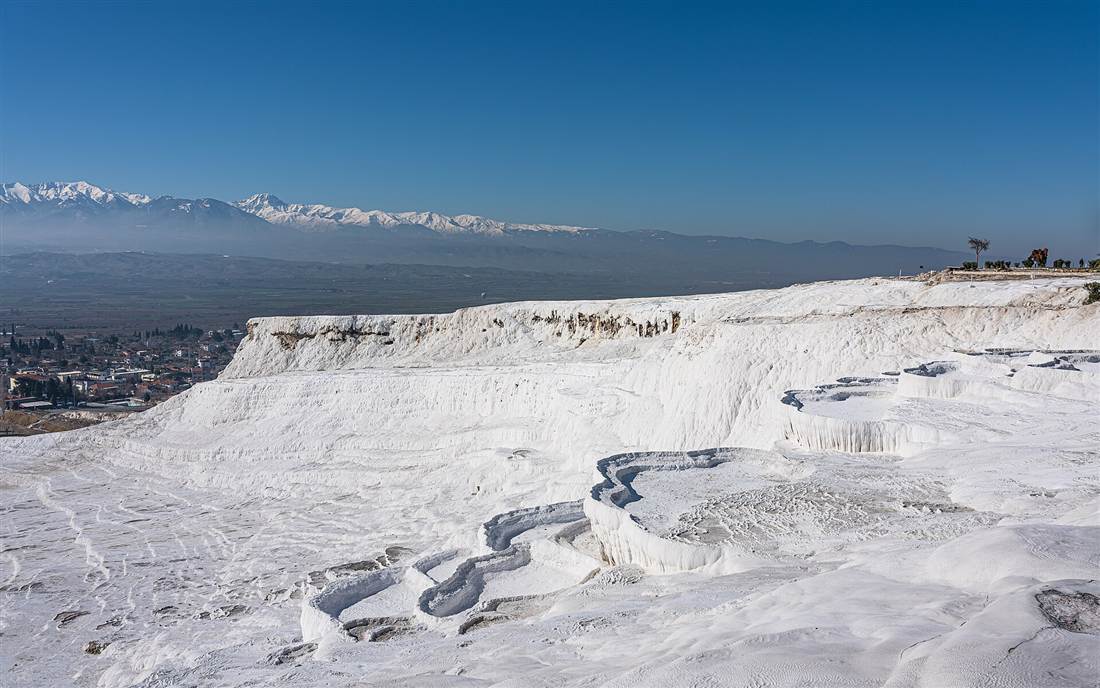
The tour joins the two most photographed archaeological destinations in the region into one route. Ephesus stands 3 kilometres from Selcuk on the Aegean side, a Greco-Roman metropolis of marble streets, temples and a library facade. Pamukkale sits inland, a hillside of calcite pools fed by mineral hot springs, crowned by the spa city of Hierapolis. Together they present classical antiquity and a natural wonder in a single itinerary.
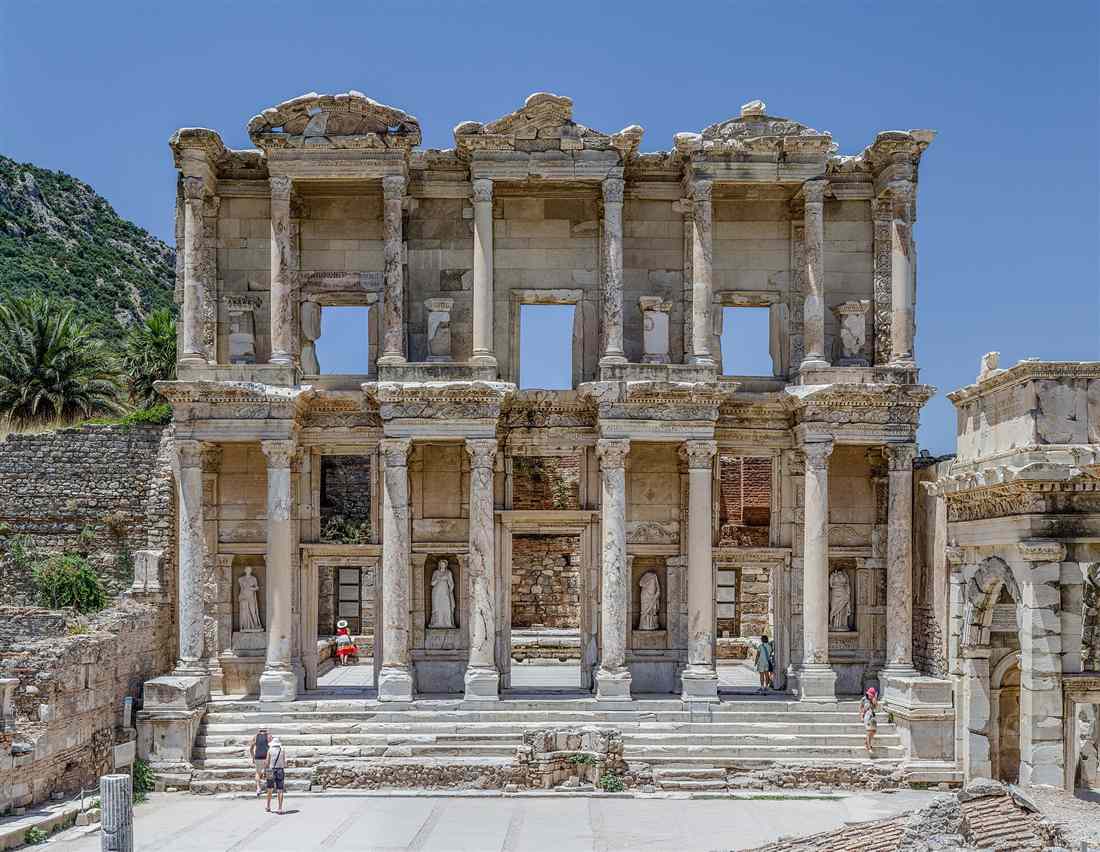
Travellers pick this pairing because the two sites complement each other. Ephesus delivers the built world of Rome and early Christianity, from the Ephesus Library of Celsus to a theatre that seated 25,000 spectators. Pamukkale delivers geology and thermal water, the terraces gleaming white against the plain below. A guided tour threads the drive between them, supplies the site entries, and adds context that turns loose ruins and rock formations into a connected story of ancient Anatolia.
The combined tour also solves a logistics problem. Western Turkey spreads its headline attractions across a wide inland arc, and public transport between Ephesus and Pamukkale strings together buses and taxis that eat a day. A packaged tour folds the transfer, the tickets and the overnight into one booking, so travellers ride a direct coach, walk both sites with a licensed guide, and sleep beside the terraces rather than juggle timetables. The format converts two demanding self-drive destinations into a smooth, escorted circuit.
How long do you need for Ephesus and Pamukkale?
Two days is the natural pace for Ephesus and Pamukkale. The sites sit roughly 190 kilometres apart, a drive of about 3 hours, so a two-day tour gives Ephesus a full morning, an overnight near the terraces, and Pamukkale with Hierapolis the following day without a rushed schedule.
The two-day structure fits the geography. Day one covers Ephesus and its satellites near the coast, then the coach transfers inland to a hotel at the foot of the travertines. Day two opens at the terraces early, before the crowds thicken and the midday sun flattens the light, and continues through Hierapolis and the Cleopatra Pool. This rhythm treats each site as a half-day of walking rather than a checkpoint.
A one-day tour exists, and operators sell it, but it compresses six hours of driving into a dawn-to-night marathon. The two-day format removes that strain and adds the thermal town of Pamukkale in the evening, when the terraces turn amber at sunset. For travellers who value the walk over the tick-box, the extra day pays for itself in depth and comfort.
A three-day plan extends the same route for travellers who add the House of the Virgin Mary, the Temple of Artemis and the Basilica of St John around Selcuk, or who take a thermal-spa night in a Pamukkale hotel built over the hot springs. The core stays two days; the third day absorbs the extras that a tight schedule drops. Choose the count by the pace you want on the ground, not by the ambition to see the region in a single sweep.
Can you visit Ephesus and Pamukkale in one day?
Visiting Ephesus and Pamukkale in one day is possible and demands a very long day. The 190-kilometre gap between them means about 6 hours of return driving, so a single-day trip trims each site to a brisk walk and leaves before the terraces reach their evening glow.
A one-day combined tour starts at first light and returns after dark. The coach reaches Ephesus for the morning, allows two hours on the marble streets, then drives 3 hours east to Pamukkale for an afternoon on the terraces and a quick pass through Hierapolis. The pace is relentless, and the day belongs to the road as much as the sites.
The two-day tour suits both places far better. Ephesus rewards slow walking through the terrace houses and the Great Theatre, and Pamukkale rewards an unhurried barefoot descent of the pools. Splitting the visit across two days removes the clock-watching, adds the overnight in Pamukkale village, and delivers the terraces in the soft light of early morning and late afternoon, the two windows when the white calcite photographs at its best.
Heat sharpens the case against the one-day rush. Both sites lie open to the sun with little shade, and midday temperatures on the plain climb past 35 degrees in high summer. A one-day tour parks travellers at Pamukkale in the hottest hours after a three-hour drive, when the white terraces throw the glare straight back. The two-day pace lands each site in a cooler window and keeps the long transfer as a separate afternoon rather than a punishment stacked onto a full day of walking.
What is the two-day Ephesus and Pamukkale tour itinerary?
The standard two-day itinerary opens with Ephesus and the House of the Virgin Mary on day one, transfers to an overnight hotel in Pamukkale, and devotes day two to the travertine terraces, Hierapolis and the Cleopatra Pool before the return leg.
Day one begins on the coast. The tour enters Ephesus through the Magnesian Gate, descends Curetes Street past the Temple of Hadrian to the Library of Celsus, and reaches the Great Theatre. A short drive up the hill leads to the House of the Virgin Mary, the stone chapel where tradition places the final home of Mary. The afternoon runs the 190-kilometre inland transfer to Pamukkale, checking into a hotel beneath the terraces for the night.
Day two starts early at the travertines. Barefoot, travellers walk the warm calcite pools that step down the hillside, then climb into Hierapolis, the Roman spa city with its theatre, necropolis and colonnaded street. The morning closes at the Cleopatra Pool, where visitors swim among submerged marble columns in thermal water at 36 degrees. The coach then returns to the starting point, arriving by evening.
The overnight is the hinge that makes the itinerary work. Checking in beside the terraces on the first evening means the group stands at the top of the travertines when the gates open, ahead of the coach parties that pour in from the coast on day trips. The hotel also supplies dinner after the inland drive and breakfast before the terrace walk, so the first hour of day two goes to the site rather than to logistics. This is the structural advantage a one-day tour surrenders.
Where do Ephesus and Pamukkale tours start from?
Ephesus and Pamukkale tours depart from Istanbul, Izmir, Kusadasi and Selcuk, and from the Kusadasi cruise port. Coastal bases sit beside Ephesus and reach Pamukkale by an inland drive; Istanbul departures add a 75-minute domestic flight to Izmir at the start.
Izmir is the closest major airport, an hour from Ephesus by road and the arrival point for most fly-in itineraries. Selcuk, the town beside the ruins, and Kusadasi, the coastal resort, both put Ephesus within a short transfer and treat Pamukkale as the day-two inland leg. Cruise passengers dock at Kusadasi port and join a shore excursion built around the same route.
Istanbul stands 480 kilometres north and works as a start through a flight rather than a coach the whole way. Travellers fly Istanbul to Izmir, meet the guide, and run the two-day loop before flying back. The starting city decides the transport at the top and tail of the tour, while the core Ephesus-to-Pamukkale drive stays the same 190-kilometre inland stretch for every base.
Base choice shapes the price and the pace. Selcuk and Kusadasi keep the whole trip on the road with no flights, which trims cost and suits travellers already on the Aegean coast. Izmir adds a city with its own airport for fly-in guests. Istanbul demands the domestic flights but opens the tour to visitors whose trip centres on the northern metropolis. Match the departure point to where your Turkey itinerary already sits, and the two-day core slots in without a detour.
How do you do an Ephesus and Pamukkale tour from Istanbul?
From Istanbul, the tour starts with a 75-minute domestic flight to Izmir, runs the two-day Ephesus and Pamukkale loop by coach with an overnight near the terraces, then flies back to Istanbul from Izmir on the second evening.
Driving the full 480 kilometres each way from Istanbul wastes the trip on the motorway, so the flight replaces the northern leg. The morning flight lands at Izmir Adnan Menderes Airport, where the guide and vehicle wait. From there the route is identical to a coastal departure: Ephesus and the House of the Virgin Mary on day one, the inland transfer to a Pamukkale hotel, and the terraces with Hierapolis on day two.
The return flight leaves Izmir after day two closes, putting travellers back in Istanbul the same night. Packages bundle both flights, airport transfers, the guide, site entries and the overnight into one price. This structure turns a distant pair of sites into a compact two-day break from Istanbul without a punishing overland haul in either direction.
Booking the flight legs through the tour operator removes the connection risk. The guide meets the morning arrival at Izmir, the coach waits, and the return flight is timed to the second day’s close, so a delayed self-booked ticket never strands the group away from the airport. Travellers who prefer full independence book their own Istanbul-Izmir flights and join the land tour at the airport, though the bundled version keeps every moving part under one voucher and one point of contact.
How do you do the tour from Kusadasi or the cruise port?
From Kusadasi or its cruise port, Ephesus sits 20 kilometres away as an easy first stop, while Pamukkale is the long inland leg 190 kilometres east. Cruise callers with one day in port take the combined shore excursion; overnight guests split the pair across two days.
Kusadasi is the coastal base built for this route. Ephesus is a 25-minute drive from the resort, so the ancient city fills the opening morning with time to spare. Pamukkale then demands the 3-hour inland transfer, which is the reason the coast-plus-terraces combination fills a full day and rewards an overnight when the schedule allows one.
Cruise passengers face the port clock. A single-day shore excursion from Kusadasi covers Ephesus in the morning and drives to Pamukkale for the afternoon, returning to the ship before the all-aboard time. Land-based visitors staying in Kusadasi choose the two-day tour, sleeping in Pamukkale village and catching the terraces in early light. The port sets the pace; the sites and the 190-kilometre drive stay fixed.
What does an Ephesus and Pamukkale tour cost and include?
A two-day Ephesus and Pamukkale tour costs roughly 150 to 350 euros per person, covering air-conditioned transport, a licensed guide, entrance tickets to Ephesus, Hierapolis and Pamukkale, one night in a hotel near the terraces, and breakfast and dinner.
The price moves with group size and hotel grade. A shared coach tour with a standard three-star hotel sits at the lower end, while a private car with a dedicated guide and a thermal spa hotel pushes toward the upper figure. Istanbul departures add the two domestic flights, which lift the total by 80 to 150 euros for the Izmir return.
Inclusions cover the entrance fees that add up quickly at the gate, the guide who reads the ruins for you, and the overnight that makes the two-day pace work. Lunches at Ephesus, the optional Cleopatra Pool swim and personal spending stay outside the base price. Confirm the terrace and Hierapolis entries and the meal plan on the voucher, since these are the items that separate one package from another.
A private tour raises the figure and buys flexibility. A dedicated car with a personal guide sets its own start times, lingers where the group wants, and skips the pick-up round of a shared coach, at a premium of 100 to 250 euros over the joined-group price. Cruise shore excursions carry their own tariff, priced for the single port day and the guarantee of a return before the ship sails. Read what each rate covers before comparing headline numbers, because a low base price that excludes entries closes the gap fast.
What is the best order — Ephesus first or Pamukkale first?
Ephesus comes first and Pamukkale second. Ephesus sits near the Aegean coast where the tours begin, so it opens day one, and the coach drives the 190 kilometres inland afterwards to reach Pamukkale for an overnight and the terraces on the morning of day two.
The order follows the map. Every coastal base — Kusadasi, Selcuk, Izmir — stands beside Ephesus and far from Pamukkale, so starting with the ancient city means no backtracking. The inland transfer then moves the group east to the terraces, which becomes the last stop before the return, keeping the whole route as one forward arc rather than a there-and-back.
Timing the light reinforces the sequence. Ephesus faces the morning sun on day one, when the marble streets photograph well and the heat stays bearable on the open site. Reaching Pamukkale for an overnight puts travellers on the terraces at dawn on day two, the coolest and brightest window for the white calcite. Ephesus first, Pamukkale second lines up the geography and the sunlight in the same direction.
What do you see at Ephesus on the tour?
At Ephesus the tour walks the Library of Celsus, the Great Theatre and the terrace houses, alongside Curetes Street, the Temple of Hadrian, the public latrines and the marble agora, plus the nearby House of the Virgin Mary on the hill above.
The Library of Celsus is the signature stop, its two-storey marble facade rebuilt from original fragments and framed by statues of Wisdom, Knowledge, Intelligence and Virtue. From the library, Curetes Street climbs past the carved Temple of Hadrian, fountains and shopfronts toward the upper city gate, the spine that organises a walk through the ruins.
The Great Theatre, cut into Mount Pion, held 25,000 people and staged the riot of the silversmiths recorded in the Acts of the Apostles. The terrace houses, protected under a modern roof and entered on a separate ticket, preserve mosaic floors, painted walls and heated rooms of wealthy Roman households. Above the site, the House of the Virgin Mary draws pilgrims to the stone chapel where tradition places Mary’s last years, a short drive that most two-day tours include.
The walk runs downhill through the site, entering at the upper Magnesian Gate and exiting near the lower gate by the theatre, so the guided route flows one way without a climb back. Along the marble the tour passes the Odeon council chamber, the Prytaneion with its eternal flame, the fountains of Trajan and Pollio, and the public latrines with their row of stone seats. Two hours covers the main street at a steady pace; the terrace houses add 40 minutes for travellers who take the extra ticket.
What do you see at Pamukkale on the tour?
At Pamukkale the tour walks the white travertine terraces, the Roman spa city of Hierapolis above them, and the Cleopatra Pool, where visitors swim among sunken marble columns in mineral water heated to 36 degrees by the same springs that built the calcite pools.
The terraces are the reason the site draws crowds. Warm mineral water spills down the hillside over thousands of years, depositing calcium carbonate that hardens into brilliant white basins the colour of cotton, which is what the Turkish name Pamukkale describes. Travellers walk the designated barefoot path down the pools, water pooling around the ankles, the plain of Denizli stretching out below.
Above the terraces spreads Hierapolis, a Roman and Byzantine spa city with a theatre carved into the slope, a colonnaded main street, a monumental gate and a vast necropolis of tombs. At the heart of the ruins the Cleopatra Pool, the antique thermal bath, lets visitors swim among fallen columns toppled by an ancient earthquake. Terraces, ruined city and thermal pool sit within one continuous hilltop, which is why Pamukkale fills the whole of day two.
The Hierapolis theatre ranks among the best-preserved stages in Anatolia, its ornate scene wall and tiered seating restored to their carved detail. The necropolis stretches for more than a kilometre along the approach roads, holding house-shaped tombs, sarcophagi and burial mounds of the visitors who came for the healing waters. The site museum, set in a restored Roman bath, guards the marble reliefs and statuary lifted from the ruins. A single ticket covers the terraces, Hierapolis and the museum; the Cleopatra Pool swim carries its own separate fee.
Frequently Asked Questions
Can you see Ephesus and Pamukkale in one day?
Ephesus and Pamukkale sit about 190 kilometres apart, a three-hour drive each way. A one-day tour of both makes for a very long day with little time at each site; a two-day tour with an overnight in Pamukkale suits both.
How long do you need for Ephesus and Pamukkale?
Two days suit Ephesus and Pamukkale: day one for the ancient city of Ephesus and the House of the Virgin Mary, an overnight in Pamukkale, and day two for the travertines, Hierapolis and Cleopatra”s Pool.
Where do Ephesus and Pamukkale tours start?
Ephesus and Pamukkale tours start from Istanbul with a flight to Izmir, or on the ground from Izmir, Kusadasi, Selcuk and the cruise port. The coastal bases put Ephesus close and Pamukkale as the inland leg.