
Hierapolis is the ancient Greco-Roman spa city that crowns the ridge above the white travertine terraces of Pamukkale in Denizli, Turkey, a UNESCO World Heritage Site famous for its Roman theatre, its vast necropolis, the Plutonium and the tomb of the Apostle Philip. Plan the whole trip with Greece Tours.
This guide covers Hierapolis in full: what the city is and where it stands, who founded it and its history, the theatre, the necropolis, the Plutonium and Temple of Apollo, the Frontinus Gate and main street, the Martyrium of St Philip, the museum and Roman baths, Cleopatra’s Antique Pool, how to visit it with the Pamukkale terraces, tickets and hours, and how it compares with Ephesus.
What is Hierapolis?
Hierapolis is an ancient Greco-Roman spa city on the plateau above the Pamukkale travertines in south-western Turkey. The Attalid kings of Pergamon founded it in the second century BC around mineral hot springs, and UNESCO inscribed it as a World Heritage Site.
The name Hierapolis means “sacred city” in Greek, a title earned by its dense concentration of temples, sanctuaries and a healing cult built on the thermal waters that rise through the limestone bedrock. The springs discharge water at a temperature near thirty-five degrees Celsius, saturated with calcium carbonate, and it is this same mineral load that deposits the white travertine terraces on the slope below the ruins. Pilgrims, patients and priests treated the city as a therapeutic centre, and the classical world associated it with cures for skin conditions, digestive complaints and rheumatic pain.
Hierapolis grew into a full Roman provincial city with a colonnaded main street, a monumental theatre, thermal bath complexes, an agora, gymnasia and one of the largest cemeteries in Anatolia. The ruins visitors walk today date mostly to the Roman rebuilding of the first and second centuries AD, after earthquakes flattened the earlier Hellenistic town. The site sits inside the Pamukkale-Hierapolis protected zone, and the archaeological ruins and the mineral terraces together form a single UNESCO listing that couples the human city with its natural setting.
The Museo Archeologico occupies the restored Roman bath building, and the ancient thermal pool, now called the Antique Pool or Cleopatra’s Pool, still holds warm spring water above submerged marble columns that toppled in an ancient earthquake. Hierapolis therefore reads as two things at once: an urban archaeological landscape of streets, gates and monuments, and a living spring-fed spa that has drawn people to the same water for more than two thousand years.
Italian archaeologists from the Missione Archeologica Italiana have excavated and restored the site across decades of continuous fieldwork, re-erecting fallen columns, reconstructing the theatre stage and mapping the full extent of the urban grid. Their work has recovered inscriptions, statues and architectural fragments now displayed in the on-site museum, and it has confirmed the phased construction history of the city from its Attalid foundation through its Byzantine Christian phase. The result is one of the most thoroughly studied ancient urban landscapes in Anatolia, a place where the physical remains and the epigraphic record together reconstruct daily life in a Roman spa city.
Where is Hierapolis?
Hierapolis stands in Denizli province, south-western Turkey, on a ridge directly above the town of Pamukkale. The ruins crown the top of the travertine slope, so the white terraces cascade down the hillside from the ancient city towards the plain of the Curuksu river.
The site lies roughly nineteen kilometres north of the city of Denizli, the provincial capital, and about two hundred and thirty kilometres inland from the Aegean coast at Kusadasi. Denizli anchors the regional transport network with an airport, a mainline railway station and an intercity bus terminal, and the short road up to Pamukkale connects the modern town to the archaeological plateau. The elevation of the ridge places the ancient city about three hundred metres above the surrounding lowland, giving the theatre and the necropolis wide views across the Lycus valley.
Geologically, Hierapolis and the travertines are one system. Fault lines beneath the plateau channel carbon-dioxide-rich groundwater to the surface as hot springs, the water cools and loses pressure as it flows over the edge of the ridge, and the dissolved calcium carbonate precipitates as the terraced white stone that gives Pamukkale its name, “cotton castle” in Turkish. The ancient builders placed the city at the source of this water, so the sanctuaries, baths and pools sit at the geological heart of the phenomenon rather than beside it. Walking from the northern gate to the southern gate follows the ridge, and the travertine terraces open up along the western flank of the route.
The wider region places Hierapolis within reach of other classical sites of the Lycus and Meander valleys, including Laodicea and Aphrodisias, which sit within an hour or two by road. This clustering of ruined cities across the interior of Caria and Phrygia made the plateau a natural hub of the Roman road network, and the position of Hierapolis on the boundary between these territories shaped its trade and its cults throughout antiquity.
The plateau rises to an elevation near three hundred and fifty metres above sea level, and the ancient city occupied the flat crest of the ridge while the terraces spilled down its western face. Two monumental gates, one at the north and one at the south, mark the ends of the urban area, and the visitor route runs the length of the ridge between them. The travertine terraces form a barrier of dazzling white stone on the western flank, so the ancient city and the natural monument share a single skyline, and the springs that fed the baths of Hierapolis are the same springs that build the terraces of Pamukkale grain by grain.
Who founded Hierapolis and what is its history?
The Attalid kings of Pergamon founded Hierapolis in the second century BC, probably under Eumenes the Second. Rome absorbed it in the same century, rebuilt it after devastating earthquakes, and it flourished as a Roman and then Byzantine Christian city before its abandonment.
The Kingdom of Pergamon controlled western Anatolia in the Hellenistic period, and its rulers planted Hierapolis as a settlement to hold the fertile Lycus valley and to exploit the healing springs. When Attalus the Third bequeathed Pergamon to Rome in the second century BC, the city passed with the rest of the kingdom into the Roman province of Asia. Under Roman administration Hierapolis prospered on textiles, wool-dyeing and the pilgrim traffic to its thermal cult, and its citizens paid for temples, a theatre and a grand colonnaded street.
Earthquakes repeatedly reshaped the city. A major shock in the first century AD, during the reign of Nero, levelled much of the Hellenistic town, and the reconstruction that followed produced the Roman street plan, the Frontinus Gate and the rebuilt monuments that dominate the ruins today. The theatre reached its ornate form during the second and third centuries AD, in the era of the emperors Hadrian and Septimius Severus, when the city stood at its economic peak and its population swelled with visitors seeking the waters.
Christianity took deep root at Hierapolis. Tradition holds that the apostle Philip died and was buried here in the first century AD, and a large octagonal building on the eastern hill, the Martyrion of Saint Philip, became a pilgrimage church in the fifth century AD. In the Byzantine period the city gained a defensive wall, basilicas and a cathedral, and it served as the seat of a bishop. Repeated earthquakes in the seventh and later centuries, together with the region’s political instability, gradually emptied the city. A final destructive earthquake in the fourteenth century AD ended permanent settlement, and Hierapolis stood as a ruin until archaeological excavation began in the modern era.
What is the theatre of Hierapolis?
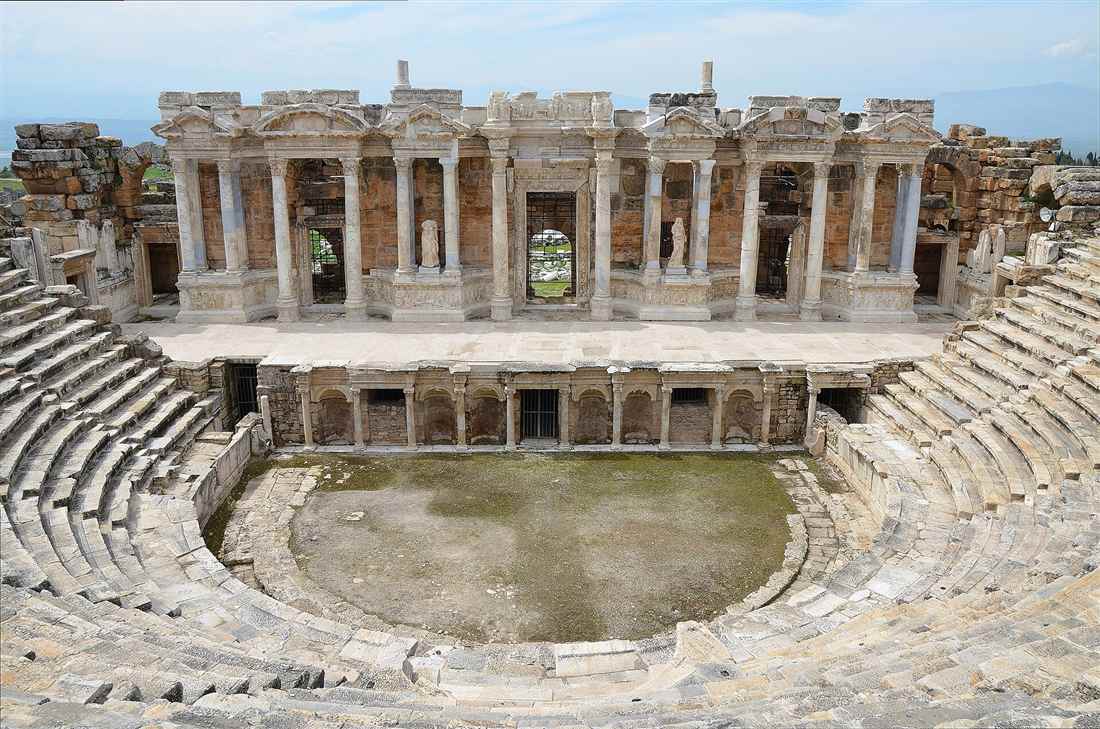
The theatre of Hierapolis is a Roman auditorium cut into the eastern hillside, seating around twelve thousand spectators across fifty tiers of stone. Its towering stage building, the scaenae frons, survives with carved reliefs of Apollo, Artemis and imperial figures, making it the best-preserved monument on the site.
Builders raised the theatre in the second century AD and elaborated its stage front through the third century AD, incorporating an earlier structure into the design. The cavea, the semicircular bank of seating, divides into an upper and a lower section split by a horizontal walkway, and radial staircases carry the audience up through the tiers. The imperial box at the centre of the seating marked the place reserved for the emperor and city dignitaries, and the acoustics of the curved bowl carried the voices of performers to the highest rows without amplification.
The scaenae frons, the multi-storey architectural backdrop behind the stage, stands as the theatre’s masterpiece. Corinthian columns frame niches and doorways across three levels, and a continuous band of relief sculpture runs along the stage. The carvings depict the myth and cult of Apollo, the chief god of the city, alongside his sister Artemis, and scenes tied to Dionysus and the imperial house. Archaeologists have re-erected columns and re-set the friezes during decades of restoration, so the reconstructed stage front now rises close to its ancient height.
The orchestra, the flat space between the seating and the stage, was refitted in late antiquity to hold water for aquatic spectacles and beast displays, a conversion recorded at other Roman theatres of Asia Minor. From the top row of seats the view reaches across the whole archaeological plateau and out over the travertine terraces, and the theatre remains the single monument that best conveys the scale and wealth of Roman Hierapolis.
What is the necropolis of Hierapolis?
The necropolis of Hierapolis is one of the largest ancient cemeteries in Anatolia, stretching for around two kilometres along the roads leading out of the city. It holds more than twelve hundred tombs, ranging from circular tumuli and house-shaped mausolea to carved marble sarcophagi raised on plinths.
The northern necropolis, on the road towards the ancient cities of the Lycus valley, is the most extensive and the most varied. The oldest graves take the form of tumuli, circular drums of masonry topped with a mound of earth and covering a burial chamber, a type inherited from the Hellenistic period. Alongside them stand house-type tombs built like small dwellings, with doors, pitched roofs and interior benches where members of a family were laid, and these structures line the approach to the Frontinus Gate in dense ranks.
Sarcophagus tombs make up the largest group. These stone coffins, most carved from local travertine and marble, rest on high bases and carry inscriptions naming the deceased, their profession and the penalties set for anyone who violated the grave. The inscriptions record the guilds and trades of Hierapolis, including the purple-dyers and the wool-workers, and they document the city’s contacts with Jewish and foreign communities who buried their dead in the same cemetery. Numerous tombs reserved space for whole families and set out rules for their use in carved legal text.
The concentration of graves reflects the reputation of Hierapolis as a place of healing and death alike: pilgrims travelled to the springs for a cure, and those who died at the spa were interred in the vast roadside cemetery. The necropolis functions today as an open-air record of Roman funerary architecture, and a walk along its main road passes every tomb type in sequence, from the earliest earthen mounds to the elaborate marble monuments of the imperial centuries.
What is the Plutonium (Pluto’s Gate) at Hierapolis?
The Plutonium, or Pluto’s Gate, is the sanctuary of the underworld god Pluto at Hierapolis, built over a cave that vents lethal carbon dioxide. Ancient priests exploited the toxic gas as a display of divine power, leading sacrificial animals to the opening where the fumes killed them.
The shrine sits beside the Temple of Apollo, above a fissure in the fault line that releases a dense stream of carbon dioxide from the earth. The heavy gas pools at ground level inside the enclosed forecourt, and any creature that lowers its head into the invisible layer suffocates within moments. Greek and Roman writers, including the geographer Strabo, described the site directly: they recorded that birds flying into the vapour dropped dead and that bulls led to the threshold collapsed, while the eunuch priests of the goddess Cybele walked in unharmed by holding their breath and keeping their heads above the gas.
Archaeologists have identified the arched opening of the cave, an enclosed pool fed by warm mineral water, and stepped seating from which spectators watched the rituals at a safe distance. Modern gas measurements at the fissure confirm the ancient accounts: carbon-dioxide concentrations near the vent reach lethal levels in the still air of early morning and settle in a layer close to the paving, exactly as the classical descriptions state. The sanctuary thus fused a genuine geological hazard with a theology of death, presenting the deadly breath of the earth as the exhalation of the underworld itself.
Pilgrims came to the Plutonium to witness the sacrifices, to incubate dreams for prophecy, and to receive the god through the small controlled doses of gas that the priests administered. The site links the healing waters of Hierapolis, which gave life, to the poisonous vapour of the same volcanic system, which dealt death, and the ancients read both as manifestations of the sacred forces beneath the city.
A marble statue of Pluto with the three-headed hound Cerberus, recovered from the sanctuary, confirms the dedication of the shrine to the lord of the dead, and a matching figure of the serpent linked the site to healing cults. The forecourt is fenced off in the present day precisely because the carbon dioxide remains lethal, and the excavators reconstructed the ritual sequence from the surviving thresholds, seating and the arched cave mouth. The Plutonium therefore stands as a rare case where a documented ancient ritual, a specific geological process and the physical archaeology align in exact detail.
What is the Temple of Apollo at Hierapolis?
The Temple of Apollo is the chief sanctuary of Hierapolis, dedicated to the city’s patron god and built directly above the gas-emitting fault beside the Plutonium. It housed an oracle, and its priests delivered prophecies drawn from the same underground forces that powered Pluto’s Gate.
Apollo Archegetes, “the founder”, stood as the principal deity of Hierapolis, and the city minted his image on its coins and carved his myth across the theatre stage. The temple occupies a terrace on the western slope, its foundations set on the fault so that the sacred fissure runs beneath the sanctuary. The surviving remains belong to a third-century AD rebuilding in marble, raised on a high podium reached by a broad flight of steps, replacing an earlier Hellenistic shrine on the same spot.
The oracle of Apollo functioned through the vapours of the fault. Ancient sources record that the priests interpreted signs delivered under the influence of the rising gas, tying the prophetic voice of the god to the geology of the plateau. This union of temple and toxic cave made the sanctuary the religious core of Hierapolis, the point where the healing springs, the deadly breath of Pluto and the prophetic power of Apollo all converged in a single sacred precinct.
Excavation has exposed the temple podium, fragments of its columns and the enclosing wall of the sanctuary, along with an altar court in front of the steps. The proximity of the Temple of Apollo to the Plutonium, only metres apart, demonstrates the deliberate planning of the religious quarter: the builders grouped the god of light and prophecy directly above the gate of the underworld, framing the whole complex as the meeting place of the upper and lower worlds.
Coins struck at Hierapolis carry the head of Apollo and the tripod that marks his prophetic office, tying the civic identity of the city to its patron deity across the centuries of Roman rule. The sanctuary formed part of a wider sacred zone on the western terrace that included a fountain house, a nymphaeum fed by the mineral springs, and a monumental staircase linking the temple platform to the main street below. This religious quarter concentrated the cults of Apollo, Pluto and Cybele in a single precinct, and its ruins record the fusion of Greek Olympian religion, Anatolian mother-goddess worship and the underworld theology that made Hierapolis a destination for pilgrims from across the Roman East.
What is the Frontinus Gate and the main street?
The Frontinus Gate is the monumental northern entrance to Hierapolis, a triple archway flanked by two round towers, built in the first century AD. From it runs the Frontinus Street, the colonnaded main avenue, or plateia, that crosses the entire city from the northern gate to the southern gate.
The proconsul of Asia, Julius Frontinus, dedicated the gate in the late first century AD during the reign of the emperor Domitian, and his name survives in the inscription across the structure. Three round-headed arches pierce the travertine facade, the central passage wider than the two flanking it, and a pair of cylindrical defensive towers rise on either side in a design borrowed from Hellenistic city fortifications. The gate marked the formal threshold of the urban centre for travellers arriving from the north along the road lined by the necropolis.
Beyond the gate stretches the plateia, the great colonnaded street that formed the spine of Hierapolis. The avenue runs dead straight for more than one kilometre, paved with large travertine blocks and framed on both sides by Doric colonnades that sheltered shops, warehouses and public buildings behind their porticoes. A covered drainage channel runs beneath the paving, carrying waste water the length of the city, and the street connects the northern Frontinus Gate to a matching monumental gate at the southern end.
The main street organised the whole Roman city. The agora, the baths, the latrine building and the principal public monuments open off it or stand close to its line, so a visitor walking the plateia passes the commercial and civic heart of Hierapolis in sequence. The gate and the avenue together express the ambition of the rebuilt Roman city: a formal, axial approach that led arriving pilgrims and traders from the roadside tombs, through the triple arch, and into the ordered grid of the sacred spa city.
Just inside the Frontinus Gate stands a large public latrine, a rectangular building with rows of seats over a flushing water channel, and beyond it the road passes the agora, one of the largest market squares of Roman Asia Minor. The southern end of the plateia terminates in a matching monumental gate and a Byzantine defensive wall that closed the city in late antiquity. The dimensions of the avenue, more than one kilometre in length and around fourteen metres in width including its porticoes, gave Hierapolis a processional axis on the scale of the greatest cities of the eastern Roman world, and the surviving paving and column bases still trace its full course across the plateau.
What is the Martyrium and tomb of St Philip at Hierapolis?
The Martyrium of St Philip is an octagonal pilgrimage building on the eastern hill above Hierapolis, raised over the site where the apostle Philip died. Italian archaeologists identified his first-century tomb close by, confirming the city as a major early Christian shrine.
The Martyrium sits on the slope east of the theatre, reached by a stepped processional way that climbs from the city grid. The structure is built to a strict octagonal plan enclosed within a square, roughly sixty metres across, with a central domed chamber ringed by eight rectangular rooms that sheltered pilgrims. Radial chapels and covered corridors framed the octagon, and the whole complex dates to the fifth century, three hundred years after the apostle’s death gave the hill its sacred status.
Excavators from the Italian mission working the site located a Roman tomb of the first century a short distance downhill from the Martyrium. The tomb’s position, its early date, and inscriptions naming Philip tie it to the apostle who preached in Phrygia and died at Hierapolis. Pilgrims travelled from Constantinople, Syria and Egypt to touch the shrine, and bronze pilgrim tokens stamped with the saint’s image circulated across the eastern Mediterranean. The bridge, the monumental stair and the ring of the octagon together turned this hillside into one of the ranking Christian destinations of Anatolia, standing alongside the tombs of apostles at Ephesus and Antioch.
Below the octagon the Italian mission uncovered a three-aisled pilgrimage church built over the apostle’s grave itself, its nave aligned to draw processions from the Martyrium down to the tomb. A fountain, a bath for ritual washing and a paved plaza framed the approach, and the marble threshold of the tomb chamber shows the wear of countless pilgrim feet. Byzantine emperors funded the complex, and its ruin marks the moment Hierapolis shifted from pagan spa to Christian sanctuary, the springs of Apollo giving way to the shrine of Philip on the same commanding hill.
What is the Hierapolis Archaeology Museum?
The Hierapolis Archaeology Museum occupies the restored Roman bath complex beside the travertine terraces. Three vaulted halls display carved sarcophagi, theatre reliefs, statues and small finds excavated across the ancient city, turning the second-century bathhouse into the region’s principal collection of Greco-Roman sculpture.
The museum stands at the southern edge of the site, its galleries roofed by the surviving barrel vaults of the great baths. The first hall gathers sarcophagi and tomb sculpture drawn from the vast necropolis, including elaborately carved marble chests from the Roman workshop tradition of the Meander valley. Garland sarcophagi, columned lids and portrait busts line the space, each cut from local and imported marble and dated by inscription to the second and third centuries.
The second hall holds the architectural sculpture recovered from the theatre, among it the relief friezes that once crowned the stage building. Panels depict Apollo, Artemis and Dionysos, the procession of the emperor cult, and the mythological cycles that decorated the scaenae frons. The third hall presents the smaller finds: glass, terracotta lamps, bronze figurines, coins struck at the city mint, and jewellery lifted from the graves. A separate section documents nearby Laodicea and the Lycus valley towns. The building itself, a monumental frigidarium and caldarium of the imperial baths, gives visitors the double reward of the collection and the standing Roman architecture that houses it.
The prize of the collection is the sculpture lifted from the theatre stage, restored and mounted so visitors read the friezes at eye level. A relief of the emperor Septimius Severus and his family with the gods presides over one wall, and panels of the birth of Apollo, the punishment of Marsyas and the abduction cycles of Greek myth line the others. Statues of Tyche, the city goddess crowned with towers, of Pluto and of the muses stand between the reliefs. The museum sets these carvings against explanatory boards that trace each piece to its findspot on the site, so a visitor who has walked the theatre recognises the ornament that once crowned the stone seats.
What are the Roman baths and gymnasium of Hierapolis?
Hierapolis holds two major bath complexes fed by warm mineral springs. The Great Baths near the southern gate, now the museum, and a second thermal establishment attached to the gymnasium provided hot, warm and cold rooms where citizens bathed, exercised and gathered daily under vaulted Roman halls.
The Great Baths date to the second century and rank among the largest surviving bath buildings in Anatolia. Their halls rise on massive travertine blocks, spanned by barrel vaults that still stand to full height. A visitor moved through the standard Roman sequence: the apodyterium for undressing, the frigidarium with its cold plunge, the tepidarium of moderate warmth, and the caldarium heated by the natural thermal water and by hypocaust flues beneath the floor. The mineral springs supplied water already warmed to roughly thirty-five degrees, sparing the furnaces much of their fuel.
A second complex on the northern side joined a palaestra, the open exercise court of the gymnasium, where young men trained in wrestling, running and boxing. Bathing at Hierapolis carried a therapeutic purpose beyond hygiene, because the calcium-rich water drew invalids seeking relief for skin and joint conditions. The baths functioned as the social heart of the town, a place of business talk, athletic display and civic ceremony, and their scale signals the wealth that thermal tourism brought the city across four centuries of Roman rule.
What is Cleopatra’s Antique Pool at Hierapolis?
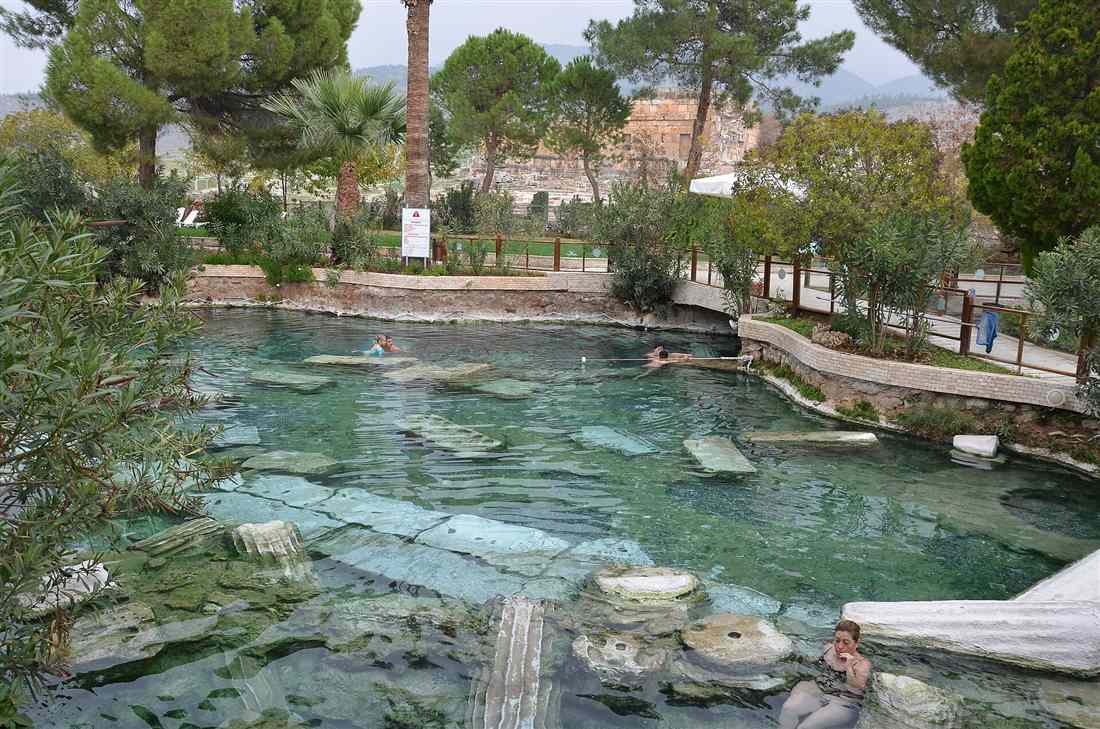
Cleopatra’s Antique Pool is a natural thermal bathing pool at the centre of Hierapolis, its floor strewn with fallen marble columns and capitals toppled by an ancient earthquake. Bathers swim among genuine Roman antiquities in warm, effervescent spring water charged with dissolved minerals.
The pool fills a basin that once stood beside a monumental temple portico. An earthquake of the seventh century brought the marble colonnade crashing into the spring, and the fluted Doric and Ionic shafts, drums and capitals settled where they fell. The water rises from the same source that built the travertines, holding it near thirty-six degrees the year round and releasing a steady stream of carbon-dioxide bubbles that cling to the skin. Swimmers glide directly over the submerged columns, resting against carved marble that has lain there for thirteen centuries.
The mineral load is high in calcium, magnesium, bicarbonate and sulphate, and the spring discharges hundreds of litres a second. Entry to the pool requires a separate ticket beyond the main Hierapolis-Pamukkale admission, with a changing area, showers and lockers arranged around the basin. The name honours the tradition that links the Ptolemaic queen to the founding gift of the springs, a legend the site carries though the pool’s antiquities are Roman. The combination of open-air thermal bathing and immersion in real classical ruins makes this the single most distinctive experience the ancient city offers.
Why was Hierapolis a healing and spa city?
Hierapolis grew wealthy as a healing resort because its hot mineral springs, rich in calcium and sulphur, drew patients from across the Roman world. Physicians prescribed its waters for skin, circulation and joint ailments, and the city built its economy on balneology and thermal tourism.
The springs emerge along a geological fault at temperatures near thirty-five degrees, saturated with calcium bicarbonate that deposits the white travertine as the water cools. Ancient medicine ranked mineral bathing as a serious treatment, and the reputation of Hierapolis reached Rome, Alexandria and Antioch. Invalids arrived to soak in the thermal pools, to drink from prescribed sources, and to breathe the warm vapours, and the same visitors who came for cures also came to worship at the sanctuary of Apollo and the neighbouring Plutonium, the gas-venting cave dedicated to the underworld.
The economy that this reputation created is visible in the ruins. A theatre seating twelve thousand, two bath complexes, colonnaded avenues and one of the largest necropolises in Anatolia all speak to a steady flow of wealthy patients and pilgrims. The graves themselves record the trade: tombstones name doctors, priests of the healing cult and travellers who died far from home. Hierapolis marketed the union of medicine, religion and leisure, a spa culture the geological setting made possible and Roman engineering made comfortable.
The city guarded the source of its fame with ritual. Priests controlled access to the Plutonium, the sacred cave beside the Apollo temple where carbon-dioxide gas pooled at the ground and killed birds and animals brought to the entrance, a demonstration the ancient writer Strabo recorded from his own visit. Eunuch priests of Cybele walked into the fumes unharmed, holding their breath above the toxic layer, and the spectacle drew crowds who read the cave as a mouth of the underworld. The pairing of a lethal vent and life-giving springs on one plateau fixed the reputation of Hierapolis as a place where the powers of health and death met, and that dual character carried its name across the Roman world.
What is the Latrine and the Agora of Hierapolis?
The Latrine is a colonnaded Roman public toilet on the main street, its stone seating flushed by continuous spring water. The Agora, north of the centre, was one of the largest market squares of Anatolia, framed by stoas and the ranking commercial heart of the city.
The Latrine stands along the Frontinus Street, the colonnaded avenue that runs the length of the city between two monumental gates. Marble seats lined the side walls above a channel of running water that carried waste away, while a second channel at the visitors’ feet supplied clean water for washing. A row of columns supported the roof and framed the interior, a design repeated in Roman towns across the empire and preserved at Hierapolis with much of its stonework in place. The thermal springs guaranteed the constant flow that kept the building sanitary.
The Agora occupies the ground north-east of the theatre and measures roughly one hundred and seventy metres by two hundred and eighty, ranking it among the largest of the Greek East. Colonnaded stoas enclosed the open square on all four sides, and a monumental basilica-stoa closed the eastern edge, its Ionic and Corinthian order carrying reliefs of the town’s mythology. Traders sold marble, textiles and the celebrated dyed wool of the Lycus valley here, and the civic administration met in the buildings around the perimeter. Together the Latrine and the Agora show the daily machinery of the Roman city, the plumbing and the marketplace that supported its monuments.
How do you visit Hierapolis and the travertines together?
Hierapolis and the Pamukkale travertines share one archaeological site and one combined ticket. Visitors climb barefoot up the white terraces from the village, reaching the ancient city at the top, or drive to the north and south gates and walk down through the ruins to the pools.
The white travertine terraces form the western flank of the plateau, and the ancient city spreads across the flat ground directly above them, so the two are inseparable parts of the same protected landscape. From the village of Pamukkale at the foot of the hill, a barefoot path leads up the terraces themselves, with shoes carried in hand to protect the calcite crust, emerging beside Cleopatra’s Pool at the heart of the ruins. The route rewards the climb with the thermal pools underfoot and the theatre and baths ahead.
Two vehicle gates serve the upper site. The South Gate opens near the museum and the Great Baths, and the North Gate sits by the necropolis and the monumental arch of Domitian, letting a visitor walk the full length of Frontinus Street downhill toward the terraces. Tour coaches use the upper gates to spare passengers the climb, then descend on foot to the pools. The full account of the terraces, the barefoot walk and the springs sits on the dedicated Pamukkale page. Whichever gate a visitor enters, the single ticket covers both the calcite terraces and the archaeological city.
What are the opening hours and ticket for Hierapolis?
The Hierapolis-Pamukkale site opens daily, from early morning to late evening in summer and to late afternoon in winter. One combined ticket admits both the travertines and the ruins, while the Archaeology Museum and Cleopatra’s Antique Pool each charge a separate entrance fee.
Summer hours run from around six-thirty in the morning to late in the evening, extended so visitors watch the sunset colour the terraces. Winter hours contract to roughly eight in the morning until five or six in the afternoon as daylight shortens. The gates stay open every day of the week, and the terraces remain accessible after dark in the warm season for those who enter before closing. Ticket prices move with the official tariff set for Turkish heritage sites, and the combined admission covers entry through any of the site gates.
The two premium attractions carry their own charges. The Archaeology Museum in the Roman baths asks a modest additional fee on top of the site ticket. Cleopatra’s Antique Pool charges a higher separate rate for swimming among the sunken columns, priced by the bathing session rather than the day. Prices sit within the ranges published by the culture ministry and rise with each season’s tariff, so a visitor confirms the current figure at the gate. The Turkish Museum Pass, valid across the national sites, admits the holder to the archaeological area, though the swim in Cleopatra’s Pool stays a paid extra.
How long do you need at Hierapolis?
Half a day covers the highlights of Hierapolis, the theatre, the terraces, Frontinus Street and the necropolis. A full day allows the Archaeology Museum, a swim in Cleopatra’s Pool, the climb to the Martyrium of St Philip and the far reaches of the tombs.
A focused visit of three to four hours takes in the essentials. From the South Gate a visitor walks the colonnaded street, climbs to the restored theatre for the view across the plateau, descends past the baths, and finishes barefoot on the travertine terraces. That circuit captures the monuments every traveller comes to see and fits comfortably into a morning or an afternoon before a coach moves on.
A whole day unlocks the depth of the site. The Archaeology Museum absorbs an hour among its sarcophagi and theatre reliefs, a swim in Cleopatra’s Pool adds a leisurely stretch of thermal bathing, and the walk east and uphill to the octagonal Martyrium of St Philip and the apostle’s tomb rewards the climb with the city’s Christian layer. The northern necropolis, one of the largest in Anatolia with more than a thousand tombs, invites a slow wander among house-tombs, tumuli and sarcophagi. Travellers who arrive early beat the midday coaches and the fierce plateau heat, then linger for the low evening light that turns the white terraces gold.
How does Hierapolis compare with Ephesus?
Hierapolis and Ephesus are both UNESCO-listed Greco-Roman cities of western Turkey, paired on most classical itineraries. Ephesus is larger and grander, with its marble Library of Celsus and vast theatre, while Hierapolis adds the white travertines, the thermal pools and the apostle’s shrine.
Ephesus was the metropolis of the Roman province of Asia, a port city of a quarter of a million people whose marble streets, terraced houses and the two-storey facade of the Library of Celsus survive in dense, monumental order. Hierapolis was a smaller spa town of the interior, its fame built on healing springs rather than commerce and administration. The contrast defines the pairing: Ephesus displays the machinery of a great imperial capital, and Hierapolis presents the resort culture of mineral bathing crowned by a geological wonder no other ancient city possesses.
The two sit within a two-and-a-half-hour drive of each other across the hills of Aydın and Denizli, and Turkey tours join them into a single classical loop, adding Aphrodisias and the Meander valley between. A traveller pairs the marble grandeur documented on the Ephesus page with the terraces and thermal ruins of Hierapolis for the fullest reading of Roman Anatolia. Where Ephesus tells the story of trade, government and the early Church at scale, Hierapolis tells the story of medicine, leisure and pilgrimage, and the two together map the range of life in the Greek and Roman East.
Frequently Asked Questions
What is Hierapolis?
Hierapolis is an ancient Greco-Roman spa city on the plateau above the Pamukkale travertines in Denizli, Turkey. Founded by the kings of Pergamon, it holds a Roman theatre, a vast necropolis, the Plutonium and the tomb of St Philip.
Is Hierapolis the same as Pamukkale?
Hierapolis and Pamukkale form one UNESCO site on the same ticket. Pamukkale is the natural white travertine terraces; Hierapolis is the ruined ancient city on the ridge directly above them.
How long do you need at Hierapolis?
Half a day covers the theatre, necropolis and main street of Hierapolis. A full day adds the museum, the Martyrium of St Philip and a swim in Cleopatra’s Antique Pool among the fallen marble columns.