
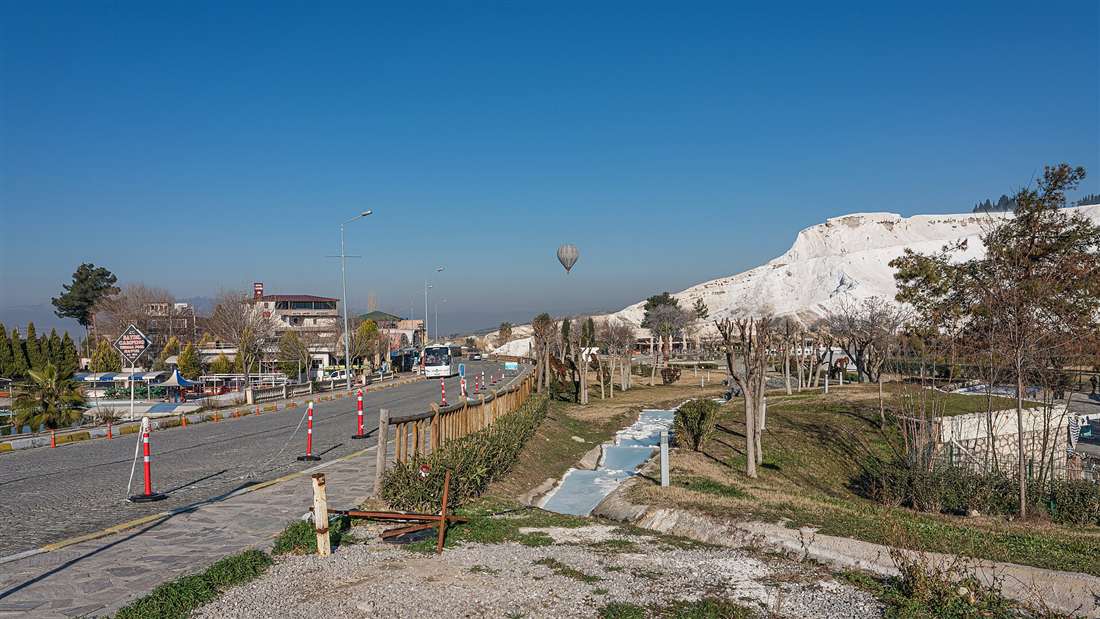
The Pamukkale hot air balloon ride lifts off at first light for a 45-to-60-minute sunrise flight over the white travertine terraces of Pamukkale and the ruins of Hierapolis, with the terraces glowing under the dawn light. Plan the whole trip with Greece Tours.
This guide covers the Pamukkale hot air balloon in full: what the ride is, when the flights take off, how long they last, the cost, what you see from the basket, the safety and the licensed pilots, the altitude, what to wear and bring, how to book it with a tour, and how a Pamukkale flight compares with Cappadocia.
What is the Pamukkale hot air balloon ride?
The Pamukkale hot air balloon ride is a sunrise flight that lifts passengers above the white travertine terraces, the ancient city of Hierapolis and the Denizli valley, delivering an aerial view of the calcium-white cliffs and turquoise thermal pools for 45 to 60 minutes.
The balloon launches from a field near the base of the travertines while the sky still holds its pre-dawn blue. As the burner fires and the envelope fills, the wicker basket rises and the whole plateau opens beneath the passengers. The dazzling white shelf of Pamukkale, formed by mineral-rich hot springs depositing carbonate over the cliff face, spreads out like frozen snow against the green farmland of the valley floor.
From the basket the ruins of Hierapolis stand out along the ridge above the terraces, the Roman theatre, the colonnaded street and the vast necropolis all visible in a single sweep. The flight traces the line where the white cliff meets the plain, then drifts over the town of Pamukkale village and the fields toward Denizli. The morning light strikes the travertines at a low angle, turning the pools amber and rose as the sun clears the eastern ridge.
The experience pairs the drama of flight with one of Turkey’s signature landscapes. Passengers stand in an open basket with a clear horizon in every direction, the pilot controlling altitude with quiet bursts of the burner. The ride is smooth and near-silent between burns, the ground sliding past in slow motion. For a broader itinerary that combines the flight with the terraces on foot, the Pamukkale guide sets out the wider destination.
The flight ranks among the calmest ways to see the site. There is no rush of speed, no engine noise, and no window frame to break the view. The basket moves with the air rather than against it, so the wind is imperceptible and the horizon stays level throughout. Photographers value the low, steady platform for the sweeping shots the ground angles deny, and first-time balloon passengers find the still ascent far gentler than expected. The whole plateau, from the springs feeding the terraces to the tombs lining the ridge, reads as a single connected landscape from the air.
When do the Pamukkale balloon flights take off?
Pamukkale balloon flights take off before dawn, launching at first light so passengers watch the sunrise from the air. Pilots inflate the envelopes in the dark and lift off as the horizon brightens, with the exact time shifting through the year as sunrise moves earlier or later.
The pre-dawn launch is deliberate. Air at first light is cool, stable and still, the ideal window for a controlled ascent and a soft landing. Winds strengthen as the ground heats through the morning, so the flight ends before the day warms. Passengers leave their hotels in the dark, reach the launch field as the crew unrolls the envelopes, and lift off just as the first colour reaches the sky.
Pickup times track the season. In the long days of high summer, sunrise arrives early and the hotel transfer starts near half past four. Through the shorter days, the pickup shifts later toward half past six. The operator confirms the exact collection time the evening before, once the meteorology office issues the dawn wind reading for the valley.
The schedule is weather-dependent. Pilots fly only when surface wind, upper wind and visibility all sit inside civil-aviation limits. A gusty morning, low cloud or fog over the plain grounds the fleet, and the flight moves to the next clear dawn. Operators build this into the booking: a cancelled flight refunds in full or reschedules for the following morning at no extra charge. Spring and autumn deliver the steadiest mornings, while summer offers the highest run of flyable days across the calendar.
How long is the Pamukkale balloon flight?
The Pamukkale balloon flight lasts 45 to 60 minutes in the air. The full experience runs 2 to 3 hours from hotel pickup to return, taking in the transfer, the inflation and safety briefing, the flight itself and the celebration on landing.
The airborne segment fills three quarters of an hour to a full hour, depending on the morning wind and the flight path the pilot draws over the terraces and Hierapolis. A steadier breeze carries the balloon farther across the valley and extends the drift; a calmer dawn holds the balloon closer to the travertines for a slower, tighter circuit above the white cliffs.
The surrounding time frames the flight. The hotel transfer to the launch field takes 15 to 30 minutes across Pamukkale village and the Denizli approach. On arrival the crew inflates the envelope with cold-air fans and then hot burners, a process that runs 15 to 20 minutes while the pilot delivers the safety briefing and the basket assignments. Passengers board as the balloon stands upright and ready.
Landing closes the sequence. The pilot selects a clear field, brings the basket down and the ground crew secures the balloon while passengers step out. A short celebration follows, a toast and the handing of a flight certificate, before the transfer returns everyone to their hotel. The early finish leaves the rest of the morning free to walk the travertines and explore Hierapolis on the same day, with the sun still low and the crowds thin.
How much does a Pamukkale hot air balloon ride cost?
A Pamukkale hot air balloon ride costs roughly 130 to 220 euros per person. The fee covers the round-trip hotel transfer, the sunrise flight of 45 to 60 minutes, the in-flight burner-lit ascent, a sparkling toast on landing and a printed flight certificate.
The price sits at the lower end for standard-basket flights that carry 16 to 24 passengers and at the upper end for smaller baskets that hold 8 to 12 and grant more room at the rail. Season drives the figure: the spring and autumn peak lifts rates as demand climbs, while the quieter shoulder mornings soften them. Booking direct with a licensed operator or through a reputable tour platform holds the rate steady and confirms the pilot’s civil-aviation credentials.
The inclusions are consistent across operators. The transfer collects passengers from hotels in Pamukkale village, Karahayit and central Denizli and returns them after landing. Flight insurance sits inside the fare, as required by the aviation authority. The celebration on landing and the personalised certificate mark the flight, and photographs from the basket come at no charge with most operators, with a professional aerial video offered as a paid extra.
What the fare excludes is worth noting at booking. The travertine and Hierapolis site entry ticket is separate from the balloon fee, purchased at the park gate. Gratuities for the pilot and ground crew are discretionary. A private full-basket charter, booked for a couple or a small group with no shared passengers, prices well above the per-person shared rate and is arranged on request for proposals and celebrations.
What do you see from the balloon over Pamukkale?
From the balloon over Pamukkale passengers see the white travertine terraces, the turquoise thermal pools stepping down the cliff, the ruins of Hierapolis along the ridge, the vast Roman necropolis, and the green Denizli plain rolling out to the Babadag and Honaz mountains.
The travertines dominate the view. The mineral cliff drops in a series of scalloped basins, each holding a pool of warm water tinted turquoise and gold in the low sun. From above, the terraces read as a single sheet of brilliant white cut into curves, the pattern of the pools sharper from the air than from any point on the ground. The contrast between the calcium-white shelf and the surrounding farmland defines the whole panorama.
Above the terraces sit the ruins of Hierapolis, the Greco-Roman spa city built on the hot springs. The balloon path reveals the theatre carved into the hillside, the long colonnaded main street, the temple platforms and the sacred pool. Beyond the walls the necropolis spreads across the slope, one of the largest ancient cemeteries in Anatolia, its tombs and sarcophagi laid out in ranks that only altitude renders whole.
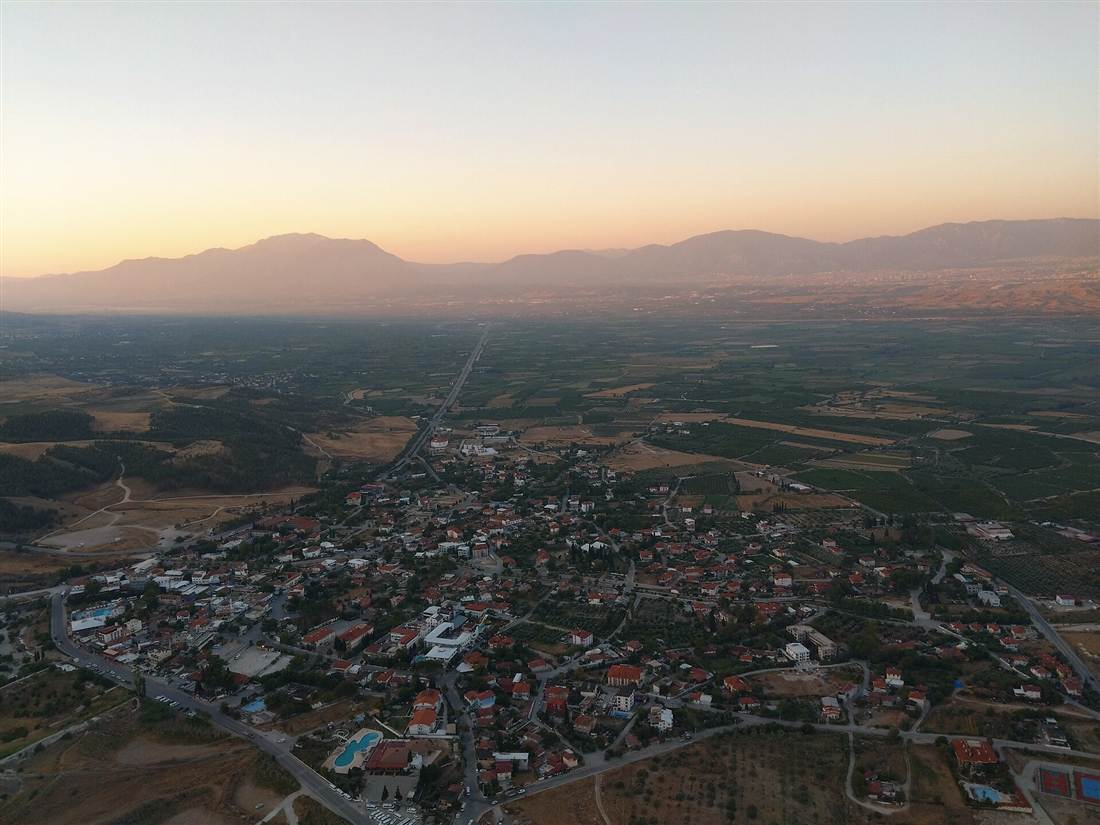
The wider frame closes the picture. The Denizli valley stretches north and west in a patchwork of cotton fields, orchards and villages threaded by the Menderes river. The mountains rim the horizon, catching the first light on their upper slopes while the plain still lies in shadow. As the sun clears the ridge, the colour floods across the terraces and the pools ignite, the single most photographed moment of the flight.
Detail sharpens on the low passes. The pilot drops the basket close to the cliff, and the ridged texture of the travertine steps into focus, the mineral crust building outward in fine ledges where the spring water spills and cools. Above, the columns and arches of Hierapolis stand at eye level, the stonework detailed enough to trace. The pattern repeats with every descent: the wide valley panorama at height, then the intimate close view of terrace and ruin as the balloon dips, each pass framing the site from a fresh angle.
Is the Pamukkale balloon ride safe?
The Pamukkale balloon ride is safe. Flights operate under the Turkish civil-aviation authority with licensed commercial pilots, certified and inspected balloons, mandatory passenger insurance and strict weather minimums that ground the fleet the moment wind or visibility falls outside the approved envelope.
Every pilot holds a commercial balloon licence issued after logged flight hours, written examinations and recurrent medical checks. The authority audits operators, inspects each envelope and basket on a fixed maintenance cycle, and records every flight. Pilots read the dawn wind and cloud data before committing to a launch and abort the morning without hesitation when the numbers sit outside limits. This discipline explains the strong safety record across the Pamukkale and wider Turkish ballooning fleet.
The equipment adds further margin. The envelope carries multiple independent fabric panels, the basket is built to absorb a firm landing, and the burner runs from separate fuel cylinders so a single fault leaves ample redundancy. The pilot briefs every passenger on the landing position before boarding: feet on the basket floor, knees bent, hands gripping the interior rope handles, facing the direction of travel. Following the brief keeps the touchdown smooth.
Ballooning demands no fitness or experience from passengers. The basket stands still through the flight, the motion between burns is gentle, and the ascent is slow rather than sudden. Passengers with a fear of heights find the enclosed rail and the absence of any tilting or swinging far calmer than an open ledge. The ground crew tracks the balloon by road throughout and reaches the landing field within moments of touchdown.
Operators cap passenger numbers per basket to the certified load and check the manifest against it before boarding. The pilot carries a radio in constant contact with the ground crew and the local aviation office, relaying position and receiving updated wind data through the flight. Children below a set height and passengers with recent surgery or advanced pregnancy sit outside the flight rules, and the operator confirms eligibility at booking. These layered checks, applied every morning, keep the Pamukkale flight inside a tight safety margin from launch to landing.
How high does the Pamukkale balloon go?
The Pamukkale balloon climbs to around 900 metres above the valley floor at its highest, then descends to skim just above the travertines and Hierapolis. The pilot varies altitude through the flight, holding to the aviation ceiling set for the airspace over the site.
Altitude is the pilot’s single control. Firing the burner heats the air inside the envelope and lifts the balloon; letting the air cool brings it down. The pilot works this vertical range to find the wind layers that carry the balloon on the intended track, since different heights hold different wind directions. A low layer drifts the basket one way across the plain, a higher layer another, and the pilot moves between them to shape the flight path.
The profile mixes high and low passes. Near the ceiling the whole valley opens, the terraces, the ruins and the distant mountains framed in one view. The pilot then descends to bring the basket within metres of the white cliff and the tops of the Hierapolis columns, close enough to pick out the detail of the pools and the carved stone. This alternation between the panorama and the low skim defines the Pamukkale flight.
The ascent stays gentle throughout. The balloon rises and falls at a walking pace, with no lurch and no sensation of speed, so ears equalise naturally and the height registers as spectacle rather than strain. The 900-metre figure marks the upper limit; much of the flight runs lower, tracing the terraces at close range where the landscape reads sharpest.
What do you wear and bring for the balloon ride?
Wear layers for the cool dawn and closed flat shoes for the launch field, and bring a camera or phone with a secured strap. The pre-dawn air is cold, the launch field is uneven, and the burner adds warmth overhead once the balloon lifts.
Dress for the early chill and the mid-flight warmth together. A base layer under a fleece or light jacket handles the cold field at first light, and the jacket comes off as the sun rises and the burner radiates heat down into the basket. Long trousers suit the walk across the launch ground, and a hat that fastens stays put through the ride. The temperature difference between the dark launch and the sunlit landing is marked, so removable layers earn their place.
Footwear matters on the ground rather than in the air. Closed, flat shoes with a firm sole cross the dewy grass and gravel of the launch field and steady the step onto the basket. Open sandals and heels leave feet cold and unstable. The basket floor is solid and level once airborne, so the shoes serve the boarding and the landing.
Bring a camera and secure it. A wrist strap or neck cord keeps a phone or camera from dropping over the rail during a low pass. A spare battery guards against the cold draining the charge. Passengers with a fear of heights face no restriction on boarding: the enclosed basket, the slow ascent and the still platform ease the nerves, and the pilot positions anxious passengers at the centre of the basket for extra reassurance.
How do you book a Pamukkale balloon flight and combine it with a tour?
Book the Pamukkale balloon flight direct with a licensed operator or through a tour platform, reserving a place on the sunrise flight before a full day at the travertines and Hierapolis. An overnight stay in Pamukkale village puts passengers minutes from the pre-dawn pickup.
The booking runs a day or two ahead in the shoulder seasons and further ahead across the spring and autumn peak, when the limited baskets fill fast. Reserving locks the transfer, the flight and the certificate; the operator confirms the pickup time and hotel the evening before once the dawn wind reading lands. A flexible ticket that refunds or reschedules on a weather cancellation protects the booking against a grounded morning.
The flight slots neatly into a Pamukkale itinerary. The balloon lands and returns passengers to their hotel with the morning still young, freeing the rest of the day to walk the white terraces barefoot through the warm water and to explore the ruins of Hierapolis above them, the theatre, the necropolis and the thermal sacred pool. The Pamukkale destination guide sets out the ground itinerary that follows the flight.
An overnight in Pamukkale village turns the trip into a comfortable two-day plan. Staying in the village or nearby Karahayit shortens the pre-dawn transfer to a short hop and removes a long early drive from Denizli or the coast. Most visitors pair the balloon and the site with a road journey from Antalya, Fethiye or the Aegean resorts, arriving the afternoon before, flying at dawn and touring the terraces before moving on. The two-day rhythm removes every rushed transfer, opens the terraces at their quietest hour after the flight, and turns Pamukkale from a stop into a destination in its own right.
Pamukkale or Cappadocia for a hot air balloon — what is the difference?
Pamukkale offers a smaller, quieter sunrise flight over white travertine terraces and Roman ruins, with a handful of balloons in the sky. Cappadocia runs a far larger daily fleet over the fairy chimneys and rock valleys, the busier and more famous of the two ballooning sites in Turkey.
The landscapes set the two apart. Pamukkale flies above the brilliant calcium-white cliff, the turquoise thermal pools and the ridge-top ruins of Hierapolis, a compact and distinctive panorama framed by the green Denizli plain. Cappadocia drifts over eroded volcanic tuff, the tall fairy-chimney pillars, cave dwellings and the deep folds of the Göreme valleys, a vast and otherworldly terrain of rock. Each delivers a scene the other has no equal to.
The scale of operation differs sharply. Cappadocia launches a large fleet at dawn, and the sky fills with balloons, a spectacle in itself and a magnet for photographers, though it brings crowds and higher prices. Pamukkale keeps a modest number of balloons aloft on any morning, so the flight feels private and the launch field calm. The quieter operation suits travellers who prefer space over spectacle.
Choice follows the trip. Travellers routing through central Anatolia lean to Cappadocia for the fairy-chimney flight and its scale. Travellers on the Aegean and Mediterranean circuit, taking in Ephesus, the coast and the thermal sites, add Pamukkale for the terrace flight without a long detour. The two sit far apart across Turkey, so the itinerary, rather than a ranking, decides which balloon a visitor boards.
Travellers with time for both fly each once and treat them as complementary rather than rival experiences. Cappadocia delivers the grand fleet and the rock-carved valleys; Pamukkale delivers the intimate flight over the white terraces and the Roman city. The Pamukkale option adds a second, quite different ballooning morning to a Turkey trip without repeating the same scene, and it slots into the western circuit where Cappadocia sits too far east to reach. For visitors choosing one, the deciding factor is the region already on the route.
Frequently Asked Questions
What is the Pamukkale hot air balloon ride?
The Pamukkale hot air balloon ride is a sunrise flight over the white travertine terraces and ancient Hierapolis, lasting 45 to 60 minutes in the air. It gives a bird”s-eye view of the pools, ruins and the Denizli valley.
How much does a Pamukkale hot air balloon cost?
A Pamukkale hot air balloon flight runs in the mid-hundreds of euros per person, including the hotel transfer, the 45-to-60-minute sunrise flight and a certificate. Booking early and combining it with a day tour lowers the overall trip cost.
Is the Pamukkale balloon ride better than Cappadocia?
The Pamukkale balloon flight is smaller and quieter than Cappadocia, drifting over white terraces and Roman ruins rather than fairy chimneys. Cappadocia fills the sky with hundreds of balloons; Pamukkale offers a calmer, more intimate sunrise.