
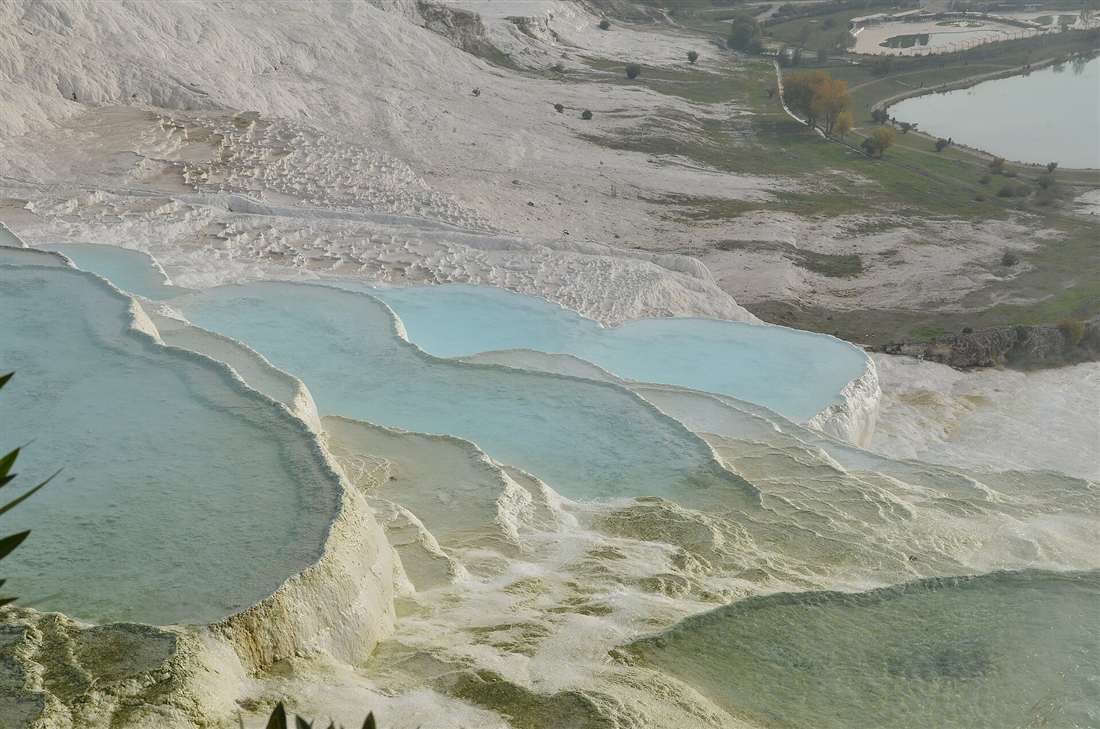
Pamukkale lies about 190 kilometres east of Kusadasi, a three-hour drive across the Aegean hinterland. A guided day tour with port or hotel pickup is the direct way to reach the travertines and Hierapolis and return the same evening. Plan the whole trip with Greece Tours.
This guide covers getting to Pamukkale from Kusadasi in full: the distance and drive time, whether the day trip is worth the long day, what a tour includes, the timing for cruise passengers, the public-transport and self-drive options, and how to combine Pamukkale with Ephesus on the same trip.
How do you get from Kuşadası to Pamukkale?
You reach Pamukkale from Kuşadası by travelling roughly 190 km east through Aydın and Nazilli, a drive of about three hours each way. A guided day tour with hotel or port pickup is the primary route; self-drive by hire car is the alternative. No direct scheduled bus links the two towns.
The overwhelming majority of visitors book an organised day trip. An air-conditioned coach collects passengers from Kuşadası hotels and the cruise port in the early morning, runs inland along the D550 and O-31 corridors, and returns the same evening. The guide handles the Hierapolis entrance, the travertine route and lunch, so the traveller spends the day at the sites rather than navigating Turkish road signs and ticket queues. This structure removes the connection gaps that make independent travel to Pamukkale slow.
Self-drive suits travellers who want to stop en route or stay overnight in Pamukkale village. Hire cars leave from Kuşadası town and Adnan Menderes Airport near İzmir, and the motorway east of Aydın carries the fastest section of the journey. Independent public transport exists in fragments — a bus to Denizli and a local minibus onward — but the transfers add time and waiting, which is why the tour dominates. The route east crosses the fertile Büyük Menderes valley, a flat agricultural plain of cotton and fig orchards that frames the drive to the white terraces.
Kuşadası itself sits on the Aegean coast in Aydın Province, a resort and cruise town built around a marina and the fortified islet of Güvercinada. Its position places Pamukkale firmly inland rather than along the shore, which fixes the eastward direction of travel and the length of the day. Travellers weigh the guided coach against self-drive on a single measure: whether they want the sites handled for them across a fixed 11-to-12-hour schedule, or the freedom of their own car at the cost of navigating tolls, parking and the full return distance unaided.
What is the distance and drive time from Kuşadası to Pamukkale?
The distance from Kuşadası to Pamukkale is about 190 km by road, and the drive time runs to roughly three hours each way. The route heads east through Aydın and Nazilli along the Büyük Menderes valley, then climbs the final stretch to Denizli and the Hierapolis plateau above Pamukkale village.
The first leg leaves Kuşadası and joins the main road toward Aydın, the provincial capital that sits at the mouth of the valley. From Aydın the O-31 motorway and the parallel D585 carry traffic east past Nazilli and Sarayköy. This central section moves quickly across level ground, so most of the three hours is genuine driving rather than stop-start town traffic. A refreshment halt at a roadside facility breaks the outbound leg on organised tours.
The closing stretch approaches Denizli, the large city that serves as the regional hub, then turns north toward the ridge where Hierapolis and the travertines sit. The total return distance across the day is close to 380 km, which explains why the itinerary fills a full day and why an early departure is fixed. Traffic through Aydın and Denizli thickens at commuter hours, so tours time their runs to clear both cities before the roads congest. The valley road stays at low altitude until the final ascent to the calcium-white terraces that overlook the plain.
Comparison with other Aegean bases sharpens the figures. Pamukkale sits about 190 km from Kuşadası, close to 230 km from Bodrum and roughly 250 km from Marmaris, so Kuşadası ranks among the shorter coastal approaches to the terraces. Denizli, the nearest airport and rail city, lies about 20 km from the site, which places the final leg of every route through that hub. Understanding the 190 km figure as a three-hour block rather than a raw number frames the day accurately: it is the reason the tour departs at dawn and the reason a single day covers the round trip without an overnight.
Is a Pamukkale day trip from Kuşadası worth it?
A Pamukkale day trip from Kuşadası rewards the long travel with the white travertine terraces and the ruined Roman city of Hierapolis, two of Turkey’s defining inland sights. The early start and six hours of return driving are the price; the calcium pools and ancient theatre are the return on that effort.
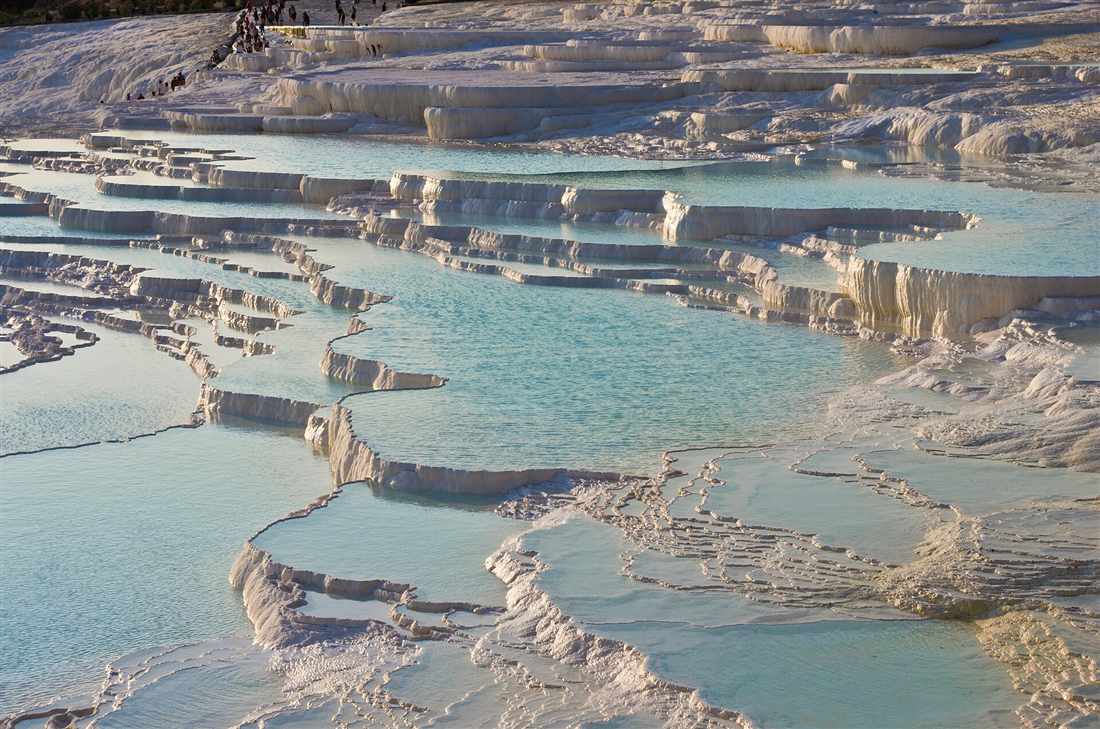
The draw is singular. Pamukkale — “cotton castle” in Turkish — is a hillside of mineral-rich hot springs that deposit white calcium carbonate, building tiered pools and frozen-looking cascades down the slope. Above them stands Hierapolis, a spa city founded by the Attalid kings of Pergamon and expanded under Rome, with a colonnaded street, a necropolis of stone sarcophagi and a theatre carved into the hillside. The pairing of a natural wonder and a UNESCO World Heritage archaeological site in one location concentrates the value of the trip.
The honest counterweight is the road. Passengers spend around six hours in the coach across the round journey and leave Kuşadası at dawn. Travellers who prize a slow beach day find that trade unappealing. Those who want to stand barefoot in the warm terraces and walk a Greco-Roman ruin without flying to a separate region find the day fully justified. For a fuller picture of the site itself, the destination page at Pamukkale sets out the terraces, the pool and the ancient city in detail.
The verdict turns on the traveller’s priorities and length of stay. A visitor with a single free day and a fixed return to a ship or flight treats the trip as the one chance to reach the terraces, and the round drive becomes a fair price for a UNESCO site otherwise unreachable from the coast. A visitor with a week on the Aegean and a car has the room to break the journey overnight, cutting the pressure of the dawn-to-dusk format. Either way the sites themselves rank among Turkey’s most photographed, and the barefoot walk down the warm white pools with the valley spread below is a landscape no coastal resort replicates.
What does a Pamukkale tour from Kuşadası include?
A standard Pamukkale tour from Kuşadası includes hotel or cruise-port pickup, an air-conditioned coach, a licensed guide, the Hierapolis-Pamukkale entrance ticket, and lunch. The itinerary covers the travertine terraces and the ruins of Hierapolis, with the thermal Cleopatra Pool offered as an add-on entry.
Transport and guiding form the core. The coach is climate-controlled for the valley heat, and the guide narrates the geology of the springs and the history of the Roman city on site rather than only in the vehicle. The entrance fee to the combined Hierapolis-Pamukkale archaeological area is bundled into most tour prices, which removes ticket queues at the gate. A buffet lunch at a restaurant near the site is standard on full-day itineraries.
The Cleopatra Pool, the antique thermal spring scattered with fallen marble columns from an earthquake, carries a separate entry charge that sits outside the base ticket, so bathing there is priced as an extra. Day-trip prices from Kuşadası run in the region of 45 to 90 euros per adult depending on group size and whether lunch and pickup are included, with small-group and private formats at the higher end. Travellers confirm at booking whether the quoted fare covers the site entrance and the meal, since budget listings sometimes strip both out.
The guiding covers the science and the story on the ground. At the terraces, the guide explains how carbon-dioxide-rich water from the springs releases gas as it cools, precipitating calcium carbonate that hardens into the white travertine and rebuilds the pools. At Hierapolis, the narration moves through the Domitian Gate, the frontinus street, the Roman baths that now house the site museum, and the theatre with its carved stage building. This context turns a photo stop into a understood visit, which is a core reason travellers pay for the guided format rather than arriving alone. What travellers pack matters too: a swimsuit for the Cleopatra Pool, a towel, sun protection for the shadeless slope, and a light bag for the barefoot walk across the terraces where footwear is barred to protect the surface.
How long is the Pamukkale day trip from Kuşadası?
The Pamukkale day trip from Kuşadası runs a full 11 to 12 hours door to door. Pickup starts between 04:00 and 05:30, the outbound drive takes about three hours, four to five hours cover the sites and lunch, and the return coach reaches Kuşadası in the early evening.
The clock is dictated by the 190 km each way. An early departure buys time at the terraces before the midday heat and the peak arrival of other coaches. After the roughly three-hour run east, the group walks the travertine slope barefoot, tours Hierapolis, breaks for lunch, and — for those paying the extra fee — bathes in the Cleopatra Pool. The site time totals four to five hours, enough to cover the terraces and the main ruins without a rush at either.
The return leg mirrors the outbound drive and lands passengers back at their Kuşadası hotels or the port around 18:00 to 20:00, subject to Aydın and Denizli traffic. Families with young children weigh the length carefully, since the day spans dawn to dusk with substantial seated travel. The reward for the long structure is a single-day round trip that reaches an inland World Heritage site from an Aegean coastal base and returns the same night.
Do cruise passengers visit Pamukkale from Kuşadası port?
Cruise passengers do visit Pamukkale from Kuşadası port, but the 190 km distance and three-hour transfer each way make timing the central concern. The safe route is a shore excursion that guarantees return to the ship before all-aboard, since the round trip consumes almost the entire port day.
Kuşadası is a major cruise call on Aegean itineraries, and Pamukkale ranks alongside Ephesus as a headline shore excursion. The arithmetic is tight: with six hours of driving plus four to five hours at the site, the excursion fills 11 to 12 hours, which sits at the edge of a standard port window. Ships that dock early morning and depart in the evening give the day the room it needs.
The decisive advantage of a booked shore excursion — whether through the cruise line or a reputable independent operator — is the return guarantee. Operators that sell to cruise passengers track the ship’s all-aboard time and structure the drive to meet it, and cruise-line excursions hold the vessel in the event of a delay. Passengers who arrange transport independently carry the full risk of a missed departure if valley traffic slows the return. For port calls with a shorter window, the closer site of Ephesus is the more time-secure choice.
Small-group excursions marketed to cruise passengers depart the port gate within minutes of disembarkation, which protects the tight schedule against wasted morning time. Passengers verify three points at booking: the guaranteed return time against the ship’s all-aboard, whether the site entrance and lunch sit inside the price, and the group size, since a large coach loses time at every stop that a minibus of eight avoids. Kuşadası’s cruise terminal at the port district feeds directly onto the road east, so the transfer starts without a town crawl and the three-hour clock begins at the quay.
How do you reach Pamukkale from Kuşadası by public transport?
Reaching Pamukkale from Kuşadası by public transport means a minibus or bus to Aydın, an intercity coach onward to Denizli, and a local servis minibus from Denizli otogar up to Pamukkale village. The connections chain together across the day, which is why a guided tour outperforms the independent route.
The first hop is a dolmuş or regional bus from Kuşadası to Aydın, the valley capital about 75 km inland. From Aydın’s terminal, intercity coaches run east to Denizli, the large city that anchors the region and sits close to the travertines. Denizli’s otogar operates free or low-cost servis minibuses up to Pamukkale village at the foot of the terraces. Each leg is scheduled independently, so waiting between connections stretches the total transit well beyond the three-hour direct drive.
The independent route works for travellers on a tight budget or those staying overnight in Pamukkale village, where guesthouses cluster below the white slope. For a single day from Kuşadası, the transfers eat the hours that a coach tour spends at the site. The fares add up across three ticketed legs, and the return timing depends on the last servis and the last Aydın coach — a chain that leaves no margin for a delayed connection. The organised day trip removes every transfer and delivers pickup at the hotel door, which is why it dominates the market for one-day visits.
How does self-driving from Kuşadası to Pamukkale work?
Self-driving from Kuşadası to Pamukkale means hiring a car, following the road east through Aydın onto the O-31 motorway toward Denizli, then climbing to the Pamukkale site, a run of about 190 km and three hours. Paid car parks sit at both the north and south gates of the archaeological area.
Hire cars are available in Kuşadası town centre and at Adnan Menderes Airport near İzmir, the region’s main international gateway. The drive leaves the coast, joins the main road to Aydın, and picks up the O-31 toll motorway that runs the fast central section of the valley. The motorway uses the HGS electronic toll system, so a hire car with a valid transponder or a topped-up account clears the barriers without a cash stop — travellers confirm the toll arrangement with the rental desk before setting off.
At Pamukkale, drivers choose between the south gate on the Hierapolis plateau and the north gate, each with its own car park and entrance. The south gate places the car nearer the ancient theatre and the top of the terraces; the north gate opens onto the necropolis. Parking is charged, and the site ticket is bought at the gate. Self-driving gives freedom to linger past the fixed tour schedule and to break the journey at Aphrodisias, the marble-carving city off the Nazilli road, though it puts the full 380 km round drive on the traveller.
How do you combine Pamukkale with Ephesus from Kuşadası?
You combine Pamukkale with Ephesus from Kuşadası either as a two-day tour that sleeps overnight near the travertines, or as two separate single days — Ephesus one day and Pamukkale the next. Ephesus sits about 20 km from Kuşadası, so it pairs as a short half-day against Pamukkale’s full-day inland run.
The two sites bracket the region’s headline attractions but lie in opposite directions and distances. Ephesus, the vast Greco-Roman city with the Library of Celsus and the Great Theatre, is a short drive north of Kuşadası. Pamukkale is three hours inland to the east. A two-day combined tour handles both in sequence: Ephesus and the surrounding sites on day one, an overnight at Pamukkale or Denizli, and the travertines plus Hierapolis on day two, which removes one long return drive.
Travellers with two separate days achieve the same coverage without the overnight by booking each as a standalone trip. The compact Ephesus excursion leaves the afternoon free, while the Pamukkale day fills dawn to dusk. Splitting the sites this way suits those based in a Kuşadası hotel who prefer to return to the coast each night. The Ephesus destination page details the ruins, the timing and the tours for the coastal half of the pairing, which slots naturally against the inland Pamukkale day.
What is the best time to do the Kuşadası to Pamukkale day trip?
The best time for the Kuşadası to Pamukkale day trip is spring, from April to June, and autumn, from September to October, when the valley heat eases and daylight stays long. A midweek date and the earliest departure beat the coach crowds and let visitors reach the terraces before the midday arrivals.
The Büyük Menderes valley and the exposed travertine slope grow intensely hot at the height of summer, and the white calcium reflects the sun with no shade on the terraces. Spring and autumn hold comfortable temperatures for the barefoot walk and the Hierapolis ruins, while daylight remains long enough to cover the three-hour return before dark. Winter brings cooler air and thinner crowds, though the terrace pools feel cold underfoot and daylight shortens the site window.
Timing within the day matters as much as the season. The travertines and Hierapolis fill through the late morning as coaches converge from Kuşadası, İzmir, Marmaris and the cruise port, so the earliest tour departure secures the terraces at their emptiest. A midweek date thins the crowd further against the weekend peak, and the golden light of early morning and late afternoon sharpens the white terraces against the valley. Booking a small-group or private format on a shoulder-season weekday delivers the calmest version of the trip.
Weather across the seasons shapes the experience directly. Spring fills the valley with green cotton fields and moderate warmth ideal for the shadeless slope, while autumn holds dry, settled conditions after the summer heat breaks. Summer delivers long daylight but midday temperatures on the exposed terraces that drive visitors toward the earliest and latest hours. Winter thins the crowds to their lowest and dusts the surrounding hills, though the terrace water runs cold and daylight closes the site sooner. Matching the season to the priority — empty terraces, mild walking weather, or long light for photographs — sets the ideal date for the trip from Kuşadası.
Frequently Asked Questions
How far is Pamukkale from Kusadasi?
Pamukkale is about 190 kilometres east of Kusadasi, a three-hour drive each way through Aydin and Nazilli. A guided day tour covers the round trip with pickup, entry and lunch in a single 11-to-12-hour day.
Is the Pamukkale day trip from Kusadasi worth it?
The Kusadasi to Pamukkale day trip rewards the long drive with the white travertine terraces, a swim option at Cleopatra’s Pool and the ruins of Hierapolis, all on one ticket, best done on an early guided tour.
Can cruise passengers visit Pamukkale from Kusadasi port?
Cruise passengers reach Pamukkale from Kusadasi port on a booked shore excursion. The three-hour each-way drive makes timing tight, so a tour that guarantees return to the ship is the safe choice over independent travel.