
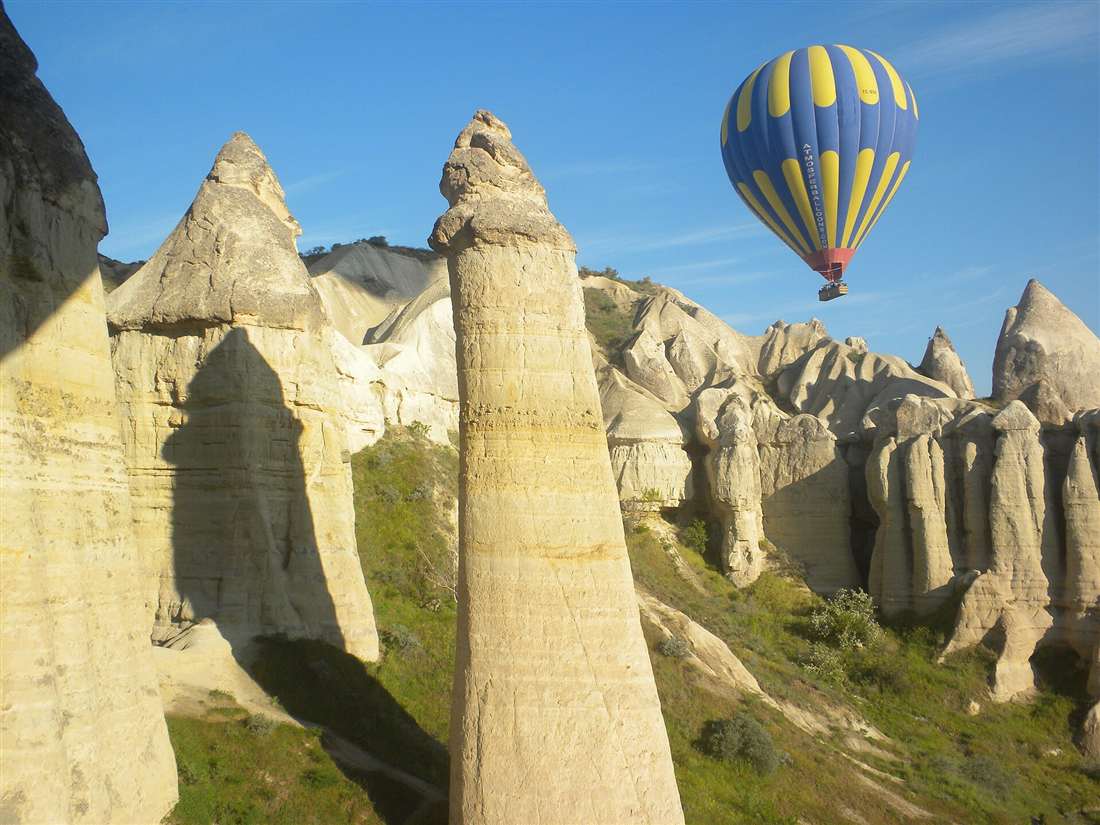
Cappadocia lies about 600 kilometres east of Pamukkale across central Anatolia. The overnight bus from Denizli is the direct link, with a connecting flight through Istanbul, self-drive, and multi-day tours the alternatives between Turkey’s two great natural wonders. Plan the whole trip with Greece Tours.
This guide covers getting from Pamukkale to Cappadocia in full: the distance and journey time, the overnight bus, the flights via Denizli and Kayseri, self-drive, the bus-versus-flight choice, the multi-day tours, the best order to travel, the stops on the way through Konya, how long to spend in Cappadocia, the cost, and why the fairy chimneys pair with the travertines of Hierapolis.
How do you get from Pamukkale to Cappadocia?
Four routes link Pamukkale and Cappadocia across roughly 600 km of central Anatolia: the overnight bus from Denizli otogar, a flight connecting through Istanbul between Denizli Çardak and Kayseri or Nevşehir, a self-drive via Konya, and a private or group tour transfer with everything arranged.
Pamukkale sits in Turkey’s south-west, in Denizli province, while Cappadocia lies deep in the central plateau east of Konya. The two natural wonders bracket a broad stretch of Anatolian farmland, salt lakes and Seljuk towns, so every route crosses the interior rather than the coast. The overnight coach is the workhorse of this corridor: it departs Denizli in the evening and rolls into Nevşehir or Göreme at breakfast, folding the journey into a night otherwise spent in a hotel.
The air route trades ground distance for two short hops and an airport connection, since no aircraft flies the city pair directly. Self-drive hands you the caravanserais, Konya’s Mevlana shrine and the lakeshore towns as stops of your own choosing. A tour transfer removes the timetable entirely, collecting you at your Pamukkale hotel and delivering you to a cave hotel in Göreme with the logistics handled. Travellers pairing the white travertine terraces with the fairy chimneys pick the route that matches their budget of money against time. The Pamukkale terraces reward an early start, so the departure day usually begins after a morning at the pools.
What is the distance and journey time from Pamukkale to Cappadocia?
Pamukkale to Cappadocia measures about 600 km by road and takes 9 to 10 hours of driving through central Anatolia. The route runs east from Denizli through Dinar, Afyon and Konya before climbing onto the volcanic plateau around Nevşehir and Göreme, the heart of the Cappadocia region.
The straight-line distance between the travertine terraces and the fairy chimneys is shorter than the road distance, near 450 km, because the highway bends around mountain ranges and the great salt lake, Tuz Gölü. Drivers who track the kilometre boards pass from the Aegean hinterland into the treeless steppe of the interior, gaining altitude the whole way. Göreme sits at about 1,000 metres above sea level, and the thinner, cooler air marks the arrival on the plateau.
Journey time stretches beyond the raw driving figure once you add fuel stops, a lunch break and the caravanserai or Konya detours that most travellers build in. A realistic door-to-door day by car runs 10 to 12 hours with stops. The overnight bus takes a touch longer than a private car, 10 to 11 hours, because it calls at intermediate otogars to set down and pick up passengers. The flight route compresses the airborne time to under three hours in total, yet the airport transfers, check-in and Istanbul connection push the practical door-to-door figure to 7 or 8 hours.
How do you travel from Pamukkale to Cappadocia by bus?
Take a shuttle from Pamukkale village to Denizli otogar, then board an overnight intercity coach east to Nevşehir. The bus leaves in the evening, runs 10 to 11 hours through the night, and arrives at breakfast, where a free servis minibus carries you the final stretch into Göreme.
Denizli otogar is the regional hub, and the terraces sit about 20 km north at Pamukkale village. Hotels arrange the short transfer to the bus station, or a local dolmuş covers it for a few lira. Major carriers such as Pamukkale Turizm, Kamil Koç and Metro Turizm run the eastern night services, and their coaches carry reclining seats, personal screens, air conditioning and an onboard steward who serves tea, water and snacks. A curtained rest keeps the night comfortable enough to arrive rested.
The coach reaches Nevşehir otogar, the transport gateway for the whole Cappadocia valley network. From there the bus company’s own servis shuttle, included in the ticket, runs the last 10 km into Göreme, Ürgüp or Avanos and drops passengers near their cave hotel. Confirm the servis at the desk when you buy the ticket, and name Göreme as your final stop so the connection is booked through. The overnight timing is the route’s great advantage: you close your eyes in Denizli after a day at Pamukkale and open them among the fairy chimneys, having saved the price of a hotel night in the exchange.
Is there a flight from Pamukkale to Cappadocia?
No direct flight links the two. The air route runs from Denizli Çardak airport to Istanbul, then a connecting flight south-east to Kayseri or Nevşehir, the two airports serving Cappadocia. Total airborne time stays under three hours, though the Istanbul connection stretches the full day to 7 or 8 hours door to door.
Denizli Çardak airport lies about 65 km east of Pamukkale, a 50-minute transfer from the village. Turkish Airlines and its domestic partners fly Çardak to Istanbul, and from Istanbul the same carriers run frequent services to Kayseri Erkilet airport and to Nevşehir Kapadokya airport. Kayseri is the busier gateway, about 75 km from Göreme, while Nevşehir sits closer at 40 km but carries fewer flights. Both airports run shuttle and private transfers into the cave-hotel villages.
The catch is the routing through Istanbul, which adds a northern dog-leg and a connection wait. A same-day itinerary works when the Çardak departure lands in Istanbul with a two-hour buffer before the onward Cappadocia flight. Fares swing widely with season and booking lead time, so the air option rewards early planning. Travellers who value a full day at the terraces and a full day among the valleys pick the flight, since it converts an overnight into two useful daylight halves rather than a night in transit.
What is the self-drive from Pamukkale to Cappadocia like?
The self-drive runs about 600 km east on Turkey’s well-surfaced D-road network, roughly 9 hours behind the wheel through Dinar, Afyon and Konya onto the volcanic plateau. Car hire from Denizli or Pamukkale gives the freedom to stop at caravanserais, lakeside towns and the Mevlana shrine along the way.
The drive is straightforward on modern dual and single carriageways, with clear signage in Latin script and fuel stations spaced across the route. From Pamukkale the road climbs east through Dinar and skirts the lake country of the Lakes District before reaching Afyonkarahisar, a natural first-stop town. Beyond Afyon the highway runs to Konya, the largest city on the route and the traditional halfway rest, then presses east across open steppe past the fringe of Tuz Gölü towards Aksaray and Nevşehir. The final approach into Cappadocia reveals the eroded tufa ridges that give the region its unearthly skyline.
Car hire desks operate at Denizli Çardak airport and in Denizli city, and one-way rentals into Cappadocia let you drop the vehicle at Kayseri or Nevşehir rather than doubling back. Fuel is the main running cost on a 600 km leg, and Turkish motorway tolls run through the HGS electronic system that most hire cars carry. Break the drive into two days with a Konya overnight and the whole journey turns from an endurance run into a proper cross-country itinerary, with the plateau’s history unrolling through the windscreen.
Is the overnight bus or the flight better from Pamukkale to Cappadocia?
Take the overnight bus to save a hotel night and stretch your budget; fly to save the day and arrive rested. The bus turns 600 km and a night’s lodging into one paid ticket, while the flight through Istanbul converts the crossing into a few hours, at a higher fare and with an airport connection.
The overnight coach wins on economy and on time efficiency of a particular kind: it consumes the night, not the day. You spend the afternoon at the travertine pools, take an evening departure from Denizli, sleep through Anatolia and wake among the fairy chimneys with a full morning ahead and one fewer hotel bill. For travellers moving on a set budget, that combined saving of fare plus accommodation is the decisive figure.
The flight wins on comfort and on daylight. It removes the long night in a coach seat and delivers you fresh, and for anyone short on holiday days it protects a full day at each end. The costs are a higher ticket price, the transfers to Çardak and from Kayseri or Nevşehir, and the wait at the Istanbul connection. The verdict splits cleanly: budget and backpack itineraries take the night bus; time-pressed or comfort-first trips take the flight. Both deposit you in Göreme in time for a next-morning balloon flight, the experience most travellers cross the country to reach.
Do tours link Pamukkale and Cappadocia in one trip?
Yes. Multi-day Turkey tours string Istanbul, Pamukkale, Ephesus and Cappadocia into one itinerary with every transfer, hotel and guide included. Packages of 4 to 10 days move you between the sites by private coach or a bus-and-flight mix, so the 600 km hop from the terraces to the fairy chimneys is handled without a timetable to read.
These packages remove the planning load that the independent traveller carries. A guide meets you at Pamukkale, the transfer to Cappadocia is booked, the cave hotel is reserved and the balloon flight, valley walks and underground-city visits are slotted into the schedule. The transfer itself takes one of two forms: a private overnight or daytime road transfer, or a bus leg to a domestic flight, depending on the package tier and how long it allots to travel.
Combining the two natural wonders in a single guided trip suits first-time visitors to Turkey and anyone who values a hand on the logistics over the freedom of a self-planned route. The tour also weaves in the intervening history that a straight transfer skips, calling at Konya’s Mevlana museum or a Seljuk caravanserai on the road east. For the deeper archaeology at the terraces end, the ruined spa city above the pools is worth a half-day; the ancient city of Hierapolis crowns the travertine plateau and gives the tour its classical bookend before the plateau crossing.
What is the best order — Pamukkale then Cappadocia, or the reverse?
Most itineraries run Istanbul to Cappadocia to Pamukkale to the Aegean coast, tackling the fairy chimneys first and the terraces later. The logic is geographic: it draws a clean west-bound arc from the central plateau down to Ephesus and the sea, ending near the airports at Izmir rather than doubling back inland.
The classic Turkey loop starts in Istanbul, flies to Cappadocia for the balloons and valleys, then moves west by road or air to Pamukkale, and finishes at Ephesus and the Aegean resorts before flying home from Izmir. Following that arc, Cappadocia comes before Pamukkale, and the 600 km leg runs east to west rather than west to east. The order keeps every transfer pointing towards the coast and avoids retracing the interior.
Travellers who begin on the coast at Ephesus and Pamukkale reverse the sequence, ending inland at Cappadocia and flying home from Kayseri or Nevşehir through Istanbul. Both directions cover the same ground; the choice hinges on where the trip starts and which airport the return flight leaves from. What settles it is the onward geography: end at the coast and run Cappadocia first, end on the plateau and run Pamukkale first. The 600 km transfer sits in the middle of the loop either way, and the overnight bus, the flight and the self-drive all work in both directions.
Where do you stop between Pamukkale and Cappadocia?
Konya is the great midway stop, home to the Mevlana shrine of the whirling dervishes and the finest Seljuk architecture in Turkey. The route also passes Afyonkarahisar, the lakeside town of Eğirdir, and roadside caravanserais such as Sultanhanı, the medieval Silk Road inns that break the steppe crossing.
Konya sits almost exactly halfway and makes the natural overnight for a two-day drive. The Mevlana Museum, the green-tiled mausoleum of the poet and mystic Rumi, is the city’s centrepiece and one of Turkey’s most visited shrines. Around it stand Seljuk mosques and madrasas from the era when Konya was an imperial capital, and the city’s kitchens serve the local oven-baked lamb, etli ekmek. A Konya break turns the transfer into a genuine leg of the itinerary rather than dead mileage.
West of Konya, Afyonkarahisar rewards a stop with its castle rock, thermal spas and a reputation for the country’s best clotted cream and Turkish delight. South of the main road, Eğirdir spreads along a mountain lake with an old Greek quarter on a causeway island, a quieter detour for travellers with time in hand. East of Konya, on the run towards Aksaray, the Sultanhanı caravanserai stands beside the highway, a vast stone-vaulted inn built to shelter Silk Road caravans, its courtyard and prayer hall open to visitors. These stops turn the long inland crossing into the backbone of a Turkey trip.
How long do you need in Cappadocia after Pamukkale?
Two to three nights in Cappadocia after Pamukkale gives time for the essentials: one dawn hot-air balloon flight, a day walking the rock valleys, a day at an underground city and an open-air museum, and an evening or two in a cave hotel. Three nights builds in a weather buffer for the balloon.
The balloon flight is the reason most travellers cross the country, and it launches at dawn when the winds are calm. Because flights are grounded on windy or wet mornings, a two-night stay risks missing the only sky window; a third night doubles the chance of a clear launch. Booking the flight for the first eligible morning and holding the extra day as insurance is the standard tactic.
Beyond the balloon, Cappadocia fills two full days without repetition. The Göreme Open-Air Museum holds rock-cut churches with frescoes; the Red and Rose valleys, Love Valley and Pigeon Valley offer marked walks among the fairy chimneys; and the underground cities of Derinkuyu and Kaymaklı descend eight levels into the tufa, whole subterranean towns carved for refuge. Pottery-making Avanos, the ridge-top castle of Uçhisar and sunset points across the valleys round out the region. A cave hotel, its rooms hewn into the soft rock, is itself part of the visit and turns two or three nights into the trip’s highlight.
How much does it cost to get from Pamukkale to Cappadocia?
Budget the overnight bus at roughly 25 to 45 euros a seat, servis shuttle included. The connecting flight through Istanbul runs about 70 to 160 euros depending on season and booking date. A self-drive costs the car hire, near 35 to 60 euros a day, plus about 50 to 70 euros of fuel and tolls for the 600 km.
The bus is the cheapest crossing and the best value, since its overnight timing also removes a hotel night from the budget. Fares shift with the carrier tier and how far ahead you book, but the servis transfer from Denizli village to the otogar and from Nevşehir into Göreme is bundled into the ticket, so the headline price is close to the all-in cost.
The flight carries the widest price band because the Istanbul routing and the season drive it. Book weeks ahead and the two hops together land near the lower figure; leave it late in peak summer and the fare climbs. Add the Çardak transfer and the Kayseri or Nevşehir airport shuttle to the ticket for the true door-to-door total. Self-drive costs depend on the rental class and whether you take a one-way drop fee into Cappadocia, and the fuel-plus-toll figure covers the 600 km on Turkey’s HGS electronic tolling. Split three or four ways, the hire car rivals the bus per head and adds the caravanserais and Konya as stops the coach skips.
What is the road like from Denizli to Konya to Nevşehir?
The road runs on modern dual and single carriageways the whole way, well surfaced and clearly signed in Latin script. It climbs east from Denizli through Dinar and Afyon, crosses to Konya on fast highway, then presses east past the salt lake to Aksaray and up onto the Nevşehir plateau, a steady 600 km of open Anatolian driving.
The first leg out of Denizli threads the Lakes District, gaining height through Dinar towards Afyonkarahisar, where the castle rock marks the transition to the central steppe. Traffic thins beyond the towns, and long straight stretches cross farmland and rolling upland. Fuel stations with rest areas, tea houses and toilets punctuate the route at workable intervals, so the drive never strands you far from a break.
From Afyon the highway drops towards Konya across a wide agricultural basin, then the Konya-to-Aksaray section runs dead flat and fast beside the fringe of Tuz Gölü, the vast salt lake that flashes white in summer. The final climb from Aksaray to Nevşehir lifts you onto the tufa plateau, and the first eroded ridges of Cappadocia rise ahead. Road conditions hold up year-round, though winter brings snow and ice to the plateau sections, and a set of chains earns its place in the boot between December and March. Night driving is feasible on the lit main routes but loses the scenery that makes the self-drive worthwhile.
Do you need to change buses between Pamukkale and Cappadocia?
The main overnight coach runs Denizli to Nevşehir as one through service, so you stay on the same bus all night. The only changes are the short servis shuttles at each end: a minibus from Pamukkale village to Denizli otogar, and a second servis from Nevşehir otogar into Göreme, both included in a through ticket.
Buying the ticket to Göreme rather than to Denizli or Nevşehir alone books the servis connections as part of the fare. At the Denizli desk, name Pamukkale as your pick-up and Göreme as your destination, and the carrier arranges the feeder minibuses at both ends. The night coach itself makes scheduled halts at intermediate otogars to set down and pick up passengers, but you keep your seat through them, so these are pauses rather than transfers.
The Nevşehir arrival is where first-timers stumble, because the intercity coach terminates at the city otogar, not in Göreme village 10 km away. The included servis minibus bridges that final gap, running a loop through Göreme, Ürgüp and Avanos to drop passengers near their hotels. Confirm the servis is booked when you buy the ticket and check its departure bay on arrival at Nevşehir. Miss it and a taxi covers the last stretch for a modest fare, but the through booking makes the whole crossing a single ticket with no luggage-hauling changeover in the dark.
What is the best time of year to travel from Pamukkale to Cappadocia?
Spring, from April to June, and autumn, from September to October, are the prime windows. Mild days suit the terraces and the valley walks, the plateau is free of snow, and calm dawn skies give the best odds for a Cappadocia balloon flight. Summer runs hot on the interior, and winter brings snow and grounded balloons.
The two shoulder seasons align the weather at both ends of the journey. At Pamukkale, spring and autumn temper the reflected glare off the white travertine and warm the pools without the fierce summer heat. Across the plateau, the same months hold the clear, still dawns that let balloons launch, and the vineyards and orchards of the valleys turn green in spring and gold in autumn. The road crossing runs at its easiest, snow-free and dry.
Summer, from July to August, delivers reliable balloon weather but bakes the interior, and the terraces fill with peak-season crowds. Winter reverses the picture: Cappadocia under snow is a striking sight, cave hotels light their fireplaces, and fares fall, but wind and cloud ground balloon flights on a share of mornings, and the plateau road ices over. Travellers set on the balloon lean towards the shoulder months and book a spare night as insurance against a weather cancellation, whatever the season.
Where do you stay in Cappadocia after arriving from Pamukkale?
Stay in a cave hotel carved into the tufa, the region’s signature lodging. Göreme sits at the centre of the valleys and the balloon launch fields and suits first-timers; Ürgüp offers larger boutique conversions and wineries; Uçhisar crowns the ridge with the widest views. All three lie within 10 km of the Nevşehir arrival point.
Göreme is the natural base off the overnight bus, since the servis shuttle drops there and the village puts you on foot from the open-air museum, the valley trailheads and the dawn balloon fields. Its cave hotels range from simple rock-cut rooms to elaborate suites with terraces facing the sunrise. The walkable centre packs restaurants, tour desks and pottery shops into a compact grid beneath the fairy chimneys.
Ürgüp, a short hop east, trades Göreme’s backpacker buzz for a more polished boutique scene, with grand stone mansions converted into hotels and the Cappadocia wine trade on its doorstep. Uçhisar, built around a honeycombed rock castle, sits highest and commands the broadest panorama across Pigeon Valley to the peaks; its hotels prize the view above proximity to the trailheads. Avanos, on the Kızılırmak river, centres on its potters and makes a quieter, craft-focused base. Book the cave room ahead in the shoulder and summer seasons, and pick a terrace that faces east so the morning fleet of balloons rises straight into your view.
What do you pack for the Pamukkale to Cappadocia journey?
Pack a swimsuit and quick-dry towel for the terraces, a warm layer for the pre-dawn balloon and the cool plateau nights, sturdy shoes for the valley walks, and a light bag for the overnight coach. Cappadocia sits at 1,000 metres, so mornings run cold even when the terraces bake at midday.
The two ends of the trip demand opposite kit. At Pamukkale the swimsuit earns its place in the Antique Pool and the warm travertine channels, and a quick-dry towel handles the barefoot walk across the terraces. Sun protection matters on the glaring white slopes, so a hat, sunglasses and high-factor cream go on top of the day bag.
Cappadocia flips the packing list towards warmth and grip. The dawn balloon lifts off in the coldest hour, and the plateau nights chill fast after sunset, so a fleece or insulated layer travels well even in summer. The valley trails are dusty and uneven underfoot, which makes closed walking shoes the sensible choice over sandals. For the overnight coach, a compact carry-on with a change of clothes, a phone charger, an eye mask and a neck pillow turns the seat into a workable bed, while the main luggage rides in the hold. A refillable water bottle covers the long road stops between the terraces and the fairy chimneys.
How do you book a Cappadocia balloon flight after arriving from Pamukkale?
Book the balloon flight before you leave Pamukkale, targeting your first full morning in Cappadocia. Reserve online or through your cave hotel, pay a deposit, and pick the standard sunrise slot. Flights launch at dawn and are limited by daily permits, so early booking secures a basket on the morning you want.
Balloon operators cap the number of baskets aloft each day under a strict permit system, and the dawn flights sell out in peak months, so a reservation made days ahead beats turning up on spec. Booking from Pamukkale, before the overnight bus or the flight east, locks in the date. Cave hotels partner with licensed operators and arrange the pre-dawn pick-up from the door, which folds the booking into the check-in.
The flight itself lifts off before sunrise, when the air is coldest and stillest, and drifts an hour over the valleys as the sun climbs and lights the fairy chimneys. A support crew tracks the basket and serves a landing toast. Grounded mornings, cancelled for wind or cloud, refund the fare or rebook the next day, which is the reason to plan a spare night in the region. Aim the flight at your first eligible morning and hold the second as the fallback, and the whole crossing from the white terraces builds to that hour in the Cappadocia sky.
What do you do at Pamukkale before leaving for Cappadocia?
Spend the departure morning at the travertine terraces and the ruined spa city above them. Walk the white calcium pools barefoot, bathe in the warm mineral water, and climb to the ancient theatre and necropolis before an afternoon coach or evening flight east. The site opens at dawn, so an early start beats the heat and the crowds.
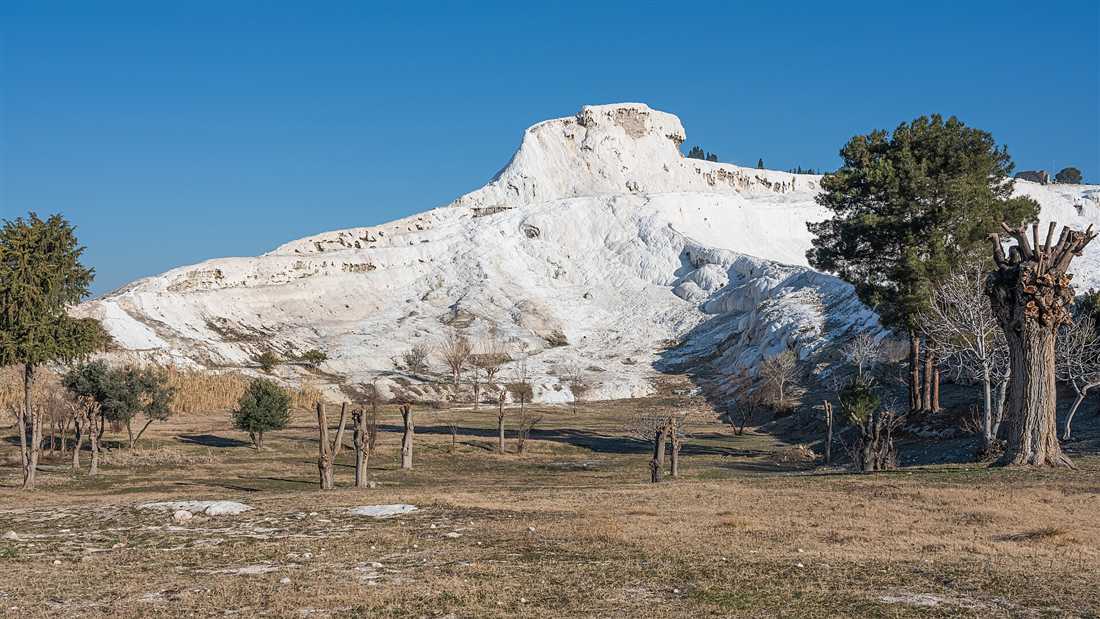
The terraces are the draw: tiers of dazzling white travertine hold shallow pools of turquoise thermal water that steps down the hillside. Visitors leave shoes at the entrance and wade the shallow channels, and the mineral-rich water is warm year-round. Early morning light throws the whitest reflections and the thinnest crowds, which makes the departure day the ideal time to arrive at opening.
Above the pools spreads the ancient spa resort the Romans built to take the waters, its colonnaded street, theatre carved into the hillside and vast necropolis of tombs all open to walk. The Antique Pool, scattered with fallen marble columns, lets you swim among the ruins in the same warm spring the ancients used. A morning covers the terraces and the ruins at a steady pace, leaving the afternoon to transfer to Denizli otogar for the night bus or to Çardak airport for the flight, so no daylight is wasted before the long crossing to the fairy chimneys.
How does the Pamukkale to Cappadocia leg fit a two-week Turkey trip?
The 600 km leg forms the spine of a classic two-week loop: Istanbul for three nights, a flight to Cappadocia for three, the overnight bus or flight west to Pamukkale for one, Ephesus and the Aegean coast for three, and Izmir for the flight home. The transfer bridges the plateau to the coast at the trip’s midpoint.
A fortnight gives room to run the arc without rushing. Istanbul opens the trip with the Blue Mosque, Hagia Sophia and the Grand Bazaar, then a one-hour domestic flight drops you into Cappadocia for the balloons, valleys and underground cities. From there the Pamukkale leg carries you west across Anatolia, either overnight by coach to save a day or by air through Istanbul to keep the daylight, landing you at the travertine terraces and the ruined spa city above.
The coast closes the loop. Beyond Pamukkale the road runs to Ephesus, the best-preserved classical city on the Mediterranean, then down to the Aegean resort towns of Kuşadası, Bodrum or Çeşme for beach days before the flight home from Izmir. Slotting the Pamukkale to Cappadocia crossing at the centre of the itinerary keeps every subsequent transfer pointing towards the sea, so no leg backtracks. The two natural wonders anchor the interior half of the fortnight, and the long central crossing between them is the journey the whole loop is built around.
What is Cappadocia and why go after Pamukkale?
Cappadocia is a volcanic region of central Turkey where wind and water have carved soft tufa into fairy chimneys, honeycomb cliffs and hidden valleys. Ancient communities hollowed churches, homes and whole underground cities from the rock. Paired with Pamukkale’s white terraces, it completes a two-part tour of Turkey’s greatest natural wonders.
The landscape formed when ancient volcanoes blanketed the plateau in ash that hardened into tufa, then eroded over millennia into cones, pinnacles and ridges. Byzantine Christians cut rock churches into the cliffs and painted them with frescoes, and villagers carved dwellings and dovecotes into the same soft stone. Beneath the surface, the underground cities of Derinkuyu and Kaymaklı drop eight storeys, with ventilation shafts, wells and stone doors that sealed against raiders. Today cave hotels turn that tradition into the region’s signature stay.
The pairing with Pamukkale is a study in contrast: two natural wonders shaped by the same slow chemistry of mineral and water, one glittering white on an Aegean hillside, the other ochre and rose across a volcanic plateau 600 km east. Pamukkale’s cascade of travertine pools and the ruined spa city above them make the western anchor of a Turkey trip; Cappadocia’s fairy chimneys and dawn balloons make the eastern one. Crossing the interior between them, by night bus, by flight or by the caravanserai road, is the through-line of the classic Anatolian journey, and reaching Göreme in time for a sunrise balloon is the moment the whole itinerary builds towards.
Frequently Asked Questions
How do you get from Pamukkale to Cappadocia?
The overnight bus from Denizli otogar is the direct way from Pamukkale to Cappadocia, about 10 hours across central Anatolia. A connecting flight through Istanbul to Kayseri or Nevsehir is faster, and multi-day tours include the transfer.
How far is Pamukkale from Cappadocia?
Pamukkale to Cappadocia is about 600 kilometres by road, a 9-to-10-hour drive east through Konya. The overnight coach covers it while you sleep; a flight via Istanbul cuts the door-to-door time to about half a day.
Is it better to take the bus or fly from Pamukkale to Cappadocia?
The overnight bus saves a hotel night and lands you in Cappadocia at dawn for the balloons. The flight via Istanbul saves daytime hours. The bus suits budget and time; the flight suits comfort and a short trip.