
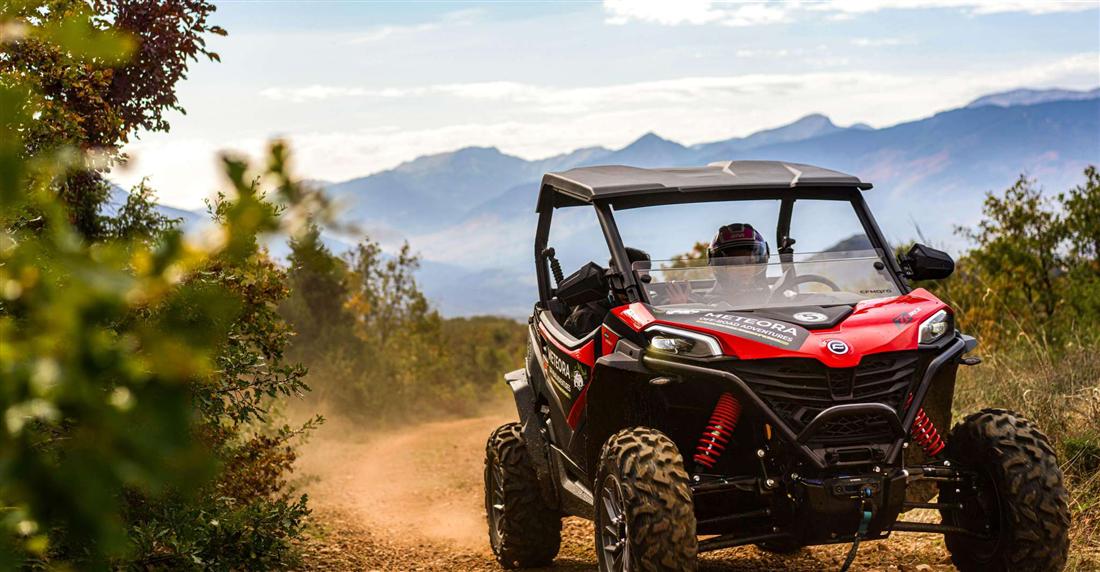
A Meteora jeep safari leaves the paved roads and follows dirt tracks between the giant rock pillars, past hermit caves and hidden viewpoints. For more active days out, browse Greece Tours.
This page sets out the rides you can book, the routes, the vehicles, the season and the kit to pack.
What is a Meteora jeep safari?
A Meteora jeep safari is a guided off-road ride on dirt tracks around the Meteora rocks in Thessaly, Greece. Guests ride in a 4×4 or drive a side-by-side buggy behind a guide. The rides start near Kalambaka, the town beside the rocks.
Meteora is a group of giant rock pillars at the northwestern edge of the Plain of Thessaly. Eastern Orthodox monasteries stand on top of the pillars. The rocks rise between Kalambaka town and Kastraki village. UNESCO lists the monastery complex as a World Heritage Site. The Greek name means “lofty” or “elevated”.
A Meteora jeep safari leaves the paved road that tour coaches follow. Its dirt tracks reach viewpoints and old hermit sites that coaches skip, because a large bus cannot drive on them. Off the asphalt, you see the pillars from ground level, where they rise straight up from the earth.
A Meteora jeep safari is not a monastery tour. A monastery tour spends its time inside the buildings on top of the rocks. The safari spends its time on the land around them, with the guide setting the route and the pace. Guests who want both can add a monastery visit before or after the ride. Each ride keeps the group small, so the guide can stop wherever a view opens up between the pillars.
Which Meteora jeep safari can you book?
GetYourGuide sells three trips that work as a Meteora jeep safari, and each one uses a buggy. Two are guided rides from Kalambaka, one in the morning and one at sunset. The third adds a buggy ride to a two-day tour from Athens.
- Meteora: off-road SxS buggy adventure with guide. A morning guided tour of 2 to 4 hours, based in Kalambaka, in a small group, inside the Meteora UNESCO Global Geopark.
- Meteora: sunset off-road buggy adventure with guide. A guided sunset tour of 4 hours, based in Kalambaka, in a small group.
- Athens: 2-day Meteora monasteries tour with buggy adventure. A two-day trip from Athens. You drive a buggy on trails at Meteora and visit hermit caves. On the second day, you choose between a hiking tour and a monastery tour.
On both Kalambaka rides, you drive your own side-by-side buggy, which the cards also call an SxS. The guide leads the group, and each guest follows at the wheel.
Viator also lists three buggy trips: “Sunset Off Road Buggy Tour in Meteora with Hermit Caves Visit”, “Morning Off Road Buggy Adventure in Meteora” and “Meteora Electric Buggy Tour with Monastery Visits”. All six listings use buggies, not closed jeeps. On the booking sites, a Meteora jeep safari in practice means a buggy ride.
Pick the time of day first. A morning Meteora jeep safari leaves the afternoon free, and a sunset ride ends the day on the rocks. Then pick the base. A short ride suits visitors who already stay in Kalambaka or Kastraki. The two-day trip suits visitors who start in Athens and want one booking for the whole visit.
Where does a Meteora jeep safari drive around the rocks?
A Meteora jeep safari drives around the rock pillars between Kalabaka and Kastraki. The routes run inside the Meteora UNESCO Global Geopark. They lead to corners of the massif that no bus or ordinary car can reach.
The rock pillars rise at the northwestern edge of the Plain of Thessaly, close to the Pineios river. A Meteora jeep safari swaps the paved roads here for rougher ground. Locals who know the land designed these routes. They take in old dirt tracks, stone bridges, forest paths, river crossings and remote chapels.
Kastraki sits in a small valley that opens into the southwest side of the Meteora massif. Cliffs surround the village on every side except the west. Two rock columns, Agion Pneuma (the Holy Spirit rock) and Surloti, flank the valley entrance. A tall, thin rock called Spindle Rock stands at the head of the valley.
On a Meteora jeep safari around Kastraki, the rocks carry their own names, grouped by the side of the village they face:
- North: Dupiani, also written Doupiani.
- East: Agion Pneuma, Kumaries, the four Toichos walls, Surloti, Modi and Alysos.
- South: Pyxari, Badovas and Ambaria.
A network of walking trails links Kastraki to these rocks and to the monasteries. Beyond Spindle Rock, the massif is too steep for any houses, so the tracks keep to the valley floors and the gaps between the pillars.
What happens on a Meteora jeep safari step by step?
A Meteora jeep safari on the morning buggy tour follows a clear order. You start in Kalabaka and join a small group. You take the wheel of your own buggy, follow a guide on dirt tracks to cave monasteries and finish the ride.
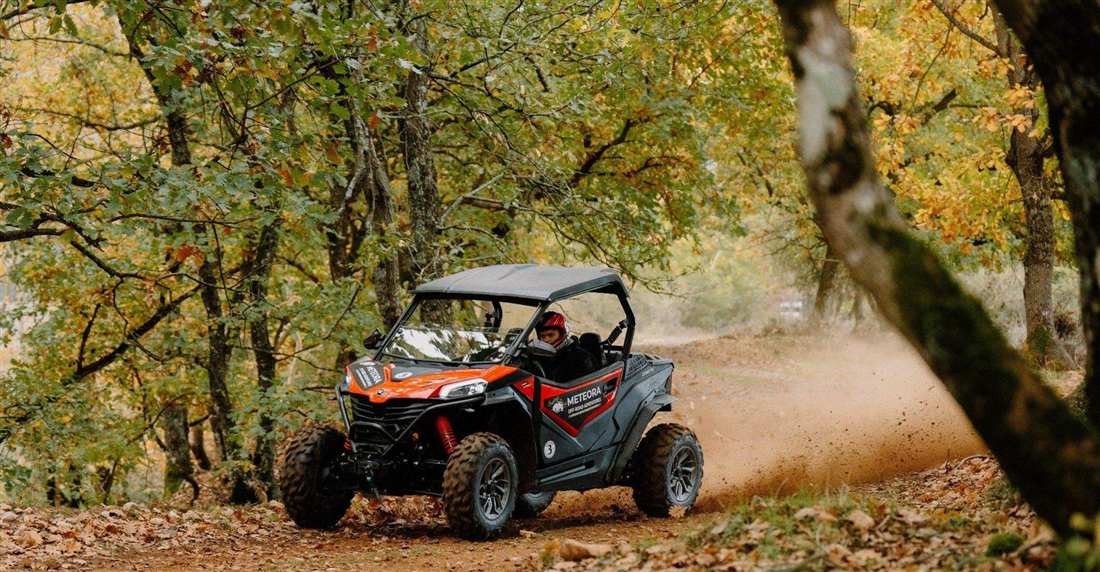
The steps below come from the morning off-road buggy tour based in Kalabaka. This Meteora jeep safari is listed as a guided tour, so the guide leads the way and the drivers follow.
- Start in Kalabaka, the town where the tour is based.
- Join a small group of up to 13 people.
- Take the wheel of your own buggy.
- Follow the guide along dirt tracks and through streams.
- Reach hidden cave monasteries in the wild heart of the geopark.
- Use the optional audio guide on the way.
- Finish the ride after 2 to 4 hours.
You do the driving yourself on this Meteora jeep safari. Guests do not sit in the back while a hired driver steers. You follow the guide, who leads the group along the tracks and through the water.
The tour title marks it as a morning trip, so the ride takes up the first half of the day. The tour card spells the base town Kalambaka, the other common form of Kalabaka. Look for either spelling when you check the start point of the tour.
Which hermit caves does a Meteora jeep safari reach?
A Meteora jeep safari runs past the rock towers where hermit monks lived in caves before any monastery stood. The Morning Off-Road Buggy Tour and Hidden Caves is the trip whose listing names cave monasteries on its dirt-track route.
Long before any Meteora jeep safari, hermit monks climbed the pinnacles in the ninth century. They were the first people recorded there after the Stone Age. They lived in hollows and cracks in the rock, up to 550 metres above the plain. The height and the sheer cliff walls kept visitors away.
At first the hermits lived alone. They met only on Sundays and special days, to pray at a chapel below Doupiani rock. Monasteries came only in the 14th century. Doupiani rock held the first skete, a small community of monks.
On Badovas rock, the ruined cave monastery of St Nicholas is reached by ladders through three caves. Pyxari and Ambaria rocks hold cave hermitages perched on cliffs, once home to ascetics. All three rocks sit at the southwestern edge of Meteora.
Holy Spirit Rock holds two more sites. Kerchiefs called mandilia hang by tradition at the cave of St George of Mandila. That cave lies about 30 metres above the ground. The Monks’ Prison perches on a cliff of the same rock.
Among the buggy trips, the morning tour is the one built around the caves. Its guide leads riders to hidden cave monasteries along the way.
The sunset buggy listing names hidden monasteries and a viewpoint, but no caves. Pick the morning trip when caves are the goal of your Meteora jeep safari. For the full story of each cell, read our page on Meteora caves and hermitages.
How does a sunset Meteora jeep safari work?
A sunset Meteora jeep safari is a 4-hour guided ride from Kalambaka in which you drive your own buggy. Its sunset stop is a secluded panoramic viewpoint, far from the crowds, at the end of the route.
The listing shows no fixed start hour. Confirm the meeting time for your date when you book a sunset Meteora jeep safari. Riders travel in a small group. The route follows remote dirt roads through wild country and takes in hidden monasteries before the final stop.
Sunset in Kalambaka comes about two hours earlier in mid-October than in mid-June. Plan a sunset Meteora jeep safari around these approximate local times from a sun calculator:
- Mid-April: sunset about 8:10 pm, last light about 8:40 pm
- Mid-June: sunset about 9:05 pm, last light about 9:35 pm
- Mid-August: sunset about 8:30 pm, last light about 9:00 pm
- Mid-October: sunset about 6:55 pm, last light about 7:20 pm
Last light marks the end of civil twilight, when the sun sits 6 degrees below the horizon. On a Meteora jeep safari at sunset, low light warms the rock towers and stretches their shadows across the valley.
Our page on the Meteora sunset covers the evening view in more depth.
Can a Meteora jeep safari reach the Pindus mountains?
Yes, a Meteora jeep safari can reach the Pindus foothills, but only as a longer private 4×4 day. The bookable buggy rides stay near the rocks of Meteora. A mountain day drives from Kalambaka to Pyli, Elati and Pertouli.
The Pindus, also spelled Pindos, is the mountain range that runs down northern Greece. It starts near the Greek-Albanian border and ends north of the Peloponnese. The range is about 160 km long, and Mount Smolikas is its highest peak at 2,637 m. A Meteora jeep safari reaches only its eastern edge, in the Trikala area.
A Meteora jeep safari into the Pindus takes in these mountain stops:
- Pyli: a town 18 km west of Trikala. Mount Itamos and Mount Koziakas rise above it and mark the start of the Pindus. Its Porta Panagia church dates from the 13th century. The Portaikos stone arch bridge dates from the 16th century.
- Elati: a village, formerly called Tyrna, about 32 km from Trikala on the south part of the Pindus. Mount Koziakas is the highest peak around it. Its forest roads are open to cars, motorcycles, bikes and horses, and its rivers offer fishing and swimming.
- Pertouli: a mountain village at 1,150 m in the central Pindus. A small ski centre lies about 7 km from Elati, on the road to Pertouli.
- Aspropotamos valley: a river valley in the Trikala regional unit. The name means “White river”, after the river’s pale, cream-coloured water.
Kalambaka, Pyli, Elati and Pertouli all lie in the Trikala regional unit of Thessaly. Pyli, Elati and Pertouli also belong to the municipality of Pyli. For a Meteora jeep safari plus more days in the range, see the Meteora and Pindos mountains tour. For other trips around Trikala, browse our Trikala tours.
Which villages lie on a Meteora jeep safari route?
Four places sit on the roads of a Meteora jeep safari route. Kalambaka is the town below the rocks, and Kastraki is the village between them. Vlachava sits on higher ground north of the rocks, and Theopetra has a prehistoric cave.
Kalambaka is the seat of the Meteora municipality. An inscription on its Saint John the Baptist church points to an ancient Greek settlement named Aiginion. The cathedral, the Church of the Dormition, dates from the late 11th or early 12th century.
Kastraki sits at 275 m, about a 20-minute walk from Kalambaka by the main road. Its name comes from kastro, a Byzantine castle that now lies in ruins. A Meteora jeep safari also climbs to Vlachava, at 910 m on a hill overlooking Kalambaka. A paved road links Vlachava with Skepari to the northwest.
Theopetra is the southern stop of a Meteora jeep safari route, in the Vasiliki municipal unit. Its cave opens on a limestone rock 3 km south of Kalambaka. Radiocarbon tests show people there at least 50,000 years ago. A low wall inside is claimed to be the oldest known human-made structure, but the claim is unverified.
How does a Meteora jeep safari compare with a buggy, quad or e-bike tour?
A Meteora jeep safari puts you in a 4×4 with a driver-guide at the wheel, so you sit back and watch the rocks. On a buggy, quad or e-bike tour, you control the ride yourself and steer through every turn.
The four vehicles differ in who drives, how you sit and how much effort the ride takes.
- 4×4 jeep: A four-wheel drive can send power to all four wheels at once. On a Meteora jeep safari, the vehicle is closed or open, and a driver-guide handles the whole route.
- Side-by-side (SxS) buggy: This utility vehicle has at least two seats next to each other inside a roll cage. The driver steers with a wheel and works foot pedals, like in a car.
- Quad (ATV): A quad rolls on four low-pressure tyres. The rider straddles the seat and steers with handlebars, like on a motorcycle. It is built for one operator.
- E-bike: An electric motor helps the rider move. It lets riders cover longer distances and climb steeper hills with less physical effort.
A Meteora jeep safari fits guests who want to look around and listen, not drive. A buggy or quad fits guests who want their own hands on the controls. The Meteora buggy tour page covers the self-drive buggy trips in full.
Riders who want exercise along with the views can read about the Meteora e-bike tour. On a pedal-assist e-bike, the motor helps, but you still pedal and balance the bike yourself.
Can you drive yourself on a Meteora jeep safari?
On a Meteora jeep safari, the driver-guide does the driving. If you want to drive yourself, the buggy tours let guests drive their own buggy behind a guide. A self-drive 4×4 rental needs a valid licence and must stay on existing tracks.
The GetYourGuide card for the morning off-road buggy tour says guests drive their own buggy. You follow your guide on dirt tracks. The short card lists no licence rule, so ask the operator about it before you book.
Renting your own 4×4 is a different case from a Meteora jeep safari. You need a valid driving licence. A licence issued in a country of the European Economic Area (EEA) is recognised across the EEA, and Greece is part of it.
Drivers with a licence from outside the EEA bring an International Driving Permit (IDP). An IDP is a translation of your home licence. It is only valid when you carry it together with that original licence.
Next, check the rental terms. A rental company can ban off-road use in its contract. Read the rental contract at the desk and confirm that it allows dirt tracks before you drive on one.
Meteora is a UNESCO World Heritage Site, so treat the land with care. Keep every wheel on existing tracks and never drive across open ground to cut a new line.
A guided Meteora jeep safari takes this task off your hands. The driver-guide picks the tracks and drives, so you keep your eyes on the rocks.
How did the rocks on a Meteora jeep safari form?
The rocks on a Meteora jeep safari are pillars of sandstone and conglomerate. Streams dropped stone, sand and mud into a lake delta. The ground then rose into a plateau, and water, wind and temperature swings carved it into towers.
The pillars are not volcanic rock. Sandstone forms from packed grains of sand. Conglomerate is rock made of rounded stones held in sand and mud. Streams carried this material into a delta at the edge of an old lake. Layer by layer, the deposits built up over millions of years.
About 60 million years ago, earth movements pushed the old seabed upwards. This raised a high plateau and cracked the thick rock along vertical fault lines. Rain, wind and hot and cold weather then wore the rock away along those cracks. The towers you see on a Meteora jeep safari are the parts that survived.
Rock of this kind forms in other places too. Meteora looks different for two reasons. Its sedimentary layers are even from top to bottom. The weathering also cut straight down along narrow cracks instead of wearing the whole plateau down.
On a Meteora jeep safari, the pillars rise steeply from the flat ground and stand more than 20 metres tall. Plants grow from cracks in the cliff walls, and rockfalls remain a constant risk. Even so, the thin pillars stood firm through a magnitude 7 earthquake. Our page on Meteora geology goes deeper into how the pillars formed.
Which monasteries does a Meteora jeep safari pass?
A Meteora jeep safari passes viewpoints of the six monasteries that still function on the rocks. A visit inside each one is separate from the ride. It needs its own entry ticket and clothes that meet the dress code.
Six monasteries still function today, four for monks and two for nuns. Local people regard the complex as second in importance only to Mount Athos. UNESCO added the six to its World Heritage List for their architecture and beauty, along with their religious and cultural value.
A Meteora jeep safari brings each of them into view from viewpoints around the rocks:
- Great Meteoron, a monastery for monks
- Varlaam, a monastery for monks
- Rousanou, which sits 484 metres above sea level
- St. Nicholas Anapausas, built on its own rock pillar
- St. Stephen, a convent of nuns
- Holy Trinity, a monastery for monks
The rides pass viewpoints, not monastery doors. Our page on Meteora monasteries describes each one in turn. Each monastery charges its own entrance fee. Read Meteora monasteries tickets before you plan a visit inside.
Every monastery has a dress code. Men wear trousers that cover the knees. Women wear skirts or sarongs, not trousers, and keep their shoulders covered. Skirts can be borrowed at the ticket desks. Bring covering clothes if a Meteora jeep safari ends with a monastery visit.
Each monastery closes on its own day of the week, so the closing days differ from one monastery to the next. Check the opening days before you plan a visit inside after your Meteora jeep safari.
Is a Meteora jeep safari safe?
A Meteora jeep safari is a guided ride on dirt tracks, not a race. On the guided buggy trips, a guide leads and every vehicle follows. The booking cards list no helmet or seatbelt rules, so confirm the safety kit with the operator.
None of the three GetYourGuide cards for a Meteora jeep safari mentions a safety briefing or a speed limit. Ask the operator about both before the engines start, and ask who to call if a vehicle breaks down.
Off-road vehicles can carry fittings for rough ground, such as roll cages, skid plates and off-road tyres. A roll cage protects the people inside if the vehicle overturns.
Cross-country vehicle trials go further. Their rules require a roll cage and a four-point harness for every person on board. Before your Meteora jeep safari, check that your buggy or jeep has a roll cage and working belts.
Follow these general off-road rules on every Meteora jeep safari:
- Keep your seatbelt fastened for the whole ride.
- Keep hands and arms inside the vehicle.
- Wear closed shoes, not sandals or flip-flops.
- Wear sunglasses or goggles against the dust.
- Listen to every instruction the guide gives before the start.
- Match the guide’s speed and never overtake.
- Keep a safe gap to the vehicle in front.
- Drink no alcohol before you drive.
If you lose sight of the guide’s vehicle, stop on the track and wait. Never take a side turn on your own.
Dirt tracks throw up dust and jolt riders over every bump and rut. Tell the guide about any back or neck problems before the first stretch of track. Mention any recent injury or heart condition too.
Who suits a Meteora jeep safari?
A Meteora jeep safari suits couples, friends and small groups who want to drive dirt tracks with a guide. The three GetYourGuide cards print no age limit and no list of travellers the trip does not suit.
The morning and sunset buggy tours run as small-group tours, so a family or a group of friends fits in a single booking. Visitors staying in Athens have a two-day tour that starts in the capital.
Each card shows one ticket type, marked “Adult”, and no child ticket. The Kalambaka cards say you drive the buggy yourself, yet none asks for off-road experience or spells out passenger seats. None gives an accessibility note either.
Parents planning a trip with children find more ideas on our page about Meteora with kids. Ask the operator for the minimum age and seat rules before you book a child onto a Meteora jeep safari.
Travellers with limited mobility find tips in our notes on accessible travel in Meteora. Ask the operator how riders get in and out of the vehicle, and where a wheelchair waits during the ride.
Travellers who want a quiet, smooth outing pick a calmer trip than a Meteora jeep safari. So do riders who feel sick on bumpy tracks or dislike engine noise.
When does a Meteora jeep safari run?
A Meteora jeep safari runs all twelve months, with a morning trip and a sunset trip from Kalambaka. Spring and autumn bring the mildest weather for an open buggy. Summer brings the hottest days on the nearby plain.
Two GetYourGuide cards set the timetable for a Meteora jeep safari. The cards give no clock times, only the words morning and sunset. Between them, their calendars show open dates on every day of the coming twelve months.
Meteora sits between Kalambaka and Kastraki, at the northwest edge of the Thessalian plain. Nearby Trikala has a hot-summer Mediterranean climate. Winter nights dip below freezing at times, and snow falls now and then but stays light. The weather station at Trikala Castle gives these average figures:
- January: highs of 10.7 °C and lows of 1.8 °C.
- April: highs of 20.5 °C.
- Late spring: highs of 26.7 °C.
- August: highs of 34.5 °C and lows of 19.9 °C.
- October: highs of 24.6 °C.
- Rain: 80.2 mm in February and 17 mm in July.
Spring and autumn sit between the summer heat and the winter cold. That makes them the mildest months for a Meteora jeep safari. Rain peaks from autumn to early spring, and wet dirt tracks and stream crossings turn to mud. For more on the seasons, read when to visit Meteora. For cold-month trips, see Meteora in winter.
What do you wear on a Meteora jeep safari?
Wear closed shoes, long trousers and a light layer on a Meteora jeep safari. Add sunglasses or goggles and a buff against dust. Bring a hat, sun cream and water for the stops along the route.
Buggies and jeeps raise dust on dry dirt tracks, and the summer sun on the plain is strong. The two tour cards list no gear or packing notes, so bring your own kit for a Meteora jeep safari. Pack these eight items:
- Closed shoes with grip, for stepping out onto rough ground at the stops.
- Long trousers, to guard your legs against dust and scratches.
- A layer you can take off or put back on as the temperature shifts.
- Sunglasses or goggles, to keep dust out of your eyes.
- A buff or scarf, to pull over your nose and mouth on dusty stretches.
- A hat for the short walks in the sun at each stop.
- Sun cream for your face, neck and arms.
- Water, with one full bottle for each rider.
Match your clothes to the trip you book. Trikala sees wide swings between day and night temperatures. A sunset Meteora jeep safari therefore needs a warmer top for the drive back. On the morning trip, start with the layer on and take it off as the day warms.
Choose clothes you do not mind getting dusty or muddy, since dirt sticks to fabric after a ride. Dark colours hide the marks better than white. In the cold months, add gloves and a warm jacket for the open-air drive.
How do you reach the start of a Meteora jeep safari?
You reach the start of a Meteora jeep safari by getting to Kalambaka, the town near the Meteora monasteries. No trains call there right now. A rail replacement bus links Kalambaka with Palaiofarsalos, a stop on the main Athens to Thessaloniki railway.
Kalambaka station marks the end of the Palaiofarsalos–Kalambaka line, with Trikala as the next stop. Floods from Storm Daniel badly damaged this line, which is now under track renewal work. Plan your Meteora jeep safari around the bus link, not a direct train.
From Athens or Thessaloniki, the journey works like this:
- Take a Hellenic Train mainline service to Palaiofarsalos.
- Switch to the rail replacement bus for Kalambaka.
- For the return, take the bus back to Palaiofarsalos and change to the train.
Kalambaka station is staffed and sells tickets. It has waiting rooms on platform 1 and a car park. Luggage storage is no longer offered, so leave your bags at your hotel before a Meteora jeep safari.
Kastraki is a community of Kalambaka on the west side of the rock massif. The GetYourGuide cards for the morning buggy tour and the sunset buggy tour both list Kalambaka as their location. Neither card names a pickup point, so confirm where your Meteora jeep safari meets when you book.
A meeting point in Kastraki and one in central Kalambaka are not the same spot. Allow time to cross between them on the day. For local transport between the two places, see our page on getting around Meteora.
Can you join a Meteora jeep safari on a trip from Athens?
Yes, you can join a Meteora jeep safari from Athens on a two-day tour. The GetYourGuide Athens 2-day Meteora monasteries tour adds a buggy adventure. You drive a buggy on hidden trails, then pick a hiking or monastery tour on day two.
The tour starts in Athens, and its card files it as a multi-day trip. Two days mean one night away from the capital. The card does not name the vehicle that carries you north or the hotel for that night. Check both details on the tour page before you pay.
A same-day return from Athens leaves little room for an off-road ride. You ride a train to Palaiofarsalos, then the replacement bus, and repeat both legs to get back. Each change adds waiting time between the bus and the train. Four legs of travel in one day leave a short window at the rocks for a Meteora jeep safari.
The two-day format splits that travel across two days. Your Meteora jeep safari then fits into the schedule without a rush to catch the last connection home. The night in between also breaks up the hours you spend on the road.
To compare the ways to travel north from the capital, read our Athens to Meteora page. For tours that go and return on the same day, see our list of Meteora day trips from Athens.
What wildlife can you spot on a Meteora jeep safari?
A Meteora jeep safari runs through a habitat protected under the EU Natura network, site code GR1440003. Protected birds breed here, among them the Egyptian vulture, owls, eagles and other birds of prey. European otters, wolves and two kinds of tortoise live here too.
The protected zone is more than bare rock. It takes in wooded hills with sheer cliffs and the river valley of the Lithaios and the Mourgas. Forests of plane trees and oaks cover the slopes, with scrub and farmland in the gaps. The flora includes two endemic knapweeds, one of them named after Kalambaka.
Smaller animals stay close to the ground. The species list for the site includes dormice, alpine newts, green lizards, vipers and other snakes, and butterflies. Three groups of bats live here as well: horseshoe bats, mouse-eared bats and pipistrelles. Scan the ground at each stop of your Meteora jeep safari, not only the sky.
Tourism is one of the listed threats to this habitat. The others are the logging of old oak stands, road building, illegal hunting and overgrazing. On a Meteora jeep safari, keep a wide distance from nesting cliffs and keep engines quiet near nests. For a closer look at the species, read our page on Meteora wildlife.
How do you take photos on a Meteora jeep safari?
Take photos on a Meteora jeep safari at the stops, when the vehicle stands still and the dust settles. Guard your camera against dust and drops. Aim at the rocks when the morning or evening sun lights them from the side.
The cave monasteries on the morning ride and the panoramic viewpoint at the end of the sunset ride are the main photo points. On a Meteora jeep safari, these are the places where the camera comes out.
- Dust: keep the phone or camera in a sealed bag or case between stops. Wipe the lens with a soft cloth before you shoot.
- Movement: wait until the vehicle stops. A bumpy track shakes the lens and blurs the frame.
- Strap: loop a wrist or neck strap on before you step out onto loose ground.
- Light: face the pillars with the low sun to one side. Side light picks out the cracks and texture of the rock.
- Horizon: turn on the grid in your camera app and line the horizon up with one grid line, so the pillars stand straight.
- Framing: step back and switch to the wide lens to fit a whole pillar, top to base, in one shot.
- Scale: ask a friend to stand in front of a pillar. A small figure shows the true height of the rock.
Planning to fly a drone? Drone flights in Greece follow national rules, and limits apply near the monasteries. Check the current rules before you pack a drone for a Meteora jeep safari. Ask your guide before you launch at any stop. For more on shooting the rocks, read our Meteora photography guide.
What else pairs with a Meteora jeep safari?
A Meteora jeep safari pairs well with a horse ride from Kastraki or a guided hike. It also pairs with a sunset tour or a half-day small-group tour of the monasteries. Each one adds a slower pace or a closer look at the rocks.
The four GetYourGuide tours below run in the same rock country as a Meteora jeep safari. Each one lists its length, so you can fit it around your off-road ride.
- Kastraki: Meteora Sunset Horseback Riding for New Riders, 1.5 hours
- Kalabaka: Meteora Small-Group Hiking Tour with Monastery Visit, 5 hours
- Meteora: Majestic Sunset Tour and Monasteries with Local Guide, 4 hours
- Small-group monasteries tour from Meteora with hotel pickup, 4 hours
The horse ride starts in Kastraki and is built for new riders. Our Meteora horse riding page covers time in the saddle. The hiking tour leaves from Kalabaka and adds a monastery visit. Our Meteora hiking page covers walks on foot between the rocks.
A two-day plan gives each pace its own day. On day one, join a Meteora jeep safari and then a monastery tour. Pick either the half-day trip or the sunset one. On day two, trade the wheels for boots on the hiking tour, or for a saddle on the horse ride.
Hikers, trail runners, mountain bikers and rock climbers come to Meteora from around the world, above all in summer. Our Meteora rock climbing page covers the climbing side. Kastraki has also hosted the Meteora MTB Race, which gives riders a pedal-powered option after a Meteora jeep safari.


Where do you stay and eat around a Meteora jeep safari?
Base your Meteora jeep safari in Kastraki or Kalambaka, the village and town that border the rocks. Kastraki sits closest to the towers, while Kalambaka is the larger town, with the railway station and more services.
Kastraki lies right below the rocks, with a central square, a church and hotels. Waking up there puts you minutes from the dirt tracks.
Kalambaka, also spelled Kalabaka, lies in the Trikala regional unit. Either base works for a Meteora jeep safari, since the two sit a short distance apart. The small-group monasteries tour above also includes hotel pickup.
Kalabaka is a Turkish name meaning “powerful fortress”. Kastraki grew from hamlets settled by migrants from northern Epirus who fled the Ottomans. Our page on where to stay in Meteora compares the two bases in more detail.
Thessaly is farm country. Its river plains grow grain and raise cattle and sheep, and the Trikala area adds fruit, vegetables and olives. Kastraki’s tavernas cater to international visitors, close to the rocks. After a Meteora jeep safari, see our page on where to eat in Meteora for meal ideas.
How do you book a Meteora jeep safari?
You book a Meteora jeep safari online through its GetYourGuide card. Choose the ride, the date and the group size, then pay. The morning and sunset rides close 1 hour before the start, and the two-day trip closes 10 hours before.
- Pick the ride: the morning buggy tour, the sunset buggy tour or the two-day trip from Athens.
- Pick the date and the group size on the ride’s card.
- Check the cut-off time before you pay.
- Read the cancellation terms on the card.
- Save the confirmation and the meeting point.
- Reconfirm the pickup or meeting time with the operator the day before.
The morning and sunset rides start in Kalambaka, and the two-day trip starts in Athens. The morning and sunset cards carry a small group label, so you join other guests on the tour. None of the three cards lists a private Meteora jeep safari option.
A 1-hour cut-off means the morning and sunset rides accept same-day bookings while places remain. One booking covers your whole group, so everyone shares the date, the start time and the meeting point. All three cards also list an optional audio guide.
Book the sunset ride for the first evening of your stay. If clouds hide the light, a second evening gives you a spare chance at the viewpoint. Morning rides suit the hot months, when the tracks are cooler before noon and the light on the rocks is clear. Lay out your kit the night before, so the morning ride starts on time.
What do travellers ask about a Meteora jeep safari?
Do you need a driving licence for a Meteora jeep safari?
None of the three GetYourGuide cards states a licence rule, though the two Kalambaka rides have guests drive their own buggy. Check the card’s full details before booking a Meteora jeep safari. Carry your driving licence on the day in case the operator asks for it at the start.
Can children join a Meteora jeep safari?
Each card sells one ticket type, called Adult, for ages 99 and younger. No card shows a child ticket, a minimum age or an age note. Families with young riders need to check the card’s details first. Ask the operator before you book a Meteora jeep safari for a child.
What happens to a Meteora jeep safari in rain?
The three cards state no weather policy, so the rain rule is not on the booking page. Read the full terms on the card before you book. If rain is in the forecast, contact the operator the day before. Ask whether your Meteora jeep safari goes ahead or moves to a new date.
Does a Meteora jeep safari go inside the monasteries?
Each Meteora jeep safari passes viewpoints around the rocks and does not enter the monasteries. A monastery visit needs its own entrance ticket and has to fit the opening hours. The two-day trip from Athens pairs a monastery tour with the buggy ride. Check its card for what the ticket covers.
Can you cancel a Meteora jeep safari?
Yes. All three GetYourGuide cards show free cancellation. The card summaries do not show the exact deadline. Check it on the card before you pay, and note it in your calendar. To cancel a Meteora jeep safari, use your GetYourGuide booking. Keep the cancellation email until the refund reaches your account.