
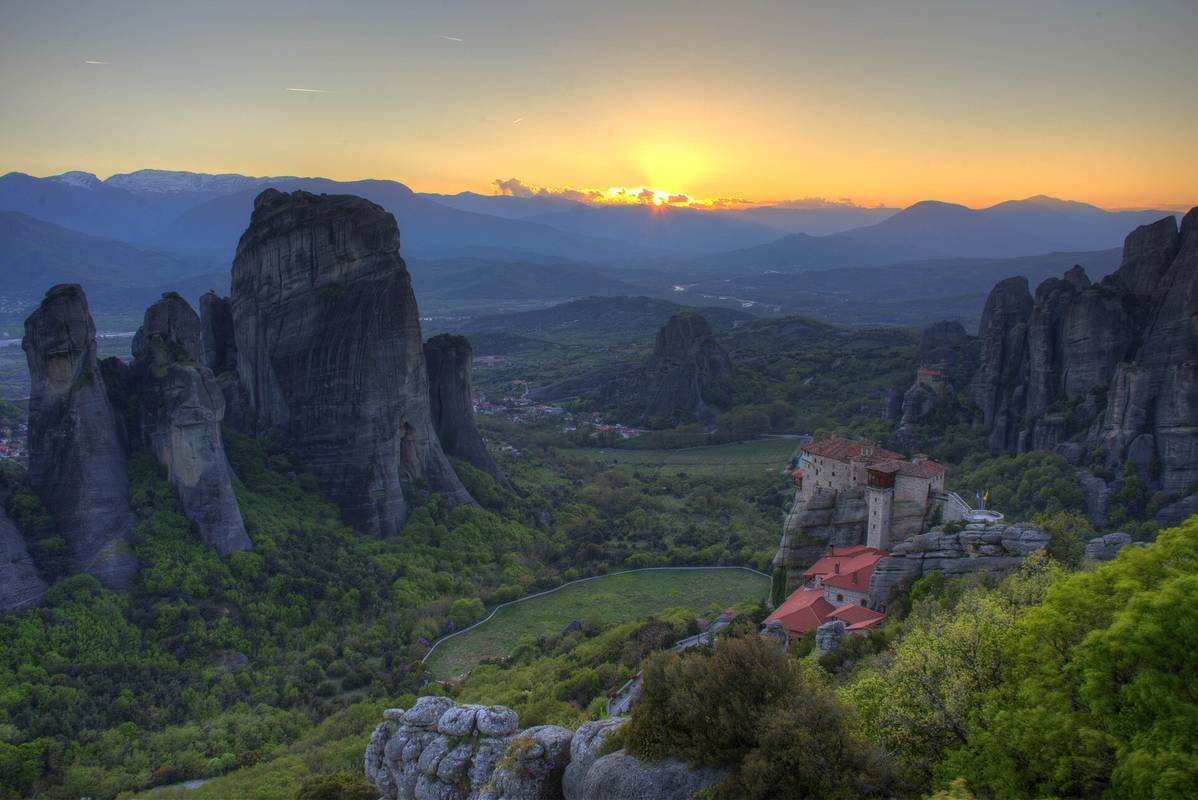
Meteora rewards photographers who plan around light and weather. Six monasteries sit on conglomerate pillars that rise 300 metres above the Thessalian plain, and their silhouettes change hour by hour as the sun sweeps across the sandstone. Sunrise sends warm light onto the eastern faces, sunset backlights the towers, and mist after rain lifts between the rocks to separate each pillar. This guide covers the ring-road viewpoints above Kastraki, the overlooks near the two largest monasteries, lens choices for scale and compression, tripod use at blue hour, and the drone restrictions over the protected site. Build the day around these windows when you travel with My Greece Tours.
The town of Kalambaka and the village of Kastraki sit directly below the rock formations, so most viewpoints lie within a ten-minute drive of either base. Use this page alongside the wider Meteora travel guide to fix your dates, transport, and monastery opening days before you shoot. The sections below cover where to stand for the classic frames, which times of day suit each face of the rocks, the two-lens kit that handles both wide vistas and tight compressions, and the rules that keep drones grounded over the UNESCO-listed monasteries and cliffs.
Where are the best photography spots in Meteora?
The ring road above Kastraki holds the strongest frames, with panoramic pullouts, the overlook near the Great Meteoron and Varlaam, and the vista toward Holy Trinity above Kalambaka. Each lines up several monasteries at once.
The paved ring road climbs out of Kastraki and loops past every monastery, and its signed pullouts give the cleanest sightlines. From the upper stretch above Kastraki you frame Roussanou and the Great Meteoron together with the plain behind them, which suits wide compositions at sunrise. The overlook near the Great Meteoron and Varlaam sits at the highest point of the loop and stacks both large monasteries against open sky. A short walk from the road delivers the Holy Trinity vista above Kalambaka, where the monastery perches alone on a slender pillar. Scout these Meteora monasteries overlooks in daylight first, then return for your chosen light window.
The Kastraki side offers a lower, closer angle that emphasises the texture of the conglomerate rather than the full skyline. Standing among the village lanes, you place stone houses and cypress trees in the foreground while the pillars rise directly behind them, which adds depth and human scale. This vantage works best in late afternoon when the western faces catch warm light. For dawn shots, the eastern pullouts on the ring road receive first sun on the monastery walls. Rotating between the high ring-road overlooks and the lower Kastraki viewpoints across a single day gives you both the sweeping panorama and the intimate, ground-level compositions that define a complete Meteora set.
When is golden hour best for photographing Meteora?
Sunrise and sunset both deliver golden hour, but they light different faces. Dawn warms the eastern monastery walls, while dusk backlights the pillars from the west. After rain, mist between the towers adds separation and mood.
At sunrise the first light strikes the eastern faces of the monasteries and the plain below often holds a low haze, so shooting from the ring-road pullouts that face east captures glowing stone above a soft valley. Arrive at the viewpoint before first light to set your composition, because the strongest colour lasts only twenty to thirty minutes. Sunset shifts the drama to the western side, where the sun drops behind the pillars and rims them with light, favouring silhouettes and backlit outlines. Timing your visit around the best time to visit Meteora lets you catch clear mornings in the shoulder seasons when the light stays crisp.
Weather is your strongest ally at Meteora. After rain clears, moisture rises off the warming rock and drifts between the pillars, isolating each monastery on its own island of stone. These conditions are common in spring and autumn and produce the atmospheric frames the site is known for. Check the forecast for a front passing overnight and plan to be on the ring road at first light the morning after. The dedicated Meteora sunset viewpoints near the Great Meteoron overlook fill quickly in the warmer months, so arrive at least forty minutes early to secure a tripod position and read the changing light.
What camera gear do you need for Meteora photography?
Carry a wide lens around 16 to 24 millimetres for the full rock scale and a short telephoto near 70 to 200 to compress single monasteries against the sky. Add a sturdy tripod for blue hour and long exposures.
A wide-angle lens in the 16 to 24 millimetre range captures the sheer height of the pillars and the sweep of the plain in one frame, which is essential from the high ring-road overlooks where several monasteries appear at once. It also lets you include foreground rock or village detail to build depth. Pair it with a short telephoto around 70 to 200 millimetres, which compresses distance and isolates one monastery against clean sky or a distant ridge. That compression is what turns a wide vista into a graphic, poster-style image of a single perched building. A polarising filter cuts haze on bright days and deepens the sky behind the sandstone.
A tripod is worth the weight because the best colour arrives at blue hour, when light levels force long exposures that no handheld grip can hold steady. Set up before the sun clears the horizon or after it drops, lock your composition, and bracket exposures to hold detail in both the lit stone and the shadowed valley. A remote release or the camera’s two-second timer prevents shake on the shutter press. Bring spare batteries, since cold shoulder-season mornings drain them fast, and dress for the exposed viewpoints where wind funnels between the rocks. The trails covered under hiking in Meteora reach angles the road misses if you plan to combine shooting with walking.
Can you fly a drone over Meteora for aerial photos?
No. Flying drones around the monasteries and over the protected UNESCO area is not permitted. The monastic community and heritage rules ban aerial craft, so plan every shot from ground-level viewpoints instead of the air.
Meteora is a UNESCO World Heritage Site and an active monastic centre, and drone flights over the monasteries and the protected rock formations are not permitted. The restriction protects the privacy of the religious communities and the integrity of the heritage zone, and enforcement is real, so do not plan aerial coverage as part of your set. Signage around the site and monastery notices make the ban clear. Treat the ground-based ring-road overlooks as your only vantage, which is no limitation given how well those pullouts already stack the monasteries against the sky. A guided visit through organised Meteora tours keeps you on the sanctioned viewpoints and the correct side of the rules.
Invest your effort in reading light and choosing elevation on foot because the aerial angle is off the table. The highest ring-road pullouts already deliver a near-aerial perspective over Roussanou and the Great Meteoron, and climbing a few metres up the marked paths near each overlook raises your line further. Use the short telephoto to lift a single monastery clear of its neighbours and the wide lens to hold the whole massif. Ground compositions also let you include foreground rock, trees, and the roofs of Kastraki, elements a drone frame usually loses. Working within the rules produces a stronger, more grounded portfolio than any grabbed aerial clip could.
How should you dress and behave when photographing inside Meteora monasteries?
Modest dress is required inside the monasteries: covered shoulders and knees for everyone, and skirts for women, with wraps often lent at the gate. Interior photography is limited, and some spaces forbid cameras entirely.
Each active monastery enforces a dress code at the entrance. Men need long trousers and covered shoulders, and women are asked to wear a skirt below the knee, though most monasteries lend a wrap-around skirt at the gate for visitors who arrive in trousers or shorts. Dressing correctly before you queue saves time and shows respect for the working religious community. Photography inside the churches and chapels is usually restricted, and flash is prohibited to protect the frescoes, so read the posted notices at each door. Save your serious shooting for the courtyards, balconies, and the approach paths, where the framed views back across the pillars are often the strongest images anyway.
The monasteries keep different opening days, and most close on one or two weekdays, so confirm the current schedule before you build a route between them. Interiors that do allow photography reward a quiet, unobtrusive approach with no tripod, since space is tight and other visitors and monks pass constantly. The dramatic frames of the buildings themselves come from outside, on the ring road and the connecting paths, not from within the walls. Sorting your beds near the trailheads through the notes on where to stay in Meteora puts you minutes from the dawn pullouts, so you reach the light before the tour buses arrive and the courtyards fill.
Frequently Asked Questions
Do I need a permit to photograph Meteora?
You do not need a permit for personal photography from the public ring road and the outdoor viewpoints around Meteora. The pullouts above Kastraki, the overlooks near the Great Meteoron and Varlaam, and the Holy Trinity vista above Kalambaka are all freely accessible, and you can set up a tripod at these spots without paperwork. Inside the monasteries the rules tighten: each charges a small entry fee, interior photography of the churches is often prohibited to protect the frescoes, and flash is banned everywhere indoors.
Commercial or professional shoots that involve models, large crews, or paid drone work require separate permission from the authorities and the monastic community, and drones are not permitted over the protected area at all. For a standard traveller carrying a camera and tripod, the outdoor viewpoints described in the Meteora monasteries section need nothing more than early arrival and respectful behaviour around the working monasteries.
What is the best month for Meteora photography?
Spring, from April to early June, and autumn, from September to October, give the strongest conditions for Meteora photography. The shoulder-season air stays clear, the plain turns green in spring and gold in autumn, and passing fronts leave the mist that rises between the pillars after rain. Temperatures at these times suit the pre-dawn climbs to the ring-road overlooks, and the crowds thin compared with midsummer. Summer brings long daylight but harsh midday haze and heavy tour traffic that fills the sunset viewpoints early. Winter offers dramatic low light, occasional snow dusting the sandstone, and empty pullouts, though some monasteries cut their hours and cloud can close in for days.
Whichever window you choose, the light logic stays the same: shoot the eastern faces at sunrise and the western silhouettes at sunset. Cross-check monastery opening days and weather trends against the best time to visit Meteora notes so your shooting days line up with clear skies and open gates.
Can I photograph Meteora at night?
Night photography works well at Meteora because the site sits away from heavy light pollution and the monasteries are floodlit after dark, giving lit stone buildings against a star field. The best window opens at blue hour, when the sky still holds deep colour and the lit walls balance against it, so set up on a ring-road pullout before full dark and lock your tripod. Long exposures of thirty seconds and beyond pull out the Milky Way over the pillars on clear, moonless nights in the warm months, while a rising moon can rim-light the rock for softer frames.
Bring a headlamp with a red mode to protect your night vision and to avoid disturbing others, and dress warmly because the exposed viewpoints turn cold once the sun drops. The floodlit monasteries also make a fine subject for a static long exposure. Combine an evening at the lit rocks with a dawn return for Meteora sunrise, and read the dusk light windows in the Meteora sunset notes to time your arrival.