
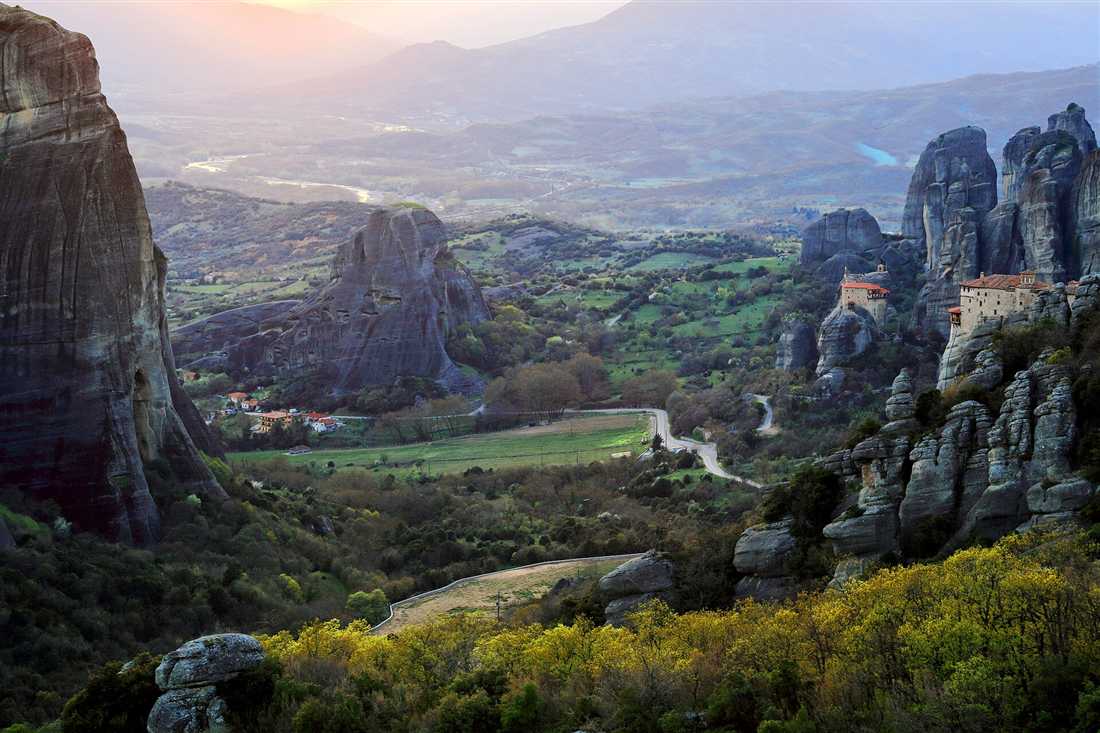
A Meteora buggy tour is a guided drive of two to three hours in a two or four-seat side-by-side buggy on the dirt tracks and the ring road around Kalambaka and Kastraki, taking in the monastery viewpoints, the hermit caves and a sunset stop. Plan the rest of the trip with Greece Tours.
This page covers the whole drive: where the route goes, the machines the operators run, the licence and age rules, the price bands, which departure time to take, the monastery stops on the electric-buggy programme, the ground conditions and safety, the season, and how to book a Meteora buggy tour.
What is a Meteora buggy tour and what happens during it?
A meteora buggy tour is a guided two to three hour drive in a two or four-seat side-by-side buggy, or an electric buggy, across the dirt tracks and ring road linking Kalambaka and Kastraki, monastery viewpoints, hermit caves and a sunset stop.
Departure points sit in Kalambaka along Trikalon and Patriarchou Dimitriou streets, and in Kastraki beside the Doupiani chapel car park. Operators run convoys of three to six machines. The guide drives the lead vehicle, holds the pace at 25 to 40 km/h on gravel, and halts six to eight times for photographs. Total driven distance runs 28 to 45 km. Shared departures leave at 09:00, 12:00, 15:00 and at sunset. The Meteora buggy tour operators state this at booking.
Two distinct products carry the same name. The petrol side-by-side programme stays on forest and quarry tracks above Kastraki and on the unpaved descent toward the Pinios plain. The electric-buggy programme sticks to the asphalt ring road that threads the six working houses of Meteora, runs almost silently past Varlaam, and includes one monastery entry. Both formats last 120 to 180 minutes door to door. The Meteora buggy tour price reflects it.
The price covers fuel or battery charge, helmets, goggles, third-party insurance and the guide. Bottled water arrives in a cooler box on the four-seat machines. Monastery admission, at 5 euros per adult, sits outside the fare. Passengers as young as six ride in the second row with a booster cushion and a four-point harness, while the driving seat stays with licence holders aged 18 and over on every meteora buggy tour. A Meteora buggy tour is planned around that.
Groups cap at 12 to 16 participants. Photographs taken by the guide arrive by WeTransfer the same evening on most departures, and hotel pickup inside Kalambaka and Kastraki adds no charge within a 4 km radius. The Meteora buggy tour season turns on this.
Where does the route go around Kalambaka and Kastraki?
Routes climb the forest tracks above Kastraki, follow the back road beneath Great Meteoron and Varlaam, pass Doupiani rock and the Badovas hermit caves, reach the Psaropetra platform, then drop on gravel toward the Pinios plain across 28 to 45 km.
The first leg leaves the village of Kastraki and gains 180 metres of altitude in under 3 km on a compacted dirt track through Aleppo pine and holm oak. Doupiani rock, the twelfth-century skete site, appears within eight minutes of the start. The convoy pauses there for five minutes, with the whole northern rock cluster and the Agios Nikolaos Anapafsas pinnacle framed to the east. Every Meteora buggy tour is timed against it.
From the saddle the track meets the back road running under Great Meteoron and Varlaam. Traffic stays light before 10:00 and after 18:00. A 1.4 km spur turns off toward the Badovas gorge, where the ascetic shelters cut into the conglomerate wall sit 40 metres above the streambed. Guides stop 300 metres short and walk the group in, since the Meteora hermit caves hold protected archaeological status and vehicles stay outside the fenced perimeter. A Meteora buggy tour books out on that count in August.
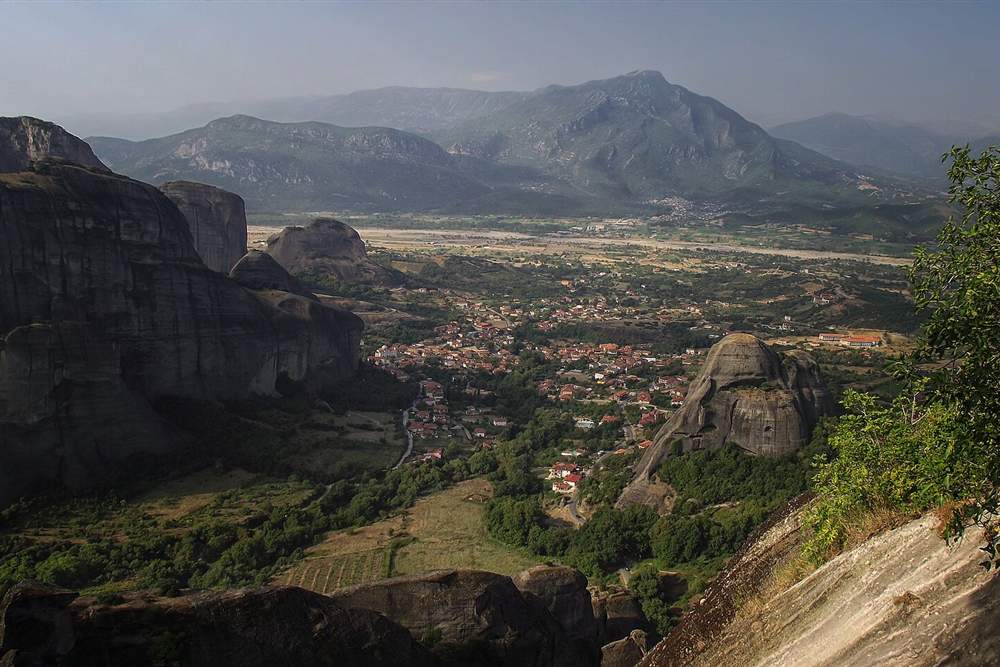
Psaropetra, the railed viewing platform 2 km east of Roussanou, marks the turning point. Elevation there reaches 570 metres, and the drop over Kalambaka measures more than 300 metres. The final third of the meteora buggy tour descends on loose limestone toward the Pinios river plain, crossing two dry fords and the olive terraces near Vlachava before rejoining asphalt at the edge of Kastraki. The Meteora buggy tour fleet is built for it.
Sunset itineraries reverse the order, reaching Psaropetra 25 minutes before the sun drops behind the Chasia range.
What buggies do operators run on a meteora buggy tour?
Fleets consist of Polaris and CFMoto side-by-side machines of 570 to 1,000 cc seating two or four, fitted with roll cages and four-point harnesses, plus quieter electric buggies reserved for the paved monastery circuit. Helmets and goggles come with every seat.
The Polaris RZR 570 and the CFMoto UForce 600 handle the two-seat bookings. Four-seat work falls to the Polaris Ranger Crew 1000 and the CFMoto ZForce 1000 Sport, both with rear bench seating, cargo beds and 27-inch tyres suited to the loose limestone above Kastraki. Ground clearance reaches 28 to 33 cm, which clears the rutted section past Doupiani without scraping the skid plate. A Meteora buggy tour is planned around that.
Safety equipment stays fixed rather than optional. Every machine carries a steel roll cage tested to the manufacturer’s standard, four-point harnesses on all seats, side nets on the front row, a fire extinguisher clipped behind the driver and a first-aid kit. Helmets in sizes XS through XXL and dust goggles hang in the departure shed. Drivers with prescription glasses receive over-glass goggles at no extra charge. The Meteora buggy tour season turns on this.
The electric buggies, six-seat and eight-seat units built on a golf-car platform with a 48-volt lithium pack, cover 60 to 80 km on one charge. They roll at 20 to 30 km/h, produce no exhaust and stay legal on the monastery ring road where noise limits apply. Families with children aged three to six choose them over the petrol machines, and photographers prefer the open sides for shooting Roussanou and Agia Triada while moving. This is what a Meteora buggy tour delivers on the tracks.
Maintenance intervals sit at 50 engine hours, and each vehicle carries a two-way radio tuned to the guide’s channel.
Do you drive the buggy yourself and which licence applies?
Drivers hold a valid category B car licence and are 18 or older. Passengers ride from age six to eight upward depending on operator. A 20-minute briefing on a closed practice area precedes departure, the guide leads in vehicle one, and every machine carries a radio.
Greek road rules treat these side-by-sides as light quadricycles when they touch public asphalt, so the category B card issued anywhere in the European Union works without extra paperwork. Holders of licences from the United States, Australia, Canada or the United Kingdom present the original card; an International Driving Permit accompanies documents printed in non-Latin script. Staff photograph the licence at check-in and file it with the rental contract. The Meteora buggy tour fleet is built for it.
The briefing runs on a flat gravel yard outside Kastraki. Instructors cover throttle response, engine braking on a 12 percent descent, harness tension, the two-wheel and four-wheel drive selector, and the convoy spacing rule of 20 metres. Each driver completes two laps of a cone circuit before the group leaves. Anyone uneasy after the practice laps swaps into the passenger seat and receives a partial refund of the driving supplement. Drivers on a Meteora buggy tour meet it in the first kilometre.
On the trail the guide holds position at the front and a second staff member closes the line on busy departures. Radios mounted in each cockpit relay stop calls, oncoming-traffic warnings and the switch to four-wheel drive before the Pinios descent. Couples alternate at the wheel at the Psaropetra halt, which suits people combining a meteora buggy tour with the walking legs of wider Meteora tours across the same two days. A Meteora buggy tour rolls out with this settled.
Solo travellers pair up with the guide at no supplement on shared departures.
What does a meteora buggy tour cost and what is included?
A two-seat buggy on the shared two-hour departure runs 85 to 130 euros, a four-seat machine 130 to 190 euros, and a private departure 200 to 300 euros. Fuel, helmets, goggles and insurance are included; monastery entry is paid separately.
Prices attach to the vehicle, not the head. Two adults sharing a Polaris RZR 570 at 110 euros pay 55 euros each. A family of four in a Ranger Crew at 170 euros pays 42.50 euros a head. That structure makes the four-seat option the cheaper per-person choice, and it explains why the two-seat machines sell out last in July and August. This is what a Meteora buggy tour delivers on the tracks.
The fare covers the guide, third-party liability insurance, a collision damage waiver with an excess of 300 to 500 euros, fuel or battery charge, helmets, goggles, water and the digital photographs. A meteora buggy tour on the electric fleet lists at 90 to 140 euros for a six-seat vehicle and includes the same items apart from the 5 euro monastery admission collected at each gate. That is the Meteora buggy tour difference.
Extras stay modest. Hotel pickup beyond the 4 km Kalambaka and Kastraki radius adds 10 to 20 euros. A GoPro chest mount rents at 15 euros. Extending the standard two hours to three costs 30 to 50 euros per vehicle. Deposits sit at 20 to 30 percent online, with the balance settled in cash or by card at the departure shed. The Meteora buggy tour timetable is built on it.
Booking two vehicles together brings a 10 percent discount at most Kalambaka operators, and shoulder-season rates in March, April and November fall 15 to 20 percent below the August level for every meteora buggy tour format.
Which departure works best, morning, afternoon or sunset?
The 09:00 start pairs open monasteries with shaded tracks and cool air. Afternoon runs catch direct light on the west rock faces. Sunset departures leave between 17:00 and 19:30 by month, reach Psaropetra for the drop, and return under headlights.
Morning suits anyone combining driving with monastery visits. All six houses admit visitors from 09:00, air temperature in July sits near 24 degrees at that hour against 37 by mid-afternoon, and the forest tracks above Kastraki stay in shadow until 10:30. Dust hangs lower after the overnight humidity. Groups leaving at 09:00 finish by 11:30, which leaves the afternoon free for Great Meteoron and Varlaam on foot. A Meteora buggy tour rolls out with this settled.
Afternoon departures at 15:00 place the sun behind the driver on the westward legs, lighting the conglomerate walls of Agia Triada and Roussanou in warm tones. Temperatures peak, so operators hand out extra water and shorten the Badovas walk. Visitor traffic on the ring road thins after 16:00 once the coaches from Trikala and Larissa leave. A Meteora buggy tour carries the kit for it.
The sunset run is the strongest seller. Departure moves from 17:00 in November to 19:30 in late June, timed so the convoy stands at Psaropetra 25 minutes before the sun meets the Chasia ridge. The return leg to Kastraki takes 30 minutes under headlights across the lower gravel. Guests who add a Meteora sunrise excursion the following morning see the same rocks lit from the opposite side. Guides brief it before a Meteora buggy tour leaves.
Photographers book the sunset slot four to five days ahead in August. Families with children under eight take the 09:00 slot, since the electric fleet runs its monastery programme only in the morning window.
Can you visit the monasteries during the tour?
The electric-buggy programme stops at one monastery for 20 to 30 minutes, with 5 euro entry paid at the gate and a dress code of covered shoulders and knees. Diesel and petrol buggies park lower down and stay outside the monastery grounds.
Six houses remain active: Great Meteoron, Varlaam, Roussanou, Agios Nikolaos Anapafsas, Agia Triada and Agios Stefanos. Each closes one weekday, and the closing day shifts by season, so guides confirm the schedule the evening before. Great Meteoron shuts on Tuesday through the warm months, Varlaam on Friday, Roussanou on Wednesday, Agios Nikolaos on Friday, Agia Triada on Thursday and Agios Stefanos on Monday. The Meteora buggy tour timetable is built on it.
Dress rules apply at every gate. Women wear a skirt covering the knee, men wear long trousers, and both cover the shoulders. Wraparound skirts hang in a basket at the entrance for anyone arriving in shorts, at no charge. Agios Stefanos, reached by a level bridge rather than a staircase, works for visitors with limited mobility; Great Meteoron demands 300 steps in each direction. The Meteora buggy tour route is set by it.
Petrol side-by-sides stay off the monastery approaches for noise and parking reasons. Coach bays fill the small lots, and the municipality restricts recreational vehicles on that stretch during opening hours. Operators therefore park the machines at the Doupiani or Psaropetra pull-offs and cover the monastery interiors on the electric programme instead, which keeps the meteora buggy tour within the local traffic rules while preserving the viewpoints. It decides which Meteora buggy tour to take.
Photography inside the katholikon of each house is prohibited. Courtyards, cellars and the rope-basket winch towers at Great Meteoron and Varlaam remain open to cameras throughout the visit.
What are the ground conditions and safety rules on a meteora buggy tour?
Tracks combine gravel and bare limestone with loose surface stone. July and August bring heavy dust, March and November bring mud after rain, the guide caps convoy speed, harnesses stay fastened throughout, and alcohol before driving voids the insurance.
Surfaces change every kilometre. The climb from Kastraki runs on compacted forest road with a firm base. The section beneath Varlaam alternates between asphalt patches and washed gravel. The descent toward the Pinios plain crosses exposed conglomerate slabs where tyre grip drops sharply, and guides switch the convoy into four-wheel drive by radio before that leg. Two dry fords hold standing water for 48 hours after a storm. Guides brief it before a Meteora buggy tour leaves.
Dust dominates from mid-June to early September. Spacing widens to 30 metres, goggles stay on, and a buff over the mouth keeps the grit out. After autumn and spring rain the same tracks turn slick clay; operators cancel and refund in full when the Kalambaka rain gauge passes 20 mm in 24 hours, and they reroute onto the asphalt ring road for lighter showers. The Meteora buggy tour operators state this at booking.
Rules stay short and enforced. Speed holds at 25 to 40 km/h and never passes the lead vehicle. Harnesses remain locked from departure to return, including at photo stops. No overtaking, no standing while moving, no phone in hand at the wheel. Drivers aged 18 and over sign a declaration of zero alcohol consumption; staff refuse service to anyone smelling of drink and retain the deposit. The Meteora buggy tour price reflects it.
Third-party liability covers 1,000,000 euros per incident, and personal accident cover of 15,000 euros applies to every occupant on each meteora buggy tour.
When does the season run, what do you wear, and how do you book?
The season runs March to November, with ice closing the upper tracks from December to February. Closed shoes, sunglasses and a dust buff work year-round, a windproof layer suits the post-sunset descent, and July and August need booking two to five days ahead.
March and April bring green slopes, air temperatures of 14 to 20 degrees and mud on the shaded tracks. May, June and September hold the steadiest conditions, with dry tracks and daytime highs of 25 to 30 degrees. July and August push past 35 degrees, so morning and sunset departures dominate. October and November deliver clear air and the strongest visibility toward the Pindus, then frost and ice shut the forest roads above 500 metres. It decides which Meteora buggy tour to take.
Clothing stays practical. Closed shoes with a firm sole protect the ankles on the Badovas walk; sandals are refused at check-in. Long sleeves keep the dust off the forearms. Sunglasses sit under the goggles, and a tube buff covers nose and mouth on the dry sections. A windproof jacket matters after 19:00, since the temperature at Psaropetra drops six to eight degrees within 40 minutes of sunset. Every Meteora buggy tour is timed against it.
Bookings run through operator websites, hotel desks in Kalambaka and the Kastraki departure sheds. Two to five days of notice covers July and August; 24 hours suffices in April, May, October and November. Free cancellation applies up to 24 hours before departure on the standard rate, and full refunds follow any weather cancellation. Reserving a meteora buggy tour alongside a morning monastery walk fills a single day in the region without overlap, and a meteora buggy tour deposit of 20 to 30 percent secures the vehicle. A Meteora buggy tour books out on that count in August.
Frequently Asked Questions
What does a Meteora buggy tour cost?
From 85 to 130 euros for a two-seat buggy on the shared two-hour tour, 130 to 190 euros for a four-seat machine, and 200 to 300 euros for a private departure, with fuel, helmets and the guide included.
Do you need a licence for a Meteora buggy tour?
A category B car licence for the driver, who is 18 or over. Passengers ride from age six to eight by operator. The briefing runs 20 minutes on a closed area before the convoy leaves.
Where does a Meteora buggy tour go?
Up the forest tracks above Kastraki, along the back road under Great Meteoron and Varlaam, past the Doupiani rock and the hermit caves at Badovas, and out to the Psaropetra platform for the sunset.