
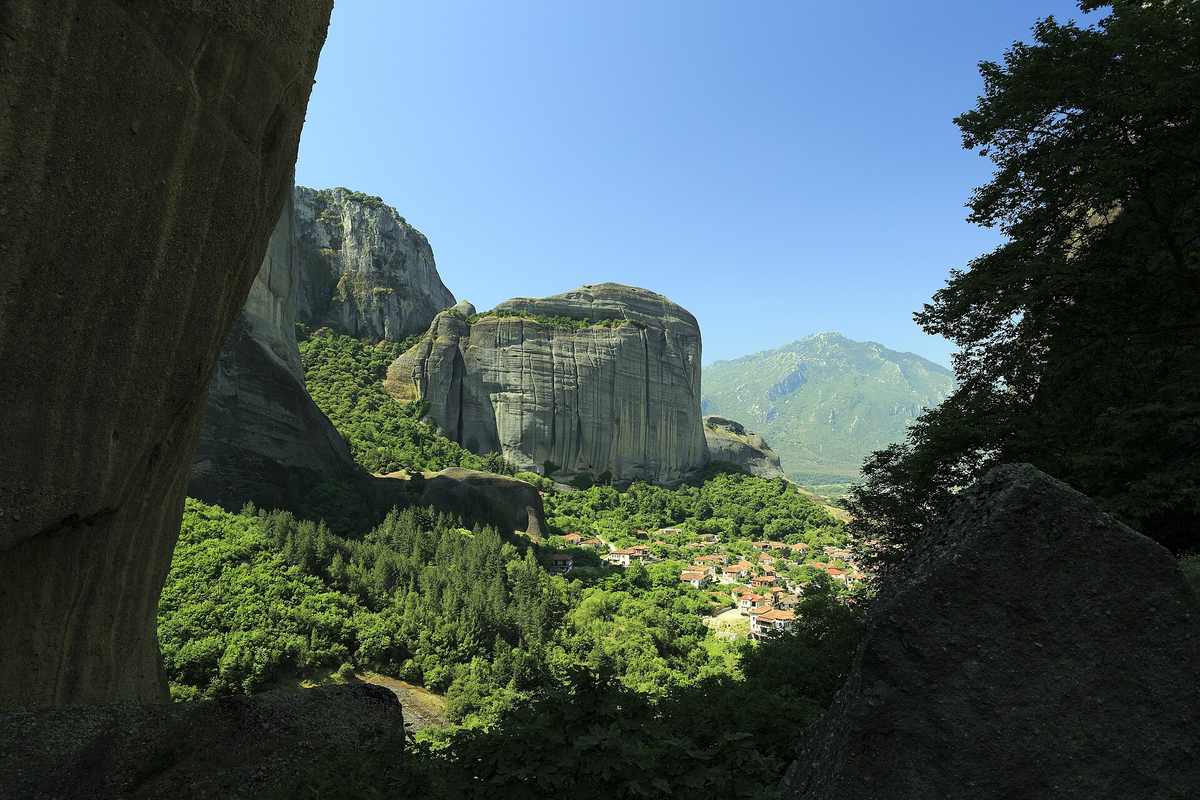
Kastraki sits directly at the foot of the Meteora rock pillars, a traditional stone village of narrow lanes and red-tiled roofs that seems to grow out of the conglomerate towers rising above it. Roughly 2 kilometres northwest of Kalabaka, in the Thessalian plain of central Greece, it is the closest inhabited settlement to the sandstone giants and the monasteries perched on their summits. Villagers still keep vineyards on the slopes below the rocks, and the sheer face of Doupiani looms at the edge of the square. If you want to sleep beneath Meteora rather than merely visit it, plan Kastraki with My Greece Tours.
It works as a compact walking base rather than a place you drive through because kastraki lies right against the base of the pillars. Trailheads for the older monk paths begin at the village edge, and the main paved road up to the monasteries passes through it on the way from Kalabaka. For the wider region, orientation, and monastery visiting hours, use the Meteora travel guide alongside this page. The sections below cover where Kastraki sits and why climbers gather here. They also explain how it compares with its larger neighbour, what the village itself offers, and how to reach the monasteries on foot.
Where is Kastraki and how close is it to the Meteora rocks?
Kastraki sits about 2 kilometres northwest of Kalabaka in Thessaly, wedged directly against the base of the Meteora conglomerate pillars. It is the closest inhabited village to the rocks and their clifftop monasteries.
Kastraki occupies a shallow bowl at the western foot of the Meteora massif, where the flat Thessalian plain meets the first of the towering sandstone-and-conglomerate columns. The pillars do not sit on a distant horizon here. They rise straight out of the gardens and vineyards at the village edge, with the isolated Doupiani rock standing sentinel above the central square. This immediacy is the whole point of choosing Kastraki. From Kalabaka, the larger town on the plain, the rocks are a short drive away, but from Kastraki you step out of your door and stand beneath them.
The paved monastery road climbs from the open plain, passes through the heart of the village, and switchbacks up toward the six inhabited monasteries above.
The setting is geological as much as scenic. The Meteora pillars formed from a river delta deposit that was uplifted and eroded over millions of years into rounded, near-vertical towers. Kastraki itself nestles in the gaps where softer ground allowed a settlement to take root. Sunrise and sunset paint the towering rock faces in shifting colour directly overhead, which is why landscape photographers base themselves here in the village. The settlement sits so low against the cliffs that the light show unfolds right above the rooftops. For a fuller picture of the region and its history, read the Meteora monasteries guide before you climb.
That way you will know which of the six clifftop houses are open on the day you plan to walk up from the village.
Why is Kastraki the hub for rock climbing in Meteora?
Kastraki sits at the literal base of the climbing pillars, so climbers can walk to routes on the Doupiani, Holy Ghost, and Sourloti towers within minutes. Local guides, gear, and short approaches all cluster in the village.
The Meteora towers are a world-renowned trad and bolted climbing destination, and Kastraki is the small stone settlement that grew over time into its natural base camp. The rounded conglomerate offers friction climbing on pebbled faces. Routes range from short single pitches to long multi-pitch lines up towers like Sourloti, the Holy Ghost, and the Doupiani rock at the village edge. Climbers can walk from a guesthouse in the square to the foot of a route before the morning sun heats the rock. The approaches here are measured in minutes rather than hours.
Anyone planning to tie in should study rock climbing in Meteora for grades, seasons, and the ethics that protect the pillars, which sit within a protected and partly sacred landscape.
Climbing here carries real responsibilities that the whole village community takes seriously to this day. The monasteries are active religious sites, so certain towers and faces are closed to climbing out of respect. The local culture leans toward clean, minimal-impact ascents established by pioneers who opposed heavy bolting. Kastraki’s tavernas and guesthouses fill with climbers in spring and autumn, when temperatures suit long days on the rock. The village then functions as an informal meeting point where partners are found and conditions are traded. The network of marked footpaths described under hiking in Meteora starts from the very same trailheads that climbers use.
You can keep your feet on the ground and still explore the same terrain on those paths.
How does staying in Kastraki compare with staying in Kalabaka?
Kastraki is smaller, quieter, and set right under the rocks, favouring walkers and climbers who want the monasteries at their doorstep. Kalabaka is larger, with the train station, more shops, restaurants, and services on the plain.
The choice between the two neighbouring settlements shapes your whole visit. Kastraki is a village of roughly 400 residents built into the folds of the rock. Small family-run guesthouses, a scattering of tavernas around the square, and an atmosphere that goes quiet after dark set its tone. You trade convenience for proximity: you are literally beneath the pillars, the trailheads are a stroll away, and the first light of day hits the towers right above your roof. This suits hikers, climbers, and travellers who came for the landscape rather than the amenities.
To weigh accommodation options across the whole area, the where to stay in Meteora guide sets Kastraki’s guesthouses against the larger hotels and services down on the plain.
Kalabaka, by contrast, is the region’s main town, home to the railway station that connects Meteora to Athens and Thessaloniki. It offers a wider choice of restaurants, banks, pharmacies, car hire, and evening life. Visitors who prize practicality base themselves there and drive the short distance to the rocks each morning. The two settlements sit so close together that you can stay in one and easily eat or shop in the other. A single well-trodden footpath links them directly at the base of the cliffs. Compare the departures listed under Meteora tours, certain ones collecting guests from both Kastraki and Kalabaka.
This suits travellers arriving without a car who want an organised way to see the clifftop monasteries from either base.
What does the village of Kastraki itself offer visitors?
Kastraki offers traditional stone architecture, family tavernas serving Thessalian dishes, small guesthouses, hillside vineyards, and a central square framed by the Doupiani rock. It is a base for walking, dining, and watching light change on the pillars.
Kastraki rewards travellers who slow down. Its lanes wind between old stone-and-timber houses with wooden balconies, small courtyards, and vine trellises, climbing gently toward the rock faces that enclose the village on three sides. The central square, overlooked by the Doupiani rock and a small chapel at its foot, is the social heart. Tavernas set out tables under plane trees and serve Thessalian cooking: grilled meats, wild greens, local cheeses, and wine pressed from the vineyards on the slopes just below the pillars. Evenings are unhurried, and the floodlit monasteries glow on the cliffs above.
Everything is walkable, and the same lanes that lead to dinner lead on toward the monastery paths covered in the Meteora monasteries guide because the village is compact.
The village also preserves a working rural character that larger tourist resorts have long since lost. Grapevines and small kitchen gardens still line the approaches, and in autumn the grape harvest fills the air with the sweet smell of pressing. Small churches and roadside shrines mark the old paths the monks once used to reach the rocks. The ruined Doupiani hermitage above the square hints at the earliest ascetic settlement here, centuries before the great monasteries were raised. Kastraki is a place to base yourself for two or three unhurried days rather than a single rushed stop.
Spend early mornings and late afternoons on the trails, and reserve midday for the shade of a taverna beneath the towering conglomerate walls.
Can you walk to the Meteora monasteries from Kastraki?
Yes. Marked footpaths and the old monk trails begin at the edge of Kastraki and climb directly to several clifftop monasteries, so you can reach them on foot in roughly one to two hours without a car.
Walking up from Kastraki is by far the oldest and most rewarding way to reach the clifftop monasteries. The village sits at the foot of the massif. The historic stone-cut paths that monks used for centuries begin right at its upper edge and switchback up through the gaps between the pillars. From Kastraki a marked route climbs toward the Great Meteoron and Varlaam, the two largest monasteries, while other paths branch off to smaller houses along the way. The gradient is steady rather than brutal, and reaching a monastery on foot, arriving as pilgrims once did, gives a sense of the landscape that the paved road cannot.
The full route network, distances, and surfaces are laid out under hiking in Meteora.
Practical planning matters because these are living religious sites, not just viewpoints. Each monastery keeps its own opening days and hours and closes on set days of the week. Check schedules before you set out, and observe the modest dress code: covered shoulders and, for women, a long skirt, which the monasteries lend at the gate. Carry a full bottle of water, wear grippy shoes for the worn stone steps, and start early to beat both the midday heat and the tour buses. An organised outing listed under Meteora tours can drive you between the clifftop entrances.
That leaves only the final flights of steps to walk if a full climb on foot is more than you want in the summer heat.
Frequently Asked Questions
How far is Kastraki from Kalabaka, and how do I get between them?
Kastraki lies roughly 2 kilometres northwest of Kalabaka, so close that the two neighbouring settlements almost blend into each other at the very foot of the Meteora rocks. The short gap between them is filled with vineyards and gardens rather than open countryside. The distance is easily covered by car in under ten minutes, by a local bus that runs the short hop, or on foot. A path and road link the villages at the base of the cliffs, a walk of around twenty to thirty minutes. Kalabaka holds the region’s railway station with connections toward Athens and Thessaloniki, so most travellers arrive there first, then continue the short distance to Kastraki.
You can comfortably sleep in Kastraki beneath the pillars and still use the shops, banks, and restaurants of the larger town because the two are so near. The wider guide to Kalabaka explains the transport links and how the two settlements complement each other.
Is Kastraki a good base for hiking and climbing in Meteora?
Kastraki is arguably the best base in the region for anyone whose visit centres on walking or climbing, because it sits at the literal foot of the pillars. Trailheads for both the marked footpaths and the old monk routes start at the upper edge of the village. The climbing towers rise straight above the last houses, so approaches take minutes rather than a long drive. Climbers gather here in spring and autumn when the conglomerate rock is at its best, and the tavernas double as informal meeting points. Walkers benefit from the same short, direct access to the marked trails that thread between the rocks and climb up to the monasteries.
Read rock climbing in Meteora for route grades, seasons, and the local ethics that keep certain sacred faces off-limits. Pair it with the footpath details so you can plan whichever type of day out suits your fitness and the weather.
When is the best time to visit Kastraki and Meteora?
Spring and autumn are the most comfortable seasons to visit Kastraki and the surrounding rocks. Daytime temperatures are mild, the light is soft on the conglomerate faces, and the crowds thinner than at the height of summer. Late spring brings green slopes and bright wildflowers around the edges of the village, while autumn adds the grape harvest and warm colours to the vineyards below the pillars. Summer is busy and can be very hot on exposed trails, so early mornings and late afternoons are best for walking, with midday spent in the shade of a taverna. Winter is quiet and atmospheric, with mist wreathing the towers and occasional snow dusting the monasteries, though local services scale back.
Whatever the season, check monastery opening days before you climb up, since each keeps its own schedule. To compare accommodation across the seasons, the where to stay in Meteora guide covers Kastraki’s guesthouses and the options nearby.