
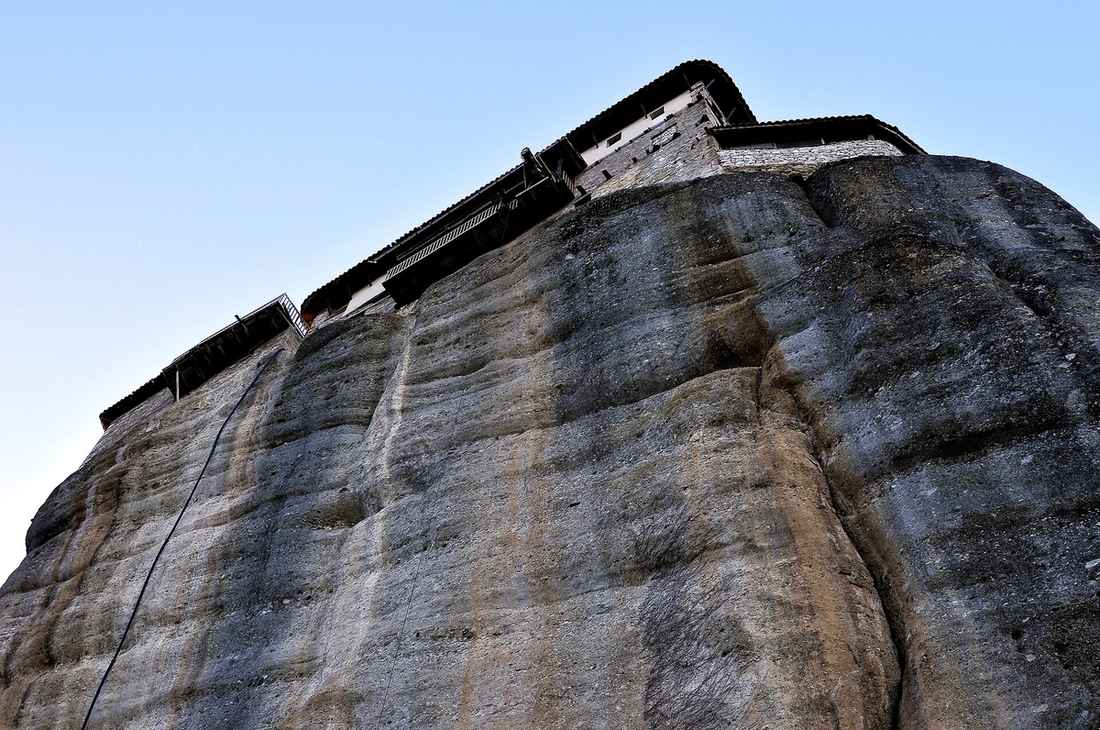
The tall grey pillars of Meteora are famous for the monasteries perched on their summits, yet the first religious life here happened far lower and far earlier. Hermits and ascetics settled in natural caves, clefts, and rock ledges long before a single monastery stood. These solitary monks prayed in hollows worn into the sandstone, reaching them by rope and wooden ladder. Their cave cells, known as the askitaria, still cling to the cliffs above the modern trail. This page traces that hidden ascetic layer beneath the monastic skyline, and helps you find the surviving hermitages on your own visit with My Greece Tours.
Meteora rewards travellers who look past the summit monasteries to the rock faces below, where the earliest devotion took root. Our Meteora travel guide sets the wider scene, and this article zooms into the caves, cells, and painted chapels of the first hermits. The sections below cover who these ascetics were, where they lived, how they climbed, which hermitages survive today, and how their cave life grew into the organised monasteries of the fourteenth century. Read it before you walk the base of the rocks, and the empty ledges overhead will suddenly make sense.
Who were the first hermits of Meteora?
The first Meteora hermits were solitary ascetic monks who settled in natural caves and rock clefts from around the ninth to eleventh centuries, praying alone in the pillars long before organised monasteries appeared.
The earliest ascetics of Meteora were individual monks seeking silence and prayer away from the towns of Thessaly. They chose the vertical rock faces near the village of Kastraki because the caves offered shelter, isolation, and a natural defence against raiders on the plain below. Each hermit lived apart, meeting only occasionally for worship. Their diet was bread, water, and wild plants, and their days followed a strict cycle of psalms and manual craft. This solitary pattern, called the eremitic life, laid the spiritual groundwork for everything built later.
The history is traced in detail in our guide to the history of the Meteora monasteries, which shows how scattered hermits slowly gathered into shared communities on the same rocks.
These pioneers left few written records, so the caves themselves are the main evidence. Soot from oil lamps still darkens some ceilings, and cut footholds mark the routes hermits used to reach higher ledges. The rock is a natural conglomerate of pebble and sandstone, and its erosion patterns are explained in our page on the geology of Meteora. Hermits read that geology instinctively, choosing overhangs that stayed dry and clefts that hid a small entrance. A single monk might occupy one cave for decades, carving a niche for an icon and a ledge for sleep. The austerity was the point, and it shaped a spiritual reputation that later drew the founders of the great monasteries.
Where in Meteora did the ascetics live?
Ascetics lived in caves and rock hollows scattered through the Meteora pillars, most densely near Kastraki, where the Skete of Doupiani formed the earliest organised community at the foot of the rocks.
The densest cluster of hermit caves lies on the rocks above and around the village of Kastraki, the settlement closest to the pillars. Our page on Kastraki covers the village that grew beneath these ascetic sites and still serves as the natural base for exploring them. From the village edge you can look up and pick out dark cave mouths on the grey rock, some barely wide enough for one person. The hermits favoured the sheltered inland faces, where wind and rain caused less damage to their icons and stores. This concentration near Kastraki was no accident, since it kept solitary monks within reach of a water source and a small population that could supply bread and oil.
The most important early centre was the Skete of Doupiani, also linked to the medieval settlement of Stagoi, at the base of the pillars near Kastraki. A skete is a loose community where hermits live separately but share a central church for worship. At Doupiani that church was the small chapel of the Panagia Doupiani, the Virgin of Doupiani, which survives in rebuilt form and marks the spiritual heart of the first monastic gathering. The Doupiani community gave the scattered hermits a shared identity and a rule of life. From this seed the fully organised monasteries later grew, a transition explained across our overview of the Meteora monasteries that crown the rocks today.
How did hermits climb the Meteora rocks?
Hermits reached their high caves using knotted ropes, removable wooden ladders, and later timber scaffolding pinned to the cliff, pulling the ladders up behind them to seal off the ledge from the ground.
Access was the central problem of ascetic life on the pillars. A hermit chose a cave precisely because it was hard to reach, then had to devise a way in that could be sealed once inside. The simplest method was a long rope, knotted for grip, hanging from an anchor point above the cave. Removable ladders of wood and rope came next, lashed together in sections so a monk could haul the whole assembly up after climbing. This turned a plain ledge into a defensible cell that no raider could storm.
The same climbing culture is echoed today by walkers who follow the marked paths, described on our page about hiking in Meteora, though modern trails keep firmly to the ground.
The hermits and early monks built timber scaffolding fixed into holes cut in the rock, the square sockets still visible on many faces, as communities grew. These frames supported platforms and covered walkways that let monks move between cells and carry building materials upward. Supplies rose in nets and baskets hauled by hand-turned windlasses, a system the later monasteries expanded into their famous rope-and-net lifts. The climb was genuinely dangerous, and falls were a known risk of the ascetic vocation. Winter made it worse, with ice on the rope and snow on the ledges, a season detailed on our page about Meteora in winter.
The difficulty was inseparable from the spiritual meaning, since the hard ascent mirrored the monk’s climb toward heaven.
What hermitages survive on the Meteora cliffs?
Surviving Meteora hermitages include the cave cells of the askitaria high on the rock faces, the hermitage of Ypapanti, and painted rock chapels with faded frescoes still clinging to the cliffs above Kastraki.
The clearest survivors are the askitaria, the cave cells and hermit dwellings that dot the vertical faces above the modern road. From the ground you can spot walled-up cave mouths, small windows set into the rock, and the timber remains of old access frames. The hermitage of Ypapanti, set in a long horizontal cleft, is among the best preserved and shows how a natural fissure was closed with masonry to form a chapel and living space. These sites predate the summit monasteries and reveal the raw form of Meteora devotion.
The founding of the largest houses that followed is covered on our page for the Great Meteoron monastery, which rose on a summit while the older askitaria remained below.
Several rock chapels retain painted decoration, their frescoes weathered but legible where the overhang has kept off rain. Pigments of red ochre, blue, and gold once covered walls that now show saints in fading outline. These paintings confirm that the caves were not mere shelters but consecrated spaces of worship, complete with altars and icons. Access to most askitaria is now restricted for safety and preservation, so travellers view them from the marked viewpoints and trails rather than climbing. Even from a distance the effect is striking, a scatter of tiny human structures pinned to an immense grey wall.
They form the quiet counterpart to the crowded monasteries above, and they reward anyone who takes time to scan the cliffs carefully.
How did Meteora caves become monasteries?
The scattered Meteora hermits gradually gathered into organised communities during the fourteenth century, moving from solitary caves to shared summit monasteries that peaked between the fourteenth and sixteenth centuries.
The shift from cave to monastery was slow and deliberate. Solitary hermits first drew together into loose sketes like Doupiani, sharing a church while keeping separate cells. The next stage was the cenobitic, or communal, monastery, where monks lived under one roof, one abbot, and one shared rule. This model demanded larger, safer buildings than a single cave could offer, which pushed the communities upward onto the flat pillar summits. The move began in earnest in the fourteenth century and reshaped the whole landscape of the rocks. The full sequence of foundations is set out in our history of the Meteora monasteries, tracing each house from its hermit roots to its final summit form.
Building on the summits required the very climbing and hauling skills the hermits had perfected over earlier centuries. Rope lifts, timber scaffolds, and windlasses that once served single cells now carried stone, timber, and monks to the tops of the pillars. The result was a golden age of monastic construction that reached its height between the fourteenth and sixteenth centuries, when many summit houses were founded and richly decorated. The caves were never wholly abandoned, and some hermits kept to the old ascetic way even as the monasteries flourished above them.
The two layers, cliff cave and summit monastery, together tell the complete story of Meteora, a place where solitary prayer in the rock grew into one of the most remarkable monastic centres in the Orthodox world.
Frequently Asked Questions
Can you visit the hermit caves of Meteora today?
You can view the hermit caves and askitaria of Meteora, though almost all of them are closed to entry for safety and preservation. The cave cells sit high on sheer rock faces, and their old rope-and-ladder access is long gone, so climbing is neither permitted nor safe. Travellers instead observe the caves from the road, marked viewpoints, and walking trails that pass beneath the pillars. Our page on hiking in Meteora lists the paths that give the closest legal views of the old hermitages. Bring binoculars, since the dark cave mouths, walled windows, and timber remains read far better through a lens than with the naked eye.
The base of the rocks near Kastraki offers the richest cluster to scan. A guided walk helps, because a local guide can point out which ledge held a cell and which cleft became the hermitage of Ypapanti.
What was the Skete of Doupiani at Meteora?
The Skete of Doupiani was the earliest organised monastic community at Meteora, formed at the foot of the pillars near Kastraki and linked to the medieval settlement of Stagoi. A skete is a middle stage between total solitude and a full monastery, where hermits live in separate cells yet gather at a shared church for worship. At Doupiani that central church was the small chapel of the Panagia Doupiani, dedicated to the Virgin, which survives in rebuilt form and still marks the site. The skete gave the scattered ascetics of the rocks a common rule, a leader, and a fixed place of prayer, turning isolated hermits into a recognisable community.
From this early gathering the tradition grew toward the great summit houses. The wider story of that growth appears in our guide to the history of the Meteora monasteries, which traces the line from Doupiani to the famous cliff-top monasteries.
Why did hermits choose the Meteora rocks for their caves?
Hermits chose the Meteora rocks because the tall pillars combined isolation, natural shelter, and defence in a single dramatic setting. The caves and clefts offered dry hollows shielded from wind and rain, ideal for a life of prayer stripped of comfort. Height kept the ascetics apart from the towns and traffic of the Thessalian plain, granting the silence their vocation demanded. The sheer faces also gave protection, since a cave reached only by a removable ladder could not be stormed by raiders. The unusual rock itself, a conglomerate of pebble and sandstone shaped by erosion, is described on our page about the geology of Meteora, and its overhangs and fissures were perfect for hermit cells.
Proximity to Kastraki meant a nearby source of bread, oil, and water without breaking the solitude. The combination proved so suited to ascetic life that it seeded one of the greatest monastic centres of Orthodox Christianity.