
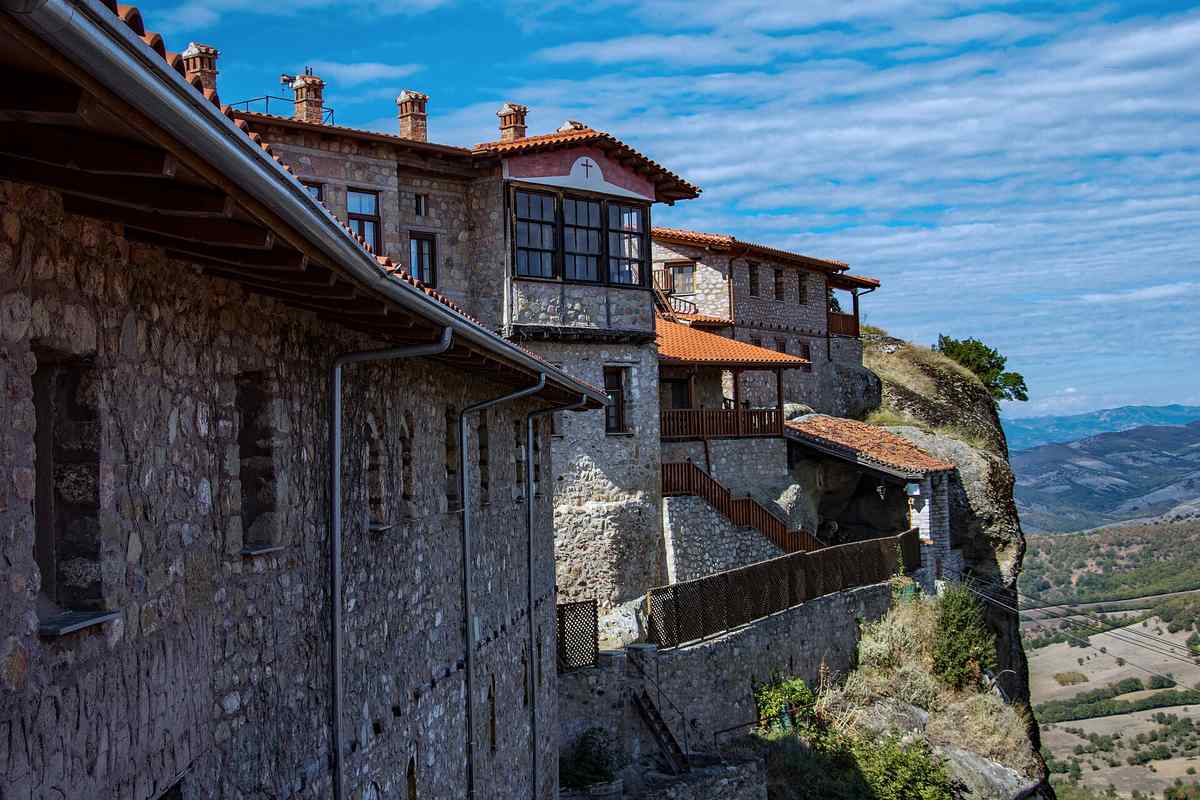
Great Meteoron crowns the Broad Rock above Kalabaka, the tallest and largest of the six working monasteries that give Meteora its fame. The full name is the Holy Monastery of the Transfiguration of Christ, and locals call it Megalo Meteoro. Its stone buildings rise near six hundred metres, reached by a long flight of carved steps cut into the cliff. A monk named Athanasios the Meteorite founded the community in the fourteenth century, coining the word that named the whole rock landscape. The site pairs a grand church, an old refectory museum and quiet monastic rooms with sweeping views over Thessaly. Plan your climb, dress and route with My Greece Tours.
Great Meteoron rewards a slow visit, and it anchors most itineraries across the rock cluster. This page sits inside a wider Meteora travel guide that maps the roads, the viewpoints and the neighbouring monasteries you can pair on one loop. The sections below cover what the Great Meteoron is, how it was founded and grew, the church and refectory museum, the practical climb and dress code, and where it fits among the six monasteries. Read on to picture the setting before you arrive, then match the monastery to your energy, your timing and the day of the week it stays open.
What is the Great Meteoron and where does it stand in Meteora?
The Great Meteoron is the largest and highest of the six Meteora monasteries, set atop the Broad Rock near six hundred metres. Its formal name honours the Transfiguration of Christ, and locals call it Megalo Meteoro.
Great Meteoron stands on the Broad Rock, a sheer sandstone pillar that towers over the plain of Thessaly and the town of Kalabaka below. The monastery caps the summit at roughly six hundred metres, higher than any of its neighbours, and its terraces open onto long views of the surrounding rock forest. Grey stone walls, red-tiled roofs and a domed church form a compact stone village clinging to the flat crown of the pillar. The formal dedication is to the Transfiguration of Christ, and the local name Megalo Meteoro simply means the great suspended rock. The site forms the heart of the Meteora monasteries, drawing more visitors than any other cliff-top community here.
The word Meteora describes rocks that seem suspended in mid-air, and the Great Meteoron gave that idea its name. Athanasios the Meteorite chose the tallest pillar for his community, and the title spread to the whole cluster of monasteries perched on the crags. The monastery reads as a small self-contained world once you reach the top: a church, living quarters, storerooms, cisterns and a museum share the flat summit. Stone paths link the buildings, and low walls guard the drops on every side. A visit here sets the scale for the entire region, and it pairs naturally with a broader tour that takes in Meteora tours across the six active sites.
Who founded the Great Meteoron and how did its history unfold?
Saint Athanasios the Meteorite founded the monastery in the fourteenth century on the Broad Rock. Joasaph, a monk who had ruled as a Serbian-Byzantine king, later expanded it and endowed the church that still stands.
Athanasios the Meteorite climbed the Broad Rock in the fourteenth century and gathered the first monks into an organised community on its summit. He drew up rules for the brotherhood and gave the towering pillar the name Meteoron, the suspended rock. His work turned a scattering of hermits on the crags into a structured monastery with a church, cells and shared discipline. The founding era set the pattern that later monasteries across the cliffs would follow. This early chapter forms the opening of the wider history of the Meteora monasteries, a story of ascetics who traded valley life for the safety and silence of the rock tops.
Joasaph carried the monastery into its next great phase. He had ruled as a Serbian-Byzantine king before he renounced the throne, took monastic vows and joined the brotherhood on the Broad Rock. Under his patronage the community rebuilt and enlarged the main church, endowed it with treasures and secured its standing among the growing cluster of monastic houses. Fortunes rose and fell across the following centuries as raids, decline and revival touched the rock in turn. The Great Meteoron survived each swing and kept its place as the leading house of the region. Its long record helps explain why it remains the most visited monastery, a living link to the founders who first climbed these cliffs.
What can you see inside the church and refectory museum?
The katholikon of the Transfiguration holds old frescoes beneath a high dome. The former refectory now serves as a museum, and the old kitchen, wine cellar and an ossuary of monks’ skulls complete the tour of the summit buildings.
The katholikon, the main church of the Transfiguration, forms the spiritual centre of the summit. Its high dome rises over a cross-shaped plan, and old frescoes cover the walls with scenes from scripture and rows of saints painted in deep, aged colour. Carved wood and hanging lamps fill the sanctuary, and the quiet interior contrasts with the bright terraces outside. The old refectory, once the dining hall of the brotherhood, now houses the monastery museum, where icons, manuscripts, vestments and everyday tools trace centuries of monastic life. A walk through these rooms rewards a slower pace, much like the reflective mood people seek when planning hiking in Meteora between the pillars below.
Service rooms round out the visit and show how the community fed and sustained itself on an isolated rock. The old kitchen keeps its blackened hearth and great cooking vessels, evidence of meals prepared for a full brotherhood. A wine cellar with huge storage barrels stands nearby, a reminder of how supplies were stockpiled against hard winters on the summit. The ossuary displays the skulls of departed monks arranged on shelves, a stark and honest meditation on mortality that sits at the heart of the monastic outlook.
Each room tells part of one story, and the museum, church and stores together make the Great Meteoron the fullest visit among the neighbouring houses such as Varlaam Monastery across the gap.
How do you reach and visit the Great Meteoron in Meteora?
You climb a long flight of carved stone steps to reach the summit from the road. Modest dress is required for all visitors, and the monastery closes one day each week on a seasonal schedule.
A road winds up from Kalabaka toward the base of the Broad Rock, and parking sits near the foot of the climb. From there a long staircase of stone steps carved and built into the cliff carries you up to the monastery gate. The ascent is steady rather than technical, with rails and landings that let you pause and take in the widening view. Sturdy shoes and a slow pace make the climb comfortable for most fit visitors. The steps replaced the old net-and-basket hoists that once lifted monks and supplies, so the modern approach is far easier than the historic one.
Guides who run Meteora tours time the visit to avoid the busiest midday crush at the entrance.
Modest dress is required, in keeping with the monastery’s active religious life. Shoulders and knees must be covered, and women are asked to wear a skirt, with wraps usually available to borrow at the entrance for those who arrive unprepared. The Great Meteoron closes one day each week, and the exact closing day shifts with the season, so a quick check before you set out saves a wasted trip. Opening hours run through the daytime and tend to shorten in the colder months. Photography rules vary inside the church, and quiet, respectful behaviour is expected throughout.
A little planning around the closing day and the dress code keeps a visit to the largest of the Meteora monasteries smooth and rewarding.
How does the Great Meteoron fit among the six Meteora monasteries?
The Great Meteoron ranks as the largest and most visited of the six active monasteries. Most visitors start here, then pair it with nearby Varlaam across the gap and choose others by time, energy and closing days.
Six working monasteries survive on the rock pillars today, and the Great Meteoron leads them in size, height and visitor numbers. Its scale and central position make it the natural first stop on a touring loop, and its terraces frame the classic view across the cliffs to the neighbouring houses. Varlaam stands closest, just across a narrow gap, and the two pair well within a single morning. The remaining four sit within short drives along the ridge road, each with its own steps, character and viewpoint. A well-planned circuit weaves the Great Meteoron together with the others, a rhythm that guided Meteora tours handle with ease for first-time visitors.
Closing days shape any circuit, since each monastery rests on a different day of the week, so a smart route checks the calendar before it locks in the order of stops. Energy matters too, because every site demands its own climb of carved steps under the sun. Pairing the Great Meteoron with Varlaam first banks the two grandest houses early, then leaves the smaller ones for later. Walkers who add stretches of hiking in Meteora link the monasteries on old monk paths rather than the road, a quieter way to feel the scale of the rocks. The Great Meteoron stays the anchor of any plan, the largest and most complete of the six.
Frequently Asked Questions
Why is it called the Great Meteoron?
The name marks it as the greatest of the rock monasteries. Its formal dedication is to the Transfiguration of Christ, but locals call it Megalo Meteoro, which means the great suspended rock. Athanasios the Meteorite, its founder, coined the word Meteoron for the towering pillar he settled in the fourteenth century, a term describing rocks that seem to hang in mid-air. The title stuck to the whole cluster and gave the region its name. The word great reflects the monastery’s rank as the largest and highest of the six houses, set atop the Broad Rock near six hundred metres. Its size, its founding role and its long standing as the leading community all justify the label.
The name therefore carries a double meaning, pointing at once to the suspended rock and to the monastery’s place as the foremost of the cliff-top brotherhoods that crown the pillars above Kalabaka.
How many steps do you climb to reach the Great Meteoron?
You climb a long flight of carved stone steps cut and built into the cliff, and the count runs to well over a hundred by the time you reach the gate. The exact number is debated and often quoted differently, so treat any single figure with caution rather than as a fixed fact. The staircase rises steadily from a car park near the base of the Broad Rock up to the monastery entrance on the summit. Rails and landings break the ascent, letting you rest and enjoy the broadening view over the surrounding pillars. The climb is steady rather than steep or technical, and most reasonably fit visitors manage it with pauses.
Sturdy shoes and an unhurried pace make the ascent comfortable. These steps replaced the old rope nets and baskets that once hauled monks and supplies to the top, so today’s approach is far gentler than the historic one that early pilgrims faced.
What is inside the Great Meteoron monastery?
The summit holds a compact stone village of church, museum and service rooms. The katholikon of the Transfiguration is the main church, crowned by a high dome and lined with old frescoes of saints and scripture scenes. The former refectory, the monks’ dining hall, now serves as a museum displaying icons, manuscripts, vestments and everyday objects from centuries of monastic life. The old kitchen keeps its blackened hearth and great cooking vessels, and a wine cellar nearby preserves huge storage barrels once used to stock supplies for hard winters. An ossuary lines its shelves with the skulls of departed monks, a stark reminder of mortality central to the monastic outlook.
Terraces and cisterns complete the picture of a self-sufficient community on an isolated rock. Together these rooms make the Great Meteoron the fullest and richest visit among the six monasteries, a place where church, museum and daily life all sit within a short walk on the summit.