
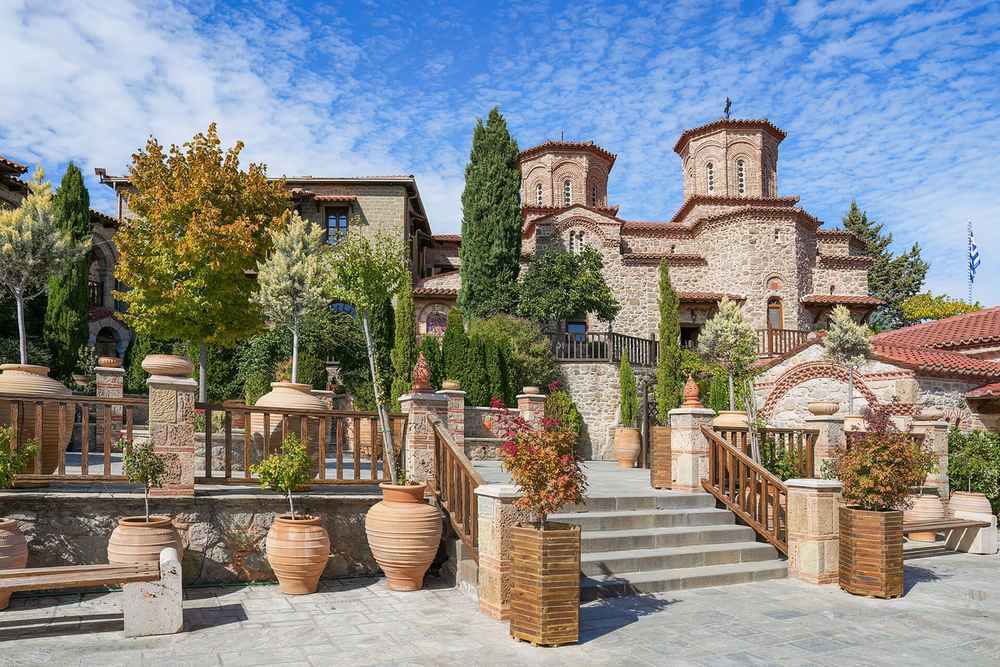
Varlaam Monastery sits on one of the tallest rock pillars in the Meteora region of Thessaly, in central Greece near Kalabaka. The monastery is dedicated to All Saints and ranks as the second largest of the six active Meteora houses. It stands directly next to the Great Meteoron, sharing a dramatic clifftop skyline. Carved steps and a short stone bridge carry visitors up to the summit terrace. The monastery preserves vivid post-Byzantine frescoes, a katholikon rich with painted scenes, and reminders of the old rope access. Travellers weigh setting, history, and practical entry before they climb. Plan your visit to this remarkable clifftop landmark with My Greece Tours.
The rock of Varlaam rises above the wooded valley floor, giving wide views across the surrounding pillars and the town below. Monks first reached the summit centuries ago and shaped a self-contained community high above the plain. Our full Meteora travel guide sets the wider context, mapping the six houses and the paths that link them. The sections below cover what Varlaam Monastery is, how it came to stand on its rock, the church and its treasures, the practical side of visiting, and how the site pairs with its famous neighbour. Each answer keeps to facts, so you arrive prepared and dressed correctly.
What is Varlaam Monastery and where does it stand in Meteora?
Varlaam Monastery is an active Greek Orthodox house dedicated to All Saints. It stands on a tall rock pillar in the Meteora complex near Kalabaka, ranking as the second largest of the six surviving monasteries.
Varlaam Monastery crowns a slender rock tower that rises sharply from the valley floor. The summit holds a compact community of buildings, courtyards, and terraces wrapped around the central church. The house takes its dedication from All Saints, a common Orthodox theme that gathers many holy figures under one feast. Its position places it among the cluster of houses that make the wider Meteora monasteries a lasting draw for travellers. The rock stands apart from its neighbours, joined to the access road only by a carved stairway and a short bridge. Views from the terrace stretch across the pillars and reach the rooftops of Kalabaka far below, framing a scene shaped by wind and stone over long ages.
The monastery ranks second in size among the six active Meteora houses, behind only the Great Meteoron. Its scale reflects a settled community that grew beyond a single hermit’s cell into a walled complex with a refectory, cells, and storerooms. Stone walls follow the natural edge of the rock, so the buildings seem to grow straight from the cliff. The summit gathers rainwater, tends small gardens, and keeps the daily rhythm of prayer that has marked the site for centuries. Varlaam Monastery sits within easy sight of its neighbours, letting visitors trace the layout of the whole region in one sweeping look. The setting rewards a slow, careful visit rather than a rushed stop between other stops.
How did the hermit Varlaam and the Apsaras brothers shape the monastery?
The hermit Varlaam first climbed the rock in the fourteenth century and built a small church and cells. Two brothers, the monks Nektarios and Theophanes Apsaras, rebuilt and expanded the house in the sixteenth century.
The monastery carries the name of Varlaam, a hermit who scaled the bare rock in the fourteenth century. He raised a small church and a few cells, then lived in solitude on the summit. His retreat faded after his death, and the rock stood quiet for a long stretch. The story of that first ascent mirrors the wider settlement of the region, when ascetics sought the highest, least reachable ledges for prayer. Varlaam’s early work set the footprint that later builders would follow. His name stayed fixed to the rock across the intervening years, so the sixteenth-century community inherited both a site and a memory.
The hermit’s choice of such a lofty perch shaped every stone that rose on the summit afterwards.
Two brothers from a notable family, the monks Nektarios and Theophanes Apsaras, revived the rock in the sixteenth century. They cleared the old ruins, raised a new katholikon, and organised a proper community with cells, a refectory, and storerooms. Their effort turned a forgotten hermitage into one of the leading houses of the region. The brothers are remembered as careful founders who planned the layout with care and drew skilled painters to decorate the church. Their names remain tied to the katholikon of All Saints and to the wave of building that reshaped several nearby rocks in the same century.
The work of the Apsaras brothers gave Varlaam the size and standing it still holds among the Meteora houses today.
What frescoes, the net-tower, and water barrel does Meteora’s Varlaam preserve?
The katholikon of All Saints holds vivid frescoes by the post-Byzantine painter Frangos Katelanos. The monastery also keeps a tower with a rope-and-net windlass once used to haul people and goods, plus a huge old wooden barrel for storing water.
The katholikon of All Saints shelters some of the finest painting in the whole region. Its walls carry vivid frescoes by Frangos Katelanos, a noted post-Byzantine master whose scenes fill the church with colour and detail. The programme spreads across the nave and side spaces, showing saints, feasts, and narrative cycles in the settled Orthodox tradition. These frescoes rank among the treasures that draw art-minded travellers on organised Meteora tours, since guides can point out the painter’s hand and the meaning of each scene. The painted surfaces have survived centuries of candle smoke and mountain weather. They give the church a hushed, luminous interior that repays quiet attention once visitors step inside from the bright terrace.
The monastery preserves striking reminders of the old access. A tower on the edge of the rock houses a rope-and-net windlass, the winch that once hauled people and goods up the sheer face in a swaying net. The same tower shows how monks reached the summit before carved steps existed. The house also keeps a huge old wooden barrel used to store rainwater, a practical answer to life on a waterless rock. These objects sit close to the frescoed church, so a single visit takes in both art and daily survival.
Evening light across the pillars, seen at the famous Meteora sunset, throws the tower and terrace into sharp relief and makes the old winch a memorable last sight before descent.
How do you visit Varlaam Monastery on the rock?
Visitors reach Varlaam by carved steps and a short bridge that cross to the summit. The monastery closes one day each week, and modest dress is required, with covered shoulders and knees for every guest.
Reaching the summit means climbing a flight of stone steps cut into the rock, followed by a short bridge that spans the gap to the terrace. The stairway replaced the old net and winch long ago, so the climb is steady rather than daunting. Sturdy footwear helps on the worn treads, and pauses on the way up open fresh views over the valley. The rock stands next to the road that threads the whole complex, which makes Varlaam an easy addition to a wider circuit of the Meteora monasteries. Guided groups often pair it with a neighbour to keep the walking sensible.
The ascent rewards each step with a wider horizon, and the final bridge delivers a first close look at the walls.
The monastery keeps a weekly closing day, so plan the visit for an open day and start early to beat the crowds. Modest dress is required for entry, with shoulders and knees covered for men and women alike. Wraps or long skirts are often provided at the gate for those who arrive uncovered. The house asks for quiet inside the church and respect for the monks who still live and pray there. Photography rules vary, so ask before raising a camera in the katholikon. A calm, unhurried visit suits the setting, which remains a place of worship rather than a museum.
Simple preparation on dress and timing lets every guest enjoy the frescoes, the terrace views, and the old tower without friction.
How does Varlaam pair with the Great Meteoron and the other Meteora monasteries?
Varlaam stands directly beside the Great Meteoron, so the two pair naturally on one visit. Together they anchor a circuit that links the six Meteora houses along a single winding road above Kalabaka.
Varlaam and its larger neighbour share the same stretch of clifftop, separated only by a narrow gorge. A short walk or drive connects the two, which makes a joint visit the natural choice for most travellers. The Great Meteoron holds the rank of largest and oldest of the six houses, so pairing it with second-largest Varlaam sets the two leading monasteries side by side. The route between them opens some of the best photo angles in the region, with each rock framing the other. Many visitors climb Varlaam first, then cross to the Great Meteoron, or reverse the order to suit opening days.
The two houses together give a full sense of the scale and ambition that shaped the settlement of these rocks.
The wider circuit strings all six active houses along a single winding road that climbs from Kalabaka. Beyond Varlaam and the Great Meteoron, the loop reaches Rousanou, Saint Nicholas Anapafsas, Holy Trinity, and Saint Stephen, each on its own pillar. A well-planned day, or one of the organised Meteora tours, can take in several houses in sensible order while respecting each closing day. Varlaam’s central position and its link to the Great Meteoron make it a fitting anchor near the start of the route. Guides often time the loop to end high on the rocks for the evening light. That pacing turns a string of separate stops into one connected journey across the whole clifftop landscape.
Frequently Asked Questions
What is Varlaam Monastery known for?
Varlaam Monastery is known as the second largest of the six active Meteora houses and for its rich post-Byzantine art. Its katholikon of All Saints holds vivid frescoes by Frangos Katelanos, a noted master whose painted scenes fill the church with saints, feasts, and narrative cycles. The monastery also keeps two vivid reminders of its clifftop past. A tower on the rock edge houses the rope-and-net windlass that once hauled people and goods up the sheer face. A huge old wooden barrel, used to store rainwater, shows how the community survived on a rock without a spring. The house stands directly beside the Great Meteoron, so the two form the leading pair of the region.
Travellers remember Varlaam for its frescoed interior, its dramatic setting on a tall pillar, and the way the old winch tower speaks of daily life before carved steps replaced the swaying net.
How do you reach Varlaam Monastery?
You reach Varlaam Monastery by a flight of stone steps carved into the rock, followed by a short bridge that crosses to the summit terrace. The stairway long ago replaced the old rope-and-net winch, so the climb is steady and manageable for most visitors with reasonable fitness. The rock sits beside the road that threads the whole Meteora complex above Kalabaka, which makes the monastery an easy stop on a wider circuit. Sturdy footwear helps on the worn treads, and short pauses on the way up open fresh views over the valley and the neighbouring pillars. Plan the visit for a day the house is open, since it keeps a weekly closing day.
Arriving early helps beat the busiest hours. Guided groups often pair Varlaam with the adjoining Great Meteoron to keep the walking sensible and the two leading houses within one visit.
What is inside Varlaam Monastery?
Inside Varlaam Monastery, the katholikon of All Saints forms the heart of the site. Its walls carry vivid frescoes by the post-Byzantine painter Frangos Katelanos, spreading across the nave and side spaces with saints, feasts, and detailed narrative scenes. The compact summit also holds cells, a refectory, storerooms, and terraces wrapped around the church, the layout the Apsaras brothers set in the sixteenth century. A tower on the rock edge preserves the rope-and-net windlass that once served as the only way up, and a huge old wooden barrel shows how the community stored precious rainwater. Small courtyards and viewing terraces open wide vistas across the pillars and toward Kalabaka far below.
The interior stays quiet and reverent, since the house remains active with resident monks. Modest dress is required, and visitors are asked to keep calm and respect the worship that continues on the rock.