
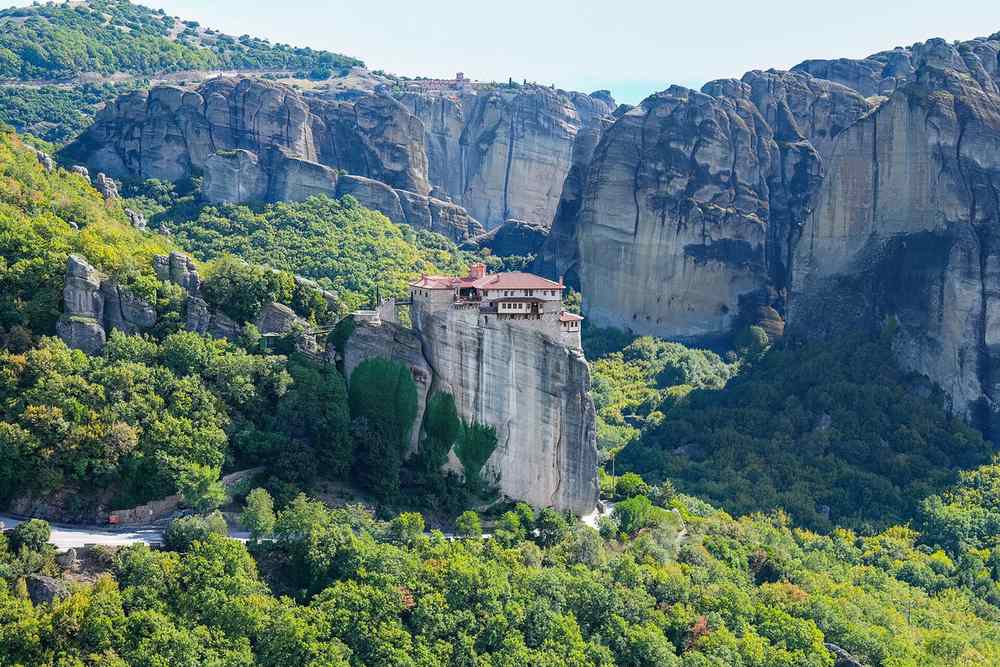
Rousanou Monastery ranks among the most photographed sights of the Meteora rock cluster. It stands on a lower, rounded pillar in the heart of the formation, wrapped so closely by the stone that walls and rock seem to merge. Small footbridges carry visitors across the narrow gap from the neighbouring rock, making the climb gentler than at the higher houses. The building rises for a range of storeys and crowns its pinnacle completely. A community of nuns keeps the church, tends the terraced gardens and welcomes pilgrims who reach the summit. The setting draws photographers at every hour of the day. Plan your Meteora journey to Rousanou and its neighbours with My Greece Tours.
Rousanou honours the Transfiguration of Christ and Saint Barbara, and the church holds post-Byzantine frescoes painted after the convent took shape. Its perch near the road turns it into a natural viewpoint for the whole valley of pinnacles. Our Meteora travel guide places Rousanou within the wider circuit of monasteries, viewpoints and villages around Kalabaka. Modest dress remains the rule, and the convent closes on one fixed day each week. The sections below cover what the monastery is and where it sits, its history and its life as a convent, the church and gardens, the practical side of a visit, and the reasons it photographs so well.
What is Rousanou Monastery and where does it sit in Meteora?
Rousanou Monastery is a working convent perched on a rounded rock pillar in central Meteora. It honours the Transfiguration and Saint Barbara. Footbridges link it to the neighbouring rock, and terraced gardens surround the church at the summit.
Rousanou occupies a lower, rounded pinnacle set deep among the Meteora rocks near Kalabaka in Thessaly. The monastery caps its rock so completely that the masonry appears to grow straight out of the stone. Vertical cliffs drop on every side, and the building climbs for a wide range of storeys to fit the narrow crown. This tight bond of architecture and geology gives Rousanou its unmistakable profile. The convent belongs to the group of six inhabited houses that make up the broader family of Meteora monasteries, each crowning its own pillar. Rousanou stands lower than most of its neighbours, tucked into the centre of the cluster rather than on the outer heights.
Its central position lets visitors take in surrounding rocks and rooflines in a single sweep.
The name Rousanou attaches to the rock and to the monastery that grew on it, dedicated to the Transfiguration of Christ and to Saint Barbara. Access sets Rousanou apart from the taller houses of the region. Small footbridges span the gap between a road-side rock and the monastery pinnacle, replacing the nets and ladders of earlier centuries. The short crossing makes the summit reachable for a variety of who would struggle with steeper approaches. Gardens and cypress trees soften the terraces around the church, and stone steps thread between the levels. Nuns maintain the whole compound, from the katholikon to the guest areas.
Rousanou reads as an intimate, self-contained world balanced on a rock in the middle of a stone forest.
What is the history of Rousanou and its life as a convent?
Rousanou was established in the sixteenth century on an older, abandoned site and later restored. It declined over time, then revived in the twentieth century as a convent. Nuns now live there, keep the church and tend the gardens.
Monastic life on the Rousanou rock reaches back to earlier centuries, but the house recognised today took shape in the sixteenth century. Two monk-brothers rebuilt the site and raised the katholikon dedicated to the Transfiguration. The monastery joined the flourishing network of hermitages and communities that spread across the pinnacles during that era of Meteora’s growth. Fortunes shifted over the following centuries. Numbers fell, buildings suffered, and the rock stood quiet for long stretches. Renewal arrived in the twentieth century, when the site was repaired and reorganised as a convent. Nuns replaced the earlier community of monks and brought the terraces, church and cells back into daily use.
The long arc of decline and revival mirrors the story of Meteora as a whole.
Rousanou functions today as an active convent, home to a small community of nuns. The sisters keep a rhythm of prayer, care for the katholikon and welcome visitors who cross the footbridges to the summit. Their work extends to the gardens, where flowers, herbs and cypress trees fill the narrow terraces. This living presence separates the inhabited houses from the ruined sites scattered across the valley. Rousanou sits beside other active foundations such as St Stephen Monastery, which also serves as a convent on its own pillar. The two convents anchor the community life that still animates Meteora.
Visitors who respect the quiet find a place shaped by centuries of devotion rather than a museum frozen in time.
What can you see inside the church, frescoes and gardens?
The katholikon holds post-Byzantine frescoes covering its walls with saints, feasts and scenes from Christian tradition. Around the church, terraced gardens hold flowers, herbs and cypress trees. Cells, walkways and viewing terraces fill the remaining space on the rock.
The heart of Rousanou is its katholikon, the main church dedicated to the Transfiguration of Christ. Painters covered its interior with post-Byzantine frescoes after the convent took its lasting form. The programme follows Orthodox tradition, with saints, martyrs, feast scenes and narrative cycles spread across walls and vaults. Rich colour and crowded compositions fill every surface, a hallmark of the fresco schools active across Meteora in that age. The dim, incense-scented space rewards a slow, quiet look. Photography inside the churches is generally restricted, so visitors take in the paintings with their eyes rather than a lens.
Rousanou shares this artistic heritage with the other painted katholika of the region, each preserving frescoes that record centuries of monastic faith and craft.
Beyond the church, the convent life shows in gardens and everyday spaces. Nuns tend narrow terraces planted with flowers, herbs and small shrubs, softening the hard stone with colour. Cypress trees rise from the ledges and frame views of neighbouring pillars. Cells, a small refectory and storerooms occupy the tight interior of the building, stacked over a selection of storeys to make use of the cramped rock. Balconies and terraces open onto the surrounding cliffs, offering part of the finest close views in Meteora. A visit here pairs naturally with organised Meteora tours that link a host of monasteries in a single day.
The gardens and viewpoints give Rousanou a gentle, human scale that an array of visitors remember as strongly as the frescoes.
How do you visit Rousanou Monastery in Meteora?
Reach Rousanou from the Meteora road, then cross short footbridges from the neighbouring rock to the summit. Access is easier than at the higher monasteries. Modest dress is required, and the convent closes on one fixed day each week.
Rousanou lies on the main circuit of the Meteora rocks, a short drive or walk from Kalabaka and the village of Kastraki. A parking area and viewpoint sit close to the monastery, since the rock rises near the road. From there a path leads to the footbridges that carry visitors across the gap to the pinnacle. The bridges make Rousanou one of the more accessible houses, with fewer steep steps than the taller monasteries demand. Sturdy shoes still help on the stone paths and stairs. The central location places Rousanou within easy reach of its neighbours, so it fits comfortably into a route that strings an array of Meteora monasteries together in one outing across the rock cluster.
Dress rules apply strictly at Rousanou, as at every active house in Meteora. Women cover shoulders and wear long skirts, men wear long trousers, and wraps are often available at the entrance for those who arrive unprepared. The convent keeps set opening hours and closes on one fixed day each week, so checking the current schedule before setting out avoids a wasted trip. Visitors move quietly through the church and terraces out of respect for the resident nuns. A small entrance donation supports the community.
Rousanou pairs well with an evening on the rocks, since a mix of travellers combine a daytime monastery visit with a later stop for the Meteora sunset from a nearby viewpoint over the pillars.
Why is Rousanou so photogenic in the Meteora circuit?
Rousanou photographs beautifully because its building wraps its rounded rock completely and sits low among the pillars. Nearby viewpoints frame it against cliffs and sky. Warm evening light on the stone makes it a favourite subject at sunset.
Rousanou earns its reputation as the most photogenic of the Meteora houses through its shape and position. The building follows the curve of its rounded rock so closely that stone and masonry blend into a single tower. Its central, lower placement lets photographers frame it with taller pillars rising behind and around it. A road-side viewpoint delivers a clean, elevated angle across the gap, capturing the whole monastery in one image. Cypress trees and gardens add colour and depth to the composition. These qualities make Rousanou a signature view of the region, reproduced on a wealth of postcards and guidebook covers. Any tour of the Meteora monasteries almost inevitably pauses at the overlook that frames this rock.
Light transforms Rousanou through the day, and evening treats it best. Warm, low sun washes the pale stone in gold and throws long shadows across the pillars, deepening the drama of the scene. Photographers gather at the nearby overlook to catch this glow, and the moment ranks among the highlights of any Meteora sunset. The convent’s position also keeps it easy to reach for a quick evening stop after a fuller day among the rocks. Rousanou fits the wider monastery circuit as both a working convent to enter and a landmark to admire from afar. It rewards visitors twice, once from within its terraces and once from the viewpoint that made its silhouette famous across Greece.
Frequently Asked Questions
Is Rousanou a convent with nuns?
Rousanou serves as an active convent, home to a small community of nuns. Monks first rebuilt the house in the sixteenth century, but the site declined over later centuries and stood quiet for long periods. Renewal in the twentieth century reorganised it as a convent, and the sisters have kept it alive ever since. They maintain a daily round of prayer, care for the katholikon dedicated to the Transfiguration and Saint Barbara, and tend the terraced gardens. The nuns also welcome pilgrims and visitors who cross the footbridges to the summit. Their presence gives Rousanou the atmosphere of a lived-in home rather than a museum.
Visitors respect the community by moving quietly, dressing modestly and observing the opening hours. Rousanou stands alongside St Stephen as one of the two active convents that keep the female monastic tradition of Meteora going on its own pillar of rock.
How do you reach Rousanou Monastery?
Rousanou sits near the main Meteora road, a short drive or walk from Kalabaka and Kastraki. A parking area and viewpoint lie close to the rock, since the pinnacle rises near the roadside. From there a marked path leads to small footbridges that span the gap from the neighbouring rock to the monastery summit. These bridges replaced the nets and ladders of earlier centuries and make Rousanou far easier to enter than the taller houses. The crossing involves only a short walk and a modest set of steps, so the climb suits a spread of visitors who avoid steeper approaches. Sturdy shoes help on the stone paths.
The central location places Rousanou within easy reach of its neighbours, letting travellers combine a mix of monasteries in one route. Guided tours and shuttle services from Kalabaka often include a stop here, dropping visitors at the viewpoint before the short walk across to the rock.
Is Rousanou good for photos?
Rousanou counts as the most photogenic monastery in Meteora for a cluster of visitors. Its building wraps a rounded rock so closely that stone and walls merge into one striking tower. The convent sits low in the centre of the cluster, so photographers can frame it against taller pillars and open sky. A road-side overlook offers a clean, elevated angle straight across the gap, capturing the whole monastery in a single shot. Cypress trees and garden terraces add colour and depth. Evening light suits it best, washing the pale stone in warm gold and casting long shadows over the rocks. The overlook draws crowds at sunset for exactly this reason.
Photography inside the church is generally restricted, so the finest images come from the exterior and the nearby viewpoint. Rousanou appears on a wealth of postcards and covers, and a stop at its overlook ranks among the essential moments of any visit to the rocks.