
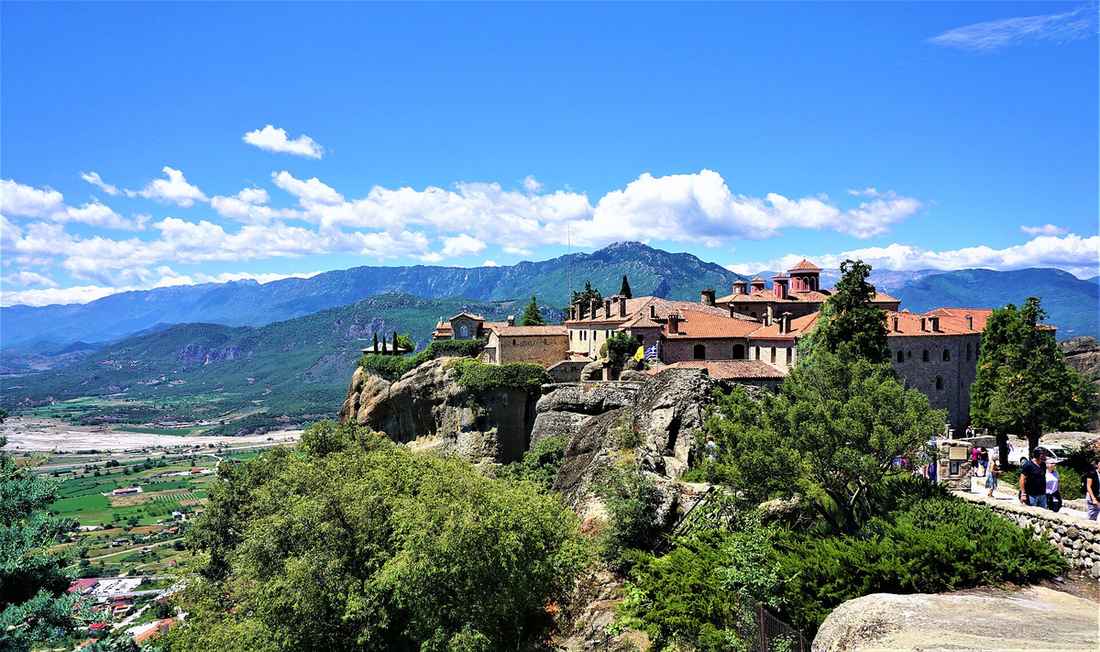
St Stephen Monastery crowns the southern edge of the Meteora rocks, directly above the town of Kalabaka in central Greece. Agios Stefanos holds a clear distinction among the six active monasteries: a short, flat bridge carries visitors straight onto the rock. Older travellers and people with limited mobility reach the gate without the steep stone stairways that guard the other houses. A community of nuns keeps the convent alive today. Two churches stand within its walls, and wide terraces open over the plain of Thessaly. This guide explains the monastery, its position, its churches, and the practical steps for a smooth visit. Plan the trip with My Greece Tours.
St Stephen fits naturally into any circuit of the rock-pillar houses, and it pairs well with the town at its feet. The wider Meteora travel guide maps the full route between the monasteries and the trailheads below. St Stephen works best as a first or final stop, since the bridge demands no climb and rewards the visitor with immediate, sweeping views. The convent keeps set opening hours and closes one fixed day each week. Modest dress applies at the gate. The sections below cover what the monastery is, why it earns its accessible reputation, its life as a convent, the details of a visit, and how it joins a full monastery day.
What is St Stephen Monastery and where does it stand in Meteora?
St Stephen Monastery, or Agios Stefanos, is an active convent on the southern rim of the Meteora rocks. It stands directly above Kalabaka, on a rock platform that meets the road behind it almost at ground level.
St Stephen occupies the most southerly of the great Meteora pillars, the rock nearest the modern town. The monastery grew from a hermit settlement into an organised community over a range of centuries, one of the a variety of houses that once dotted these sandstone towers. Records tie its early years to founders who cut cells and a first chapel into the stone. The complex today gathers churches, cells, a refectory, and reception rooms around enclosed courtyards. St Stephen belongs to the same tradition as the other Meteora monasteries that crown the surrounding rocks.
Its walls rise straight from the pillar, so the buildings read as an extension of the natural stone rather than a structure set upon it.
Position defines the character of St Stephen more than any single feature. The rock sits at the southern edge of the massif, where the pillars give way to the Thessalian plain. A person on the terrace looks down over the rooftops of Kalabaka and across flat farmland toward distant hills. The Pindus foothills frame the view to the west. This southern seat separates St Stephen from the cluster of houses set deeper among the rocks, such as the smaller Rousanou Monastery perched on its own narrow pinnacle. The gap of open air below the walls is real, yet the approach from the road hides it, which shapes the whole experience of arriving at the gate.
Why is St Stephen the easiest Meteora monastery to visit?
St Stephen is reached by a short, flat footbridge that crosses straight from the parking area onto the rock. The route avoids the long stone stairways that climb to the other five monasteries, so almost no ascent stands between the gate and the visitor.
The bridge is the single reason St Stephen earns its reputation. A gap once separated the rock from the ground, and the community spanned it with a level walkway. A visitor crosses that bridge on flat footing and arrives at the entrance without a staircase. The other houses demand a real climb: dozens or hundreds of carved steps rise up sheer rock faces, and a hot afternoon turns those stairs into hard work. St Stephen removes that barrier entirely. Older travellers, families with young children, and anyone who tires on steep ground choose it first.
A variety of Meteora tours place St Stephen early in the day, precisely so guests warm up on the gentlest approach before facing the steeper houses.
Accessibility here means the physical route, not full step-free passage through every room. The bridge and the main courtyard sit on level ground, and a person with limited mobility reaches the terraces and the churches with modest effort. Certain thresholds and interior stairs remain, as expected in an old stone complex built into a rock. Wheelchair users still find far more of St Stephen open to them than any other monastery on the massif. The flat crossing also shortens the visit, which suits a traveller pacing an array of stops across one morning.
St Stephen therefore anchors an itinerary that balances effort, letting the group see a working convent up close without the demanding climb the deeper rocks require.
What is life like as a convent, and what are the two churches?
St Stephen functions as a convent, home to a community of nuns who maintain daily worship and the buildings. It holds two churches: the small old chapel of Saint Stephen and the larger katholikon of Saint Charalambos, which keeps a revered relic.
The community of nuns gives St Stephen its living rhythm. The sisters keep the monastery in good order, tend gardens and workshops, and welcome visitors with a quiet discipline. They restored the complex after hard decades and returned it to full religious use. A small museum and a shop present icons, embroidery, and manuscripts that reflect the house’s craft traditions. Daily services follow the Orthodox calendar, and the terraces stay peaceful outside worship. This life as a working convent sets the tone a guest should respect.
The wider network of Meteora houses splits between convents and men’s monasteries, and knowing which is which helps a visitor plan behaviour and timing before the trip, especially when choosing a place among the options for where to stay nearby.
The two churches mark distinct chapters of the house. The old chapel of Saint Stephen is the smaller, earlier church, cut close to the original core of the settlement, with weathered frescoes and an intimate scale. The larger katholikon honours Saint Charalambos and serves as the main church of the convent. It shelters a relic tied to that saint, an object of veneration that draws pilgrims. The katholikon carries painted decoration across its walls and a carved wooden screen before the sanctuary. Both churches ask for silence and modest conduct.
A visitor moves between them within a handful of steps, so the pairing gives a compact lesson in how a Meteora monastery layered old and new worship spaces over the long centuries of its growth on the rock.
How do you visit St Stephen Monastery in Meteora?
Cross the flat bridge from the road-side parking, enter through the gate, and follow the courtyard to the churches, museum, and view terraces. The convent keeps fixed daytime hours and closes one set day each week. Modest dress is required.
Access begins at the small parking area on the road that rings the southern rocks. A short flat bridge leads from there onto the pillar, and the gate opens into the main courtyard. From the courtyard a visitor reaches the two churches, the museum rooms, and the shop within a compact footprint. The terraces on the outer edge deliver the widest views over Kalabaka and the plain of Thessaly. St Stephen opens for daytime visiting hours and closes on one fixed day of the week, so a traveller should confirm the current day and times before arriving.
Guides who run Meteora tours track those hours and build the schedule around them, which spares independent visitors an arrival at a locked gate.
Dress rules apply at the gate and follow Orthodox custom for every Meteora house. Men wear long trousers, and women wear a skirt below the knee; shoulders stay covered. Wraps are often available at the entrance for guests who arrive without suitable clothing, though carrying your own is safer. Photography is welcome outdoors on the terraces, while interiors of the churches usually forbid it. Early morning brings soft light over the plain and thinner crowds, a strong window for the terrace views. A visit here runs shorter than at the steeper houses, since the flat approach saves time.
Travellers weighing bases for the trip can review where to stay in Meteora, as a room in Kalabaka puts St Stephen almost overhead.
How does St Stephen fit a full Meteora monastery visit?
St Stephen anchors a monastery circuit as the gentlest stop and pairs naturally with Kalabaka below. Travellers often start or end here, then link it with the steeper houses and the town’s tavernas, churches, and trailheads for a full day.
A complete day on the rocks usually strings a mix of monasteries together along the ring road. St Stephen slots in as the easy bookend, either the warm-up before the climbs or the calm finish after them. Its southern seat above Kalabaka makes it the closest house to town, so a visitor drops down to the streets in minutes. That link matters, because the town supplies lunch, water, and rest between rock stops. Pairing St Stephen with the neighbouring houses builds a route that samples both convents and men’s monasteries across one morning.
Choosing a base among the listings for where to stay in Meteora shortens every transfer, and Kalabaka rooms sit directly under the St Stephen rock for the fastest possible start.
St Stephen also pairs well with the town’s own attractions beyond the monastery gate. Kalabaka holds an old cathedral church, quiet squares, and paths that lead toward the base of the pillars. A traveller can walk part of the older footpaths that once served the monasteries, reading the rocks from below before riding up to them. The convent’s terrace view frames that whole landscape and helps orient a first-time visitor to the massif. Booked Meteora tours tie these threads together, moving a group from town to rock to viewpoint without wasted time. St Stephen, gentle and close, gives the day its anchor and sends the visitor into the rest of Meteora with the layout already clear in mind.
Frequently Asked Questions
Which is the easiest Meteora monastery to visit?
St Stephen Monastery is the easiest of the six active houses to reach. A short, flat footbridge crosses from the road-side parking straight onto the rock, so a visitor arrives at the gate with almost no climb. The other five monasteries sit atop long stone stairways carved up sheer pillars, and those routes demand real effort on steep, uneven ground. St Stephen removes that barrier by sitting on the southern edge of the massif, where the rock nearly meets the road behind it. The gentle approach makes St Stephen the natural first stop on a monastery circuit and the friendliest choice for older travellers, families, and anyone who tires on stairs.
Its terraces still deliver sweeping views over Kalabaka and the plain of Thessaly, so an easy visit sacrifices none of the scenery that defines a trip to these rocks.
Is St Stephen Monastery accessible for people with limited mobility?
St Stephen is the most accessible monastery in Meteora, though it is not fully step-free throughout. The flat bridge and the main courtyard sit on level ground, so a person with limited mobility reaches the entrance, the terraces, and most of the complex with modest effort. This contrasts sharply with the other houses, where long carved staircases block easy access. Certain interior thresholds and short stairs remain inside the old stone buildings, as expected in a centuries-old complex built into a rock. Wheelchair users therefore find more open to them here than anywhere else on the massif, even if a handful of rooms stay out of reach.
The short, level approach also shortens the visit, which helps a traveller pacing a spread of stops. Anyone with mobility concerns should treat St Stephen as the priority monastery and confirm the current opening day and hours before setting out from Kalabaka.
What is inside St Stephen Monastery?
St Stephen holds two churches, museum rooms, a shop, and wide view terraces within a compact walled complex. The small old chapel of Saint Stephen is the earlier church, intimate in scale, with weathered frescoes near the original core of the settlement. The larger katholikon of Saint Charalambos serves as the main church and shelters a revered relic tied to that saint, a focus for visiting pilgrims. Painted decoration and a carved wooden screen mark the katholikon’s interior. A small museum displays icons, manuscripts, and embroidery that reflect the convent’s craft traditions, and a shop sells similar work. The community of nuns maintains the buildings and gardens and keeps the daily services.
The outer terraces open over Kalabaka and the plain of Thessaly, offering the widest panoramas on the southern rocks. A visitor moves between all of these spaces within a small, level footprint just beyond the bridge.