
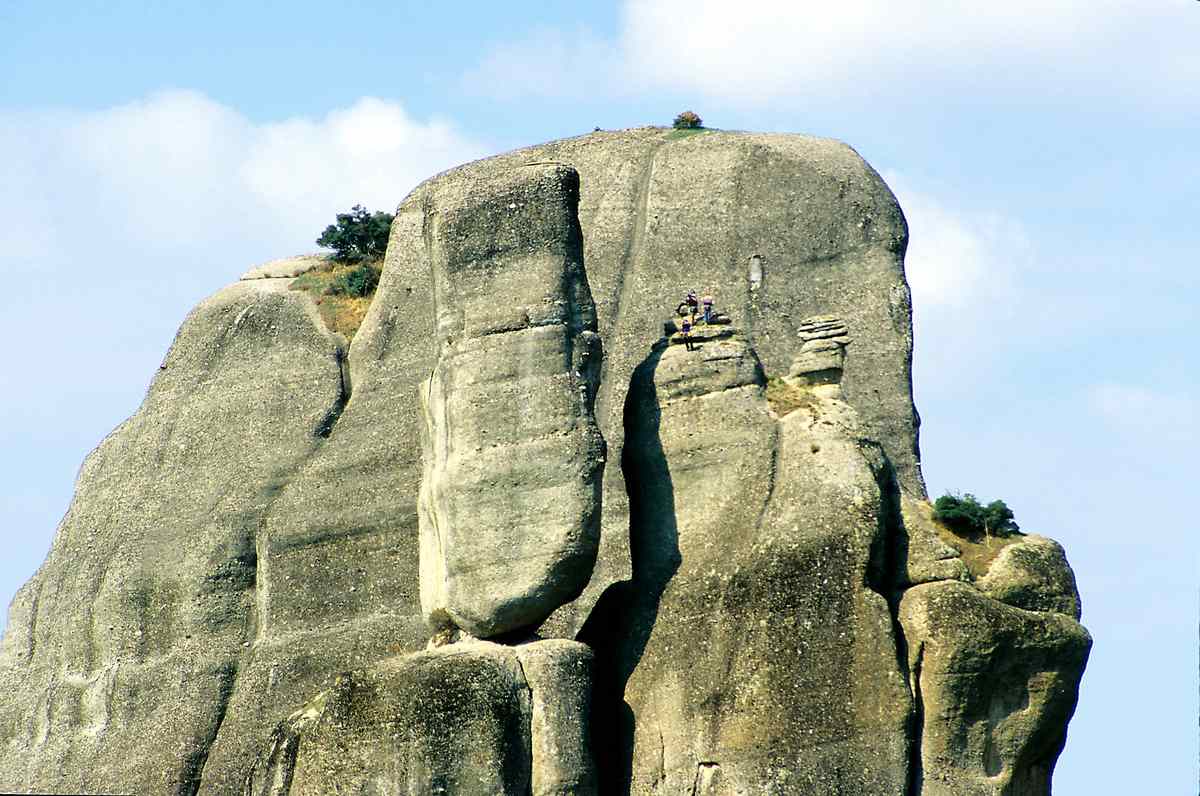
The towers of Meteora rise from the Thessaly plain like the pillars of a lost cathedral, yet their origin is sedimentary, not divine. Each pillar is conglomerate: rounded river pebbles and cobbles locked into a sandstone and marl matrix, deposited tens of millions of years ago where an ancient river spilled into a lake or sea. Tectonic uplift later raised that hardened delta, and vertical erosion carved the isolated stone towers that dominate Kalabaka today. Read this guide to understand the rock beneath the monasteries, then plan your visit to this Tertiary landscape with My Greece Tours.
The pillars stand within the Meso-Hellenic trough, a sediment-filled basin that ran through the heart of Thessaly during the Paleogene and Neogene. Understanding that basin turns a scenic view into a readable record of river, lake, and uplift. This page sits beside our Meteora travel guide and gives the geological backbone for everything above it. The sections below cover the conglomerate itself, the ancient river delta, the tectonic uplift, the erosion that shaped the towers, and the caves that hermits and builders later put to use across this landscape.
What are the Meteora rock pillars made of?
The Meteora pillars are conglomerate. Rounded river pebbles and cobbles sit cemented in a sandstone and marl matrix, a hardened sedimentary rock built from river gravel rather than volcanic or molten origins that many visitors first assume.
Conglomerate forms when a matrix of finer sand and mud binds coarse rounded stones into solid rock. At Meteora the pebbles and cobbles are quartzite, limestone, and other resistant rock types worn smooth by long river transport before deposition. The sandstone and marl cement locks them together, producing a rock that resists erosion as a mass yet fractures cleanly along vertical joints. This dual character explains the towers: the conglomerate stands firm against weather while splitting into steep-sided pillars. The colour ranges from grey to warm brown, and the embedded stones remain visible in the cliff faces.
Climbers who scale the walls above Kastraki grip these exposed cobbles directly, and photographers chasing texture find the conglomerate surface reveals its river-born pebbles in raking evening light across the valley.
The rock dates to the Tertiary period, spanning the Paleogene and Neogene, which places its formation tens of millions of years ago. That immense age gave the cement time to harden into competent rock capable of standing as vertical cliffs. Marl layers within the sequence record quieter water, while coarse conglomerate beds mark stronger river floods carrying heavier stones. Reading these alternating layers tells the story of an ancient waterway that changed its energy over long spans of time. Visitors on rock climbing in Meteora and walkers on hiking in Meteora trails move across this Tertiary record at eye level, tracing the layering that most guidebooks reduce to a single dramatic photograph of the monasteries.
How did the ancient river delta that formed Meteora develop?
An ancient river carried gravel down into a lake or sea and dropped it as a delta and alluvial fan. That thick pile of pebbles and sand accumulated in the Meso-Hellenic trough across Thessaly and later hardened into conglomerate rock.
The Meso-Hellenic trough was a long basin that collected sediment as surrounding highlands eroded. A powerful river system drained those uplands and delivered rounded stones toward the basin’s edge, where flowing water lost energy on meeting standing water. That energy loss forced the river to dump its coarse load, building a fan of gravel and sand that stacked into great thickness over long ages. Finer marl settled where the current slowed further, interleaving with the coarse beds. This layered pile is the raw material of every pillar you see today.
The Meteora photography that captures the towers at dawn is really recording a fossilised river mouth, a delta turned to stone and then lifted into the Thessaly sky above Kalabaka.
Delta deposits sort themselves by size as water speed drops, so the coarsest cobbles settle first and finer material travels further into the basin. That sorting survives in the Meteora conglomerate, where beds grade from boulder-rich zones to sandier layers. The direction the stones lean, and the shape of the beds, let geologists reconstruct which way the ancient river flowed. The delta grew for a long geological interval, thickening as the trough subsided and made room for more sediment. Understanding this delta reframes the whole site: the drama above the plain began as a muddy river mouth.
That same plain now feeds the tavernas covered in our guide to where to eat in Meteora, where the fertile Pineios valley still owes its soil to sediment.
How did tectonic uplift raise the Meteora conglomerate?
Tectonic forces across Thessaly lifted the hardened delta deposit high above its original basin floor. This uplift raised the conglomerate mass, exposing it to air and water so that erosion could begin sculpting the towers we recognise today.
Greece sits on an active tectonic margin where continental plates converge, and that pressure has shaped much of the mainland’s mountainous relief. The Meso-Hellenic trough experienced regional uplift that pushed its buried sediments upward over long spans of time. The once-flat delta pile, now lithified into competent conglomerate, was raised hundreds of metres. Uplift also stressed the rock, opening vertical fractures and joint sets that would later guide erosion. Rivers responded by cutting down into the rising mass, deepening valleys and beginning to isolate blocks. This interplay of rising rock and downcutting water is the engine that turned a horizontal deposit into vertical scenery.
The monasteries perched on the summits, described in our Meteora monasteries guide, sit on the highest surviving remnants of that lifted platform.
Uplift alone does not carve towers; it sets the stage by giving water the height it needs to cut. As the conglomerate rose, the Pineios and its tributaries gained gradient and eroded faster, exploiting the joints that uplift had opened. Weaker zones washed away while resistant conglomerate stood proud, and the drainage pattern etched the future shape of the pillars. The vertical jointing proved decisive: fractures set the flat walls and sharp edges that make Meteora look sculpted rather than merely worn. The result is a field of separated stone towers rising above the surrounding plain.
The dramatic access routes recorded in the history of the Meteora monasteries exist only because uplift and erosion together produced summits that were nearly impossible to reach without ropes and nets.
What erosion carved the Meteora towers into their vertical shape?
Water, wind, and freeze-thaw exploited vertical joints in the raised conglomerate, widening fractures and stripping weaker rock. This selective erosion isolated resistant blocks into steep towers that rise roughly three hundred metres above the Pineios valley.
Erosion at Meteora follows the joints. Rainwater and rivers seep into vertical fractures, dissolving and loosening the cement that binds the pebbles, and gravity pulls away undermined slabs. Freeze-thaw action drives water into cracks that expand when it turns to ice, prising the rock apart along existing planes. Wind removes loosened grains and keeps the faces clean and sheer. This combination attacks fracture lines far faster than it wears the solid rock between them, so the joints become the valleys and gullies while the intact conglomerate survives as towers.
The steepest walls draw climbers year round, and the network of trails for hiking in Meteora threads between the pillars along the very gullies that erosion opened, giving walkers a ground-level view of the sculpting process still at work.
The towers rise roughly three hundred metres above the Pineios valley near Kalabaka, though heights vary across the pillar field. Their near-vertical walls reflect the strength of the conglomerate and the control of the vertical joints. Where the cement is weaker, whole slabs peel away and crash to the base as rockfall, a slow ongoing process that keeps the cliffs steep. Rounded overhangs and hollows appear where water pools and works the rock differently. The overall form is a landscape mid-sculpture, still changing on a human-invisible timescale.
The vertical walls that erosion left behind are exactly what draw the rock climbing in Meteora community, who read the joint patterns and cobble textures as routes up faces that geology spent an age preparing.
Why does Meteora rock have so many caves and hollows?
Weathering attacks softer patches and joint intersections in the conglomerate, dissolving cement and dislodging stones to open pockets and caves. Hermits and monks later occupied these natural hollows, giving the rock its long human history.
The caves of Meteora are weathering features, not tunnels cut by people. Water works into the conglomerate where cement is thinner or where joints cross, dissolving the binding matrix and letting embedded pebbles fall free. Over long spans this hollows out rounded pockets, alcoves, and deeper caves in the tower faces. Sheltered ledges form where a resistant bed overhangs a softer one that erosion has eaten back. These natural shelters offered dry, defensible refuge high on the cliffs, and ascetics settled in them long before the great monasteries were built. The link between geology and faith is direct: the rock provided ready-made cells.
Our history of the Meteora monasteries traces how those early cave-dwellers grew into organised communities that later capped the pillars with stone buildings.
The hollows also shape how the site looks and functions today. Photographers frame the caves as dark accents against pale conglomerate, and our Meteora photography guide points out the best light for capturing their depth. Some hollows still hold the remains of hermit platforms and painted chapels reached only by daring climbs. The pockets vary from shallow scoops to caves large enough to shelter a standing figure, and their distribution follows the weakest zones in the rock. Visitors based in Kastraki can spot cave openings on the towers directly above the village, a reminder that the same weathering that carved the pillars also drilled the shelters that made human occupation of these summits possible in the first place.
Frequently Asked Questions
Is Meteora volcanic rock?
Meteora is not volcanic. The pillars are conglomerate, a sedimentary rock built from rounded river pebbles and cobbles cemented in a sandstone and marl matrix. It formed from water-borne gravel dropped by an ancient river, not from lava or molten material. The confusion is common because the towering isolated pillars look dramatic enough to suggest a violent volcanic birth. The reality is quieter: a river carried worn stones into a lake or sea, built a thick delta, and that gravel pile hardened into rock over tens of millions of years during the Tertiary period. Tectonic uplift then raised the deposit, and erosion along vertical joints carved the towers.
You can confirm the sedimentary origin by looking at any cliff face and spotting the individual rounded pebbles set in finer cement, a texture no volcanic rock produces. Our hiking in Meteora trails bring you close enough to read that texture yourself.
How old are the Meteora rock formations?
The Meteora conglomerate dates to the Tertiary period, spanning the Paleogene and Neogene, which places its deposition tens of millions of years ago. The sediment accumulated in the Meso-Hellenic trough as an ancient river built a delta into a lake or sea, and the gravel pile then hardened into rock over that long interval. Tectonic uplift raised the hardened mass afterward, and the erosion that carved the visible towers has continued into the present, so the landscape you see is younger than the rock itself. Precise ages vary through the sedimentary sequence because the delta grew over a long span rather than in a single event.
The takeaway is scale: the pebbles you touch were rounded by a river that flowed before humans existed, in a Thessaly that looked nothing like today. Our Meteora monasteries guide adds the human chapter that arrived only recently on this ancient stone.
Why are the Meteora pillars so tall and steep?
The pillars rise roughly three hundred metres above the Pineios valley because two processes worked together. Tectonic uplift raised the hardened conglomerate high above its original basin floor, giving rivers the height needed to cut deep. Vertical jointing then controlled the erosion: water, wind, and freeze-thaw attacked the fractures far faster than the solid rock between them, so the joints widened into gullies while the intact conglomerate survived as steep-walled towers. The strength of the cemented pebbles lets the walls stand nearly vertical without collapsing, and rockfall keeps the faces sheer as undermined slabs peel away. The Pineios and its tributaries near Kalabaka did the deepest cutting, isolating the blocks into the free-standing pillars that define the skyline.
The steepness is precisely what made the summits defensible refuges for hermits and later monks. Climbers reading those same vertical joints as routes explore the towers through rock climbing in Meteora, tracing lines that geology laid out over an immense span of time.