
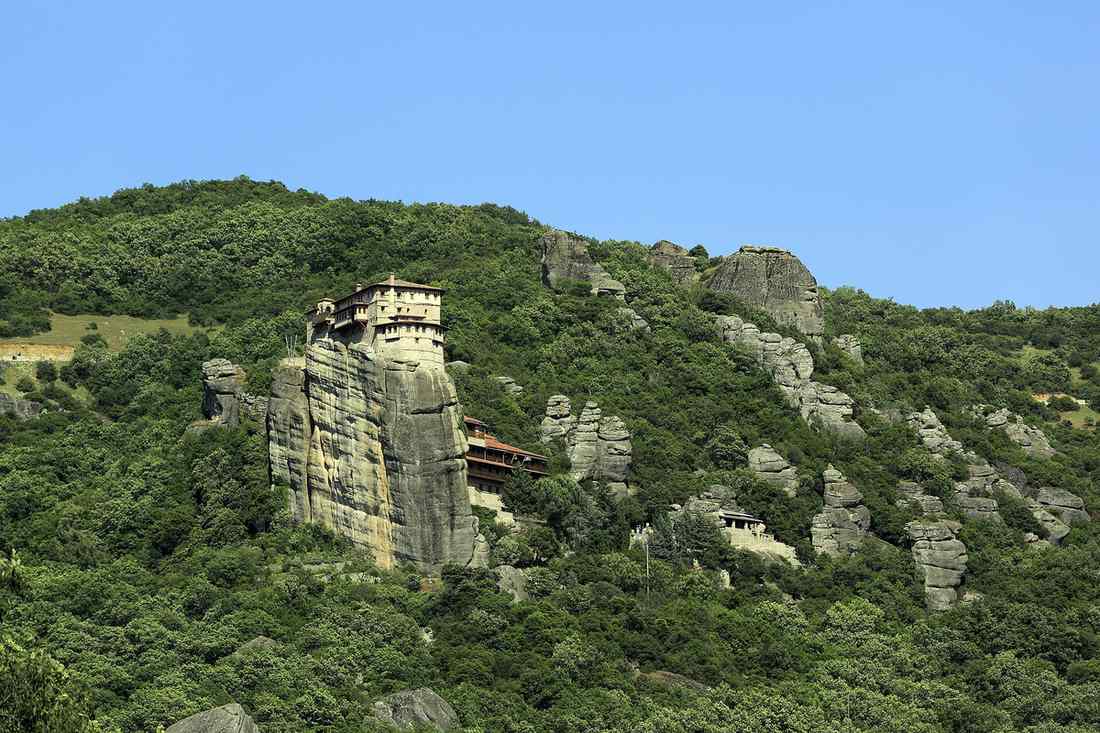
Meteora is compact once you arrive. A single paved ring road climbs out of Kalabaka, threads through Kastraki, and links all six active monasteries: the Great Meteoron, Varlaam, Rousanou, Holy Trinity, St Nicholas Anapausas, and St Stephen. The full circuit runs only three kilometres, yet the road climbs and winds around the pillars, so the way you travel it shapes your whole day. Your choices are a rental car, a limited local bus, point-to-point taxis, a guided minibus, or the old monk footpaths that connect the rocks on foot. This guide sets out each option and its trade-offs so you can plan smoothly with My Greece Tours.
Kalabaka and Kastraki sit directly beneath the rocks, so every monastery lies within a short drive or a determined walk of either base. Read this page alongside the wider Meteora travel guide to fix your dates, base town, and which monasteries open on your day before you settle on transport. The sections below cover self-driving the ring road and its small car parks, the local bus schedule up from Kalabaka, using taxis for point-to-point hops, joining a guided minibus that handles the driving and timing, and walking the historic monk footpaths that thread between the six monasteries for travellers who are fit and confident on uneven stone.
How do you get around Meteora between the monasteries?
One paved ring road links all six monasteries above Kalabaka and Kastraki. Cover it by rental car, local bus, taxi, guided minibus, or on the connecting monk footpaths. The full loop spans roughly three kilometres.
The whole of Meteora hangs on that single ring road, which starts in Kalabaka, passes through Kastraki, and curls up past every monastery gate before descending again. The distances between stops are short, often a kilometre or less, but the road gains height quickly and bends hard around the rock pillars, so it feels longer than the map suggests. A rental car gives you the most freedom to arrive early and move at your own pace, and the local bus and taxis suit travellers without a vehicle of their own.
Cross-check which monasteries stand open on your chosen day, since each one closes on a set weekday, using the Meteora monasteries schedule before you commit to a route around the loop and lose time driving up to a locked gate.
Choosing your transport starts with your base and your appetite for driving. Kalabaka offers the widest choice of taxis and the bus stop, and travellers who set up in Kalabaka reach the foot of the ring road in minutes. Kastraki sits higher and closer to the trailheads, so walkers based there shorten the climb. A rental car parks at each monastery in turn; a taxi drops and collects; a guided minibus removes the driving entirely. The footpaths run parallel to the road and reward anyone happy on steep, uneven ground, threading between the pillars where cars cannot go.
Match the method to your fitness, your budget, and how far around the six gates you plan to travel in one visit, then decide whether independence or a guided pace fits your day best.
Is it better to rent a car or take a tour of Meteora?
A rental car gives the most flexibility and beats the crowds at each small car park, while a guided minibus handles the driving, timing, and closing days for you. Your choice depends on confidence with mountain roads.
A rental car is the most flexible way to work the ring road. You set your own start time, so you can reach the Great Meteoron car park before the first buses arrive, then move to Varlaam and Rousanou as the morning warms. Each monastery has a small car park at its gate, and these fill fast in peak months, which rewards early arrivals and punishes late ones. The road is paved and short but steep and twisting, so drivers uneasy on mountain bends should weigh that honestly.
Confident drivers gain the freedom to skip a monastery that has closed for its weekday and reorder the loop on the spot, a flexibility that no fixed timetable can match on a busy morning. The rental picks up in Kalabaka or at the wider region’s transport hubs.
A guided minibus removes every logistical worry. A driver handles the bends and the parking scramble, and a guide steers you to whichever monasteries open that day, so you never drive to a locked gate. This suits travellers short on time, nervous about the road, or arriving on a day trip who want the six rocks explained as they go. Organised Meteora tours also lift the burden of tracking each monastery’s hours and closing weekday. The trade-off is a fixed pace and set stops, so photographers chasing a precise light window may prefer their own wheels.
Weigh the comfort of being driven against the freedom of driving, then pick the option that fits how independent you want your day to feel. A guided run also frees you to look up at the rocks rather than down at the twisting road.
Is there a bus to the Meteora monasteries?
A local bus runs from Kalabaka up the ring road to the monasteries on a limited daily schedule, usually a small number of departures. Confirm current times locally, since the service is sparse and varies by season.
A local bus does climb from Kalabaka up the ring road toward the monasteries, which helps travellers without a car or the budget for repeated taxis. The service is limited, running only two or three times a day, and the timetable shifts between the high and low seasons, so treat any schedule you find online with caution and confirm the current departures at the Kalabaka bus stop or your accommodation on arrival. The bus typically climbs to a stop near the upper monasteries, from where you walk between the gates and back to catch a return departure.
Plan your monastery visits tightly around those fixed times, because missing the return can leave a long wait or a walk back down. Note the last downhill departure the moment you board so the closing gates do not strand you.
The bus works best for travellers happy to combine short rides with walking and to structure the day around a sparse timetable. From the upper stop you can reach the Great Meteoron and Varlaam on foot, then descend the road or a footpath to the lower monasteries before the return departure. Pair the bus with the connecting paths to see more gates in one run. Independent travellers often ride it one way and take a taxi or walk for the other, since the service is thin and the return departures are spaced far apart.
Travellers staying in Kastraki start higher up and can often skip the lower stretch of road, shortening the climb up to the first monastery and giving the sparse schedule more slack.
Can you use taxis and walk between the Meteora monasteries?
Yes. Taxis in Kalabaka run point-to-point drops between monasteries, and the old monk footpaths link the rocks on foot for fit walkers. Combining a taxi lift up with a walk down suits independent visitors well.
Taxis wait in Kalabaka and Kastraki and handle point-to-point hops well, dropping you at one monastery gate and collecting you later or carrying you to the next. This works neatly for travellers who want a lift up the steep first stretch, then intend to walk between the closer monasteries at the top. A common pattern is a taxi up to the Great Meteoron early, a walk across to Varlaam, Rousanou, and Holy Trinity, then a taxi or the bus back down. Travellers reviewing where to stay in Meteora can pick a base that keeps these taxi hops short and cheap.
Fix the fare and the pickup point before you ride, since drivers work either the meter or an agreed flat rate up the loop road.
The old monk footpaths are the most atmospheric way to move between the rocks. Stone-cut steps and dirt trails once carried the monks and their supplies, and four survive as marked routes linking the monasteries and climbing from Kastraki to the ridge. Walking them puts you among the pillars at eye level, away from the road and the car parks, and reveals angles no driver sees. The paths are steep, uneven, and exposed in places, so they demand proper shoes, water, and a head for heights. Allow more time than the short map distances imply. A day built around one day in Meteora can mix a taxi lift with a downhill walk to balance effort and coverage.
Carry water and wear grippy shoes on the footpaths before you set the direction of your walk.
How long does it take to get around all six Meteora monasteries?
Plan a full day to visit all six Meteora monasteries. The ring-road circuit runs only three kilometres, but staggered opening hours, weekday closures, entry queues, and steep steps at each gate stretch the day out.
The driving itself is quick, since the loop measures only three kilometres and each gate sits minutes from the next. The time goes on everything else. Every monastery keeps its own hours and closes on a set weekday, so on any given day one or two of the six may be shut, which forces you to reorder your route. Entry queues build through the morning as tour buses arrive, and each gate involves a climb of stone steps to the buildings above the car park. Modest dress is required, and wraps are lent at the gate, adding a pause before you enter. Budget generously rather than tightly, and start at first opening to move ahead of the crowds.
The climb of stone steps at each gate slows the pace further, so tired legs by the sixth monastery are normal.
A realistic plan visits three or four monasteries in a focused half day or all six across a relaxed full day. Start high at the Great Meteoron and Varlaam when they open, then work down through Rousanou, Holy Trinity, St Nicholas Anapausas, and St Stephen as the loop descends toward Kalabaka. Travellers arriving on a Meteora day trip from Athens reach the rocks around midday and usually see two or three gates, which makes an overnight stay the better way to cover all six without rushing. Whatever your transport, anchor the day on opening times and closing weekdays first, then slot the driving, walking, or bus rides around that fixed frame.
An overnight in Kalabaka or Kastraki turns a rushed sprint into a steady tour of all six rocks.
Frequently Asked Questions
Do you need a car to visit Meteora?
You do not strictly need a car to visit Meteora, though one makes the day easier. The six monasteries sit on a single paved ring road that climbs from Kalabaka through Kastraki, and travellers without a vehicle reach them by local bus, taxi, guided minibus, or on foot along the old monk footpaths. A rental car gives the most freedom, letting you arrive at each small car park early and reorder your route when a monastery closes for its weekday. Without one, the limited daily bus climbs from Kalabaka toward the upper monasteries, taxis handle point-to-point drops, and the connecting trails link the rocks for fit walkers.
A guided minibus removes the driving entirely and tracks the opening days for you. Base yourself in Kalabaka or Kastraki, both within a short ride or walk of the first gate, and you can see the monasteries comfortably by whichever method matches your budget and energy.
Can you walk to the Meteora monasteries?
Yes, you can walk to the Meteora monasteries along the historic monk footpaths that thread between the rock pillars. These stone-cut steps and dirt trails once served the monks and their supplies, and marked routes now climb from Kastraki to the ridge and link the six gates. Walking is the most atmospheric approach, placing you among the pillars away from the road and the car parks. The paths are steep, uneven, and exposed in places, so they suit fit walkers in proper shoes carrying water, not casual strollers in sandals. Distances look short on the map, but the climbing stretches the times, so allow more than you expect.
Independent travellers often combine a taxi or bus lift up the steepest first section with a downhill walk between the upper monasteries, which balances effort against coverage. Start early, before the midday heat and the tour buses, and confirm which gates open on your day so your route ends at a monastery you can enter.
What are the parking and closing rules at the Meteora monasteries?
Each of the six Meteora monasteries has a small car park at its gate, and these fill quickly in peak months, so arriving at first opening is the surest way to secure a space. The paved ring road links every car park in turn, with only a short drive between them. Every monastery keeps its own opening hours and closes on a set weekday, and those closing days differ from gate to gate, so on any day one or two of the six may be shut. Confirm the current schedule before you build a route, and start with whichever monasteries open earliest.
Modest dress is required to enter: covered shoulders and knees for everyone, and skirts for women, with wrap-around skirts usually lent at the gate. Each charges a small entry fee, and a climb of stone steps leads from the car park up to the buildings. Planning your loop around these closing days and opening times matters more than the short driving distances between the rocks.