
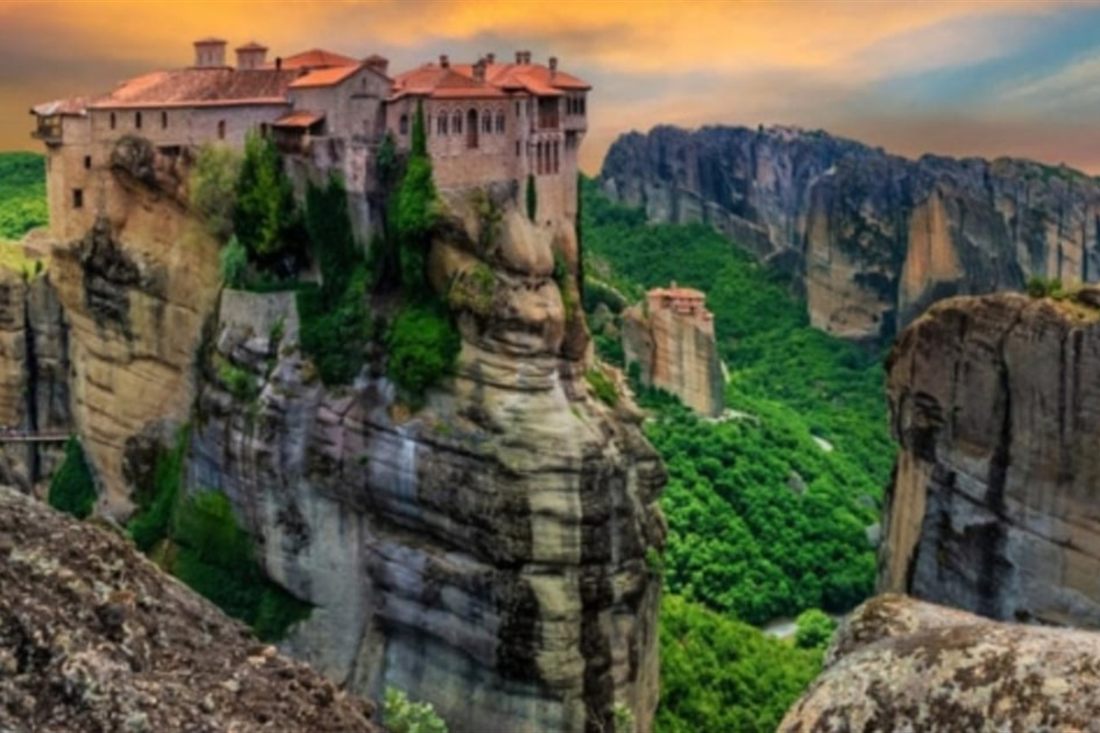
A Meteora day trip from Halkidiki is a full-day excursion from the resorts of Kassandra and Sithonia to the rock-top monasteries of Meteora in Thessaly. The drive takes 3.5 to 4.5 hours each way. Tours across the rest of the country are listed on Greece Tours.
The sections below cover the tours you can book, the pickups, the route, the monasteries, the dress code, the opening days, food, the seasons and booking, with links into the Meteora pages. The tours shown are checked on GetYourGuide and Viator.
What is a Meteora day trip from Halkidiki?
A Meteora day trip from Halkidiki is a full-day excursion to the rock-top monasteries of Thessaly. Travelers leave the beach resorts in the morning and return the same evening. This Meteora day trip from Halkidiki covers a long distance across northern Greece.
The journey connects the coastal peninsula with an inland region known for tall stone pillars. Visitors spend their time looking at religious buildings built on top of these rocks. The whole experience takes place within a single day.
Travelers ride in a coach or a private vehicle for the entire route. The Halkidiki transfers page covers private cars across the peninsula.
Guests leave their hotels early in the morning. They arrive back at their resorts late in the evening after seeing the monasteries. The schedule requires spending hours inside a vehicle each way.
Which Meteora day trips from Halkidiki can you book?
Travelers booking a Meteora day trip from Halkidiki find group coach tours and private excursions. Platforms like Viator list full-day tours departing directly from the peninsula. GetYourGuide offers a private ten-hour option that starts in Thessaloniki or Halkidiki.

The private tour shows all six monasteries from the outside and enters three of them. It also includes a stop at the Byzantine church of the Assumption of the Virgin Mary in Kalambaka. Guests customize this itinerary to fit their preferences.
A local agency runs a guided group tour every Thursday. This ten-hour excursion provides hotel transfers, an English-speaking guide, and entry into two monasteries. The group stops for lunch in Kalambaka during the middle of the day.
A guesthouse in Kriopigi on the Kassandra peninsula sells its own day tour. The bus leaves around 06:30 and stops for breakfast along the road. The guide talks about Greek history from antiquity to today while the group travels.
- Viator lists a “Full Day Tour to Meteora from Halkidiki” for groups.
- Viator also features a “Full Day Meteora Monasteries from Chalkidiki” option.
- GetYourGuide provides a private ten-hour tour starting in Thessaloniki or Halkidiki.
- A Kassandra agency runs a Thursday group tour with an English-speaking guide.
- A Kriopigi guesthouse sells a tour that includes a visit to an icon painting workshop.
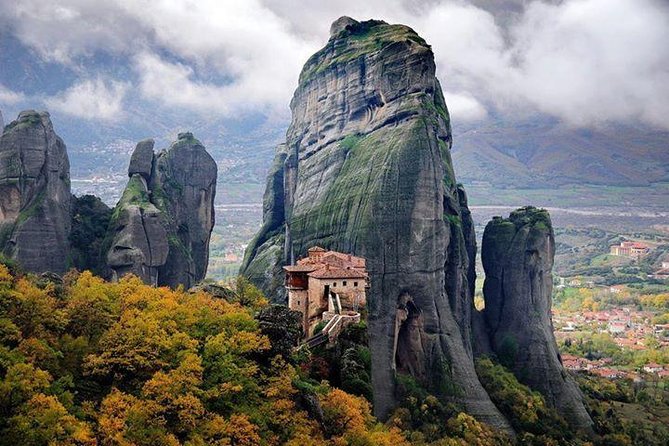

Where do Meteora day trips from Halkidiki pick up?
A Meteora day trip from Halkidiki collects passengers directly from hotels across the peninsula. Organized coach tours start in Thessaloniki and add resort pickups. Pickup times differ by location, running earlier for Sithonia than for Kassandra.
On the Kassandra peninsula, buses stop at resorts including Kallithea, Pefkochori, and Hanioti. On Sithonia, drivers collect guests in Nikiti, Neos Marmaras, and Sarti. Vehicles also travel to Ouranoupoli and Polygyros to gather travelers.
The exact pickup time depends on where the hotel stands along the route. Guests receive a voucher stating their specific collection hour before the trip begins.
Private tours offer more flexibility with departure points. A driver meets guests at their chosen address anywhere on the peninsula. This arrangement removes the need to wait for other passengers at different hotels.
Visitors staying near Thessaloniki join the main coach there instead of waiting for a resort transfer. This saves time on the road. Check options for a Meteora tour from Thessaloniki if the accommodation sits close to the city.
- Kassandra pickups include Kallithea, Pefkochori, and Hanioti.
- Sithonia pickups cover Nikiti, Neos Marmaras, and Sarti.
- Buses also collect passengers in Ouranoupoli and Polygyros.
- Pickup times run earlier for Sithonia resorts than for Kassandra locations.
- Private tours collect guests directly at their chosen hotel address.
What route does a Meteora day trip from Halkidiki follow?
A Meteora day trip from Halkidiki follows highways west toward Thessaly. From Kassandra, the road passes through Nea Moudania toward Thessaloniki. Vehicles then take the motorway west toward Larissa and Trikala to reach Kalambaka.
Kalambaka sits at the foot of the rock formations. The drive from Thessaloniki to Kalambaka covers about 216 kilometers. A car completes this specific stretch in about two and a half hours.
Total drive times vary depending on the starting resort. Leaving from Kassandra takes about three and a half to four hours one way by car. Starting from Nikiti on Sithonia adds thirty to forty-five minutes to that journey.
Travelers leaving from Ouranoupoli face a longer initial drive. Reaching the Thessaloniki ring road takes one and a half to two hours. The remaining drive to Kalambaka adds another two and a half to three hours.
Guests departing from Polygyros spend about three to three and a half hours in the vehicle. Overall, the drive from the peninsula takes 3.5 to 4.5 hours one way. The bus follows the same highways back in the evening.
How long does a Meteora day trip from Halkidiki take?
A Meteora day trip from Halkidiki requires seven to nine hours inside a vehicle. Guided group tours last about ten hours from pickup to drop-off. Private excursions follow a similar ten-hour schedule across the peninsula and Thessaly.
The long driving time means the excursion fills an entire day. Buses leave the resorts early in the morning. They arrive back at the hotels late in the evening after visiting the monasteries.
Group tours with an English-speaking guide stick to a strict ten-hour timetable. This schedule includes the driving time, the monastery visits, and the midday meal break. The voucher provided at booking states the exact pickup time to keep the schedule on track.
Private tours allow guests to adjust the pace slightly. However, the physical distance between the coast and the rocks remains the same. Drivers still need over three hours each way to complete the journey safely.
The guesthouse tour from Kriopigi departs around 06:30 to account for the distance. This early start ensures enough time for the breakfast stop and the history commentary on the bus. The group also watches icon painting at a workshop during the day.
- Total vehicle time ranges from seven to nine hours round trip.
- Guided group tours operate on a ten-hour schedule.
- Private tours last about ten hours from start to finish.
- The Kriopigi guesthouse tour departs around 06:30 in the morning.
- All tours return to the resorts late in the evening.
Which days does a Meteora day trip from Halkidiki run?
A Meteora day trip from Halkidiki runs on specific weekdays depending on the operator. The English-guide group tour departs every Thursday. Private tours run on whichever date the guest chooses to book.
Guests who want to join this specific group excursion must plan their holiday around that weekday. The ten-hour itinerary remains the same every Thursday.
Private tours offer complete freedom regarding dates. Travelers select the exact day they want to travel when making their reservation. The driver and guide accommodate the chosen date without relying on a fixed weekly schedule.
Each monastery closes its doors on one specific weekday. Tour operators plan their routes to match these closures. Guides select which buildings to enter based on the day of the week the trip takes place.
Holy Trinity, for example, closes on Thursdays. A Meteora day trip from Halkidiki on a Thursday enters other monasteries.
What kind of place is Meteora?
Meteora is a group of tall rock pillars in central Greece. It holds one of the largest Eastern Orthodox monastery complexes. Planning a Meteora day trip from Halkidiki means visiting these sandstone towers between Kalambaka and Kastraki.
The name comes from a Greek word meaning “lofty” or “suspended in the air.” It shares the same root as the word meteor. The rocks rise near the Pineios river and the Pindus mountains in the Trikala regional unit of Thessaly.
Monasteries sit on top of these tall pillars. A Meteora day trip from Halkidiki brings visitors right to the base of these massive formations. The site stands as one of the largest complexes of Eastern Orthodox monasteries in Greece.
- Tall rock pillars rise above the valley floor
- Eastern Orthodox monasteries sit on the rock tops
- The Pineios river flows near the rock formations
- The Pindus mountains stand close to the site
How did the Meteora rocks form?
The pillars are sandstone and conglomerate, shaped by water and weather over millions of years, not volcanic activity. Understanding this geology makes a Meteora day trip from Halkidiki much more interesting for visitors.
Streams laid down thick layers of sediment over millions of years. About 60 million years ago, earth movements lifted this land upward. Rain, wind, and rivers then carved the soft rock into the tall pillars seen today.
Learning about the geology of the rocks helps travelers understand the landscape. The Great Meteoron stands on a rock more than 415 meters above the Pineios valley floor. Its peak reaches 613 meters above sea level.
This height explains why the area feels suspended in the air. Visitors taking a Meteora day trip from Halkidiki look up at these giant stone columns. The sandstone and conglomerate materials give the rocks their rough, layered appearance.
Who were the first hermits of Meteora?
Hermit monks arrived around the 9th century and lived in caves and cracks high up in the rocks. Learning about these early residents adds deep meaning to any Meteora day trip from Halkidiki.
These early monks sought quiet places away from towns. They climbed the tall rocks to find peace. By the 11th century, monks lived inside the natural caves scattered across the stone pillars.
Exploring the caves and old hermitages shows where these people stayed. The cracks in the rocks offered shelter from rain and wind. These hermits started a long religious tradition that continues at the site today.
A Meteora day trip from Halkidiki allows travelers to see these ancient living spaces. The monks chose spots high above the ground for safety and silence. Their presence turned the rocks into a holy place.
- Hermit monks arrived around the 9th century
- They lived in natural caves and rock cracks
- By the 11th century monks settled in the caves
- They sought quiet places far from busy towns
How were the monasteries of Meteora built and reached?
Monasteries were built from the 14th century as safe refuges during raids. Supplies went up by nets and winches. Seeing these structures is the main goal of a Meteora day trip from Halkidiki.
Athanasios the Meteorite, a monk from Mount Athos, founded the Great Meteoron. He received support from the local lord Simeon Uroš. About 24 monasteries stood at the peak in the 16th century. Only six survive today.
Monks and supplies once went up by ladders, ropes, nets, and baskets hauled by winches. Reading about the history of the monasteries explains how hard this work was. Workers cut steps into the rock in the early 20th century.
Old winch towers still stand near the edges. Visitors on a Meteora day trip from Halkidiki walk up carved steps instead. The six remaining buildings show how the monks adapted to the tall rocks.
- Ladders and ropes helped monks climb the rocks
- Nets and baskets carried supplies up by winches
- Steps were cut into the rock in the early 20th century
- Old winch towers remain visible near the edges
- About 24 monasteries existed in the 16th century
- Six monasteries survive today
Why is Meteora a UNESCO World Heritage Site?
Meteora joined the UNESCO World Heritage List in the late 20th century. UNESCO cited its architecture, natural beauty and cultural meaning. This global recognition makes a Meteora day trip from Halkidiki a visit to a protected landmark.
The protected site covers about 272 hectares. A larger buffer zone of about 1,884 hectares surrounds it. This space keeps the rocks and buildings safe from new construction. The rules protect both the stone pillars and the historic monasteries.
UNESCO recognized the site for its religious and cultural meaning alongside its physical features. The combination of human effort and natural geology earned this status. A Meteora day trip from Halkidiki lets visitors step inside this protected zone.
The six surviving monasteries form the core of this heritage site.
What is Theopetra Cave near Meteora?
Theopetra Cave lies about 4 km from Kalambaka and shows human presence about 50,000 years ago. It lies close to the route of a Meteora day trip from Halkidiki.
A stone wall inside the cave is about 23,000 years old.
The cave shows a far older chapter of the area. The monasteries seen on a Meteora day trip from Halkidiki came much later.
The 50,000-year timeline connects modern travelers to early humans. The four-kilometer distance from Kalambaka keeps the cave close to the main rock pillars. It adds a prehistoric layer to the entire region.
- The cave lies about 4 km from Kalambaka
- Human presence dates back about 50,000 years
- A stone wall inside is about 23,000 years old
Which monasteries does a Meteora day trip from Halkidiki visit?
A Meteora day trip from Halkidiki covers six surviving monasteries built on tall rock pillars. Group tours enter two of them. Private tours see all six from outside and go inside three.
The stops depend on which monasteries are open that day. The six surviving sites are Great Meteoron, Varlaam, Rousanou, St Stephen, Holy Trinity and St Nicholas Anapafsas. Visitors plan their route around these opening schedules.
Choosing between a group tour and a private tour changes the experience. A private option allows more time at each pillar. It also offers views of every monastery during one Meteora day trip from Halkidiki.
- Great Meteoron serves as the main museum
- Varlaam features post-Byzantine frescoes
- Rousanou operates as a convent for nuns
- St Stephen connects by a flat footbridge
- Holy Trinity stands on an isolated pillar
- St Nicholas Anapafsas follows Mount Athos style
Each site has its own character and history. Travelers read about the options before booking. This helps them pick the right Meteora day trip from Halkidiki for their interests.
What is the Great Meteoron?
The Great Meteoron is the largest monastery and the main museum on a Meteora day trip from Halkidiki. People also call it the Monastery of the Transfiguration of the Saviour. Athanasios the Meteorite founded it in the fourteenth century.
This large complex holds a vast collection of old texts. Its library keeps 610 of the 1,124 codices catalogued across the six monasteries. These manuscripts represent the largest collection found anywhere at the site.
The Great Meteoron page covers its rooms in detail. Because it is the largest of the six, it takes the longest to explore. Guides explain how Athanasios the Meteorite started this community.
Its size and its library make it a key stop on a Meteora day trip from Halkidiki.
What is Varlaam Monastery?
Varlaam Monastery sits high on a rock pillar visited during a Meteora day trip from Halkidiki. The hermit Varlaam climbed the rock in the fourteenth century and built a small church. Later, monks Nektarios and Theophanes Apsaras rebuilt and enlarged it in the sixteenth century.
The main church of All Saints holds post-Byzantine frescoes painted by Frangos Katelanos. These paintings cover the walls with detailed figures and scenes. A huge old wooden barrel once stored rainwater for the monks living up here.
A tower on the edge holds the rope-and-net winch. This machine once hauled people and goods straight up the cliff face. Today carved steps and a short bridge lead to the top instead. Walking those steps gives visitors a sense of the height involved. Learn more on a Varlaam Monastery visit.
Photographers on a Meteora day trip from Halkidiki aim at the old winch tower.
What is Rousanou Monastery?
Rousanou Monastery is dedicated to the Transfiguration and Saint Barbara. Two monk-brothers rebuilt it and raised its main church in the sixteenth century. Today it operates as a convent of nuns, adding quiet life to a Meteora day trip from Halkidiki.
The building sits on a lower, rounded pillar in central Meteora. The structure wraps the rock so closely that wall and stone seem to merge. Small footbridges cross from a neighbouring rock to reach the entrance. This tight fit makes the architecture look like part of the mountain itself.
Inside the church, post-Byzantine frescoes fill the walls with color. Outside, terraced gardens hold flowers, herbs and cypress trees. The nuns tend these plants carefully throughout the year. A roadside overlook nearby is a photo spot for passing groups. See details on a Rousanou Monastery page.
Seeing Rousanou, a working convent, brings a quieter mood to a Meteora day trip from Halkidiki.
What is St Stephen’s Monastery?
St Stephen’s Monastery is a convent of nuns on the southernmost pillar. It is the nearest site to Kalambaka on a Meteora day trip from Halkidiki. A short, flat footbridge leads from the roadside parking onto the rock without a steep climb.
The main church is dedicated to Saint Charalambos. It holds a relic of the saint and a carved wooden screen. The older church of Saint Stephen keeps weathered frescoes from earlier centuries. Both churches show different periods of art and devotion side by side.
A small museum shows icons, manuscripts and embroidery. The terraces look over the rooftops of Kalambaka and the Thessaly plain. Because the footbridge is flat, reaching the entrance is easy for everyone. Read more at the St Stephen’s Monastery page.
The lack of stairs makes this stop comfortable after hours of walking. Visitors step directly from the parking area onto the bridge.
St Stephen’s makes a calm last stop on a Meteora day trip from Halkidiki, close to Kalambaka.
What are Holy Trinity and St Nicholas Anapafsas?
Holy Trinity and St Nicholas Anapafsas complete the six sites seen on a Meteora day trip from Halkidiki. Holy Trinity stands on a tall, isolated pillar above Kalambaka. St Nicholas Anapafsas dates from the end of the fourteenth century, in the Byzantine style of Mount Athos.
Holy Trinity requires a footbridge crossing to the base, then a long, steep stairway carved in the rock. The old winch tower survives at the top. A footpath links it down to Kalambaka. The climax of the James Bond film “For Your Eyes Only” was filmed here. Explore further via a Holy Trinity Monastery overview.
Climbing the steep stairway tests the legs of every visitor. The steps are cut directly into the stone pillar. Reaching the top rewards the effort with wide views in every direction.
St Nicholas Anapafsas is one of the oldest surviving monasteries at Meteora. Its builders followed the architectural rules used on Mount Athos. This connection ties the site to a wider network of Greek Orthodox traditions. The late fourteenth-century foundation places it among the earliest structures in the area.
Both sites add deep history to a Meteora day trip from Halkidiki.
- Holy Trinity features a steep carved stairway
- The James Bond film used Holy Trinity as a location
- A footpath connects Holy Trinity down to Kalambaka
- St Nicholas Anapafsas follows Mount Athos architecture
- St Nicholas Anapafsas dates to the late fourteenth century
Together, these two monasteries show the range of building styles at the site. One sits on a lonely peak while the other follows older blueprints. Visitors compare the two approaches to living on the rocks. Seeing both finishes the story of a Meteora day trip from Halkidiki.
What do you wear to the monasteries on a Meteora day trip from Halkidiki?
A strict dress code applies during any Meteora day trip from Halkidiki. Everyone must cover their shoulders, and sleeveless tops are not allowed. Women need skirts below the knee, while men wear long trousers.
Shorts and vests are not allowed inside. Wrap-around skirts are lent to women who arrive without one. This helps travelers respect the religious site easily.
Footwear matters just as much for a Meteora day trip from Halkidiki. The stone steps leading up to the buildings are steep and uneven. Closed shoes or sturdy sandals with good grip keep feet safe. Avoid flip-flops entirely.
- Cover both shoulders completely before approaching any entrance gate.
- Wear a skirt that falls below the knee if visiting as a woman.
- Choose long trousers instead of shorts if visiting as a man.
- Pick closed shoes or sturdy sandals with thick soles for the stone stairs.
Packing the right clothes prevents disappointment upon arrival. Travelers planning a Meteora day trip from Halkidiki pack light layers in their bags. A scarf or shawl works well to cover bare arms quickly. Dressing properly shows respect for the active monastic community living there.
On which weekdays do the Meteora monasteries close?
Each monastery closes on specific weekdays, so plan your Meteora day trip from Halkidiki carefully. Closing days change between the summer timetable and the winter timetable. Checking the schedule prevents wasted travel time.
The summer timetable runs from 1 April to 31 October. During this period, Great Meteoron closes on Tuesdays. Varlaam shuts its doors on Fridays. Rousanou remains closed on Wednesdays, while Holy Trinity does not open on Thursdays.
The winter timetable takes over from 1 November to 31 March. Great Meteoron adds Wednesday and Thursday to its Tuesday closure. Varlaam closes on both Thursdays and Fridays. St Nicholas Anapafsas stays shut on Fridays year-round.
St Stephen closes on Mondays regardless of the season. Rousanou keeps its Wednesday closure through winter too. Holy Trinity maintains its Thursday closure all year. Knowing these patterns helps organize a smooth Meteora day trip from Halkidiki.
- Great Meteoron: closed Tuesdays in summer; closed Tuesdays, Wednesdays, and Thursdays in winter.
- Varlaam: closed Fridays in summer; closed Thursdays and Fridays in winter.
- Rousanou: closed Wednesdays in both summer and winter.
- Holy Trinity: closed Thursdays in both summer and winter.
- St Stephen: closed Mondays in both summer and winter.
- St Nicholas Anapafsas: closed Fridays in both summer and winter.
Monks hold the authority to change these hours without prior notice. Religious feast days change them too. Holy Week before Easter follows entirely special schedules. Always confirm opening status on the morning of a visit.
What are the opening hours of the Meteora monasteries?
Opening times vary by building and season, which shapes every Meteora day trip from Halkidiki. The summer timetable starts 1 April, and the winter one begins 1 November. Each monastery sets its own daily schedule.
Great Meteoron opens at 09:30 and closes at 15:00 all year. Varlaam welcomes visitors from 09:00 to 16:00 regardless of the season. Holy Trinity operates between 10:00 and 16:00 throughout the year. These fixed hours help structure the day.
Rousanou changes its hours based on the season. In summer, it opens from 09:00 to 16:30, except Sundays when it closes at 16:00. Winter hours shorten to 09:00 until 14:00. Arriving early ensures enough time inside.
St Stephen splits its day into two shifts. Summer hours run 09:00 to 13:30 and 15:30 to 17:30. Winter shifts adjust slightly to 09:00 to 13:00 and 15:30 to 17:00. St Nicholas Anapafsas opens 09:00 to 17:00 in summer.
Winter reduces St Nicholas Anapafsas hours to 09:00 until 16:00. Monks alter these times for religious events without warning. Holy Week before Easter brings special schedules to all locations. Planning a Meteora day trip from Halkidiki requires checking current times.
Entry is paid per monastery, directly at the entrance. Visitors hand over cash to the attendant at the door. Carrying small bills speeds up this process. Read more about Meteora monasteries tickets to prepare for these payments.
What to bring on a Meteora day trip from Halkidiki?
Packing the right items makes a Meteora day trip from Halkidiki comfortable and stress-free. Bring water, snacks, sun protection, and light layers for changing weather. Cash pays for entry fees at each monastery gate.
A small backpack holds everything needed for the day. Walking between the rock formations takes physical effort. Having water nearby prevents dehydration during the climb. Snacks provide quick energy between stops at different buildings.
Sun protection matters under the open sky. Hats, sunscreen, and sunglasses shield skin from direct sunlight. Light layers adapt to cooler winds at higher elevations.
A phone or camera captures the towering rocks and old architecture. Bring a spare battery for a long day of photos. Basic medicine handles headaches or minor scrapes from uneven paths. Travel documents stay secure inside the zipped backpack.
- Water bottles to stay hydrated during long walks between sites.
- Packaged snacks for quick energy on the stone staircases.
- Sunscreen and a hat to block direct sunlight on exposed paths.
- Light layers to adjust to wind and shifting temperatures.
- Cash in small bills to pay entry fees at each gate.
Leaving unnecessary weight behind improves the experience. Every extra item slows down movement on steep steps. Packing only essentials keeps the focus on the surroundings. A well-prepared bag supports a successful Meteora day trip from Halkidiki.
Where do you eat on a Meteora day trip from Halkidiki?
Meals happen in local towns during a Meteora day trip from Halkidiki. Group tours with English guides stop for lunch in Kalambaka. Food and drinks are paid separately by each traveler at the restaurant.
Tours pause for lunch in either Kalambaka or the nearby village of Kastraki. Sitting down for a meal breaks up the long travel day. Restaurants serve cooked dishes and cold drinks.
The Kassandra guesthouse tour includes an extra stop earlier in the journey. This tour pauses for breakfast on the way to the rocks. Eating a morning meal provides energy before climbing the steep monastery stairs. It keeps hunger away until the scheduled lunch break.
Travelers exploring dining options find choices in both settlements. Local taverns serve regional dishes. Finding the right table saves time during a tight schedule. Look into where to eat in Meteora to plan meal stops ahead of arrival.
Paying separately for meals means carrying enough cash for the day.
What are Kalambaka and Kastraki?
Kalambaka and Kastraki anchor every Meteora day trip from Halkidiki as the main base areas. Kalambaka is the town sitting at the foot of the giant rocks. Kastraki is the smaller village located between the town and the pillars.
Kalambaka serves as the central hub for visitors arriving from distant regions. Streets here hold shops, bakeries, and restaurants catering to travelers. The Byzantine church of the Assumption of the Virgin Mary stands inside this town. Private tours include a stop at this historic building.
Kastraki offers a quieter atmosphere closer to the towering stone columns. Houses here sit directly beneath the vertical cliffs. Walking paths connect the village to the lower monastery trails. Spending time in Kastraki places visitors right beside the natural landscape.
Transportation links the two settlements to the elevated sites above. A local bus runs from Kalambaka up to the monasteries in about 30 minutes. This service removes the need to walk the entire steep route.
- Kalambaka acts as the main town at the base of the rocks.
- Kastraki functions as a smaller village positioned closer to the pillars.
- The Byzantine church of the Assumption of the Virgin Mary sits in Kalambaka.
- A local bus connects Kalambaka to the monasteries in about 30 minutes.
Understanding the layout helps organize movement during the day. Travelers learn where to board buses and where to find meals. Exploring Kalambaka reveals the busy center of activity for arriving groups. Meanwhile, wandering through Kastraki shows a peaceful setting beneath the cliffs. Both places support a smooth Meteora day trip from Halkidiki.
Which season suits a Meteora day trip from Halkidiki?
A Meteora day trip from Halkidiki works in every season. Spring and autumn are the mildest. Summer brings strong heat and bigger crowds, while winter means shorter days and less predictable weather.
April and late spring bring pleasant temperatures to the region. Wildflowers cover the landscape during these months. Visitors planning a Meteora visit find walking much easier before the summer heat arrives.
June through August marks the peak season for travel. Strong midday heat makes climbing steps harder. Summer weekends get congested with visitors. A Meteora day trip from Halkidiki requires an earlier start during these hot months.
September and October offer softer light for looking at the rock formations. Temperatures remain manageable throughout the day. Autumn is a practical time to schedule a Meteora day trip from Halkidiki without dealing with heavy traffic.
November through March brings shorter days to the area. Monastery hours shrink during this period. Weather becomes less predictable. Anyone taking a Meteora day trip from Halkidiki in winter needs warm layers for the entire journey.
- Spring offers wildflowers and pleasant walking temperatures.
- Summer demands early starts to avoid midday heat.
- Autumn provides softer light and milder heat.
- Winter features shorter days and unpredictable weather patterns.
How do private and group Meteora trips from Halkidiki differ?
A private Meteora day trip from Halkidiki allows customisation, while a group tour follows a fixed schedule. Private tours enter three monasteries, whereas group tours enter two. Both options last about ten hours.
A private tour lets travellers shape their own schedule. The vehicle picks guests up directly from Thessaloniki or Halkidiki. This type of Meteora day trip from Halkidiki stops at all six monasteries from the outside. Guests go inside three of them.
The private route adds a specific historical stop. Visitors see the Byzantine church of the Assumption of the Virgin Mary in Kalambaka. The total duration stays around ten hours. Travellers control the pace of this Meteora day trip from Halkidiki.
A group tour runs on a set day. The English-guide tour departs on Thursdays. It lasts about ten hours. Participants go inside two monasteries. The schedule includes a lunch break in Kalambaka. Hotel transfers are part of the arrangement.
An English-speaking guide leads the group throughout the journey. Food and drinks cost extra on this tour. Monastery entry fees are paid separately by each guest. A group Meteora day trip from Halkidiki follows a strict timetable for everyone.
- Private tours offer full schedule customisation.
- Group tours run only on Thursdays with an English guide.
- Private tours enter three monasteries instead of two.
- Group tours include hotel transfers in the arrangement.
- The group tour charges food and entry separately.
How does a Meteora day trip from Halkidiki compare with a trip from Thessaloniki?
A Meteora day trip from Halkidiki takes longer because the driving distance exceeds the route from Thessaloniki. From Thessaloniki, Kalambaka sits about 216 kilometres away. The drive from Halkidiki adds extra hours to the total travel time.
Driving from Thessaloniki to Kalambaka takes about 2.5 to 3 hours. Public transport connects the city to the rocks as well. About six buses a day run to Kalambaka. The bus ride takes about 3 hours in total.
There is no direct train between Thessaloniki and Kalambaka. Passengers change trains at Larissa. The rail journey takes between 2 hours 50 minutes and 4 hours 18 minutes. Organised bus trips also depart from Thessaloniki regularly.
A full-day bus trip from Thessaloniki lasts about 11 hours. It visits two monasteries and stops for lunch at a village taverna. More details about this Thessaloniki departure help travellers compare routes.
From Halkidiki the drive takes 3.5 to 4.5 hours one way. The day becomes noticeably longer than a departure from Thessaloniki. A Meteora day trip from Halkidiki means spending more time inside the vehicle compared to other starting points.
Can you drive to Meteora from Halkidiki yourself?
Self-driving a Meteora day trip from Halkidiki requires leaving around 05:00 to 06:00 in the morning. The route passes through Nea Moudania toward Thessaloniki, then heads west on the motorway. Plan for 7 to 9 hours of driving.
Travellers starting from Kassandra drive through Nea Moudania first. The road leads toward Thessaloniki before turning west onto the motorway. This long stretch of road defines a self-driven Meteora day trip from Halkidiki. Early alarms are necessary.
The total driving time reaches 7 to 9 hours for the whole day. Fatigue becomes a real factor after hours behind the wheel. Drivers need to share the task or take breaks along the motorway route.
Roadside parking sits next to St Stephen and Rousanou. Learning about local transport options helps drivers plan the final stage. A local bus reaches the monasteries from Kalambaka in about 30 minutes.
Walkers take the long hike up from the town instead. The climb demands steady legs after a 3.5 to 4.5 hour drive. Self-driving a Meteora day trip from Halkidiki gives freedom but requires physical stamina for the steep paths.
- Leave between 05:00 and 06:00 to maximise daylight.
- Drive through Nea Moudania toward Thessaloniki first.
- Head west on the motorway after passing Thessaloniki.
- Expect 7 to 9 hours of total driving time.
- Use the local bus from Kalambaka to save energy.
When does a night in Meteora make more sense than a day trip?
An overnight stay suits travellers who want more than two or three monasteries. A single Meteora day trip from Halkidiki limits the number of sites visited. Staying the night allows access to quieter early hours and better light.
A day journey forces a tight schedule due to the 3.5 to 4.5 hour drive each way. Sleeping nearby removes the pressure of rushing back to the coast. Visitors gain time to explore paths that a Meteora day trip from Halkidiki skips entirely.
Sunrise and sunset light hits the rocks at specific angles. A Meteora day trip from Halkidiki cannot reach these times because of the long drive. An overnight stay places travellers right under the formations when the light changes.
Travellers planning a longer visit follow a structured two-day schedule to see everything. This approach covers all six monasteries without running. Choosing where to rest matters too, so checking overnight accommodation options helps secure a good room.
Packing for an overnight stay requires specific items. Bring a light jacket for the cooler evening air. Pack comfortable clothes for dinner in town. Carry chargers for phones and cameras. These small additions make the extended visit far smoother.
- Overnight stays allow visits to more than three monasteries.
- Sleeping nearby grants access to sunrise and sunset light.
- A longer visit removes the rush of a same-day return.
- Packing a light jacket prepares travellers for cooler evenings.
- Bringing chargers keeps devices ready for the next morning.
Who suits a Meteora day trip from Halkidiki?
A Meteora day trip from Halkidiki suits beach guests wanting one cultural day, history fans, and photographers. Families with children who handle long days also join. Children travel with an adult on this journey.
This excursion asks for seven to nine hours on the road. Visitors climb stone steps at the monasteries during the visit. Travellers who find long drives or stairs hard pick St Stephen. A flat footbridge reaches that specific site.
Planning a Meteora trip with kids requires checking stamina first. A child rate applies up to age twelve on the group tour. The long drive means early mornings and late returns to the hotel.
- Beach-holiday guests looking for one cultural day away from the coast
- History and religion fans interested in monastery life
- Photographers seeking dramatic rock formations and old buildings
- Families with children prepared for a long day of travel
What else can you do in Halkidiki between beach days?
Halkidiki offers boat tours along the coast, peninsula excursions, resort visits, and olive oil tastings. These activities fill the days before or after a Meteora day trip from Halkidiki.
Visitors spend time on the water with Halkidiki boat tours along the coastline. These trips show the shore from a different angle. Guests see small coves and rocky shores while sitting on deck.
Travellers also explore the region through Sithonia peninsula tours. Another option is visiting the resorts of Kassandra in Halkidiki, where beaches meet village squares.
Food lovers join an olive oil tasting in Halkidiki. These shorter activities balance the long hours spent on the road during a Meteora day trip from Halkidiki.
How do you book a Meteora day trip from Halkidiki?
Booking a Meteora day trip from Halkidiki happens through Viator, GetYourGuide, or local agencies. Pick the date, check open monasteries, verify lunch inclusion, and read cancellation terms before paying.
Viator lists a full-day tour to the monasteries departing from the peninsula. GetYourGuide lists a private full-day tour starting from Thessaloniki or the peninsula. Local Halkidiki agencies sell a Thursday tour with an English-speaking guide.
When choosing a date, check which monasteries are open that weekday. Each site closes one specific day. Verify whether monastery entry and lunch are included in the total cost. Read the cancellation terms carefully before confirming the reservation.
The Thursday agency tour confirms within eight hours. It charges nothing if cancelled seven or more days ahead. Cancellations three to six days ahead cost half the price. Cancelling within two days costs the full amount.
- Select a specific date and check which monasteries operate that weekday
- Verify whether monastery entry fees and meals are included in the cost
- Read the cancellation terms to understand refund rules before paying
- Confirm the pickup location matches your hotel or apartment address
Frequently Asked Questions
How early does a Meteora day trip from Halkidiki start?
Tours leave early in the morning to cover the distance. One Kassandra tour leaves around 06:30. Earlier pickups apply for guests staying in Sithonia due to the longer drive.
Are monastery tickets included in a Meteora day trip from Halkidiki?
No, monastery entry is not included on the group tour. Visitors pay in cash at each monastery door. Bring coins and small bills to cover the entry fees during the stops.
Can children join a Meteora day trip from Halkidiki?
Yes, children travel with an adult on this excursion. A child rate applies up to age twelve on the group tour. Parents check that their children handle long drives and stone steps.
Is lunch included?
No, food is paid separately on the group tour. The lunch break takes place in Kalambaka. Guests choose their own meal at local restaurants and pay directly for what they order.
Can you see all six monasteries in one day?
Yes, the private tour sees all six monasteries from outside and goes inside three. Group tours go inside only two monasteries. Both options give views of the rock pillars from the road.
What happens if a monastery is closed on the day?
Each monastery closes one weekday. The guide swaps a closed monastery for an open one. The group still enters the planned number of monasteries on a Meteora day trip from Halkidiki.