
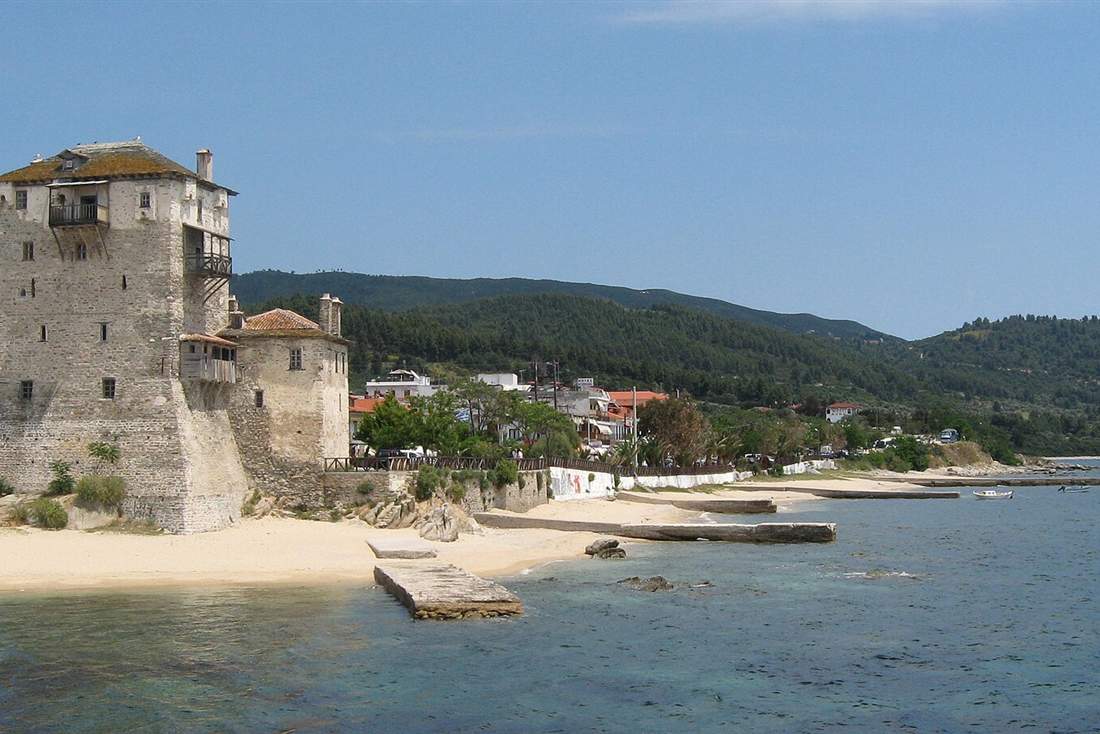
Halkidiki boat tours sail from Ouranoupoli on the Athos peninsula and from Ormos Panagias on Sithonia, running the Blue Lagoon and Ammouliani circuit, the Drenia sandbars and the coastal line of Mount Athos, with swim stops and lunch on board through a day of five to seven hours. Plan the rest of the trip with Greece Tours.
This guide sets out the whole picture: the departure ports, the islands and lagoons each route reaches, the Mount Athos coastal cruise and the rule that keeps boats offshore, the glass-bottom vessels, what the ticket includes, the private charters, the price ranges, the season and the sea conditions that cancel a sailing, and how the day works from Thessaloniki.
What boat tours run in Halkidiki, and where do they depart from?
Halkidiki boat tours depart from Ouranoupoli on the Athos peninsula and from Ormos Panagias on Sithonia. The routes cover the Blue Lagoon at Vourvourou, Ammouliani island, the Drenia islets and the monastery coastline of Mount Athos on half-day and full-day sailings.
Hotel transfer is bundled into the Thessaloniki version of Halkidiki boat tours. The Ouranoupoli fleet holds the larger share of departures. From that small harbour at the neck of the Athos peninsula, five products carry the market: the Blue Lagoon Two Island Cruise, a Mount Athos glass-bottom cruise with a stop on Ammouliani, an Athos sightseeing cruise with a beach halt at the Drenia islets, a Blue Lagoon and Ammouliani cruise with lunch on board, and a Thessaloniki-based version of that lagoon day with the road transfer built into the ticket.
Private charters turn Halkidiki boat tours into a boat for one party. Ormos Panagias, on the east coast of Sithonia, forms the second cluster. Boats leave the pier there for the Vourvourou lagoon and the Diaporos archipelago, then run south around Cape Drepano toward the Athos shore. The sailing distance is longer, so Sithonia departures concentrate on full-day tickets rather than three-hour loops.
Families take Halkidiki boat tours for the shallow bays and the short crossings. A third stream starts in the city rather than on the coast. Visitors staying in Thessaloniki board a minibus at a central meeting point, ride ninety minutes south through Nea Moudania and Nea Kallikratia, and join the same hulls that local guests board at the pier. The boat portion is identical; the ticket simply absorbs the drive.
A north wind cancels Halkidiki boat tours rather than risking the crossing. Every route shares one structure: a cruising leg with commentary, one or two anchored swim stops in sheltered water, and a return leg with the afternoon light behind the ridge. The differences sit in the stops, the lunch and the hull.
Why is Ouranoupoli the main departure port on the Athos peninsula?
Ouranoupoli is the last secular village before the monastic border, so it holds the only pier with legal access to the Athos coastline. Boats leave from a quay in the middle of the seafront, minutes from the parking lots, tavernas and the Byzantine tower.
The season for Halkidiki boat tours runs from late spring to the middle of autumn. The border of the Athonite state cuts across the peninsula a short distance south of the village. Land traffic stops at that line. Sea traffic does not, which turns the Ouranoupoli quay into the single gateway for anyone who wants to see the monasteries without a residence permit from the monastic community.
The price of Halkidiki boat tours tracks the hours, the lunch and the boat. The village itself is compact. The fourteenth-century Prosforiou Tower stands at the water’s edge and works as the meeting landmark for almost every operator, because a guide holding a clipboard beside a stone tower is impossible to miss. Ticket kiosks line the promenade behind it, and the walk from the furthest public parking area to the gangway runs under ten minutes.
The monasteries on the Athos ridge are the reason Halkidiki boat tours sail east. Departure times cluster in two waves. Morning sailings leave between 10:00 and 10:45 and return in the early afternoon; afternoon sailings leave between 14:00 and 14:30 and return before sunset. The Blue Lagoon Two Island Cruise and the Mount Athos glass-bottom cruise both run on that rhythm, which lets a determined visitor take one route in the morning and a different one after lunch.
Booking Halkidiki boat tours ahead secures the deck space in the peak weeks. Ouranoupoli also anchors the practical side of the day: showers, a supermarket, pharmacies and shaded cafes sit within two streets of the pier, so a delayed boarding costs nothing in comfort.
What sails from Ormos Panagias on the Sithonia peninsula?
Ormos Panagias sends boats into the Vourvourou Blue Lagoon and the Diaporos island cluster, then south along the Athos coast. The sheltered bay gives calm water at the pier even when the open gulf turns choppy, which protects the schedule through the windy weeks.
A north wind cancels Halkidiki boat tours rather than risking the crossing. The harbour sits in a deep inlet on the east side of Sithonia, screened by headlands on both sides. That geometry matters. A north wind that builds a metre of swell off Ouranoupoli leaves the Ormos Panagias pier flat, so morning boardings there proceed while other quays hold their passengers ashore.
Hotel transfer is bundled into the Thessaloniki version of Halkidiki boat tours. The classic Sithonia itinerary runs three legs. The boat crosses first to the Diaporos group, threads between the islets and anchors in the pale shallows for a long swim. It then heads south past Cape Drepano into the Singitic Gulf, tracks the Athos shoreline for the monastery commentary, and turns back with a second, shorter swim stop on the way north.
Kassandra, Sithonia and Athos each put a different menu of Halkidiki boat tours on the water. Full-day tickets dominate here because the round trip covers a serious distance. A boat leaving at 09:30 returns between 17:30 and 18:00, and the lunch service on board is a functional necessity rather than a luxury add-on.
Families take Halkidiki boat tours for the shallow bays and the short crossings. Sithonia departures suit guests staying in Vourvourou, Nikiti, Neos Marmaras or Sarti, who reach the pier in under forty minutes. Guests based on Kassandra face a longer drive and gain a better deal from the Ouranoupoli side.
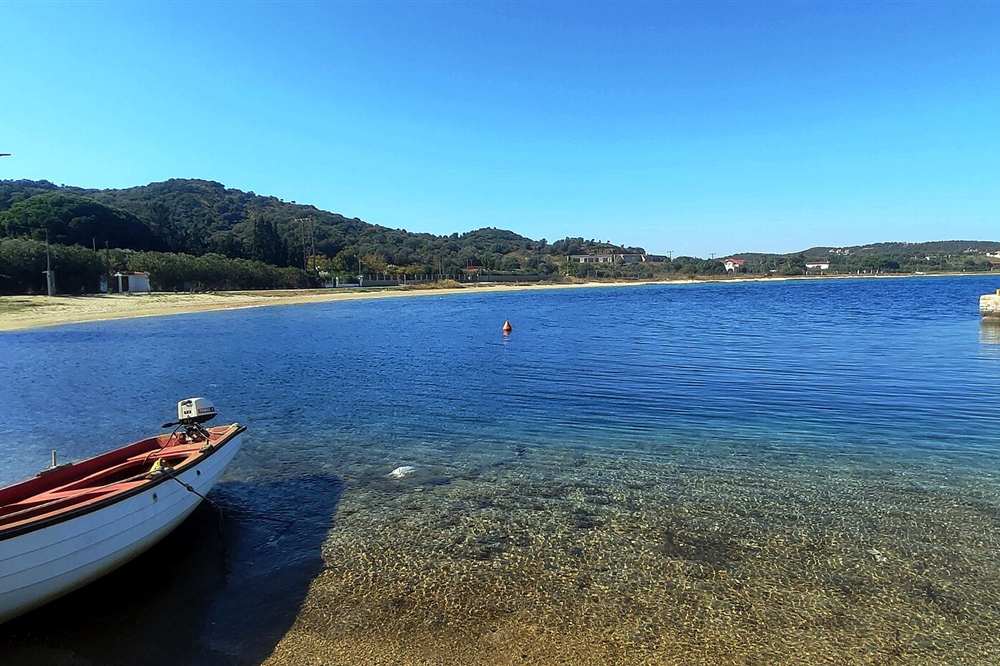
What is the Blue Lagoon at Vourvourou, and what does the Diaporos cluster look like from the water?
The Blue Lagoon is the shallow channel between Diaporos island and the Vourvourou shoreline on Sithonia. A pale sand bed two to four metres down scatters sunlight upward and turns the water turquoise, and nine wooded islets ring the bay around it.
Booking Halkidiki boat tours ahead secures the deck space in the peak weeks. Colour in seawater is a function of depth and bottom material. Over dark rock or seagrass, light is absorbed and the surface reads deep blue. Over clean pale sand in shallow water, light bounces back through the column and returns as turquoise. The Vourvourou channel holds exactly that combination across a stretch wide enough for a boat to anchor inside it, and the crew cuts the engine in the middle rather than against the beach, so swimmers drop from the platform into water they can see the bottom of.
The season for Halkidiki boat tours runs from late spring to the middle of autumn. Diaporos itself is the largest island of the group, roughly two kilometres long, privately held in parts and undeveloped apart from a handful of houses set back in the pines. It carries no port, no road and no shop, so it reaches visitors by boat alone. Pine woods run down to the waterline, the shore breaks into small coves of white sand, and the passages between the islets stay shallow enough to read the seabed from the rail.
Sunset sailings close the day for Halkidiki boat tours in the summer months. The smaller islets carry the names the crew calls out as the hull passes: Agios Isidoros with its tiny chapel, Peristeronisi, Gaidouronisi. Channels between them narrow to a few dozen metres and the skipper drops speed so the wake stays low. Photographers work the outbound leg, when morning light strikes the eastern faces, the pines throw hard shadows onto the sand, and a phone camera catches the tree line and the channel bottom in one exposure. Snorkellers find sand ripples, wrasse, sea bream and an octopus lodged under a rock at the channel edge.
The monasteries on the Athos ridge are the reason Halkidiki boat tours sail east. The lagoon is the headline stop on the Chalkidiki Blue Lagoon and Ammouliani Island Cruise with Lunch and on the From Ouranoupoli Blue Lagoon Two Island Cruise, and both allocate the longest anchored period of the day to it, in the range of forty-five to sixty minutes. Wind direction decides the exact spot: under a north breeze the skipper tucks the hull behind the northern lobe of Diaporos, and under a southerly the boat shifts to the lee side of the channel with the swim area moving alongside it.
What is Ammouliani, the only inhabited island of Halkidiki?
Ammouliani lies eight hundred metres off the Athos peninsula coast and holds a permanent population near six hundred. It measures four square kilometres, carries one village, a working fishing fleet and a ferry link from Tripiti, and anchors the island stop on the lagoon cruises.
Families take Halkidiki boat tours for the shallow bays and the short crossings. The island was settled in the twentieth century by refugee families from Asia Minor, who received land that had belonged to the Vatopedi monastery. That history shows in the village layout: a single harbour front of white houses, a church above it, and narrow lanes climbing the slope behind rather than a sprawling resort grid.
A north wind cancels Halkidiki boat tours rather than risking the crossing. Life on Ammouliani still runs on fishing and on summer visitors. The tavernas along the port serve what the boats land that morning, and the prices sit below the Ouranoupoli seafront because the clientele is local as much as visiting.
Halkidiki boat tours sail from Ouranoupoli on the Athos peninsula each morning. The Mount Athos Glass-Bottom Cruise with Ammouliani Island visit and the Chalkidiki Blue Lagoon and Ammouliani Island Cruise with Lunch both allocate ninety minutes to two hours ashore. That window covers a swim, a coffee and a walk through the village without pressure.
Kassandra, Sithonia and Athos each put a different menu of Halkidiki boat tours on the water. A separate car ferry crosses from Tripiti in fifteen minutes for independent travellers, which makes Ammouliani one of the few Halkidiki boat destinations reachable without a tour ticket. The cruise still wins on time, because it arrives directly at the beach side rather than the vehicle ramp.
Which Ammouliani beaches do the cruises reach, Alykes or Megali Ammos?
Alykes and Megali Ammos are the two beaches the cruises use. Alykes sits on the south-west shore with shallow turquoise water and organised sunbeds; Megali Ammos runs long and open on the north side and faces the Athos ridge across the strait.
The monasteries on the Athos ridge are the reason Halkidiki boat tours sail east. Alykes takes the majority of tender landings. The bay shelves gently, the bottom stays sand for thirty metres out, and a beach bar behind the sunbed rows sells cold drinks and grilled food. Families with small children pick this side because a child stands in waist-deep water a long way from shore.
Booking Halkidiki boat tours ahead secures the deck space in the peak weeks. Megali Ammos, the name translates as Great Sand, stretches wider and stays emptier. The view across the water lands on the Athonite coastline and, in clear air, on the pyramid of the holy mountain behind it. Swimmers who want space rather than service walk here in fifteen minutes from the port.
The Sithonia departures for Halkidiki boat tours leave from Ormos Panagias. A third option, Agios Georgios, sits on the eastern side and draws windsurfers when the meltemi builds. Cruise schedules rarely reach it, because the tender landing needs calmer water than that exposure provides.
Sunset sailings close the day for Halkidiki boat tours in the summer months. The practical decision comes down to the clock. Two hours ashore covers the port, a swim at Alykes and a taverna table. Reaching Megali Ammos and returning consumes the same two hours with no stop for food, so guests pick one target and commit to it.
What are the Drenia islets, and why do people call them the Greek Maldives?
The Drenia islets form a low, uninhabited chain between Ouranoupoli and Ammouliani. A sandbar links two of them under knee-deep water, the seabed is white sand throughout, and the resulting turquoise flats earned the group its Maldives nickname.
Kassandra, Sithonia and Athos each put a different menu of Halkidiki boat tours on the water. The chain carries the local name Gaidouronisia, the donkey islands, from the animals once pastured there. Nothing is built on them. There is no pier, no power and no permanent structure beyond a seasonal beach canteen that opens on the main islet through the summer weeks.
Families take Halkidiki boat tours for the shallow bays and the short crossings. The sandbar is the attraction. Between the two largest islets the water thins to thirty or forty centimetres over pure sand, so a visitor walks from one island to the other with the sea at shin height and the colour running from white through mint to deep blue within twenty metres.
Most Halkidiki boat tours run five to seven hours from the quay and back. The Ouranoupoli Mount Athos Sightseeing Cruise builds its beach stop here, and the Blue Lagoon Two Island Cruise counts Drenia as one of its two islands. Anchored time runs between forty and seventy-five minutes, enough for a swim and a walk across the bar.
Halkidiki boat tours sail from Ouranoupoli on the Athos peninsula each morning. Bring water and shade. The islets have no natural cover taller than scrub, and the reflected light off the white bottom raises the effective sun exposure well above what the same hour delivers on a mainland beach.
What does the Mount Athos coastal cruise show, and how close does the boat go?
The Athos cruise runs the west coast of the monastic peninsula past Zografou, Kastamonitou, Docheiariou, Xenophontos, Panteleimonos, Xiropotamou and Simonopetra. Greek law holds passenger vessels five hundred metres off that shoreline, and the guide names each foundation as it passes the rail.
Sunset sailings close the day for Halkidiki boat tours in the summer months. The peninsula is an autonomous monastic republic of twenty ruling monasteries, continuously inhabited for more than a thousand years, and a UNESCO World Heritage property. From the deck the buildings read as fortified towns rather than churches: stone walls, defensive towers and tiled roofs stacked against the slope, with the two-thousand-metre summit rising at the southern end of the ridge behind them.
The monasteries on the Athos ridge are the reason Halkidiki boat tours sail east. Saint Panteleimon, the Russian house, delivers the most photographed silhouette on this coast with its green domes and ochre blocks. Simonopetra, built on a rock pillar with wooden balconies hanging over the drop, comes into view on the itineraries that push further south. Commentary runs in English and in the operator’s second language, delivered live rather than from a recording on the smaller vessels, and it covers the founding dates, the treasuries and the daily rule of the monks.
The Blue Lagoon at Vourvourou is the headline stop on Halkidiki boat tours. The five-hundred-metre limit protects the community’s seclusion and its avaton, the prohibition governing who sets foot on the peninsula. Enforcement is real: the boundary is charted, patrol craft work the coast, and a skipper who crosses it loses the licence that feeds the business. The distance sounds like a barrier and functions as a frame, because at that range a monastery fills a third of a phone screen and the whole of a modest zoom lens, with the balconies of Simonopetra and the domes of Panteleimonos resolving clearly in daylight.
The Sithonia departures for Halkidiki boat tours leave from Ormos Panagias. Carry eight-power binoculars if the monasteries are the point of the day; crews hand out a shared pair on request and a personal set removes the queue. Guests based in the city reach the same coastline on a Mount Athos cruise from Thessaloniki, which pairs the road transfer with the identical sailing leg out of Ouranoupoli.
Why do women board the Athos cruise when the peninsula stays closed to them?
The avaton bars all women from setting foot on the Athos peninsula, a rule the monastic community has held for over a thousand years. The five-hundred-metre sea boundary lies outside that jurisdiction, so women view every monastery from the deck without restriction.
Halkidiki boat tours sail from Ouranoupoli on the Athos peninsula each morning. Male visitors who want to land need a diamonitirion, a written permit issued in limited daily numbers through the Pilgrims’ Bureau in Thessaloniki, arranged months ahead and tied to a fixed entry date. Women hold no such route. The land border is absolute for them.
Kassandra, Sithonia and Athos each put a different menu of Halkidiki boat tours on the water. The cruise closes that gap. Boats from Ouranoupoli and Ormos Panagias carry mixed passengers with no permit, no paperwork and no dress code beyond ordinary beachwear discretion. A ticket bought the previous evening delivers a full morning along the same coastline that a permitted pilgrim walks.
Ammouliani, the only inhabited island of the region, anchors Halkidiki boat tours. The rule extends beyond people. Female domestic animals are excluded as well, with the cats that control the mice standing as the practical exception. Guides explain the history on the outbound leg, tracing the prohibition to imperial decrees of the Byzantine era.
Most Halkidiki boat tours run five to seven hours from the quay and back. Understanding the frame changes the experience. Passengers looking at Docheiariou from the rail are looking at a functioning community with a rule older than most European states, and the boat is the only vehicle that puts every visitor in front of it on equal terms.
What is visible through the hull of a glass-bottom boat?
The glass panel in the hull shows the seabed under the vessel: sand ripples, posidonia meadows, rock ledges, and fish moving through them. Visibility runs eight to fifteen metres in calm water, so the panel stays useful over the shallow ground near Ammouliani and Drenia.
The Sithonia departures for Halkidiki boat tours leave from Ormos Panagias. The Mount Athos Glass-Bottom Cruise with Ammouliani Island visit builds its identity on that panel. The viewing well sits amidships with bench seating on both sides, shaded so reflections stay off the glass, and the crew slows the boat over the shallowest ground to hold the image steady.
Sunset sailings close the day for Halkidiki boat tours in the summer months. Posidonia seagrass covers a large share of the bed here. The meadows look like dark waving fields from above and function as the nursery of the gulf, sheltering juvenile bream, wrasse, damselfish and the occasional cuttlefish that fires off in a puff of sand as the shadow crosses it.
The Drenia islets and their sandbars draw Halkidiki boat tours to shallow water. The panel earns its keep with passengers who do not swim. A grandparent, a nervous child or anyone who prefers a dry seat still sees the underwater half of the day, which is the argument for choosing this hull over a plain caique.
The Blue Lagoon at Vourvourou is the headline stop on Halkidiki boat tours. Anyone who wants the reef at close range takes the water itself. Operators along this coast run Halkidiki scuba diving programmes on the same grounds, and a discover-dive session slots neatly into a spare afternoon.
How does the boat menu differ across Kassandra, Sithonia and Athos?
Kassandra runs short pleasure cruises, sunset sailings and speedboat transfers from its resort marinas. Sithonia sends full-day boats to the Blue Lagoon and Diaporos. The Athos leg holds the monastery cruises out of Ouranoupoli, with Ammouliani and Drenia attached.
Most Halkidiki boat tours run five to seven hours from the quay and back. Kassandra, the western prong, carries the densest hotel supply in Halkidiki. Boats leave from Kallithea, Pefkochori, Nea Fokea and Sani for two-hour coastal loops, party cruises and rides to the caves near Cape Poseidi. The distances are short, the fares low, and the emphasis sits on the water rather than on a destination.
Halkidiki boat tours sail from Ouranoupoli on the Athos peninsula each morning. Sithonia, the middle prong, gives the most varied coastline. Ormos Panagias covers the east side toward Diaporos; Neos Marmaras and Porto Koufo on the west side supply trips to Kelyfos, the turtle-shaped island offshore, and along the cliffs of the southern cape.
Halkidiki boat tours hold five hundred metres off the Mount Athos shore under maritime rule. Athos, the eastern prong, carries the cultural weight. No swimming stop on the monastic shore is permitted, so every operator pairs the coastal leg with an island where passengers actually get wet, which is precisely why Ammouliani and Drenia appear on almost every Ouranoupoli ticket.
Ammouliani, the only inhabited island of the region, anchors Halkidiki boat tours. Choose the prong that matches the intent. Colour and swimming point to Sithonia; history and scale point to Athos; convenience and a short afternoon point to Kassandra.
Which vessels run these cruises, and what is the capacity of each?
Three hull types work this coast. Traditional wooden caiques carry forty to eighty passengers on two decks, motor catamarans carry one hundred and fifty to two hundred and fifty with a bar and a sun deck, and rigid inflatable speedboats carry eight to twelve on private charters.
The Blue Lagoon at Vourvourou is the headline stop on Halkidiki boat tours. The caique is the classic Aegean workboat converted for passengers: a wooden hull, a shaded lower deck with tables, an open upper deck with benches, and a swim ladder at the stern. It rolls more in a chop than a catamaran does and it delivers far more atmosphere, and it stays close to the water so the coastline reads bigger.
The Sithonia departures for Halkidiki boat tours leave from Ormos Panagias. The catamarans dominate the busy summer weeks. Two hulls damp the motion, the wide beam creates a genuine sun deck, and the onboard galley makes the lunch cruises workable. Passengers prone to seasickness benefit from the stability, and the trade-off is a crowd of two hundred sharing the rail at the photo moments.
Women board Halkidiki boat tours to the Athos coast, since the boat never lands. Rigid inflatables serve the private end. Eight passengers, a skipper, a cool box and a route decided at the pier, with the speed to reach Drenia in twelve minutes rather than forty.
The Drenia islets and their sandbars draw Halkidiki boat tours to shallow water. Confirm the hull before booking when it matters. Product pages name the vessel type, and the capacity figure tells you exactly what the swim stop is going to feel like.
What is included in a Halkidiki boat tour ticket?
Standard inclusions cover the cruise, an English-speaking guide or crew commentary, one or two swim stops and use of the swim ladder and shower. Lunch, drinks, snorkelling gear and hotel transfer appear on specific products rather than across the whole fleet.
Ammouliani, the only inhabited island of the region, anchors Halkidiki boat tours. The Chalkidiki Blue Lagoon and Ammouliani Island Cruise with Lunch and the From Thessaloniki Halkidiki Blue Lagoon Cruise with Lunch both serve a hot meal on board. The plate runs to grilled chicken or fish, a Greek salad, bread and a soft drink, prepared in the galley and served at the anchored stop rather than under way.
Most Halkidiki boat tours run five to seven hours from the quay and back. Ticket-only products such as the Mount Athos Sightseeing Cruise leave catering to a bar on deck. Water, coffee, beer and soft drinks are sold at pier prices, and passengers carry their own food aboard without objection from the crew.
Glass-bottom vessels let Halkidiki boat tours show the seabed without a mask. Snorkelling masks appear on the glass-bottom and lagoon products, handed out at the swim stop in limited sizes. A personal mask fits better and removes the leak that ruins the stop.
Halkidiki boat tours hold five hundred metres off the Mount Athos shore under maritime rule. Hotel pickup is the clearest dividing line. Coastal products expect you at the pier under your own power; the Thessaloniki-based lagoon cruise collects you in the city and returns you there, and the fare reflects the four hours of road time it absorbs.


What do private and semi-private charters add to the day?
A private charter buys the route, the timing and the passenger list. The skipper adjusts the itinerary to the wind and to your preferences, swim stops last as long as the group wants, and the boat carries between eight and twelve guests instead of two hundred.
The Drenia islets and their sandbars draw Halkidiki boat tours to shallow water. Semi-private products sit between the two models. The operator caps the manifest at twelve to twenty passengers, keeps the shared price structure, and delivers a swim stop where the ladder is free the moment you reach it. Small-group lagoon cruises out of Ormos Panagias and Vourvourou run on that basis.
The Blue Lagoon at Vourvourou is the headline stop on Halkidiki boat tours. The full charter changes the geography of the day. A private skipper reaches coves the scheduled fleet skips, waits out a passing squall in a sheltered bay rather than turning back, and lands at a taverna pier for lunch when the group prefers a table ashore.
Lunch on board is included on the longer Halkidiki boat tours. Families and groups of friends do the arithmetic quickly. A charter priced at four hundred euros across eight people lands near the price of eight shared tickets with lunch, and the day it delivers bears no resemblance to the shared version.
Women board Halkidiki boat tours to the Athos coast, since the boat never lands. Larger parties and multi-day plans move up to a crewed yacht. Operators list Halkidiki yacht charter options with skipper, fuel and cool box included, booked by the half-day, the full day or the week.
What do Halkidiki boat tours cost in euros?
Shared cruises from Ouranoupoli run in the twenty-five to forty-five euro band per adult. Full-day lagoon cruises with lunch sit between fifty and eighty euros. Thessaloniki departures with transfer run seventy to ninety-five euros, and private charters start near three hundred and fifty.
Halkidiki boat tours hold five hundred metres off the Mount Athos shore under maritime rule. Those bands move with the calendar. High summer carries the top of each range, while the shoulder weeks in June and September trade ten to fifteen per cent lower on the same product with the same crew. Prices quoted here are researched ranges, and the operator’s live page holds the figure that binds.
Ammouliani, the only inhabited island of the region, anchors Halkidiki boat tours. Children are priced separately across the fleet. Infants under three ride free on most manifests, ages four to twelve pay roughly half the adult fare, and family tickets bundling two adults and two children appear on the lunch cruises.
Swim stops break up Halkidiki boat tours at two or three anchorages. The lunch upgrade earns its cost on the long routes. A full-day Sithonia sailing without catering pushes passengers toward a bar tab that closes the gap anyway, so the inclusive fare comes out level and removes the queue at the counter.
Glass-bottom vessels let Halkidiki boat tours show the seabed without a mask. Compare the total, not the headline. A twenty-five euro cruise plus forty kilometres of driving, parking and lunch ashore lands close to a seventy euro inclusive ticket that collects you at the hotel door.
When does the boat season run, and what sea conditions cancel a sailing?
The Halkidiki boat season opens in late April and closes in mid-October, with daily departures from mid-June to mid-September. Skippers cancel when the wind exceeds force five to six, when swell builds above one metre, or when a storm warning covers the gulf.
Women board Halkidiki boat tours to the Athos coast, since the boat never lands. The dominant summer wind is the meltemi, a north to north-east flow that strengthens through the afternoon and drops after dark. It reaches this coast weakened by the mainland, so full cancellations stay rare, and the practical effect is a shifted anchorage rather than a lost day.
The Drenia islets and their sandbars draw Halkidiki boat tours to shallow water. Early and late season sailings run on reduced frequency. In April and October operators drop to three or four departures a week and consolidate bookings onto a single hull, so a fixed date needs a phone call rather than an assumption.
Wooden caiques and catamarans both work the Halkidiki boat tours routes. Sea temperature governs the swim stops more than air temperature does. The water climbs through the low twenties Celsius in June, peaks near twenty-six in August, and holds swimmable warmth deep into October long after the crowds have gone.
Lunch on board is included on the longer Halkidiki boat tours. When a sailing is cancelled for weather, the operator rebooks onto the next available departure or refunds in full. Crews make that call in the morning, from the pier, with the day’s forecast and their own eyes on the water.
What is the booking lead time, and what are the cancellation terms?
Book two to five days ahead through July and August, when the popular lagoon cruises with lunch fill their manifests. Standard terms allow free cancellation up to twenty-four hours before departure, with a full refund processed to the original payment method.
Glass-bottom vessels let Halkidiki boat tours show the seabed without a mask. Outside high summer the pressure eases. A booking made the previous evening secures a seat on most Ouranoupoli departures in June or in late September, and the pier kiosks release unsold places on the morning itself for anyone happy to gamble.
Hotel transfer is bundled into the Thessaloniki version of Halkidiki boat tours. Small-group and glass-bottom products break that pattern. Capacity of forty rather than two hundred means the popular morning slot closes a week ahead in August, and a private charter for a specific date needs two to three weeks in peak season.
Private charters turn Halkidiki boat tours into a boat for one party. The twenty-four-hour window is the industry standard on the platforms, and it works in the traveller’s favour on a weather-dependent product. Watch the forecast the day before, cancel free if the wind turns, rebook for later in the week.
Swim stops break up Halkidiki boat tours at two or three anchorages. Reserve-now-pay-later options appear on most listings, holding the seat without charging the card until closer to the date. That combination, a free hold plus a free cancellation, makes early booking the low-risk choice for a fixed holiday window.
How does a boat day from Thessaloniki work, and does it beat staying in Halkidiki?
The Thessaloniki version collects you in the city around 07:30, drives ninety minutes to the coast, sails the lagoon and island route with lunch aboard, and returns by early evening. Total duration runs ten to eleven hours, of which three are on the road.
Lunch on board is included on the longer Halkidiki boat tours. The From Thessaloniki Halkidiki Blue Lagoon Cruise with Lunch exists for guests with a city base and no rental car. The transfer runs by minibus or coach down the E75 and the Kassandra road, with a coffee halt on the way, and the guide handles the pier logistics on arrival.
The season for Halkidiki boat tours runs from late spring to the middle of autumn. The arithmetic favours it for a single day. Renting a car, driving unfamiliar roads, finding parking in Ouranoupoli in August and driving back tired after a day in the sun costs more in stress than the transfer costs in euros.
The price of Halkidiki boat tours tracks the hours, the lunch and the boat. Guests staying three nights or more on the peninsula flip the calculation. From a hotel in Ouranoupoli or Vourvourou the pier is a ten-minute walk, the day starts at 10:00 instead of 07:30, and the same money buys two cruises rather than one. A full Halkidiki day trip from Thessaloniki covers the ground efficiently for anyone without that base.
Wooden caiques and catamarans both work the Halkidiki boat tours routes. Motion-sensitive travellers plan around the road, not the sea. Three hours in a coach on winding coastal sections affects more passengers than the boat leg does.
What do families with young children need on board, and what is worth bringing?
Children travel free under three and at half fare to twelve on most Halkidiki cruises. Bring high-factor sunscreen, hats, water, a change of clothes and a towel per person. Operators supply life jackets in child sizes and shaded seating on the lower deck.
Swim stops break up Halkidiki boat tours at two or three anchorages. The shallow stops suit small children well. Alykes on Ammouliani and the Drenia sandbar both give waist-deep water over sand with no drop-off, so a parent stands beside a paddling child rather than swimming to reach one.
A north wind cancels Halkidiki boat tours rather than risking the crossing. Shade governs comfort more than anything else. The lower deck of a caique and the covered saloon of a catamaran both stay cool, and a seat there beats the sun deck for anyone travelling with a toddler or a baby.
Hotel transfer is bundled into the Thessaloniki version of Halkidiki boat tours. Accessibility varies sharply by hull and by pier. Catamarans board over a wide gangway at a fixed quay and carry step-free deck space; wooden caiques board over a narrow plank and hold their facilities down a companionway. Passengers using a wheelchair confirm the vessel and the boarding arrangement with the operator before booking, because the difference between the two is absolute.
Private charters turn Halkidiki boat tours into a boat for one party. Pack light and pack dry. A soft bag with a towel, water, sunscreen, a hat and a phone in a waterproof sleeve covers the entire day; anything heavier sits at your feet in a crowded saloon for eight hours.
What does a sunset cruise show on the Athos ridge, and how does a boat day fit with the sites on land?
Evening sailings turn the western face of the Athos peninsula gold, then rose, as the sun drops behind Sithonia. The two-thousand-metre summit holds light after the coastline falls dark, and the water flattens through the last hour into glass.
Wooden caiques and catamarans both work the Halkidiki boat tours routes. Sunset departures leave Ouranoupoli and the Kassandra marinas in the late afternoon, run two to three hours, and pour a drink rather than serving a meal. The route stays short by design, because the light is the product and the anchorage matters less than the angle.
Booking Halkidiki boat tours ahead secures the deck space in the peak weeks. The same holiday holds a full programme ashore. Ancient Olynthos preserves the finest grid-planned houses in northern Greece with their pebble mosaics intact; the Petralona cave holds the archaic skull and its stalactite chambers; Aristotle’s birthplace at Ancient Stagira sits on a wooded headland above the sea; and the tower at Nea Fokea guards the coast an hour from the beach umbrellas.
The season for Halkidiki boat tours runs from late spring to the middle of autumn. Pair them by geography rather than by theme. A morning at Olynthos runs naturally into an afternoon on the Sithonia beaches; a Drenia cruise from Ouranoupoli sits an easy drive from Stagira and the Aristotle park at Stagira village.
The price of Halkidiki boat tours tracks the hours, the lunch and the boat. Visitors working from the city fold both halves into a wider plan of Thessaloniki day trips, alternating a boat day on the peninsula with an inland run to Vergina or Pella.
Frequently Asked Questions
Where do Halkidiki boat tours depart from?
From Ouranoupoli on the Athos peninsula for the Ammouliani, Drenia and Mount Athos routes, and from Ormos Panagias on Sithonia for the Blue Lagoon at Vourvourou and the Diaporos island cluster.
What do Halkidiki boat tours cost?
The shared day cruise runs from about 30 to 55 euros per adult, and the lunch cruise from about 45 to 75 euros. A private charter for the boat runs from about 500 to 1,200 euros for the day.
Can women join the Mount Athos cruise?
Yes. The monastic peninsula itself stays closed to women, and the cruise never lands. The boat holds five hundred metres offshore under maritime rule, so every passenger sees the monasteries from the water.