
Thessaloniki sits at the crossroads of northern Greece, and its position turns the city into a launch pad for the wider region of Macedonia. Monastery cliffs, a mythic mountain, royal tombs, turquoise bays and thermal waterfalls all lie within a single day’s reach of the waterfront. A traveller can base in the port capital, sleep in one hotel, and still touch UNESCO sites, ancient capitals and wild wetlands on separate mornings. The road network fans out in every direction, so the choice comes down to interest and driving appetite rather than raw distance. Map the region before booking, and shape each excursion around a clear theme with My Greece Tours.
The sections below cover each major escape in turn, grouped by theme and ranked by the effort each one demands. History readers get the Macedonian capitals of Pella and Vergina; beach seekers get the three prongs of Halkidiki; nature lovers get Lake Kerkini, the Edessa waterfalls and the caves of the north. Every entry notes the rough drive, what fills the day on arrival, and whether a self-drive or a guided coach fits better. Compare the options against your own calendar, then match them to the guided Thessaloniki tours that reach these sites without the wheel.
Which day trips from Thessaloniki repay the effort?
The strongest day trips from Thessaloniki split into four themes: Macedonian archaeology at Pella and Vergina, monastery landscapes at Meteora, the Halkidiki beaches, and northern nature at Edessa, Kerkini and the caves. Interest and drive time decide the pick.
Distance sets the first filter. Pella sits under an hour west of the city, Vergina about an hour southwest, and the nearest Halkidiki beaches around an hour and a quarter down the coast. Meteora, by contrast, demands close to three hours each way, which turns it into a dawn-to-dusk commitment. Reading the map first keeps expectations honest. It also prevents the rushed loop that spends more of the day in the car than at the actual site. A short list of realistic candidates beats an ambitious plan that collapses on the road.
Theme sets the second filter. A history-led day threads the Macedonian capitals and their museums. A coast day chases sand, shade and swimming. A nature day trades monuments for pelicans, waterfalls and caverns underground. Pairing two nearby sites, such as Pella with Vergina or Edessa with a thermal spring, packs more into the daylight without a punishing schedule. The clearer the theme, the tighter the route and the fuller the payoff.
Season shapes the shortlist too. The archaeological parks and the monasteries stay open across the calendar, while Halkidiki peaks in high summer and Kerkini rewards winter and spring birdwatchers. Travellers who exhaust the city’s own landmarks and want more range beyond the ring road often turn to the region after a first pass through the classic things to do in Thessaloniki. The day trips extend the stay rather than compete with the centre.
Drive effort sorts the region into clear tiers. Short hops under an hour reach Pella, Petralona and the first Halkidiki beaches, leaving a leisurely pace on both ends. Middle-distance runs of about an hour and a half open Olympus, Edessa, Naoussa and Kerkini, still comfortable for a full day. The long haul to Meteora sits in a tier of its own at close to three hours each way. Matching the tier to the hours in hand keeps every outing unhurried.
Is Meteora a realistic day trip from Thessaloniki?
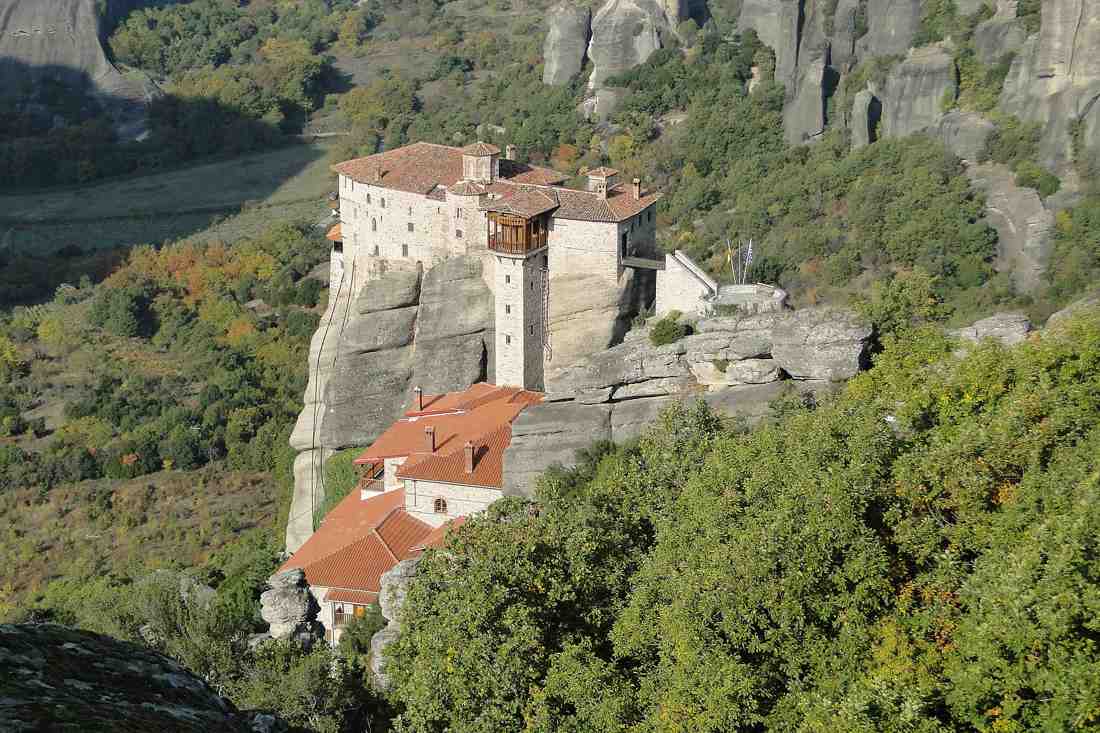
Meteora works as a full-day trip from Thessaloniki despite the three-hour drive each way. An early start buys time for two or three of the six clifftop monasteries, the viewpoints between them, and lunch in Kalambaka before the return.
The monasteries crown a forest of sandstone pinnacles that rise straight from the Thessalian plain. Orthodox monks built the retreats on the summits during the late medieval centuries, hauling supplies by rope and net long before the modern stairways arrived. Six of the original two dozen still function as living communities. Each keeps its own visiting rhythm and closing day, so a guide plans the sequence around open hours and quieter windows. The scale astonishes on arrival: chapels and cells balanced on stone towers hundreds of feet above the valley.
A day tour pairs two monasteries with photo stops on the connecting road, where the whole massif fills the windscreen. Modest dress is required at every entrance, with covered shoulders and knees, and shawls wait at the gates for anyone caught short. The interiors hold Byzantine frescoes, carved screens and small museums of icons and manuscripts. The full geological and monastic story sits in the dedicated Meteora guide for travellers who want the deeper background before they climb the steps.
Self-drivers face a long but simple motorway run southwest, then a twisting final climb between the rocks. The reward is total control of the timing, from a sunrise start to a sunset viewpoint on the way out. A guided coach removes the fatigue of six hours behind the wheel and adds running commentary on the geology and the monastic history. Either format delivers the same rare sight of monasteries perched on pillars above the morning mist.
Timing separates a good Meteora day from a scramble. Leaving Thessaloniki at first light beats both the midday coaches and the harshest heat on the exposed rock. Two monasteries with unhurried stops make a fuller memory than a dash through four. A break in Kalambaka or the stone village of Kastraki, tucked right under the towers, closes the visit before the drive home along the plain.
What waits at Mount Olympus and the Dion archaeological park?
Mount Olympus and Dion pair Greece’s highest peak with the sacred city at its foot. Dion’s park holds temple foundations, a theatre and mosaic floors, while the Olympus trailheads and the Enipeas Gorge open the mythic mountain to walkers.
Olympus rises above the coast an hour and a half south of the city, its summit hidden in cloud for much of the year. Greek myth crowned the peak as the seat of the twelve Olympian gods, with Zeus at their head. The mountain now anchors a national park laced with marked trails and stone refuges. The gateway town of Litochoro sends hikers up the Enipeas Gorge, a green corridor of pools and waterfalls that climbs toward the high country. Casual walkers keep to the lower gorge and return for lunch.
Dion lies on the plain below, where the ancient Macedonians honoured Zeus with a sanctuary and a festival before their campaigns. Alexander the Great offered sacrifices at Dion before marching east into Asia. The archaeological park spreads across wetland meadows, threading paths past the sanctuary of Isis, a Hellenistic theatre, bath complexes and grand villa mosaics. Water bubbles up everywhere through the site, which lends the ruins a strange, half-flooded beauty. The town museum guards the finest finds, among them a working reconstruction of an ancient water organ.
A combined day gives a mountain morning and an archaeological afternoon, or the reverse to dodge the summer heat. Stronger hikers tackle a stretch of the ascent toward the refuges and return by dusk, while families keep to the park loops and the shaded gorge. The drive stays short enough to leave room for a swim on the Pieria coast on the way back. The mix of myth, ruin and mountain air makes the trip a favourite for first-time visitors.
Practical planning smooths the day. Sturdy shoes handle both the gorge path and the uneven ground at Dion, and water matters on the exposed archaeological flats. The park and the mountain each ask for two to three hours to do them justice. Guided trips fold the two together with transport and context, sparing walkers the trailhead logistics and the search for the museum’s opening window.
Where can you stand in Alexander the Great’s birthplace?
Pella, an hour west of Thessaloniki, was the capital of ancient Macedon and the birthplace of Alexander the Great. Vergina, the old royal seat of Aigai an hour southwest, guards the underground tomb of his father, Philip the Second.
Pella grew into the political heart of Macedon under Alexander’s forebears, and the future conqueror spent his boyhood here before his tutor Aristotle arrived. The site is famed for pebble mosaics of lions and mythological hunts, laid in coloured river stones across the floors of grand courtyard houses. Broad avenues and the footprints of workshops and mansions map out a planned Hellenistic city. An adjoining museum reconstructs the street grid and displays the finds, from marble statuary to household tools and terracottas.
Vergina protects a different treasure beneath a great earthen mound. Archaeologists uncovered the unlooted royal tombs of the Macedonian dynasty here, and the burial identified as Philip the Second yielded a gold larnax, a suit of armour and a delicate gold wreath of oak leaves. The museum keeps the treasures in the dim, climate-controlled interior of the tumulus, directly above the tombs themselves. Walking through that hushed, low-lit space ranks among the most atmospheric encounters with antiquity in Greece.
The two sites pair neatly into a single Macedonian day, since a cross-country road links them in under an hour. History-minded travellers walk the mosaics of Pella in the morning, break for lunch in a village taverna, and descend into the Vergina tumulus in the afternoon. Both parks carry UNESCO World Heritage listing, and neither draws the dense crowds of the southern classics. The pairing tells the Macedonian story from cradle to grave in one focused outing.
Context turns the stones into a narrative. The rise of Philip and the conquests of Alexander reshaped the ancient world, and standing in their capital and their necropolis grounds the tale in real ground. A guide connects the mosaics, the tombs and the museum objects into one thread, naming the kings and the battles. Self-drivers cover the loop easily on good roads, museum labels in hand, for a quieter and more independent visit.
Which Halkidiki peninsula fits one day from Thessaloniki?
Kassandra, the first and most developed of Halkidiki’s three prongs, sits closest for a beach day, roughly an hour and a quarter out. Sithonia rewards a longer drive with quieter pine-fringed coves, while the Athos leg stays monastic.
Halkidiki reaches into the Aegean on three long fingers, each with its own distinct character. Kassandra, the westernmost, carries the resorts, beach bars and nightlife, and its sandy bays fill fastest in high summer. Roads run good and services line the coast, from sunbed rentals to seafood tavernas over the water. The short drive makes it the default choice for travellers who want sea and sand without a marathon behind the wheel. Families in particular lean toward its organised, shallow-water beaches.
Sithonia, the middle prong, trades development for pine forest that runs right down to turquoise water. Its coves range from organised beaches with sunbeds to hidden strips reached by dirt track and a short scramble. The quieter scale suits swimmers, snorkellers and campers who prize space over amenities. The extra half hour of driving thins the crowds noticeably compared with Kassandra. A loop of the coast road links viewpoints, fishing harbours and one photogenic bay after another.
Both legs work as self-drive days, with the coast road curling past headlands and small ports. A guided trip handles the parking and the beach-hopping, and pairs the swim with a village lunch of grilled fish and salad. Late spring and early autumn offer warm water without the peak-season squeeze on the sand. The third finger, Athos, follows entirely different rules and belongs to the monastic republic covered in the next section.
Choosing between the two prongs comes down to appetite for driving and crowds. Kassandra answers the call for an easy, lively beach day close to the city. Sithonia rewards those willing to trade thirty minutes of road for clearer water and calmer sand. Either way, an early departure secures shade and parking before the midday rush, and a sunset drink on the coast makes a fitting close before the run home.
Can you visit Mount Athos on a day trip from Thessaloniki?
You can see Mount Athos on a day cruise from Ouranoupoli, which sails along the peninsula to view the monasteries from the sea. Landing is another matter: the monastic republic bars women entirely and admits men only by advance permit.
The Athos peninsula forms a self-governing monastic state under Greek sovereignty, home to twenty ruling monasteries and a scatter of smaller houses and hermitages. A rule of centuries’ standing, the avaton, forbids women from setting foot on the peninsula at all. Even male pilgrims apply well ahead for the diamonitirion permit, which caps the daily number of visitors. The restriction keeps the shoreline free of ordinary tourism and preserves the rhythm of prayer and labour that governs the mountain.
Cruise boats close the gap for everyone else. Departing from Ouranoupoli at the neck of the peninsula, they run parallel to the wooded coast at the legal distance offshore. The route passes the fortified monasteries that cling to cliffs and inlets, their towers and red-tiled roofs stacked against the forest. A commentary names each house and its founding order as the great sea walls slide by. Binoculars bring the frescoed balconies and the tiny harbours into focus from the deck.
The excursion suits mixed groups and families, since it grants the spectacle without the permit process or the male-only limit. The boat turns back near the towering peak that gives the peninsula its name, rising sheer from the water at its southern tip. Pairing the cruise with a stroll around Ouranoupoli’s Byzantine tower and beach rounds out a relaxed coastal day. The village also serves as a gateway for the beaches of the third Halkidiki prong.
Understanding the rules avoids disappointment before booking. Women cannot land, full stop, so the cruise is the only route to Athos for female travellers and for men without a permit. Male pilgrims who do secure a diamonitirion arrange overnight stays inside the monasteries, a separate and slower kind of visit. For a single day from Thessaloniki, the coastal cruise is the practical and inclusive answer.
Are the Edessa waterfalls worth a day trip from Thessaloniki?
Edessa earns its nickname as the city of waters, with cascades that plunge through the town centre into a gorge. The tallest fall, the Karanos, drops around seventy metres, and a water museum and cave sit at its base.
Streams from the surrounding highlands converge above the town and spill over the edge of a plateau in a run of waterfalls. The main cascade, the Karanos, ranks as the tallest in the Balkans, and a path leads behind the sheet of water into a small cave. Mist drifts across a landscaped park of footbridges, old watermills and industrial buildings turned into museums. The sound of falling water follows visitors along every path and viewpoint.
The old quarter of Varosi crowns the plateau above, its wooden-balconied houses overlooking the gorge and the plain toward the mountains. Cobbled lanes, restored mansions and a clutch of small churches make an easy stroll after the falls. An open-air water museum explains how the cascades once powered hemp mills and the town’s early hydroelectric works. The compact layout puts the falls, the park and the old town within a short, level walk of one another.
Edessa lies about an hour and a half northwest, which leaves room to pair it with the Pozar thermal springs in the same broad valley. A soak in the warm, mineral-rich pools after the waterfall walk makes a balanced nature day. Self-drivers reach the town on a straightforward route across the plain, then climb gently into the hills. Guided trips fold in the springs and a village lunch, turning the falls into one stop on a fuller circuit.
The season colours the visit. Spring and early summer send the greatest volume of water over the Karanos, when snowmelt swells the streams above the town. Autumn dresses the gorge in colour, and even winter has its charm as mist hangs in the cold air. The falls run year-round, which keeps Edessa a dependable choice when the coast turns too warm or the archaeological sites feel too familiar.
Can you tour the Naoussa wine region from Thessaloniki?
Naoussa, an hour and a half west on the slopes of Mount Vermio, is one of Greece’s flagship red-wine appellations. Its estates specialise in the local Xinomavro grape and open their cellars for tastings and vineyard walks.
The Naoussa appellation covers vineyards on the eastern foothills of Vermio, where cool air and clay soils shape a firm, age-worthy red. Xinomavro, the signature grape, gives wines of high acidity and grippy tannin, often likened to the Nebbiolo of Piedmont. The name translates as acid-black, a nod to its bracing structure and dark fruit. Estate visits walk guests through the rows and the barrel rooms before a seated tasting of current and library vintages.
A wine day pairs the cellars with the food of the region, from local cured meats to the peaches for which the town is famous. The tasting route travels well beside a Thessaloniki food tour for travellers who want to trace northern Greek flavour from the city markets out to the source in the hills. Small family wineries welcome visitors alongside larger estates with polished tasting rooms. Booking ahead secures a guided tasting and, crucially, a driver for the road home.
The region rewards autumn visits around the grape harvest, when the vines turn red and gold and the wineries hum with picking. Naoussa town adds a leafy park, the rushing Arapitsa river and the memory of the nineteenth-century Macedonian struggle. The nearby ski slopes and beech forests of Vermio give the trip an alpine backdrop rare in Greece. The drive climbs gently from the plain, so the road stays as pleasant as the destination.
A guided wine tour solves the obvious problem of tasting and driving. A licensed driver handles the winding approach roads while guests sample freely across two or three estates. The guide reads the labels, explains the appellation rules and lines up the visits so the cellars expect the group. Self-drivers can still enjoy the region by nominating a non-drinking driver and pacing the pours accordingly.
What makes Lake Kerkini a rewarding day trip?
Lake Kerkini, a man-made wetland an hour and a half north, ranks among Europe’s finest birdwatching sites. Dalmatian pelicans, herons and over three hundred recorded species gather here, and flat-bottomed boats glide out among the buffalo and reed beds.
Engineers dammed the Strymon river to create Kerkini, and the shallow lake grew into a Ramsar-listed haven on the flyway between Europe and Africa. Dalmatian pelicans, a globally threatened bird, breed on floating platforms and drift close to the boats. Herons, egrets, cormorants and raptors work the shallows and the fringing woodland. Herds of water buffalo wade along the muddy shore, a rare living link to an older rural Greece. The birdlife shifts with the calendar, which rewards repeat visits in different seasons.
Local boatmen run quiet trips at dawn and dusk, the best light for both the birds and the photographers. Gliding through mirror-still water among rafts of pelicans ranks as the trip’s signature moment. The northern shore rises into the forests of the Kerkini and Beles mountains, adding walking and cycling routes to the wildlife. A visitor centre maps the species and the seasons and orients first-time birders before they head to the water.
Winter and early spring bring the greatest numbers, when migrants stack up on the lake in their thousands. The wetland stays productive across the year, though, with resident pelicans and buffalo on show even through the summer months. Fishermen still work the lake with traditional flat boats, a scene that has changed little in generations. The drive north runs through the town of Serres, an easy road that turns a wildlife morning into a full day.
The trip suits nature lovers, families and photographers in equal measure. Children take to the buffalo and the giant pelicans, while serious birders tick species from a hide or a slow boat. Warm layers matter on the water even in mild weather, and binoculars transform the experience. A guided outing lines up the boatman, the timing and the light, so the group hits the shallows when the birds are most active.
Which caves near Thessaloniki can you explore?
Two caves headline the region. Alistrati, near Serres, is one of Greece’s largest show caves, with lit galleries of stalactites reached by a train. Petralona, in Halkidiki, is famous for the ancient skull of the Archanthropus and its red formations.
Alistrati opens deep into a hillside east of Serres, and its walkways thread past forests of stalactites, flowstone curtains and rare eccentric formations that grow sideways against gravity. A small electric train carries visitors from the entrance building down to the cave mouth. An outdoor zipline and a via ferrata run over the neighbouring Aggitis gorge for the more adventurous. The cave holds a steady cool temperature year-round, a welcome retreat from the summer heat on the plain.
Petralona cave, on the western side of Halkidiki, made headlines in the story of Greek prehistory when a fossil human skull turned up in its chambers. The Petralona skull, embedded in the cave wall, counts among the oldest human remains found in the country, though its exact age remains debated. The passages glitter with red and white stalactites, stalagmites and rippled draperies of stone. A site museum sets out the discovery and the long scientific argument over the fossil’s date.
Both caves make short, weatherproof outings that pair well with other stops nearby. Alistrati sits close enough to combine with Lake Kerkini or the Serres plain, while Petralona slots neatly into a Halkidiki beach day. Sturdy shoes and a light layer handle the damp floors and the cool underground air. Guided tours inside are standard practice, so the geology and the finds come with expert commentary rather than guesswork.
The caves add welcome variety to a run of beaches and ruins. Their steady temperature makes them a smart choice on a scorching day or during a rainy spell that shuts the coast down. Photography is possible in the lit galleries, though a tripod helps in the low light. Booking or checking tour times ahead avoids a wait, since entries run in timed groups led by a guide.
Should you drive yourself or book a guided day trip from Thessaloniki?
Self-driving suits the beaches and the nearer archaeological parks, where roads run simple and parking stays easy. Guided coaches win for Meteora, the Athos cruise and the wineries, removing long drives, permits and tasting logistics from the traveller’s plate.
A hire car buys freedom for the coast and the closer sites. The motorways toward Halkidiki, Pella and Vergina run in good condition, and a village taverna rewards an unplanned detour off the main road. The trade-offs are the parking hunt at busy beaches, the toll booths on the highways, and the fatigue on the long Meteora haul. That fatigue erodes the day for a solo driver, who arrives tired and leaves rushed to beat the dark.
Guided trips flip those trade-offs. A coach or minivan absorbs the driving, adds a licensed guide’s commentary, and clears the hurdles that self-drivers dread. The guide handles the Athos permit rules, the winery tasting that leaves no sober driver, and the timed cave entries without a hitch. The fixed schedule is the price of that ease, trading spontaneity for a smooth, briefed and sociable day. Small-group formats keep the numbers low and the pace flexible.
The smartest plan often mixes both across a stay, and the choice ties back to your base and your calendar. Pinning down where to stay in Thessaloniki near the ring road or the port shortens every outbound drive. Sketching a day-by-day Thessaloniki itinerary then slots the far trips such as Meteora onto the freshest mornings. The closer beaches and caves fill the relaxed afternoons at the end of the stay.
Budget and company tip the final call. A car spreads its cost across a group and rewards independent travellers who like to linger. A guided seat makes sense for solo visitors, nervous drivers and anyone who wants the history delivered on the spot. Matching the format to each specific trip, rather than the whole holiday, extracts the best of both across a week in the north.
Frequently Asked Questions
How many day trips fit into a short Thessaloniki stay?
A three-night stay comfortably holds two day trips beside the city sights. Pairing one nearby double, such as Pella with Vergina, and one longer escape like Meteora or a Halkidiki beach balances range against travel fatigue.
Do you need a car for day trips from Thessaloniki?
A car helps for the beaches and the caves, where public transport thins out. Trains reach Meteora’s Kalambaka and buses serve Pella and Vergina, though guided coaches cover the awkward routes and long drives without the wait.
Which day trip is best for first-time visitors?
First-timers gravitate to Meteora for its rare monastery landscape, or to the Macedonian capitals for the direct Alexander connection. Summer travellers swap one of those for a Halkidiki beach or the Mount Athos coastal cruise.
Can women visit Mount Athos from Thessaloniki?
Women cannot land on the Athos peninsula, which the monastic rule reserves for men holding a permit. Everyone can still join the coastal cruise from Ouranoupoli and view the monasteries from the water.
When is the best season for a Lake Kerkini day trip?
Winter and early spring deliver peak bird numbers at Kerkini, including breeding Dalmatian pelicans. The wetland stays rewarding across the year, with resident buffalo and pelicans visible even through the summer months.
How far is Meteora from Thessaloniki?
Meteora lies roughly three hours by road southwest of Thessaloniki, near the town of Kalambaka. The distance makes an early departure essential for a comfortable day among the clifftop monasteries.