
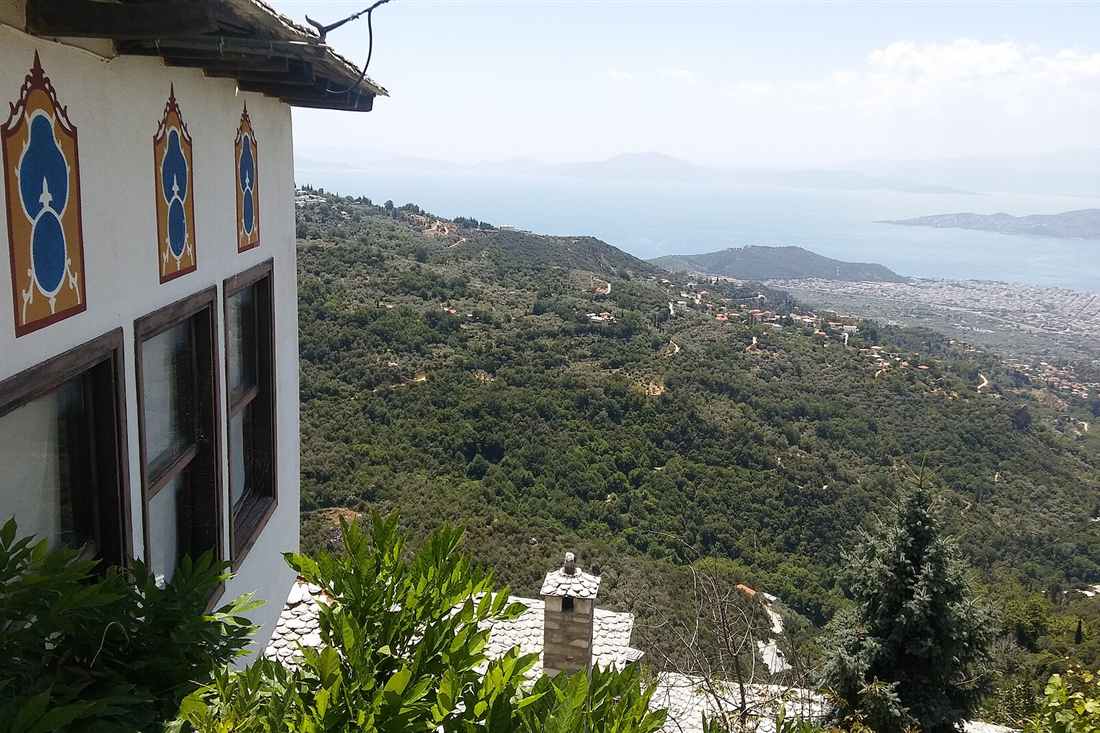
A Pelion villages tour climbs from Volos into the stone settlements of the mountain, taking in Makrinitsa on its balcony above the gulf, the mansion lanes of Vizitsa and Pinakates, and Milies with the station of the Moutzouris narrow-gauge train, over four to eight hours. Plan the rest of the trip with Greece Tours.
This guide covers the whole run: the drive up from the port, each village and what stands in it, the train and the De Chirico bridge, the east-coast villages and the beaches under them, the olive oil and tsipouro tastings, the swim stop and the lunch, the private and small-group formats, the prices, and the season on the mountain.
What does a Pelion villages tour cover, and where does it start?
A Pelion villages tour starts in Volos, climbs the mountain by road, and stops in three or four stone settlements — Makrinitsa, Pinakates, Vizitsa, Milies or Tsagkarada — for cobbled squares, mansion architecture, local tastings and a long view over the Pagasetic Gulf.
Makrinitsa, the balcony of the mountain, is the first stop on a Pelion villages tour. Mount Pelion rises out of the back streets of Volos and tops out at 1,624 metres. Twenty-four traditional settlements hold its slopes, each built around a plane-shaded square, a stone church and stepped cobbled lanes called kalderimia.
Spring puts the wildflowers and the running water into a Pelion villages tour. Four distinct products depart from Volos, and each frames the same mountain differently. The small-group tour built around the cruise call takes Pinakates, Vizitsa and Milies. The full-day tour adds a swim stop and a seated lunch. The private olive oil experience turns the day toward growers, a press and a tasting table. The fourth crosses the ridge to Tsagkarada and drops to Mylopotamos Beach.
Olive oil and tsipouro tastings sit inside the private Pelion villages tour. Every version follows one spine — leave the port, climb through chestnut and beech forest, walk the villages on foot, and return in the late afternoon. Village profiles and driving times sit in the Pelion destination guide.
Why does Volos serve as the gateway to Mount Pelion?
Volos sits at the head of the Pagasetic Gulf with the mountain rising directly behind it. The cruise berth, the railway station and the intercity bus terminal stand within two kilometres of each other, and the first village square is a twenty-minute drive uphill.
Portaria sits beside Makrinitsa on the west slope of a Pelion villages tour. The city is the ancient Iolcos of myth, the harbour where Jason assembled the Argo, and the range above it is where the centaur Chiron taught Achilles. Guides read the mountain through that story, and the Athanasakio Archaeological Museum anchors it to excavated settlements.
The switchback road makes a Pelion villages tour a slow climb rather than a dash. Volos also sets the food identity of the day. Its waterfront tsipouradika serve small measures of tsipouro against a rotating plate of meze — grilled octopus, salted mackerel, fried gavros — and that ritual repeats at every village tasting further up the slope.
A swim stop breaks the full-day Pelion villages tour on the Pagasetic shore. Arrival works from three directions. Nea Anchialos lies thirty kilometres southwest, and Volos airport transfers reach the city hotels in under an hour. Trains connect through Larissa, and the motorway puts Athens three and a half hours away.
Which stone villages line the western slope of Pelion?
Makrinitsa, Portaria, Pinakates, Vizitsa and Milies line the western and southwestern slope above Volos. All five keep slate-roofed mansions, plane-shaded squares and stepped cobbled lanes, and all five stand between four hundred and six hundred metres with the gulf beneath them.
The mansion lanes of Vizitsa carry a Pelion villages tour into the south of the range. Makrinitsa carries the nickname balcony of Pelion and earns it: the village hangs on a near-vertical slope looking straight down on Volos. Its square holds a hollow marble fountain, enormous plane trees, and the kafeneio whose walls carry frescoes by the folk painter Theophilos Hatzimichail.
The switchback road makes a Pelion villages tour a slow climb rather than a dash. Portaria, one ridge along, is larger and busier, with hotels and the Byzantine church of Panagia Portarea. Pinakates and Vizitsa sit further south and stay quiet. Vizitsa is the set piece — a cluster of restored eighteenth-century archontika reached by a broad stone staircase.
Lunch in a village tavern closes the long format of a Pelion villages tour. Milies closes the circuit. Its square holds the church of the Taxiarches with clay acoustic jars set into the walls, the celebrated village library, and the railway terminus. Because the five stand within forty minutes of the port on one road, they form the backbone of the standard pelion villages tour.
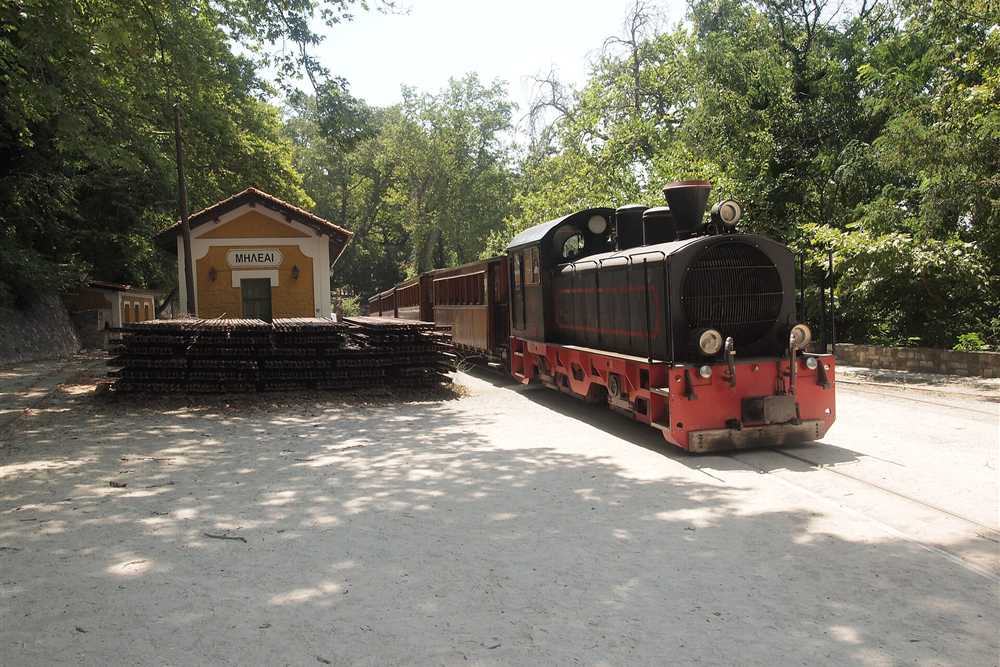
What is the Moutzouris, and what stands at Milies station?
The Moutzouris is the narrow-gauge Pelion railway that climbs sixteen kilometres from Ano Lechonia to Milies on a six-hundred-millimetre track. Its terminus keeps the original stone station, a turning loop, wooden carriages and the curved iron bridge crossing the Taxiarches ravine.
Pinakates and its square hold a Pelion villages tour for an hour of walking. The nickname means the sooty one, earned by the coal smoke that coated passengers on the open cars. The line was engineered by Evaristo De Chirico, whose son Giorgio painted the empty arcades of metaphysical art. The father’s signature work is that steel bridge, curved in plan with no central pier.
Cobbled lanes shape what a Pelion villages tour asks of walking shoes. The full run takes an hour and a half in each direction, tracing terraces, tunnels and stone viaducts through olive and apple country. Services operate at weekends across the warm half of the year, and operators time the Milies stop so the group stands in the square when the locomotive arrives.
Cruise passengers at Volos take a Pelion villages tour timed to the port call. Even without a departure scheduled, the station earns a stop. The platform sits under plane trees at the edge of the village, the old rolling stock parked in view, and two tavernas serve beside the rails.
Which villages sit on the east coast of Pelion?
Tsagkarada, Zagora and Kissos hold the eastern slope facing the Aegean. Tsagkarada spreads across four hamlets around a plane tree fourteen metres in girth, Zagora grows the firiki apple on terraced orchards, and Kissos guards a carved iconostasis inside the church of Agia Marina.
Milies closes a Pelion villages tour at the station of the Moutzouris train. Tsagkarada is the anchor. Its quarters — Agia Paraskevi, Agios Stefanos, Agioi Taxiarches and Agia Kyriaki — each keep a church and a square, and the settlement never consolidated into one centre. The plane tree in Agia Paraskevi square is the largest in Greece.
A Pelion villages tour pairs with Meteora across a two-day run through Thessaly. Zagora is the biggest village on the mountain and the historic trading one, enriched by silk and later by fruit. Its cooperative still ships the firiki, and the village library holds manuscripts from the era when Zagora funded scholars in Europe.
Tsagkarada and its plane tree open the east-coast leg of a Pelion villages tour. Kissos sits in chestnut forest at five hundred metres, and its eighteenth-century church of Agia Marina is the finest interior on the coast side, with a gilded iconostasis running the width of the nave. The eastern slope catches the Aegean weather and stays green.
Which beaches does the private Tsagkarada and Mylopotamos tour reach?
The private tour from Volos crosses the ridge to Tsagkarada, then drops the last kilometres to Mylopotamos, a twin cove divided by a pierced rock arch. Fakistra and Damouchari lie within a short drive, each reached by a stair path or a narrow descending road.
The narrow-gauge line and the De Chirico bridge frame a Pelion villages tour. Mylopotamos is the photograph everyone recognises from Pelion: two crescents of pale pebble split by a limestone headland the sea has bored straight through, so swimmers pass from one beach to the other under the rock.
The price of a Pelion villages tour is set by the hours and the group size. Fakistra is the wilder neighbour, a strip beneath cliffs reached by a steep path, with a cave at its northern end that sheltered a secret school under Ottoman rule. Damouchari is the opposite temperament — a pebble harbour with a ruined tower and stone houses around the water.
Mylopotamos and Fakistra lie below the villages a Pelion villages tour visits. The same shoreline reads differently from the sea, and a Volos yacht charter reaches the caves no vehicle serves. On land, the private format is what makes this itinerary work: the driver waits at the top of the descent, and the swim runs as long as the group asks.
What defines the mountain architecture of the Pelion villages?
Pelion architecture rests on three elements: grey schist slate roofing, a thick stone ground floor built as a fortified base, and a projecting timber upper storey. Mansions add carved wooden ceilings, painted plaster panels and shuttered bay windows that overhang the lane below.
Slate roofs and stone mansions give a Pelion villages tour its architecture. The slate comes from quarries on the mountain itself, split into irregular plates and laid in overlapping courses that shed snowmelt and survive the Aegean gales. From above, a village reads as a grey scaled surface with chimneys and cypress spikes breaking through it.
Booking a Pelion villages tour ahead secures the guide through the summer weeks. The archontika of Vizitsa, Makrinitsa and Zagora were financed by silk, tanning and shipping. The ground floor stored goods behind rifle slits, the middle floor held the winter rooms, and the top floor opened into a long summer hall lit on three sides.
The private format of a Pelion villages tour bends the route to your own list. Public buildings repeat the same grammar. The library at Milies, founded by the scholars Anthimos Gazis, Grigorios Konstantas and Daniil Philippidis, sits beside the Taxiarches church in a stone shell identical to a private mansion, and the village schools follow that three-part elevation.
What does the private olive oil experience put on the table?
The private olive oil and local product experience visits a working grove and press on the lower slopes, then seats the group for a tasting of extra virgin oil, table olives, cheese, honey, spoon sweets and tsipouro, with the producer explaining harvest, cold milling and acidity.
Olive oil and tsipouro tastings sit inside the private Pelion villages tour. Olive groves cover the foothills between the coast road and four hundred metres, above which the chestnuts take over. Harvest runs from late autumn into January, the fruit reaches the press within hours of picking, and cold extraction keeps the polyphenols behind the peppery finish.
A Pelion villages tour starts in Volos and climbs the mountain road from the port. Tsipouro follows the oil. It is distilled from grape pomace after pressing, served in small carafes rather than shots, and drunk against a moving procession of plates. On the mountain the distilling is a household autumn ritual, and a private guide arranges a visit while the still runs.
Autumn brings the chestnut and apple harvest to a Pelion villages tour. The table then widens to the rest of the Pelion pantry: firiki apples from Zagora, chestnuts from Xourichti, thyme and fir honey, walnut spoon sweets, wild greens and hand-cut hilopites. Because the format is private, the schedule bends around the tasting instead of cutting it short.
Where do the swim stop and the lunch fall on the full-day tour?
The full-day Pelion tour with swim and lunch places the village walks in the morning, the beach stop around midday and the meal in a village taverna afterwards. The swim runs a full hour, and the lunch is a seated menu of mountain dishes, not a packed box.
A swim stop breaks the full-day Pelion villages tour on the Pagasetic shore. Which water the group swims in depends on the route. A Pagasetic itinerary uses the calm south-facing bays at Kala Nera, Afissos or Milina, where the gulf is warm and shallow-shelving. An Aegean itinerary crosses the ridge for Mylopotamos or Papa Nero, where the water is colder and clearer.
Makrinitsa, the balcony of the mountain, is the first stop on a Pelion villages tour. Lunch is where the mountain declares itself. The plates that recur are spetsofai — village sausage stewed with peppers in tomato — plus wild greens with lemon, oven-baked beans, grilled goat, and a tyropita of local cheese. House wine arrives in a copper jug.
Spring puts the wildflowers and the running water into a Pelion villages tour. Preparation is short: swimwear worn under clothes, a towel, water shoes for pebble beaches, and a light layer for the ridge, where the temperature drops five to eight degrees below the coast. The full day covers seven to eight hours door to door.
What length does each Pelion villages tour run, and what fits inside it?
The cruise-timed small-group tour runs four to five hours, the full-day tour with swim and lunch runs seven to eight, and the private olive oil and Tsagkarada itineraries run six to eight. Three western villages fit a half day; an Aegean beach demands a full one.
Lunch in a village tavern closes the long format of a Pelion villages tour. Driving distances set those limits. Volos to Makrinitsa takes twenty minutes, Volos to Vizitsa or Milies takes forty, and Volos to Tsagkarada takes an hour and a quarter over the Chania pass. Each village stop absorbs forty to sixty minutes on foot, and a beach stop ninety.
Portaria sits beside Makrinitsa on the west slope of a Pelion villages tour. A half day therefore stays on the western slope: two or three villages, one long viewpoint, one tasting stop. Pushing a swim into that window means cutting a village, and the operators running the short format refuse to do it.
The switchback road makes a Pelion villages tour a slow climb rather than a dash. A full day buys the ridge crossing — the difference between seeing the mountain from Volos and seeing both of its faces, the terraced grey west above the gulf and the wet green east above the Aegean, inside one drive.
How does the cruise-passenger tour match the Volos port call?
The small-group tour to Pinakates, Vizitsa and Milies begins at the Volos cruise berth, runs four to five hours and returns with a clear margin before all-aboard. All three villages lie within forty minutes of the pier on one connected mountain road.
Cruise passengers at Volos take a Pelion villages tour timed to the port call. Ships calling at Volos hold the berth for eight to ten hours, and the terminal sits inside the working port a few hundred metres from the promenade. The guide meets the group at the pier gate rather than a city hotel, so no transfer time is lost.
The mansion lanes of Vizitsa carry a Pelion villages tour into the south of the range. The village selection is engineered for that constraint. Pinakates, Vizitsa and Milies string along the southwestern slope in sequence, so the minibus never doubles back and never crosses the ridge. Group size stays between eight and sixteen, keeping the vehicle small enough for the switchbacks.
Cobbled lanes shape what a Pelion villages tour asks of walking shoes. Passengers who prefer the harbour panorama over the mansions swap Pinakates for Makrinitsa when the operator confirms in advance. Either way the guide holds a return buffer of at least ninety minutes against the printed departure time.
What separates the private tour from the small-group tour, and what are the price ranges?
A small-group tour sells per seat and follows a fixed route with eight to sixteen travellers. A private tour books the whole vehicle and reorders the stops at its own pace. Seat prices sit in the sixty to one hundred euro band; private days sit in the three hundred to five hundred euro band.
Tsagkarada and its plane tree open the east-coast leg of a Pelion villages tour. The arithmetic decides it. Two people pay less on a shared minibus. A family of four or a group of six crosses the break-even point and buys the private vehicle for a similar total, gaining pier pick-up, an unhurried tasting and the freedom to add a second beach.
Pinakates and its square hold a Pelion villages tour for an hour of walking. What the fare covers is consistent: air-conditioned transport, a licensed driver-guide, fuel and parking, and the tastings named in the product. Outside it sit museum entries, the railway ticket at Milies, unnamed meals, and drinks beyond the tasting.
A Pelion villages tour pairs with Meteora across a two-day run through Thessaly. Booking behaviour differs by season. Cruise-timed departures fill as soon as the ship’s manifest is confirmed, and private guides on the Tsagkarada route are committed weeks ahead in high season. Reserving early costs nothing and secures the pick-up slot.
Which season suits a Pelion villages tour?
Each season rewrites the mountain. Spring covers the slopes with wildflowers and running water, summer opens the beaches, autumn brings the chestnut and apple harvest against red beech forest, and winter runs the Agriolefkes ski centre above Chania at fifteen hundred metres.
Mylopotamos and Fakistra lie below the villages a Pelion villages tour visits. Spring is the walking season. Snowmelt fills the ravines, the kalderimia between Tsagkarada and Damouchari stay dry underfoot, and orchids, cyclamen and Judas trees line the terraces. Village squares reopen while traffic on the mountain road is still thin.
Milies closes a Pelion villages tour at the station of the Moutzouris train. Summer is the swim season, and the tours pairing villages with a beach run at full frequency. Coastal temperatures climb into the mid-thirties while the villages at six hundred metres hold ten degrees cooler under the plane trees, which is why the mountain filled with mansions.
The price of a Pelion villages tour is set by the hours and the group size. Autumn is the harvest: chestnuts come down at Xourichti and Tsagkarada around the roasting fires, Zagora picks the firiki, the stills run tsipouro, and the canopy turns copper. Winter closes the circle with snow on the ridge and the Agriolefkes runs open.
Who does the tour suit, and what do the switchback road and the cobbled lanes demand?
The tour suits travellers steady on winding roads and comfortable walking on uneven stone. The mountain road turns without pause and climbs to twelve hundred metres at the Chania pass, and every historic village core is stepped cobble closed to vehicles.
The private format of a Pelion villages tour bends the route to your own list. Motion sickness deserves planning rather than hope. Take medication before departure rather than after the first bend, request a forward seat, keep the eyes on the road ahead instead of a phone, and ask for the viewpoint stops that every guide builds into the ascent.
The narrow-gauge line and the De Chirico bridge frame a Pelion villages tour. Footing matters as much. Kalderimia are worn schist slabs, polished by centuries of use and slick after rain, with stairs standing in for streets in Makrinitsa and Vizitsa. Closed shoes with grip beat sandals by a wide margin, and a walking pole helps on the descents to the beaches.
Booking a Pelion villages tour ahead secures the guide through the summer weeks. Wheeled access is limited by that same stone. A wheelchair cannot cross a kalderimi, but a private vehicle reaches the square at Portaria, the platform at Milies and the terrace at Tsagkarada, so a traveller with reduced mobility keeps the squares, the churches and the views while skipping the lanes.
How does a Pelion day pair with Meteora and the wider Thessaly trip?
Pelion and Meteora stand two hours apart across the Thessalian plain, and together they form the standard two-day circuit of the region: monasteries balanced on rock pillars one day, stone mountain villages and the Aegean coast the next.
Autumn brings the chestnut and apple harvest to a Pelion villages tour. The sequencing that works starts inland. Reach Kalambaka first for the early light on the pinnacles, walk two or three of the Meteora monasteries, then drive east to Volos and give the whole second day to the mountain. That order puts the swim and the taverna lunch at the end of the trip.
Slate roofs and stone mansions give a Pelion villages tour its architecture. Public transport supports the same pairing. Trains run Volos to Larissa in under an hour, and Larissa connects onward to Kalambaka, so a traveller without a car links the two anchors and books a guided day at each end. Drivers cover the same ground through Trikala on the plain road.
A Pelion villages tour starts in Volos and climbs the mountain road from the port. Volos widens the itinerary further. Ferries and hydrofoils leave the port for Skiathos, Skopelos and Alonnisos, Ancient Dimini and Sesklo sit twenty minutes from the city, and the Pagasetic coast road strings together Afissos, Kala Nera and Platanias for a third day inside the peninsula.
Frequently Asked Questions
Which villages does a Pelion villages tour visit?
Makrinitsa and Portaria on the west slope above Volos, then Pinakates, Vizitsa and Milies on the south side. The private formats add Tsagkarada and the beach at Mylopotamos on the east coast.
What is the length of a Pelion villages tour?
Four to five hours on the small-group run built for cruise calls at Volos, and seven to eight hours on the full-day format that adds a swim stop and a sit-down lunch in a village tavern.
What does a Pelion villages tour cost?
The small-group tour runs from about 60 to 95 euros per person. The private tour with tastings runs from about 300 to 600 euros for the vehicle, set by the group size and the hours booked.