
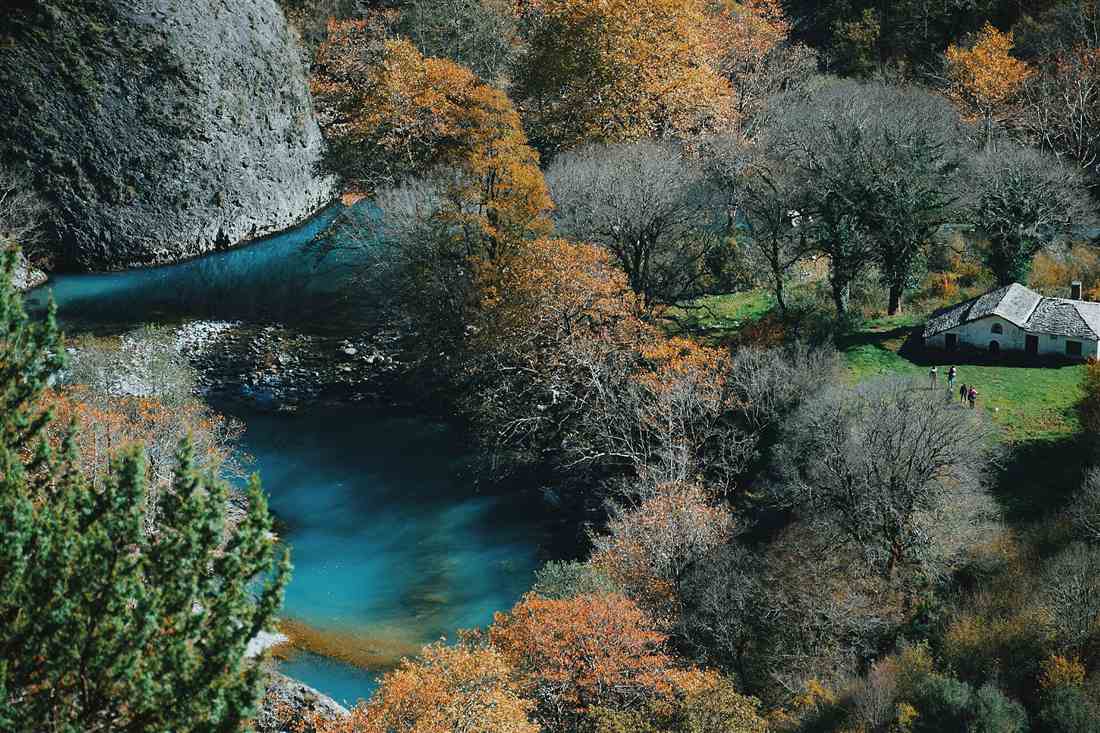
Voidomatis river rafting runs the clear cold water below the Vikos gorge, from the bridge at Aristi down to the old stone arch at Klidonia, a grade one to two float of about two hours that families with young children paddle alongside first-timers. Plan the rest of the trip with Greece Tours.
This guide sets out the whole run: the river and the karst springs that feed it, the standard route and its length, the water grade and the age and weight rules, the wetsuit and the kit, the guides and the briefing, the meeting points, the photo package, the combination day with horses and a riverside meal, the harder Arachthos alternative, the season and the prices.
What is Voidomatis river rafting and where does the river run?
Voidomatis river rafting is a guided descent in an inflatable raft down the Voidomatis, the spring-fed river of Zagori in north-west Greece. The commercial run starts at the Aristi bridge, crosses clear grade I to II water, and finishes at the old Klidonia bridge.
High water after storms closes Voidomatis river rafting rather than risking the run. The river rises at the Voidomatis springs beside Vikos village, at the northern mouth of the Vikos Gorge, and runs about fifteen kilometres north-west to join the Aoos near Konitsa. Snow and rain falling on the Timfi massif sink into limestone, travel underground for weeks, and surface at those springs already filtered. That underground route gives the channel its steady flow and its glass-clear colour.
Snowmelt raises the level for Voidomatis river rafting through the spring. Rafting occupies the lower half of that course. Above the springs the gorge floor is a boulder bed that carries water only after storms, so no boat runs it. Below Aristi the channel widens into a paddling river with gravel bars, gentle drops and long green pools, and a road reaches the water at both ends of the stretch.
The combination day pairs Voidomatis river rafting with horses and a meal by the water. Five commercial products sell this water. The easy rafting experience from Ioannina takes families down the gentle section in about three hours. A tour launching at Aristi adds photographs and video of the whole descent. A Zagori run meeting at Kleidonia covers the classic Aristi to Klidonia bridge line. A longer excursion pairs the raft with horseback riding and a traditional meal beside the river.
Meeting points for Voidomatis river rafting sit at Aristi, Papingo, Kleidonia and Ioannina. Paddlers who want bigger water than the Voidomatis delivers book the fifth product, a descent of the Arachthos at Tzoumerka, an hour south-east of Zagori. All five run on the same class of equipment, with state-licensed guides, and all five end with dry clothes, a hot drink and a shuttle back to the parked cars.
Which national park surrounds the river, and what is the Vikos Gorge?
The Voidomatis drains the Vikos Gorge inside Vikos-Aoos National Park, a protected block of limestone mountain in Epirus. The gorge runs about twelve kilometres from Monodendri to Vikos village, and its walls stand close to nine hundred metres above the dry riverbed.
The Arachthos at Tzoumerka is the harder alternative to Voidomatis river rafting. The park covers the Timfi massif, the Aoos valley and the Zagori plateau, and it forms the core of a UNESCO Global Geopark. Forty-six stone villages sit inside or on the edge of the protected zone, linked by cobbled mule paths, arched bridges and a network of marked trails that the walking maps label O3 and Z routes.
Low clear summer water gives Voidomatis river rafting its postcard colour. Vikos is measured as one of the deepest gorges on the planet in relation to its width, and that ratio explains the scenery from the raft. The paddler sits at the bottom of a landscape that drops from Astraka at two thousand four hundred and thirty-six metres to a riverbed near four hundred and thirty metres in a horizontal distance of a few kilometres.
Vikos-Aoos National Park sets the rules that Voidomatis river rafting operates under. The rafting stretch lies just outside the gorge proper, in the open valley between Aristi and Klidonia. That placement is deliberate: the gorge floor above the springs holds no permanent water, and the walls leave no exit route. The valley below carries the full spring flow, holds an access road on one bank, and stays inside the same protected landscape.
Dry bags keep phones and keys out of the water on Voidomatis river rafting. Protection status shapes the trip in practical ways. Operators hold permits, launch and land at fixed points, cap group sizes, and keep boats off the water at dusk. Fires, camping on the gravel bars and off-track driving are prohibited.
Why is the Voidomatis water so clear and so cold?
The Voidomatis is fed by karst springs at Vikos village rather than by surface run-off. Rain filters through hundreds of metres of limestone before it emerges, arriving free of silt at four to eight degrees Celsius and holding that chill through the whole rafting season.
Meeting points for Voidomatis river rafting sit at Aristi, Papingo, Kleidonia and Ioannina. Limestone acts as a slow filter. Water enters through fissures on the Timfi plateau, loses its suspended clay in the rock, and resurfaces at a temperature set by the mountain interior rather than by the air outside. The river therefore looks the same in a heatwave as it does after a storm, and the gravel on the bed reads clearly through two metres of flow.
High water after storms closes Voidomatis river rafting rather than risking the run. That clarity carries a long-standing reputation: water quality surveys have ranked the Voidomatis among the cleanest rivers in Europe, and the local water is drawn straight from the same springs.
Snowmelt raises the level for Voidomatis river rafting through the spring. Cold is the trade-off. Even in August the flow stays near ten degrees where it leaves the springs and warms only marginally along the run, so a wetsuit is standard equipment on every trip rather than an optional extra. Guides brief the group on the cold-shock reflex, and swims in the first pool are short by design.
The stone bridges of Zagori pass overhead during Voidomatis river rafting. The spring feed also explains the river’s reliability. Surface-fed rivers in Epirus drop to a trickle in high summer, while the Voidomatis holds a workable flow of about four to six cubic metres per second right through the dry months. That constancy is the reason the rafting season here stretches from early spring into late autumn.
What does the standard run from the Aristi bridge to the Klidonia bridge cover?
The classic descent covers about five kilometres between the Aristi bridge and the Klidonia bridge. Paddling time runs from ninety minutes to two hours, and the full trip, counting kit issue, briefing, shuttle and changing, takes about three hours from the meeting point.
Dry bags keep phones and keys out of the water on Voidomatis river rafting. Boats launch at the gravel bank beside the Aristi bridge, where the road from Aristi village crosses the water at the Klima chapel. The first two hundred metres are flat and shallow, which gives the guide space to drill the paddle commands with a live crew before the current takes hold. The bank here is wide enough for four rafts to rig at once.
The Arachthos at Tzoumerka is the harder alternative to Voidomatis river rafting. Below the launch the river runs through a series of easy drops divided by long pools. The channel braids around gravel islands, tightens under a limestone wall on the right, and delivers three or four wave trains that soak the front two paddlers. Between them the crew stops paddling, and the guide points out the cliffs of the gorge mouth behind the boat.
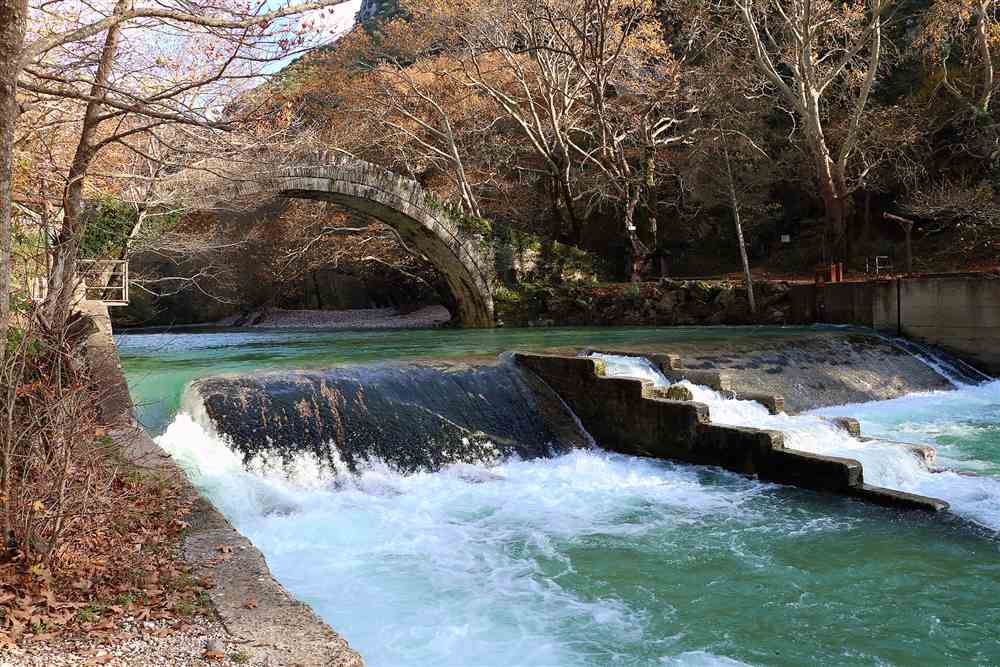
Low clear summer water gives Voidomatis river rafting its postcard colour. The last kilometre slows into a green pool under the single stone arch of the Klidonia bridge, and rafts land on the gravel beach on the left bank. A trailer and a minibus wait at the road above, boats go on the trailer, and paddlers ride the ten minutes back to Aristi or Kleidonia in their wetsuits.
Booking Voidomatis river rafting ahead secures the morning slot in the busy weeks. Operators adjust the line rather than the length across the season. In high water the crew reads a faster, deeper channel with fewer stops; in low summer flow the guide picks routes around exposed gravel and adds two swimming stops in the deep pools. The distance stays the same, and the water stays grade I to II throughout.
What does grade I to II water mean for beginners and children?
Grade I is moving water with small waves and clear passage. Grade II is a straightforward rapid with wide channels and obvious routes. Together they define a river that a first-time paddler and a child of eight handle under instruction, without prior experience and without technical skill.
The stone bridges of Zagori pass overhead during Voidomatis river rafting. The international scale of river difficulty runs from grade I to grade VI. Grades III and above bring irregular waves, tight lines, obstacles that demand precise boat handling, and a real prospect of a swim. The Voidomatis sits below that threshold along its whole commercial stretch, which is why it carries families rather than trained crews.
Meeting points for Voidomatis river rafting sit at Aristi, Papingo, Kleidonia and Ioannina. In practice the crew paddles hard for thirty seconds at a time, then drifts. The guide steers from the stern and calls forward, back, stop and hold on. A missed stroke costs nothing on this water, and a raft that spins simply arrives at the next pool backwards, to laughter rather than alarm.
High water after storms closes Voidomatis river rafting rather than risking the run. Children respond well to that rhythm. The gentle drops read as fun rather than as threat, the pools invite a supervised swim in a buoyancy aid, and the trip stays short enough that attention holds to the finish. Operators run the easy family version with a lighter crew and an extra guide in the boat.
A Vikos Gorge hike pairs naturally with Voidomatis river rafting on the same trip. Confident paddlers who want committing water in the same region book the Arachthos at Tzoumerka instead, where spring flow builds grade III and grade IV rapids. That river demands swimming ability, a higher age floor and a stronger crew, and the difference between the two runs is the clearest choice a visitor to Epirus makes.
What are the minimum age, weight and swimming requirements?
Operators set the age floor at eight for the easy family descent, ten to twelve for the standard Zagori run, and twelve upward for the Arachthos. Paddlers between roughly thirty and one hundred and twenty kilograms fit the wetsuits and buoyancy aids carried in the vans.
Booking Voidomatis river rafting ahead secures the morning slot in the busy weeks. Swimming ability is not demanded on the Voidomatis. The buoyancy aid holds a person face-up in moving water, the guide teaches the defensive swimming position before launch, and the safety kayak or the throw bag recovers anyone who leaves the boat. Non-swimmers state that fact at booking so the guide places them mid-raft.
Dry bags keep phones and keys out of the water on Voidomatis river rafting. The Arachthos reverses that rule. Bigger water, longer rapids and a genuine swim risk make comfortable swimming a condition of joining, and operators refuse a place to anyone who cannot self-rescue in current. The booking form asks the question directly, and the guide repeats it at the river.
The Arachthos at Tzoumerka is the harder alternative to Voidomatis river rafting. Weight limits exist for fit rather than for strength. A wetsuit that hangs loose floods and chills the wearer, and a buoyancy aid that cannot be cinched down rides up over the ears in the water. Operators stock child sizes from about twenty-five kilograms upward, and adult sizes to the top of the stated band.
The price of Voidomatis river rafting is set by the format and the photo package. Health declarations cover the rest. Pregnancy, recent surgery, back and neck injury, epilepsy, heart conditions and alcohol within the previous hours all rule a person out of the boat. Under-eighteens paddle with a parent or a guardian present, and the guardian signs the waiver at the meeting point rather than online.
What equipment does the operator supply for the river?
Every booking includes a full-length neoprene wetsuit, a neoprene or fleece jacket, river booties, a certified helmet, a buoyancy aid and a paddle. Paddlers arrive with swimwear, a towel and a dry change of clothes, and carry nothing else into the raft.
A Vikos Gorge hike pairs naturally with Voidomatis river rafting on the same trip. The wetsuit is the core item on a river this cold. Operators issue five-millimetre long-john suits that cover the torso and legs, worn over swimwear, with a separate jacket or splash top on top. Bare skin under a suit chafes on a long run, so a swimsuit or thin technical shorts sit underneath.
The stone bridges of Zagori pass overhead during Voidomatis river rafting. Footwear is issued as neoprene booties or supplied by the paddler as trainers that stay on the foot in water. Flip-flops and slides are refused at the van, because a lost shoe on a gravel bank ends the walk back barefoot. Sandals with a fixed heel strap pass the check.
Grade one to two water makes Voidomatis river rafting the gentlest paddle in Greece. The helmet and the buoyancy aid are the two safety items the guide adjusts personally. The helmet sits level and holds a finger’s width above the eyebrows; the aid closes at the waist and at the shoulders so that a lift on the shoulder straps does not raise it off the body.
Voidomatis river rafting starts at the bridge below Aristi in the heart of Zagori. Paddles come in adult and junior lengths and stay with the same crew member all day. Operators also carry spare paddles, a throw bag on every boat, a first-aid kit, a repair kit and a dry barrel for the group’s valuables.
Who guides the descent, and what does the safety briefing cover?
Greek regulation requires river guides to hold a recognised rafting qualification and current first-aid certification, and operators to carry insurance for every client. The briefing before launch covers paddle commands, the position for a swim, re-boarding a raft, and rescue with a throw bag.
The price of Voidomatis river rafting is set by the format and the photo package. Guides on the Voidomatis work the same river through the whole season and read its levels from memory. Most are from Zagori, Konitsa or Ioannina, work in English and Greek, and carry the local knowledge that turns a paddle into a commentary on the gorge, the bridges and the trout under the boat.
Booking Voidomatis river rafting ahead secures the morning slot in the busy weeks. The briefing follows a fixed order. It starts with the boat: where each paddler sits, how the foot cone locks the feet, how the hands hold the T-grip and the shaft. It moves to the commands, which are drilled on flat water. It closes with the two swim drills that matter most.
Karst springs under the Vikos gorge feed the water that Voidomatis river rafting crosses. Those drills are simple and precise. A paddler in the water floats on the back with the feet up and pointing downstream, so that the legs absorb any impact. A paddler within reach of the raft is pulled in by the shoulder straps of the buoyancy aid, face down, in one movement.
The standard Voidomatis river rafting run ends at the old stone arch of Klidonia. Group sizes stay small. A guide handles one raft, and larger bookings run two or three boats in convoy with a lead and a sweep, keeping every crew within sight of another. On busier weekends a safety kayaker travels with the group, sitting downstream of the drops where a swimmer floats out.
What is the raft itself, and what is its capacity?
Operators run self-bailing inflatable rafts of about four metres, built in reinforced PVC or Hypalon with four independent air chambers. The standard boat holds six paddlers and a guide; family versions run lighter crews of four adults with children seated between them.
Voidomatis river rafting starts at the bridge below Aristi in the heart of Zagori. Self-bailing means the floor is a separate inflated deck laced above the tubes, with holes at the seam. Water that comes over the bow drains out within seconds instead of pooling at the paddlers’ feet, which keeps the boat light, responsive and warm on a river fed by four-degree springs.
A Vikos Gorge hike pairs naturally with Voidomatis river rafting on the same trip. Independent chambers give the raft its safety margin. A puncture in one tube leaves the other three inflated, and the boat still floats level with a full crew aboard. Operators check pressure at the van, top the tubes up at the launch, and inspect the floor lacing before each descent.
The cold is the first thing paddlers notice on Voidomatis river rafting. Crew position matters more than crew strength. The two heaviest paddlers sit at the front to punch the waves, lighter paddlers and children sit in the middle, and the guide takes the stern with a longer paddle for steering. Everyone wedges a foot into the moulded cone and keeps one hand on the T-grip.
Grade one to two water makes Voidomatis river rafting the gentlest paddle in Greece. Grab lines run the full perimeter of the tubes, and a swimmer holds them until the guide reaches down. The bow carries a short line for the shuttle, and a dry barrel clipped inside the boat holds car keys and phones. Nothing loose travels in the raft, since loose objects go into the river.
Where are the meeting points, and how does the transfer to the river work?
Groups meet at Aristi, Papingo, Kleidonia or in Ioannina. Aristi and Kleidonia sit within ten minutes of the water. From Ioannina the drive north through the Zagori villages covers about sixty-five kilometres and takes an hour, and the operator provides the minibus.
The standard Voidomatis river rafting run ends at the old stone arch of Klidonia. Aristi is the natural base. The village stands above the bridge that gives the launch its name, holds hotels and tavernas, and puts the meeting point a five-minute drive from the gravel bank. Kleidonia, at the other end of the run, sits by the take-out and suits paddlers who leave a car at the finish.
The price of Voidomatis river rafting is set by the format and the photo package. Papingo pickups serve walkers staying under Astraka for the Dragon Lake ascent, and add about twenty-five minutes of mountain road each way. Ioannina pickups suit visitors without a car; the minibus collects from a central point, runs the group to the river, waits through the descent and returns in the afternoon.
A full wetsuit, boots and a buoyancy aid come with every Voidomatis river rafting booking. Visitors flying in land at Ioannina National Airport, ten minutes from the city centre, and the simplest connection is a booked Ioannina airport transfer to your Zagori hotel, which reaches Aristi in about an hour. Car hire desks at the airport cover the same route on the E951 and the Zagori road.
Karst springs under the Vikos gorge feed the water that Voidomatis river rafting crosses. Drivers arriving from the east cross the Egnatia Odos motorway; the run from Thessaloniki and its northern Greece day trips to Ioannina takes about three and a half hours, with a further hour to the river. The shuttle at the end of the descent is included in every product and carries paddlers and boats back to the start.
What does the photo and video package include?
The photo tour from Aristi puts a dedicated shooter on the run. Images come from the bank at the main drops and from a camera mounted on the guide’s helmet or chest, and the edited set of stills and video clips arrives by download link after the trip.
Grade one to two water makes Voidomatis river rafting the gentlest paddle in Greece. Coverage starts at the van. The photographer records the kit issue and the briefing, moves ahead to the first rapid on foot, and shoots the crew head-on as the raft drops in. A second position downstream catches the wave train, and the swimming stop in the emerald pool supplies the calm frames.
Voidomatis river rafting starts at the bridge below Aristi in the heart of Zagori. Delivery is digital. Operators upload the gallery the same evening or the following morning, send a link by email or messaging app, and leave the files available for download at full resolution for a fixed period. The package covers the whole boat rather than one paddler, so a family receives one shared set.
Guides run the safety briefing before Voidomatis river rafting leaves the bank. Drone coverage is restricted. The valley sits inside a national park where flight over the river and the wildlife needs specific permission, so operators build the package around ground positions and mounted action cameras instead. That constraint keeps the shoot legal and keeps the noise off a river valued for its quiet.
The cold is the first thing paddlers notice on Voidomatis river rafting. Paddlers who book a run without the package still bring their own camera, on one condition: it is tethered. A phone in a floating waterproof pouch on a wrist leash survives the day; a phone in a pocket does not. The dry barrel in the raft carries anything that stays switched off.
What happens on the combination day with horseback riding and a riverside meal?
The Voidomatis excursion joins three elements in one outing: the rafting descent, a guided horseback ride on the riverside tracks, and a traditional meal at a farm beside the water. The day runs about five to six hours and suits families and mixed-ability groups.
Karst springs under the Vikos gorge feed the water that Voidomatis river rafting crosses. The raft goes first, while the water is quiet and the light is low over the gorge mouth. The crew paddles the standard line to the Klidonia bridge, lands on the gravel beach, changes out of wetsuits at the vans, and moves on to the stables in dry clothes with an appetite already built.
The standard Voidomatis river rafting run ends at the old stone arch of Klidonia. Riding is gentle and led. Horses walk the flat tracks along the riverbank and through the plane trees, with a handler at the head for beginners and children, over about an hour. Riders receive a helmet, a mounting block and a short lesson on rein and seat before the group sets off.
Children from the age of six join Voidomatis river rafting beside a parent. The meal closes the day at a riverside farm kitchen. Plates cover the Epirot repertoire: hand-rolled pites, feta and local graviera, grilled meat or trout, seasonal greens, bread from a wood oven, and a glass of tsipouro or wine from the region. Vegetarian versions are arranged at booking rather than at the table.
A full wetsuit, boots and a buoyancy aid come with every Voidomatis river rafting booking. The combination sells because it fills a day without a second drive. Groups with a non-paddler in them split the elements as needed, with a walker taking the riverside track while the boat runs, and the whole party reuniting at the table. Operators run the excursion for private groups on request throughout the season.
How does the Arachthos at Tzoumerka differ from the Voidomatis?
The Arachthos is the harder river of the pair. Its upper section below the Plaka bridge in Tzoumerka runs grade III to IV in spring meltwater and grade II to III in summer, over a course of about twelve kilometres and two to three hours of paddling.
The cold is the first thing paddlers notice on Voidomatis river rafting. Scale is the first difference. The Arachthos drains a large mountain catchment in the Tzoumerka range and carries far more volume than the spring-fed Voidomatis, which turns its rapids into sustained sequences rather than isolated drops. Waves stand higher, holes form behind boulders, and the crew paddles through the feature instead of drifting into it.
Grade one to two water makes Voidomatis river rafting the gentlest paddle in Greece. The second difference is temperature and character. Arachthos water is surface-fed, warmer than the Voidomatis and darker in colour after rain. The valley is broader, the cliffs stand further back, and the landmark is the great single stone arch of the Plaka bridge, rebuilt after a flood swept it away.
The raft on Voidomatis river rafting carries six paddlers and one guide. Requirements rise with the grade. Operators set the age floor at twelve or higher on the harder section, ask for swimming ability, run a safety kayak alongside, and refuse the descent to anyone in poor physical condition. The briefing is longer, and the crew practises the commands until the responses are automatic.
Guides run the safety briefing before Voidomatis river rafting leaves the bank. Access suits travellers on a circuit. Tzoumerka lies an hour and a half south-east of the Voidomatis put-in, and drivers heading on to the monasteries of Meteora and its clifftop monasteries pass within reach of the Arachthos valley. Paddlers with two days in Epirus run the gentle river first and the demanding one second.
When does the rafting season open, and when does the river close?
Commercial descents on the Voidomatis run from March to the end of October, and warm autumns extend the calendar into November. Spring snowmelt brings the highest flow, midsummer delivers low clear water, and winter closes the operation on temperature rather than on level.
A full wetsuit, boots and a buoyancy aid come with every Voidomatis river rafting booking. Spring is the strongest water of the year. Snow from Timfi and Smolikas feeds the springs and the side streams, the river runs fast and full, and the descent shortens to ninety minutes of continuous movement. Wetsuits earn their keep, and the valley is green with the first growth under the cliffs.
Karst springs under the Vikos gorge feed the water that Voidomatis river rafting crosses. Summer is the family season. Flow settles, the pools clear to their maximum visibility, air temperatures climb into the thirties, and the contrast between hot sun and ten-degree water becomes the whole appeal of the trip. This is the period when swimming stops are added and the descent stretches to two relaxed hours.
Photo and video packages record Voidomatis river rafting from the bank and the boat. Autumn returns the drama. The plane trees along the banks turn yellow and rust, the first rains lift the level again, and the crowds of August disappear from Aristi and Papingo. Guides rate the light in October as the finest of the year for photography from the raft.
Children from the age of six join Voidomatis river rafting beside a parent. Winter shuts the commercial run. The water holds its spring temperature, but air temperatures in the valley fall below freezing, roads to the launch ice over, and daylight shortens beyond a comfortable schedule. Operators use those months for boat repair and for guide training, and reopen when the road clears in March.
What water level cancels a run on the Voidomatis?
Heavy rain over Timfi lifts the river beyond its safe working range within hours, and operators cancel when the level reaches the marks they read at the Aristi bridge. Storms, lightning, floating timber and a brown, silt-heavy flow are the four standard grounds for calling a day off.
Guides run the safety briefing before Voidomatis river rafting leaves the bank. The Voidomatis rises quickly and drops quickly. The springs hold a steady base flow, but the side torrents that enter below Aristi respond to a mountain storm within an hour, pushing the level up by a metre and turning the clear water opaque. Once the rain stops, the river clears again inside a day.
The cold is the first thing paddlers notice on Voidomatis river rafting. Guides judge levels against fixed reference points rather than against a published gauge. The height of the water on the bridge piers, the state of the gravel bank at the launch, and the visibility of the bed in the first pool between them give a reliable reading that the head guide takes each morning.
The combination day pairs Voidomatis river rafting with horses and a meal by the water. Floating debris is the specific danger of a spate. Branches and whole trunks travel with the current after a flood, and a strainer across the channel is the one obstacle that a grade II river turns lethal. Operators clear the line on foot after a big rise, and postpone the run until they have.
The raft on Voidomatis river rafting carries six paddlers and one guide. Cancellations are handled by rescheduling or by refund. Booking platforms return the fare for a weather cancellation made by the operator, and local companies offer a slot on the following day where the visitor’s schedule allows. Bookings made a day ahead in unsettled weather carry the operator’s phone number for a morning check.
What do paddlers wear, and what stays behind in a dry bag?
Paddlers arrive in swimwear under light clothing and bring a towel, a full change of dry clothes and secure footwear. Phones, wallets, car keys and cameras travel in the operator’s dry barrel or stay locked in the vehicle at the meeting point.
Children from the age of six join Voidomatis river rafting beside a parent. Cotton has no place on this trip. A cotton t-shirt under a wetsuit holds cold water against the skin for the entire descent, while a thin technical layer or a rash vest dries in minutes. Swimwear goes on at the hotel so that changing at the river takes one minute behind the van.
A full wetsuit, boots and a buoyancy aid come with every Voidomatis river rafting booking. Glasses and sunglasses need a retaining strap, and contact lenses beat glasses on a wave train. Hats sit under helmets on cold days as a thin beanie rather than as a cap with a brim. Jewellery, watches and anything on a loose chain go into the barrel before the boat leaves the bank.
Vikos-Aoos National Park sets the rules that Voidomatis river rafting operates under. Sun protection is the item people forget on cold water. Reflected light off a clear river burns faces and the backs of hands within an hour, so waterproof sunscreen goes on before the wetsuit and again at the swimming stop. A long-sleeved rash vest solves the same problem for children.
Photo and video packages record Voidomatis river rafting from the bank and the boat. After the take-out the priority is dry warmth. A towel, a dry base layer, trousers and a fleece in the vehicle turn the shuttle ride into a comfortable one, and a bottle of water and a snack close the gap until lunch.
Which stone bridges of Zagori appear from the water?
The descent finishes under the single stone arch of the Klidonia bridge, the landmark of the run and the take-out marker. The launch sits at the Aristi bridge, and the wider Zagori region holds the Kokkorou, Kalogeriko, Misios and Noutsos arches within a short drive.
The raft on Voidomatis river rafting carries six paddlers and one guide. The Klidonia arch is the photograph everyone takes. Built by muleteer money and local masons to carry the path between the Zagori villages and Konitsa, it springs from bedrock on both banks in one clean curve, and rafts drift under it in the last slow pool of the run.
Guides run the safety briefing before Voidomatis river rafting leaves the bank. These bridges are the signature of Zagori. Stone-arched, mortared with lime and egg, and paved with slabs cut from the same hillsides, they replaced fords on the mule routes that carried goods between the villages, the Aoos valley and the trading towns of the north. Craft guilds from the region built them under commission.
Snowmelt raises the level for Voidomatis river rafting through the spring. The most photographed of the group stands away from the raft route. Kalogeriko, also called Plakidas, carries three linked arches across the Bagiotiko stream near Kipoi, and the Kokkorou bridge one valley away frames a deep pool in a single high span. Both are reachable by car and a short marked footpath.
The combination day pairs Voidomatis river rafting with horses and a meal by the water. Paddlers with time build a bridge circuit around the descent. A morning on the water and an afternoon on the Kipoi bridges, ending in the cobbled square of Dilofo or Koukouli, fills a day inside a ten-kilometre radius.
What wildlife lives along the banks, and what rules does the park set?
Brown trout hold in the pools, dippers and kingfishers work the shallows, and otters hunt the banks at dawn and dusk. The uplands above the river carry brown bear, roe deer, wild boar, Balkan chamois and griffon and Egyptian vultures inside a strictly protected zone.
Photo and video packages record Voidomatis river rafting from the bank and the boat. Trout are the animal every crew sees. The native Salmo of the Voidomatis holds station in the current under the cliffs, visible through water that carries no silt, and the fish scatter under the raft and re-form behind it. Angling on the river is regulated, and the rafting operators carry no rods.
Children from the age of six join Voidomatis river rafting beside a parent. Birds along the banks reward a quiet boat. The white-breasted dipper walks underwater on the gravel, the kingfisher crosses the channel as a blue line, and grey herons stand at the tail of the pools. Vultures circle the cliffs above the gorge, and the park runs feeding stations that support the Egyptian vulture population.
Low clear summer water gives Voidomatis river rafting its postcard colour. Larger mammals keep to the forest and the high plateau. Brown bears range across Timfi and the Aoos valley, chamois hold the rock above Astraka, and wolves work the ridges. Sightings from a raft are rare; tracks on the gravel bars beside the launch are not, and guides read them for the group.
Vikos-Aoos National Park sets the rules that Voidomatis river rafting operates under. Park rules bind every visitor. Litter leaves with the party, fires are prohibited, camping on the riverbanks is banned, dogs stay leashed, and vehicles keep to marked roads and parking areas. Drone flight needs authorisation, and swimming and paddling stay within the stretches the management authority designates for those uses.
How does a raft descent combine with the Vikos Gorge hike or the Dragon Lake trek?
The rafting run takes a morning, which leaves the afternoon for a short trail and a full second day for a long one. The Vikos Gorge crossing from Monodendri to Vikos village covers about twelve kilometres; the Dragon Lake ascent from Mikro Papingo gains nine hundred metres.
The combination day pairs Voidomatis river rafting with horses and a meal by the water. The gorge walk is the region’s classic. It drops from the Monodendri steps to the dry riverbed, follows the boulder floor under nine-hundred-metre walls for five to six hours, and climbs out at the Voidomatis springs below Vikos village, the exact point where the water the raft uses first sees daylight.
The raft on Voidomatis river rafting carries six paddlers and one guide. Drakolimni sits on the Timfi plateau above Mikro Papingo. The path climbs to the Astraka refuge in three hours, traverses to the lake in forty minutes more, and returns the same way, with alpine newts in the shallow water and the Aoos valley opening to the north. Walkers start at first light.
High water after storms closes Voidomatis river rafting rather than risking the run. Sequencing matters. Rafting in the morning and walking the Kipoi bridges or the Vikos viewpoint at Oxya in the afternoon fits one day without strain. A gorge crossing or a lake ascent takes the whole of a separate day, so a three-night base in Aristi, Papingo or Monodendri covers the set comfortably.
Snowmelt raises the level for Voidomatis river rafting through the spring. Visitors without a car assemble the same programme through the city. Operators running guided day tours from Ioannina pair the river with Zagori villages, the Perama caves and the island in Lake Pamvotida, and their minibuses reach the trailheads that public buses to the mountain villages serve on a thin timetable.
What price ranges in euros apply to the easy run, the photo tour and the combination day?
Published fares in the region place the easy family descent at about forty to fifty-five euros per person, the photo and video tour at about forty-five to seventy euros, the Zagori classic at about forty to sixty, and the combination day at about seventy-five to one hundred and ten.
Vikos-Aoos National Park sets the rules that Voidomatis river rafting operates under. The Arachthos at Tzoumerka sits in a band of about forty-five to seventy-five euros per person, reflecting the longer descent, the safety kayak and the extra guide ratio the harder water demands. Rates across the region move with season and with group size rather than with the day of the week.
Photo and video packages record Voidomatis river rafting from the bank and the boat. What the fare includes is consistent. Every quoted price covers the guide, the raft, the wetsuit, jacket, helmet, buoyancy aid, paddle, booties, the insurance and the shuttle back to the start. The photo product adds the shooter and the gallery. The excursion adds the horses, the handler and the meal at the farm.
The Arachthos at Tzoumerka is the harder alternative to Voidomatis river rafting. Extras sit outside the fare. Transfers from Ioannina add a per-person charge on trips that meet at the river, private group bookings carry a minimum-numbers fee, and a photo gallery bought after a standard descent is priced separately. Children pay reduced rates on the family run at most operators.
Low clear summer water gives Voidomatis river rafting its postcard colour. Booking practice is straightforward. Places are reserved online with the balance settled at the meeting point, cards and cash both work at the base, and free cancellation up to twenty-four hours ahead is standard on the platforms. Weekend slots in July and August fill a week in advance, so early reservation secures the preferred hour.
Frequently Asked Questions
Is Voidomatis river rafting suitable for beginners?
Yes. The Aristi to Klidonia run is graded one to two, the gentlest water in Greece that still moves. Children from the age of six paddle it with a parent, and no prior experience is asked for.
How cold is the water on the Voidomatis?
Between four and twelve degrees all year, because the river rises from karst springs under the Vikos gorge rather than from surface run-off. The operator supplies a full wetsuit, boots and a jacket for every paddler.
What does Voidomatis river rafting cost?
The standard run costs from about 45 to 70 euros per person. The version with a photo and video package runs from about 60 to 85 euros, and the full day with horse riding and a riverside meal from about 95 euros.