
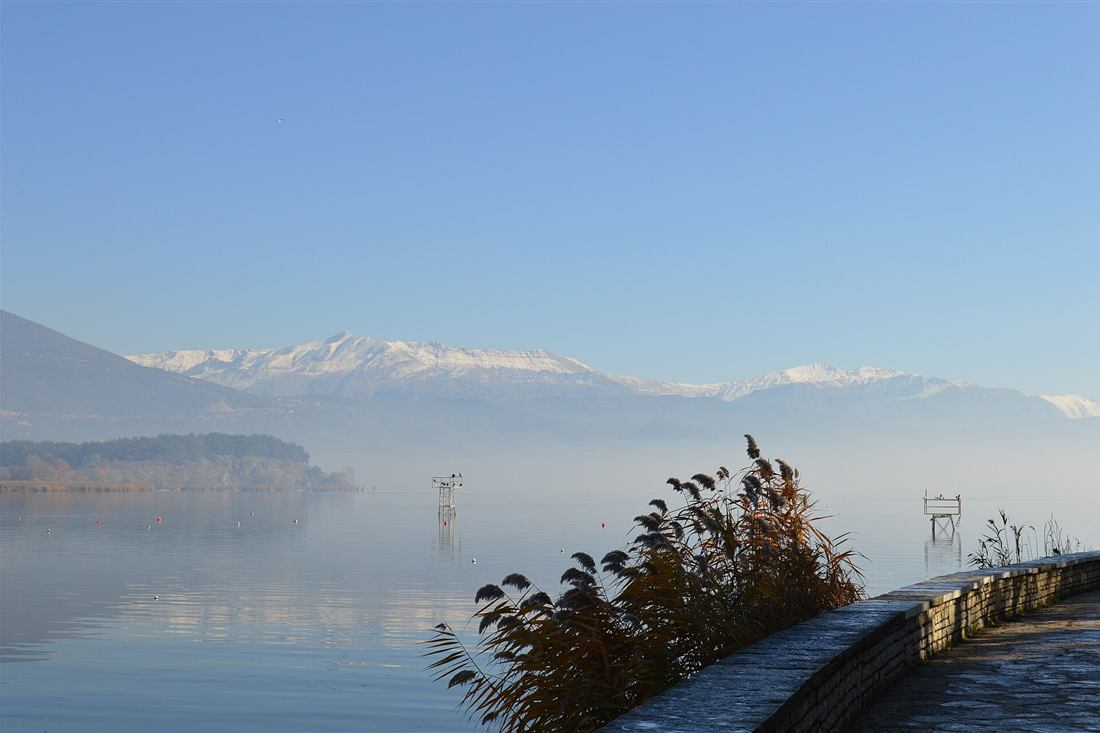
Ioannina tours run from the walled city on Lake Pamvotida: a day inside the castle and the Its Kale citadel, the ten-minute boat to the lake island and its monasteries, the oracle and theatre at Dodoni, and the mountain roads into Tzoumerka and Zagori. Plan the rest of the trip with Greece Tours.
This guide covers each of them: the castle and the tomb of Ali Pasha, the island and the room where he was shot, the silversmithing the city is built on, the scale of the theatre at Dodoni, the Perama cave, the Tzoumerka stone bridges, the Meteora day, the tour lengths and group sizes, the prices, the season and how to reach the city.
What tours run from Ioannina, and what kind of city is it?
Ioannina tours divide into five products: a one-day city sightseeing route, a lake-island lifestyle day, the Dodoni oracle and museum trip, a private walking tour with a local guide, and the Tzoumerka Grand Tour into the eastern mountains.
Metsovo and its cheese sit on the mountain road that the longer Ioannina tours take. Ioannina stands on the eastern shore of lake Pamvotida at 480 metres, the capital of Epirus and the largest city in north-west Greece. Byzantine walls ring the old quarter and two Ottoman minarets rise above the waterfront.
The airport and the Egnatia motorway put Ioannina tours within reach of Thessaloniki. Each tour starts inside the walls or at a hotel pick-up point, and the longest returns before dark. Arriving travellers reach the old town in fifteen minutes with Ioannina airport transfers from the terminal five kilometres north.
The oracle and theatre at Dodoni draw Ioannina tours south-west of the city. The five products cover three landscapes: the walled lakeside city, the archaeological plain to the south-west, and the limestone mountains to the east. One product from each band fills three days without repetition.
What is inside the walled castle of Ioannina?
The castle of Ioannina is a living walled quarter of roughly 200,000 square metres, ringed by Byzantine and Ottoman ramparts. Inside stand lanes of stone houses, two mosques, a synagogue, the Its Kale inner citadel and the municipal ethnographic museum.
The old bazaar and its workshops close the walking leg of Ioannina tours. The walls rest on Byzantine foundations laid under Michael I Komnenos Doukas and carry the rebuilding ordered by Ali Pasha, who thickened the ramparts and cut the two surviving gates.
Families take Ioannina tours for the boat ride and the castle walls. The Aslan Pasha mosque occupies the northern bastion and houses the Municipal Ethnographic Museum, whose rooms hold embroidered costumes, silver weapons, prayer books and household objects from the three communities that shared these lanes.
The Perama cave sits a short drive north on the route of Ioannina tours. Families still live behind the gates, which keeps the quarter working rather than fenced. The Kahal Kadosh Yashan synagogue, one of the oldest of its kind in Greece, stands near the eastern wall. A full circuit of the ramparts takes thirty minutes.
What stands on Its Kale, and where is Ali Pasha buried?
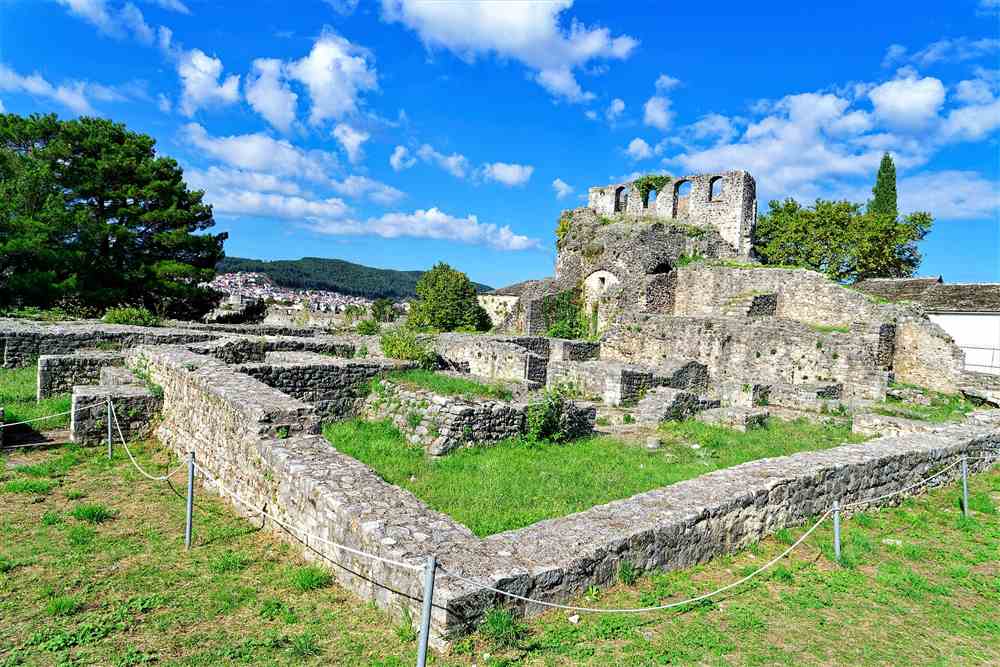
Its Kale is the inner citadel on the south-eastern bastion. It holds the Fethiye Mosque, the Byzantine Museum, the treasury building with the silversmithing collection, the foundations of Ali Pasha’s palace, and the railed tomb of Ali Pasha beside the mosque wall.
Ioannina tours begin inside the walled city on the shore of Lake Pamvotida. Ali Pasha governed Epirus from this bastion as a near-independent ruler, negotiating with the Sultan, Napoleon’s envoys and the British. His palace platform survives as a terrace facing the full width of the lake.
Cobbled lanes shape what Ioannina tours ask of walking shoes. The Byzantine Museum stands on the same terrace and displays icons, manuscripts, coins and carved stonework from churches across Epirus, running from early Christian Epirus through the Despotate to the Ottoman centuries.
Tzoumerka and its stone bridges make the mountain day among Ioannina tours. The tomb sits under an iron grille a few metres from the Fethiye Mosque door. Soldiers killed Ali Pasha on the lake island and buried his body here; his head travelled to Constantinople. Guides close his story at that grille.
North of the city the Zagori gorges add a wet adventure: Zagori canyoning descends the Nefeli gorge at Papigo with a guide, rappelling small waterfalls and swimming through clear limestone pools.
What does the Ioannina Top Sites in 1 Day tour cover?
Ioannina’s Top Sites in 1 Day walks the castle ramparts, the Its Kale citadel, the Aslan Pasha mosque and the silversmithing museum on one guided route, then adds the bazaar streets outside the gates. The circuit runs four to five hours.
The castle and the Its Kale citadel anchor the city day on Ioannina tours. The route opens at the main gate and climbs to the northern bastion first, so the lake view arrives while morning light sits low on the water. The guide works through Byzantine, Ottoman and Greek layers building by building.
The lake reflects Mitsikeli on the still mornings that open Ioannina tours. Entrance to the ethnographic museum, the Byzantine Museum and the silver collection forms part of the day, and the guide holds the group inside long enough to read the key cases. The pace suits a first day in the city.
Zagori and the Vikos gorge lie within reach of Ioannina tours by road. The circuit closes in the old bazaar outside the eastern gate, where coppersmiths, silver workshops and grill houses share three narrow streets, so the tour ends where the lunch is.
What does the boat crossing to the island of lake Pamvotida reveal?
The Day Tour of Ioannina Lake Island lifestyle starts with the ferry from Mavili square, which sails on the half hour and crosses in ten minutes. The island carries one village of about two hundred residents, seven monastic foundations, and footpaths in place of roads.
The Fethiye mosque and the tomb of Ali Pasha stand at the top of Ioannina tours. Lake Pamvotida is shallow, reaching eight metres at its deepest point, and karst springs under the western mountain feed it. Reeds fringe the shoreline, and the crossing passes punts working nets for eel and crayfish.
Booking Ioannina tours ahead secures the guide through the summer weeks. No cars exist on the island. The village runs on stepped lanes between whitewashed houses, every delivery arrives by boat at the quay, and its residents descend from families who settled the shore under Ottoman rule.
Meteora is a full-day run from the city for Ioannina tours that head east. The tavernas along the quay cook what the lake gives: trout, eel grilled over charcoal, crayfish and frogs’ legs, with mountain greens from the far shore. The tour builds a meal into the day.
Which monasteries stand on the island, and where was Ali Pasha killed?
The island holds the monasteries of Agios Panteleimon, Filanthropinon, Stratigopoulou, Eleousa and Prodromou, all reached on foot within twenty minutes. Agios Panteleimon houses the Ali Pasha Museum, set in the cell where soldiers shot the pasha through the floorboards from beneath.
A ten-minute boat crossing puts Ioannina tours on the island in the lake. Filanthropinon carries the strongest frescoes on the island. Its narthex wall shows a row of ancient Greek philosophers painted alongside the saints, a rare survival of how post-Byzantine painters handled the classical past.
The price of Ioannina tours is set by the hours and the group size. The Ali Pasha Museum fills three rooms with weapons, long pipes, seals, engravings and portraits of the pasha and of Kyra Frosini, whose drowning in the lake sits at the centre of the local song tradition.
A local guide gives Ioannina tours the lanes and the stories behind the walls. Entry to the island museum runs in the three-to-five-euro band, and the monastery churches ask a donation rather than a ticket. Shoulders and knees stay covered inside the churches, a rule the guides state at the quay.
Why is Ioannina the silver city, and what fills the silversmithing museum?
Ioannina has worked silver since the Ottoman centuries, when its guilds supplied the western Balkans. The Silversmithing Museum inside the Its Kale treasury lays the craft out across two floors, showing filigree, niello and repoussé work beside the benches and hammers of the workshops.
The monasteries and the Ali Pasha museum fill the island leg of Ioannina tours. The upper floor explains technique through worked stages: wire drawn thin for filigree, black niello alloy burned into engraved lines, sheet raised from behind for repoussé. The lower floor shows finished jewellery, buckles, icon covers and cased pistols.
Metsovo and its cheese sit on the mountain road that the longer Ioannina tours take. The craft moved between the city and the mountain village of Kalarrytes, whose silversmiths carried the trade into Italy. That link puts the museum and the Tzoumerka mountain day on one thread.
Group sizes on Ioannina tours stay small, and private formats run on request. Workshops still cut and solder silver in the bazaar streets below the citadel. Small hand-made pieces run in the twenty-to-eighty-euro band, with commissioned filigree priced above that.
What does the Oracle of Dodoni and Archaeological Museum Tour show?
The Oracle of Dodoni and Archaeological Museum Tour drives twenty-two kilometres south-west to the oldest oracle in Greece, where priests read answers in the rustling leaves of a sacred oak. The half-day route pairs the sanctuary with the archaeological museum in Ioannina.
Silversmithing is the craft that Ioannina tours trace through the old bazaar. Zeus and Dione shared the sanctuary, and pilgrims scratched their questions onto thin lead tablets: questions about marriage, flocks, voyages and inheritance. Hundreds of those tablets survive in the museum cases in the city.
The old bazaar and its workshops close the walking leg of Ioannina tours. The theatre dominates the valley. Built under King Pyrrhus of Epirus and rebuilt in the Roman period, it seats close to seventeen thousand spectators in a bowl cut into the hillside, ranking among the largest in the Greek world.
Spring and autumn suit Ioannina tours best, between the winter cold and the summer heat. Around the theatre lie the stadium, the bouleuterion and the acropolis wall. The valley stays quiet, with sheep bells carrying across the zone, which makes Dodoni the calmest site near the city.
What waits inside the Perama cave north of the city?
Perama cave lies four kilometres north of Ioannina inside the hill of Goritsa. Lit walkways run 1,100 metres through nineteen chambers of stalactites, stalagmites and columns, and the guided walk underground lasts forty-five minutes at a constant seventeen degrees.
The oracle and theatre at Dodoni draw Ioannina tours south-west of the city. Residents found the cave while sheltering from wartime bombing, and speleologists mapped the passages afterwards. The route runs one way through the hill, entering low and climbing through nineteen chambers named for their formations.
Ioannina tours begin inside the walled city on the shore of Lake Pamvotida. The formations reach exceptional density here, with curtain sheets, helictites bending against gravity, and columns where stalactite and stalagmite have fused. The lighting is fixed and low throughout.
The airport and the Egnatia motorway put Ioannina tours within reach of Thessaloniki. The walk includes about 160 steps between entrance and exit, so the cave is not step-free and firm shoes matter on damp stone. Its position on the northern road pairs it with the city day.
What does the Tzoumerka Grand Tour cross?
The Tzoumerka Grand Tour climbs east into the Athamanika range, crosses the Arachthos river at the Plaka arch bridge, and stops in the stone villages of Pramanta, Syrrako and Kalarrytes. The mountain day runs eight to nine hours door to door.
The Perama cave sits a short drive north on the route of Ioannina tours. Epirus built its roads on single-arch masonry bridges, and the Plaka bridge is the largest in the Balkans, spanning forty metres in one leap of dressed stone. Craftsmen rebuilt it after a flood with the recovered blocks.
The castle and the Its Kale citadel anchor the city day on Ioannina tours. Syrrako and Kalarrytes face each other across a gorge, both built in slate on cliff shelves where vehicles stop at the village edge. Kalarrytes sent silversmiths across Europe, and its stepped alleys stand as the trade left them.
Families take Ioannina tours for the boat ride and the castle walls. The day crosses the Tzoumerka national park, taking in the Katarraktis waterfalls, the Kipina monastery built into a cliff face above the river, and high pasture where flocks move on foot.
Which day trips reach Zagori, the Vikos Gorge and Metsovo?
Zagori spreads north of Ioannina across forty-six stone villages joined by mule paths and arched bridges. The Vikos Gorge cuts through the centre of the region, and Metsovo sits east at 1,160 metres on the historic pass over the Pindus mountains.
A multi-day format that spends three days across Zagori, the Vikos Gorge and the Tzoumerka villages is covered on the 3-day Epirus tour page.
Travellers based in Thessaloniki cross the Pindus on the Egnatia Odos for the day: the Ioannina day trip from Thessaloniki page covers the road, the castle, the island, Dodona and Konitsa.
Tzoumerka and its stone bridges make the mountain day among Ioannina tours. Zagori routes take in Monodendri and the Oxia viewpoint over the gorge, the twin villages of Papingo under the Astraka towers, and the three-arched bridge at Kipi. The gorge drops 900 metres between narrow walls.
The Fethiye mosque and the tomb of Ali Pasha stand at the top of Ioannina tours. The Voidomatis river rises at the northern mouth of the gorge and runs cold and glass-clear over white gravel. Trips on the Voidomatis river cover the gentle lower section, which puts a water day inside a walking itinerary.
Cobbled lanes shape what Ioannina tours ask of walking shoes. Metsovo holds the eastern edge of the prefecture, a Vlach town of stone houses, wood-carving workshops and a cheese tradition built on smoked metsovone. The Averoff Gallery displays nineteenth-century Greek painting.
What does the Meteora day from Ioannina involve?
The Meteora day drives 150 kilometres east from Ioannina on the Egnatia motorway and through the Katara tunnel, reaching Kalambaka in two hours. Six active monasteries crown the rock pillars, and the guided route enters two or three of them.
A private 4-day tour from Athens that links Delphi and the Meteora monasteries with a sunset cruise on Lake Pamvotis is covered on the 4-day tour of Meteora and Ioannina page.
Tours that drive from Ioannina to the monasteries and back in one day, including the sunset tour and private options, are compared on the Meteora day trip from Ioannina page.
A local guide gives Ioannina tours the lanes and the stories behind the walls. The drive carries half the value. The motorway climbs past Metsovo, tunnels under the old Katara pass, and drops onto the Thessalian plain, so mountain forest turns to farmland within one hour.
A ten-minute boat crossing puts Ioannina tours on the island in the lake. At the rocks the tour works the viewpoints between monastery visits, so the pillars are read from below as well as from the terraces above. Shoulders and knees stay covered, and skirts are lent at the gates.
The lake reflects Mitsikeli on the still mornings that open Ioannina tours. Travellers building a longer northern itinerary link the rock monasteries at Meteora with the city to the north-east, where Thessaloniki day trips continue along the same Egnatia corridor.
What does a local guide add on the private walking tour of Ioannina?
Best of Ioannina: Private Walking Tour with a Local runs two to three hours for one booking party alone, at the pace that party sets. The guide opens the castle lanes, the bazaar workshops, the lakefront promenade and the food stalls in one walk.
Group sizes on Ioannina tours stay small, and private formats run on request. A private guide changes the route in real time. A party drawn to Ottoman architecture spends the extra half hour on Its Kale; a party drawn to food stops at the bougatsa counters and the grill houses behind the bazaar.
The monasteries and the Ali Pasha museum fill the island leg of Ioannina tours. Local knowledge decides which door is worth opening: which workshop still raises silver by hand, which bakery pulls trays out at eleven, which courtyard welcomes visitors. That editing separates the walk from a self-guided map.
Booking Ioannina tours ahead secures the guide through the summer weeks. The format suits families with children, who set a slower rhythm, and travellers with one free afternoon. Rain moves the route indoors to the museums, and the guide meets the party at its hotel door.
What do these tours cost, which season suits them, and who do they fit?
Ioannina tours run from two hours to a nine-hour mountain day. Shared groups cap at fifteen to twenty travellers and private tours take one party. Half-day rates sit in the forty-to-ninety-euro band per person, full days in the ninety-to-one-hundred-and-sixty-euro band.
Spring and autumn suit Ioannina tours best, between the winter cold and the summer heat. Private walking tours price per group rather than per head, landing in the 120-to-250-euro range for a party of two to six, so the per-person figure falls as the party grows. Entrance fees are stated at booking.
Silversmithing is the craft that Ioannina tours trace through the old bazaar. Season shapes the day. The plain reaches thirty-five degrees at the height of summer, so the castle walk moves to early morning; winter brings snow on the Tzoumerka roads and freezing fog over the lake. Spring and autumn hold mild air.
The price of Ioannina tours is set by the hours and the group size. The city day and the lake island suit families and casual walkers, since both stay flat apart from the citadel ramp. The mountain days ask for firm shoes. Castle lanes are cobbled and uneven, while the lakefront promenade and the island quay stay level.
What history do Ioannina tours cover before Ali Pasha?
Tradition credits the emperor Justinian with founding Ioannina in the sixth century, yet excavations have found Hellenistic walls. The city grew under the Despotate of Epirus, surrendered to the Ottomans in 1430 and joined Greece in 1913.
Wealthy families fled to Ioannina after the Crusaders sacked Constantinople in 1204. The city then became part of the Despotate of Epirus.
Ioannina surrendered to the Ottoman commander Sinan Pasha on 9 October 1430. It served as the seat of an Ottoman province until 1867.
In the eighteenth and nineteenth centuries the city was a leading centre of the modern Greek Enlightenment. The Greek army entered Ioannina in February 1913, after the battle of Bizani.
What do Konitsa and the Aoös gorge hold?
Konitsa rises like an amphitheatre on a slope of the Pindus, above the meeting of the Aoös and the Voidomatis, near the Albanian border. Ioannina tours reach it in about an hour for the single-arch stone bridge and the Aoös gorge.
A path leaves the bridge and follows the river into the gorge, under the north wall of Mount Tymfi. Rafting trips run on the Aoös below the town.
The Aoös rises near Vovousa in the Pindus. It crosses into Albania near Molyvdoskepastos, where it takes the name Vjosa.
Molyvdoskepastos keeps a Byzantine monastery above the point where the Sarantaporos joins the Aoös. Our Konitsa via ferrata page covers the climbing route above the gorge.
How do walkers cross the Vikos Gorge?
Walkers on Ioannina tours cross the Vikos Gorge from Monodendri down to the gorge bed and out to the village of Vikos or on to Papingo. The Beloi viewpoint above Vradeto looks straight down the canyon on a shorter three-hour walk.
The Guinness Book of Records lists Vikos as the deepest gorge in the world in proportion to its width. Its main part begins between Vitsa and Koukouli and ends near the village of Vikos.
From Vradeto, the stepped path of the Skala climbs the rock face in tight zigzags. It was the only way into the village until the road came.
The Vikos-Aoös National Park was founded in 1973. It is one of the last strongholds of the brown bear in Europe. Our Vikos gorge hike page covers the full crossing.
Who built the Zagori stone bridges seen on Ioannina tours?
Merchants from Zagori who had made money abroad paid for the arched stone bridges in the eighteenth and nineteenth centuries, replacing older wooden crossings. The bridges and mule paths carried all traffic until the first roads arrived in the 1950s.
From the seventeenth to the nineteenth century the Zagori villages held a self-governing status under Ottoman rule. Their wealth came from trade.
The region also became a centre of folk medicine. Its healers used the herbs of the Vikos gorge.
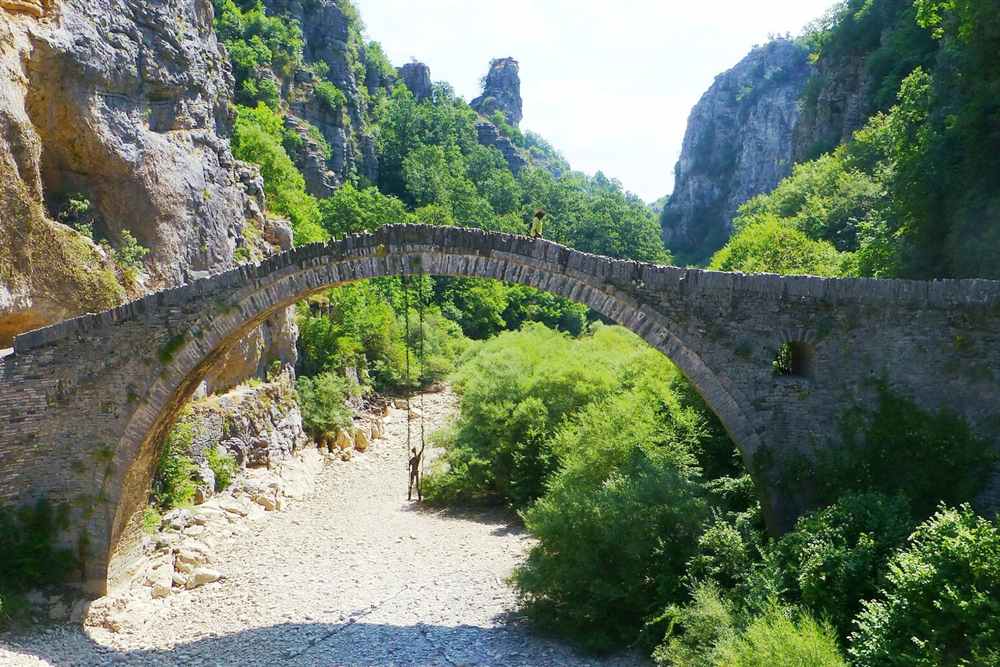
A cluster of bridges stands around Kipoi and Koukouli, a short walk apart. Our Zagori stone bridges page covers each crossing.
What waits at the Dragon Lake of Mount Tymfi?
Drakolimni, the Dragon Lake, lies at 2,050 metres on Mount Tymfi, below the peaks of Ploskos and Astraka. Walkers on Ioannina tours reach it from Mikro Papingo in about five hours, and alpine newts live in its water.
The path climbs past the saddle of the Astraka refuge. Folk tales say dragons lived in the mountain lakes. They fought each other by hurling pines and rocks, and so shaped the landscape.
Gamila, the highest peak of Tymfi, reaches 2,497 metres. Astraka rises to 2,436 metres.
A second Dragon Lake lies on Smolikas, the second highest mountain in Greece, across the Aoös to the north.
What do Ioannina tours show at Nicopolis and the Acheron?
Nicopolis is the Roman city that Octavian founded in 29 BC, 7 kilometres north of Preveza, to mark his victory over Antony and Cleopatra at Actium. The Acheron, the river of the dead in Greek myth, reaches the sea at Ammoudia near Parga.
The battle of Actium was fought at sea off this coast on 2 September 31 BC. Octavian built a monument to Apollo on the hill where his tent had stood. He set the bronze rams of captured warships into its wall.
Kassope, on a high terrace above the sea, is a city laid out on a grid in the fourth century BC. Its people moved to Nicopolis when the new city was founded. Our Nikopolis tour page covers the Roman ruins.
Greek myth made Charon ferry the dead across the Acheron. The Necromanteion, the oracle of the dead, stood on its banks near ancient Ephyra. Walks and kayak trips start near the springs of the river at Glyki.
What stands in Arta, the old capital of Pyrrhus?
Arta, the ancient Ambracia, keeps its Ottoman arched bridge over the Arachthos, a thirteenth-century castle and the Byzantine church of Panagia Paregoritissa of about 1290. Pyrrhus of Epirus made the city his capital in 294 BC.
Pyrrhus won victories over Rome at a heavy loss, and his name gave the phrase Pyrrhic victory.
After the Fourth Crusade, Michael I Komnenos Doukas made Arta the first capital of the Despotate of Epirus.
The present bridge dates from the early seventeenth century. A folk ballad tells of the master builder who walled his wife into its foundations to stop the bridge falling each night. From 1881 to 1912 the bridge marked the border between Greece and the Ottoman Empire. Our Arta tours page covers the town.
What food and wine do Ioannina tours taste beyond the lake?
Beyond the lake fish, Ioannina tours taste hand-rolled pies of wild greens, pumpkin, leek or cheese, the smoked Metsovone cheese of Metsovo, lamb and goat from the mountain flocks, tsipouro from village stills and the Debina white wine of Zitsa.
Epirus is a region of pies. Cooks roll the pastry sheets by hand and bake the pies in large round trays.
Metsovone is a semi-hard smoked cheese with a European protected designation of origin. The Tositsa Foundation dairy in Metsovo makes it.
Zitsa lies north-west of Ioannina. Its Debina grape gives a white wine, still or sparkling. Metsovo makes red wine in some of the highest vineyards of Greece.
A culinary walk through the old bazaar tastes the food of the city. Our Ioannina food tour page covers the stops.
Frequently Asked Questions
What do Ioannina tours cover in one day?
The castle walls, the Its Kale citadel with the Fethiye mosque and the tomb of Ali Pasha, the silversmithing museum, the old bazaar lanes, and the boat crossing to the island on Lake Pamvotida.
How do you reach the island on Lake Pamvotida?
By the public boat from the Molos quay below the castle. The crossing takes ten minutes and the boats run through the day, so the island fits inside a half-day tour of the city.
What do Ioannina tours cost?
A private walking tour of the city runs from about 80 to 150 euros for the group. The Dodoni tour runs from about 60 to 120 euros, and the full-day Tzoumerka or Zagori run from about 250 euros for the vehicle.
Do you tour Jewish tours of Ioannina? We will be there on October 15th.
Thank you so much.
Susan Cantos
Of course we accept, you are welcome.