
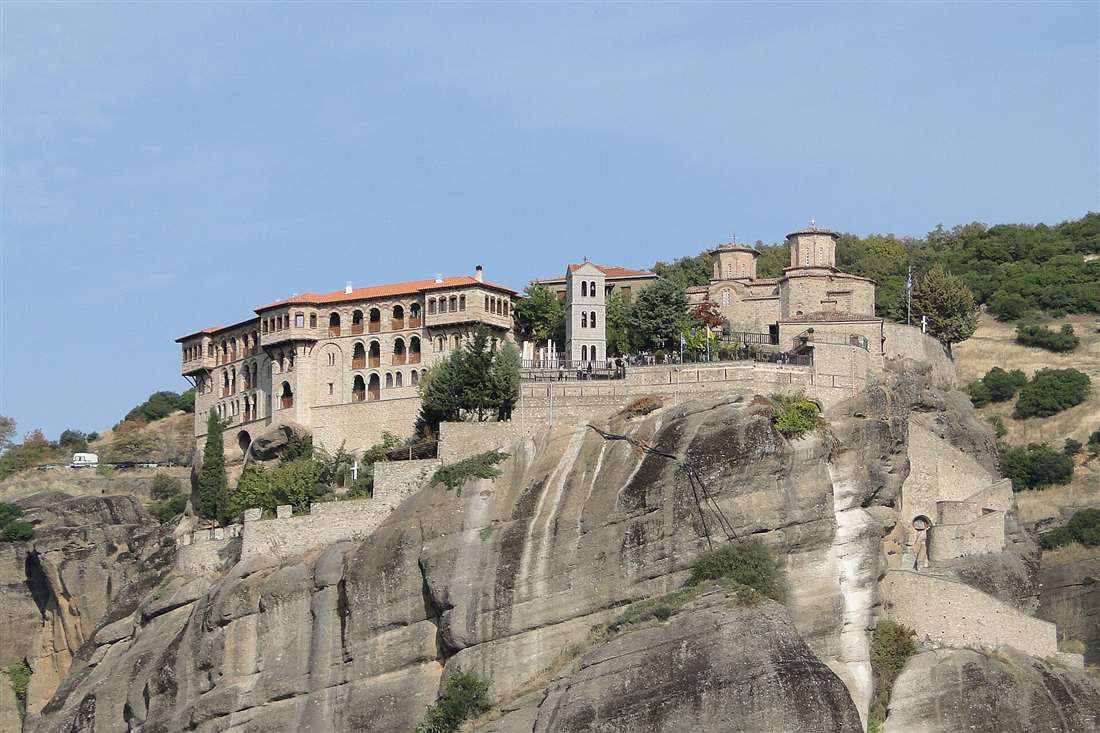
The private 4-day tour of Meteora and Ioannina from Athens joins Delphi, the Meteora monasteries and a sunset cruise on Lake Pamvotis. Tours across the rest of the country are listed on Greece Tours.
The sections below cover what the tour of Meteora and Ioannina includes, Delphi, the monasteries, the road over the Pindos, Lake Pamvotis, the Balkan Wars, season and booking, with links into the Ioannina tours pages. The tours shown are checked on GetYourGuide and Viator.
What is the private 4-day tour of Meteora and Ioannina?
A 4-day tour of Meteora and Ioannina is a private mainland circuit starting in Athens. It links Delphi and Meteora with Epirus stops, then returns south through Nafpaktos and the Rio-Antirrio Bridge. The private plan can be tailored to the group’s pace and preferences.
The private format begins with morning pickup from Athens city or the airport in a luxury minibus. The activity is new, has no reviews yet, and sits in the Delphi category. Live tour languages are English and Greek. Final drop-off can be at a hotel, residence, or Athens International Airport.
The first overnight is in Kalambaka, beneath Meteora’s rock formations. The following two nights are based in Ioannina, the city that anchors the tour’s northern section. This schedule uses two hotel locations, with no hotel change between the second and third nights. Day four is reserved for the southbound return.
The two-day Delphi and Meteora tour links those destinations from Athens, with an overnight in Kalambaka. By contrast, this 4-day tour of Meteora and Ioannina adds an Epirus section and stops in western Greece. A Meteora day trip from Athens centres on one region.
The product specifies exclusive use of a luxury minibus, rather than a shared coach. That keeps the group together during transfers between scheduled stops. The private party can set its pace and preferences within that format. This differs from fixed-seat transport shared with unrelated passengers.
What does the tour of Meteora and Ioannina include?
A 4-day tour of Meteora and Ioannina includes private transport and three hotel nights. It also covers a chauffeur, a Perama Cave tour, boat transfer, and travel logistics. Breakfast comes with the hotels; lunches, dinners, entrance fees, and personal expenses are separate.
The vehicle is an exclusive-use Mercedes-Benz Sprinter minibus. A certified professional chauffeur is available to the group 24/7. This 4-day tour of Meteora and Ioannina keeps its transport private from Athens pickup to the final return.
The three nights are in selected four- or five-star boutique hotels, with breakfast. Grand Meteora or Divani Meteora is named for Kalambaka. Hotel Du Lac Congress Center & Spa or Lake Spirit is named for Ioannina. Both stays allow a similar property as an alternative.
- Exclusive use of a luxury Mercedes-Benz Sprinter minibus.
- Certified professional chauffeur at the group’s disposal 24/7.
- Three nights in selected four- or five-star boutique hotels, with breakfast.
- Guided tour of Perama Cave.
- Private boat transfer in Ioannina.
- Fuel, highway tolls, Rio bridge pass, parking, and driver’s accommodation and meals.
A separate private boat transfer is part of the Ioannina arrangements. Road logistics cover fuel, tolls, parking, the Rio bridge pass, and the driver’s accommodation and meals. This 4-day tour of Meteora and Ioannina therefore includes ground transport and a boat transfer.
Museum and archaeological-site entrance fees, lunches, dinners, and personal expenses sit outside the package. Breakfast is the included meal, so scheduled lunch stops do not mean that lunch is prepaid. These items need a separate daily budget.
Which route does the four-day trip follow from Athens?
The 4-day tour of Meteora and Ioannina starts in Athens and first reaches Delphi. It continues through Arachova, Kalambaka, Meteora, Metsovo, Ioannina, Zagori, Nafpaktos, and the Rio-Antirrio Bridge before returning to Athens. The plan moves from central Greece into Epirus, then south again.
On day one, Arachova is the scheduled lunch-and-stroll pause. Kalambaka is the overnight base beneath Meteora’s rock formations. The day begins with a guided visit at Delphi, then continues through Arachova toward Kalambaka. This places the village break between the first named site and the first hotel night. Arachova is not an overnight stop.
On day two, the 4-day tour of Meteora and Ioannina visits Meteora’s clifftop monasteries. It stops for lunch in Metsovo before reaching Perama Cave. Metsovo is a mountain town in Epirus, within the Pindus range, marking a shift toward Ioannina. Perama Cave is a guided visit. Metsovo lies between Ioannina and Meteora.
Zagori is mountainous, with about 46 villages and traditional arched bridges. The 4-day tour of Meteora and Ioannina reaches this region on day three. Its named bridge stops date to the eighteenth century, linking the itinerary with local stone architecture. The area also supports rare flora under distinct microclimatic conditions.
Vikos Gorge lies in northwestern Zagori, between Ioannina and Konitsa. Its canyon runs about ten kilometres and exceeds 900 metres in depth. The Oxya viewpoint overlooks this feature. Monodendri is the scheduled lunch stop before the return to Ioannina. The gorge corridor extends from Monodendri and Koukouli toward the historic bridge at Kleidonia. Voidomatis River crosses the canyon.
- Day 1: Athens, Delphi, Arachova, Kalambaka.
- Day 2: Meteora, Metsovo, Perama Cave, Ioannina.
- Day 3: Zagorochoria, Kokkoris and Plakidas bridges, Oxya, Vikos Gorge, Monodendri, Ioannina.
- Day 4: Ioannina, Nafpaktos, Rio-Antirrio Bridge, Athens.
How does it compare with the 4-day Meteora and Pindos Mountains tour?
A 4-day tour of Meteora and Ioannina gives itinerary space to Delphi, Epirus, and the return route. The 4-day Meteora and Pindos Mountains tour centres on monasteries and mountain villages. Both start in Athens, but their named stops define different mainland circuits.
The Meteora and Pindos Mountains tour names Great Meteoron, Varlaam, and Roussanou, along with Metsovo, Elati, and Pertouli. By contrast, this 4-day tour of Meteora and Ioannina includes Delphi, Perama Cave, Zagori, and Nafpaktos. It also crosses the Rio-Antirrio Bridge.
The difference is itinerary emphasis, not duration: each product describes four days from Athens. The Pindos route gives space to a larger set of named monasteries and settlements. This route combines its Meteora visit with a wider circuit through Ioannina and the Epirus countryside. Metsovo appears in both itineraries as a shared stop.
For a practical comparison, line up each itinerary’s daily stops, overnight bases, transport format, and inclusions. One itinerary names a first night at Kalambaka and two Ioannina nights. The Pindos option names monastery and village visits, so its stop list offers another focus. It also offers private or small-group formats, while this trip specifies exclusive vehicle use.
On its southbound return, the 4-day tour of Meteora and Ioannina adds Nafpaktos. The fortified port stop includes coffee and a seafood lunch before the Rio-Antirrio crossing. This final segment contrasts with the Pindos option’s monastery and village focus.
How did monks reach the Meteora monasteries before the stairways?
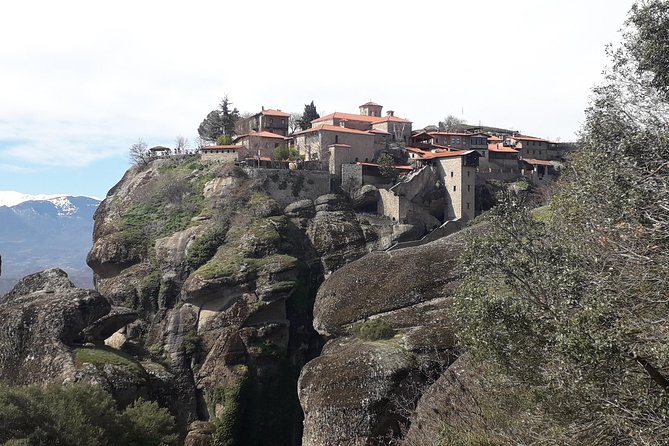
Before stone steps crossed the cliffs, monks reached Meteora by ladders, ropes, baskets, and nets. A 4-day tour of Meteora and Ioannina includes a Meteora visit. There, old access methods explain how religious communities reached isolated retreats.
For centuries, sheer rock isolated Meteora’s monasteries from the plain. Monks used removable ladders or ropes to reach the summits. Steep rock walls shaped access and daily life at Meteora. The 4-day tour of Meteora and Ioannina visits these cliffs. Hermits first settled the rocks during the eleventh century.
With no practicable roads to the peaks, monks relied on removable equipment. Each method addressed a different task, from lifting supplies to reaching a summit. Varlaam’s net represented the fragile tradition of cliff access. The slopes separated the communities from the plain below.
- Removable ladders let monks climb, then withdraw the route from outsiders.
- Joined ladders extended a climb where one wooden section fell short.
- Rope nets lifted people and supplies beside the exposed rock faces.
- Baskets carried provisions upward on ropes from the ground below.
- At Holy Trinity, a winch raised provisions in baskets on rope-ladders.
At Varlaam, a net once hoisted people beside a cliff above the valley. Accounts said ropes were replaced only when they broke. The lift ran vertically beside the rock, rather than along a ground trail. The net carried people as well as goods.
During the twentieth century, steps cut into rock made access simpler. Visitors now use stairs and paths, not a suspended net. A Meteora visit on a 4-day tour of Meteora and Ioannina places the old rope system in context. Details on Meteora’s monasteries show architecture adapted to the pillars.
Why are Delphi and Meteora both UNESCO World Heritage Sites?
UNESCO recognizes Delphi for its ancient sanctuary and Meteora for monasteries among sandstone pillars. A 4-day tour of Meteora and Ioannina visits both listed places. Each site meets distinct cultural criteria and holds a separate history.
Delphi entered the World Heritage List under criteria i, ii, iii, iv, and vi. Its layout forms an artistic ensemble, and its oracle influenced ancient communities. The sanctuary’s stadium hosted the Pythian Games at four-year intervals. Delphi’s monuments sit within a landscape that shaped the sanctuary’s design.
UNESCO recognizes both sites under five criteria, but their lists differ. Delphi’s criteria include the oracle and sanctuary’s influence. Meteora’s include its monasteries, frescoes, and sandstone peaks. The 4-day tour of Meteora and Ioannina joins a religious sanctuary with a monastic landscape.
Meteora qualifies under criteria i, ii, iv, v, and vii. Its monasteries adapt architecture to near-vertical rock, while their frescoes shaped post-Byzantine painting. A 4-day tour of Meteora and Ioannina links this cultural record with the crossing from Thessaly toward Epirus. Those frescoes date to the sixteenth century.
- Delphi’s criterion i recognizes a unique artistic layout on Mount Parnassus.
- Criterion ii records Delphi’s influence across the ancient world.
- Criteria iii and iv record ancient Greek religion and Delphi’s architectural ensemble.
- Criterion vi connects Delphi with belief in the world’s centre.
- Meteora’s criteria i, iv, and v recognize its monastic architecture and settlement.
- Criteria ii and vii recognize influential frescoes and the sandstone setting.
At Delphi, the oracle shaped religious life in ancient Greece. At Meteora, twenty-four monasteries stood on the heights by the fifteenth century. Six remain today, and the 4-day tour of Meteora and Ioannina includes both World Heritage properties. The Delphi page sets out the sanctuary and its museum.
Which road crosses the Pindos from Meteora to Ioannina?
Egnatia Odos, also called the A2 motorway, crosses the Pindos and serves Ioannina and Metsovo. A 4-day tour of Meteora and Ioannina follows this road on day two. Its route runs from Meteora via Metsovo toward Ioannina.
The A2 runs east to west across northern Greece, from Igoumenitsa to the border with Turkey. Its route crosses the Pindos and reaches Ioannina. On a 4-day tour of Meteora and Ioannina, this mountain passage links Thessaly with Epirus.
The road’s name recalls the Roman Via Egnatia, an older road across the region. The modern motorway is a separate road, though the names share a history. This distinction keeps the ancient title from implying an identical alignment. The Roman route linked the Adriatic and Black Sea regions. That road carried military, commercial, and cultural traffic.
Day two places Metsovo between Meteora and Ioannina. A scenic lunch stop comes before arrival in Ioannina for the Perama Cave. Egnatia Odos frames a mountain crossing, not every local road.
Modern Egnatia Odos connects Ioannina and Metsovo with cities farther east, using tunnels and bridges through rugged terrain. A separate day trip to Meteora from Ioannina starts on the western side of this mountain region.

Which motorways carry the return from Ioannina to Athens?
Two motorways carry the return to Athens. The Ionia Odos runs south from Ioannina to the Gulf of Corinth. The Olympia Odos then links Patras with Athens. The 4-day tour of Meteora and Ioannina uses both roads on day four.
The Ionia Odos, or A5 motorway, starts at Ioannina and follows the western side of mainland Greece. It runs 196 km with two lanes in each direction. The last section, between Perdika and Ioannina, opened in the 21st century and completed the road.
The road runs along the foothills of the Pindus range, which made it a hard project to build. It cut the drive between Antirrio and Ioannina to about 1 hour 40 minutes. On the 4-day tour of Meteora and Ioannina, it brings the group to Nafpaktos for lunch.
- Ionia Odos (A5): Ioannina to Antirrio, 196 km
- Rio-Antirrio Bridge: the crossing of the Rion Strait
- Olympia Odos (A8): Patras to Athens, about 210 km
- Time saved: Antirrio to Ioannina, down from about 3 hours 30 minutes
At Rio, the road crosses the gulf on the Rio-Antirrio Bridge and meets the A8 near Patras. The Olympia Odos is a toll motorway between Patras and Athens. Its stretch from Corinth to Patras reached full motorway standard in the 21st century.
The A8 began as National Road 8a, built in the second half of the 20th century. Its stretch from Elefsina to Corinth reached motorway standard before the turn of the century. The later upgrade added 19 km of tunnels and twenty interchanges along the route.
Both roads form part of a wider network. The Ionia Odos belongs to the European routes E55 and E951. It is the second major north-south road in Greece after the A1 motorway. The 4-day tour of Meteora and Ioannina returns by a different road than it took north.
What does the sunset cruise on Lake Pamvotis show?
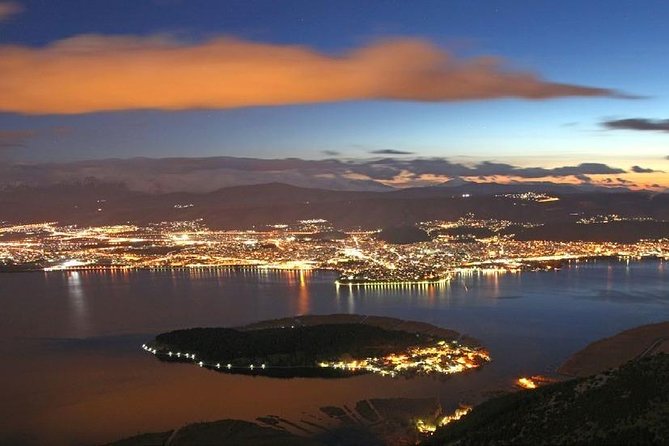
The sunset boat ride brings Ioannina Island into view beside the city’s western shore and foothills. Mount Mitsikeli forms a mountain backdrop. The 4-day tour of Meteora and Ioannina frames the evening crossing over this living wetland.
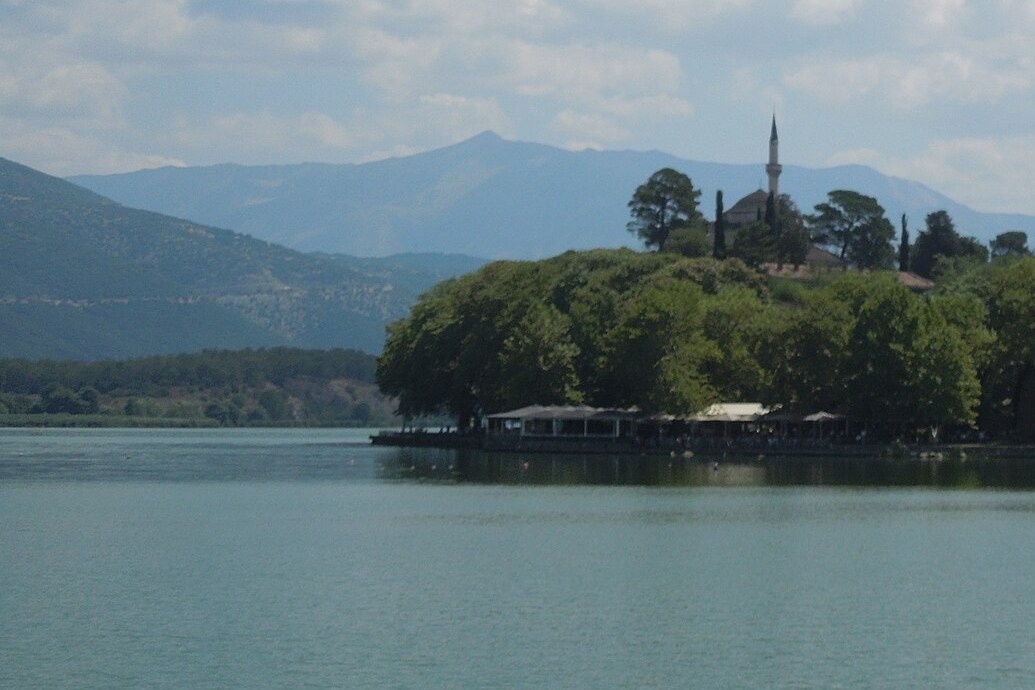
The private boat cruise takes place on the third day, after Zagorochoria and Vikos Gorge. The boat heads from Ioannina toward the island of Lake Pamvotis. The 4-day tour of Meteora and Ioannina adds a water-level view of the regional capital. For another outing, see a Zagori day trip from Ioannina.
From the western shore, Ioannina faces the broad lake, with Perama on its northern edge. Farmland traces much of the remaining perimeter. The lake has no surface outlet. It drains underground through karst sinkholes toward the Arachthos, Louros and Kalamas rivers.
- Area: the lake covers about 22 square kilometres.
- Elevation: its surface sits 470 metres above sea level.
- Island: Ioannina Island holds an inhabited village.
- Wildlife: waterbirds, small mammals, fish and crustaceans.
- Fish: the tsima, a species found only in this lake.
Reeds line parts of the shore and the island. Urban growth and pollution put pressure on the lake. Eutrophication brings algal blooms in summer. The lake belongs to Natura 2000, the European network of protected sites.
A regular boat service connects Ioannina Island with the shore. At sunset, the 4-day tour of Meteora and Ioannina makes that crossing part of the evening. The island sits near the northern shore of the lake. The lake is shallow, at about 4 m deep on average.
Who was Kyra Frosini, the woman of the lake legend?
Kyra Frosini was a Greek woman of Ioannina, executed on the orders of Ali Pasha. She drowned in Lake Pamvotis with 17 other women. The 4-day tour of Meteora and Ioannina crosses the same lake at sunset.
Her full name was Euphrosyne Vasileiou. She was the niece of the Bishop of Ioannina. She married Dimitrios Vasileiou, a wealthy merchant, and had two children with him. Her husband spent long periods away on business.
Frosini led a salon of local intellectuals who met to celebrate the arts and literature. Muhtar Pasha, a son of Ali Pasha, attended these gatherings. He came to admire her, and the two had a love affair.
Local Turkish women complained to Ali Pasha about the salon. In January, at the turn of the 19th century, he had Frosini arrested with 17 other women. The charge was adultery. Only one of the 18 women went free.
- Folk songs of Epirus about her death
- A novel based on her life
- An opera on the same story
- A film that retells the case
Legend later turned Frosini into a national heroine. In that version, Ali Pasha killed her for political reasons, not for adultery. On the 4-day tour of Meteora and Ioannina, the sunset cruise crosses the waters of her death.
How does the University of Ioannina shape the city?
The University of Ioannina makes the capital of Epirus a student city with a large campus. It began in the 20th century as a branch of the university in Thessaloniki. The 4-day tour of Meteora and Ioannina reaches this university city.
The first unit was a Department of Philosophy, opened as a branch of the Aristotle University of Thessaloniki. It started with two hundred students. Six years later, the University of Ioannina became independent. A committee in Athens had campaigned for a university in Ioannina before the first classes began.
- Location: 6 km from the centre of Ioannina
- Scale: one of the largest university campuses in Greece
- Housing: two student residence halls on the site
- Structure: seven schools and fifteen departments
- Heritage: the Monastery of Dourouti, an 18th-century building
The campus lies outside the old town. The 4-day tour of Meteora and Ioannina centres on the lake shore instead. The Monastery of Dourouti on the campus is being restored as a guest house for university visitors.
Research adds to the teaching. The Biomedical Research Institute opened in the late 20th century. It works with the Medical School, the University Hospital and other institutes of FORTH, the national research foundation. The taverns and bakeries of the old town appear on the Ioannina food tour page.
By the latest census, 64,896 people live in the city and 113,978 in the wider municipality. Ioannina is the capital and largest city of Epirus. On the 4-day tour of Meteora and Ioannina, it is the largest town on the route after Athens.
When did Ioannina become part of Greece?
Ioannina became part of Greece in the early 20th century, during the First Balkan War. Greek troops broke the Ottoman forts at Bizani, and the city surrendered. The 4-day tour of Meteora and Ioannina reaches a city that joined Greece late.
Greece won independence in the early 19th century, but Epirus stayed under Ottoman rule. Late in the 19th century, signs of national agitation grew among the Greeks of the city. A committee asked European governments for union with Greece, and a memorandum appeared in Paris.
The Ottomans fortified the hills south of Ioannina. The German general Colmar von der Goltz directed the building of permanent forts. Two major fortresses, Bizani and Kastritsa, guarded the southern approaches. Five smaller forts ringed the city on the west and northwest.
- Autumn: Greek forces take Preveza and push north
- December: the first Greek attack on the forts fails
- Winter: artillery duels and Greek air missions over the city
- Early March: the army breaks through at Bizani
- Surrender: Esad Pasha hands over Ioannina
The December fighting cost the Ottomans heavy losses. Their force around the city fell to about 26,000 men. Albanian irregulars raided Greek supply lines through the winter. Greek airplanes flew reconnaissance and bombing missions over Ioannina during the siege.
The campaign in Macedonia ended first, and more Greek troops moved to Epirus. Crown Prince Constantine took command in person. In early March, by the modern calendar, the Greek army broke the Ottoman line at Bizani. Esad Pasha then surrendered the city.
Ioannina marks the surrender every year on 21 February, its date in the old calendar. That war shaped the city the 4-day tour of Meteora and Ioannina visits today. Visitors from the north reach the same city on an Ioannina day trip from Thessaloniki.

How long are the drives on the four-day route?
The 4-day tour of Meteora and Ioannina covers long mainland drives between four named city pairs. The legs run from about 130 km to about 410 km. Meal stops and detours add to each figure.
Day one runs from Athens to Delphi, then through Arachova toward Kalambaka. Day one includes a guided visit at Delphi, then a lunch stop and village stroll in Arachova. This route begins with the private pickup in Athens.
A mapped Delphi-to-Kalambaka route measures about 220 km. Arachova lies along the tour route. The stop in Arachova adds time to that leg. Kalambaka holds the first overnight stay.
- Athens to Delphi: about 180 km.
- Delphi to Kalambaka: about 220 km.
- Kalambaka to Ioannina: about 130 km.
- Ioannina to Athens: about 410 km by the direct route.
The second leg includes a lunch stop in Metsovo before arrival in Ioannina. The tour follows the Egnatia Motorway through the mountains, so total mileage differs from the city estimate. Treat the figure as a city-to-city reference, not the day’s full odometer reading.
The final itinerary adds Nafpaktos and the Rio-Antirrio Bridge before Athens. Its full mileage therefore exceeds a direct Ioannina-to-Athens estimate. Traffic and road works change the time on each leg. Coffee and a seaside seafood lunch are also scheduled.
Which season suits the 4-day tour of Meteora and Ioannina?
Late spring and early autumn suit the 4-day tour of Meteora and Ioannina. These seasons fit outdoor stops and mountain viewpoints; Ioannina’s summer heat and winter chill favor milder dates. Weather-appropriate clothing remains useful on every departure date.
Ioannina averages highs of 30.9°C in July and August. Its average January low is 0.2°C. Those readings frame the city’s warmest and coldest periods. Daily weather still varies, so check the forecast before each day.
For the 4-day tour of Meteora and Ioannina, late spring falls outside the city’s peak summer heat. Early autumn also follows the warmest months. Both windows suit an itinerary with outdoor viewpoints, village walks, a cave visit, and a lakeside evening stop. The route includes pauses beyond the city center.
Meteora sits in northwestern Thessaly near the Pindus Mountains, in a temperate setting. The tour includes panoramic stops and walking between visitor areas, plus a walk beside Ioannina’s lake. Comfortable shoes support those visits. The region’s high peaks make flexible layers sensible.
Read more about seasonal timing for Meteora before selecting dates. Epirus offers a year-round travel setting, with snow-capped mountains in the inland region. Layered clothing suits a route that crosses mountain scenery and a lakeside city. Day three also stops at stone arch bridges and a viewpoint over Vikos Gorge.
How do you book and cancel the tour of Meteora and Ioannina?
To reserve the 4-day tour of Meteora and Ioannina, select a date. Check available starting times and pickup details; reserve-now, pay-later booking is available. Cancel at least 24 hours in advance for a full refund.
The tour is private, includes pickup, and offers live-tour languages in English or Greek. Select a date to view availability. Pickup is available in Athens city or at the airport. Return drop-off is available at a hotel, residence, or Athens International Airport. Match the return point to the flight or hotel plan.
Before booking the 4-day tour of Meteora and Ioannina, review the selected date, group details, and pickup information. Check starting times and pickup specifics before selecting. The private format can be tailored to the group’s preferences and pace. Review each selection before confirming the reservation.
- Choose an available date.
- Review pickup details and starting-time availability.
- Select the travelers for the private group.
- Reserve now and use the pay-later option if preferred.
Related information about a Meteora private tour appears on a separate page. The four-day itinerary gives example hotels or similar properties, rather than promising one fixed hotel. Confirm the assigned property before travel if a particular stay matters.
Save the reservation confirmation and the selected date’s terms after completing the booking. Keep pickup information with the travel plan. If plans change, act through the booking platform before its cutoff, then retain the cancellation record for reference. Keep the confirmation with other travel documents.
Frequently Asked Questions
How long does the tour last?
This private trip runs for four days from pickup to return. The 4-day tour of Meteora and Ioannina starts with pickup in Athens and ends with an Athens drop-off. Three hotel nights fall between the first and final travel days.
Does Delphi form part of the itinerary?
Yes. The 4-day tour of Meteora and Ioannina includes Delphi on day one. Day one includes a guided visit to the archaeological site and museum. Lunch follows in Arachova. The drive then continues north to Kalambaka for the first hotel.
Is a sunset boat cruise included?
The 4-day tour of Meteora and Ioannina lists a private sunset boat cruise on day three. The group returns to Ioannina after the Zagorochoria excursion, then travels by boat to the island. The inclusions also name a private boat transfer in Ioannina.
Is this a private tour?
This is a private group experience. The 4-day tour of Meteora and Ioannina uses an exclusive Mercedes-Benz Sprinter minibus and a certified professional chauffeur. Its schedule can be tailored to the group’s preferences and pace. The chauffeur stays at the group’s disposal 24/7. Live tour-guide languages are English and Greek.
Where are the overnight stays?
The 4-day tour of Meteora and Ioannina includes three hotel nights. The properties are selected four- or five-star boutique hotels. Breakfast is included. Night one is in Kalambaka, while nights two and three are in Ioannina. Hotel names are examples with similar alternatives, so no single property is guaranteed.
Does the activity have traveler reviews?
This activity has new-activity status and no tour-specific review score. The 4-day tour of Meteora and Ioannina therefore has no guest rating yet. Travelers can review the itinerary and booking terms before selecting an available date. No written traveler comments have appeared yet.