
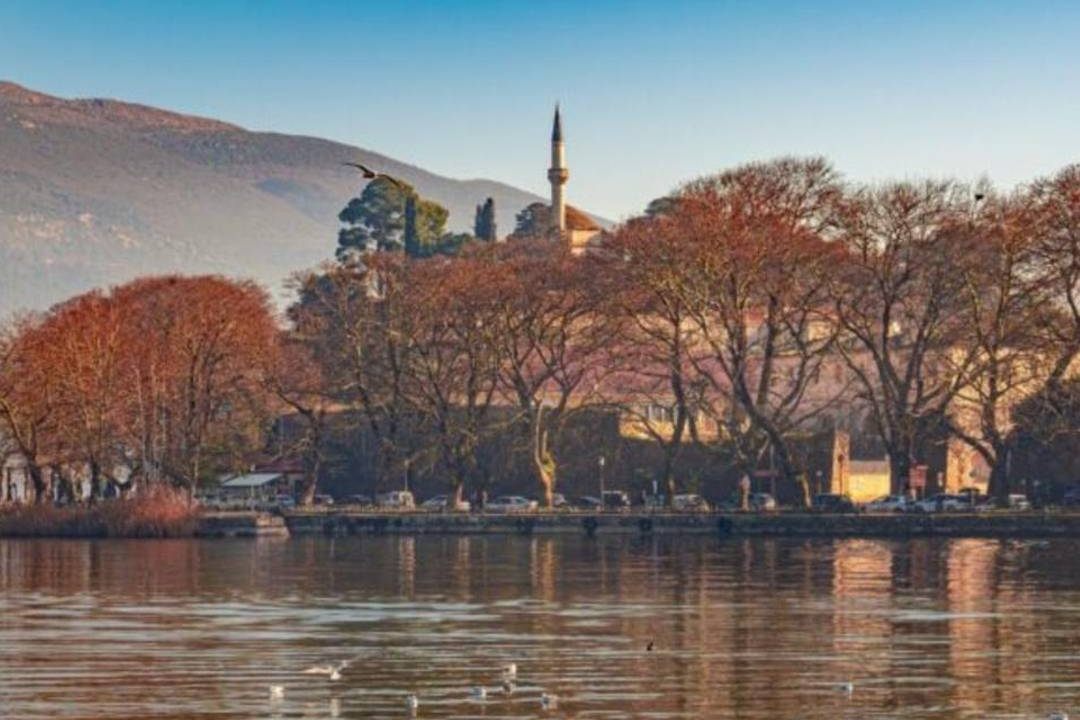
An Ioannina day trip from Thessaloniki crosses northern Greece on the Egnatia Odos to the lakeside capital of Epirus, with its castle, its island and the oracle of Dodona nearby, and returns the same evening. Tours across the rest of the country are listed on Greece Tours.
The sections below cover the tours you can book, the road, timing, stops, the castle, Ali Pasha, Its Kale, the island, silverwork, the Perama cave, Dodona, Konitsa, food, the season, packing and booking for an Ioannina day trip from Thessaloniki, with links into the Ioannina tours pages. The tours shown are checked on GetYourGuide and Viator.
What is an Ioannina day trip from Thessaloniki?
An Ioannina day trip from Thessaloniki is a full-day drive west to the capital of Epirus. The city stands on Lake Pamvotida, with a walled old town and an island. The oracle of Dodona lies nearby.
Ioannina is the capital and the largest city of Epirus. It stands at about 500 metres above sea level, on the western shore of Lake Pamvotida. Mountains rise on all sides, with Mitsikeli to the north-east of the lake. The University of Ioannina gives the city a large student population and a busy evening life.
The road crosses from Central Macedonia into Western Macedonia and then over the Pindus into Epirus. On an Ioannina day trip from Thessaloniki, the river plains give way to high mountain forest.
The city mixes Byzantine, Ottoman and modern Greek layers. A castle with two citadels, mosques and old mansions stand close together. A lively lakefront runs below them.
Travellers who prefer a shorter day in Macedonia compare the Vergina day trip from Thessaloniki. An Ioannina day trip from Thessaloniki covers more ground and reaches a different region of Greece.
- Region: Epirus, in north-western Greece.
- Setting: the western shore of Lake Pamvotida.
- Old town: a walled castle on a headland in the lake.
- Nearby: Dodona, the Perama cave and Konitsa.
Which Ioannina day trips from Thessaloniki can you book?
Two private GetYourGuide tours and one private Viator tour run an Ioannina day trip from Thessaloniki. One adds Konitsa and the home of Saint Paisios, and one adds Dodona. The Viator tour focuses on the city.
“From Thessaloniki: Ioannina & St. Paisios’ Konitsa Home Tour” runs for 10 hours. It visits Lake Pamvotida and the Its Kale citadel. It then heads north to the stone bridge of Konitsa and the home of Saint Paisios.
“Thessaloniki: Private Day Trip to Dodona & Ioannina” runs for 11 hours. It visits the oracle of Dodona, a museum and the city of Ioannina. A meal at a local restaurant is part of the day.
Viator lists “Thessaloniki to Ioannina – Private Day Trip”, a private car day built around the city. All three tours collect travellers in Thessaloniki and bring them back the same night. The driver handles the long motorway stretch, so the group can rest between the stops.
- Konitsa tour: 10 hours, private, with Saint Paisios’ home.
- Dodona tour: 11 hours, private, with the oracle and a meal.
- Viator tour: private, focused on Ioannina.
Two more tours start in Ioannina itself. One covers Dodoni, the old town, the island and the Perama cave in 7 hours. The other spends 9.5 hours on the lakefront, the Silversmithing Museum and a boat ride to the island.

Which road leads from Thessaloniki to Ioannina on the Egnatia Odos?
An Ioannina day trip from Thessaloniki follows the A2 Egnatia Odos west past Veria, Kozani and Grevena. It crosses the Pindus in tunnels near Metsovo and descends to Ioannina on Lake Pamvotida.
The A2 runs across the whole of northern Greece, from the port of Igoumenitsa to the Turkish border. It is a toll motorway with long tunnels and high bridges through the mountains. The road takes its name from the Via Egnatia, the Roman road that crossed the Balkans to Thessaloniki.
From Thessaloniki, the road crosses the plain to Veria at the foot of the Vermio range. It then climbs over the mountains to Kozani and runs on through the Aliakmonas valley to Grevena.
West of Grevena, the motorway enters the Pindus. A chain of tunnels near Metsovo carries it under the highest ground. The road then drops into the basin of Ioannina.
- Thessaloniki to Veria: across the plain.
- Veria to Kozani: over the Vermio range.
- Kozani to Grevena: along the Aliakmonas valley.
- Grevena to Metsovo: into the Pindus tunnels.
- Metsovo to Ioannina: down to Lake Pamvotida.
The motorway replaced the old mountain road over the Katara pass. An Ioannina day trip from Thessaloniki now crosses the Pindus quickly, even in winter.
How long does an Ioannina day trip from Thessaloniki take?
An Ioannina day trip from Thessaloniki takes 10 to 11 hours on the private tours. The drive covers about 260 km each way and takes about three hours without stops. Ioannina and the added sites share the rest of the day.
Six hours on the road leave four to five hours on the ground. That time fits the castle, the lakefront and either Dodona or Konitsa, but not both.
- Drive west: about three hours.
- Castle and lakefront: about two hours.
- Dodona or Konitsa: about two hours with the drive.
- Lunch in town: about one hour.
- Drive back: about three hours.
An early start keeps the castle visit inside opening hours. On an Ioannina day trip from Thessaloniki, the return leaves Ioannina in the late afternoon.
A private car lets the group change the order of the stops. Service areas along the motorway sell fuel and coffee. Travellers who want the island, Dodona and the cave together stay a night in Ioannina instead.
Where can you stop at Veria, Kozani and Metsovo on the way?
Veria, Kozani and Metsovo lie on or near the Egnatia Odos. They break an Ioannina day trip from Thessaloniki. Veria holds Byzantine churches, and Kozani is the main town of Western Macedonia. Metsovo is a stone village in the Pindus.
Veria stands at the foot of the Vermio mountains, about an hour from Thessaloniki. Its old town holds dozens of small Byzantine churches and a Jewish quarter called Barbouta. The royal tombs of Vergina lie a short drive to the south-east. The Byzantine Museum of Veria fills an old flour mill by the river.
Kozani sits on a plateau in Western Macedonia. Its central square with a clock tower makes a short coffee stop beside the motorway. The town holds the Kovendareios library, one of the old libraries of northern Greece.
Metsovo lies just off the A2 in the Pindus, at about 1,150 metres. Its stone houses, the Averoff Gallery and its smoked cheese make a common stop on the way back. More on the village sits on the Metsovo tours page.
- Veria: Byzantine churches and the Barbouta quarter.
- Kozani: a square with a clock tower.
- Grevena: a gateway town to the Pindus.
- Metsovo: stone houses, art and smoked cheese.
Each stop adds time to a long day. On an Ioannina day trip from Thessaloniki, one short stop on the way back keeps the schedule safe.
Why do the walls of the Ioannina castle still enclose a living quarter?
The walls survive because the castle is Ioannina’s fortified old town, not a detached ruin. The enclosure also held civic and religious institutions within Ioannina’s historic walled quarter. An Ioannina day trip from Thessaloniki reveals two citadels, public buildings and streets within one defensive boundary.
Ioannina Castle stands on a rocky promontory at the city’s southeastern edge, projecting into Lake Pamvotida. The enclosure is the fortified old town, not an isolated stronghold beyond the city. Its present walls preserve Byzantine fabric and reflect Ali Pasha’s rebuilding, completed in the early nineteenth century. An Ioannina day trip from Thessaloniki shows this fortress embedded in the city.
The northeastern citadel served as the Byzantine governor’s seat, then housed the Despots of Epirus. A palace and Church of Saint John stood within its walls. Its southern gate remains a marked entrance, protected by a circular tower. This administrative precinct shows how government and defense occupied the same compact ground. The seat remained important under Ottoman administration in Ioannina.
After the early seventeenth-century revolt, authorities replaced Saint John’s church with the Aslan Pasha Mosque complex. Its grounds held a founder’s tomb, a religious school and a kitchen. Aslan Pasha served as Ioannina’s Ottoman governor. An Ioannina day trip from Thessaloniki visits the Aslan Pasha Mosque, now Ioannina’s Municipal Ethnographic Museum. The mosque became the Muslim religious centre in Ioannina.
- The northeastern citadel covers about six thousand square metres and has its own wall within the wider castle.
- Byzantine sources called its circular tower the Upper Tower, or Epanō Goula, during the medieval period.
- The Aslan Pasha Mosque has a damaged minaret above its former prayer hall.
- The Turkish library stood near the mosque complex, outside the northeastern citadel proper during Ottoman rule.
- Soufari Sarai served as cavalry barracks during Ali Pasha’s final years in power.
- The Jewish synagogue inside the walls ranks among Greece’s oldest surviving large synagogues.
Who was Ali Pasha, and how did he rule from Ioannina?
Ali Pasha was an influential Ottoman Albanian ruler whose capital and court stood in Ioannina. An Ioannina day trip from Thessaloniki places his power in context at the castle site. The castle preserves his rebuilt walls and former residence within Ioannina’s historic walled quarter.
Ali Pasha governed the Pashalik of Yanina from the late eighteenth century into the early nineteenth century. His territory gained wide autonomy and acted as a de facto independent state. Ioannina served as his capital and principal seat of government. His pashalik belonged to Ottoman Rumelia in the empire’s western lands. Tepelena also served as his second headquarters beside Ioannina.
His reach crossed parts of Greece and Albania. His court corresponded with European leaders. Scholars who joined the Greek Revolution visited Ioannina. An Ioannina day trip from Thessaloniki places diplomacy and learning in the city’s history. Ioannina became a centre of the Modern Greek Enlightenment in the eighteenth and nineteenth centuries. He also discussed possible independence with a British visitor.
The record of his rule combines statecraft with coercion. Accounts describe his administrative skill and efforts to impose order, alongside harsh punishments and violence. The castle’s reconstruction used older Byzantine walls and added outer defenses for cannon. An Ioannina day trip from Thessaloniki gives these political changes a physical setting. Ottoman campaigns ended his rule in the early nineteenth century.
Which monuments crown the Its Kale citadel above the lake?
Its Kale holds the former palace site, Fethiye Mosque, Ali Pasha’s tomb and museum buildings. An Ioannina day trip from Thessaloniki brings these monuments together in one connected citadel walk. They crown the southeastern citadel above Lake Pamvotida and preserve layers of Ottoman rule.
The mosque crowns Its Kale’s highest eastern point. It occupies a Byzantine cathedral site dedicated to Archangels Michael and Gabriel. The first mosque followed the Ottoman conquest of Ioannina in the fifteenth century. Ali Pasha remodelled it as his palace mosque in the late eighteenth century. A wooden mosque preceded the stone building. Mosque use ended in the nineteenth century.
Northwest of the mosque, a tomb holds Ali Pasha and his wife. The Byzantine Museum occupies the palace site. The Treasury displays local silversmithing. An Ioannina day trip from Thessaloniki reveals the Fethiye Mosque’s prayer hall beneath its dome. Four semi-domes support it, and a wooden gallery runs along the north wall. Wall paintings and Arabic inscriptions decorate the interior.
Visitors on an Ioannina day trip from Thessaloniki can trace further layers on foot. The central circular Tower of Bohemond is a Byzantine remnant. A second tower survives as a base near the kitchens, while restored structures host exhibitions and cultural events. The kitchens date from the early nineteenth century. The powder magazine now supports educational activities inside the citadel.
- Its Kale covers about thirty thousand square metres as a separate fortress within the old town.
- The elevated archaeological site is arranged across two levels with restored historic buildings in Its Kale.
- Archaeologists found Hellenistic foundations beneath later structures inside the citadel.
- The palace complex included audience rooms, family apartments, servants’ rooms and a harem.
- The selamlik stood on the northern side of the palace, while women’s quarters occupied the southern side.
- The palace remained an administrative centre after Ali Pasha’s fall and was demolished in the nineteenth century.
Why take the boat to the island in Lake Pamvotida?
The inhabited island adds lakeside streets and monastic history to Ioannina’s castle quarter. An Ioannina day trip from Thessaloniki reaches churches across Lake Pamvotida by regular boat service. The crossing leads to a separate community with historic lanes and monasteries beyond the mainland’s fortified centre.
Lake Pamvotida surrounds the island near Ioannina’s northern shore. Regular boats connect it with the mainland, bringing the city’s waterfront and castle into the same view. The island’s winding streets belong to an inhabited place. Its religious buildings recall a Byzantine monastic past. Pamvotida is Epirus’s largest lake, at 470 metres above sea level. It has no natural surface outflow.
An Ioannina day trip from Thessaloniki reaches Agios Nikolaos of Philanthropenoi. The monastery began in the late Byzantine period and flourished in the sixteenth century. Its church preserves visible wall paintings, a barrel-vaulted roof, a vaulted narthex and three exonartheces. Michael Philanthropenos renovated the church in the late thirteenth century. Wall painting followed in three phases during the sixteenth century.
On an Ioannina day trip from Thessaloniki, the walk shifts across Lake Pamvotida from lanes to monasteries. Its religious houses span different periods and architectural styles. St Panteleimon’s monastery houses everyday objects and relics from Ali Pasha’s period. The Philanthropenoi church hosts services on designated days. Gift shops and churches also line the island’s narrow, winding streets.
- St Nicholas of Ntiliou, also called Strategopoulou, dates from the eleventh century.
- The monastery of St John the Baptist dates from the sixteenth century.
- Eleousis is another island monastery established during the sixteenth century.
- St Panteleimon’s monastery dates from the seventeenth century.
- The Monastery of the Transfiguration of Christ dates from the nineteenth century.
How did silverwork make Ioannina a craft city?
Silverwork shaped Ioannina’s reputation through skilled workshops, trade and decorative objects. An Ioannina day trip from Thessaloniki links this craft history with historic castle exhibitions in Ioannina. Historic rooms also explain how local artisans worked and sold metalwork across the city’s long craft tradition.
Ioannina is known across Greece for silverwork, and shops sell silver jewelry, bronzeware and decorative pieces. The craft belongs to a longer history of commercial activity in Ioannina. In the late seventeenth century, Ottoman traveller Evliya Çelebi recorded about nineteen hundred shops and workshops in Ioannina. Silver goods included serving trays and decorative reproductions of shields and swords.
Merchants from Ioannina traded with Venice and Livorno, establishing commercial and banking houses in the two ports. Venetian printing presses channelled books into Greek lands. An Ioannina day trip from Thessaloniki places these networks beside the city’s workshops. The stone villages north of the city appear on the Zagori day trip from Ioannina page. These merchants also founded charitable and educational institutions in their home city.
The Treasury contains a silversmithing exhibition. The square Treasury’s original use remains unknown. The Silversmithing Museum opened in a restored western bastion during the twenty-first century. The Piraeus Bank Group Cultural Foundation operates the museum. Its displays document techniques from Ioannina and the surrounding area. Travellers who stay a night in the city add the Meteora day trip from Ioannina.
What lies underground in the Perama cave near Ioannina?
The Perama cave holds chambers of stalactites and stalagmites under a hill north of Ioannina. An Ioannina day trip from Thessaloniki reaches it by car or on a city tour.
Villagers found the cave during the Second World War, while they hid from air raids. Explorers later mapped long passages, and a lit path now leads through the open section.
The path runs past columns, curtains and pools formed over hundreds of thousands of years. Steps climb in and out of the chambers, and the air stays cool all year.
The cave also kept the bones of cave bears, which lived in the area during the Ice Age. Displays near the entrance show these finds.
- Location: the village of Perama, on the lake north of the city.
- Found: during the Second World War.
- Inside: stalactites, stalagmites and small pools.
- Finds: bones of Ice Age cave bears.
On an Ioannina day trip from Thessaloniki, the cave suits a car and a light schedule. The guided walk inside takes under an hour.
What remains of the oracle of Zeus at Dodona?
Dodona keeps the sanctuary of Zeus, a large theatre, a council house and a stadium. The site lies in a quiet valley south-west of Ioannina. The Dodona tour on an Ioannina day trip from Thessaloniki visits the site and its museum.
Dodona was the oldest oracle of ancient Greece. Priests read the will of Zeus in the rustling of the leaves of a sacred oak tree. Bronze cauldrons around the tree rang in the wind as part of the ritual.
Homer names the oracle in the Iliad, where Achilles prays to Zeus of Dodona. Pilgrims wrote their questions on thin strips of lead. Thousands of these tablets survive, with questions about marriage, health, journeys and trade.
King Pyrrhus of Epirus rebuilt the sanctuary in the 3rd century BC. The theatre he added seated about 17,000 people and ranks among the largest in Greece.
- The site of the sacred oak, with a young tree planted in its place.
- The theatre of Pyrrhus at the foot of the hill.
- The council house and the prytaneion.
- The stadium behind the theatre.
Dodona lies about 20 km from Ioannina. An Ioannina day trip from Thessaloniki reaches it in under half an hour from the city centre.
Why do pilgrims travel to Konitsa for Saint Paisios?
Saint Paisios grew up in Konitsa after his family fled Cappadocia. His childhood home still stands in the town. The Konitsa tour on an Ioannina day trip from Thessaloniki visits the house.
Paisios was born in Farasa, in Cappadocia. He came to Greece as a baby during the exchange of populations. His family settled in Konitsa, where he grew up and worked as a carpenter.
He later became a monk on Mount Athos, where he gained fame as a spiritual guide. The Ecumenical Patriarchate declared him a saint in the 21st century.
His family house in Konitsa now receives visitors who come to pray and to see where he lived. He spent time as a young monk at the monastery of Stomio, in the gorge nearby.
On an Ioannina day trip from Thessaloniki, Konitsa lies about an hour north of Ioannina. The town climbs the slope of Mount Trapezitsa above a wide valley. Adventure travellers also come for the Konitsa via ferrata on the cliffs above the river.
What does the stone bridge of Konitsa cross?
The stone bridge of Konitsa crosses the Aoos river with a single tall arch. An Ioannina day trip from Thessaloniki stops there on the Konitsa tour, just below the town.
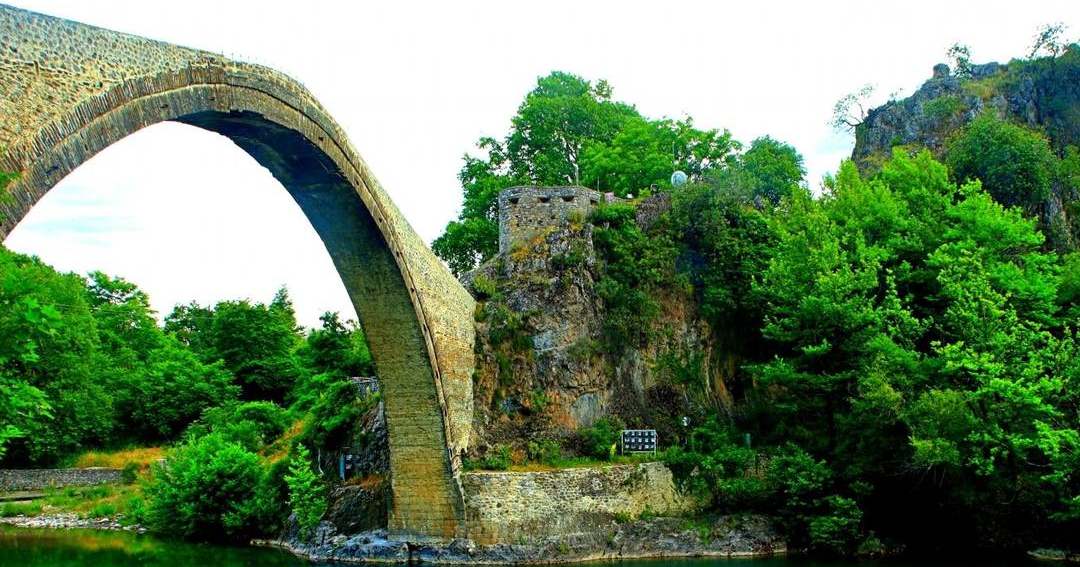
Master builders raised the bridge in the 19th century. Its arch spans about 40 metres and rises about 20 metres above the water. It ranks among the largest stone bridges in the Balkans.
A small bell hangs under the arch. It rings when the wind blows hard, as a warning to anyone crossing on foot.
A path leads from the bridge into the Aoos gorge, towards the monastery of Stomio. Kayakers and rafters also start their runs on the river here.
- River: the Aoos, at the mouth of its gorge.
- Arch: one span of about 40 metres.
- Bell: rings in strong wind.
- Path: into the gorge towards Stomio.
On an Ioannina day trip from Thessaloniki, the bridge makes the main photo stop of the Konitsa tour. The Voidomatis river joins the Aoos in the valley below the town.
What do you eat on an Ioannina day trip from Thessaloniki?
Ioannina food centres on savoury pies, lake fish, frog legs, local feta and syrup-soaked sweets. An Ioannina day trip from Thessaloniki fits a long lunch by the lake. The Dodona tour includes a meal at a local restaurant.
Epirus is known across Greece for its pies, with fillings of cheese, greens, leek or meat. Bakeries in the old town sell them warm from the oven in the morning.
Tavernas on the lakefront and on the island serve trout, eel and crayfish from Lake Pamvotida. Frog legs fried in batter are a local speciality of the island.
The city is also known for its sweets, such as baklava and other pastries in syrup. Bougatsa with cream or cheese makes a common breakfast before the walk.
- Pies with cheese, greens or meat.
- Trout and eel from the lake.
- Fried frog legs on the island.
- Baklava and bougatsa from the bakeries.
A guided tasting of these dishes runs on the Ioannina food tour. Lunch by the lake fits between the castle and the drive back.
What does the lakefront of Ioannina offer for a walk?
The lakefront of Ioannina is a long promenade of plane trees, cafes and benches below the castle walls. An Ioannina day trip from Thessaloniki uses it for a slow walk between the castle and lunch. Mitsikeli rises across the water.
The promenade runs along the water from the foot of the castle towards the north of the city. Old plane trees shade the path, and cafes spread their tables close to the water.
Rowing boats and small pleasure boats tie up along the shore. The boats to the island leave from the quay at Mole, just below the castle walls.
The lake covers about 20 square kilometres. Mount Mitsikeli rises steeply on its far side. Its long grey ridge turns pink in the evening light.
- A shaded path of old plane trees.
- Cafes and tavernas by the water.
- The boat quay below the castle.
- Views across the lake to Mitsikeli.
A coffee by the lake makes a calm break before the drive back. Locals walk the promenade in the late afternoon.
What do the old market streets of Ioannina sell?
The old market streets below the castle sell silver jewellery, copper pots, sweets and local cheese. An Ioannina day trip from Thessaloniki crosses them on the way to the castle gate.
The market grew up outside the castle walls in Ottoman times. Craftsmen and traders worked in rows of small shops, grouped by trade.
Silversmiths still work in the lanes near the castle. Their shops sell filigree jewellery, decorated boxes and copies of old ornaments.
The clock tower on the central square was built in the early 20th century. It marks the start of the walk down to the market and the castle.
- Silver filigree and jewellery.
- Copper and brass ware.
- Sweets, nuts and local honey.
- Cheese and cured meats from Epirus.
On an Ioannina day trip from Thessaloniki, the market lanes suit a short browse before lunch. Morning brings the busiest trade in the lanes.
Who were the Romaniote Jews of Ioannina?
The Romaniote Jews of Ioannina were a Greek-speaking Jewish community with roots in the Byzantine era. An Ioannina day trip from Thessaloniki passes their synagogue, the Kahal Kadosh Yashan, inside the castle walls.
The Romaniotes spoke Greek and kept their own prayer rites. These differed from the rites of the Sephardic Jews of Thessaloniki. Ioannina was their main centre in Greece.
The synagogue inside the castle dates from the 19th century and stands on the site of older buildings. Its interior keeps wooden benches along the walls and a raised platform for reading.
In the Second World War, the German army deported almost the whole community to the death camps. A memorial near the castle remembers the victims.
On an Ioannina day trip from Thessaloniki, the synagogue links two cities with deep Jewish roots. Visits inside depend on the opening days set by the community.
What does the Archaeological Museum of Ioannina hold?
The Archaeological Museum of Ioannina holds finds from Dodona, Stone Age tools and ancient sculpture from Epirus. An Ioannina day trip from Thessaloniki fits it in near the clock tower.
The museum stands in the park of Litharitsia, close to the central square. Its modern building suits a visit of about an hour.
The finds from Dodona include the lead tablets on which pilgrims wrote their questions to Zeus. Bronze figures and offerings from the sanctuary fill other cases.
Older rooms show stone tools from Palaeolithic sites of Epirus. Later rooms cover the cities and tombs of the region in the Classical and Roman periods.
- Lead oracle tablets from Dodona.
- Bronze figures and offerings.
- Stone Age tools from Epirus.
- Sculpture from Roman Epirus.
On the Dodona tour, the museum explains what the site no longer shows. The Dodona tour includes a museum visit as part of the day.
Why is Ioannina known as a city of letters?
Ioannina became a centre of Greek learning under Ottoman rule, with schools funded by its merchants abroad. An Ioannina day trip from Thessaloniki passes the Zosimaia School on the main street of the city.
Merchants from Ioannina traded in Venice, Livorno and the cities of Central Europe. These merchants sent money home to found schools, libraries and charities.
The Zosimaia School opened in the 19th century with funds from the Zosimas brothers, merchants who lived abroad. Its neoclassical building still houses a secondary school.
Earlier schools in the city taught Greek language, philosophy and science in the 17th and 18th centuries. Their teachers made Ioannina a leading centre of the Modern Greek Enlightenment.
The University of Ioannina, founded in the 20th century, keeps that role today. Its students give the old town a young crowd in the cafes and bars of the evening.
What does the Vrellis museum of Greek history show?
The Pavlos Vrellis Museum shows scenes from Greek history in wax figures by the sculptor Pavlos Vrellis. It stands at Bizani, south of Ioannina. An Ioannina day trip from Thessaloniki passes it on the road towards Dodona.
Vrellis built the museum himself in a stone building styled like a fortress. Inside, life-size wax figures stand in rooms set up as historic scenes.
The scenes cover the history of Epirus, from the court of Ali Pasha to the women of Souli. Others show the Greek War of Independence.
The museum takes about an hour to see. Bizani lies close to the route south of the city on the Dodona tour.
- Founder: the sculptor Pavlos Vrellis.
- Location: Bizani, south of Ioannina.
- Inside: life-size wax figures in historic scenes.
- Theme: the history of Epirus and Greece.
Which months suit an Ioannina day trip from Thessaloniki?
Late spring and early autumn suit an Ioannina day trip from Thessaloniki. Mild days help on the castle walk and the lakefront. Summer brings heat, and winter brings frost, fog over the lake and snow on the Pindus.
Ioannina has hot, fairly dry summers and cold, wet winters. In July and August, daytime highs reach about 31°C. The city lies inland and higher than Thessaloniki, so evenings feel cooler.
Late spring brings green hills and flowers along the lake. Easter, when it falls in spring, fills the old town churches with candlelit services. Autumn colours the plane trees of the lakefront and the forests of the Pindus in red and gold.
On winter mornings, fog settles over Lake Pamvotida, and snow falls on the mountains along the motorway. A winter Ioannina day trip from Thessaloniki needs a check of the road forecast.
- Late spring: green hills and mild days.
- Summer: hot afternoons, long daylight.
- Autumn: golden plane trees on the lakefront.
- Winter: fog on the lake, snow in the Pindus.
Museum and site hours run longer in summer and shorter in winter. In the cold months, an early start fits the castle and Dodona into daylight.
What do you bring on an Ioannina day trip from Thessaloniki?
Bring walking shoes, a warm layer, a rain jacket and water on an Ioannina day trip from Thessaloniki. The castle lanes are paved with stone, and the weather in the mountains changes fast.
The old town and Its Kale have uneven paving and slopes. Shoes with grip help on wet stone. The Perama cave and Dodona add more walking on steps and gravel.
The temperature drops as the motorway climbs into the Pindus. A warm layer helps in the mountains even on a mild day in Thessaloniki.
- Walking shoes with grip.
- A warm layer and a rain jacket.
- Water and a snack for the road.
- Sun hat and sun cream in summer.
- Charged phone and ID.
Cash helps for the boat to the island and for small purchases in the old town. A refillable bottle helps on the castle walk, since the citadel has little shade. On an Ioannina day trip from Thessaloniki, a small bag keeps everything at hand during the walk.
How do you book and cancel an Ioannina day trip from Thessaloniki?
Choose the Konitsa tour or the Dodona tour, and check the pickup time in Thessaloniki. Read the cancellation line before payment. GetYourGuide listings with free cancellation allow it up to 24 hours before an Ioannina day trip from Thessaloniki.
The Konitsa tour suits travellers interested in Saint Paisios and the stone bridge. The Dodona tour suits those drawn to ancient Greece and includes a meal at a local restaurant.
The Viator tour suits travellers who want a day built around the city of Ioannina alone. All three run as private tours for the booking group.
- Pick the tour that matches the main interest.
- Check the pickup point and time.
- Read the cancellation deadline.
- Keep the booking on the phone.
More day trips from the city appear on the Thessaloniki page. On an Ioannina day trip from Thessaloniki, the driver collects travellers from their hotel in the early morning.
How does Ioannina compare with Meteora as a day out from Thessaloniki?
Ioannina offers a lakeside city with a castle, mosques, an island and Dodona. Meteora offers monasteries on rock pillars. An Ioannina day trip from Thessaloniki suits travellers who prefer a living city to monasteries.
Meteora lies about three hours from Thessaloniki, near Kalambaka in Thessaly. Its monasteries stand on top of sandstone towers, and a visit centres on the climb into them. One route from Thessaloniki to Meteora also follows the Egnatia Odos as far as Grevena before turning south. Each monastery closes on its own weekday, so a Meteora day needs a check of the open days.
Ioannina offers more variety in one place. The castle, the lake, the island, the market and the food all lie close together. Dodona or Konitsa adds an ancient site or a pilgrim town.
The full plan for the monasteries sits on the Meteora day trip from Thessaloniki page. An Ioannina day trip from Thessaloniki and a Meteora day fit on two separate days.
- Ioannina: city, lake, castle, island and food.
- Meteora: monasteries on rock pillars.
- Drive: about three hours each way to both.
- Extras: Dodona or Konitsa from Ioannina.
Frequently Asked Questions
Is an Ioannina day trip from Thessaloniki possible in one day?
Yes. The private tours run for 10 to 11 hours, with about three hours of driving each way. The day covers the castle, the lakefront and either Dodona or Konitsa.
Can an Ioannina day trip from Thessaloniki go by bus or train?
KTEL buses link Thessaloniki and Ioannina daily in about three and a half hours. No railway reaches Ioannina, so the bus or a car is the only public way. A same-day return by bus leaves little time in the city.
Can an Ioannina day trip from Thessaloniki include Dodona and Konitsa?
Not both in one day. Dodona lies south-west of the city and Konitsa an hour to the north. The private tours each add one of them to the visit of Ioannina.
Is the tour private?
Yes. The two GetYourGuide tours and the Viator tour run as private tours for the booking group. A driver collects travellers in the city.
Is there snow on an Ioannina day trip from Thessaloniki in winter?
Snow falls on the Pindus around Metsovo in winter, and frost and fog are common in Ioannina. The motorway stays open, but a check of the road forecast the day before helps.
How much walking does an Ioannina day trip from Thessaloniki involve?
The castle walk covers about two hours on paved lanes with slopes. Dodona adds a walk on gravel paths, and Konitsa a short walk down to the bridge. Shoes with grip help on wet stone.
How far ahead do you book?
Book once the travel date is fixed. Free cancellation up to 24 hours before the start keeps an early booking flexible.