
A Zagori day trip from Ioannina is a full day in the Pindus mountains north of the city, among the stone villages, the arched bridges and the Vikos Gorge of Zagori. Tours across the rest of the country are listed on Greece Tours.
The sections below cover the tours you can book, the drive, the villages, Monodendri, the gorge, the bridges, Papigo, rafting, the seasons and booking for a Zagori day trip from Ioannina, with links into the Zagori tours pages. The tours shown are checked on GetYourGuide and Viator.
What is a Zagori day trip from Ioannina?
A Zagori day trip from Ioannina is an outing into the Pindus mountains north of the city. The trip covers stone villages, stone bridges and the Vikos Gorge. Ioannina, the capital of Epirus, is the start and end point.
Zagori is a region and a municipality in the Ioannina regional unit of Epirus, in northwestern Greece. The seat of the municipality is the village of Asprangeloi. About 3,400 people live in the area.
The Pindus range runs north to south through mainland Greece and is known as the spine of Greece. It stretches about 160 km, from southern Albania into northern Greece. Zagori covers one part of that range.
A Zagori day trip from Ioannina runs as a shared tour, a private tour or an independent outing. Independent visitors travel by car or by intercity bus. The tours add a driver and a set plan for the day.
Ioannina is also the largest city in Epirus, home to about 65,000 people. Staying there keeps one hotel for the whole visit. Zagori is one of the mountain areas reached by tours that start in Ioannina.
Which Zagori day trips from Ioannina can you book?
GetYourGuide and Viator list five tours that run a Zagori day trip from Ioannina. GetYourGuide offers two sightseeing tours and a private jeep tour. Viator offers a Vikos Gorge and Papingo tour plus a daily sightseeing tour.
All five start in Ioannina, so a Zagori day trip from Ioannina on a tour needs no car. The tour takes care of the mountain roads. The two platforms list the five under these titles:
- “Ioannina: Zagori Sightseeing Daily Tour” on GetYourGuide
- “Zagori Sightseeing Tour with Guide” on GetYourGuide
- “Zagori Private Vikos Gorge, Voidomatis and More Jeep Tour” on GetYourGuide
- “Vikos Gorge and Papingo One Day Tour from Ioannina” on Viator
- “Sightseeing Zagori daily tour” on Viator
The titles show the format of each tour. Two of them use the word daily, which points to a regular departure. One more names a guide. Each title names Zagori or the Vikos Gorge, so every tour keeps to the region.
The private jeep tour gives the group its own vehicle. Its title names the Vikos Gorge and the Voidomatis river. The Viator tour that names Papingo uses another spelling of Papigo.
GetYourGuide also lists a “Guided All-Day Tour to Zagori Area” that starts in Mikro Papigo, inside Zagori. That tour suits visitors who already stay in the villages rather than in the city. The words All-Day in its title mark a full-day outing.

How far is Zagori from Ioannina?
A Zagori day trip from Ioannina covers a short distance. Monodendri, a Zagori village, lies 41 km north of the city. Both Papigo villages sit about 30 km north as the crow flies, inside the Vikos–Aoös National Park.
Zagori has the shape of an upturned triangle, with Ioannina at its southern point. The southeastern side runs to Mount Mavrovouni, near Metsovo. Ioannina itself sits about 500 metres above sea level.
For a Zagori day trip from Ioannina, the airport is a handy reference point. It lies 4 km from the city, and road times from the airport run as follows:
- Monodendri: 1 hour
- Vikos Gorge viewpoint: 1 hour 15 minutes
- Papigo: 1 hour 30 minutes
- Metsovo, outside Zagori: 1 hour
The 30 km figure for the two Papigo villages is a straight line on the map. The road between them and the city runs longer, since it bends around the mountain slopes.
Visitors who fly in can use Ioannina airport transfers to reach their hotel in the city. The mountain trip then leaves from Ioannina on a later morning, with bags left at the hotel.
Which route does a Zagori day trip from Ioannina follow?
A Zagori day trip from Ioannina drives north to a village, a gorge viewpoint and two stone bridges. Monodendri, the Oxia viewpoint and the bridges near Kipi form the core route. Papigo tours go west to Megalo and Mikro Papigo.
The route used by Zagori day tours links four named stops. A self-drive Zagori day trip from Ioannina can follow the same road north. The list below gives each stop with its detail:
- Monodendri: a walk and free time in the village
- Oxia viewpoint: 8 km by road from Monodendri
- Kokkori bridge: a stone bridge near Kipi
- Kalogeriko bridge: a stone bridge near Kipi
The core route crosses two municipal units of Zagori. Monodendri belongs to Central Zagori. Kipi, spelled Kipoi in the municipal list, belongs to the Tymfi unit. Papigo forms a municipal unit of its own, reached on the western road.
A Zagori day trip from Ioannina by public transport follows the bus instead of a tour plan. A KTEL intercity bus leaves the Ioannina city bus station for Zagori on a fixed timetable. That timetable, not a guide, sets the pace of the day.
How long does a Zagori day trip from Ioannina last?
A Zagori day trip from Ioannina fills one full day. It leaves the city in the morning and returns to Ioannina the same day. Shared group tours and private jeep tours both run as full days.
From Parga, Zagori day trips take 8 to 11 hours. Parga lies on the Ionian coast of Epirus, in the Preveza regional unit. Ioannina lies about an hour from Monodendri, far closer to the villages. A Zagori day trip from Ioannina therefore spends less of the day on the road.
Modern roads reached the Zagori villages only in the mid-20th century. Those roads make a same-day return from the city possible today. The short drive leaves room for all four stops of the core route. Four things set the length of each trip:
- The tour format: shared, private or self-drive
- The road chosen: the core route or the western road to Papigo
- The number of stops on the plan
- The KTEL timetable, for travellers without a car
What is the Zagori region?
Zagori is a mountain region and municipality in the Pindus range of Epirus, in north-west Greece. It holds 46 villages across roughly 1,000 square kilometres. A Zagori day trip from Ioannina starts in the city at the region’s southern point.
Mount Mitsikeli marks the south-west border of Zagori. The Aoos river flows along its northern edge, and Mount Tymfi rises in the north. Greeks call the settlements the Zagorochoria, the Zagori villages.
The name traces back to a Slavic word for beyond the mountains. Aromanians lived in the eastern villages. Sarakatsani shepherds arrived in the late 18th century to tend local flocks. Roma families worked as musicians and blacksmiths. Herbal healers called the Vikos doctors made Zagori a centre of folk medicine.
A Zagori day trip from Ioannina enters a UNESCO World Heritage Site, the Zagori Cultural Landscape. The listing covers the villages, bridges and mountain land that people shaped over centuries. UNESCO calls the stone settlements a representative example of Byzantine and Ottoman building in the wider Balkans.
How did the Koinon of the Zagorians shape the villages?
In the 15th century, the Zagorians made an agreement with the Ottomans that gave them self-rule. This system was the Koinon of the Zagorians. Self-rule and emigrant money together shaped the villages a Zagori day trip from Ioannina reaches today.
The deal was a treaty with Sinan Pasha. The arrangement first went by the name Voiniko. It kept Ottoman lords out of local affairs and barred Ottoman armed units from Zagori. A Council of Elders, the Demogerontia, ran the region. Its head held the title Vekylis. Each village sent horsemen to a sipahi cavalry force, in line with its means.
The eastern villages joined in the late 15th century. Western villages followed in the 17th century, bringing the total to 60. A later treaty confirmed the union with privileges called the Surutia. They held until Ali Pasha’s revolt in the early 19th century. Ismael Pasha then removed nearly all of them and imposed heavy taxes.
Trade drew Zagorians far from home. Merchants worked in Romania, Ukraine, Russia and Constantinople and sent money back. From the 17th century, the local economy leaned on these remittances and bequests. The flow peaked in the 18th century. Their gifts paid for the public works a Zagori day trip from Ioannina still passes:
- Schools that kept the Greek language alive
- Churches and monasteries
- Stone arched bridges
- Cobbled streets and public fountains
- Charity for families in need
How are the stone villages of Zagori built?
Each village centres on a square with a large church, a plane tree and a public fountain. Houses rise from local stone under stone-slab roofs. On a Zagori day trip from Ioannina, stone sets the look of every street, wall and roof.
Locals call this central square the mesochori, the village centre. Stone-paved lanes and footpaths lead from it to every quarter, and each neighbourhood keeps its own smaller church. A Zagori day trip from Ioannina shows the same plan repeated from one village to the next.
The main churches are stone basilicas with wooden roofs covered in slate. Their interiors carry decoration in the Byzantine tradition. A colonnaded arcade can shade the entrance, and a detached bell tower rises beside the church.
Early houses were simple stone dwellings of a single storey. Wealthier families later raised multi-storey manors, with wooden staircases and an upper landing inside. The stone roof slabs stay in place by their own weight, with no cement. On a Zagori day trip from Ioannina, the houses along the lanes show these features:
- Walled courtyards in front of the houses
- Courtyard gates with their own stone roofs
- Stone walls up to a metre thick
- Slab roofs that need constant upkeep
What does Monodendri offer on a Zagori day trip from Ioannina?
Monodendri is a village of Central Zagori, 41 km north of Ioannina, at 1,060 metres. About 133 people live there, and its stone buildings stand intact. A Zagori day trip from Ioannina that stops here gives free time to walk its paths.
The name recalls a lone large fir near the former monastery of Agios Minas. Lightning struck the tree, yet it survived into the 19th century. In ancient times, a small Molossian settlement stood between Monodendri and Vitsa. Later the village counted as a neighbourhood of Vitsa.
Trade made the village wealthy in the 17th and 18th centuries. Its first school, the Scholarcheion, opened in the 18th century. The Rizaris brothers later founded more schools, including one for girls. Their bequests still serve the village. On a Zagori day trip from Ioannina, these landmarks stand out:
- The church of Agios Athanasios
- An open-air stone theatre
- The Rizarios Exhibition Center
- The Rizarios Handicraft School
- The village primary school
Agios Athanasios stands in the middle of the central square and carries high historical value. The theatre sits at the end of the village, built in tiers, and hosts cultural festivals in summer. Day tours list Monodendri as the first village stop on a Zagori day trip from Ioannina.
What is the monastery of Agia Paraskevi?
The monastery of Agia Paraskevi stands on the edge of the gorge near Monodendri. It dates from the 15th century and was refounded as a convent in the 18th century. On a Zagori day trip from Ioannina, a walk from the village leads there.
An inscription names the founders: Michael Voevodas Therianos and the people of Vitsa. The founding came during the reign of Carlo I Tocco, ruler of Epirus. For a time the monastery belonged to the monastery of Saint Elias. This record ties a Zagori day trip from Ioannina to the late medieval past of the region.
The monastery is named after Saint Paraskevi, a Christian martyr of the 2nd century. Her name means Friday in Greek. The Orthodox Church honours her as a healer of the blind, and icons show her holding two eyes. Local tradition in Epirus places her death in Thesprotia. Her feast falls on 26 July.
Old frescoes survive inside the monastery church. Zagori holds other monasteries too, such as Saint John Rogovos and Panagia Spiliotissa. On a Zagori day trip from Ioannina, Agia Paraskevi is the one beside Monodendri.
How deep is the Vikos Gorge?
The Vikos Gorge drops up to 1,350 m at its deepest point. Guinness World Records lists it for its depth compared with its width. A Zagori day trip from Ioannina reaches the rim of this canyon in the Pindus Mountains.
The record rests on a ratio, not on raw depth alone. The cliffs climb far above a floor that turns slot-narrow in tight spots. From the bottom of those spots, a hiker sees only a thin strip of sky. Not every canyon expert accepts the record, and the claim still draws debate.
Water behaves in an odd way here. For much of the year, the stream sinks into the limestone and leaves the bed dry. Only the lowest stretch carries water all year round. That stretch drains into the Voidomatis River, which feeds the Aoös.
Depth changes along the gorge, so the drop below one ledge differs from the drop below the next. The full drop belongs to the main section, where the walls stand tallest. Seen from a rim ledge on a Zagori day trip from Ioannina, that section fills the whole view. Elsewhere, walls of about 120 m mark the shallowest parts.
- Mountain: the southern slopes of Mount Tymfi
- Length: about 32 km from end to end
- Widest point: about 2,500 m from rim to rim
- Protected core: about 12 km inside the Vikos–Aoös National Park
Where can you look down into the Vikos Gorge?
Oxia and Beloi look into the Vikos Gorge from opposite rims. Oxia stands over the deepest part, and Beloi sits on the eastern side. A Zagori day trip from Ioannina can reach Oxia by road and Beloi on foot.
Oxia is a natural viewing platform on the edge of the gorge. Its name is the Greek word for beech. It lies 8 km by road from Monodendri. Visitors on a Zagori day trip from Ioannina reach it by car, without a long hike.
The path to Beloi starts in the village of Vradeto, at about 1,340 m on Mount Tymfi. One theory links the name Beloi to a Slavic word for a balcony or a good view. GetYourGuide lists a tour called “Vikos Gorge: Beloi Viewpoint 3-Hour Hike” that sets out from Vradeto.
Seeing both rims on one Zagori day trip from Ioannina means a change of side. Each ledge frames the gorge from a different angle, so the two views do not repeat. At Oxia the eye falls straight down the cliffs, while Beloi faces the opposite wall.
Can you hike the Vikos Gorge on a Zagori day trip from Ioannina?
Yes, a Zagori day trip from Ioannina can include the full Vikos Gorge crossing at medium difficulty. The trail drops into the canyon and climbs out at another village. Hikers therefore need a ride back to their starting point.
The crossing takes six to seven hours on foot, which leaves little time for other stops. An early start helps, because the climb out comes at the end of the day. The medium grade means a long day on rough ground, with no ropes needed. The trail runs in four stages:
- A descent from Monodendri to the gorge floor
- A walk north along the floor between the cliffs
- A stop at the Voidomatis springs, where the river rises
- A climb out to Papigo or to Vikos village
Vikos village marks the southern exit, at 770 m above sea level. It belongs to the community of Aristi. The village stands on a hill above the gorge, so the final stretch of trail climbs uphill. Papigo, the other exit, lies on the north side.
GetYourGuide lists “Hike Vikos Gorge” and “Epirus: Vikos Gorge & Voidomatis Springs Hike,” both from Monodendri. It also lists “Trekking Day at Vikos Gorge for All” from Kleidonia. Hikers who book one on a Zagori day trip from Ioannina walk with a guide. The Vikos Gorge hike page covers each stage in more depth.
Which stone bridges stand near Kipi?
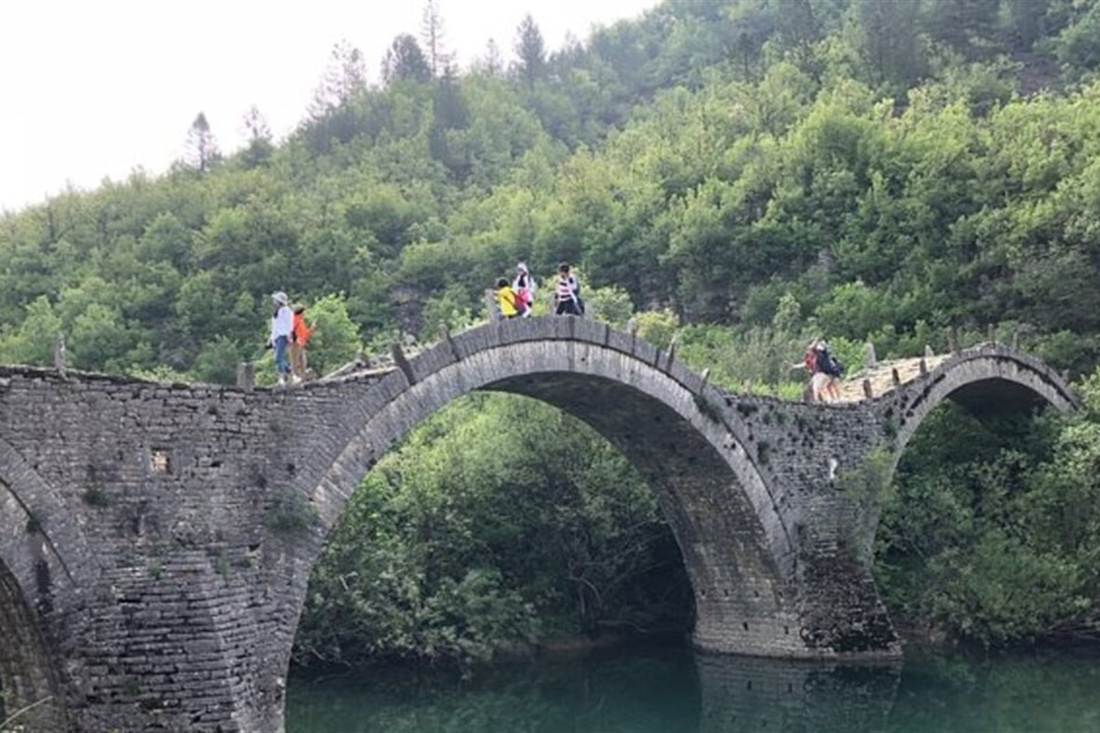
The Kalogeriko and Kokkori bridges both cross the Bagiotiko stream near Kipi. A Zagori day trip from Ioannina can stop at both. The region counts more than 160 arched stone bridges, built in the 18th and 19th centuries.
The Kalogeriko bridge also goes by the name Plakidas. Kalogeriko means “the monk’s” in Greek. It stands about 1.5 km below Kipi and carries three arches. The arches rest on two stone piers set in the stream bed. GetYourGuide lists “Stone Bridges of Zagori,” a tour that starts from Kipi.
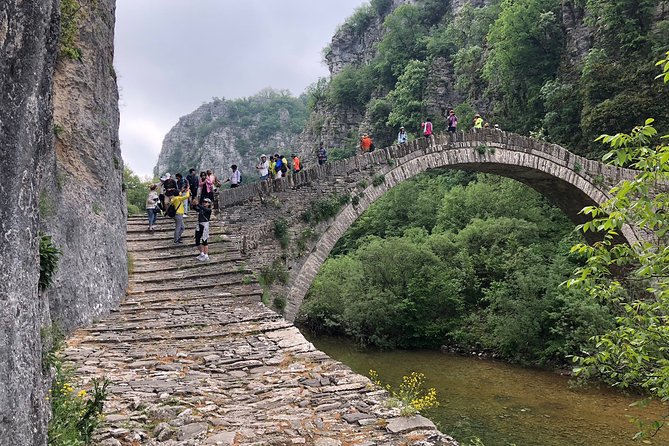
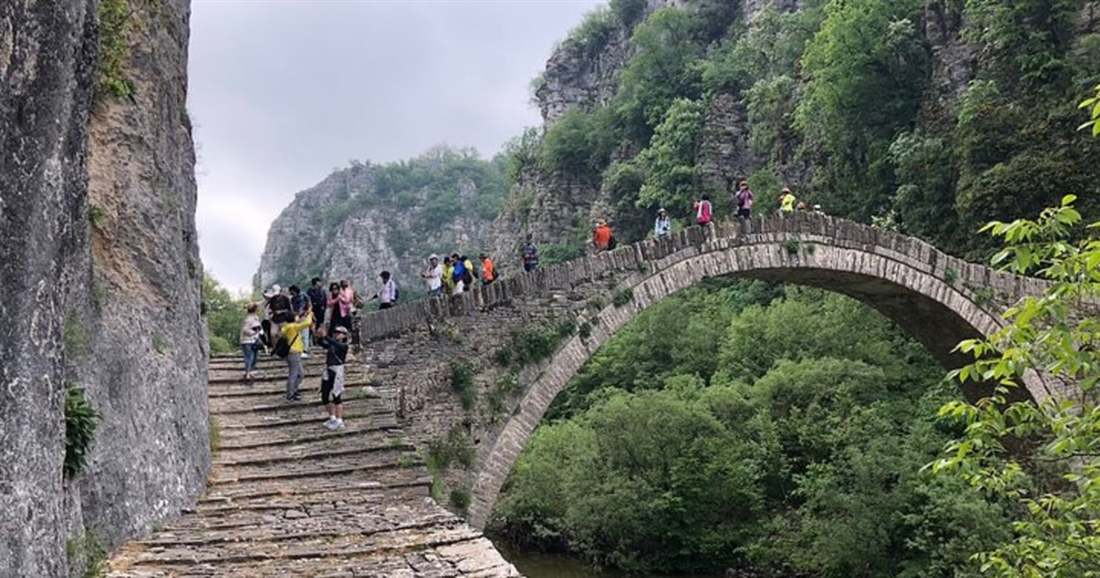
The Kokkori bridge crosses the same stream with one high arch, finished in the mid-18th century. It spans nearly 13 m and stands 10 m above the summer water. A marked pull-off on the Kipi–Koukouli road leads to it on a 10-minute walk. GetYourGuide also lists “Hiking at the Stone Bridges & Traditional Villages of Zagori” from Koukouli.
A Zagori day trip from Ioannina can add more crossings around Kipi and beyond it. A trail heading south from Monodendri also reaches the bridges near Kipi. Each one carries the same arched shape as the Kipi pair. Other bridges in the area include these:
- Milos bridge, between Kipi and an old water mill
- Petsonis bridge, at the Kipi exit toward Fragades
- Missios bridge, below the village of Vitsa
- Klidonia bridge, over the Voidomatis River
Who funded and built the arched bridges of Zagori?
Emigrants from Zagori who grew rich abroad paid for the stone bridges. Master masons from the towns and villages of northern Epirus built them. A Zagori day trip from Ioannina reveals the result of that partnership in stone.
The emigrants traded in big cities far from their mountain homes. They grew rich in Constantinople, Odessa and Bucharest. Part of that wealth came back as donations for bridges over the local streams. The arches seen on a Zagori day trip from Ioannina began as those donations.
The masons shaped local stone into arches, with no steel or concrete in the frame. Each arch had to carry its own weight and stand up to the stream below it. They came from Konitsa and from the villages of Pyrsogianni and Vourbiani.
The stone arches replaced older wooden bridges over the same streams. They joined the villages of Zagori along mountain paths. Paths and bridges carried local travel until modern roads arrived. A Zagori day trip from Ioannina drives those roads, then crosses the old arches on foot.
What are Megalo Papigo and Mikro Papigo?
Megalo Papigo and Mikro Papigo are the twin villages of the Papigo municipal unit in Zagori. Both lie inside the Vikos–Aoös National Park. A Zagori day trip from Ioannina comes here for the rock pools and the Tymfi trails.
The Papigo municipal unit covers 34.131 km² of mountain land. The latest census counted 184 people in Megalo Papigo and 39 in Mikro Papigo. In Greek, megalo means big and mikro means small, and the population figures match the names.
Astraka, a peak of Mount Tymfi, towers over the villages, and deciduous forest surrounds them. Megalo Papigo keeps the church of Saint Blaise. In Mikro Papigo, a church holds a wooden screen made by craftsmen from Epirus.
The Ovires rock pools lie on the Rogovo stream, which runs down Mount Tymfi. The water has cut the pools into the limestone. On a summer Zagori day trip from Ioannina, a swim there cools the body between two walks.
Guided outings around the twin villages appear on the Papigo tours page. A local guide names the paths, peaks and streams along the way. That saves time on a Zagori day trip from Ioannina, where every hour counts.
What is the Dragon Lake of Tymfi?
The Dragon Lake of Tymfi, or Drakolimni, is a glacial lake at 2,050 metres where alpine newts live. The hike takes 4 hours from Mikro Papigo. A full Dragon Lake hike fills its own day, beyond a standard Zagori day trip from Ioannina.
Drakolimni is the biggest lake of the Vikos–Aoös National Park. Its Greek name means dragon lake. Local folk tales about dragons and dragon battles stand behind that name. The alpine newts in its water are linked to those stories. Other spots on Tymfi carry names from myth, such as the Hole of Odysseus and the Chasm of Epos.
The lake formed after the glaciers retreated from Mount Tymfi. Its surface covers 1 hectare, and its deepest point reaches 4.95 metres. Rock glaciers and limestone pavements on the uplands mark the same glacial past.
The shorter approach starts at the Astraka refuge, one hour from the lake on foot. The refuge sits on the pass between the Astraka and Lapatos peaks. A night there splits the climb into two shorter days.
GetYourGuide lists “Mikro Papigko: Dragon Lake Alpine Guided Hike with Lunch” for walkers who want a guide. From the lake shore, the main summits of Tymfi rise on three sides, in these directions:
- Astraka rises to the south-west.
- Ploskos, at 2,377 metres, rises to the south-east.
- Gamila, the highest peak of Tymfi at 2,497 metres, rises to the east-south-east.
Can you raft the Voidomatis river from Ioannina?
Yes, the Voidomatis is rafted on a 6 to 7 km stretch between the Aristi and Kleidonia bridges. A Zagori day trip from Ioannina fits one run, which takes 3 hours in total. Of that, 1.5 to 2 hours are spent on the water.
The river flows at Class I to II, the gentle end of the rafting scale. That level suits first-timers and families with children aged 8 and over. Swimming is required for every rafter, children included.
The Voidomatis runs for 15 kilometres in total. Its main sources rise in the village of Vikos. It ends near Konitsa as a tributary of the Aoös. It is counted among the cleanest rivers in Europe. Kayaks share the river with the rafts.
GetYourGuide lists “Voidomatis River Rafting Zagori” and “Epirus: Zagori Rafting Tour with Viewpoints, Lunch and Photos”. Either one adds a river outing to a Zagori day trip from Ioannina. The rafting kit includes:
- Helmets to protect the head
- Life jackets to keep rafters afloat
- Neoprene shoes to grip wet rock
- Paddles to steer the raft
GetYourGuide also lists canyoning at the Nefeli gorge near Papigo. Canyoning means moving down a gorge on foot and by swimming, without a boat. The Zagori canyoning page covers this second water option for a Zagori day trip from Ioannina.
Which plants and animals live in the Vikos–Aoös National Park?
The Vikos–Aoös National Park covers 12,600 hectares, and studies count 873 vascular plants there. Wolves, foxes, roe deer, otters and chamois live inside its borders. A Zagori day trip from Ioannina spends time in this protected land.
The rare chamois climbs the cliffs, at high altitude and far from human activity. A Zagori day trip from Ioannina rarely crosses its path, so a sighting counts as luck. Wild cats also live in the park. The wider Pindus range shelters the endangered brown bear and the lynx.
The park has a record of 121 bird species. Birds of prey include the griffon vulture, the Egyptian vulture, the peregrine falcon and the common kestrel. The list also holds the hazel grouse, Tengmalm’s owl, the wallcreeper and the willow tit.
Brown trout, roach and barbel swim in the park’s rivers. A threatened snake, Vipera ursinii, lives in the subalpine meadows. The yellow-bellied toad, Bombina variegata, also lives within the park.
Plant life spreads from riverbank to summit. Oriental plane trees form a gallery forest along the banks of the Voidomatis. Wych elm, horse-chestnut, large-leaved linden and nettle-leaved bellflower grow in the forests. Juniper species dominate the Papigo area. In the Vikos Gorge, wild herbs include:
- Lemon balm
- Spearmint
- St John’s wort
- Mountain tea
When does a Zagori day trip from Ioannina work?
A Zagori day trip from Ioannina works in all four seasons. The climate is Mediterranean, shifting toward continental, so each season gives the trip a different face. The right month depends on whether the visitor wants swims, snow or autumn colour.
Summer brings a dry spell of two to three months and stable warm weather. It also brings the largest number of visitors to Zagori. A summer Zagori day trip from Ioannina gains from an early start and long daylight.
Autumn turns the foliage red, copper and vermilion. Snow in the mountains starts to melt at the end of February, as spring approaches. An autumn or spring Zagori day trip from Ioannina meets smaller crowds than the summer peak.
Winter brings heavy snowfalls and very low temperatures. Wood smoke rises from the village chimneys. GetYourGuide lists a snowshoeing tour in Zagori from Vradeto for the snow months. Snowshoes spread the weight, so walkers stay on top of deep snow.
What do you see in Ioannina before or after the trip?
Ioannina is the capital of Epirus and sits on Lake Pamvotida. Before or after a Zagori day trip from Ioannina, walk the walled castle by the lake. You can also cross to the lake island or visit the Perama Cave.
The castle walls enclose the old town of Ioannina. Inside them stands an old synagogue, one of the oldest and largest of its type in Greece. Its Kale, the inner citadel, was the main residence of Ali Pasha, Ottoman ruler of the region. Three museums sit inside the walls.
- The Municipal Ethnographic Museum, in the Aslan Pasha Mosque
- The Byzantine Museum, in the Its Kale citadel
- The silversmithing museum, in the western bastion of Its Kale
People still live on the island in the lake, and boats cross to it from the city. Its settlement keeps stone houses with slate roofs. Ali Pasha was killed on the island, and the site is open to visitors.
Silverwork gave Ioannina its nickname, the silver city. Two more sights lie outside the city. The Perama Cave sits 15 minutes from the airport and holds cave bear fossils. Metsovo, 1 hour away at 1,160 m, is the largest centre of Aromanian, or Vlach, life in Greece.
Where do you eat on a Zagori day trip from Ioannina?
Lunch on a Zagori day trip from Ioannina depends on the tour you book. Certain listings include a traditional lunch of pies, grilled meat and local salads. On other listings, guests buy their own lunch in Monodendri.
Pies, feta and tsipouro belong to the food of Epirus. Feta is a white cheese kept in brine, made from sheep’s milk or sheep and goat milk. Tsipouro is a strong spirit distilled from grape pomace and served in shot glasses with meze.
Metsovo adds its own cheese to the table. Metsovone is a smoked cheese made from cow’s milk, or cow milk mixed with sheep or goat milk. It carries protected designation of origin status in Europe.
Back in the city, Ioannina is known for its baklava. The lake island specialises in frog and eel. A guided food tour of Ioannina covers more regional dishes and drinks. Plan it for the day before or after a Zagori day trip from Ioannina.
What do you bring on a Zagori day trip from Ioannina?
Pack for cooler mountain air and uneven ground on a Zagori day trip from Ioannina. Good shoes, warm layers and enough water come first. Everything fits in one small daypack. Sun gear, a snack and cash fill the rest of the bag.
Wear sturdy shoes with good grip, because stone paths and steps turn slippery when wet. Add a light jacket and layers for the higher ground away from the lake. Layers let you adjust as the day warms up or cools down.
Carry one to one and a half litres of water per person in the daypack. Drink before you feel thirsty, since short walks between stops add up across the day. Five small items complete the kit.
- A hat for shade at open viewpoints
- Sunscreen for exposed skin
- Sunglasses for glare on bright days
- A small snack for the gaps between stops
- Cash for coffee, lunch and village shops
How does a Zagori day trip from Ioannina compare with trips from Parga?
A Zagori day trip from Ioannina starts much closer to the villages than a trip from Parga. Monodendri lies about 1 hour from Ioannina by road. From Parga, the drive to Monodendri takes about 1.5 to 2 hours.
A Zagori tour from Parga runs 8 to 11 hours from start to finish. More of that day goes to the road. Full details sit on the Zagori trip from Parga page.
Ioannina works as a base for more than one mountain day. A Meteora trip from Ioannina crosses the Pindus range into Thessaly. A Zagori day trip from Ioannina stays inside Epirus, on the near side of the range.
The choice comes down to where you sleep. Staying in Ioannina keeps the ride short and the evening free for the city. Staying in Parga trades a longer ride for nights on the Ionian coast.
How do you book and cancel a Zagori day trip from Ioannina?
Book a Zagori day trip from Ioannina online through GetYourGuide or Viator, which list daily and private tours. Free cancellation up to 24 hours before the start is standard on both sites. You cancel through the same site where you booked.
GetYourGuide lists the “Ioannina: Zagori Sightseeing Daily Tour” and the “Zagori Sightseeing Tour with Guide”. For a private day, it also lists the “Zagori Private Vikos Gorge, Voidomatis and More Jeep Tour”. A private tour keeps the vehicle and the guide for your party alone.
On Viator, look for the “Vikos Gorge and Papingo One Day Tour from Ioannina”. The same site lists a “Sightseeing Zagori daily tour” as well. Before you pay, check five points on each listing.
- The pickup point and how you reach it
- The start time and the return time
- The lunch and fees the price includes
- The language the guide speaks
- The cancellation terms and cutoff
Frequently Asked Questions
How long is the drive on a Zagori day trip from Ioannina?
Monodendri sits about 1 hour’s drive from Ioannina, and Papingo about 1 hour 30 minutes. The ride back to the city takes a similar time, depending on the last village visited.
Does a Zagori day trip from Ioannina visit the Vikos Gorge?
Yes, on the listings that name it. Viator’s Vikos Gorge and Papingo One Day Tour from Ioannina has the gorge in its title. So does the GetYourGuide private jeep tour. Read each itinerary for the viewpoints it stops at.
Can you see Papigo on a Zagori day trip from Ioannina?
Yes. Papigo, also spelled Papingo, is one of the Zagori villages. A Viator day tour from Ioannina names it in its title. On other listings, check the itinerary, because stops differ from tour to tour.
Is there a bus from Ioannina to Zagori?
Yes. A KTEL intercity bus runs from the Ioannina city bus station to Zagori on a fixed timetable. Check the departure times in advance, since the schedule sets when you leave and return. A guided tour adds pickup, a guide and transport between stops.
Can a Zagori day trip from Ioannina include rafting?
Yes, as a separate booking or a combined tour. Rafting on the Voidomatis runs as its own 3-hour activity from the Aristi bridge. GetYourGuide also lists a Zagori rafting tour that adds viewpoints and lunch.
Can you cancel a Zagori day trip from Ioannina?
Yes. GetYourGuide and Viator both list free cancellation up to 24 hours before the start as standard. After that cutoff, the listing’s own terms apply, so read them before you pay.