
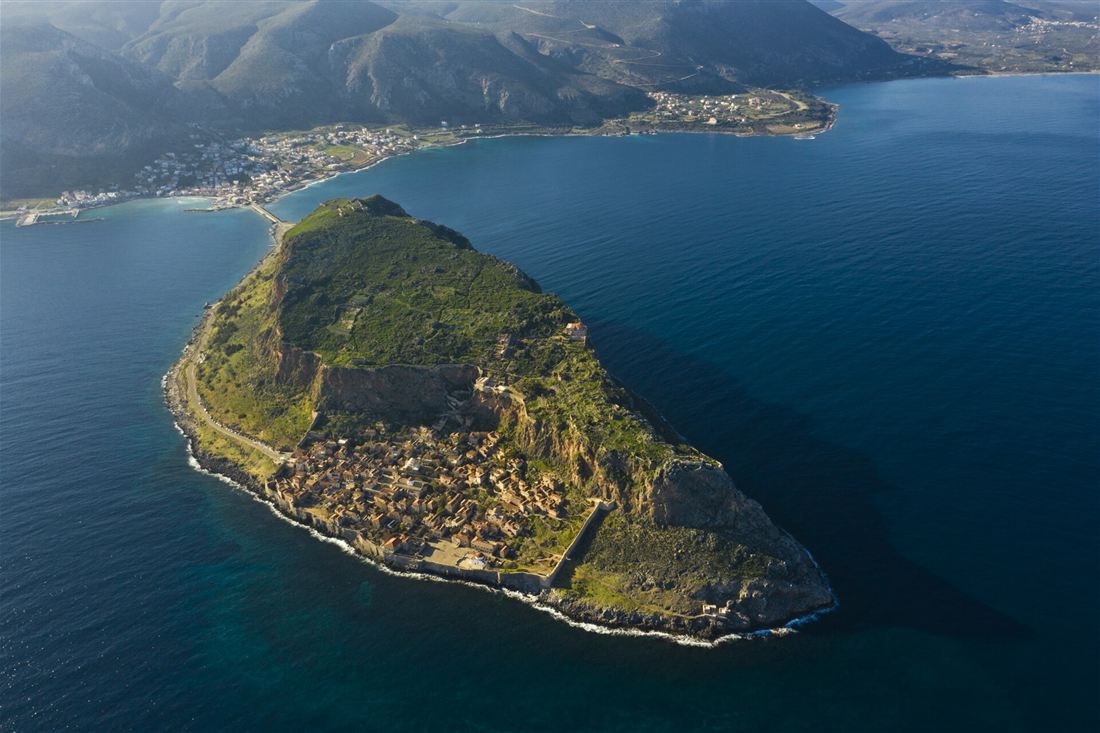
The 2-day private tour to Sparta and Monemvasia from Athens adds Mystras, Nemea, the Mani and Gytheio to the city of King Leonidas and the rock town on the sea. Tours across the rest of the country are listed on Greece Tours.
The sections below cover what the tour to Sparta and Monemvasia includes, the Spartan phalanx, iron money, a city without walls, Monemvasia in the War of Independence, the old mosque collection, season and booking, with links into the Monemvasia tours pages. The tours shown are checked on GetYourGuide and Viator.
What is the 2-day private tour to Sparta and Monemvasia?
The 2-day tour to Sparta and Monemvasia is a private trip from Athens with one night in Sparta. It covers Ancient Sparta, Mystras, Nemea, Areopolis in the Mani, Gytheio and Monemvasia. The group travels alone, with no other travellers joining.
Stops on the 2-day tour to Sparta and Monemvasia spread across two regional units, Corinthia and Laconia. Nemea is the one stop in Corinthia. Its sanctuary of Zeus holds a 4th-century BC temple that had 32 limestone columns. Three have stood since construction, and more were raised again in modern times.
Ancient Sparta and Mystras are the two inland stops in Laconia on the tour to Sparta and Monemvasia. The ancient site lies beside modern Sparti, in the Evrotas valley. The Evrotas river runs past it toward the Laconian Gulf. Mystras rises on a slope of Mount Taygetos, above ancient Sparta.
The coastal stops on the 2-day tour to Sparta and Monemvasia lie south of Sparti. Gytheio, seat of the East Mani municipality, sits on the Laconian Gulf. Areopolis is a Mani town of field-stone tower houses. Monemvasia is a rock 1 km long, joined to the mainland by a 400 m causeway.
Off Gytheio, the islet of Marathonisi joins the town by a causeway. It holds the Tzannetakis Tower, now the Historical and Cultural Museum of Mani, and a marble lighthouse. Areopolis lies 1.5 km from the port of Limeni, near the west coast of the Mani.
Sparti, the capital of Laconia, hosts the one night of the 2-day tour to Sparta and Monemvasia. Mystras lies about 8 km west of the town, and Gytheio 40 km away. A Monemvasia day trip from Athens covers the rock with no night away.
What does the tour to Sparta and Monemvasia include?
The 2-day tour to Sparta and Monemvasia includes pickup in Athens and a private group. Its route covers six named stops in Corinthia and Laconia. Accommodation for the one night in Sparta and all food on both days are not included.
- Included: a private tour for the booking party only
- Included: pickup in Athens
- Included: Nemea, Ancient Sparta, Mystras, the Mani with Areopolis, Gytheio and Monemvasia
- Not included: accommodation for the night in Sparta
- Not included: food on both days
- Shown on the listing: the cancellation terms
Pickup on the 2-day tour to Sparta and Monemvasia starts the route in Athens. From there, the group crosses Corinthia and Laconia without a hire car, a train or a bus ticket. Transport between the six stops is part of the private tour.
Accommodation is not included on the tour to Sparta and Monemvasia, even with one night in Sparta. Travellers book their own room in Sparti before the trip starts. Sparti lies on the eastern foothills of Mount Taygetos, south of Nemea and north of the coast.
Food is not included on the 2-day tour to Sparta and Monemvasia either. Each traveller pays for meals at the stops on both days. Nemea, one of those stops, grows Agiorgitiko, the only grape allowed in its red wine appellation.
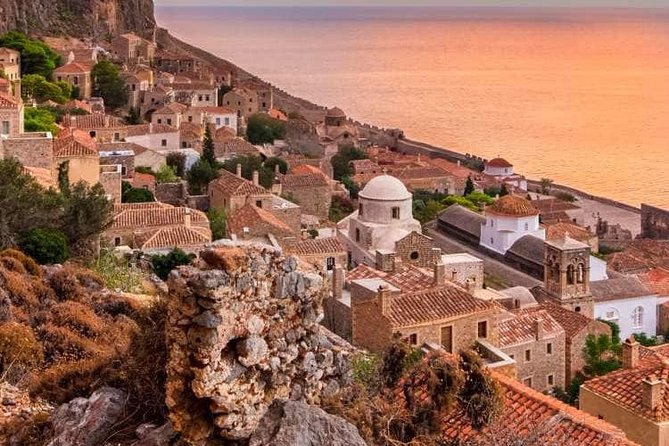
The Monemvasia stop is a walk, since the lower town’s streets fit only pedestrians and donkeys. The road from the mainland ends at the west gate. The upper town on the plateau, 100 m above the sea, is reached by a winding path.
How does it differ from the 2-day Sparta, Mystras and Monemvasia tour?
Both trips last two days and start in Athens. The 2-day tour to Sparta and Monemvasia adds Nemea, the Mani, Areopolis and Gytheio. The other trip adds the Corinth Canal, an olive oil museum and a named hotel in Sparti.
The 2-day Sparta, Mystras and Monemvasia tour follows a set day order. Day one covers the Corinth Canal, Sparta, Mystras and an olive oil museum, with the night in Sparti. Day two visits Monemvasia and ends with the drive back to Athens. The canal, 6.4 km long, links the Gulf of Corinth with the Saronic Gulf.
- Stops on this trip: Nemea, Ancient Sparta, Mystras, Areopolis in the Mani, Gytheio and Monemvasia
- Stops on the other trip: the Corinth Canal, Sparta, Mystras, an olive oil museum and Monemvasia
- Hotel: not included on this trip; a four-star or boutique hotel in Sparti named on the other
- Pickup: included on this trip; available on the other
- Group: private on this trip; private group or small group on the other
- Extra regions on this trip: Nemea in Corinthia, the Mani, Areopolis and Gytheio
Both trips spend the night in Sparti, but only the other one names a four-star or boutique hotel. Pickup is included on the tour to Sparta and Monemvasia and listed as available on the other trip. The other trip also shows private group, small group and free cancellation labels.
Extra regions on the 2-day tour to Sparta and Monemvasia lie north and south of the shared stops. Nemea sits in Corinthia, north of Laconia. Gytheio stands on the eastern shore of the Mani, 20 km northeast of Areopolis.
A longer option is the 3-day trip to Sparta, Monemvasia and the Diros caves. The Diros caves lie in the Mani, south of Areopolis, and visitors tour them by boat. The two-day listing here names Areopolis but no cave stop.
How did the Spartan phalanx fight?
Spartan hoplites fought in a phalanx eight to twelve men deep, with shields locked into one wall. The front ranks stabbed with spears while the rear ranks pushed forward. A 2-day tour to Sparta and Monemvasia visits Ancient Sparta, the city of King Leonidas.
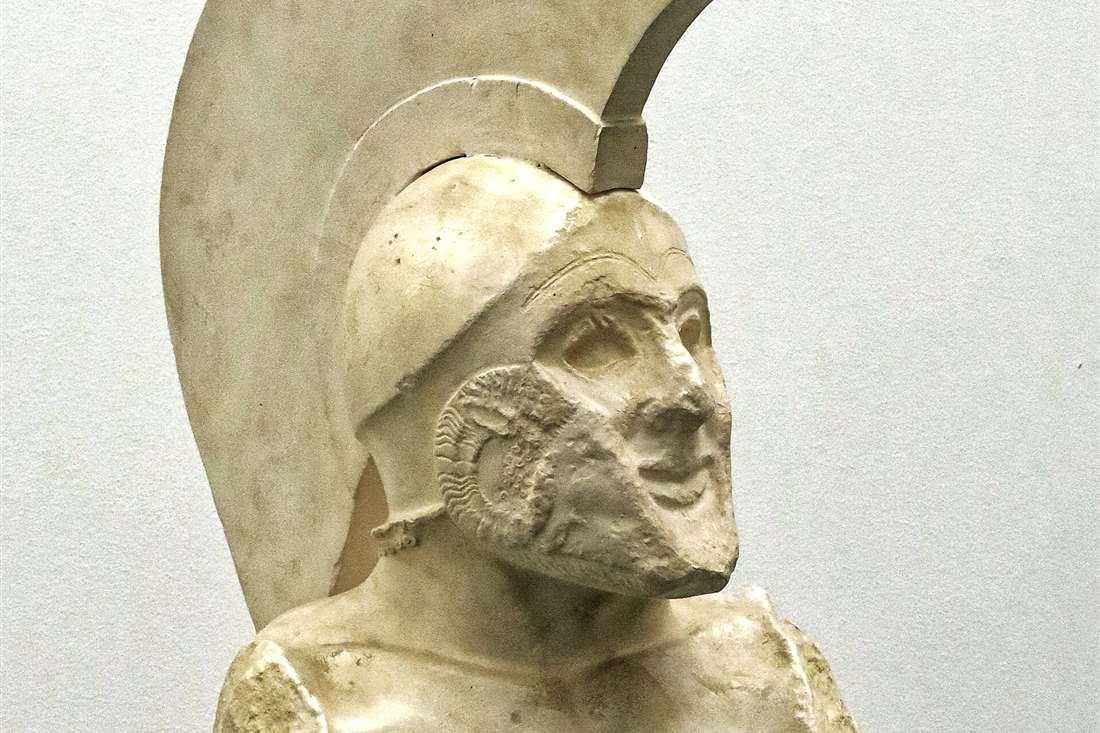
The smallest Spartan unit was the enomotia, 36 men in three files of twelve. Two enomotiai made a pentekostys of 72 men. Two of those formed a lochos of 144. Four lochoi made a mora of 576 men under a polemarch. The 2-day tour to Sparta and Monemvasia reaches the home base of all six morai.
Each shield covered the left side of its bearer and the right side of the man beside him. Whole lines drifted rightward as each soldier pressed toward a neighbour’s cover. Guests on the 2-day tour to Sparta and Monemvasia stand in the valley where these lines trained.
- Aspis: a round shield about 90 cm across, made of wood faced with bronze.
- Dory: a thrusting spear about 2.5 m long, the main weapon of the line.
- Xiphos: a short iron sword, only 30 to 45 cm long in the Spartan version.
- Helmet: a bronze Corinthian helmet that covered the face except the eyes and mouth.
- Cuirass: a flanged bronze plate that guarded the chest and back.
- Greaves: bronze shin guards that clipped around the leg from knee to ankle.
Spartiates marched in crimson tunics and cloaks, the one mark that set them apart on the field. Dropping a shield meant disgrace, since each shield guarded the whole formation. In the 5th century BC, Leonidas held the pass of Thermopylae with 300 Spartans in phalanx order. Thermopylae tours reach that pass, about 200 km north-west of Athens.
Sparta’s hold on the battlefield broke at Leuctra in the 4th century BC. Theban general Epaminondas stacked his left wing 50 ranks deep and crushed a Spartan line 12 deep. Among Sparta tours, this private tour covers that ground over 2 days from Athens.
Why did Sparta use iron money instead of silver?
Spartan law banned gold and silver coins and used heavy iron bars as money. Wealth in iron grew too bulky to hoard or hide. A 2-day tour to Sparta and Monemvasia stops in the city that kept this rule for centuries.
Tradition credits the iron rule to Lycurgus, a lawgiver dated between the 9th and 8th centuries BC. The iron was quenched in vinegar while red-hot, which left it brittle and useless for tools. Storing a modest sum took a whole room, and moving it took a yoke of oxen.
Foreign merchants refused the iron bars, so luxury imports stopped reaching Laconia. Silver captured in the Peloponnesian War entered the state treasury in the late 5th century BC. Sparta minted no coins of its own until the 3rd century BC. Ancient Sparta, a stop on the 2-day tour to Sparta and Monemvasia, lies north of the modern town.
Every citizen held one farm estate, a kleros, farmed by state serfs. The land reform of Lycurgus created 9,000 equal estates for Spartan citizens. Each kleros was sized to yield 70 medimnoi of barley a year for its owner. Fields of the Eurotas plain, seen on the 2-day tour to Sparta and Monemvasia, once held these estates.
Further laws credited to Lycurgus kept the code unwritten and allowed only the axe and saw for houses. Each citizen paid food dues to a common mess, the syssitia, or lost his citizen rank. Modern Sparti, the overnight stop on the 2-day tour to Sparta and Monemvasia, dates from the 19th century.
Why did Sparta stay without city walls for centuries?
Sparta trusted its citizen army and a mountain-ringed valley instead of stone walls. No enemy army reached the city until the 4th century BC. A 2-day tour to Sparta and Monemvasia explores a city left unwalled until the Hellenistic period.
A saying linked to Lycurgus holds that a city ringed by men, not bricks, is well fortified. In the 4th century BC, Agesilaus II pointed to his armed citizens and called them Sparta’s walls. The 2-day tour to Sparta and Monemvasia takes guests into the city these living walls guarded.
Mount Taygetus, at 2,404 m, walls the valley to the west, and Parnon closes the east. Epaminondas of Thebes led the first invasion and camped on the Eurotas facing the city. His army never took Sparta itself. Travellers on the 2-day tour to Sparta and Monemvasia see both ranges frame the valley.
Sparta grew as a cluster of open villages beside the Eurotas river. In the 5th century BC, Thucydides described a city with no splendid temples or public buildings. He judged its remains too plain to show later ages its true power.
The first ditches and palisades went up in the late 4th century BC, against Macedonian armies. Pyrrhus of Epirus attacked in the 3rd century BC and failed to take the city. A full stone circuit, built in stages, closed around Sparta only in the 2nd century BC.
Sparta’s acropolis hill gained a Late Roman wall after a Gothic raid in the 3rd century AD. Stretches survive near the Roman theatre, on the site the 2-day tour to Sparta and Monemvasia reaches. A Sparta day trip from Athens returns to the capital the same evening.

What happened at Monemvasia in the Greek War of Independence?
Greek rebels besieged the Ottoman garrison of Monemvasia by land and sea from 15 March. The fortress surrendered on 23 July, after four months short of food and water. A 2-day tour to Sparta and Monemvasia leaves Athens and explores this medieval town.
Georgios Michalakis led local bands from the Monemvasia district in the land siege. About 250 Tsakonians under Leonidiotis and the Maniots of Tzannetakis Grigorakis joined him. In all, about 10,000 people from the surrounding provinces took part in the blockade. The rock that a 2-day tour to Sparta and Monemvasia reaches faced this whole force.
Between 1,500 and 1,600 Ottomans lived inside the walls. The defenders broke the bridge to the mainland and fired cannon at the rebel lines. The strongest men carried their food up to the acropolis on the summit. The causeway on a 2-day tour to Sparta and Monemvasia links the rock to mainland Gefyra.
Water and grain ran short in both the lower town and the acropolis. Even so, the garrison refused to give in through spring and early summer. That summit, visible on any 2-day tour to Sparta and Monemvasia, held the last holdouts. The siege and surrender ran in this order:
- Mid-March, early 19th century: Bishop Anthimos of Elos blesses the chieftains’ flags, and the blockade begins
- During the blockade: about 150 defenders slip out toward Old Monemvasia, and more than half are killed
- Mid-June: Dimitrios Ypsilantis reaches the Peloponnese to lead the revolt
- July: his envoy Alexandros Kantakouzenos agrees terms with the lower fortress, then with the acropolis
- 23 July: the fortress and all its weapons pass to the Greek forces
- Two days later: the Tsakonians leave for the siege of Tripolitsa and hand the garrison to Tzannetakis Grigorakis
Under the terms, the Ottomans gave up their movable property. They boarded ships for Kuşadası, on the coast of Asia Minor. Kantakouzenos then named Michalakis commander of a Tsakonian garrison. Quarrels over the spoils and the town’s administration soon followed. The handover made the town on a 2-day tour to Sparta and Monemvasia an early Greek-held fortress.
Two years after the surrender, in September, Maniots under Konstantinos Mavromichalis besieged the fortress again. By the next March, Maniots held half the villages of the province. Cretans and Psarans reached the fortress after the destruction of Psara, but the siege went on.
In January, late in the war, Dimitris Plapoutas came with 200 soldiers, then withdrew. Mavromichalis ended up in charge of the castle. These quarrels kept Monemvasia from a leading role in the new Greek state. The 2-day tour to Sparta and Monemvasia runs as a private trip.
What does the archaeological collection in the old mosque of Monemvasia hold?
The former mosque on Elkomenos Square shows finds from early Christian times to the end of Ottoman rule. Carved marble and daily pottery fill its vaulted 60-square-metre hall. The square sits inside the walled lower town on a 2-day tour to Sparta and Monemvasia.
The Ottomans took Monemvasia in November, in the 16th century, and raised this mosque soon after. Its Turkish name was Benefşe Camii. The brick and stone prayer hall is square, 6.5 metres a side. Its dome, a landmark on any 2-day tour to Sparta and Monemvasia, rests on four squinches. When built, the dome rose 8.5 metres high.
Venetian forces retook the town late in the 17th century and turned the mosque into a hospice. Muslim prayer returned with the Ottomans in the early 18th century. After independence, the hall on the 2-day tour to Sparta and Monemvasia route became a prison. It ran as a café in the early 20th century, when Ramsay Traquair visited.
The collection opened in July, at the close of the 20th century, after restoration of the building. The 5th Ephorate of Byzantine Antiquities keeps offices in the same building. The finds come from Monemvasia in Laconia, the region a 2-day tour to Sparta and Monemvasia covers. The exhibits fall into these groups:
- Early Christian architectural sculpture in marble, from the 4th to the 7th century
- Byzantine carvings, including sculpted pieces from the church of Hagia Sophia
- A fully restored marble iconostasis
- Post-Byzantine stonework from the 15th to the 19th century
- Venetian-era coats of arms
- Ceramic objects of daily use from the walled town
- A small set of coins, oil lamps and glass objects
An iconostasis is the screen that divides the altar from the rest of an Orthodox church. The restored example came from a small church of the Middle Byzantine period, 9th to 12th centuries. Marble remains of a 12th-century church join it. These carvings record the stonework of the medieval tower city a 2-day tour to Sparta and Monemvasia explores.
The building has two halls, the domed square hall and a rectangular space to the west. Ceramic tiles protect the original floor of the display hall. A two-storey room on the north side serves as visitor reception. The minaret at the southwest corner is gone, and neither the mihrab nor the porch survives.
The display sets out the public and private life of the townspeople inside the walls. Apart from the 2-day tour to Sparta and Monemvasia, the area also hosts Monemvasia wine tasting. A Monemvasia day trip from Nafplio starts in the Argolid instead.


Which season suits the 2-day tour to Sparta and Monemvasia?
Spring and autumn suit the 2-day tour to Sparta and Monemvasia. In late spring, daytime highs reach about 28°C in Sparta and 25°C in Monemvasia. In October, highs sit near 26°C in Sparta and 24°C in Monemvasia.
Summer brings the hottest days of the year on this route. July highs average about 36°C in Sparta, and the town gets only 10 mm of rain that month. Monemvasia, on the coast, averages about 32°C in July. Pack water, a hat and sun cream for a summer 2-day tour to Sparta and Monemvasia.
In winter, January highs reach about 15°C in both places, while Sparta drops to about 3°C at night. Monemvasia stays near 11°C on January nights. January is also the wettest month in Sparta, with about 125 mm of rain. A rain jacket and grippy shoes suit a winter tour to Sparta and Monemvasia.
Monemvasia is a rock joined to the mainland by a causeway about 400 metres long. Its upper town sits on a plateau about 100 metres above sea level. A winding cobblestone path climbs there through two gates. The old streets fit only people on foot and donkeys, so flat shoes with good grip matter.
Mystras adds another hillside walk on the 2-day tour to Sparta and Monemvasia. The site spreads over a hill on Mount Taygetus, west of modern Sparta. Other ways to visit that hill town are listed under Mystras tours.
How do you book and cancel the tour to Sparta and Monemvasia?
Booking the 2-day tour to Sparta and Monemvasia goes through GetYourGuide listing 930523. Pick a date, set the group size and read the cancellation terms first. Free cancellation runs up to 24 hours before the start where the listing shows that label.
The six steps below cover the booking of a 2-day tour to Sparta and Monemvasia. Five take place on the listing and its checkout, and the sixth is a hotel booking in Sparta. Other trips across the region appear on the Peloponnese tours page.
- Open the listing and check the six named stops.
- Pick the start date on the availability calendar.
- Set the number of travellers in the private group.
- Read the cancellation terms shown on the listing.
- Add the Athens pickup address when checkout asks for it.
- Reserve a room in Sparta for the overnight stop.
Cancelling the 2-day tour to Sparta and Monemvasia happens in the GetYourGuide account, under the booking itself. A room booked in Sparta keeps its own terms with the hotel. Cancel both when plans change, since one does not cancel the other.
Frequently Asked Questions
How long does the private Sparta and Monemvasia trip last?
The trip lasts 2 days and starts in Athens. The two days run back to back, with a single overnight stop between them. Two days give the tour to Sparta and Monemvasia time for inland sites and the Laconian coast.
Where is the night spent on the trip?
The night is spent in Sparta, the only overnight stop on the route. Sparta sits in the Eurotas valley, a short drive east of the hill of Mystras. Roads from the town lead south to Gytheio and the Mani, and southeast to Monemvasia.
Is the trip private?
Yes, the listing sells this trip as a private tour. Only the travellers named in the booking take part, with no strangers added to the group. The private format covers the whole 2-day tour to Sparta and Monemvasia, both days included.
Which places does the route visit?
The listing names six stops for the 2-day tour to Sparta and Monemvasia. They are Ancient Sparta, Mystras, Nemea, the Mani with Areopolis, Gytheio and Monemvasia. Nemea lies in the northeast Peloponnese, on the road from Athens. Gytheio and Monemvasia face the sea in Laconia.
Is pickup from Athens included?
Yes, pickup is included, and the trip starts in Athens. That removes the need for a train, bus or rental car to reach the Peloponnese. Travellers share their Athens hotel or address for pickup during booking, as listed in the steps above.
Are hotel and meals included?
No, accommodation and food are not included. Travellers book their own room for the night in Sparta and pay for each meal on the road. Tavernas in Sparta, Gytheio and Monemvasia serve lunch and dinner along the route. Snacks for the drives between stops go in the bag before pickup.