
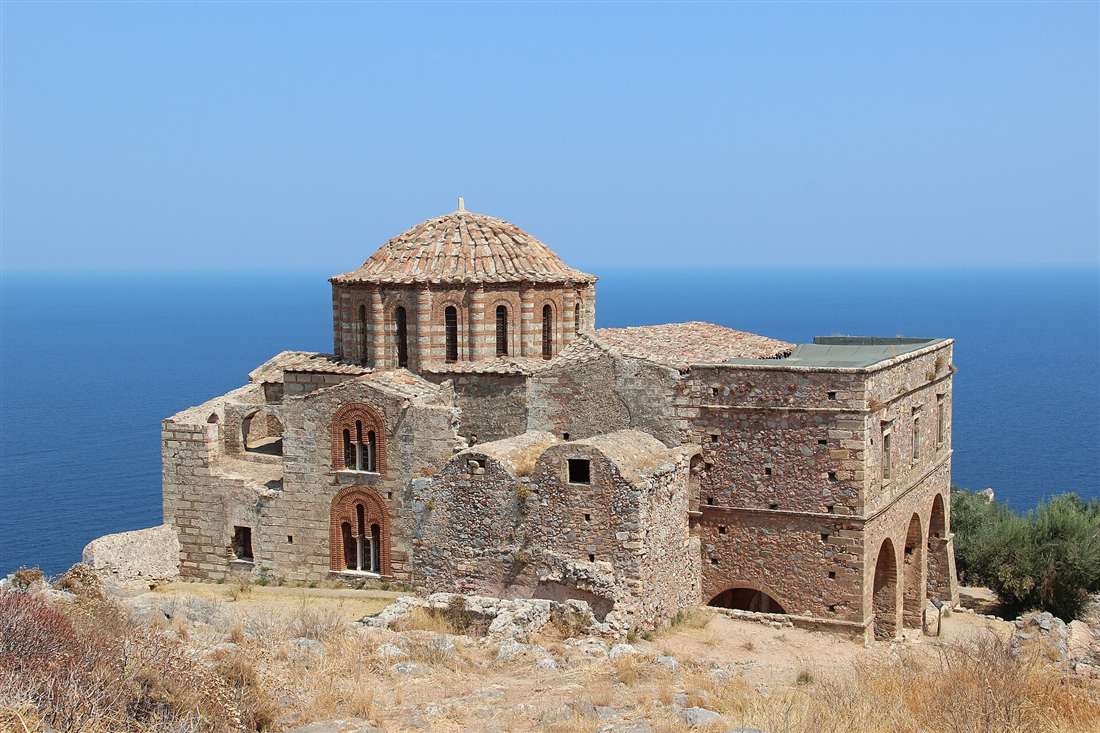
The private 2-day Sparta, Mystras and Monemvasia tour from Athens joins the ruins of ancient Sparta, the Byzantine city of Mystras and the medieval town of Monemvasia. Tours across the rest of the country are listed on Greece Tours.
The sections below cover what the Mystras and Monemvasia tour includes, the route, Sparta, the churches and castle of Mystras, the churches of Monemvasia, season and booking, with links into the Monemvasia tours pages. The tours shown are checked on GetYourGuide and Viator.
What is the private 2-day Sparta, Mystras and Monemvasia tour?
The Sparta, Mystras and Monemvasia tour runs for two days from Athens. It visits Sparta’s ancient ruins, Byzantine Mystras and medieval Monemvasia. One overnight stay in Sparti separates the inland visits from the coastal stop.
From Athens, the route enters the southeastern Peloponnese and reaches sites across Laconia. This Sparta, Mystras and Monemvasia tour links three different settings. It pairs an ancient archaeological landscape with a Byzantine settlement and a medieval coastal town. The sequence stays within the region before the return north.
Sparta stands in the Eurotas valley, with the Taygetus range to the west. Mystras occupies a steep foothill on Taygetus, six kilometres northwest of Sparta. These locations keep the first day’s archaeological and Byzantine stops within the same inland area.
Monemvasia is on a tied island off the Peloponnese’s east coast, joined to the mainland by a causeway. This gives the final stop a coastal setting unlike inland Sparta and Mystras. The causeway makes its connection to the mainland clear in the landscape. A separate Monemvasia day trip from Athens page focuses on this town.
What does the Mystras and Monemvasia tour include?
The Sparta, Mystras and Monemvasia tour connects Athens with one overnight base in Sparti. Its stated arrangements cover transport, pickup, an English-speaking driver and lodging. Booking labels also state group format, departure notice and cancellation terms.
The overnight stop comes after the first day’s visits and before departure toward Monemvasia. This Sparta, Mystras and Monemvasia tour places its single night between inland and coastal stages. The return to Athens concludes the second day’s plan, without adding another hotel base.
Private group and small group appear as activity labels, but no party limit accompanies them. The labels classify the activity without defining the number of travellers in each party. Pickup is available, and the English-speaking driver forms part of the transport arrangement.
Advance booking and cancellation set separate conditions. One sets how early a reservation must be made. The other sets the withdrawal deadline. The activity has no reviews yet, so there is no customer rating alongside its new status. These are booking conditions, not sightseeing stops.
- Two-day activity from Athens; private-group and small-group labels.
- Pickup available, with an English-speaking driver.
- One night in Sparti at a four-star or boutique hotel.
- Free cancellation until 24 hours before the start.
- Booking required at least 10 hours before departure.
- New activity with no reviews yet.
Which stops does the two-day route make?
This Sparta, Mystras and Monemvasia tour follows a two-day route from Athens through Laconia. Day one includes the canal, Sparta, Mystras and the Olive Oil Museum. Day two visits Monemvasia before the return to Athens.
The first stop is the Corinth Canal, where the tour allows a short photo break. The waterway connects the Gulf of Corinth with the Saronic Gulf. It cuts the Isthmus of Corinth, separating the Peloponnese from mainland Greece. This crossing marks the route’s passage onto the peninsula by road.
In Sparta, the stops are the Ancient Acropolis ruins and the statue of King Leonidas. Mystras follows, on the Taygetus slope above Sparta. The Sparta, Mystras and Monemvasia tour then visits Sparta’s Olive Oil Museum before the Sparti overnight.
Monemvasia comes the next morning, followed by the return drive to Athens. The town occupies a tied island linked to the mainland by a causeway. The coastal crossing differs from the inland settings visited on day one. For a separate hillside-focused outing, see the Mystras day trip from Athens page.
- Corinth Canal photo stop.
- Ancient Acropolis ruins in Sparta.
- Statue of King Leonidas.
- Mystras.
- Sparta’s Olive Oil Museum.
- Monemvasia on day two.
How does it compare with the 3-day trip that adds the Diros caves?
The Sparta, Mystras and Monemvasia tour runs for two days with one Sparti overnight. The three-day trip adds a night in Monemvasia and another in Gytheio. It also adds the Diros Caves boat route and a Gytheio stop.
The extra day changes the trip’s geographic scope, not just its pace. The three-day plan reaches the Mani coast and adds a boat passage through the Diros Caves. By comparison, the Sparta, Mystras and Monemvasia tour stays focused on its named inland and coastal destinations.
On the longer itinerary, the first night is in Monemvasia, and the second is in Gytheio. Day three then reaches Sparti and Mystras. The Sparta, Mystras and Monemvasia tour instead places its overnight in Sparti before continuing to Monemvasia.
The cave visit is a small-boat passage through water-filled chambers. This activity differs from the archaeological and town visits on the two-day route. A short walk on land follows the boat route. The longer trip also includes time in Gytheio, a port on the Laconian Gulf. See the three-day Sparta, Monemvasia and Diros Caves itinerary for that expanded route.
Which Sparta sights fit into a two-day route?
The ancient Acropolis holds a theatre, temple remains, shops, and a circular structure. These remains mark different civic uses. A Sparta, Mystras and Monemvasia tour also names the Leonidas statue and Olive Oil Museum as Sparta stops.
The route lists ruins of the Ancient Acropolis, a Leonidas statue photo stop, and the Olive Oil Museum. The site and statue show different parts of Sparta’s landscape. A Sparta, Mystras and Monemvasia tour sets excavated remains beside a modern public monument.
At the Acropolis, the ancient theatre occupies the south side of the hill. The Ministry of Culture dates it to the Early Imperial period and records its orchestra and retaining walls. Part of the large cavea also survives.
Those theatre walls preserve inscriptions naming Sparta’s rulers under Roman rule. Shop remains beside the theatre served performance visitors. Excavations also identified the Athena Chalkioikos temple from limited architectural traces.
The Sparta tours page offers wider regional context. A Sparta, Mystras and Monemvasia tour differs from the shorter Sparta day trip page. That page focuses on Sparta beyond this itinerary.
Which churches and frescoes stand out at Mystras?
Late Byzantine churches at Mystras retain painted interiors worth comparing for scale and placement. A Sparta, Mystras and Monemvasia tour includes a Mystras stop among the Peloponnese sites. The churches connect fresco painting with the settlement’s steep hillside setting.
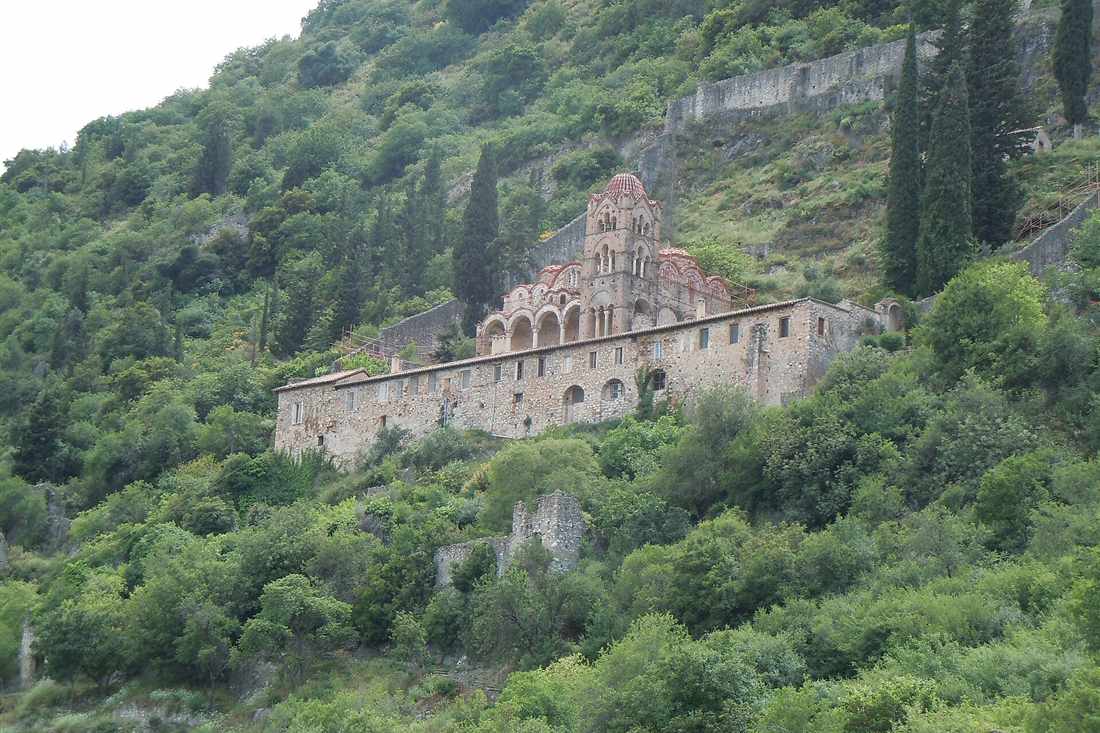
Mystras’s churches carry fresco programs that reflect the city’s late Byzantine artistic life. Frescoes remain visible in a number of buildings. Their walls preserve a rich record of interior painting.
At Peribleptos, frescoes from the mid-to-late 14th century cover the main church interior. The scenes form a connected program, with compositions arranged across the sanctuary and adjoining wall surfaces. A Sparta, Mystras and Monemvasia tour encounters these paintings within the site.
A Sparta, Mystras and Monemvasia tour brings the site into a route linking ancient and medieval places. The Mystras tours page provides a wider look at the hilltop settlement and its monuments.
The churches occupy different positions across the site. Their architectural features distinguish each sacred space. Each listing below pairs a church with a defining feature. Church facades also reflect different periods of construction. Pantanassa remains occupied by nuns.
- Agios Dimitrios served as Mystras’s cathedral.
- Peribleptos is built into a cliffside cave.
- Pantanassa was dedicated in the early 15th century.
- Agia Sofia dates to the mid-14th century.


What is the Frankish castle above Mystras?
The Frankish castle crowns the hill above Mystras. William II of Villehardouin established the stronghold in the mid-13th century. On a Sparta, Mystras and Monemvasia tour, it offers a clear view of Mystras’s layered history.
The Ministry of Culture places the castle on a steep foothill of Mount Taygetos, northwest of Sparta. The medieval settlement grew below its summit, following the contours of the slope.
UNESCO describes Mystras as an amphitheatre built around the fortress. The Franks surrendered the castle to the Byzantines during the 13th century. Mystras then became a center of Byzantine power in southern Greece.
The castle began as a military stronghold, while later palaces and churches occupied the settlement below. This distinction helps separate the hilltop fortification from the broader medieval city that developed around it.
A Sparta, Mystras and Monemvasia tour connects the Frankish foundation with the Byzantine monuments lower on the hillside. The castle’s position explains how defense and urban growth shaped Mystras as one connected site.
Which Byzantine churches stand in Monemvasia?
Monemvasia’s fortified town holds Byzantine churches at different levels. A Sparta, Mystras and Monemvasia tour names ancient churches among the town’s stops. Hagia Sophia and Christ Elkomenos occupy distinct settings within Monemvasia’s medieval walled town.
The route description identifies Monemvasia’s medieval castle and ancient churches among its town stops. Churches stand in both upper and lower sections of the fortified settlement. Their locations extend beyond one square or terrace. A Sparta, Mystras and Monemvasia tour visits both town levels. A causeway links the town to the mainland.
Hagia Sophia stands in the upper town near the cliff edge. Its cross-in-square plan has a dome, and its main room measures fourteen metres by fourteen metres. A narthex stands west of the main space. The dome has sixteen windows and measures seven metres across.
A Sparta, Mystras and Monemvasia tour stops in this medieval town after visiting Sparta and Mystras in sequence. The churches below show a range of forms and settings within Monemvasia’s walls.
Christ Elkomenos stands in the central square of the lower town. The church is now a three-aisled basilica with a dome. A separate belfry stands northwest. The surviving church underwent changes under multiple rulers.
- Hagia Sophia sits in Monemvasia’s upper town.
- Christ Elkomenos stands in the lower town’s central square.
- Panagia Chrysafitissa rises near the sea wall.
- Agios Nikolaos carries an inscription dating its construction to the early 18th century.


How did one treaty join Mystras and Monemvasia?
One treaty of the 13th century joined Mystras and Monemvasia. After his defeat at Pelagonia, the Frankish prince William of Villehardouin handed both to Byzantium. The Sparta, Mystras and Monemvasia tour visits two places that changed hands together.
In the late 1240s, William II of Villehardouin ruled the Frankish Principality of Achaea. He captured Monemvasia, the last Byzantine outpost on the Morea. Morea was the medieval name for the Peloponnese. He then raised a castle on a hill above Sparta, and that castle became the core of Mystras.
At the Battle of Pelagonia, the forces of the Nicaean emperor Michael VIII Palaiologos defeated William. They captured him together with his nobles. The emperor freed them in exchange for an oath of loyalty. The price was three strongholds: Monemvasia, Grand Magne and Mystras.
The handover took place in the early 1260s. From then on, Mystras was the seat of the Byzantine governor of the Morea. William broke his oath soon after his return home. War between the Byzantines and the Franks followed.
In the 14th and 15th centuries, Mystras became the capital of the Despotate of the Morea. Manuel Kantakouzenos was its first Despot. The scholar Gemistos Plethon worked there during the Palaeologan Renaissance.
That shared past links the two days of the Sparta, Mystras and Monemvasia tour. Both towns belonged to the same Byzantine province. One served as its capital in the hills, and the other as its fortified port on the sea.
Which season suits the Mystras and Monemvasia tour?
Spring and autumn suit the Sparta, Mystras and Monemvasia tour. Milder days help on the steep paths of Mystras and on the open rock of Monemvasia. Summer brings the hottest days, so early starts, hats and water matter.
Mystras covers a steep foothill of the Taygetus range. Paths climb from the lower town past the churches to the castle at the top. Walking between the sites means steps and uneven stone, which feel harder in midday heat.
Monemvasia adds a second climb on day two. A path rises from the lower town to the plateau of the upper town. The plateau is open ground with little shade. The Sparta, Mystras and Monemvasia tour therefore asks for the same care on both days.
Summer in Laconia is hot and dry. Spring brings green slopes on the Taygetus range and milder air for walking. Autumn keeps warm days with less heat than midsummer. Winter brings shorter daylight, and snow can cap the high Taygetus peaks.
Shoes with grip help on worn marble steps and stone paths at both sites. A hat and a refillable bottle cover the open plateau of Monemvasia. A light layer helps on the hillside of Mystras on cooler mornings.
How do you book and cancel the Mystras and Monemvasia tour?
Book the Sparta, Mystras and Monemvasia tour on its GetYourGuide listing at least 10 hours before the start. Free cancellation runs up to 24 hours before departure. Pickup is available, and the listing shows a private group.
The booking runs on the listing page from start to finish. Choose a date and the number of travellers, then pay online. The confirmation arrives by email. Check the pickup details on the listing before the first morning.
- Open the GetYourGuide listing for the tour.
- Choose the date and the number of travellers.
- Read the terms and the pickup details.
- Pay online and keep the email confirmation.
- Cancel at least 24 hours before the start for free.
GetYourGuide free cancellation applies on listings that show it, and this listing shows it. Count back 24 hours from the start time to find the deadline. The Sparta, Mystras and Monemvasia tour is a new activity with no reviews yet. The listing page is the main source of detail.
Travellers based in Nafplio can compare the Monemvasia day trip from Nafplio. Longer routes across the region appear on the Peloponnese tours page.
Frequently Asked Questions
How long is the Sparta, Mystras and Monemvasia tour?
The tour lasts two days and starts from Athens. Day one covers the Corinth Canal, Sparta, Mystras and the Olive Oil Museum. Day two visits Monemvasia before the return drive to Athens. The listing gives one night between the two days.
Where is the night spent?
The night is spent in Sparti, the modern town of Sparta. The listing names a four-star or boutique hotel for that night. The overnight falls after the visit to Mystras and before the drive to Monemvasia on the second morning.
Is the Mystras and Monemvasia tour private?
Yes. The listing shows a private group label, and it also shows a small group label. An English-speaking driver handles the transport. Travellers set the date and the number of people in the party when they book on GetYourGuide.
Does the tour include pickup?
Yes. The listing shows pickup as available. The exact pickup details sit on the listing page, so read them before booking. Note the time and the place before the first morning. The route leaves Athens for the Corinth Canal.
Does the tour have reviews yet?
No. The tour is a new activity on GetYourGuide, and no traveller reviews appear yet. The listing page is therefore the main source of detail. Read its stops, terms and pickup notes in full before paying for the tour.