
The private 3-day tour to Corinth, Sparta and Mystras from Athens adds Mycenae, Epidaurus, Nafplio and Monemvasia with a personal driver-guide. Tours across the rest of the country are listed on Greece Tours.
The sections below cover what the 3-day tour to Corinth includes, the canal, Ancient Corinth, Mycenae, Epidaurus, Nafplio, Sparta, Mystras, Monemvasia, season and booking, with links into the Sparta tours pages. The tours shown are checked on GetYourGuide and Viator.
What is the private 3-day tour to Corinth, Sparta and Mystras?
The private 3-day tour to Corinth, Sparta and Mystras is a GetYourGuide activity that starts in Athens. A personal driver-guide leads one party through Corinth, Mycenae, Epidaurus, Nafplio, Sparta, Mystras and Monemvasia over three days.
GetYourGuide files the 3-day tour to Corinth, Sparta and Mystras under Nafplio, a port town in the Argolid. The route leaves Athens, crosses the isthmus and runs south through the Peloponnese. Seven places share the three days, from Bronze Age ruins to medieval towns.
The listing sums up the trip in three parts: ancient ruins, a theatre and medieval towns. The ruins stand at Corinth and Mycenae. The theatre belongs to the sanctuary of Epidaurus. The medieval towns are Mystras, on a hill above Sparta, and Monemvasia, on a rock in the sea.
A private format means one booking per vehicle. No strangers share the seats, and the driver-guide works for that party alone. The 3-day tour to Corinth is new on GetYourGuide, and no traveller reviews appear yet.
The route mixes three eras of Greek history. Mycenae belongs to the Bronze Age. Corinth and Epidaurus belong to the Classical and Roman world. Mystras and Monemvasia belong to the Byzantine and medieval centuries.
Travellers with a single free day can compare the Mystras day trip from Athens. That route reaches the Byzantine town and returns to the capital the same day. The three-day format adds the Argolid sites and Monemvasia to the same trip south.
What does the 3-day tour to Corinth include?
Each booking of the 3-day tour to Corinth includes private transport from Athens and a personal driver-guide. The driver-guide stays with the party for all three days. The inclusions list states whether tickets, meals and hotels are covered.
A driver-guide combines two roles in one person. The same person drives the car and explains each site along the way. On the 3-day tour to Corinth, Sparta and Mystras, that means one contact for timing, stops and questions.
- Private tour for one booking only
- Personal driver-guide for all three days
- Departure from Athens
- Seven stops across the Peloponnese
- Booking and cancellation through GetYourGuide
Greek archaeological sites charge their own entry fees at the gate or online. Mycenae, Ancient Corinth, Epidaurus and Mystras each sell a separate ticket. The inclusions list shows whether the price of the tour covers them.
Inside Greek archaeological sites, guided talks are reserved for state-licensed guides. A driver-guide explains the history on the road and outside the gates. The listing states whether the driver-guide holds that licence or a site guide joins the party.
A longer private option crosses the same region and then heads north. The 6-day private Peloponnese tour with a Meteora sunset adds the rock monasteries of Thessaly. By contrast, the 3-day tour to Corinth keeps the whole trip south of Athens.
Which places does the route visit over three days?
Seven places fill the 3-day tour to Corinth, from the isthmus to Laconia in the south. Corinth, Mycenae, Epidaurus and Nafplio lie in the northeast Peloponnese. Sparta, Mystras and Monemvasia lie in Laconia.
- Corinth: the canal and the ancient city on the isthmus
- Mycenae: the Bronze Age citadel of the Argolid
- Epidaurus: the sanctuary of Asclepius and its theatre
- Nafplio: the first capital of modern Greece
- Sparta: the modern town over the ancient city
- Mystras: the Byzantine capital on a foothill of the Taygetus
- Monemvasia: the walled town on a rock off the Laconian coast
The northern half of the route stays compact. The Corinth Canal lies about 80 km west of Athens by motorway. Mycenae, Epidaurus and Nafplio all sit in the Argolid, the plain and coast south of Corinth. Short drives link the three sites.
The southern half runs into Laconia. Sparta stands in the valley of the Evrotas river, below the Taygetus range. Mystras rises about 5 km west of the modern town. Monemvasia lies on the east coast, on a rock joined to the land by a causeway.
In all, the route crosses three regional units: Corinthia, Argolis and Laconia. For the 3-day tour to Corinth, the listing page sets the order of days and the overnight stops. Read it before booking to plan luggage and timing.
How does it compare with the 2-day Sparta, Mystras and Monemvasia tour?
Next to the two-day route, the 3-day tour to Corinth adds one day and four places. Those places are Ancient Corinth, Mycenae, Epidaurus and Nafplio. The 2-day Sparta, Mystras and Monemvasia tour stays in Laconia after a stop at the Corinth Canal.
The 2-day Sparta, Mystras and Monemvasia tour spends its first day at the Corinth Canal and in Sparta. Mystras and an olive oil museum close that day. Its single night falls in Sparti. Day two covers Monemvasia and the drive back to Athens.
Both routes share the Laconian core. The longer route adds the Argolid, with Mycenae, the Bronze Age citadel, and Epidaurus, the healing sanctuary. Nafplio adds a harbour town with Venetian forts. On the 3-day tour to Corinth, Sparta and Mystras, those extra stops come first.
- Length: three days against two days
- Start: Athens for both routes
- Format: private for both routes
- Argolid sites: on the three-day route only
- Reviews: none yet on either listing
The three-day route also spreads the driving. Two nights away from Athens split the trip into shorter legs. The two-day route fits the drive to Laconia, the sites and the return into one overnight loop.
The two-day route suits travellers who want Laconia alone. The 3-day tour to Corinth suits travellers who want Bronze Age, Classical and Byzantine sites on one booking. Both listings run through GetYourGuide with the same booking steps.
What do you see at the Corinth Canal?
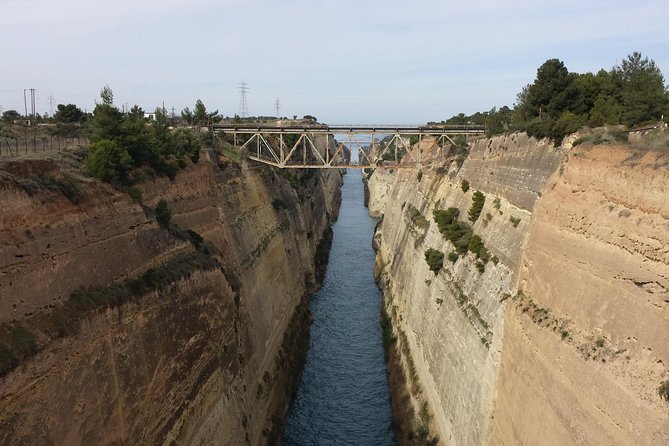
The Corinth Canal is a straight cut 6.4 km long through the Isthmus of Corinth. Its rock walls rise up to about 90 m above the water. The 3-day tour to Corinth begins its list of stops at this cut between two seas.
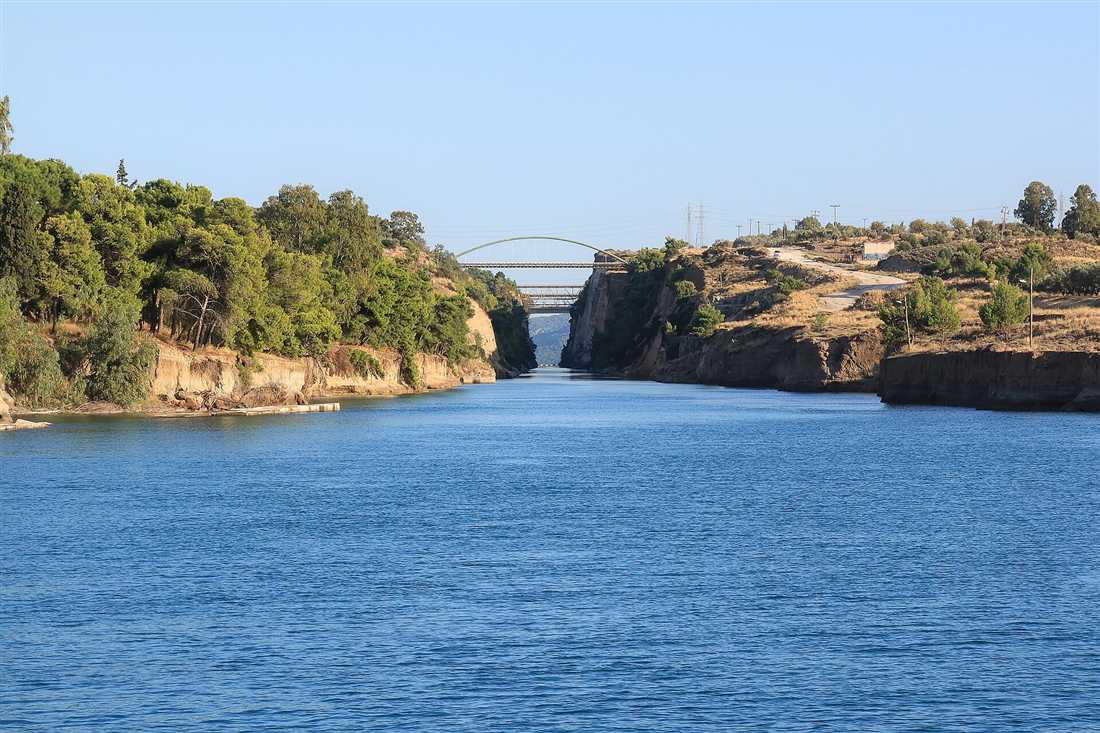
The canal measures 24.6 m wide at sea level. That width is too narrow for large modern ships, so tankers and container vessels sail around the peninsula. Today yachts and small passenger boats use the cut, and it works mainly as a sight for visitors.
The idea is ancient. Periander, the ruler of Corinth around the 7th century BC, judged a canal too costly to dig. He built the Diolkos instead, a paved track for hauling ships across the isthmus. Remains of the Diolkos still lie beside the western end of the modern canal.
The Roman emperor Nero broke the ground with a pickaxe in the 1st century AD. Work stopped soon after his death. Engineers finished the present canal in the late 19th century. Travellers on the 3-day tour to Corinth see that finished cut, not the Roman trench. Submersible bridges at both ends sink below the water to let boats pass.
A road bridge with a footway gives a clear view straight down into the cut. On the 3-day tour to Corinth, Sparta and Mystras, the canal marks the crossing into the Peloponnese. Canal cruises and bungee jumps are listed on the Corinth Canal tours page.
What stands at Ancient Corinth today?
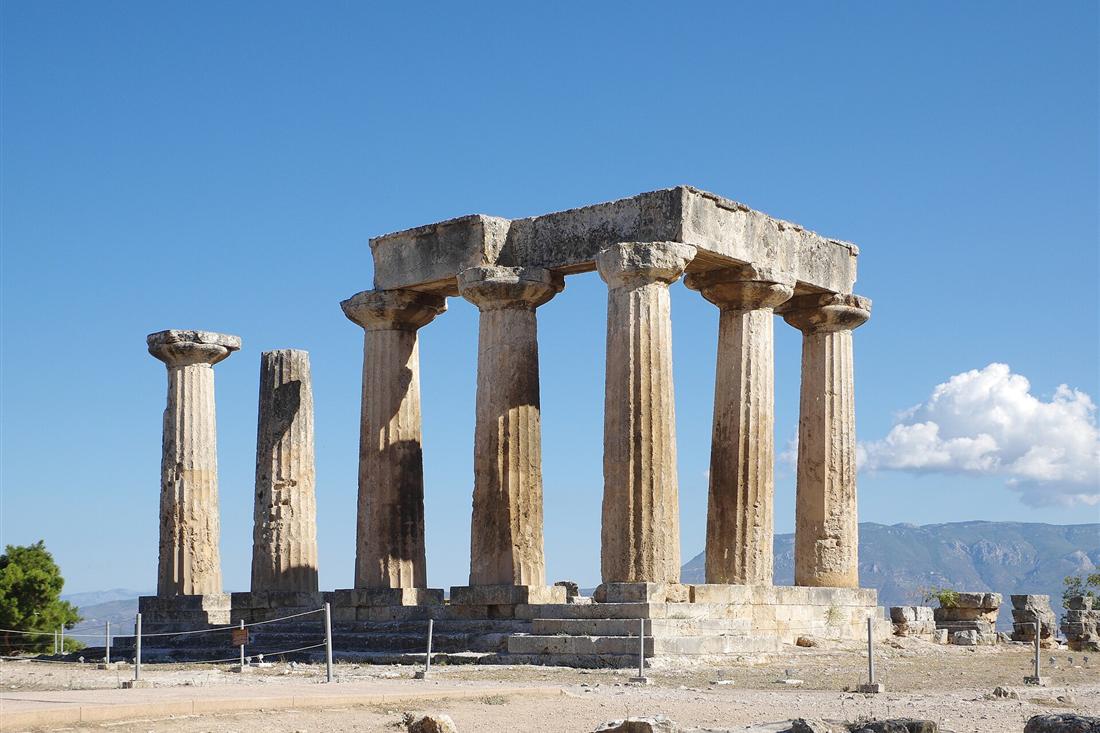
Ancient Corinth today shows the Temple of Apollo, the Roman forum, the Peirene fountain and the Bema. A site museum stands beside them. The 3-day tour to Corinth reaches these ruins below the rock of Acrocorinth.
Corinth grew rich on two harbours. Lechaion faced west on the Corinthian Gulf, toward Italy and the western colonies. Kenchreai faced east on the Saronic Gulf, toward Athens, Ionia, Cyprus and the Levant. Trade across the isthmus funded the city for centuries.
- Temple of Apollo: a Doric temple of the 6th century BC, with seven columns still standing
- Peirene fountain: the main spring of the lower city, rebuilt in Roman times
- Roman forum: the public square of the Roman colony
- Bema: the speaker’s platform linked by tradition to Paul the Apostle
- Site museum: pottery, sculpture and mosaics from the excavations
Rome destroyed the Greek city in the 2nd century BC. The army of Lucius Mummius captured it and burned it. Julius Caesar refounded Corinth as a Roman colony in the 1st century BC. The forum and fountain houses seen on the 3-day tour to Corinth date from that Roman city.
Paul the Apostle stayed in Corinth in the 1st century AD. His two letters to the Corinthians are books of the Christian Bible. The site draws Christian pilgrims as well as students of history on the 3-day tour to Corinth.
The museum rooms and the layout of the excavations are set out on the Ancient Corinth page. The Lechaion road, the paved Roman street to the western harbour, still runs north from the forum.

Why did Acrocorinth guard the isthmus?
Acrocorinth guarded the isthmus because it towers over the only land route into the Peloponnese. It also holds its own spring. The 3-day tour to Corinth passes below this rock, which rises about 575 m above the sea.
A garrison on the summit saw any army long before it reached the isthmus. A secure water supply let defenders hold out through long sieges. On the 3-day tour to Corinth, Sparta and Mystras, the rock looms over the ruins below.
In the Hellenistic age, the Macedonian kings held Acrocorinth as one of the Fetters of Greece. The other two fetters were Demetrias in Thessaly and Chalcis on Euboea. With these three forts, Macedon kept the Greek city-states under control.
Later owners rebuilt the walls in turn. The Byzantines made it the seat of a provincial military governor. The Franks of the Principality of Achaea, the Venetians and the Ottomans followed. Three lines of walls and three gates now lead up to the summit.
A temple of Aphrodite once crowned the highest peak. The Upper Peirene spring lies inside the walls. Myth says the river god Asopus gave it to Sisyphus, king of Corinth. The price was news of where Zeus had taken Aegina, the daughter of Asopus.
What did Grave Circle A and the Treasury of Atreus hold at Mycenae?
Grave Circle A held six royal shaft graves full of gold. The Treasury of Atreus is a later tomb under a vast stone dome. Both lie at Mycenae, the Bronze Age citadel on the 3-day tour to Corinth.
Grave Circle A is a royal cemetery of the 16th century BC, just south of the Lion Gate. Its ring wall measures 27.5 m across. Visitors on the 3-day tour to Corinth pass it just inside the gate. The largest of its six shaft graves is about 6.5 m long and 4.1 m wide.
Heinrich Schliemann and Panagiotis Stamatakis dug the graves in the late 19th century. They followed the accounts of Homer and Pausanias. Schliemann named one gold face mask the Mask of Agamemnon. The burials, though, date about three centuries before the age of Agamemnon in myth.
- Gold death masks, one of them called the Mask of Agamemnon
- Full sets of weapons and ornate staffs
- Gold jewellery and cups of gold and silver
- About 15 kg of gold across the whole circle
- A lintel stone of about 120 tonnes over the door of the Treasury
The Treasury of Atreus is a tholos, or beehive tomb, of the 13th century BC. A long open passage called the dromos leads to its doorway. Inside, a corbelled dome of stone rings rises about 13.5 m over a round chamber.
That dome stayed the largest in the world until the Roman period. The names Atreus and Agamemnon were attached to the tomb only in the 18th century. Lord Elgin removed parts of its carved marble front in the 19th century.
The gold finds of Grave Circle A now fill a hall of the National Archaeological Museum in Athens. On the 3-day tour to Corinth, Sparta and Mystras, the empty circle and the tomb stand on site. The Lion Gate and the walls are described on the Mycenae page.

How did the healing sanctuary of Asclepius at Epidaurus work?
The sanctuary of Asclepius at Epidaurus worked through temple sleep. Patients slept in a sacred hall and waited for a healing dream. Priests then read the dream and set a cure. The 3-day tour to Corinth stops at this sanctuary in the Argolid.
Asclepius was the god of medicine, a son of Apollo in Greek myth. The centaur Chiron taught him the art of healing. His staff with a coiled snake remains a symbol of medicine today. Pilgrims came to Epidaurus from across the Greek world.
The Greek name for temple sleep is enkoimesis, and Latin writers called it incubatio. The sleeping hall at Epidaurus is the abaton, a long stoa beside the temple. Patients washed and made offerings before they entered it for the night.
- Arrival: the patient enters the sanctuary and makes an offering
- Purification: the patient washes before the night in the hall
- Sleep: the patient lies down in the abaton and waits for the god
- Dream: Asclepius or one of his children appears in the dream
- Cure: a priest reads the dream and sets a treatment, such as baths or exercise
Three marble boards of the 4th century BC record the cases of about 70 patients. Each entry gives a name, a complaint and a cure. These boards make Epidaurus a written record of ancient medicine on the 3-day tour to Corinth.
The sanctuary also held a temple of Asclepius and a round building called the Tholos. Both date from the same century as the boards. On the 3-day tour to Corinth, Sparta and Mystras, the theatre stands in the same site. Site details are set out on the Epidaurus page.
Which sights in Nafplio fit a short stop?
A short stop in Nafplio fits Syntagma Square, the church of Agios Spyridon and the harbour front. From the quay, the Bourtzi castle sits on its islet. Nafplio is the harbour town of the Argolid on the 3-day tour to Corinth.
Nafplio served as the first official capital of the modern Greek state in the early 19th century. Venice and the Ottomans fought over its port for centuries before that. Under Venetian rule, the town held off sieges by Mehmed the Conqueror and by Suleiman the Magnificent.
- Syntagma Square: the main square, paved in marble and lined with Venetian and Ottoman buildings
- Archaeological Museum: finds from the Argolid in a Venetian building of the early 18th century
- Agios Spyridon: the church where Ioannis Kapodistrias, the first governor of Greece, was shot
- Bourtzi: a Venetian castle of the 15th century on an islet in the harbour
- Palamidi: a Venetian fortress of the early 18th century on the hill above the town
Kapodistrias died outside Agios Spyridon on his way to the morning service. A bullet mark is still shown in the stone beside the church door. The Vouleftiko, a former mosque near the square, hosted the first parliament of the Greek state. Both buildings stand a short walk apart on the 3-day tour to Corinth.
Palamidi rises above the old town and is reached by a long stone stairway or by road. The Lion of Bavaria, carved in rock at the edge of town, honours Bavarian soldiers under King Otto.
On the 3-day tour to Corinth, a walk from the square to the harbour covers the old town. Boat trips, walks and longer stays appear on the Nafplio page.
What was the agoge, the training of young Spartans?
The agoge was the state training that every Spartan citizen boy passed through, from age seven to adulthood. It built soldiers through hardship, drill and loyalty to the group. Sparta, the city that ran it, is a stop on the 3-day tour to Corinth.
Completion of the agoge was the condition for full citizen status as a Spartiate. Tradition credits its laws to Lycurgus, the lawgiver of Sparta. Only sons of citizen families entered it. Citizens formed a small share of the people of Laconia. Laconia holds the last three stops of the 3-day tour to Corinth.
- Paides: boys from about 7 to 12
- Paidiskoi: teenagers from 12 to 20
- Hebontes: young men from 20 to 30
Boys left their families and lived in barracks or in the open air. Food, sleep and shelter were kept short on purpose. Training covered weapons, pain tolerance, hunting, dancing, singing and public speaking. The age groups competed hard against each other.
Around age 18, a selected group joined the Crypteia, a secret force that watched the helots. The helots were the unfree farmers who worked Spartan land. Adult citizens later ate in common messes called syssitia, and membership was part of citizen status.
Ruins of the ancient city lie at the north edge of modern Sparti. The sanctuary of Artemis Orthia, where boys faced endurance contests, lies beside the Evrotas river. On the 3-day tour to Corinth, Sparta and Mystras, both sites sit close to the town centre.
What was life like in Mystras under the Despots of the Morea?
Life in Mystras under the Despots of the Morea centred on a Byzantine court, monks and scholars. The town was the capital of Byzantine Morea from the mid-14th to the mid-15th century. The 3-day tour to Corinth climbs to this former capital above Sparta.
The Despotate was a province of the Byzantine Empire. Its ruler held the title despotes, a court rank with no link to tyranny. The post went to a son or brother of the reigning emperor. That kept the court at Mystras tied to Constantinople.
Emperor John VI Kantakouzenos set up the province in the mid-14th century for his son Manuel. The rival Palaiologos family took it over late in the same century. Theodore I Palaiologos then ruled for over two decades and accepted Ottoman overlordship. Four sons of Emperor Manuel II followed him.
- Theodore II Palaiologos, the eldest of the four despots
- Constantine Palaiologos, later the last Byzantine emperor
- Demetrios Palaiologos, who handed Mystras to the Ottomans
- Thomas Palaiologos, who fled to Italy after the conquest
In the 15th century the Despotate grew to cover the whole peninsula. Constantine took Patras from the Latins. He was proclaimed emperor at Mystras and died in the Ottoman siege of Constantinople.
Scholars gave the town its fame in the Palaiologan Renaissance. The philosopher Gemistos Plethon taught there and revived the study of Plato. The Ottomans took Mystras seven years after the fall of Constantinople.
On the 3-day tour to Corinth, Sparta and Mystras, the old court town covers a whole hillside. Its paths and palaces appear on the Mystras tours page.
Why is Monemvasia called the Gibraltar of the East?
Monemvasia is called the Gibraltar of the East for its shape and its role. A huge rock rises from the sea and joins the mainland by one narrow strip. The 3-day tour to Corinth ends its list of stops at this fortified town.
The rock is a tied island off the east coast of the Peloponnese, in the Myrtoan Sea. A tombolo, a sandy isthmus about 400 m long, links it to the shore. A road now runs along that strip to the gate of the walled town.
On top lies a plateau about 100 m above the sea. It measures up to 300 m wide and about 1 km long. Cliffs drop to the water on the seaward sides. The plateau held the upper town and its citadel.
- Shape: a steep rock joined to the land by a narrow strip
- Defence: sheer cliffs above the open sea
- Trade: a port on the sea route to the eastern Mediterranean
- Layout: a walled lower town and an upper town on the plateau
Like Gibraltar, the rock watched over a busy sea lane. Ships between Italy and the eastern Mediterranean passed its harbour. The town dates from the 6th century AD. A medieval chronicle says people from Sparta moved here to escape raids.
The church of Christ Elkomenos in the lower town has a first phase of the same century. On the 3-day tour to Corinth, Sparta and Mystras, Monemvasia is the stop on the sea. Boat trips and walks on the rock appear on the Monemvasia tours page.

Which season suits the 3-day tour to Corinth, Sparta and Mystras?
Spring and autumn suit the 3-day tour to Corinth, Sparta and Mystras. Mild days help on the open ruins of Mycenae, Corinth and Mystras. Summer brings strong heat, and winter brings short daylight for a long route.
Seven sites in three days mean long hours on foot and in the car. Mycenae, Ancient Corinth and the sanctuary at Epidaurus offer little shade. Midday sun in July and August turns these walks into hard work.
Mystras and Monemvasia add steep stone paths. Mystras climbs a foothill of the Taygetus range, with the castle at the top. At Monemvasia, a zigzag path leads from the lower town up to the plateau.
- Spring: green hills and wild flowers at the Argolid sites
- Summer: long days and high heat at every stop
- Autumn: warm sea and lower heat for walking
- Winter: short days, rain and snow on the high Taygetus
Greek state archaeological sites keep longer opening hours in summer and shorter hours in winter. On the 3-day tour to Corinth, a winter date leaves less time at each site before closing. A spring or autumn date balances daylight and heat.
Pack shoes with grip, a hat and a refillable bottle in every season. A light layer helps on cool mornings at Mystras and on windy days on the rock of Monemvasia.
How do you book and cancel the 3-day tour to Corinth?
Book the 3-day tour to Corinth on its GetYourGuide listing. Pick a date, set the number of travellers and pay online. The cancellation terms appear before payment, and the confirmation arrives by email with the meeting details.
The listing carries the title From Athens: Private 3-Day Tour to Corinth, Sparta and Mystras. The booking runs on that page from start to finish. The calendar on the page shows which start dates remain open.
- Open the GetYourGuide listing for the tour.
- Choose the start date and the number of travellers.
- Read the inclusions, the meeting point and the cancellation terms.
- Pay online and keep the email confirmation.
- Message the operator through GetYourGuide with any questions.
Free cancellation on GetYourGuide runs up to 24 hours before the start on listings that show the label. Count back 24 hours from the start time to find the deadline. A private 3-day tour to Corinth, Sparta and Mystras holds one driver-guide for three full days. An early booking secures the date.
Check the listing for the meeting point and the start time before the first morning. Other routes across the region appear on the Peloponnese tours page, from single days to longer private trips.
Frequently Asked Questions
How long is the 3-day tour to Corinth?
The tour lasts three days and starts from Athens. It covers seven places: Corinth, Mycenae, Epidaurus, Nafplio, Sparta, Mystras and Monemvasia. The listing page sets the daily timings and the return to Athens. It also gives the order of the stops on each day.
Where are the nights spent?
A three-day route from Athens means two nights away from the capital. The listing page names the overnight towns and the standard of the hotels. Nafplio and Sparta both lie on the route between Corinth and Monemvasia, the first and last stops.
Is the 3-day tour to Corinth private?
Yes. The tour is private, so only the travellers in one booking share the vehicle and the driver-guide. No strangers join the party at any point. The driver-guide works for that one party from the first morning to the end of the third day.
What does the driver-guide do?
The driver-guide drives the party from Athens through the Peloponnese and explains each place along the route. One person covers both roles for all three days. Questions about entry tickets, site visits and timing go to the same person on the road.
Which places does the tour visit?
The tour visits Corinth, Mycenae, Epidaurus, Nafplio, Sparta, Mystras and Monemvasia. The first four lie in Corinthia and the Argolid, close to the isthmus. The last three lie in Laconia, in the southeast Peloponnese. Monemvasia sits on the coast of the Myrtoan Sea.
Does the 3-day tour to Corinth have reviews?
No. The tour is a new activity on GetYourGuide, and no traveller reviews appear yet. The listing page is the main source of detail. Read its inclusions, terms and meeting point before paying for the 3-day tour to Corinth, Sparta and Mystras.