
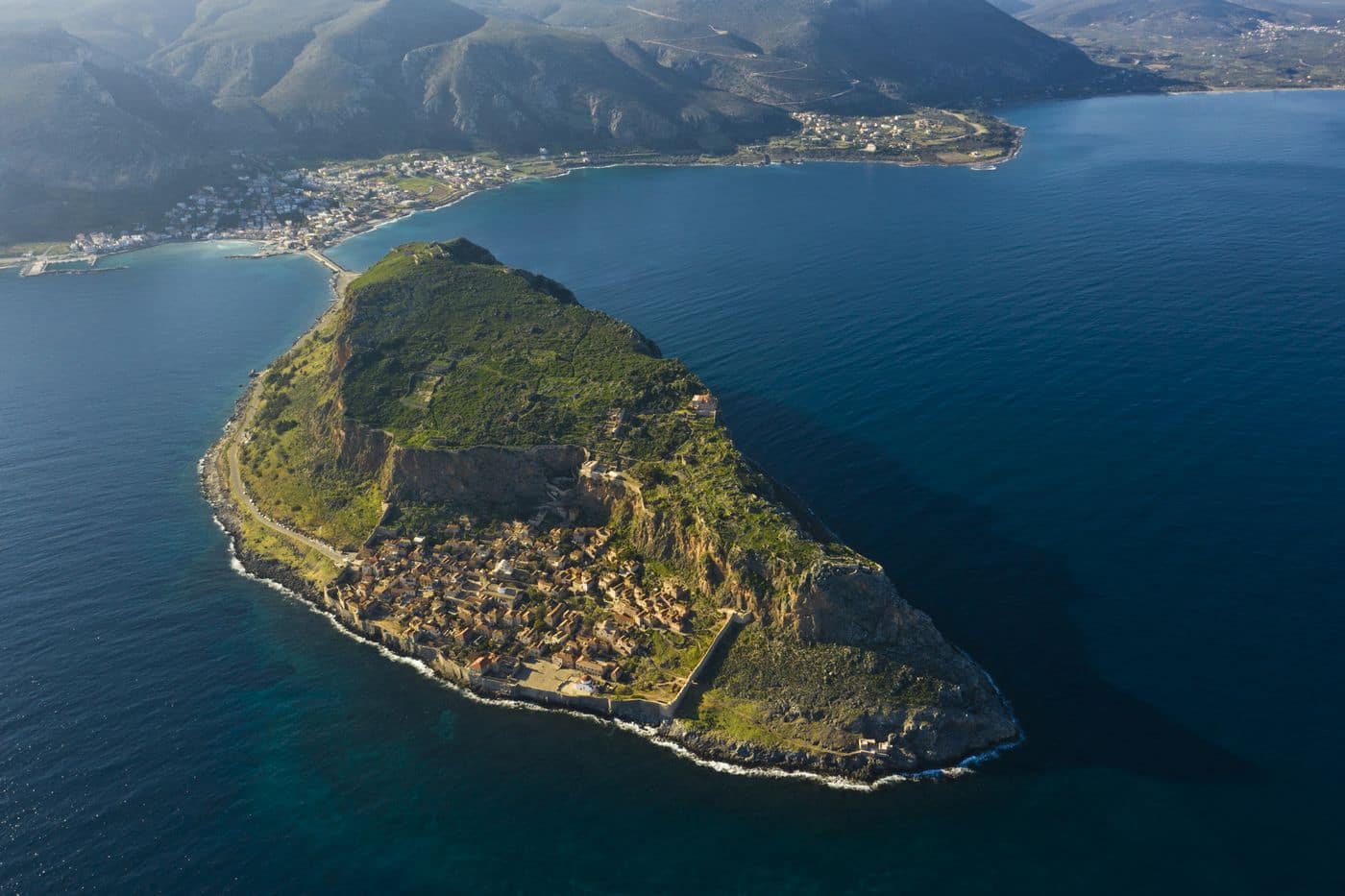
Monemvasia tours start on a rock island off the east coast of Laconia in the Peloponnese, joined to the village of Gefyra by a causeway, with a walled Byzantine town on its southern slope. The routes cover the Lower Town, the church of Agia Sofia in the Upper Town, the Malvasia wine country and the coast to Elafonisos. Greece Tours lists the day tours that pair Monemvasia with Sparta and Mystras.
This page covers what Monemvasia tours see inside the walls, the history of the rock and the poet Yannis Ritsos, which routes reach Elafonisos, the coastal villages, the petrified forest and Sparta, which beaches lie nearby, how visitors reach Monemvasia and which season suits each route. The tours below are checked on GetYourGuide and leave from Monemvasia, Mystras and Athens.
What do Monemvasia tours cover?
Monemvasia tours cover a rock off the east coast of Laconia, 1.5 kilometres long, up to 600 metres wide and 198.5 metres high. A 400-metre causeway joins it to Gefyra, and the walled town on its south-east slope dates from the 6th century.
The name joins two Greek words, moni and emvasis, and means a single entrance. Its Italian form is Malvasia, and the town carries the nickname Gibraltar of the East. Monemvasia tours start at that single way in, the causeway from Gefyra. Gefyra, also known as Nea Monemvasia, takes its own name from the bridge.
In 1890 a short section of the tombolo was cut to make a small bridge, and small boats pass beneath it. An older bridge stood here before, with 13 vaults over 14 openings. The Upper Town sits on the plateau at the top of the limestone rock, and the Lower Town lies on its south-east side. No vehicles enter the castle town, so Monemvasia tours continue on foot from the gate. Route and timing details for Monemvasia tours sit on the Monemvasia day trip from Athens page.
- Sea: the Myrtoan Sea surrounds the rock.
- Causeway: a natural tombolo 400 m long, the single approach from the mainland.
- Municipality: formed in 2011 from Asopos, Molaoi, Monemvasia, Voies and Zarakas, with its seat at Molaoi.
- 2021 census: 21,816 residents in the municipality and 1,441 in Gefyra.
- Protection: the area is Natura 2000 site GR2540001.
What do Monemvasia tours see in the Lower Town?
Monemvasia tours see the walls and west gate, the old market street and the central square, where the church of Elkomenos Christos faces the former mosque that holds the archaeological collection. Panagia Chrysafitissa stands by the sea wall, and the episcopal palace keeps a Venetian lion.
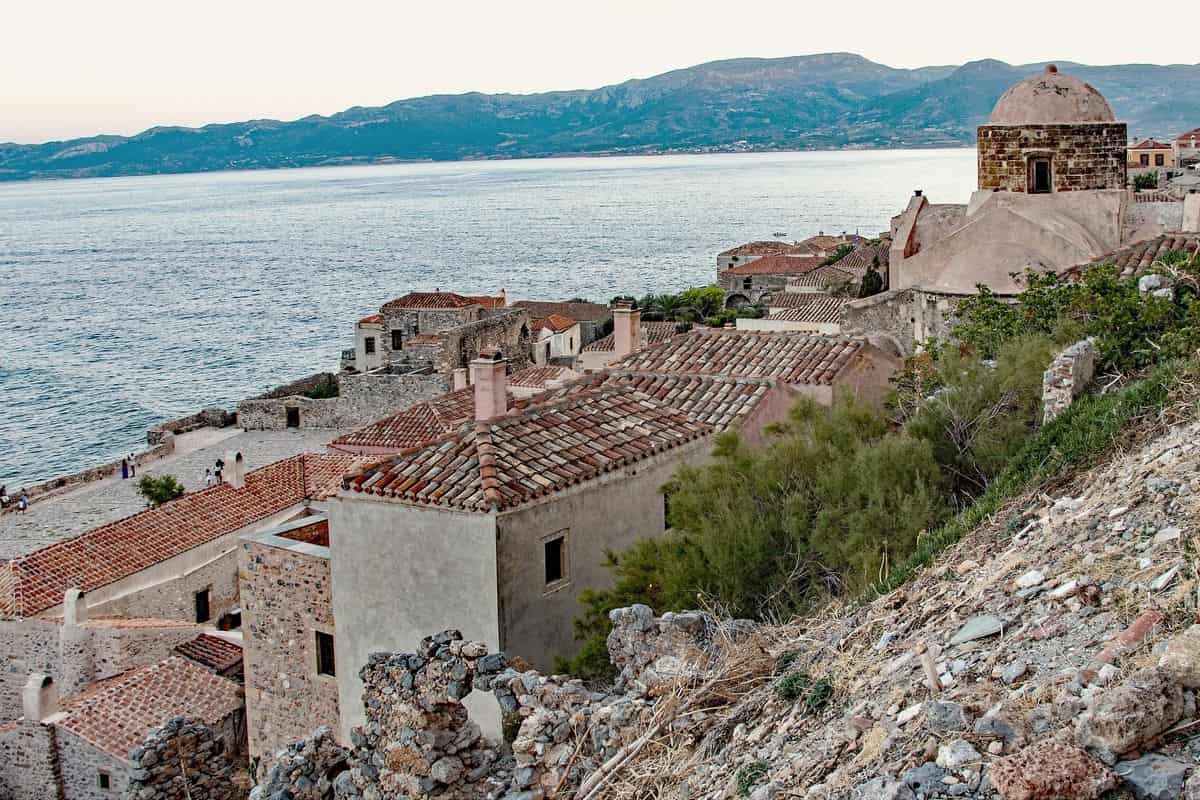
Walls close the Lower Town on the east, south and west. Monemvasia tours enter by the west gate, which leads to the bridge and the harbour. The main street, called the Middle Street in Byzantine times, is lined with shops and now bears the name of Yannis Ritsos. A cross street drops from the Upper Town to the Portello, a gate in the sea wall.
The two streets meet at Elkomenos Christos square. Elkomenos Christos, the metropolitan church, is a three-aisled basilica with a dome and a separate bell tower. Its first phase dates from the 6th century, and its dome and outer narthex from 1697. A 14th-century icon of Christ Elkomenos, stolen in 1979 and cut into three pieces, came back from the Byzantine Museum of Athens in 2011.
The former mosque opposite, built in 1540, later served as a prison and a café. Since July 1999 its 60-square-metre vaulted hall has held the archaeological collection, and Monemvasia tours stop there for finds from the rock. South of the church, the episcopal palace keeps a lion relief, the symbol of Venice.
- Collection: early Christian, Byzantine and post-Byzantine sculpture, pottery, coins, lamps and glass.
- Key exhibits: carvings from Agia Sofia and a restored Middle Byzantine marble iconostasis.
- Panagia Chrysafitissa: a 17th-century domed church by the sea wall with a small holy spring.
- Agios Nikolaos: a domed basilica built by Andrea Licinio in 1703.
- Churches: 40 inside the castle, by the municipality’s count.
What do Monemvasia tours see in the Upper Town and at Agia Sofia?
Monemvasia tours climb a winding cobbled path with two middle gates to the Upper Town, called Goulas, a plateau of walls and ruins. At the cliff edge stands Agia Sofia, a cross-in-square church dated to 1150, with a 7-metre dome and 16 windows.
Monemvasia tours need 15 minutes for the walk up, according to the municipality. Nobody lives in the Upper Town today. A north gate also existed until the Ottomans sealed it with a wall that the Venetians called Mura Rossa, the Red Wall.
At the highest point stood the acropolis, a 6th-century rectangular fort with four corner towers, where the monogram of Theodore Palaiologos was found. The rock has no natural springs, so three large public reservoirs lie in the western part. Monemvasia relied on cisterns for water until 1964. Monemvasia tours also pass a ruined 17th-century bathhouse near Agia Sofia, which keeps its small dome.
Agia Sofia, also written Hagia Sophia, was first dedicated to Panagia Hodegetria. Its main hall measures 14 by 14 metres. Frescoes show two archangels, Christ as the Ancient of Days and scenes from the life of Saint Nicholas, tied to the theft of his relics from Myra in 1087 by Italian merchants who stopped at Monemvasia on the way to Bari. The Ottomans made the church a mosque and whitewashed the frescoes. After 1821 the minaret came down and the church took the name of Holy Wisdom. Eustathios Stikas restored it in 1958.
- Gate rooms: Ottoman vaulted rooms beside the upper gate, one of them a mosque.
- Powder magazine: a Venetian store on the site of the fort’s south-west tower.
- Fountain: four-sided, under a dome, near the reservoirs.
What history do Monemvasia tours tell?
Monemvasia tours tell how people from Sparta settled the rock in the 6th century, how the port grew into a Byzantine trade centre, and how Venetian and Ottoman rule followed. The story closes with the Greek siege that won the fortress on 23 July 1821.
Monemvasia tours begin with the founding, when the people of Sparta, then called Lacedaemon, moved to the rock. The later Chronicle of Monemvasia blames a Slav raid in 587–588, but the first phase of Christ Elkomenos dates from the reign of Justinian, decades earlier.
Sea routes to Sicily made the town a trade centre. Ships of Roger II of Sicily failed to take it in 1147. William of Villehardouin captured it after a three-year siege, then handed it to Byzantium in 1262 with Mystras, Grand Magne and Geraki; Mystras tours follow that thread inland. The years up to 1460 count as the golden age of Monemvasia.
In 1460 the residents offered the town to Pope Pius II, and by the end of 1463 Venice held it. A treaty of 2 October 1540 gave it to the Ottomans, who called it Menekşe, meaning violet. Venice returned on 12 August 1690, and the Ottomans on 7 September 1715.
- 6th century: settlers from Sparta found the town.
- 1540 to 1690: first Ottoman rule.
- 1690 to 1715: second Venetian rule.
The Greek siege ran from 15 March to 23 July 1821. The 1,500 to 1,600 Ottomans inside destroyed the bridge and ran short of food and water, then surrendered and sailed to Kuşadası in Asia Minor. Monemvasia tours on 23 July see the town burn a ship filled with fireworks in the port.
Who was Yannis Ritsos for Monemvasia tours?
Monemvasia tours pass the family house of Yannis Ritsos, the poet born in Monemvasia in 1909, on the left just inside the gate. Ritsos died in Athens on 11 November 1990 and lies buried in his home town, which honours him with events every year.
His father, Eleftherios, bought that house at the entrance of the castle town, next to the walls, after the poet was born; restored, it still stands. Before that, the family lived opposite Panagia Chrysafitissa. Ritsos was the youngest of four children, and from 1914 to 1921 he went to school in the church of Agios Nikolaos.
Ritsos published more than 100 poetry collections, 22 novels and one play, and left 50 unpublished collections. Mikis Theodorakis set Epitaphios, written in 1936, to music. In Romiosini the poet recalls the waterless rock of Monemvasia, and the municipality calls the castle town his stone ship. His 75th birthday was celebrated in Chrysafitissa square. Monemvasia tours that walk in his footsteps take in both his house and his grave.
Moonlight Sonata, from 1956, won him the first State Poetry Prize. He also received the Lenin Peace Prize and, in 1985, the Golden Wreath of the Struga Poetry Evenings. He was shortlisted for the Nobel Prize in Literature in 1973, and Louis Aragon called him the greatest poet of his age.
- House: the restored family home on the left inside the gate.
- Grave: in Monemvasia, his birthplace.
- Works: Epitaphios, Romiosini, Moonlight Sonata and 18 Short Songs of the Bitter Motherland.
- Summer home: Liotrivi, the family mansion at Velies, used up to 1930.
What wine do Monemvasia tours taste?
Monemvasia tours taste Monemvasia-Malvasia, a sweet white PDO wine made from sun-dried grapes. The blend holds at least 51% Monemvasia grapes, joined by Assyrtiko, Asproudes and Kydonitsa, and the rules require at least two years of oxidative ageing.
Monemvasia tours begin the wine story with a name. Malvasia is the Italian form of Monemvasia. In the Middle Ages the town’s port shipped wine from the eastern Peloponnese to Mediterranean harbours and on into Europe. Venetian traders sold so much of it that wine shops in Venice were called malvasie. In English it became Malmsey, one of three major wines that Greece exported in medieval times.
English tradition links Malmsey to the death of George, Duke of Clarence, in 1478. Rumour said he was drowned in a butt of it, a scene Shakespeare staged in Richard III. Venetian merchants also carried Greek vine cuttings to Istria in the 14th century. After the Ottomans took Monemvasia, the vineyards were destroyed and the old wine vanished, while Europe kept the name for other vines.
The PDO Monemvasia-Malvasia zone dates from July 2010 and covers Monemvasia, Asopos, Voies and Molaoi, at the south-east end of Laconia. No grape called Malvasia goes into it. The lead grape, Monemvasia, comes from Laconia but now grows almost only on Paros.
- Styles: sweet white from sun-dried grapes, plain or fortified.
- Ageing: two years at least; longer ageing runs four years or a multiple of four.
- Labels: every bottle carries the double name Monemvasia-Malvasia.
- Method: liastos, Greek for sun-dried, is the Greek term for straw wine.
Monemvasia tours with a cellar stop follow the route on the Monemvasia wine tasting page.
Which Monemvasia tours cross to Elafonisos?
Monemvasia tours cross to Elafonisos from Pounta, on the Laconian shore, where a ferry covers about 300 metres in six minutes. The island spans 19 square kilometres, and its Simos beach splits into two bays backed by dunes close to 10 metres high.
Elafonisos lies between the Peloponnese and Kythira, off Cape Malea and the Vatika coast. In antiquity it was a peninsula, which Pausanias called Onou Gnathos, the donkey’s jaw. Landing craft and car ferries sail from Ypostego at Pounta. Monemvasia tours land on the east side of the island’s village, where the ferries moor.
Simos lies on the south side, in the Lefki area. Sarakiniko divides it into a large bay that runs to Kournospila and a smaller bay that runs to Frangos. A sea-cedar forest joins the two, and the sand is fine and golden. The beach takes its name from Simos, a sponge diver from Kalymnos who drowned near Frangos. Elafonisos is a Natura 2000 site, code GR2540002, with shifting dunes, juniper woods and green sea turtles, and it is a key stop for migrating birds.
- Panagia beach: a large sandy beach on the west side, sheltered by three islets: Kasela, Prasonisi and Lefto Nisi.
- Agios Spyridon: the main church, on a tiny islet joined to the island by a bridge over shallow water.
- Pavlopetri: a sunken town off Pounta, with at least 15 buildings 3 to 4 metres under the sea.
- Pounta beach: golden-white sand and dunes up to 3 metres, just past the Ypostego ferry point.
On Monemvasia tours, the view from Vardia, the highest point at 276 metres, runs from Sarakiniko to Kythira and the Malea peninsula.
Which coastal villages do Monemvasia tours reach?
Monemvasia tours reach four coastal stops: Limani Gerakas, 22 km north-east of Gefyra by road; Kyparissi, on the north-east coast of Laconia; Neapoli, 27 km by road from Gefyra, with ferries to Kythira; and Plytra, on the Laconian Gulf, 17 km from Molaoi.
Monemvasia tours that follow the east coast leave from Gefyra, the modern town of Monemvasia. Limani Gerakas sits inside a fjord, called the southernmost fjord in Europe, and yachts shelter there from the wind. In Byzantine times it was called Hierax, and its mouth was once Porto Cadena, after the chain that closed it. The acropolis of ancient Zarax, with a Hellenistic wall, crowns the hill north of the entrance.
Kyparissi has become a rock-climbing destination. It has been a listed traditional settlement since 2012, and in 2021 ERT filmed the series Vardianos sta Sporka there. Its seaside hamlet, Paralia, lies 2 km away on the Myrtoan Sea, about 85 km from Sparta.
Neapoli stands on the site of ancient Boeae, near Cape Malea, on a street plan drawn in 1837. Ferries link its port to Antikythera and to Kythira, where boats dock at Diakofti. Monemvasia tours on the Laconian Gulf side stop at Plytra, on the site of ancient Asopos. That town sank after an earthquake in 365 AD, and at Kokkines its ruins still show in the water.
- Gerakas village: 4.4 km by road from its harbour.
- Neapoli museum: a clay model of an ancient galley, raised from the seabed in fishing nets.
- Plytra beach: Pachia Ammos has won a Blue Flag, and a Roman bath with a mosaic floor lies near the shore.
What do Monemvasia tours see at the petrified forest and Cape Maleas?
Monemvasia tours see the Agios Nikolaos Geopark at Agia Marina, where stone columns up to 2.5 metres tall stand on the shore, and Cape Maleas, the second-southernmost point of mainland Greece, with a stone lighthouse built in 1883.
Monemvasia tours reach the Geopark 8 km south-east of Agios Nikolaos Voion. The columns formed 2 to 3 million years ago and are known as Kaminades. At Korakas they reach 4 metres, and locals call the largest O Anthropos, the Man. Thirty-three carry a waterproof coat against sea erosion. Guided tours run in the summer months, and the drive from Neapoli via Lachi takes 30 to 40 minutes.
Two readings explain the columns. One sees a petrified palm forest of the genus Rhizopalamoxylon, turned to stone by calcification as the sea rose. The other sees hard-walled pipes, cut by a strong flow of fluid that rose where two conglomerate layers meet.
Monemvasia tours that go on to Cape Maleas reach cliffs 600 metres high, where the Laconian Gulf meets the Aegean. The lighthouse stands 40 metres above the sea, and its tower rises 15 metres. Its beam now reaches 17 nautical miles, one for each of the 17 sailors lost in a wreck off the cape on 6 January 1993. In the Odyssey, the wind drives Odysseus off course at Malea, and Strabo recorded the saying: round Malea and forget home.
- Wildlife: Mediterranean seals have been recorded in the sunken caves, and jackals live on the cape.
- Lore: in the late 18th century, a hermit at a chapel of the Taxiarchs rang a bell at passing sailing ships, and crews sent him food when the weather allowed.
- Status: UNESCO has named the cape a biosphere reserve.
Which Monemvasia tours continue to Sparta and Mystras?
Monemvasia tours continue to Sparta, 89 km north-west of Gefyra by road via Molaoi, and to Mystras, about 8 km west of Sparta on a Taygetos slope, the capital of the Byzantine Despotate of the Morea and a UNESCO World Heritage Site since 1989.
Monemvasia tours run inland first to Molaoi, the seat of Monemvasia municipality, 61 km south-east of Sparta. From there the road to Skala enters the Evrotas Valley. The valley runs 82 km between Taygetos and Parnon, and Homer called it hollow Lacedaemon. It grows the largest orange crop in the Peloponnese, and the farms of Skala grow Valencia oranges and mandarins.
Monemvasia tours tie the two castles together through a shared past. In 1262 William of Villehardouin handed Monemvasia, Mystras and Grand Magne to the Byzantines to win his release. The Byzantine governor first sat at Monemvasia, and in 1289 the seat moved to Mystras. The plan of Mystras includes a Monemvasia Gate, and the site museum keeps three manuscript codices of the Metropolis of Monemvasia and Sparta.
Mystras became a centre of the Palaiologan Renaissance. The philosopher Gemistos Plethon lived there until his death in 1452, and Constantine XI Palaiologos served as despot there before he became the last Byzantine emperor. A group of nuns still lives in the Pantanassa Monastery. Day plans for the modern city sit on the Sparta tours page.
- Conquest: William of Villehardouin took Monemvasia in late 1248, then built the Mystras fortress.
- Despotate: from 1349, Mystras housed a despot, starting with Manuel Kantakouzenos.
- Surrender: Demetrios Palaiologos, the last despot, gave Mystras to Mehmed II in 1460.
Which beaches do Monemvasia tours reach?
Monemvasia tours reach Kakavos, a pebble beach about 1,000 metres long in Gefyra, and Pori, a strand almost two kilometres long. Kastraki and Kochylas lie to the north on the Gerakas road. Ambelakia, Xifias and Aghios Fokas line the Nomia coast to the south.
The municipal tourism site lists over 50 beaches that are easy to reach by road. The east coast faces the Myrtoan Sea and the west coast faces the Gulf of Laconia.
Kakavos is the nearest beach to Gefyra, the new town, and sits at the end of the bridge, below the fortress. It has umbrellas, sunbeds, beach volley nets, cafes and restaurants. Pori is one of the longest beaches in the Peloponnese, with a canteen, sunbeds and a view of the old town. Both first won the Blue Flag in 2013, and both give shelter from every wind except the north wind.
Monemvasia tours that head north find Kastraki, a sandy beach shaded by a wood, about 10 minutes from town on the Aghios Ioannis to Gerakas road. Kochylas is a pebble beach facing the islet of Daskaleio, 300 metres down a side road at Arianna.
- Pori access: a left turn at the Pori sign, 3 km before Monemvasia on the road from Molaoi.
- Ambelakia: fine sand on the Monemvasia to Nomia road, with sunbeds, a mobile canteen, a view of the fortress and shelter from southerly and south-westerly winds.
- Xifias: a long beach in Nomia, 7 km south of Monemvasia, sheltered from the meltemi, with the sunken city of Xifoupolis at its northern end.
- Aghios Fokas: a sandy beach beside the small church in the port of the same name, suited to water sports.
How do visitors reach Monemvasia for Monemvasia tours?
Monemvasia tours travel about 300 km by road from Athens. Drivers take the A7 and its A71 branch to Sparta, then the EO86 through Molaoi to Gefyra, 89 km beyond Sparta. KTEL Lakonias buses leave Athens, and Kalamata International Airport connects by the EO82.
Monemvasia tours by car follow the A7 Moreas Motorway, which leaves the Olympia Odos just west of the Isthmus of Corinth and runs via Tripoli. At Lefktro, near Megalopoli, the A71 toll branch splits off and covers 45.5 km to Sparta. South of Sparta, the EO86 starts at Dafni and runs east through Krokees and Molaoi, the seat of the municipality, 25 km before Monemvasia.
Kalamata International Airport (KLX) sits 9 km west of Kalamata, on the EO82 road to Sparta. It mainly receives summer flights, and Aegean Airlines opened a base there in March 2013. Travellers who land there can book Kalamata airport transfers for the drive east to Sparta and on to the EO86.
- Bus: KTEL Lakonias runs to Monemvasia from the Kifissos Bus Terminal in Peristeri, Athens.
- Local bus: a regular service links Gefyra with the fortress town.
- Ferry: the municipal guide lists a summer sea connection with Piraeus, 84 nautical miles away.
- Yacht: a marina beside the port serves pleasure craft and fishing boats, and the harbour of Gerakas lies 7 nautical miles north.
The same roads serve longer Peloponnese tours that pair the rock with other stops.
When do Monemvasia tours run best?
Monemvasia tours run best in spring, which the municipal tourism site names the ideal season, and in the dry months up to September, when monthly rain stays under 26 mm. Easter brings candlelit processions, and 23 July brings a ship set on fire in the port.
The National Observatory of Athens runs a weather station 17 metres above sea level, just off the rock, and its data place Monemvasia in a hot-summer Mediterranean climate. April averages a high of 20.7 °C. July’s average high peaks at 32.3 °C, with 2.5 mm of rain, and October still averages a high of 23.9 °C. Inland Sparta runs hotter, with July and August highs near 36 °C.
Monemvasia tours at Easter centre on the church of Christos Elkomenos. On Good Friday, believers carry white candles behind the Epitaph through the cobbled lanes. On Holy Saturday, the Holy Fire passes from candle to candle, and tavernas serve magiritsa soup after the service. On Easter Sunday, a wood-and-straw effigy of Judas burns in the church precinct in a burst of fireworks.
The 23 July anniversary marks the surrender of the fortress to the Greeks in 1821, after a four-month siege. Speeches in the main port retell the story of Tzannetakis Grigorakis and his men in Greek and English. Then a ship, built each year and packed with fireworks, is set alight as the Turkish schooner, under the auspices of the municipality, the fishermen and the Coast Guard.
- Klidonas, 23 and 24 June: villagers in Metamorfosi, 5 km from Molaoi, and Agios Nikolaos Voion, 7 km from Neapoli, carry the silent water and jump over bonfires for the feast of the birth of John the Baptist.
- Olive harvest: picking starts in the first 10 days of October around Neapoli and runs to mid-March on the plain of Molaoi, and Monemvasia tours can follow the process from harvest to press.
- Summer season: summer tourism in Laconia flows to the coast and to the Diros Caves, the stalactite caves south of Areopolis.
What do Monemvasia tours eat?
Monemvasia tours eat amygdalota, the almond sweets of Gefyra’s pastry workshops, along with saitia pies of goat’s cheese and wild greens, Vatika onions stewed with cumin and shrimp fritters from Gerakas. Olive oil, 99 percent extra virgin, comes from Koroneiki and Athinolia olives.
The municipal recipe pages describe the cooking of Monemvasia, Vatika and Zarakas as simple, built on fresh produce and free of heavy sauces. Olive oil is the main crop, at about 8,000 tons a year. Koroneiki has a slightly more bitter and spicy aroma than Athinolia.
Saitia are thin squares of dough filled with goat’s cheese, spinach, lettuce, kafkalithres greens, shallots and dill. Cooks fry them on a very hot metal plate, or for 4 to 6 minutes a side in an oiled pan. Monemvasia tours that stop in Gerakas meet garidopetoules, fritters of tiny lagoon shrimp with dill and shallots. Fishermen catch the shrimp by dipping branches of mastic or kermes oak into the water.
Vatika grows the Vatikiotika onion, a sharp local variety 35 to 80 mm across, with coppery skin and reddish flesh, on about 120 hectares. Cooks stew it with tomato and cumin as yiachni, and in Vatika the stifado has always taken cumin, not rosemary.
- Amygdalota: ground almonds, icing sugar, egg whites and fine semolina, shaped into small pears with a clove on top, baked for 15 minutes, dipped in rose water and coated in icing sugar.
- Samousades: pastries stuffed with walnuts, honey and almonds.
- Diples: thin strips of dough, fried and folded in hot oil, dipped in sugar or honey syrup and served at every celebration in the area.
- Gogles: hand-shaped pasta shells served with grated cheese and cheese browned in butter.
Frequently Asked Questions
Can Monemvasia tours include a swim below the fortress?
Yes. Monemvasia tours can stop at Portelo, a small cove under the south wall of the fortress town. Swimmers reach it only on foot, through an opening in the wall. The cove once served as the supply port of the fortress, and the municipal Easter page suggests it for the first dip of the year.
Do Monemvasia tours suit windsurfers?
Pori beach gives windsurfers fair conditions in summer when north-east and east winds blow, on a side-on course. The spot does not suit kitesurfing. The area has no windsurfing or kitesurfing schools and no equipment rental, so Monemvasia tours for board riders need their own gear and experience.
Do Monemvasia tours run in winter?
Gefyra draws thousands of visitors all year round. Monemvasia tours in winter meet average January highs of 15.2 °C and lows of 10.6 °C, and Monemvasia has never recorded a temperature below 1.5 °C. Snow has not settled for over 80 years. January is the wettest month, at 106.0 mm of rain.
Which local products do Monemvasia tours take home?
Monemvasia tours can buy bottled olive oil in shops of traditional products or straight from the producers. Thyme honey is gathered in July and August on slopes from Zarakas to Cape Maleas, and heather honey follows the October and November bloom. Producers also sell pollen, propolis, beeswax and honey wine.