
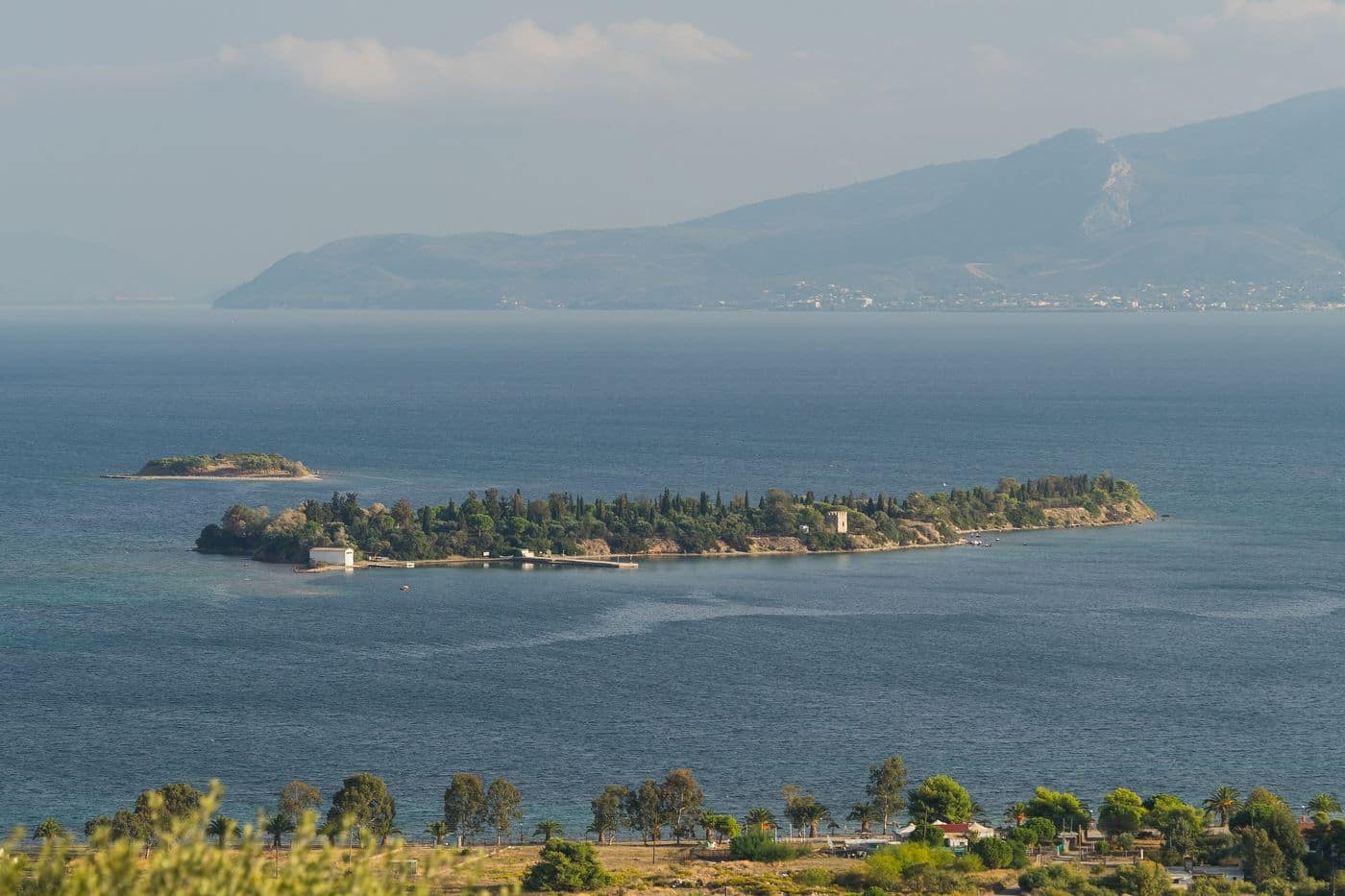
Eretria tours start in a seaside town on the south-west coast of Evia, across the South Euboean Gulf from Oropos, built over the ancient city of Eretria. The routes cover the theatre, the temples and the House of Mosaics of the ancient city, the archaeological museum, the islets off the shore and the coast of South Evia. Greece Tours lists the boat trips, hikes and wine days that start in the town.
This page covers what Eretria tours see at the ancient site and the museum, the history of the city, which boats sail the gulf, which day trips reach South Evia, which wines the island pours, how visitors reach Eretria and which season suits each route. The tours below are checked on GetYourGuide and leave from Eretria and Athens.
What do Eretria tours cover?
Eretria tours cover a port town on the west coast of central Evia, on the South Euboean Gulf, 19 km south-east of Chalkida. The town had 4,373 residents at the 2021 census, and a ferry links its harbour with Skala Oropou in Attica.
The name Eretria means city of the rowers, from the ancient Greek word for a rower. The modern town stands on the foundations of the ancient city-state, and the excavations lie along its northern edge. Eretria tours therefore reach the West Gate, the West Quarter and the temple of Apollo on foot from the town streets. North of the port rises the ancient acropolis, a limestone hill 123 m high.
Eretria is the seat of the Municipality of Eretria, formed in 2011 by the merger of Eretria and Amarynthos, with an area of 168.557 km². The town lies on a small plain between Mount Voudochi and Mount Olympos. Eretria tours from Attica cross by ferry from Skala Oropou, a port 8 km to the south and 38 km north of central Athens. An Evia day trip from Athens reaches the town by this ferry or by road through Chalkida.
- Ancient city: temples, a theatre, gymnasia, houses with mosaics and parts of the city wall.
- Museum: finds that run from a Cycladic idol of 2500 BC to an Aphrodite and Eros group of the 2nd to 1st century BC.
- Modern town: a street plan of 1834, 19th-century neoclassical houses, tavernas and a long beach promenade.
- Sea: the harbour, four islets and the open water between Evia and the mainland.
What do Eretria tours see at ancient Eretria?
Eretria tours at the ancient city see the temple of Apollo Daphnephoros, the theatre and its vaulted underground passage, the gymnasium, the West Gate and the House of the Mosaics. Parts of the city walls, 4 km long, still stand around them.
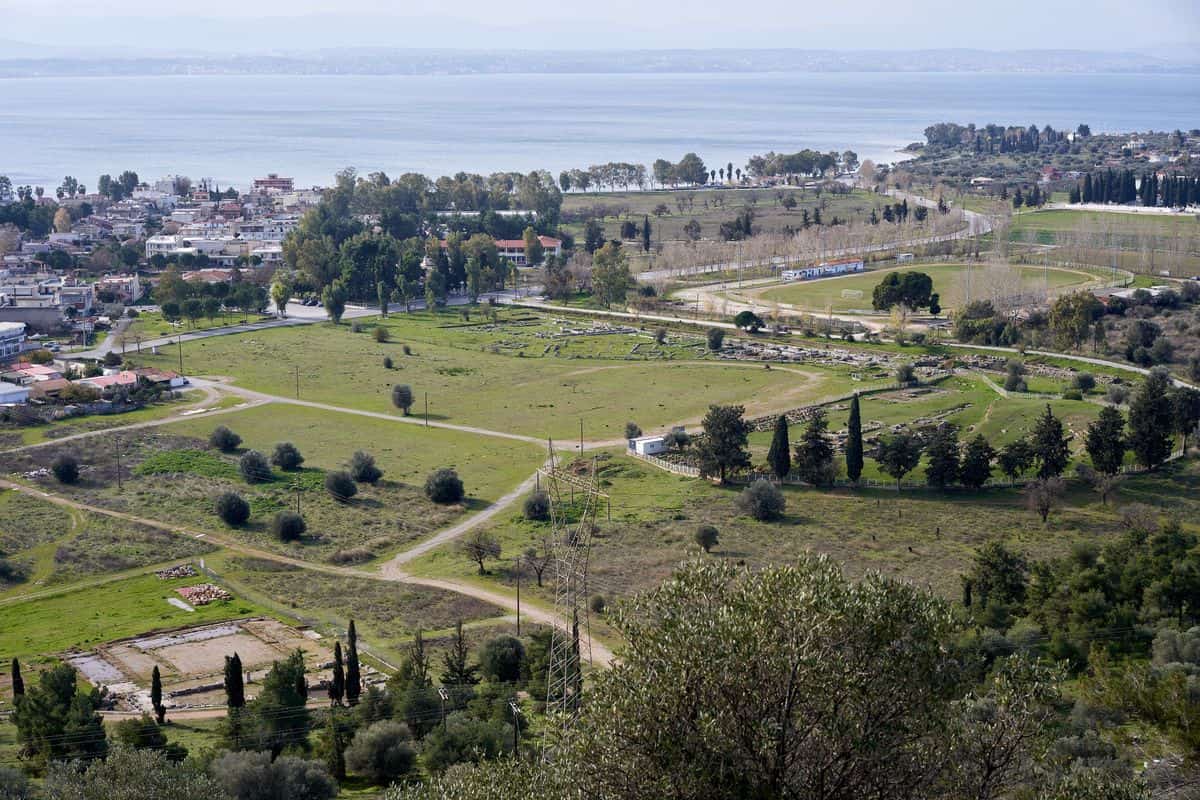
The temple of Apollo Daphnephoros stood north of the agora as the main cult place of the city. Its last form, a Doric temple of poros stone and marble with 6 by 14 columns, was built between 520 and 490 BC over two older temples 100 feet long. To the south of the first temple stood the oldest building in Eretria, the space with laurels, linked to the early cult of Apollo at Delphi. Eretria tours see only the foundations of these temples today.
The theatre lies in the west of the town, between the West Gate and the upper gymnasium. Its cavea stood on an artificial mound and held 6,300 spectators on eleven tiers. A vaulted passage under the stage led to the centre of the orchestra and served scenes in which figures of the Underworld appeared. Eretria tours no longer enter the theatre, as access is forbidden because of advanced weathering of the stone.
The Swiss School of Archaeology in Greece marks out three Eretria tours on foot. The first crosses the lower town in 27 stops, from the West Quarter to the harbour. The second covers the Iseion, the palaestra and the sanctuary of Eileithyia. The third follows the fortification wall to the summit of the acropolis, with a panoramic view over the Euboean Gulf.
- West Gate: dated to the 6th to 2nd century BC, next to the Heroon, where a triangular building rose around 680 BC over warrior graves.
- Gymnasium: uncovered in 1917 and dated to the 4th century BC, with a sanctuary of Eileithyia in its north-western section and a well that held about 100 terracotta cups.
- House of the Mosaics: built around 370 BC, with pebble floors of Nereids riding a seahorse, Arimaspians fighting griffins, sphinxes and panthers.
- Open areas: Eretria tours enter the West Quarter and the pavilion over the House of the Mosaics during museum hours, and the museum keeps the pavilion key.
Which museum do Eretria tours visit?
Eretria tours visit the Archaeological Museum of Eretria, next to the ancient site, where two rooms show finds from Eretria, Lefkandi and Amarynthos. Its main pieces include the terracotta Centaur of Lefkandi and the Theseus and Antiope group from the temple of Apollo Daphnephoros.
The museum was built in 1960. The 11th Ephorate of Antiquities and the Swiss School of Archaeology in Greece renovated and extended it between 1987 and 1991, and a gift from the Federal Office of Culture of Switzerland renewed the permanent exhibition in 2014. Sculptures and inscriptions stand in the gallery next door and in the garden. Other finds from Eretria sit in the National Archaeological Museum in Athens and in the Louvre in Paris.
Swiss archaeologists began digging at Eretria in April 1964, and the mission took the title of School of Archaeology in 1975. The school keeps offices in a 19th-century neoclassical house in Eretria. Greek and Swiss teams still explore the city, so Eretria tours follow research that is under way.
- Centaur of Lefkandi: a terracotta figure of the second half of the 10th century BC, found broken in two parts, each placed in a different grave.
- Theseus and Antiope: a group from the Amazonomachy on the west pediment of the temple of Apollo, attributed to the Athenian sculptor Antenor.
- Mycenaean alabastron: a three-handled vase from Lefkandi of the 12th century BC, painted with a griffin, a roe and a deer.
- Panathenaic amphora: a prize vase of 363 to 362 BC, with the armed goddess Athena on the front.
- Gorgoneion: a 4th-century BC terracotta that decorated the House of the Mosaics.
Scale models of the Doric temple of Apollo and of the House of the Mosaics help Eretria tours read the ruins outside.
What history do Eretria tours tell?
Eretria tours tell the story of a city named in Homer’s Iliad. It fought Chalcis in the Lelantine War, founded Pithekoussai and Cumae in Italy with Chalcis, and fell to the Persians in 490 BC. Refugees from Psara refounded it in the 19th century.
Eretria tours start in the 8th century BC, when Eretria and Chalcis, today Chalkida, were powerful trading cities. Eretria controlled Andros, Tenos and Ceos and at its height fielded 3,000 hoplites, 600 cavalry and 60 chariots. Euboeans from both cities settled on Pithekoussai, today Ischia, to trade with the Etruscans, and then founded Cumae, the first Greek colony on the Italian mainland. Between about 710 and 650 BC the two cities fought the Lelantine War over the fertile Lelantine Plain.
In 499 BC Eretria joined Athens in aiding the Ionian Revolt, and their force burned Sardis. Darius I struck back in 490 BC. A fleet under Datis and Artaphernes besieged Eretria for six days, until two nobles, Euphorbus and Philagrus, opened the gates. The Persians burned the temples and sailed on to Marathon, and the captive Eretrians were deported to Ardericca in Susiana.
Rome took the city in 198 BC, and the site lay empty from the 6th century AD. After the Ottomans destroyed Psara in June 1824, survivors from the island settled on the ancient site and named it Nea Psara. Stamatios Kleanthis and Eduard Schaubert drew the street plan in 1834, the plan that Eretria tours still walk, and the Community of Nea Psara took the name Eretria in 1960.
- Iliad: Homer lists Eretria among the Greek cities that sent ships to the Trojan War.
- Nestor’s Cup: a Euboean cup of about 730 BC, found in a grave on Ischia in 1953, with lines in the early Greek alphabet.
- Plataea: the rebuilt city sent 600 hoplites to the battle of 479 BC.
- Philoxenus: the Eretrian painter of the battle of Issus, which the Alexander Mosaic in Naples copies.
Which Eretria tours sail the South Euboean Gulf?
Eretria tours by boat leave the harbour for the South Euboean Gulf, which separates southern Evia from Boeotia and Attica on the Greek mainland. Four small islets lie off the town: Pezonisi, also called the Island of Dreams, Agia Triada, Kolokythi and Aspronisi.
Boat-based Eretria tours leave from the ancient harbour, whose basin matches the modern port and covers more than 70 hectares, the same area as the ancient city. The coast and the Pezonisi peninsula sheltered it from eastern currents, and the Eretrians closed the western anchorage with a mole over 600 m long. West of the walls, the mole stays visible for over 300 m at depths of 2.5 to 3.5 m. The Ephorate of Underwater Antiquities and the Swiss School have cleaned and mapped these remains in a three-year project.
The water that Eretria tours cross today saw the naval Battle of Eretria in September 411 BC. A signal fire from the town told the Spartan admiral Hegesandridas to attack while the Athenian fleet took on supplies, and Athens lost 22 ships.
- Pezonisi: the Island of Dreams, joined to the shore by a bridge.
- Agia Triada: an islet near the harbour with no residents at the 2011 census.
- Gulf depth: under 250 m, and no deeper than 70 m in its middle stretch.
- Gulf reach: from the Euripus Strait at Chalkida in the north-west to the Petalioi Gulf in the south-east.
Sea-based Eretria tours appear in full on the Eretria boat cruise page.
Which South Evia day trips do Eretria tours include?
Eretria tours heading south take the road to Aliveri and on into the south of Evia. The day trips reach the Dimosari gorge, the dragon houses of Mount Ochi and Styra, the port of Marmari, the Petalioi islands and Karystos, 129 km from Chalkida.
The Dimosari gorge runs for about 10 km, from Petrokanalo on Mount Ochi, at 950 m, down to the beach of Kallianos on the Aegean. Its stream crosses the hamlet of Lenosaioi, near which small waterfalls drop into natural pools at Skala Lenosaion. Agatho, near the mouth of the gorge, marks the end of trails that cross Ochi, a network covered under Evia hiking.
Mount Ochi rises to 1,398 m at its Profitis Ilias summit, 6 km north-east of Karystos. The summit holds the best-preserved dragon house, 12.7 m by 7.7 m, with a corbelled roof of large stone blocks. Cult finds there span the 6th to the 2nd–1st century BC, and the building is regarded as a sanctuary of Zeus and Hera. About twenty such buildings stand in south Evia, all of stone blocks set without mortar, and the three at Palli-Lakka are the best preserved around Styra. Eretria tours can add the cave of Agia Triada, the largest cave in southern Evia.
- Karystos: a town of about 5,000 people, laid out by the Bavarian engineer Bierbach in the mid-19th century, with the 13th-century Venetian Bourtzi fortress on its eastern beach.
- Marmari: a fishing village 13 km west-north-west of Karystos, in a bay opposite Rafina; its ferry covers the 14 nautical miles to Rafina in about one hour.
- Petalioi: ten islands and islets covering 22.5 km², led by Megalonisos at 17 km²; Greek shipowners own the bulk of them, and none has had permanent residents since 2021.
- New Styra: a port 94 km south-east of Chalkida, where Evia narrows to 10 km, with daily car ferries to Agia Marina in Attica.
Eretria tours that walk the gorge downhill finish at Kallianos, 134 km south-east of Chalkida.
Which wines do Eretria tours taste?
Eretria tours taste Savatiano, the white grape behind retsina, which Evia growers blend with Roditis, and the wines of the Lykos family winery at Malakonta, next to Eretria. Vines also cover parts of the Lelantine plain, about 40 km² of farmland between Chalkida and Eretria.
Savatiano covers a large share of Greek vineyards and stands up well to drought and heat. Its wines carry notes of pear, green apple and peach, and Evia pairs it with Roditis, a pink-skinned grape. Retsina comes from the same grapes, with small pieces of Aleppo pine resin added to the must during fermentation, and the European Union protects the name as a Greek designation of origin. Evia ranks with Attica and Boeotia as a main retsina centre, and Ritsona, 21 km south-west of Chalkida, echoes retsini, the pine resin, in its name and holds vineyards and large wineries.
The Lykos winery began in a family tavern, where the grandfather, Dimitris Lykos, kept a stone treading vat for wines from his own and nearby vineyards. Today the third generation runs a winery with cooled stainless steel tanks, a bottling line, underground cellars of oak barrels and a tasting room. It fills 300,000 bottles a year, half white and half red. Eretria tours reach it 4 km along the road from Eretria to Malakonta.
- Grapes: the Lykos partner vineyards in central and south Evia, Boeotia and Nemea grow Savatiano, Roditis, Assyrtiko, Athiri, Malagousia, Vradiano and Mavrokountoura.
- Lelantine plain: watered by the Lilas river, it was called the eye and garden of Euboea in a Venetian document of 1439, and small vine-growing units still work it.
- Mytikas: a village of the plain with wineries open to visits, part of central Evia wine tourism.
- Gymno: a village at 135 m at the foot of Euboean Olympus and a winter destination known for its local cooking, wines and farm produce.
Eretria tours extend into Evia wine tasting routes across the island.
How do visitors reach the start of Eretria tours?
Eretria tours start either from Skala Oropou, where car ferries cross the South Euboean Gulf to Eretria, or from Chalkida, about 80 km from Athens, which trains, coaches and two bridges link with the mainland. From Chalkida, Eretria lies 19 km to the south-east.
The ferry line joins Skala Oropou, in north-east Attica, with Eretria across a gulf no more than 14 km wide. The passenger and car ferries Aris III, Aiolos and Anna Maria work it for three Eretria shipping companies. Drivers from Athens reach the port on the EO79 road, which meets the A1 motorway at Malakasa, exit 25. Oropos lies 55 km north of central Athens, and Eretria tours that use the ferry skip the drive round through Chalkida.
By road, the A11 motorway branches off the A1 at Schimatari and ends at the High Bridge of Chalkida, a cable-stayed span opened on 9 July 1993, 694.5 m long with 34.5 m of clearance. The old sliding bridge crosses the Euripus at its narrowest point, 38 m wide, and slides aside for ships; heavy traffic keeps it for city trips. Eretria tours that begin there add a Chalkida walking tour along the strait.
- Train: Line A3 of the Athens Suburban Railway runs from Athens to Chalkida through Oinoi in about 1 hour 19 minutes, on a 21.69 km branch opened on 8 March 1904.
- Station: Chalkida station stands at the city entrance, beside the old bridge on the mainland side, in a protected building of 1905.
- Coach: KTEL Evias coaches leave the Liosion bus station in Patisia, near Kato Patisia metro on Line 1, for Chalkida, Aliveri, Karystos and Kymi; Chalkida is the busiest route there.
When do Eretria tours run best?
Eretria tours run best from June to September, the dry and sunny months. Chalkida, 19 km to the north-west, records mean highs of 28.9 °C to 32.6 °C and 4.2 to 11.9 mm of rain a month in that period.
July is the hottest month, with a mean high of 32.6 °C, a mean low of 22.5 °C, humidity of 48% and 373.7 hours of sunshine, the peak of the year. Rain returns in October with 47.7 mm, and December is the wettest month at 66.6 mm. January averages a high of 12.9 °C and a low of 6.5 °C, in a Mediterranean climate of hot, dry summers and mild, rainy winters.
Eretria tours in the swimming months use the beaches of the gulf. Malakonta, next to Eretria, has a long beach of sand and pebbles that locals call Agios Andreas. Amarynthos is known for its beaches and tavernas and fills with visitors in summer. Further south, Kokkini beach at Marmari holds a Blue Flag, and Megali Ammos beach is a base for windsurfing and kitesurfing.
- Kanareia: a week of music, theatre and traditional dance in the central square of Eretria in late July.
- Varkaroles: local musicians play island songs from a caique off Amarynthos beach on a Sunday, customarily in the first week of August, before fireworks.
- Patron saint feast: Amarynthos honours Saint John the Baptist on 29 August, after vespers and an icon procession on the eve.
- Carnival season: Amarynthos stages a carnival with floats and masqueraders, Gymno holds its own, and Clean Monday brings kites and Lenten food.
Eretria tours in winter meet the Ritsona hill climb, a car race held on the first weekend of December since 1956.
Frequently Asked Questions
What makes the Euripus current a stop on Eretria tours?
The Euripus current reverses about every 6 hours on 22 to 23 days a month and up to 14 times a day on the rest. The tidal wave entering from the south reaches the strait 1 hour 15 minutes before the northern wave and raises the water 30 to 40 cm.
Which mountain villages suit winter Eretria tours?
Seta sits at 800 m among the fir forests of Xirovouni and carries the nickname Switzerland of Greece. Nearby lie Volathro, the deepest chasm in Evia at about 120 m, and the Seta cave at Lamna. Winter Eretria tours also reach Ano Vathia, whose convent of Agios Nikolaos dates from 1455.
Which protected area do Eretria tours cross on Mount Ochi?
Mount Ochi and its coastal zone form the Natura 2000 site GR2420001. Chestnut woods grow near the highest peak, and oriental plane trees shade the meadows. Protected species include Euboean tea, the Euboea violet, the Carystian bellflower, European otters and horseshoe bats. Eretria tours on Ochi pass through this zone.
Which local products do Eretria tours find in Evia?
Evia produces olive oil and olives, and the Rovies conserve olive holds PDO status, as do the dried figs of Kymi. Its honey comes from pine, fir and aromatic plants, its dairies make touloumotyri, feta and mizithra, and 31 floating fish farms raise gilthead bream, sea bass and trout.