
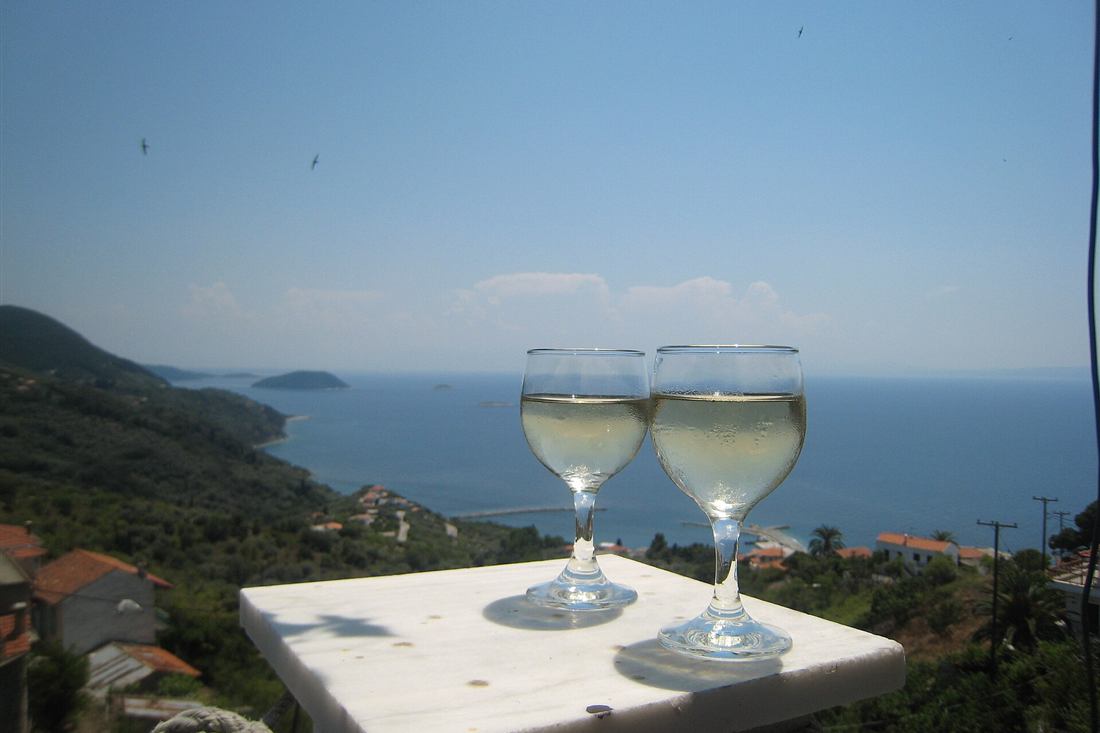
Evia Wine Tasting
Evia wine tasting is a winery visit on Evia, the island joined to mainland Greece by the Chalkida bridges, where local producers pour Savatiano, Malagousia, Mavrokoudoura and Syrah beside cheese and small plates. The Greece Tours team lists two Evia wine tasting tours on the island: a three-winery day from Eretria and a private wine hike on the Ritsona trail.
The wineries sit in three zones: the Lilantio Plain and the Chalkida area in the centre, the green hills around Aidipsos and Istiaia in the north, and the windy terraces of Karystos in the south. Every Evia wine tasting in these zones moves from crisp whites to structured reds, and the southern estates close with a sweet wine.
What is Evia wine tasting?
Evia wine tasting is a seated or guided session at a winery on Evia where the producer pours a line of three to five local wines, explains the grapes and the soil behind each glass, and serves cheese or small plates beside the wines.
Evia is the second-largest island in Greece, and about 4,000 hectares of its land are planted with vines. Its wines carry the PGI Evia label, a protected geographical indication that covers the whole island, while two smaller zones, PGI Lilantio Pedio and PGI Ritsona, mark the best-known growing areas. An Evia wine tasting therefore reads one island through its soils, from the clay and loam of the central plains to the limestone and schist of the slopes and the slate of the far south.
The sea shapes the flavour of every Evia wine tasting. Vineyards near the Euboean Gulf and the Aegean give white wines a light salty edge and a fresh herbal note. Mountain plots add a wide gap between day and night temperatures, and that gap keeps acidity high in the ripe grapes. Whites from the central plains show citrus peel, pear and wild thyme, and reds from higher ground show dark cherry, spice and dried fig.
A session follows a set order: the freshest white comes first, rose wine and red follow, and a structured red or a sweet wine closes the line. Hosts match the depth of the talk to the guest, from a first look at Greek wine to technical points such as skin contact, fermentation temperature and yeast. The same format runs at small family cellars and at larger estates, and it forms the core of every Evia wine tasting tour on the island.
Which Evia wine tasting tours can you book?
Two Evia wine tasting tours are open for direct booking: a wine tour from Eretria with tastings at three wineries, and a private wine hike on the Ritsona trail that ends with a visit to the Tzivani organic winery.
The Eretria tour suits guests who want a wide sample in one outing. Its title sets tastings at three separate wineries, so the day compares three cellars, three winemaking styles and three sets of labels one after another. Eretria lies on the south-west coast of the island inside the central wine zone, close to the vineyards of the Lilantio Plain. This Evia wine tasting tour sits in the wider range of central Greece tours, and the wineries on the day, the meeting point and the start time are set per date, so check the tour listing.
The Ritsona tour joins walking and wine, and it is the one tour on sale that pairs a hike with the cellar visit. It runs as a private tour, so the booking party walks as its own group through the semi-mountainous Ritsona wine area before the Evia wine tasting at Tzivani, an organic producer based in Vathy. The route, the walking time and the number of wines poured are set per departure, so check the tour listing for the details of the day.
Individual estates also run their own Evia wine tasting sessions at the cellar door. Avantis Estate in the Chalkida area offers a tiered set, from a welcome tour with tasting up to heritage and signature tastings that include a winery tour. Lykos Winery near Eretria pairs a guided tour with a tasting and also sells a body and face massage combined with wine. Guests based in the capital can set these against an Athens wine tasting before choosing a day on the island.
- Eretria wine tour – tastings at three Evia wineries in a single outing.
- Ritsona trail wine hike – a private walk that ends at the Tzivani organic winery.
- Estate tastings – cellar-door sessions booked directly with one winery.
- Multi-day wine tours – five-day and seven-day routes from Athens that include Evia.
Which grape varieties does Evia wine tasting feature?
Evia wine tasting features Savatiano as the leading white grape, Malagousia for aromatic whites, the local red Mavrokoudoura, the revived red Vradiano and Syrah, the international grape that suits the warm, dry centre of the island best.
Savatiano is the backbone of Evia wine tasting. The grape resists drought and gives wines with yellow fruit, herbs, a round texture, medium body and crisp acidity, and modern winemaking has turned it into a white that ages well. Producers ferment it in stainless steel for a clean, pure style or age it in barrel for more texture. The dry PGI Evia Savatiano sits between 12 and 13 percent alcohol and is served at 10 to 12 degrees Celsius.
Malagousia brings the most perfume to an Evia wine tasting, with floral scents, peach and a green pepper note. It grows well on the semi-mountainous ground of the island, and cellars keep it in cool stainless steel tanks to protect its aromas. Skoumpris Winery bottles a fresh, aromatic Malagouzia, the local spelling of the same grape, and some estates pour a chilled Assyrtiko at outdoor tastings among the vines.
The reds give an Evia wine tasting its depth. Mavrokoudoura, a local clone of Mandilaria, gives deep colour, red fruit and spice, prefers the warmer sites of central Evia and rests in oak for 12 to 18 months. Vradiano, an ancient red now being revived, offers moderate tannins and bright cherry fruit. Syrah gives spicy, full-bodied wines, and Skoumpris blends it with Ritino in its Flevaris Red. These grapes place the island among the popular wine regions in Greece.
- Savatiano – dry white with yellow fruit, herbs and crisp acidity.
- Malagousia – aromatic white with floral, peach and green pepper notes.
- Mavrokoudoura – deep red with red fruit, spice and oak ageing.
- Vradiano – revived red with moderate tannins and bright cherry.
- Syrah – full-bodied red with a spicy finish.
Which wineries open for Evia wine tasting in central Evia?
Central Evia holds the densest cluster of estates open for Evia wine tasting, led by Avantis Estate and Skoumpris Winery in the Chalkida area, Lykos Winery near Eretria, and Sabanis Estate and Tzivani Bio Wines at Avlida and Vathy across the bridges.
Central Evia hosts more than a dozen significant producers, which makes it the easiest zone for an Evia wine tasting that takes in two cellars in one half day. The vineyards spread over the Lilantio Plain between Chalkida and Eretria and up the semi-mountainous slopes of Ritsona. Producers on the Lilantio Plain led the return of Savatiano to the top of the island’s wine list, and the clay-rich earth of the plain shapes the central whites.
Avantis Estate, listed in the Chalkida area, runs five separate Evia wine tasting formats, from a welcome tour to heritage and signature tastings, each joined to a walk through the winery. Skoumpris Winery, also in the Chalkida area, is a boutique cellar run by winemaker Spyros Skoumpris. Its range includes a Malagouzia white, the Flevaris Red blend of Ritino and Syrah, and Licario, a semi-sweet rose wine from Evia.
Lykos Winery near Eretria combines a guided tour with an Evia wine tasting and adds a massage option paired with wine. Across the Chalkida bridges, on the mainland shore of the Chalkida area, Sabanis Estate works at Avlida and Tzivani Bio Wines farms organically at Vathy. Chalkida and Eretria also anchor the Evia day trip from Athens, which covers the towns themselves, so a winery stop fits beside that route.
Which wineries open for Evia wine tasting in the north and south of the island?
In the north, Evia wine tasting takes place at Vriniotis Winery in Gialtra near Aidipsos and at Koutsogiorgakis Winery in Istiaia, while the south centres on Montofoli Estate, whose historic terraces face the windy Aegean coast around Karystos.
North Evia is greener and more forested than the centre, and its producers work to recover lost native grape varieties. Vriniotis Winery is a family estate in Gialtra, a small village 14 kilometres from Aidipsos, where earlier generations of the family first planted vines and built the old winery. Its own vineyard of 100 acres keeps the rare varieties the family has brought back into production, and Koutsogiorgakis Winery in Istiaia adds a second northern cellar.
The Vriniotis site sets the old stone grape mill and its traditional underground fermentation tank next to the new winery, so an Evia wine tasting there shows old and new winemaking side by side. The estate’s rose wine shows a clear pink colour and aromas of red fruit, cassis, cherry, strawberry and toffee. In the mouth it is refreshing and mellow, and the red fruit returns on the palate before a long, fruity finish.
The south runs on schist and slate soils and strong winds off the Aegean. Montofoli Estate holds an Evia wine tasting of five wines on its terraces in the Karystos area: four dry wines under the Myrtilos and Montofoli labels and a flagship dessert wine made in limited quantities. Its Evia Wine Experience follows four dry wines from the north of the island to the south before the dessert wine, and guests add a guided tour of the grounds, where children are welcome. Karystos is also known for sweet wines made from sun-dried grapes, with caramel and dried apricot notes.
What happens during an Evia wine tasting visit?
An Evia wine tasting visit starts with a walk through the vine rows, moves into the cellar to see tanks and barrels, and ends at the tasting table, where the host pours whites first, then reds, and closes with a reserve or sweet wine.
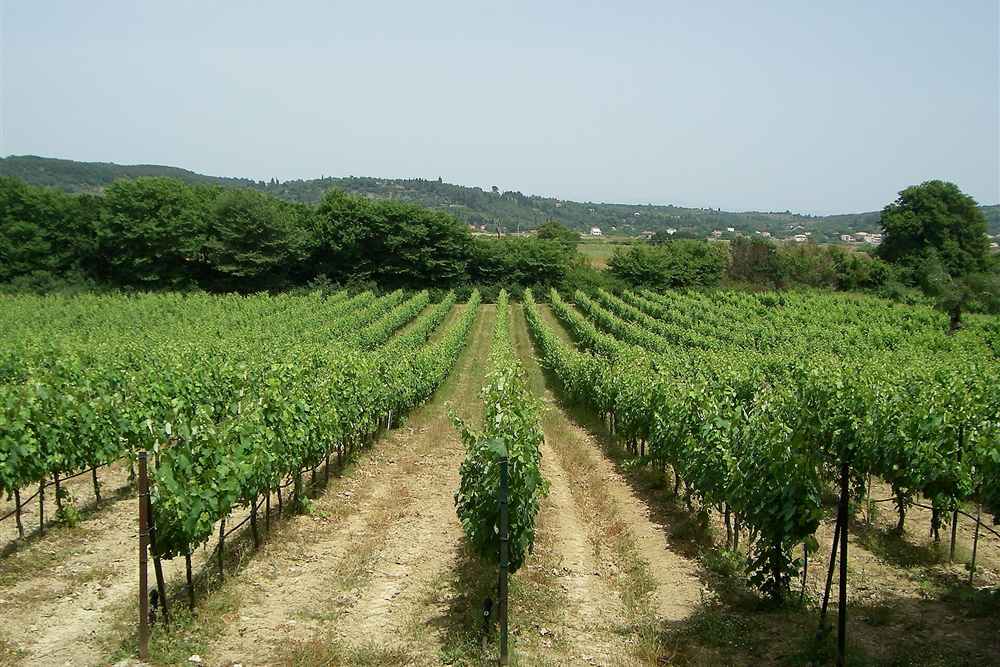
The vineyard walk comes first on a full winery tour. In windy spots the vines grow low in the goblet shape to shield the grapes from the Meltemi winds, and guides explain how the leaf canopy protects the fruit from sunburn and how growers manage scarce water. Altitude matters on an Evia wine tasting tour: 200 metres of height moves the harvest by two weeks, and premium hillside plots stay below 6,000 kilograms of grapes per hectare.
Inside the cellar the air turns cool and smells of fermentation and oak. Temperature-controlled stainless steel tanks keep the aromas of Malagousia fresh, and French oak barrels hold Syrah and Mavrokoudoura while they age. Some producers test concrete eggs or clay amphorae to add texture without wood flavour. Labels to look for during an Evia wine tasting include single-vineyard bottlings, wild-ferment wines and wines aged on their lees.
At the table, an Evia wine tasting pours three to five wines between 12.5 and 14 percent alcohol. Comparative flights set a steel-tank Savatiano beside an oak-aged one, or a fresh tank sample beside the current release and a reserve bottle, and a vertical tasting, where a winery offers one, shows the same wine across five or ten vintages. Children get local juices and snacks, alcohol-free drinks are standard, and wineries handle vegetarian or gluten-free requests when told in advance.
What is the Ritsona trail wine hike?
The Ritsona trail wine hike is a private walking tour through the semi-mountainous Ritsona wine area near Chalkida that finishes with an Evia wine tasting at the Tzivani organic winery, joining a hike and a cellar visit in one outing.
Ritsona is one of the two named sub-zones inside PGI Evia, and its vineyards sit on semi-mountainous slopes rather than on the flat plain. The height brings a wide difference between day and night temperatures, which keeps acidity in the grapes, and aromatic Malagousia grows well on this kind of ground. Walking the trail before an Evia wine tasting puts the vines, the slopes and the soil in view before the first glass is poured.
The walk ends at Tzivani Bio Wines in Vathy, a producer that farms its vines organically, and the Evia wine tasting there centres on organic wines. The tour is sold as private, so only the booking party walks and tastes together, and the pace follows that group. The trail length, walking time, meeting point and wines poured are set per departure, so check the tour listing before booking. Vathy sits on the mainland shore across the Chalkida bridges.
The hike suits travellers who want wine and nature in one outing, and the Ritsona slopes sit close to Chalkida, so the walk fits a stay in the central wine zone. Walking shoes and water suit the trail, and the tasting table rewards the effort of the climb. Guests who want more time on foot can add routes from the Evia hiking page, and a morning walk followed by an afternoon Evia wine tasting gives a balanced day on the island.
Which foods pair with Evia wine tasting?
Evia wine tasting pairs with local cheeses such as feta and blue cheese, estate olives, bread from wood-fired ovens, wild greens, cured meats, lamb and dried Kymi figs, each chosen to match the acidity, tannin or sweetness of the wine.
A seated Evia wine tasting comes with a platter of cold cuts and cheeses, and premium formats add a full lunch of warm traditional dishes. The produce comes from close by: feta from local shepherds, olives from the estate’s own trees and bread baked in wood-fired ovens. Outdoor tastings among the vines add a basket of rusks, cheese, tomatoes and olives, and the wines are made to support these flavours rather than overpower them.
Each pairing follows a clear rule. The high acidity of a dry Savatiano cuts through the richness of fried feta, and the tannins of a red Vradiano soften against slow-cooked lamb. Mavrokoudoura binds with the protein and fat of grilled lamb chops, which smooths the wine and lifts the dish. At Montofoli, the Evia wine tasting closes with the flagship dessert wine beside blue cheese, Evian dry nuts and bread sticks.
Evia also produces PDO foods, and the dried figs of Kymi, a town on the Aegean side of central Evia, are the best known. Their honeyed notes match the residual sugar of sweet Muscat or sweet Savatiano, which makes them a classic dessert partner. The local table adds wild greens called chorta and olive oil from the island’s groves. Food and wine tours extend an Evia wine tasting to olive oil presses, cheese makers and fig farms.
- Savatiano – fried feta, olives and wild greens.
- Vradiano – slow-cooked lamb.
- Mavrokoudoura – grilled lamb chops.
- Dessert wine – blue cheese, dry nuts and Kymi figs.
When is the best season for Evia wine tasting?
The best season for Evia wine tasting is late spring, from May to June, or autumn, from September to October. Days in these months sit around 20 to 25 degrees Celsius, which keeps vineyard walks and outdoor tastings comfortable.
Spring brings vines in fresh leaf, mild air and Open Cellars in May, when Greek wineries open their doors for tours and special tastings as part of the Greece-wide Anoichtes Portes event. An Evia wine tasting in May or June comes before the summer peak, and mild days suit a walk along the rows. The Open Cellars dates draw crowds to the estates, so a private session sits better on another day.
Autumn is cellar season. The red grape harvest runs through September and October, and some estates invite guests to join the harvest in late August and September. An Evia wine tasting at this time of year adds the scent of fermentation in the cool cellar and fresh grapes arriving from the vineyard. The sea stays warm enough for a swim after the last glass. October and November also bring the tsipouro festivals, when villages mark the distilling season with music and food in the square.
July and August are hot and dry, the white grape harvest starts in August, and the cool cellars give a break from the heat. Sunset tastings begin around 6:30 or 7:00 in the evening in these months, and places at them are limited, so a booking a week ahead secures a slot. Some small family wineries close for a short break in August. From November to March the island is quiet, every Evia wine tasting runs by appointment, and some estates pour by the fireplace.
- May to June – mild days, green vines and the Open Cellars event in May.
- July to August – hot days, the white harvest from August and sunset sessions in the evening.
- September to October – the red harvest, busy cellars and a warm sea.
- November to March – quiet estates, visits by appointment and fireside tastings.
How do you reach Evia wine tasting estates from Athens?
You reach Evia wine tasting estates from Athens by road. Drive north to Chalkida, where two bridges cross the Euripus Strait onto the island; the central wine zone around Chalkida and Ritsona sits about an hour’s drive from the capital.
The road route is direct. From Athens the motorway runs north through Attica, and a branch road leads to Chalkida on the Euripus Strait. Two bridges join the town to the mainland: the low bridge in the town centre and the high suspension bridge to the south. Part of the wine zone, around Ritsona and Avlida, lies on the mainland shore opposite Chalkida, so an Evia wine tasting there begins before the bridges. A walking tour of Chalkida fits in before or after the estates.
The Evia wine tour on sale starts in Eretria, a coastal town southeast of Chalkida on the Euboean Gulf. The coast road from Chalkida reaches Eretria in a short drive, and from the meeting point the tour moves on to tastings at three wineries. Lykos Winery sits at Eretria, so the town works as a natural base for an Evia wine tasting day. Travellers who stay the night in the town can add an Eretria boat cruise on the gulf. The exact meeting point and start time appear on the tour listing.
The north and south of the island take longer. Evia is long and mountainous, and winding mountain roads make driving times longer than the map suggests. The north suits a full day with two or three tastings, while the Karystos area in the south suits a weekend with a night near the port. Planning the stops in one direction avoids backtracking along the island. For a first Evia wine tasting from Athens, the central zone gives the most time at the table for the least time on the road.
How long does an Evia wine tasting tour last, and what does it include?
An Evia wine tasting tour from Eretria includes tastings at three wineries, and the exact length and inclusions appear on the tour listing. A standard visit at one estate runs for 60 to 90 minutes, and a visit with a meal runs for two to three hours.
The tour title sets out its core: it starts in Eretria and stops at three wineries, with a tasting at each one. Details such as the start time, total hours, transport between the estates and the number of wines poured sit on the tour listing, so check the tour listing before booking. Three estate visits of 60 to 90 minutes each fill three hours or more before the drives, so an Evia wine tasting tour of this kind takes most of a day.
At each stop an Evia wine tasting runs through three to five wines, moving from crisp whites to structured reds and, where the estate makes one, a sweet dessert wine. Most hosts lead the sessions in English and match the depth of the talk to the group, from new tasters to enthusiasts. Seated tastings at most estates come with a platter of cheese and cold cuts, and vegetarian or gluten-free requests are met when the estate knows in advance.
Other formats change the length. A tasting with a full lunch of warm traditional dishes takes two to three hours at a single estate. The private wine hike on the Ritsona trail adds a walk before a visit to the Tzivani organic winery, and its length appears on its own listing. For a first Evia wine tasting, the three-winery day from Eretria puts three estates into one booking and one day.
- Start point – Eretria, on the Euboean Gulf coast of the island.
- Wineries – three estates, with a tasting at each stop.
- Wines per stop – three to five at a standard estate tasting.
- Length and transport – set per date, so check the tour listing.
How old is winemaking on Evia?
Winemaking on Evia reaches back generations: family estates grow on vineyards their forefathers planted, and old stone grape mills and historic terraces still stand beside modern cellars. An Evia wine tasting shows the old craft and the new technology side by side.
The clearest example sits at Gialtra, a small village in North Evia 14 km from Aidipsos. There the Vriniotis family runs a new winery next to the old stone grape mill and the traditional underground fermentation tank that earlier generations built. The family vineyard covers 100 acres and keeps rare varieties that the family brought back to life. An Evia wine tasting at an estate like this links the glass to a working family history, with the old mill and the modern tanks a few steps apart.
In the far south, the Montofoli estate near Karystos grows its vines on historic terraces, on slopes open to the windy Aegean. Terraced ground holds soil on steep hillsides, and these old walls show how long the south of the island has shaped its slopes for the vine. Karystos also has a tradition of sweet wines made from sun-dried grapes, and the estate makes a flagship dessert wine in limited quantities. An Evia wine tasting in the south puts these old terraces in full view of the tasting table.
The modern chapter is a revival. Growers in North Evia are recovering lost indigenous grapes, and Vradiano, an ancient red variety, is being revived. Savatiano, the main white grape of the island, was once misunderstood, and modern winemaking has turned it into a structured white that ages well. The island’s wines carry the PGI Evia label, a protected geographical indication that covers the whole island. Each Evia wine tasting today reflects this mix of old vineyards, rescued grapes and new cellar methods such as temperature-controlled steel tanks.
How do Evia wines differ from other Greek wine regions?
Evia wines differ through their island setting: sea air from the Euboean Gulf and the Aegean gives the whites a salty, herbal freshness, and mountain slopes give the reds dark fruit and spice. An Evia wine tasting shows this sea and mountain contrast in one flight.
Soil is the first difference. The Lilantio Plain in central Evia has clay-rich earth, and the south around Karystos has schist and slate, which give the wines a mineral backbone. Across the island, clay and loam fill the plains while limestone and schist cover the slopes. The gap between day and night temperatures in the centre and north keeps acidity in the grapes through the hot summer. An Evia wine tasting that moves from a plain estate to a hillside estate makes these soil changes easy to taste.
Wind and height shape the vineyards too. In windy areas growers train the vines low to the ground in the goblet style to protect the grapes from the summer meltemi. Altitude matters: a rise of 200 metres can move the harvest date by two weeks. The island holds about 4,000 hectares of vines under the PGI Evia label, with the sub-zones PGI Lilantio Pedio and PGI Ritsona. This range of sites gives an Evia wine tasting more contrast than a region built around a single valley.
Nearby regions show the contrast. Attica, around Athens, is the historical heartland of Savatiano. Boeotia, across the strait, is known for hot summers and robust reds, and the Copais valleys there have richer, deeper soils than the stony slopes of Evia. Further afield, Santorini grows its vines on a small volcanic island in the Cyclades, and a visit to the Santorini wineries makes a clear counterpoint to the long, mountainous shape of Evia. An Evia wine tasting reflects that position between sea and peaks.
Can you buy wine at the wineries after an Evia wine tasting?
Yes, the cellar door at an Evia wine tasting estate is the place to buy the wines just tasted, straight from the producer. Small family estates bottle limited quantities, and some labels, such as a flagship dessert wine, come in small runs, so the choice depends on the estate.
Buying at the estate has a clear advantage: the bottles come from the cellar where they were made, and the host explains each label before the choice. Montofoli in Karystos, for example, pours four dry wines under the Myrtilos and Montofoli names and a flagship dessert wine made in limited quantities. The Vriniotis family in Gialtra bottles its wines in small numbers of rare bottles from its own vineyard. An Evia wine tasting at a family estate gives direct access to small-batch wines like these, with the maker on hand to explain them.
Estate wines cover a wide range of styles. Skoumpris Winery near Chalkida makes a fresh Malagouzia white, a red blend of Ritino and Syrah and a semi-sweet rose, and Evia labels like these have reached Athens wine bars by the glass. Buying at the source after an Evia wine tasting lets guests pick the exact wines they liked in the glass, from fresh whites to oak-aged reds and sweet wines from the south.
Carrying bottles home takes a little planning. On a three-winery day, buying at the last stop keeps bottles out of a hot parked car in summer. Bottles travel best wrapped in clothing in checked luggage, and airlines limit liquids in cabin bags, so a look at the airline’s rules before an Evia wine tasting trip avoids problems at the airport. For travellers heading home by car, the bottles ride back to Athens over the same bridges the day began on.
What etiquette applies at an Evia wine tasting?
Etiquette at an Evia wine tasting is simple: spit or pour out freely, never drive after drinking, pace the pours across the day and keep children with an adult. Hosts expect guests to taste, ask questions and book ahead rather than turn up unannounced.
Spitting is normal and polite. Estates set out a spittoon or a dump bucket, and using it lets a guest taste every wine in the flight without drinking each glass. Pouring the rest of a glass into the bucket is equally accepted, and hosts do not read it as a comment on the wine. Water and bread between wines keep the palate clear. On a three-winery Evia wine tasting day, spitting at the first two stops keeps the palate sharp for the last one.
Driving is the main safety point. Greece enforces drink-driving limits, and a full flight at each estate adds up quickly over a day. A designated driver who spits every wine, or a guided tour with transport, removes the problem. Guided multi-winery days exist for this reason: they let every guest compare styles without the stress of driving on winding island roads. A driver at an Evia wine tasting tastes each wine, spits the rest and drinks water.
Pacing matters on a long day. Each estate pours three to five wines, so three stops add up to a large number of tastes; small sips, water and the food platter keep the day steady. Two wineries per day is a realistic pace for self-drivers. Families are welcome at Evia estates: children explore the gardens with local juices and snacks, some wineries keep farm animals or play areas, and Montofoli welcomes children under 14 on its guided tour of the grounds. Only adults take part in the Evia wine tasting itself.
- Spit – use the spittoon or pour out, with no offence to the host.
- Drive – name a designated driver or book a tour with transport.
- Pace – take small sips and drink water between wines.
- Children – keep them with an adult and ask for local juice.
- Book – reserve the visit and state dietary needs in advance.
Is Evia wine tasting worth adding to a stay in Athens?
Yes, Evia wine tasting is worth adding to a stay in Athens: the central wine zone sits about an hour’s drive away, two estates fit into a half day, and the visits are small, personal sessions with the people who make the wine.
The main draw is the setting and the contact. Wine tourism on Evia is intimate and unpretentious, and a visit means a shaded table above the Euboean Gulf, a conversation with the winemaker and a slower island pace. The estates are family-run and boutique rather than grand chateaux. An Evia wine tasting gives a traveller based in Athens a day in the countryside with wine as the thread, and the central zone lets the day end back in the city the same evening.
Evia fits alongside the other day trips from Athens as the wine-focused option to the north of the capital. For travellers who already know Greek wine, a Nemea wine day trip from Athens offers a second region, in the Peloponnese, to compare against the island, and pairing the two in one stay shows how far Greek wine styles range. An Evia wine tasting brings the island side to that comparison, with sea air and mountain slopes shaping the wines in the same glass.
The day suits couples, groups of friends and families with older children, and it works in every season with a booking. Travellers with one free day pick the Eretria tour with three wineries for the widest spread of estates; those with two days add a night on the island and a second Evia wine tasting further north or south. A morning swim or a walk before the tasting rounds out the day, and the route home to Athens runs back over the Chalkida bridges.
Frequently Asked Questions
Do you need to book an Evia wine tasting in advance?
Yes, book an Evia wine tasting in advance. Estates open by appointment from November to March, summer sunset sessions have limited places and need booking a week ahead, and summer weekends fill early, so a reservation secures both the table and the date.
Can non-drinkers join a wine tour on Evia?
Yes, non-drinkers join an Evia wine tasting on the same terms as everyone else. Non-alcoholic drinks are standard at the estates, local juices are on hand, and the vineyard walk, the cellar visit and the food platter make a full visit without a glass of wine.
What wine is Evia known for?
Evia is known for Savatiano, a dry white with medium body and crisp acidity that forms the backbone of the island’s vineyards. An Evia wine tasting also covers aromatic Malagousia, the rare red Mavrokoudoura, Syrah and sweet wines from the Karystos area.
Is a guide needed to visit Evia wineries?
No, a guide is not required, since estates welcome booked visitors and the hosts lead each tasting themselves. A guided Evia wine tasting day removes the stress of driving between estates after drinking, which matters when three wineries share one day.
Can you combine a winery visit with a beach day on Evia?
Yes, a morning swim followed by an afternoon Evia wine tasting makes a balanced day, and a pace of two wineries per day leaves time for the sea. In September and October the water stays warm enough for a swim between harvest-season visits.