
Central Greece tours cover the mainland region between Attica and Thessaly: Delphi and its oracle on the slope of Parnassus, the ski town of Arachova, the 11th-century mosaics of Hosios Loukas, Thebes and the battlefields of the Boeotian plain, the pass of Thermopylae, Lamia and the Spercheios valley, the gorges and rivers of Evrytania, and the island of Evia, which belongs to the same region. Plan the rest of the trip with Greece Tours.
This page covers the Central Greece tours you can book from Athens, Delphi and Kalambaka, what each regional unit holds, the sanctuaries, castles and monasteries, the mountains, gorges and ski centres, the food and the wine, and how the roads, the seasons and the opening hours shape the route.
What do Central Greece tours cover?
Central Greece tours cover Delphi and its oracle on the slope of Parnassus, the ski town of Arachova, the mosaics of Hosios Loukas, Thebes and the Boeotian plain, the pass of Thermopylae, Lamia and the Spercheios valley, the mountains of Evrytania and the island of Evia.
The administrative region of Central Greece runs from the Corinthian Gulf to the Aegean and from Attica to Thessaly. Its capital is Lamia, its largest city is Chalkida on Evia, and it holds five regional units: Boeotia, Euboea, Evrytania, Phocis and Phthiotis. The traditional name for the wider area is Roumeli, from the Ottoman Rum-eli, the land of the Romans.
It is the most mountainous part of the country outside Epirus. Giona reaches 2,510 m and is the highest peak south of Olympus, Vardousia 2,495 m, Parnassus 2,457 m, Tymfristos 2,315 m and Oiti 2,152 m. Between them lie the plain of Boeotia, the drained bed of Lake Copais, the Spercheios valley and the gorges of Evrytania.
Which formats do Central Greece tours take?
- Day trips from Athens to Delphi, 180 km each way, with the site and the museum.
- Delphi and Thermopylae in one private day, taking both of the region’s famous sites.
- Two-day Delphi and Meteora tours that cross the region from south to north.
- Guided walking tours of the sanctuary with a licensed archaeologist.
- Mythology and Arachova days, with the museum, the Corycian cave and the mountain town.
- Ski and outdoor trips to Parnassos and Velouchi, rafting on the Evrytanian rivers.
Our pages on Delphi, Arachova and Evia tours cover parts of the region in detail, and Greece Tours sets out the rest of the country.
Which regional units make up Central Greece?
Central Greece holds five regional units: Phocis with Delphi and Amfissa, Boeotia with Thebes, Livadeia and Arachova, Phthiotis with Lamia and Thermopylae, Evrytania with Karpenisi, and Euboea with Chalkida and Skyros.
Each unit has its own character. Phocis is the mountain shelf between Parnassus and the Corinthian Gulf, with Delphi on its slope, Itea and Galaxidi on its water and the olive forest of the Crissaean plain between them. Boeotia is the farmed plain of Thebes and Livadeia, with Copais drained at its centre and Hosios Loukas on the slope above it.
Phthiotis runs from the Spercheios delta to the pass of Thermopylae and the spa coast at Kamena Vourla, with Lamia as the regional capital. Evrytania is the mountain block behind them, the least populated unit in the country, with Karpenisi in its valley. Euboea, the second largest Greek island, belongs to the same region and is reached by bridge at Chalkida.
- Phocis – Delphi, Amfissa, Itea, Galaxidi, Parnassus and Giona.
- Boeotia – Thebes, Livadeia, Arachova, Orchomenos, Chaeronea and Hosios Loukas.
- Phthiotis – Lamia, Thermopylae, Kamena Vourla, Agios Konstantinos and Mount Oiti.
- Evrytania – Karpenisi, Proussos, Lake Kremasta and Mount Tymfristos.
- Euboea – Chalkida, Eretria, Karystos, Edipsos and the island of Skyros.
The region covers a population that fell by 7.7 per cent between the 2011 and 2021 censuses, and its economy runs on farming, aluminium at Distomo, quarrying and tourism. Central Greece tours cross two or three of these units in a day, because the distances are short and the roads run between the mountains.
Which Central Greece tours leave Athens?
Central Greece tours from Athens run the full-day trip to Delphi, the private day that adds Thermopylae, the mythology day with the museum and Arachova, and the two-day tour that takes Delphi and Meteora together.
Delphi lies 180 km from Athens by the national road through Thebes and Livadeia, which makes it the standard long day trip from the capital: three hours out, three hours back, and four hours on the site and in the museum. “From Athens: Delphi and Thermopylae Full-Day Private Tour” takes both passes in one run, and “Delphi and Meteora 2-Day Tour” continues north to Kalambaka.
The guided versions work the sanctuary itself. “Delphi Guided Walking Tour” and “Delphi Oracle and Museum with a Licensed Guide” walk the Sacred Way and the museum with an archaeologist; the audio versions cover the same ground at the visitor’s own pace. “Mythology of Delphi, Museum and Arachova” adds the mountain town on the way back.
Longer routes cross the whole country. The four-day Mycenae, Epidaurus, Olympia, Delphi and Meteora tour takes the classical circuit; the four-day ancient and Byzantine Greece tour adds Hosios Loukas and the monasteries. Central Greece tours on these routes use Delphi or Arachova as the overnight stop.
Our page on one day in Delphi sets out the schedule, and how to get to Delphi covers the road and the bus.
What do Central Greece tours see at Delphi?
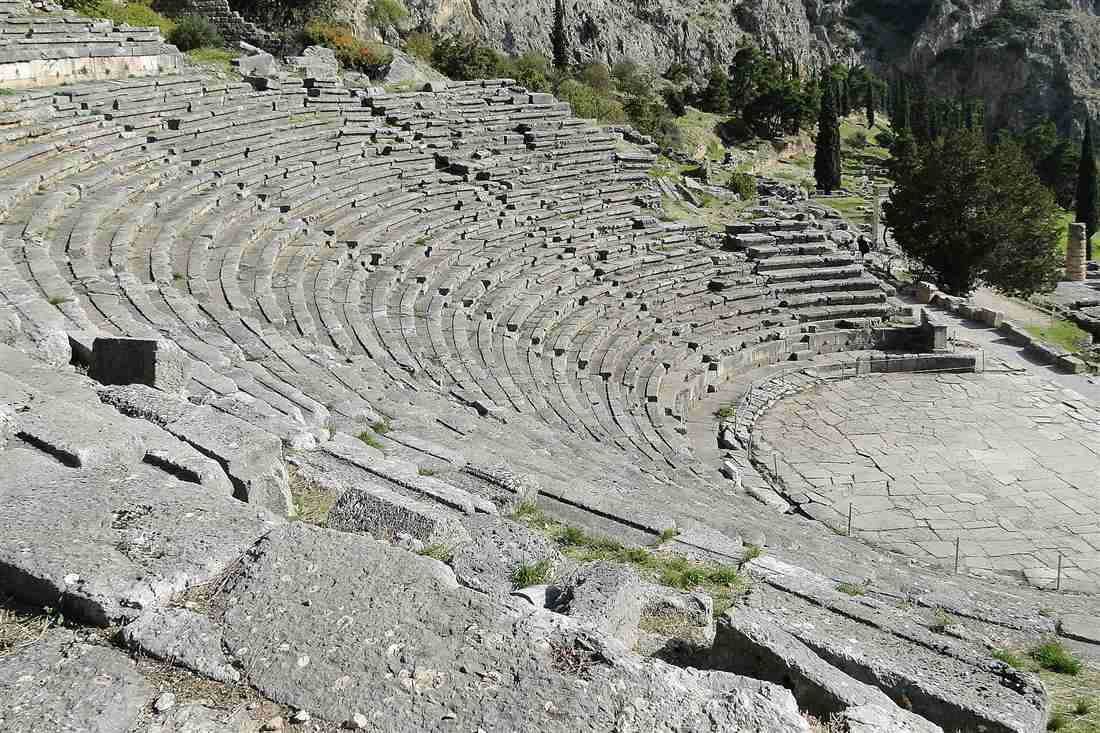
Central Greece tours at Delphi walk the Sacred Way past the treasuries to the temple of Apollo, climb to the theatre and the stadium, cross to the Tholos of Athena Pronaia, and see the Charioteer of 478 BC in the museum. UNESCO inscribed the site in 1987.
The sanctuary sits on the south-western slope of Parnassus above the valley of the Pleistos, with the Phaedriades cliffs behind it and the olive plain running down to Itea. The Greeks held it to be the centre of the world, marked by the stone omphalos, the navel, after Zeus released two eagles from the ends of the earth and they met here.
The Sacred Way climbs in zigzags from the entrance. The treasuries of the city-states line it, and the Athenian treasury of about 490 BC, rebuilt from its own blocks in 1906, still stands. Above them the polygonal wall carries thousands of inscriptions, and the temple of Apollo of the 4th century BC stands on the terrace with six columns re-erected.
- Temple of Apollo – the fourth-century building on the site of earlier temples, where the Pythia prophesied.
- Theatre – 5,000 seats above the temple, with the whole valley in the view.
- Stadium – the best preserved in Greece, 177 m long, with stone seats for 6,500.
- Tholos of Athena Pronaia – the round building of about 380 BC below the road, with three columns standing.
- Castalian spring – where visitors and the priestess washed before entering the sanctuary.
- Delphi museum – the Charioteer, the Naxian sphinx, the twin kouroi and the Siphnian frieze.
The Charioteer, cast about 478 BC and buried by a landslide, keeps his inlaid eyes and his eyelashes of bronze. Central Greece tours give the site three hours and the museum one. Our page on the temple of Apollo covers the terrace in detail.
What was the oracle of Delphi?
The oracle of Delphi was the Pythia, the priestess of Apollo, consulted from at least the 8th century BC until Theodosius closed the temple in the late 4th century AD. Cities and kings asked her before wars, colonies and laws, and her answers were recorded in hexameter verse.
The Pythia sat in the temple’s inner chamber on a tripod over a cleft in the rock. Ancient writers describe vapours rising from it, and modern geology has found two faults crossing under the temple with hydrocarbon gases in the water. Whether the priestess spoke in her own voice or in ecstasy is argued: Herodotus and Plutarch record intelligible verse, later writers a frenzy.
The oracle shaped the Greek world. Colonies were founded on its instruction, Croesus of Lydia was told that in crossing the Halys he destroyed a great empire, and the empire he destroyed was his own, and Athens was advised to trust its wooden walls before Salamis. The maxims cut at the entrance, know yourself and nothing in excess, became the shorthand for Greek thought.
The sanctuary grew rich on it. City-states built treasuries along the Sacred Way to hold their offerings, the Amphictyonic League of twelve tribes governed the site, and the Pythian Games, second only to Olympia, were held every four years with music and poetry as well as sport.
Central Greece tours read that history on the ground: the spring where petitioners washed, the wall where the answers were carved, the temple where the tripod stood. Our page on the oracle of Delphi covers the practice and the records.
What do Central Greece tours see at Arachova?
Central Greece tours at Arachova see a stone town on the slope of Parnassus at 950 m, 10 km east of Delphi, known for its formaela cheese, its woven rugs, its clock tower and its winter season as the ski town of Athens.
Arachova hangs on the mountainside above the Delphi road, in tiers of stone houses with red roofs, and the main street runs the length of it with cheese shops, weavers and tavernas. The clock tower of 1870 stands on the rock above the church, reached by steps, and the view runs down the Pleistos valley to the olive plain.
The town lives on two seasons. In winter the Parnassos ski centre 25 km above it fills the hotels with Athenians, and the bars stay open until morning. In spring and autumn the same rooms serve walkers on the mountain and visitors coming up from Delphi for lunch.
Formaela is the local cheese: a hard sheep’s cheese made in a cylinder, grilled or fried until it blisters and served with lemon. The town also weaves rugs and blankets in bright geometric patterns, sells the honey and the hilopites noodles of the mountain, and pours the red wine of the Parnassus slopes.
The feast of Agios Georgios, on 23 April or the Tuesday after Easter, is the biggest panigyri in the region: three days of dancing in traditional dress, a race of old men up the rock to the church, and the whole town in the street. Central Greece tours in that week book months ahead. Our page on the Arachova day trip covers the town.
What do Central Greece tours see on Mount Parnassus?
Central Greece tours on Parnassus see the national park declared in 1938, the Corycian cave where the Delphic rites were held, the fir forest above Arachova, the ski centre at Kelaria and Fterolakka, and the summit of Liakoura at 2,457 m.
Parnassus rises directly behind Delphi and gives the sanctuary its setting. The mountain was sacred to Apollo and to the Muses, and Dionysos held the winter half of the year on its slopes. The national park, one of the first two in Greece, protects the fir forest, the alpine meadows and the limestone plateaus above 1,800 m.
The Corycian cave sits at 1,360 m on the plateau above Delphi, an hour and a half on foot from the ancient stadium along the old path. Its chamber runs 60 m deep, votive finds date the cult from the Neolithic to the Roman period, and Pausanias records the Thyiades dancing here for Dionysos. The path continues across the plateau to Kalyvia and the ski road.
- Liakoura – the summit at 2,457 m, climbed in about four hours from the ski road.
- Corycian cave – the cult cave at 1,360 m, reached on foot from Delphi or by track from Arachova.
- Parnassos ski centre – Kelaria and Fterolakka, the largest ski area in Greece, at 1,600 to 2,260 m.
- Fir forest – the Greek fir belt between 1,000 and 1,800 m, walked from Arachova and Eptalofos.
- Livadi plateau – the shepherds’ summer pasture above Arachova.
- E4 path – the European route crossing the mountain from Delphi to the north.
Snow lies from December to April and the ski centre works that season with 19 runs. In summer the same road serves walkers, and the mountain holds wolves, wild boar and golden eagles. Central Greece tours put Parnassus above Delphi in the same day, because the ski road leaves from Arachova.
What do Central Greece tours see at Galaxidi and the Corinthian Gulf?
Central Greece tours at Galaxidi see a captains’ town of neoclassical houses on two harbours, the Nautical and Historical Museum, the olive plain and port of Itea below Delphi, and the Corinthian Gulf shore that runs west to Nafpaktos.
Galaxidi built and sailed wooden ships. In the middle of the 19th century its fleet ran to hundreds of sailing vessels trading across the Mediterranean, and the shipowners built the two-storey stone houses that line the waterfront and the lanes behind it. Steam ended the trade, the town emptied, and what survives is one of the best preserved 19th-century towns in Greece.
The Nautical and Historical Museum holds ship models, figureheads, charts and the town’s Chronicle of Galaxidi, a local history written in 1703. Agios Nikolaos, the cathedral above the harbour, carries a carved wooden screen. Pine woods run to the water at Kalafatis and Pera Panta, and the swimming is off flat rock rather than sand.
Itea, 10 km east, is the port below Delphi and the landing point for cruise passengers going up to the sanctuary. Kirra beside it was the ancient harbour of the oracle, and the olive forest of the Crissaean plain between them holds more than a million trees that supply the Amfissa table olive.
On Clean Monday, the first day of Lent, Galaxidi holds the alevromoutzouroma, the flour war, when the town throws coloured flour at itself around the harbour. Central Greece tours in that week come for it. The gulf road continues west to Nafpaktos and its Venetian harbour, an hour away.
What do Central Greece tours see at Hosios Loukas?
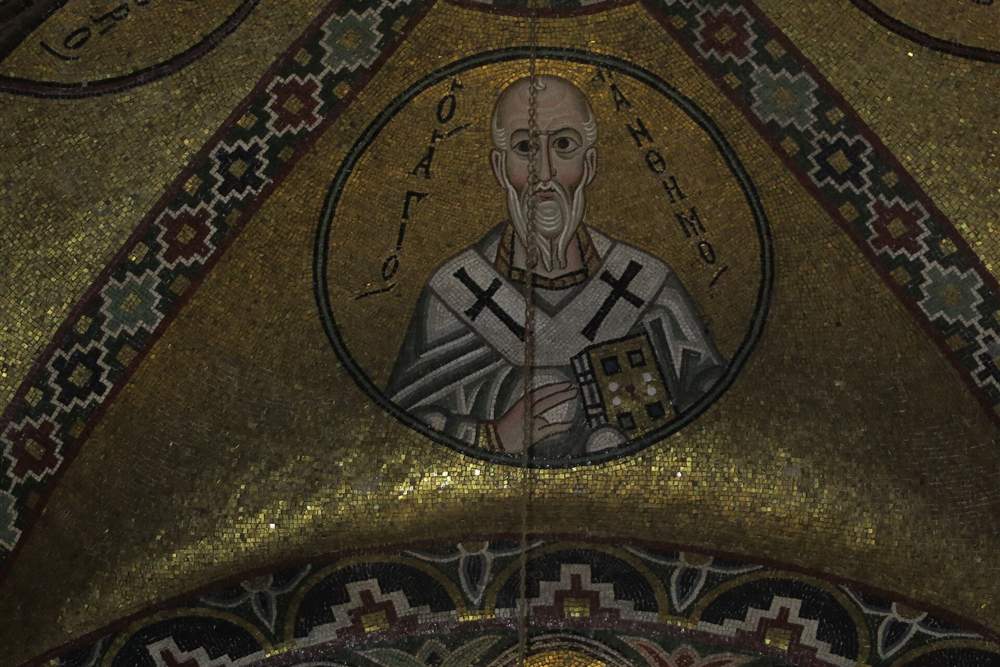
Central Greece tours at Hosios Loukas see an 11th-century monastery on the slope of Mount Helicon with gold-ground mosaics, a marble floor and two joined churches. UNESCO inscribed it in 1990 with Daphni and Nea Moni of Chios as the finest Middle Byzantine art in Greece.
The monastery stands 35 km from Delphi above the village of Distomo, looking across a valley of olives and almonds. Luke the Hermit, who died in 953, settled here and was credited with foreseeing the Byzantine reconquest of Crete; his tomb drew pilgrims, and the buildings grew around it in the following century.
Two churches share a wall. The smaller church of the Theotokos, of the late 10th century, is the older, built in brick with cloisonne masonry and a dome on a drum. The katholikon beside it, of about 1011, carries the mosaics: Christ washing the feet of the disciples, the Nativity, the Presentation, the Crucifixion, and saints on gold ground in the squinches under the dome.
The crypt below holds the founder’s tomb and a full programme of 11th-century frescoes, dim and complete. The marble floors are opus sectile in green, red and white, the screen is carved marble, and the refectory beside the church is now the sculpture museum.
Distomo, the village below, keeps the memorial to the massacre of 10 June 1944, when German troops killed 218 civilians. Central Greece tours stop at both on the road between Delphi and Athens, since the monastery is 9 km off the national road.
What do Central Greece tours see at Thebes and the Boeotian plain?
Central Greece tours at Thebes see the Archaeological Museum with its Mycenaean larnakes and Linear B tablets, the Cadmea hill under the modern town, the Ismenion sanctuary and the plain where Alexander destroyed the city in 335 BC.
Thebes was the great rival of Athens. Its citadel, the Cadmea, held a Mycenaean palace, and myth gave the city to Cadmus, who sowed the dragon’s teeth, to Oedipus and to the seven gates of the Seven Against Thebes. Under Epaminondas it broke Sparta at Leuctra in 371 BC and led Greece for a decade, then Alexander razed it in 335 BC and spared only the house of Pindar.
The modern museum, rebuilt and reopened in 2016, is one of the best regional collections in the country. It holds painted Mycenaean larnakes from Tanagra, Linear B tablets from the palace, the Boeotian black-figure pottery, Tanagra figurines and the archaic kouroi of the Ptoion sanctuary, arranged from the Neolithic through the Ottoman centuries.
The plain around it carries the rest. Chaeronea, 35 km east of Delphi, is where Philip II and the young Alexander beat the Greek cities in 338 BC; the Lion of Chaeronea, rebuilt from its pieces, stands over the grave of the Theban Sacred Band. Plataea, Leuctra, Thespiae and Tanagra lie on the same plain.
Central Greece tours take Thebes as a stop on the Athens to Delphi road, since the national road passes the town. Our page on Delphi covers the sanctuary at the other end of that drive.
What do Central Greece tours see at Livadeia?
Central Greece tours at Livadeia see the Frankish castle above the town, the springs of the Herkyna in their gorge, the site of the oracle of Trophonius, the restored watermills on the river and the clock tower over the old bazaar.
Livadeia is the capital of Boeotia, built where the Herkyna comes out of a rock gorge. The springs, called Kria, run cold under plane trees at the foot of the cliff, with cafes on the water and stone bridges across it. The gorge above them held the oracle of Trophonius, which Pausanias describes at length: the petitioner drank from Lethe and Mnemosyne, was lowered into a chasm feet first, and came out unable to smile for days.
The Catalan castle on the hill dates from the 14th century and keeps three enceintes on the rock, with a view over the plain to Parnassus and Helicon. Below it the old bazaar street runs under a clock tower, and the town’s watermills on the Herkyna, which ground flour and fulled cloth into the 20th century, have been restored as a park.
Livadeia was the second city of Ottoman central Greece, rich on cotton and grain, and it kept a mixed population of Greeks, Turks and Jews. The 19th-century houses of the upper town survive, and the war memorials mark the executions of 1944 in the same square.
Mount Helicon rises south of the town, the mountain of the Muses, with the Valley of the Muses and the sanctuary at Thespiae on its flank, and the spring of Hippocrene on the summit ridge. Central Greece tours put Livadeia on the Delphi road, 45 minutes before Arachova.
What do Central Greece tours see at Orchomenos and Lake Copais?
Central Greece tours at Orchomenos see the Treasury of Minyas, a Mycenaean tholos tomb whose roof was carved with rosettes, the theatre beside it and the 9th-century church of the Dormition, and cross the drained bed of Lake Copais with the citadel of Gla on its former island.
Orchomenos was the rival of Thebes in the Bronze Age. The Minyans who ruled it grew rich on the drainage of Copais, and Homer ranked its wealth with Egyptian Thebes. The tholos tomb, which Pausanias called the Treasury of Minyas, matches the tombs at Mycenae in size, with a side chamber whose ceiling slabs are cut in spirals and rosettes.
The Mycenaeans drained the lake. Canals, dykes and sinkholes carried the Cephissus away and turned the basin into farmland in the 14th century BC, and the works failed when their palaces did. The lake returned for three thousand years, malarial and shallow, until a French and then a British company drained it again between 1865 and 1931. The bed is now the most productive land in Boeotia.
Gla, on a rock that was an island in the lake, is the largest Mycenaean fortification known: a circuit of 3 km, four gates and a palace complex at the north end, larger in area than Mycenae and Tiryns together. It stands empty in the fields, without ticket office or fence, north-east of Orchomenos.
The church of the Dormition at Orchomenos, built in 874 from blocks of the ancient buildings, is one of the oldest dated churches in Greece. Central Greece tours reach all three sites within twenty minutes of the Livadeia road.
What do Central Greece tours see at Thermopylae?
Central Greece tours at Thermopylae see the monument to Leonidas of 1955 beside the national road, the hill where the last of the 300 fell, the sulphur springs that named the hot gates, and the museum that reconstructs the battle of 480 BC.
Thermopylae is a pass rather than a site. It was the only land route wide enough to carry an army between Thessaly and the south, squeezed between the cliffs of Kallidromo and the sea, and it has been fought over from 480 BC to 1941. The shoreline has moved: the sea that lapped the road in antiquity now lies more than three kilometres away across silt from the Spercheios.
In August 480 BC a Greek force under Leonidas of Sparta held the pass against the army of Xerxes for three days, until the Malian Ephialtes showed the Persians the mountain path of Anopaia. Leonidas sent most of the allies away and stayed with 300 Spartans, 700 Thespians and 400 Thebans; they were surrounded and killed on the hill of Kolonos, where the epitaph of Simonides was set.
- Leonidas monument – the bronze of 1955 with the inscription “Molon labe”, come and take them.
- Kolonos hill – the mound across the road where the last stand was made, with the epitaph stone.
- Thermopylae Historical Information Centre – the museum with a three-dimensional reconstruction of the battle.
- Hot springs – the sulphur water that gives the pass its name, running out of the rock beside it.
- Anopaia path – the mountain route over Kallidromo that turned the position.
- Gorgopotamos viaduct – 20 km north, blown up by the resistance on 25 November 1942.
The springs still run hot and sulphurous, and bathers use the pools below the road. Central Greece tours take Thermopylae as a half-hour stop on the Athens to Thessaloniki road, or pair it with Delphi on a private day.
What do Central Greece tours see at Lamia and in Phthiotis?
Central Greece tours at Lamia see the castle on its hill with the archaeological museum inside, the four squares of the old town, and in Phthiotis the Spercheios valley, the spa coast at Kamena Vourla, the port of Agios Konstantinos and Mount Oiti above them.
Lamia is the capital of the region, a market town of squares and arcades built under a fortress that has been Greek, Catalan, Ottoman and Greek again. The castle holds the archaeological museum of Phthiotis in a 19th-century barracks, and the view runs over the Spercheios plain to Oiti and Tymfristos. The city gave its name to the Lamian War of 323 BC, when the Greeks besieged Antipater here after the death of Alexander.
The Spercheios runs west of it through the widest valley in the region, with the delta on the Malian Gulf a wetland of waders and flamingos. Kamena Vourla, on the coast road south, is a spa town whose radioactive springs made it a resort in the 1930s, and Agios Konstantinos beside it is the port for Skiathos, Skopelos and Alonnisos.
Mount Oiti stands above the valley. Its national park, declared in 1966, protects fir forest and mountain meadows, the gorge of the Gorgopotamos and the Kremastos waterfall, the highest in Central Greece. Herakles was said to have burned himself on this summit, and the pyre site at Katavothra keeps the name.
Phthiotis also carries the region’s wine. The Atalanti valley on the east coast grows Chardonnay, Syrah and Assyrtiko for a group of estates, and the coast road to Arkitsa gives the ferry to Evia. Central Greece tours use Lamia as the halfway stop between Athens and Meteora.
What do Central Greece tours see in Evrytania and Karpenisi?
Central Greece tours in Evrytania see Karpenisi in its valley under Tymfristos at 2,315 m, the monastery of Proussos in its gorge, the villages of Megalo and Mikro Chorio, the Panta Vrexei gorge where the rain never stops, and Lake Kremasta below them.
Evrytania is the emptiest unit in Greece, a block of fir mountains in the southern Pindus with about 20,000 people in it. Karpenisi, its capital, sits at 960 m in the valley of the Karpenisiotis with the ski centre of Velouchi on the mountain above. The name comes from the Aromanian word for hornbeam, and the town first appears in an Ottoman tax ledger of 1454.
The valley south of the town holds the villages. Megalo Chorio and Mikro Chorio face each other across it; a landslide buried part of Mikro Chorio in January 1963, and the old village below is left as it fell. Koryschades, above the town, hosted the national assembly of the resistance in 1944 and keeps its stone houses as a heritage settlement.
- Proussos monastery – built into a cliff in the Krikeliotis gorge, with an icon attributed to Saint Luke.
- Panta Vrexei – the canyon of the Krikeliotis where water falls from the walls year-round.
- Velouchi – the ski centre on Tymfristos, with runs between 1,840 and 2,040 m.
- Lake Kremasta – the largest artificial lake in Greece, made in 1965 on the Acheloos.
- Black Cave – the Mavri Spilia gorge walk above Proussos.
- Rafting rivers – the Karpenisiotis, the Krikeliotis and the Tavropos, run from March to June.
The region works as a winter destination for Athens and as a rafting and walking base in spring. Central Greece tours reach Karpenisi in about four hours from Athens by Lamia, and the road west continues to Agrinio and the Ionian.
What do Central Greece tours see on Evia?
Central Greece tours on Evia see Chalkida and the Euripus strait, whose current reverses about every six hours, ancient Eretria, the dragon houses of Karystos, the chestnut forests of Dirfys and the hot springs of Edipsos. The island belongs to the same administrative region.
Evia is the second largest Greek island and the largest city of the region, Chalkida, stands on it. The Euripus strait narrows to 40 m there, crossed by a sliding bridge in the town and a suspension bridge to the south, so the island is reached from the mainland by road. That makes it part of the region in practice as well as on the map.
The island runs 180 km from Cape Lichada to Cape Kafireas, with Dirfys at 1,743 m in the middle. Karystos in the south sits under Mount Ochi with the Venetian Castello Rosso above it and the dragon houses on the ridge; Edipsos in the north holds 80 of the 752 thermal springs of Greece; Kymi on the east coast ships figs and runs the ferry to Skyros.
Skyros itself belongs to the Euboea regional unit, which puts a Sporades island inside Central Greece. It is reached from Kymi in under two hours, and it keeps its own ponies, its carved furniture and its goat-bell carnival.
Central Greece tours treat Evia as a separate trip rather than a day stop, because the island is as long as the mainland part of the region. Our page on Evia tours covers it end to end, and Sporades tours covers Skyros and its neighbours.
Which mountains do Central Greece tours climb?
Central Greece tours climb Giona at 2,510 m, the highest peak south of Olympus, Vardousia at 2,495 m, Parnassus at 2,457 m, Tymfristos at 2,315 m above Karpenisi, Oiti at 2,152 m and Kallidromo above the Thermopylae pass.
The region carries the highest ground in southern mainland Greece. Giona, the moonless mountain of antiquity, rises between Parnassus and Vardousia with Pyramida as its summit; bauxite mines cut its lower slopes, and the path from Sykia climbs to the ridge in five hours. Vardousia beside it is the sharper of the two, with a wall of rock above Athanasios Diakos village.
- Giona – 2,510 m at Pyramida, fifth highest in Greece, climbed from Sykia or Kaloskopi.
- Vardousia – 2,495 m at Korakas, the sharpest ridge in the region.
- Parnassus – 2,457 m at Liakoura, with the national park and the ski centre.
- Tymfristos or Velouchi – 2,315 m above Karpenisi, with the ski runs on its north face.
- Oiti – 2,152 m, a national park since 1966, with the Kremastos waterfall on its north side.
- Kallidromo and Helicon – the ridges above Thermopylae and above Livadeia, both walked in a day.
The E4 European path crosses the whole region, from Delphi over Parnassus and Giona to the Vardousia and on into Evrytania. Refuges stand on Parnassus, Giona, Vardousia and Oiti, and the walking season runs from May to October with snow above 1,800 m outside it. Central Greece tours with a mountain guide take two or three days over a traverse.
Which gorges and rivers do Central Greece tours follow?
Central Greece tours follow the Krikeliotis through the Panta Vrexei canyon, the Karpenisiotis and the Tavropos for rafting, the Gorgopotamos gorge under Oiti, the Pleistos below Delphi and the Mornos, which supplies the water of Athens.
The Evrytanian rivers carry the rafting. The Karpenisiotis runs a beginner’s descent through fir forest, the Krikeliotis a harder one through the canyon, and the Tavropos below Lake Plastira a long day in spring meltwater. The season runs from March to June, when the snow on Tymfristos and the Agrafa feeds them.
Panta Vrexei, the gorge of the Krikeliotis above Proussos, is the strangest of them: water seeps from the walls all year and falls in a constant curtain, so the name means it always rains. The walk through it is done with a guide, in the water, from spring to autumn.
- Panta Vrexei – the always-raining canyon in the Krikeliotis gorge, Evrytania.
- Gorgopotamos – the gorge under Oiti, with the railway viaduct blown up in 1942.
- Mornos – the river dammed in 1979 to supply Athens, with its lake in western Phocis.
- Pleistos – the valley below Delphi, walked on the old path down to the olive plain.
- Spercheios – the river of Phthiotis, with a delta of waders on the Malian Gulf.
- Cephissus of Boeotia – the river that once filled Lake Copais, now channelled across the drained bed.
Water shapes the region’s economy as well as its walking: the Mornos and Evinos reservoirs supply Athens through a tunnel and aqueduct system 190 km long. Central Greece tours cross that line at Amfissa without noticing it.
What do Central Greece tours see at Amfissa?
Central Greece tours at Amfissa see the Frankish castle of Salona on the acropolis, the Harmena tanners’ quarter below it, the cathedral square with its bell foundries, and the olive forest of the Crissaean plain that begins at the edge of the town.
Amfissa lies 20 km west of Delphi between Giona and Parnassus, at the head of the olive plain. It was the chief town of the Ozolian Locrians, one of the powerful cities of Central Greece, and its 3,000 years of history run through the Sacred Wars, the Frankish duchy of Salona and the War of Independence, when the town was taken in March 1821.
The castle stands on the ancient acropolis. Its walls use classical polygonal blocks at the base and Frankish masonry above, with three towers and a keep built by the de la Roche family after 1205. The view runs down the plain to Itea and across to the Parnassus slope with Delphi on it.
Below the castle the Harmena quarter kept the tanneries that made the town’s name, worked with water channelled from the Kefalovryso springs; a row of the buildings survives along the stream. Amfissa also cast bells and forged the sheep bells of the region, and two workshops still make them by hand.
The olive is the local crop. The Amfissa table olive, round and dark and softer than the Kalamata, carries its own protected designation, and the mills press oil from the same trees. Central Greece tours stop here on the road between Delphi and the Mornos valley, or on the way north to Lamia.
What do Central Greece tours see at Antikyra and the Desfina peninsula?
Central Greece tours on the Desfina peninsula see the fishing town of Antikyra on its bay, the ancient harbour of the sanctuary of Delphi, the mountain village of Desfina between them, and the coast road that runs above the Corinthian Gulf.
The peninsula hangs south of the Delphi valley, a limestone block between the Pleistos and the gulf. Desfina sits in its middle at 700 m, a farming village of stone houses that grows vines and olives and keeps the road across to Distomo and Hosios Loukas.
Antikyra, on the water below, was famous in antiquity for hellebore, the plant used to treat madness; the Greek saying about sailing to Antikyra meant telling somebody to get their head seen to. The modern town is a small port with an aluminium plant along the coast from it, a beach at Agios Isidoros and the remains of ancient walls and a bath on the headland.
Medeon, on the same bay, keeps a Mycenaean cemetery and an acropolis, and Kirra at the other end of the plain was the port of Delphi itself, sacked in the First Sacred War of the 590s BC and left as an archaeological site beside the modern village.
The peninsula roads are empty and the views run across the gulf to the Peloponnese. Central Greece tours use them as the scenic way between Delphi and Hosios Loukas, an hour that most itineraries replace with thirty minutes on the main road.
Which battlefields do Central Greece tours visit?
Central Greece tours visit Chaeronea, where Philip II beat the Greek cities in 338 BC and the Lion stands over the Theban dead, Plataea, where the Persians were destroyed in 479 BC, Leuctra, where Thebes broke Sparta in 371 BC, and Thermopylae.
Boeotia was called the dancing floor of Ares because so many armies met on it. The plain is flat, wide and crossed by the main road north, which made it the natural battlefield of the Greek world, and four of its engagements changed the course of Greek history.
- Thermopylae, 480 BC – Leonidas and the 300 hold the pass for three days against Xerxes.
- Plataea, 479 BC – the allied Greek army destroys the Persian force under Mardonius.
- Leuctra, 371 BC – Epaminondas breaks the Spartan line and ends Spartan supremacy.
- Chaeronea, 338 BC – Philip II and Alexander defeat Athens and Thebes; the Sacred Band dies where the Lion stands.
- Chaeronea and Orchomenos, 86 BC – Sulla beats the armies of Mithridates on the same ground.
- Alamana, 1821 – Athanasios Diakos is taken at the Spercheios bridge and killed at Lamia.
The Lion of Chaeronea sits in a fenced enclosure beside the road, rebuilt in 1902 from the fragments found in 1818, above a mass grave of 254 men. Plataea and Leuctra are marked by low walls and a modern trophy in open fields. Central Greece tours take all of them within an hour’s drive of Livadeia.
What do Central Greece tours see at the Ptoion sanctuary and Lake Yliki?
Central Greece tours at the Ptoion sanctuary see the terraces of the oracle of Apollo Ptoios above Akraifnio, where more than a hundred archaic kouroi were found, and below it Lake Yliki, the reservoir that supplies Athens with water from Boeotia.
The sanctuary lies on the slope of Mount Ptoon, east of the Copais basin. Apollo had an oracle here that answered in the questioner’s own language, and the Boeotian cities sent statues to it through the 6th century BC. French excavation from the 1880s recovered the kouroi that now fill a room in the Thebes museum, along with tripods and inscriptions.
The site itself is a series of terraces, a spring, the foundations of the temple and the hostel, in oak scrub with the lake below. Akraifnio, the village on the road, keeps the 9th-century church of Agios Georgios with reused ancient blocks in its walls.
Yliki and the smaller Paralimni are the surviving lakes of a basin that once held Copais as well. Yliki was dammed in 1958 and pipes water to Athens; its level rises and falls sharply, exposing an old shoreline and, in dry years, the foundations of a submerged village.
The road round the lake runs empty through oak and vineyard between Thebes and the Evia bridges. Central Greece tours use it as the back route from Delphi to Chalkida, and birdwatchers work the shallows in spring.
What do Central Greece tours see at Tanagra?
Central Greece tours at Tanagra see the cemetery that produced the Tanagra figurines, the small painted terracottas of the late 4th century BC, the acropolis of the ancient city above the Asopos, and the museum rooms at Thebes and Schimatari that hold the finds.
Tanagra stands on the Asopos in eastern Boeotia, an hour from Athens. The city was old, independent of Thebes and rich enough to mint its own coins, but its fame is modern: in the 1870s the graves of its cemetery were robbed and sold, and thousands of small terracotta figures of standing women in cloaks and hats reached the museums and dealers of Europe.
The figurines changed how the 19th century saw Greek art. They showed ordinary people in everyday dress rather than gods and athletes, painted in pink, blue and gold, and they were copied and faked across Europe for decades. The genuine ones are in Thebes, in the Athens National Museum, in the Louvre and in Berlin.
The site keeps its walls, the outline of the acropolis and the chamber tombs cut into the soft rock. Schimatari, the modern village, holds the local museum with the Tanagra material and the finds from the Boeotian coast.
Central Greece tours take Tanagra as a short stop on the Athens road, with the Thebes museum in the same morning, where the figurines stand beside the Mycenaean larnakes from the same district.
Which outdoor tours run in Central Greece?
Outdoor Central Greece tours ski at Parnassos and Velouchi, raft the Evrytanian rivers, walk the E4 across Parnassus and Giona, climb to the Corycian cave from Delphi, ride mountain bikes above Arachova and canyon in the gorges of Oiti.
Parnassos is the largest ski area in the country, with 19 runs on two linked centres at Kelaria and Fterolakka between 1,600 and 2,260 m, an hour and a half from Athens by the Arachova road. Velouchi above Karpenisi is smaller and quieter, with 12 runs on the north face of Tymfristos. Both work from December to April.
- Skiing – Parnassos from Arachova, Velouchi from Karpenisi, both with hire and schools.
- Rafting – the Karpenisiotis, Krikeliotis and Tavropos, March to June.
- Hiking – the E4 over Parnassus and Giona, the Delphi to Corycian cave path, the Oiti circuits.
- Canyoning – Panta Vrexei and the gorges of Oiti and Vardousia with guides.
- Mountain biking – the forest roads above Arachova and around Lake Mornos.
- Birdwatching – the Spercheios delta and the Copais fields in spring passage.
The old paths carry the walking. The route from the Delphi stadium up to the Corycian cave and across the plateau is the one the ancient processions used; the E4 continues north from it across the range. Central Greece tours with guides run these between May and October and swap to snow in winter.
Which beaches do Central Greece tours reach?
Central Greece tours reach the Corinthian Gulf coast at Galaxidi, Itea and Agios Nikolaos, the Malian Gulf coast at Kamena Vourla, Agios Konstantinos and Arkitsa, and the Evian beaches of Chiliadou, Agia Anna and Marmari across the strait.
The region has two coasts and neither is a resort strip. The Corinthian Gulf side is deep, calm and rocky, with pine running to the water at Galaxidi and swimming off slabs and pebble at Kalafatis, Pera Panta and the coves west of Itea. The gulf never gets rough, which makes it a summer evening coast rather than a beach holiday.
- Galaxidi – pine and rock coves either side of the town, with clear deep water.
- Itea and Kirra – pebble beaches below the olive plain, with Delphi 20 minutes above.
- Agios Nikolaos – the ferry port west of Galaxidi, with the boat to Aigio in the Peloponnese.
- Kamena Vourla – the spa coast on the Malian Gulf, facing Evia across the strait.
- Agios Konstantinos and Arkitsa – the ports for the Sporades and for Evia.
- Evia – Chiliadou, Agia Anna and Marmari, reached by the bridges at Chalkida.
The Malian Gulf coast is shallower and warmer, lined with the spa hotels of Kamena Vourla and the ferry quays. Central Greece tours use it as the route north rather than the destination, and the swimming stops belong to the Evia side of the water.
Which monasteries and churches do Central Greece tours visit?
Central Greece tours visit Hosios Loukas with its 11th-century mosaics, Proussos in its Evrytanian gorge, the Agathonos monastery on Oiti, the Dormition church of 874 at Orchomenos and the monastery of Agios Ioannis Prodromos above Livadeia.
Hosios Loukas is the first stop of any Byzantine route in the region, and the mosaics of its katholikon rank with Daphni and Nea Moni. Proussos, in the gorge of the Krikeliotis south of Karpenisi, is the other pilgrimage: built into the cliff around an icon of the Virgin attributed by tradition to Saint Luke, rebuilt after fires, and reached by a road cut through the rock.
Agathonos stands in the fir forest on the north slope of Oiti above Ypati, with a Byzantine core and a spring under plane trees. The Dormition at Orchomenos of 874 is one of the oldest dated churches in the country, built out of blocks from the ancient city and the Minyan tomb beside it.
Smaller churches carry the region’s frescoes. Agios Nikolaos at Galaxidi, the Panagia of Skripou at Orchomenos, the Byzantine chapels of the Parnassus villages and the church of Agios Georgios at Arachova hold painted interiors and carved screens. Osios Seraphim at Domvou and the Jerusalem monastery above Davleia sit on the same forest roads.
Central Greece tours put Hosios Loukas on the Delphi day, since the monastery is 9 km off the main road, and keep Proussos for the Karpenisi trip. Both close in the early afternoon.
What do Central Greece tours eat?
Central Greece tours eat formaela cheese from Arachova, grilled at the table, the green table olives of Amfissa, trout from the Evrytanian rivers, hilopites and trahana from the mountain villages, and the lamb and goat of Parnassus and Oiti.
Arachova makes the cheese the region is known for. Formaela is a hard sheep’s cheese, cylindrical, pale and salty, fried or grilled until the crust blisters and served with lemon; the same shops sell hilopites egg noodles, trahana and mountain honey. The town’s tavernas roast lamb and cook kokoras with pasta on Sundays.
- Formaela Arachovas – the grilled sheep’s cheese with a protected designation of origin.
- Amfissa olives – the round, dark table olive of the Crissaean plain, with its own designation.
- Trout – farmed and wild in the Karpenisiotis and Krikeliotis valleys.
- Hilopites and trahana – the egg pasta and soured wheat of the mountain kitchens.
- Kopaida eels – once the luxury of Boeotia, from the lake that was drained.
- Fish – at Galaxidi, Itea and the Malian Gulf ports.
The olive forest between Amfissa and Itea holds more than a million trees and presses an oil sold under the Delphi name, and the Atalanti valley on the east coast bottles Chardonnay, Syrah and Assyrtiko. Central Greece tours take the cheese at Arachova, the oil at Amfissa and the fish at Galaxidi in one loop.
Which museums do Central Greece tours visit?
Central Greece tours visit the Delphi Archaeological Museum with the Charioteer, the Archaeological Museum of Thebes, the Nautical Museum of Galaxidi, the museum of Phthiotis inside the Lamia castle and the Thermopylae Historical Information Centre.
Delphi is the collection that decides the region. Its rooms run from the Mycenaean offerings through the Naxian sphinx, the twin kouroi of Kleobis and Biton, the Siphnian treasury frieze and the acanthus column of the dancers, to the Charioteer of about 478 BC, cast in one piece and buried under a landslide until 1896.
- Delphi Archaeological Museum – the Charioteer, the sphinx, the friezes and the omphalos.
- Archaeological Museum of Thebes – Mycenaean larnakes, Linear B tablets, Tanagra figurines.
- Nautical and Historical Museum of Galaxidi – the sailing town’s models, charts and chronicle.
- Archaeological Museum of Phthiotis – inside the Lamia castle, with the Spercheios valley finds.
- Thermopylae Information Centre – the battle in three dimensions beside the monument.
- Museum of Hosios Loukas – the sculpture and the monastic collection in the refectory.
Smaller collections hold the local record: the folk museums of Arachova and Karpenisi, the Chaeronea site museum beside the Lion, and the environmental centre at Kamena Vourla. Central Greece tours build the museum stop into the site visit, since all of them stand within a few minutes of the ruins they explain.
Which castles do Central Greece tours visit?
Central Greece tours visit the Catalan castle of Livadeia, the Frankish castle of Salona at Amfissa, the fortress of Lamia, the castle of Bodonitsa above Mendenitsa, the Ypati castle under Oiti and the walls of Gla on the Copais plain.
After 1204 the region was divided among Frankish lords, and every hill above a road took a tower. Salona at Amfissa became the seat of a duchy; Bodonitsa, above the Thermopylae pass at Mendenitsa, was a marquisate that guarded the same gate the Persians forced; Livadeia was held by the Catalan Company from 1311 and kept its three enceintes.
- Salona, Amfissa – Frankish walls on classical foundations, three towers and a keep.
- Livadeia – the Catalan castle over the Herkyna springs, with the plain in the view.
- Lamia – the fortress with the archaeological museum inside its 19th-century barracks.
- Bodonitsa, Mendenitsa – the marquisate castle above the Thermopylae plain.
- Ypati – the Byzantine and Frankish castle of Neai Patrai under Oiti.
- Gla – the Mycenaean circuit of 3 km on its rock in the drained Copais basin.
The castles trace the same sequence across the region: Mycenaean walls, classical polygonal blocks, Frankish and Catalan towers, Ottoman repairs and Greek gun positions of 1821. Central Greece tours climb two or three of them in a day, since each takes twenty minutes from the car.
What do Central Greece tours see of the War of Independence?
Central Greece tours see the bridge at Alamana where Athanasios Diakos was taken in April 1821, the inn at Gravia where Odysseas Androutsos held off Omer Vrioni with 120 men, the Amfissa castle taken in the same spring and the monuments at Lamia and Livadeia.
Roumeli was the fighting ground of the revolution’s first year. Its armatoloi knew the passes, and the war in central Greece was a war of roads: whoever held Alamana, Gravia and Thermopylae controlled the route from Thessaly to the Peloponnese.
At Alamana, on the Spercheios, Athanasios Diakos fought a rearguard on 23 April 1821 with a few hundred men against an Ottoman column, was captured and was impaled at Lamia. Three weeks later, on 8 May, Odysseas Androutsos shut 120 men into the inn at Gravia, held it through a day of assaults, killed hundreds of attackers and broke out at night with four dead.
- Alamana bridge – the monument to Diakos on the Spercheios, beside the old road.
- Inn of Gravia – the reconstructed hani and museum on the Delphi to Lamia road.
- Amfissa – the castle and town taken in March 1821, with the memorial in the square.
- Lamia – the statue of Diakos in the square named for him, near the place of his death.
- Livadeia – the first town in Roumeli to rise, on 31 March 1821.
- Distomo and Gorgopotamos – the 20th-century war sites on the same roads.
The two battles are taught in every Greek school, and both sites are marked and open. Central Greece tours passing between Delphi and Lamia cross them without a detour.
Which thermal springs do Central Greece tours use?
Central Greece tours use the springs at Kamena Vourla on the Malian Gulf, the sulphur pools at Thermopylae beside the battlefield, the spa at Ypati under Oiti, the waters of Platystomo in the Spercheios valley and Edipsos across the strait on Evia.
The region sits on a fault line and the water comes up hot along it. Thermopylae takes its name from the springs that still run out of the rock beside the monument, sulphurous and about 40 degrees, and bathers use the open pools below the road without charge.
Kamena Vourla, 20 km south-east, built a resort on the same geology in the 1930s, with radon-bearing water, hotels along the shore and a promenade under Mount Knimida. Ypati, on the north slope of Oiti above Lamia, has a spa in a plane-tree valley, and Platystomo west of it bottles its own water and runs baths beside the springs.
- Thermopylae – free sulphur pools beside the pass, hot through the year.
- Kamena Vourla – the 1930s spa town, with hotels and treatment centres on the gulf.
- Ypati – the spa under Oiti, with the village and its castle above.
- Platystomo – the Spercheios valley springs and bottling plant.
- Edipsos, Evia – 80 of the 752 hot springs of Greece, an hour by ferry from Arkitsa.
- Kallidromo foothills – smaller warm springs along the same fault.
The spa season runs through winter and early spring, when the coast is empty and the hotels take their main trade. Central Greece tours add a bath at Thermopylae to the battlefield stop, because the two are fifty metres apart.
Which wines do Central Greece tours taste?
Central Greece tours taste the wines of the Atalanti valley on the Phthiotis coast, the reds of the Parnassus slopes above Amfissa, the whites of the Boeotian plain and the Evian vineyards, with Chardonnay, Syrah, Assyrtiko and the Greek varieties side by side.
The Atalanti valley is the region’s wine country. Its estates planted international varieties in the 1980s alongside Greek ones and put the district on the map; the vineyards run between the Knimida hills and the sea, and the cellars take visitors through the year. Domaine Hatzimichalis, the largest, works hundreds of hectares around Atalanti.
Elsewhere the scale is smaller. Growers around Amfissa and on the Parnassus foothills press reds from Agiorgitiko and Cabernet; the Boeotian plain grows Savatiano and Roditis for Athens; and Evia has a scatter of estates on the gulf side and at Ritsona.
- Atalanti valley – Chardonnay, Syrah, Assyrtiko and Merlot on the Phthiotis coast.
- Parnassus foothills – reds from the slopes between Amfissa and Polydrosos.
- Boeotia – Savatiano and Roditis on the plain, with retsina in the village tavernas.
- Evia – the Ritsona trail and the gulf estates, tasted on the wine hike.
- Tsipouro – distilled in the mountain villages of Evrytania and Phocis.
- Table olives and oil – the Amfissa olive and the Delphi oil, tasted at the mills.
Most cellars take visitors by appointment rather than on a schedule, so Central Greece tours book the tasting with the driving day rather than dropping in.
Which lesser known archaeological sites do Central Greece tours visit?
Central Greece tours visit the oracle sanctuary at Kalapodi, occupied from the Bronze Age to the Roman period, Elateia on the Cephissus, the Mycenaean cemetery at Medeon, the harbour of Kirra below Delphi and the walls of Gla on the Copais plain.
Kalapodi is the most important of them. German excavation there has found a sequence of temples running from the 14th century BC to the 2nd century AD, one built over another on the same spot without a break, which shows continuity of cult across the Dark Ages that no other Greek site has proved. The sanctuary is identified with the oracle of Apollo at Abai, which Croesus consulted and the Persians burned.
- Kalapodi – the unbroken temple sequence from the Bronze Age to Rome, in Phocis.
- Elateia – the city that controlled the Cephissus road, with its Athena sanctuary.
- Medeon – the Mycenaean cemetery and acropolis on the bay of Antikyra.
- Kirra – the harbour of Delphi, destroyed in the First Sacred War.
- Gla – the largest Mycenaean circuit in Greece, unfenced in the Copais fields.
- Thespiae and the Valley of the Muses – the Helicon sanctuary below Livadeia.
None of these has a coach park, and Gla and Medeon have no ticket office. Central Greece tours reach them with a car and a map, in combination with the bigger sites on the same road: Kalapodi with Thermopylae, Medeon and Kirra with Delphi, Gla with Orchomenos.
Which myths do Central Greece tours follow?
Central Greece tours follow Apollo killing the serpent Python at Delphi, Cadmus sowing the dragon’s teeth at Thebes, Oedipus at the crossroads below Parnassus, the Muses on Helicon, and Herakles burning himself on the summit of Oiti.
The region is the map of Greek myth. Delphi was Pytho before it was Delphi, and Apollo took it by killing the serpent that guarded the spring; the Pythian Games were founded to mark it, and the priestess kept the older name. The omphalos in the museum is the stone that fixed the centre of the world.
Thebes carries the darker cycle. Cadmus founded the city on the advice of an oracle, killed the dragon of the spring and sowed its teeth to raise the Spartoi; his descendants gave Greece Oedipus, Antigone and the Seven Against Thebes. The crossroads where Oedipus killed his father is placed at the Schiste, the split road below Delphi towards Daulis, and the modern junction still carries the name.
- Delphi – Apollo and Python, the omphalos, the Castalian spring and the Pythia.
- Thebes – Cadmus, the Spartoi, Oedipus, Antigone and the seven gates.
- Helicon – the Muses, the Valley of the Muses and the Hippocrene spring.
- Oiti – the pyre of Herakles at Katavothra, where he burned and became a god.
- Parnassus – Deucalion’s ark grounding on the summit after the flood.
- Orchomenos – the Minyans, the Charites and the treasury Pausanias described.
Every one of these places can be stood in. Central Greece tours with a classicist take the myths in the order the ancient writers give them, which puts Delphi first and the Boeotian cycle after it.
What do Central Greece tours see in the Delphi museum?
Central Greece tours in the Delphi museum see the Charioteer of about 478 BC, the twin kouroi of Kleobis and Biton, the Naxian sphinx on its column, the frieze of the Siphnian treasury, the acanthus column of the dancers and the omphalos stone.
The museum runs chronologically through fourteen rooms and takes an hour at a walk. The early rooms hold bronze tripods and griffin heads from the 8th century BC, the offerings that made the sanctuary rich before its temples were built, and the gold and ivory figures burned and buried in a pit under the Sacred Way.
The archaic rooms carry the sculpture. Kleobis and Biton, the twin kouroi of about 580 BC, are the brothers who pulled their mother’s cart to the Heraion and were granted the best gift a god can give. The Naxian sphinx of about 560 BC sat on a ten-metre column beside the temple. The Siphnian treasury frieze shows the gods at war with the giants, carved about 525 BC when Siphnos was rich on silver.
- The Charioteer – bronze of about 478 BC, with inlaid eyes and bronze eyelashes, buried by a landslide.
- Kleobis and Biton – archaic twin kouroi of about 580 BC, nearly two metres tall.
- Naxian sphinx – the winged sphinx of about 560 BC from its column.
- Siphnian frieze – the gigantomachy of about 525 BC in high relief.
- Column of the dancers – the acanthus column with three dancing girls, about 330 BC.
- Omphalos – the carved stone marking the navel of the world.
The Charioteer stands alone in his own room at the end. He was part of a group with a chariot and four horses, dedicated by Polyzalos of Gela after a Pythian victory, and the fragments of the horses stand beside him. Central Greece tours end the site visit here.
What do Central Greece tours see in the Spercheios valley?
Central Greece tours in the Spercheios valley see Ypati and its castle under Oiti, the spa at Loutra Ypatis, the Gorgopotamos viaduct, the monastery of Agathonos in the fir forest, Makrakomi and Sperchiada on the river, and the delta wetland on the Malian Gulf.
The valley runs 80 km west from Lamia between Oiti and the Othrys hills, the widest farmland in the region. The Spercheios drains it, the silt from the river has pushed the coastline three kilometres out since antiquity, and the delta now holds a wetland of herons, waders and wintering flamingos.
Ypati sits on the slope at 350 m with a Byzantine and Frankish castle above it, the seat of the medieval bishopric of Neai Patrai. The spa below the village uses sulphur water under plane trees, and the road behind climbs into the Oiti national park past the monastery of Agathonos, founded in the 14th century and rebuilt after fires, with a spring and a small zoo of rescued animals.
The Gorgopotamos viaduct crosses the gorge north of it. On the night of 25 November 1942 Greek resistance groups and British officers blew its central span and cut the rail line that supplied Rommel through Piraeus; the operation is commemorated at the bridge each November. The gorge below it carries a walking path.
Makrakomi and Sperchiada are the valley market towns, and the road continues west to Karpenisi over the Tymfristos pass. Central Greece tours use the valley as the link between Lamia and Evrytania, and stop at Ypati or Agathonos on the way.
What do Central Greece tours see of the 20th century?
Central Greece tours see the Distomo memorial to the 218 civilians killed on 10 June 1944, the Gorgopotamos viaduct blown up in November 1942, the resistance assembly hall at Koryschades, and the war cemeteries and monuments at Lamia and Livadeia.
The region was a centre of the resistance because it was mountain country astride the main road and railway. The Gorgopotamos operation, carried out by ELAS, EDES and a British team, was the first joint action of the war in Greece and cut the line for six weeks. Reprisals followed in the villages below.
Distomo, 9 km from Hosios Loukas, was the worst of them. On 10 June 1944 an SS unit killed 218 villagers, most of them women, children and old people, after an ambush nearby. The mausoleum on the hill holds the names and skulls of the dead, and the museum beside it records the day and the legal cases that followed for decades.
Koryschades, above Karpenisi, holds the other side of the story: the schoolhouse where the National Council of the resistance met in May 1944 as a provisional assembly, now a museum, with the stone village around it preserved as a heritage settlement.
Kalavryta in the Peloponnese, Distomo in Boeotia and Kommeno in Epirus are the three names Greeks use for that year. Central Greece tours that take the monastery road pass the Distomo memorial on the same hill, and the stop takes twenty minutes.
Which crafts and traditions survive in Central Greece?
Central Greece tours find weaving at Arachova, bell-forging and tanning at Amfissa, cheese-making on the Parnassus pastures, the transhumance of the Sarakatsani and Vlach shepherds, and the wooden bell towers and carved screens of the mountain churches.
Wool built the mountain economy. Arachova wove rugs, blankets and the flokati, the long-pile rug washed under a waterfall to raise its nap, and its looms still work for sale rather than for the household. The patterns are geometric in red, black and white, and the older pieces hang in the town’s folk collection.
Amfissa forged and tanned. Its bell workshops make the sheep and goat bells of the whole region by hand, tuned by ear and sold by size, and the Harmena quarter below the castle kept the tanneries that dressed the hides, powered by the springs above the town.
- Weaving – flokati rugs, blankets and bags at Arachova and the Parnassus villages.
- Bell-forging – the Amfissa workshops, tuning each bell by hand.
- Tanning – the Harmena quarter of Amfissa, worked into the 20th century.
- Cheese – formaela and kefalotyri made on the Parnassus and Oiti pastures.
- Transhumance – Sarakatsani and Vlach flocks moving between the plain and the summer grass.
- Woodcarving – the screens and bell towers of the Evrytanian and Phocian churches.
The shepherds still move. Flocks winter on the Boeotian plain and the Spercheios valley and climb to the Parnassus and Oiti meadows in June, and the bells at Amfissa are bought by the men who drive them. Central Greece tours in early summer meet them on the mountain roads.
What history do Central Greece tours tell?
Central Greece tours tell of the oracle at Delphi, the stand at Thermopylae in 480 BC, Theban power under Epaminondas, the defeat of the Greek cities at Chaeronea in 338 BC, the Frankish and Ottoman centuries, and the War of Independence that began in Roumeli.
The region was the hinge of the Greek world. Delphi was its religious centre, governed by the Amphictyonic League of twelve tribes; Thermopylae was its northern gate; the Boeotian plain was the road every invader took. Three of the decisive battles of Greek history, Thermopylae, Plataea and Chaeronea, were fought within 80 km of each other.
Thebes rose after the Peloponnesian War, broke Sparta at Leuctra in 371 BC under Epaminondas and led Greece for nine years. Philip II ended that at Chaeronea in 338 BC with the eighteen-year-old Alexander on the wing, and Alexander razed Thebes in 335 BC. Rome took the region in the 2nd century BC, and Sulla fought Mithridates at Chaeronea and Orchomenos in 86 BC.
After 1204 the Franks and then the Catalans held the castles at Livadeia, Amfissa and Lamia, and Salona, the Frankish name for Amfissa, became a duchy. The Ottomans took the region in the 15th century and called the whole of it Rum-eli. Its klephts and armatoloi ran the mountains, and men from Roumeli, among them Athanasios Diakos at Alamana in 1821 and Odysseas Androutsos at Gravia, opened the War of Independence.
The 20th century added its own marks: the Gorgopotamos viaduct blown up by the resistance in November 1942, the massacre at Distomo in June 1944, and the assembly of Koryschades in Evrytania in the same year. Central Greece tours pass all of them on the same roads.
Which villages do Central Greece tours reach?
Central Greece tours reach Arachova and Chrisso on Parnassus, Delphi village beside the site, Eptalofos and Polydrosos in the fir forest, Koryschades and Megalo Chorio in Evrytania, Ypati under Oiti and Galaxidi on the gulf.
The mountain villages sit between 700 and 1,100 m, built of grey stone with slate or tile roofs and squares under plane trees. Eptalofos and Polydrosos on the north side of Parnassus serve the ski road; Agoriani beside them keeps its running water and its walnut trees; Chrisso, below Delphi, looks down the olive plain to Itea.
- Arachova – the ski town at 950 m, with its clock tower, weavers and cheese shops.
- Delphi village – built when the site was cleared, with hotels looking down the valley.
- Eptalofos and Polydrosos – fir-forest villages on the north slope of Parnassus.
- Koryschades – the heritage settlement above Karpenisi, seat of the 1944 assembly.
- Megalo and Mikro Chorio – the Karpenisiotis valley pair, with the buried old village below.
- Ypati – the spa village under Oiti, with its Byzantine castle above.
Most of these work as winter destinations for Athens, which is two to four hours away, and empty in high summer when the coast fills. Central Greece tours use them as bases for the mountains rather than as sights, and the tavernas cook what the season gives.
Which festivals do Central Greece tours meet?
Central Greece tours meet the Agios Georgios panigyri at Arachova on 23 April, the flour war of Galaxidi on Clean Monday, the Delphic Festival at the ancient theatre, and the Gorgopotamos commemoration each November.
Arachova holds the largest feast in the region. On 23 April, or the Tuesday after Easter when the date falls in Lent, the town dresses in traditional costume, carries the icon of Saint George up the rock, and runs the race of the elders to the church, then dances for three days in the square.
Galaxidi throws flour. On Clean Monday, the first day of Lent, the harbour fills with people in old clothes hurling coloured flour at each other, a custom the town traces to the 19th century when its sailors were home for the winter. The day ends with kites and lenten food on the quay.
- Arachova, 23 April – the panigyri of Agios Georgios, three days of dancing.
- Galaxidi, Clean Monday – the alevromoutzouroma, the flour war on the waterfront.
- Delphi, summer – performances and conferences at the European Cultural Centre.
- Gorgopotamos, 25 November – the annual commemoration at the viaduct.
- Karpenisi, August – the village feasts of the Evrytanian valleys.
- Livadeia and Thebes, Carnival – the pre-Lenten parades of the Boeotian towns.
The Delphic Festivals of 1927 and 1930, staged by Angelos and Eva Sikelianos with Aeschylus in the ancient theatre, gave the site its modern cultural life, and the European Cultural Centre continues it. Central Greece tours in Lent and at Easter plan around the two big dates.
Which wildlife and landscapes do Central Greece tours cross?
Central Greece tours cross the fir forests of Parnassus and Oiti, both national parks, the olive forest of the Crissaean plain with more than a million trees, the drained bed of Lake Copais, the Spercheios delta wetland and the alpine meadows above 1,800 m.
Parnassos National Park, declared in 1938, was one of the first two in Greece. It protects Greek fir, black pine and the limestone plateaus, and it holds wolves, wild boar, roe deer, golden eagles and the endemic flowers of the high meadows. Oiti National Park, declared in 1966, protects a second fir block with the Kremastos waterfall, the highest in the region, on its north side.
The lowlands carry different ground. The Crissaean plain below Delphi is an unbroken olive forest that runs from Amfissa to the sea, planted since antiquity and still the picture from the sanctuary terrace. The Copais basin, drained in the Bronze Age and again between 1865 and 1931, is now the region’s most productive farmland, with Gla standing on its old island.
- Parnassos National Park – fir forest, plateaus and the Corycian cave, from 1938.
- Oiti National Park – fir, meadows and the Kremastos waterfall, from 1966.
- Crissaean olive plain – more than a million trees between Amfissa and Itea.
- Spercheios delta – waders, herons and flamingos on the Malian Gulf.
- Lake Copais – the drained basin, with Gla on its former island.
- Mornos and Kremasta lakes – the reservoirs of Phocis and Evrytania.
The E4 path crosses the parks and the ridges between them. Central Greece tours in spring find the meadows in flower above the snow line and the plain green below, which is the best fortnight of the year for the drive.
Which day trips combine with Central Greece tours?
Central Greece tours combine with Athens 180 km from Delphi, Meteora two and a half hours north of Lamia, the Peloponnese across the Rio bridge or the Aigio ferry, the Sporades from Agios Konstantinos and Evia over the Chalkida bridges.
The classic pairing is Delphi and Meteora. The two-day version leaves Athens, spends the afternoon at the sanctuary, sleeps at Kalambaka or Delphi and takes the monasteries the next morning; the four-day version adds Mycenae, Epidaurus and Olympia in the Peloponnese.
- Athens – 180 km from Delphi, three hours by the national road through Thebes.
- Meteora – about two and a half hours north of Lamia on the E65.
- Peloponnese – the Rio-Antirrio bridge, or the ferry from Agios Nikolaos to Aigio.
- Sporades – Agios Konstantinos to Skiathos in about two and a half hours.
- Evia – the bridges at Chalkida, 80 km from Athens and 90 from Thebes.
- Thessaly – Lamia to Volos in about an hour and a half.
The region sits on every north-south route in the country, which is why so many trips pass through it without stopping. Our pages on Thessaly tours and Peloponnese tours cover the regions on either side.
What do Central Greece tours see on Mount Helicon?
Central Greece tours on Helicon see the Valley of the Muses with its sanctuary and theatre, the site of Thespiae, the village of Askra where Hesiod farmed, the fir forest of the summit ridge at 1,749 m and the springs of Aganippe and Hippocrene.
Helicon rises south of Livadeia between the Boeotian plain and the Corinthian Gulf. The Greeks gave it to the Muses, and the sanctuary in the valley below Askra held the Mouseia, a festival of poetry and music with a theatre, a stoa and an altar; the statues from it were carried off to Constantinople in late antiquity.
Hesiod worked this ground. He says in the Theogony that the Muses found him keeping sheep on Helicon and gave him a staff of laurel, and his Works and Days describes Askra as bad in winter, hard in summer, good at no time. The village site lies on the slope above the valley with its tower still standing.
- Valley of the Muses – the sanctuary, theatre and altar below Askra, excavated by the French School.
- Thespiae – the city that ran the sanctuary, with walls and a museum store at Thespies village.
- Askra – Hesiod’s village, marked by a medieval tower on the slope.
- Hippocrene – the spring struck by the hoof of Pegasus, high on the ridge.
- Aganippe – the Muses’ spring in the valley, near the sanctuary.
- Osios Seraphim at Domvou – the monastery in the fir forest on the northern slope.
The mountain road from Thespies climbs through fir to the ridge and drops to the gulf at Agios Nikolaos, an hour of empty driving. Central Greece tours take the valley in the morning and reach Delphi or the gulf coast the same afternoon.
How do Central Greece tours plan a two-day Delphi and Meteora trip?
The two-day trip leaves Athens in the morning, reaches Delphi by midday for the sanctuary and museum, sleeps at Kalambaka after the drive north through Lamia, takes three or four Meteora monasteries the next morning and returns to Athens in the evening.
The route works because the two sites sit on the same north-south line with four hours of road between them. Day one covers 180 km to Delphi, three hours at the sanctuary, and then 230 km north to Kalambaka through Amfissa, Lamia and the E65, arriving for dinner. Day two covers the monasteries in the morning and 350 km back to Athens.
- Day 1 morning – Athens to Delphi through Thebes and Livadeia, with a stop at Arachova.
- Day 1 midday – the sanctuary, the museum and lunch in Delphi village.
- Day 1 afternoon – the drive north through Amfissa and Lamia to Kalambaka.
- Day 2 morning – Great Meteoron, Varlaam and one or two of the smaller monasteries.
- Day 2 afternoon – Kalambaka to Athens on the E65 and E75, about four and a half hours.
- Variation – reverse the order and sleep at Delphi, which puts the sanctuary in the softer evening light.
The trip runs as a coach tour, as a private car with a driver and as a self-drive itinerary; the difference is the pace rather than the route. Central Greece tours that add a third day put Hosios Loukas and Thermopylae into it, which covers the two great sites and the two famous passes of the region in one loop.
Our page on the Delphi and Meteora 2-day tour sets out the timings, and Thessaly tours covers the northern half of the route.
Which walks start at Delphi itself?
Walks from Delphi climb the old path from the stadium to the Corycian cave at 1,360 m, drop down the Pleistos valley to Chrisso and Kirra on the pilgrims’ route to the sea, cross to Arachova on the ridge track, and join the E4 above the sanctuary.
The cave path is the classic. It leaves the site above the stadium, climbs through pine and then fir on the ancient stepped route, and reaches the plateau in about two hours, with the cave on its northern edge. The Thyiades walked it for the Dionysiac rites in winter; the path is waymarked today and returns the same way or down to Kalyvia.
The descent to the sea runs the other direction. From the modern village the path drops through Chrisso and the olive forest to Kirra, the ancient harbour, in about three hours, and pilgrims arriving by ship walked it upward to the sanctuary. It is the best way to understand the site’s position: the temple terrace is visible from the plain for most of the climb.
- Delphi to the Corycian cave – two hours up, 700 m of ascent, the ancient route.
- Delphi to Kirra – three hours down through the olive forest to the gulf.
- Delphi to Arachova – about two hours on the ridge track above the road.
- E4 from Delphi – north across Parnassus towards Eptalofos and the ski road.
- Delphi to Kalyvia and Livadi – the plateau route to the summer pastures.
- Gorge of the Pleistos – the valley floor track between Delphi and Desfina.
Spring and autumn are the seasons; the plateau holds snow into April. Central Greece tours with a walking guide take one of these in a half day and the site in the other half.
What do Central Greece tours buy?
Central Greece tours buy formaela cheese and woven rugs at Arachova, table olives and oil at Amfissa, honey, hilopites and trahana from the mountain villages, sheep bells from the Amfissa forges and herbs from the Parnassus slopes.
Arachova is the shopping street of the region. Its cheese shops sell formaela, kefalotyri and the local honey; its weavers sell flokati rugs, blankets and bags in geometric patterns; and the tavernas along the same street cook the cheese they sell. Prices are highest in the ski season, when the town fills with Athenians.
- Formaela Arachovas – the grilled cheese with its own protected designation.
- Amfissa olives and oil – the round table olive and the Delphi oil from the same plain.
- Woven rugs and flokati – from Arachova and the Parnassus villages.
- Sheep bells – hand-forged at Amfissa, sold as tools and as souvenirs.
- Mountain tea and herbs – sideritis, oregano and sage from Parnassus and Oiti.
- Honey and trahana – from Evrytania and the Spercheios valley.
The olive mills around Amfissa and Itea sell direct in autumn, and the Karpenisi shops carry trout, honey and chestnut products. Central Greece tours build the stop into the driving day, since none of these towns keeps a market hall.
Which scenic roads do Central Greece tours drive?
Central Greece tours drive the Delphi to Amfissa road above the olive plain, the Mornos valley road from Amfissa to Lidoriki and Nafpaktos, the Lamia to Karpenisi mountain road, the Parnassus ski road above Arachova and the Desfina peninsula loop.
The region is driven rather than walked between sites, and the roads are the experience. The stretch from Delphi to Amfissa runs along the mountain shelf with the whole olive forest below and the gulf beyond it; the Mornos road climbs past the reservoir that supplies Athens and crosses into the Nafpaktia with the Vardousia on the right.
- Delphi to Amfissa – 20 km on the shelf above the Crissaean plain.
- Amfissa to Lidoriki and Nafpaktos – the Mornos valley and lake, two hours to the gulf.
- Lamia to Karpenisi – 80 km over the Tymfristos pass, with the fir forest on both sides.
- Arachova to the Parnassos ski centre – 25 km of switchbacks to 1,800 m.
- Desfina loop – Delphi, Chrisso, Desfina, Antikyra and back to the Distomo road.
- Thermopylae to Ypati – the Spercheios valley under the wall of Oiti.
Mountain roads add time: 60 km of the Karpenisi road takes as long as 120 km of motorway. Central Greece tours allow two hours for every hundred kilometres away from the E75, and drivers keep the fuel tank full in Evrytania, where stations are far apart.
Which tickets and opening hours do Central Greece tours work around?
Central Greece tours work around the combined Delphi ticket for the site and museum, the separate entry at Hosios Loukas, free entry at Thermopylae and the Lion of Chaeronea, and the reduced winter hours that close the archaeological sites in the early afternoon from November to March.
Delphi sells one ticket for the sanctuary and the museum, valid for both on the same day, with the site open from early morning and the museum from mid-morning. Summer hours run into the evening and winter hours close at three. The Athena Pronaia terrace below the road is inside the same ticket and is entered separately along the path.
- Delphi – combined site and museum ticket, longer hours in summer, closed on some winter holidays.
- Hosios Loukas – its own entry, closing in the early afternoon; covered shoulders and knees.
- Thebes museum – open through the day, closed one weekday in winter.
- Thermopylae – the monument, the hill and the springs are free and always open.
- Chaeronea Lion – free, fenced, visible from the road at any hour.
- Parnassos ski centre – lift tickets sold at Kelaria and Fterolakka, December to April.
Sites in the region close earlier than those in Athens, and the last admission is twenty minutes before closing. Central Greece tours build the day around that, taking Delphi in the morning and the monastery or the museum after, so the afternoon closing does not cut the visit short.
How do Central Greece tours compare with other Greek regions?
Central Greece tours cover more mountain and less coast than the island regions, hold one of the country’s four most-visited archaeological sites at Delphi, and reach the largest ski area in Greece. The region takes fewer overnight visitors than any other on the mainland road network.
The comparison that matters is with Athens and with Thessaly. Athens sends day trips into the region and takes them back the same evening, which is why Delphi has 400 hotel beds and Athens has 60,000. Thessaly to the north holds Meteora, the other great site of central Greece, and the two are paired on most two-day tours.
What the region has that its neighbours do not is height and emptiness. Giona, Vardousia, Parnassus, Tymfristos and Oiti all pass 2,100 m, Evrytania is the least populated unit in the country, and the E4 crosses the whole of it on paths that carry a few dozen walkers a week in summer.
- Against Attica – fewer crowds, higher mountains, a three-hour drive from the same airport.
- Against Thessaly – Delphi against Meteora, and the two joined in one route.
- Against the Peloponnese – a shorter drive from Athens, and a single great site instead of four.
- Against the islands – no ferry, a full winter season, and skiing instead of swimming.
- For walkers – the highest ground in southern Greece and the emptiest paths on the mainland.
- For drivers – a loop of 600 km that takes in sanctuary, monastery, gorge, ski centre and gulf.
Central Greece tours therefore work best as a three to seven day route rather than as a single day from Athens, even though the single day is what most visitors book.
Which Central Greece tours run from Thessaloniki and the north?
Central Greece tours from the north reach Delphi in about four and a half hours by the E65 and the Lamia road, take Thermopylae on the way in two and a half, and pair the sanctuary with Meteora, which lies between the two on the same route.
Most visitors approach the region from Athens, but the northern road works as well. Thessaloniki to Lamia runs about three hours on the motorway, Thermopylae sits beside it, and the turn west at Lamia or Livadeia brings Delphi within another ninety minutes. Meteora lies an hour off the same road at Kalambaka.
That geography produces the two-centre trip: Meteora and Delphi, the two most visited sites outside Athens and Crete, joined by four hours of driving. Tours sell it in both directions, starting from Athens or from Thessaloniki and finishing at the other end, with a night at Kalambaka and a night at Delphi or Arachova.
- Thessaloniki to Thermopylae – about two and a half hours by the E75.
- Thessaloniki to Delphi – about four and a half hours by Lamia or Livadeia.
- Kalambaka to Delphi – about three and a half hours through Lamia.
- Volos to Delphi – about three hours by the Lamia road.
- Ioannina to Delphi – about four hours by the Egnatia and the E65.
- Patras to Delphi – about two hours by the Rio bridge and Nafpaktos.
The Rio-Antirrio bridge makes the western approach work as well, which puts Delphi two hours from Patras and its ferries from Italy. Central Greece tours built around a hire car enter from one direction and leave by another, since the region has four road gates and no dead ends.
What do Central Greece tours do with cruise calls at Itea?
Cruise ships anchor off Itea in the Gulf of Corinth and tender passengers ashore for Delphi, 20 minutes up the mountain road. Shore excursions take the sanctuary and the museum in four hours, and longer calls add Arachova or Hosios Loukas.
Itea is the port of Delphi in the modern sense as Kirra was in the ancient one. Small and medium ships call through the season on Adriatic and Aegean itineraries, and the town’s quay and the anchorage in the bay handle the tenders. The drive climbs the olive plain and the switchbacks to the sanctuary, with the whole bay visible behind.
The standard excursion runs four hours: an hour on the road both ways, ninety minutes on the site and forty-five in the museum. Six-hour calls add Arachova for the cheese shops and the clock tower, or the monastery of Hosios Loukas, which is 40 minutes east through Distomo.
- Itea to Delphi – 20 minutes by road, 18 km up the plain and the switchbacks.
- Itea to Arachova – 30 minutes, for the town and the mountain view.
- Itea to Hosios Loukas – 40 minutes east by Distomo.
- Itea to Galaxidi – 15 minutes west, for the captains’ houses and the harbour.
- Itea town – the waterfront, the pebble beach and the tavernas by the quay.
- Kirra – the ancient harbour site beside the modern village, five minutes away.
Independent passengers take a taxi from the quay and buy the combined ticket at the gate. Central Greece tours designed for cruise calls work to the ship’s timetable and keep the sanctuary before midday, when the light on the terrace is best and the coaches from Athens have not arrived.
How do visitors reach Central Greece?
Visitors reach Central Greece by road from Athens, 180 km to Delphi and 215 km to Lamia on the E75, by train from Athens to Lianokladi near Lamia, by the KTEL buses of each unit, and by ferry from Agios Nikolaos to Aigio across the Corinthian Gulf.
Athens is the gateway. The old national road runs through Thebes and Livadeia to Arachova and Delphi in three hours; the E75 motorway runs north through Thermopylae to Lamia in two and on to Thessaly. Buses leave the Liosion terminal in Athens for Delphi, Arachova, Livadeia, Lamia and Karpenisi.
- Athens to Delphi – 180 km, about three hours by road, with five buses a day.
- Athens to Lamia – 215 km on the E75, about two hours.
- Athens to Karpenisi – about four hours by Lamia.
- Lamia to Kalambaka – about two and a half hours on the E65 for Meteora.
- Agios Nikolaos to Aigio – 45 minutes by ferry to the Peloponnese.
- Rail – Athens to Lianokladi, 20 minutes from Lamia, on the Thessaloniki line.
A car is the practical choice inland, because the sites lie apart and the bus timetable is built for residents. Central Greece tours with a driver cover Delphi, Arachova and Hosios Loukas in a day from Athens, which no bus schedule allows.
When do Central Greece tours run?
Central Greece tours run through the year. April to June brings wildflowers to Parnassus and green to the plains, July and August are hot at Delphi and cool in the mountains, September and October carry the olive and grape harvests, and December to March fills the ski centres.
The region has four seasons where the islands have two. Delphi in July reaches 35 degrees on the open terrace and is best walked before ten in the morning; the same week at 1,200 m on Parnassus is fifteen degrees cooler. Winter closes the high paths and opens the ski runs, and Arachova takes its main season between Christmas and March.
- April to June – flowers on the mountains, rivers full for rafting, sites empty at midday.
- July and August – hot at Delphi and Thebes, cool at Arachova, busy on the coast.
- September and October – the olive harvest at Amfissa, the vintage at Atalanti, clear light.
- November – the quietest month, with the Gorgopotamos commemoration at its end.
- December to March – the ski season at Parnassos and Velouchi, snow above 1,200 m.
- Clean Monday and Easter – the flour war at Galaxidi and the Arachova panigyri.
The archaeological sites keep winter and summer hours, and Delphi closes later in summer. Central Greece tours in the shoulder seasons get the sanctuary without coaches and the mountains without snow chains.
Where do Central Greece tours stay?
Central Greece tours stay at Delphi village or Arachova for the sanctuary and the mountain, at Galaxidi for the gulf, at Karpenisi for Evrytania, at Lamia for the road north, and at Chalkida or Eretria for Evia.
Delphi village has the view. It was built when the site was cleared for excavation, and its hotels look straight down the Pleistos valley to the olive plain and the sea; the site gate is a ten-minute walk. Arachova, 10 km east, has more rooms, more restaurants and a winter crowd, and the stone hotels there are the region’s most expensive.
- Delphi village – beside the site, quiet in the evening, with the valley view.
- Arachova – the ski town, busiest from December to March.
- Galaxidi – captains’ houses converted on the gulf, 35 km from Delphi.
- Karpenisi and the Karpenisiotis valley – stone guesthouses in the fir forest.
- Lamia and Kamena Vourla – the road north and the spa hotels on the coast.
- Chalkida and Eretria – the bases for Evia, 90 minutes from Athens.
Two nights at Delphi or Arachova covers Phocis and the Parnassus side, two at Karpenisi covers Evrytania, and Evia takes its own trip. Central Greece tours that run north to Meteora sleep at Delphi and Kalambaka on consecutive nights.
Which visitors do Central Greece tours suit?
Central Greece tours suit visitors following the classical sites at Delphi, Thebes and Thermopylae, Byzantine travellers going to Hosios Loukas, walkers on Parnassus and Giona, skiers at Parnassos and Velouchi, and families using the Evian and gulf beaches.
The region rewards the second visit to Greece rather than the first. Its sites are famous but scattered, its mountains are higher than most visitors expect, and its coast is a working shoreline rather than a resort. A car turns that into an advantage; without one the trips reduce to the Delphi day from Athens.
- Classical travellers – Delphi, Thermopylae, Chaeronea, Thebes and Orchomenos within 80 km.
- Byzantine travellers – Hosios Loukas, Skripou at Orchomenos and the Parnassus chapels.
- Walkers – the E4 over Parnassus and Giona, the Corycian cave path, the Oiti circuits.
- Skiers – Parnassos from Arachova, Velouchi from Karpenisi.
- Rafters – the Evrytanian rivers between March and June.
- Families – Evia and the gulf beaches, with the sites in the morning.
Central Greece tours work in small groups because the roads are mountain roads and the sites are compact. A private driver-guide from Athens covers Delphi, Arachova and Hosios Loukas in one day, and two days reach Thermopylae and the Spercheios valley as well.
What do Central Greece tours cover in a week?
A week of Central Greece tours takes two nights at Delphi or Arachova for the sanctuary, Parnassus and Hosios Loukas, a night at Galaxidi for the gulf, two at Karpenisi for Evrytania, and two on Evia or at Kamena Vourla for the coast.
The region works as a loop rather than a line. From Athens the road runs through Thebes and Livadeia to Delphi; from Delphi it drops to Itea and Galaxidi on the gulf; from there it climbs to Lamia through Amfissa and the Mornos valley; from Lamia it turns west to Karpenisi or east to Thermopylae and the coast; and it returns to Athens by the motorway or over the Chalkida bridges from Evia.
- Day 1 – Athens to Delphi through Thebes, Chaeronea and Livadeia.
- Day 2 – the sanctuary and museum in the morning, Arachova and the Corycian cave after.
- Day 3 – Hosios Loukas and Distomo, then Itea, Amfissa and Galaxidi.
- Day 4 – the Mornos valley to Karpenisi, with Proussos in the afternoon.
- Day 5 – rafting or the Panta Vrexei gorge, and the Karpenisiotis villages.
- Day 6 – Lamia, Thermopylae and the Spercheios delta, then the coast.
- Day 7 – Evia by the Arkitsa ferry or the Chalkida bridges, and back to Athens.
Shorter versions cut the Evrytanian half. Three days cover Delphi, Arachova, Hosios Loukas and Galaxidi from Athens; two cover Delphi and Thermopylae; and one covers the sanctuary alone. Central Greece tours built this way drive between 120 and 200 km a day on mountain roads.
Frequently Asked Questions
What is Central Greece?
One of the thirteen administrative regions of Greece, with its capital at Lamia and five regional units: Boeotia, Euboea, Evrytania, Phocis and Phthiotis. The traditional name for the wider area is Roumeli.
How far is Delphi from Athens?
180 km, about three hours by road through Thebes and Livadeia. Buses leave the Liosion terminal five times a day, and the drive is the standard long day trip from the capital.
How long do Central Greece tours take?
One day for Delphi from Athens, two days for Delphi with Thermopylae or Meteora, three for Delphi, Arachova, Hosios Loukas and Galaxidi, and a week for the whole region including Evrytania and Evia.
What was the oracle of Delphi?
The Pythia, the priestess of Apollo, consulted from at least the 8th century BC until the temple was closed in the late 4th century AD. Cities and kings asked her before wars, colonies and laws.
Which is the highest mountain in Central Greece?
Giona at 2,510 m, the highest peak south of Olympus. Vardousia reaches 2,495 m, Parnassus 2,457 m, Tymfristos 2,315 m and Oiti 2,152 m.
Can you ski in Central Greece?
Yes. Parnassos above Arachova is the largest ski area in Greece, with 19 runs between 1,600 and 2,260 m, and Velouchi above Karpenisi has 12 runs on Tymfristos. Both work from December to April.
What is Hosios Loukas?
An 11th-century monastery on the slope of Helicon, 35 km from Delphi, inscribed by UNESCO in 1990 with Daphni and Nea Moni for its gold-ground mosaics, marble floors and frescoed crypt.
What happened at Thermopylae?
In August 480 BC Leonidas of Sparta held the pass against the army of Xerxes for three days, then stayed with 300 Spartans, 700 Thespians and 400 Thebans after a mountain path turned the position. The monument and the springs stand beside the road.
Is Evia part of Central Greece?
Yes. Euboea is one of the five regional units, and Chalkida is the largest city in the region. The island is reached from the mainland by two bridges rather than by ferry.
Which food is Central Greece known for?
Formaela cheese from Arachova, grilled at the table, the round table olives of Amfissa, trout from the Evrytanian rivers, hilopites and trahana from the mountain villages, and the wines of the Atalanti valley.
Can you raft in Central Greece?
Yes. The Karpenisiotis, Krikeliotis and Tavropos rivers in Evrytania run guided descents from March to June, when the snow on Tymfristos and the Agrafa feeds them.
What is the Corycian cave?
A cult cave at 1,360 m on the Parnassus plateau above Delphi, used from the Neolithic to the Roman period, where the Thyiades danced for Dionysos. It is two hours on foot from the ancient stadium.
Which festivals do Central Greece tours meet?
The Agios Georgios panigyri at Arachova on 23 April, the flour war at Galaxidi on Clean Monday, the Gorgopotamos commemoration each November and the Boeotian carnival parades before Lent.
When is the best time for Central Greece tours?
April to June and September to October for the sites and the mountains, July and August for the coast, and December to March for the ski centres at Parnassos and Velouchi.