
Sporades tours cover the four inhabited islands of the archipelago off the east coast of mainland Greece: Skiathos with more than 60 beaches and the pine forest at Koukounaries, Skopelos with the chapel of the Mamma Mia wedding and the monasteries of Palouki, Alonnisos with the largest marine park in Europe, and Skyros with its ancient ponies, its goat-bell carnival and its castle. Plan the rest of the trip with Greece Tours.
This page covers the Sporades tours you can book from Skiathos and the other islands, the beaches, boat trips and walks they reach, the monasteries, museums and festivals, the monk seals of the marine park, the food, and how the flights and ferries shape the route.
What do Sporades tours cover?
Sporades tours cover the four inhabited islands of the northern Sporades: Skiathos with its 60 beaches, Skopelos with the chapel of the Mamma Mia wedding, Alonnisos with the largest marine park in Europe, and Skyros with its ponies, its carnival and the grave of Rupert Brooke.
The Sporades lie off the east coast of mainland Greece, north-east of Euboea and east of the Pelion peninsula. The name means the scattered ones, and the archipelago counts 24 islands of which four are permanently inhabited. Skiathos, Skopelos and Alonnisos form the Sporades regional unit in Thessaly; Skyros belongs to the Euboea regional unit of Central Greece.
They are the greenest islands of the Aegean. Aleppo pine covers the slopes to the waterline, the beaches are sand and white pebble, and the sea between them holds a national marine park of 2,260 square kilometres. The three northern islands sit within an hour of each other by boat, which makes island hopping the natural shape of a trip.
Which formats do Sporades tours take?
- Day cruises from Skiathos to Skopelos and Alonnisos with swimming stops.
- Mamma Mia tours to the chapel of Agios Ioannis Kastri, Kastani and Panormos on Skopelos.
- Sailing days on wooden boats and yachts out of Skiathos marina with lunch on board.
- Speedboat and licence-free boat hire for the coves of the north coasts.
- Marine park trips from Alonnisos to Peristera, Kyra Panagia and the wreck sites.
- Walking tours on the marked paths of Skopelos and Alonnisos.
Our pages on Skiathos boat tours, Skopelos boat tours and Alonnisos cover the islands one by one, and Greece Tours sets out the rest of the country.
Which islands make up the Sporades?
The Sporades hold 24 islands. Skiathos, Skopelos, Alonnisos and Skyros are inhabited; Kyra Panagia, Peristera, Gioura, Piperi, Psathoura, Skantzoura and Tsougria are not. The uninhabited ones lie inside the National Marine Park of Alonnisos.
Skyros is the largest at 209 square kilometres, and the southernmost. Skopelos covers 96 square kilometres, larger than Mykonos or Santorini. Alonnisos covers 64, Skiathos 49.9. Skiathos is the westernmost and the closest to the mainland; Alonnisos lies 3 km east of Skopelos, and Skyros sits apart to the south-east, reached from Kymi on Euboea. Sporades tours cross it in a morning.
The northern three run in a line. A boat from Skiathos reaches Skopelos in 45 minutes and Alonnisos in 75, and the same ferries serve Volos, Agios Konstantinos and Thessaloniki on the mainland. Skyros keeps its own link and its own character, with an airport, a ferry from Kymi and almost no through traffic.
How far apart are the Sporades islands?
- Skiathos to Skopelos: 45 minutes by flying cat, longer by conventional ferry.
- Skopelos to Alonnisos: 3 km of water, about 20 minutes.
- Skiathos to Volos: about 90 minutes by fast boat.
- Skiathos to Agios Konstantinos: about two hours.
- Alonnisos to Skyros: a seasonal link; the regular route runs from Kymi on Euboea.
- Skiathos to Tsougria: 15 minutes by caique to the islet off the town.
Sporades tours work the short legs rather than the long ones. Three nights on Skiathos with day boats to the other two covers the group, and a week allows a night on each.
Which Sporades tours leave Skiathos?
Sporades tours from Skiathos run the Mamma Mia island and beach cruise, day sailings on wooden boats and yachts with lunch, speedboat runs to Lalaria and the blue caves, licence-free boat hire, sunset cruises to Tsougria and full-day trips to Skopelos and Alonnisos.
Skiathos is the gateway. Its airport takes direct flights from northern Europe through the summer, its marina holds the day fleet, and every boat trip in the group can be booked from the waterfront. “Skiathos: Mamma Mia Island and Beach Day Cruise” crosses to Skopelos for the chapel and the film beaches, and “From Skiathos: Skopelos & Alonnisos Boat Trip with Highlights” takes in both neighbours in a day.
The sailing boats leave from the marina end of the harbour. “Argo III Skiathos Day Sailing with Breakfast, Lunch and Drinks” and “Skiathos: Wooden Sailboat Full or Half Day Trip with Meal” work the south coast and the islets; “Skiathos: Marina Yacht Day Sailing Boat Trip with Lunch” runs the same water under sail. Speedboats take the north coast, where “Boat Tour with a Speedboat to Lalaria Beach and Blue Caves” reaches the places the road cannot.
Sporades tours out of Skiathos also run without a skipper. Licence-free rentals put visitors in a small boat for the day, and the sunset cruise to Tsougria fills the last hours. Our page on Skiathos sailing cruises covers the fleet.
What do Sporades tours see on Skiathos?
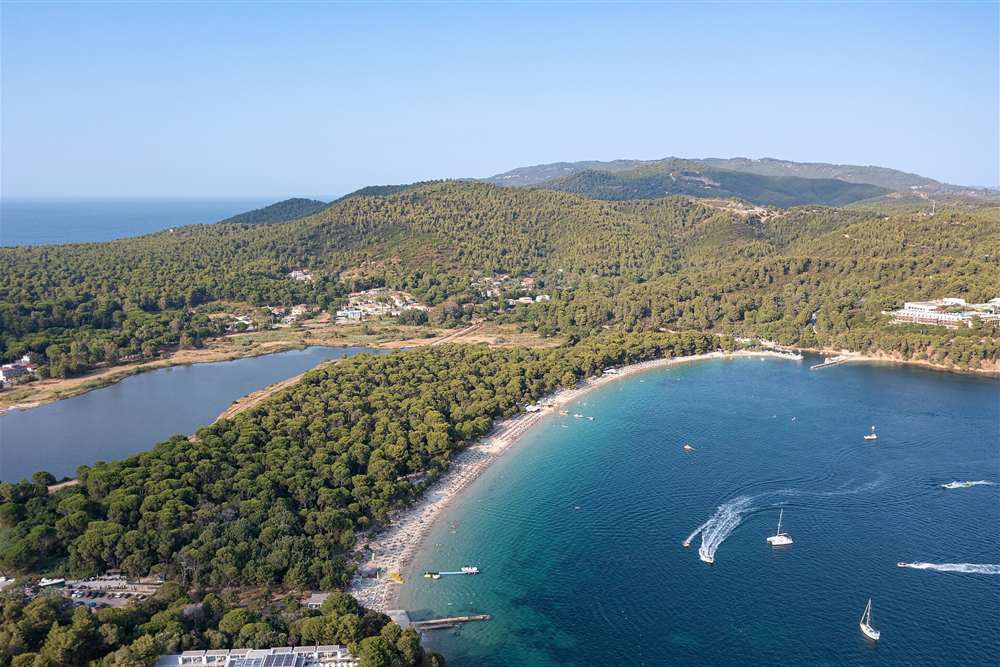
Sporades tours on Skiathos see the pine-backed sand of Koukounaries, the white pebble cove of Lalaria under its rock arch, the ruined medieval Kastro on the north cliff, the Evangelistria monastery where the Greek flag was woven, and the house of Alexandros Papadiamantis in the town.
Skiathos measures about 12 km by 6 km and covers 49.9 square kilometres. Its coastline runs 44 km and carries more than 60 beaches, most of them sand. Aleppo pine covers the slopes, and a stone pine forest stands behind the lagoon at Koukounaries. Mount Karafiltzanaka reaches 433 m in the rugged north. Skiathos town, with about 4,900 people, is the only real settlement.
The Bourtzi sits on a wooded islet in the middle of the harbour. The Ghisi brothers of Venice took the island in 1207 and built the little fortress against pirates; it failed, and in the mid-14th century the islanders moved to the Kastro on the north cliff, a site reached by a single drawbridge. The Kastro held the population until the 1830s and keeps two churches and the ruins of its houses.
Evangelistria monastery stands 4 km north of the town. Kollyvades monks from Mount Athos founded it in 1794, and in 1807 Kolokotronis, Miaoulis and other fighters swore the oath of freedom there over a white cross on a sky-blue field, woven on the monastery loom, the first Greek flag. The loom is in the museum, and the monks make a red Muscat called Alypiakos in the vineyards below.
The island wears its forest. Aleppo pine covers the southwest and the north, farmland surrounds the villages of Kalyvia, Troullos and Achladies, and a single paved road runs the southeast coast with dirt tracks branching north. The municipality takes in the islets of Tsougria, Tsougriaki, Maragos, Arkos, Troulonisi and Aspronisi, all visible from the town, and boats run out to them through the day.
Papadiamantis was born in the town in 1851 and died there in 1911, and his stories of island life made him the classic of modern Greek prose; his house is now a museum on the street that carries his name. Sporades tours take the town in an hour and the beaches in a day. Our page on Kastro on Skiathos covers the old capital.
What do Sporades tours see on Skopelos?
Sporades tours on Skopelos see the amphitheatric town under its castle, the chapel of Agios Ioannis Kastri on its rock, the monasteries of the Palouki hill, the village of Glossa above Loutraki, and the pine coves of Panormos, Milia and Stafylos.
Skopelos covers 96 square kilometres and rises to Delphi at 681 m in the centre and Palouki at 546 m in the south-east. Pine and plum orchards cover the slopes, and the island is the greenest of the group. Skopelos town holds the port and the old quarter; Glossa sits high in the north-west above the second port at Loutraki, and Neo Klima lies below it. Sporades tours cross it in a morning.
Legend gives the island to Staphylos, son of Dionysos and Ariadne, and the name means grape. The Minoans colonised it in the Late Bronze Age and brought the vine, and as Peparethos its wine was known across the Greek world; Sophocles has a wine merchant lost on the way to “Peparethos, rich in grapes and wine”. A royal Mycenaean tomb was excavated at Staphylos in 1936.
The town climbs in tiers of white houses with grey slate roofs, and a Venetian castle of the Ghisi stands at the top. Skopelos counts churches by the hundred, most of them small and whitewashed, and the monasteries of Palouki, Evangelistria, Prodromos, Metamorfosi and Agia Varvara, look back at the town from the ridge across the bay.
Sporades tours drive the island road from the town through Panormos and Milia to Glossa in under an hour, and stop at Agios Riginos, the monastery of the island’s patron saint, on the way. Our page on Skopelos town covers the Chora in detail.
Which Mamma Mia locations do Sporades tours visit?
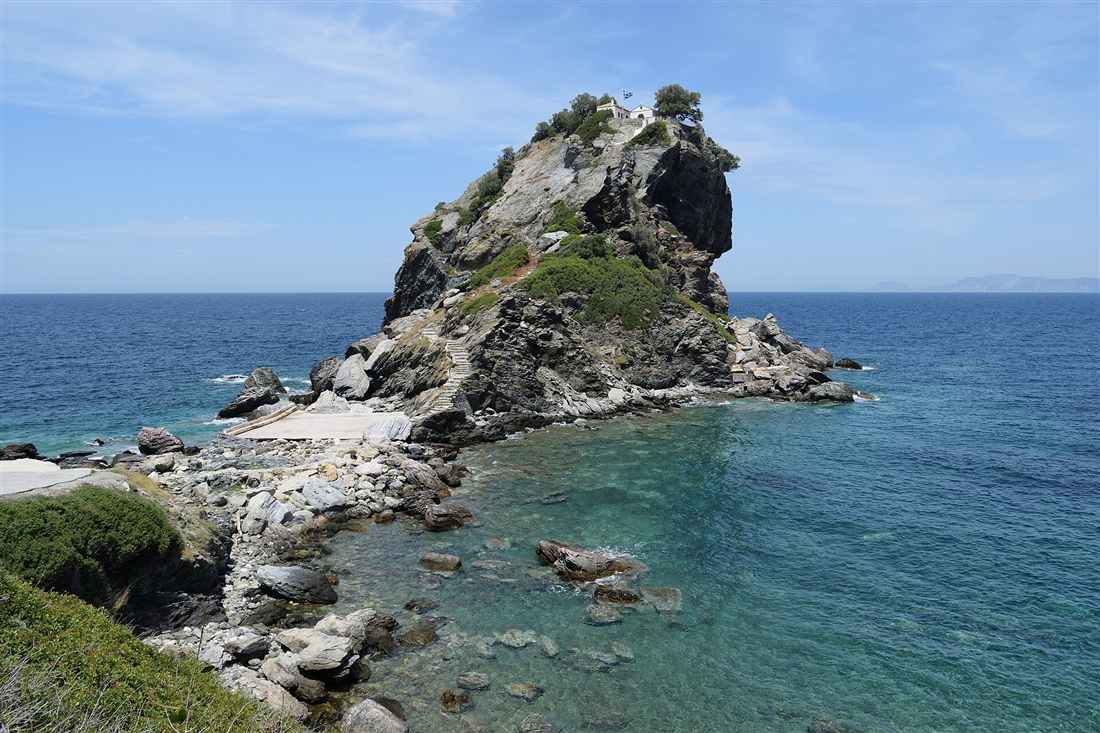
Sporades tours visit the chapel of Agios Ioannis Kastri on its rock above the sea, reached by 110 steps cut into the stone, where the wedding scene of Mamma Mia was filmed, and the beaches of Kastani and Amarantos on the west coast of Skopelos.
The film shot its exteriors on Skopelos and Skiathos in 2007. Agios Ioannis Kastri stands on a rock pillar on the north-east coast, 3 km from Glossa, joined to the shore by a neck of stone and climbed by a stair cut into the face. The chapel is tiny, the view runs to Alonnisos, and the stair is the picture that sold the island to a generation of visitors.
Kastani, on the west coast below Neo Klima, served as the beach of the film. It is a curve of white pebble and turquoise water backed by pines, with a beach bar built where the set stood. Amarantos, at the south-west cape, provided the cliff scenes, and Glysteri north of the town the boat scenes.
- Agios Ioannis Kastri – the wedding chapel, 110 steps above the sea near Glossa.
- Kastani beach – the film’s beach, white pebble under pines on the west coast.
- Amarantos – the cliffs at the south-west cape of Skopelos.
- Glysteri – the cove north of Skopelos town used for boat scenes.
- Damouchari – the Pelion harbour on the mainland that played the village port.
- Skiathos town – the waterfront and the marina in the opening sequences.
Sporades tours sell the route as a half-day from Skiathos or a morning from Skopelos town. Our page on the Mamma Mia locations on Skopelos covers each site.
What do Sporades tours see on Alonnisos?
Sporades tours on Alonnisos see the restored Old Village of Chora on its ridge, the port of Patitiri below it, the pebble coves of the east coast, and the marine park islands of Peristera, Kyra Panagia and Gioura, where monk seals breed.
Alonnisos covers 64 square kilometres and runs 20 km from south-west to north-east. The island is limestone, thick with pine, and planted with almonds, figs, olives and vines. The 2021 census counted about 3,100 people in the municipality, which also holds Gioura, Kyra Panagia, Peristera, Piperi, Psathoura, Skantzoura and the Adelfoi islets. Sporades tours reach it on the day boat from Skiathos.
The Old Village stood as the island’s fortified capital until the earthquake of 9 March 1965 wrecked it. The state moved the population to Patitiri on the coast, and Chora emptied; since then its stone houses have been restored one by one, and the ridge now holds tavernas with a view over the whole channel to Skopelos. Patitiri, the port, takes the ferries and the hydrofoils.
The island was ancient Ikos, colonised from Knossos, and it was called Liadromia through the Middle Ages; the modern name was given in 1838 after a mistaken identification with Halonnesos. Wine carried its economy until phylloxera, and the old presses that gave Patitiri its name stood along the shore.
Sporades tours use Alonnisos as the base for the marine park. Boats leave Patitiri for the blue cave of Gioura, the anchorage at Kyra Panagia with its monastery, and the classical shipwreck off Peristera, the first underwater site in Greece opened to divers. Our page on the Alonnisos marine park covers those trips.
What do Sporades tours see in the National Marine Park?
Sporades tours in the National Marine Park of Alonnisos cross 2,260 square kilometres of protected sea, the largest marine park in Europe, founded in 1992 for the Mediterranean monk seal. It holds Peristera, Kyra Panagia, Gioura, Psathoura, Piperi and Skantzoura.
The park splits into two zones. Boats reach the outer islands of zone A, with landings allowed on some and forbidden on Piperi, which is kept for the seals and the Eleonora’s falcons. About 300 Mediterranean monk seals live in Greek waters, and the park protects the largest breeding group; the species is among the rarest seals in the world.
- Peristera – the classical merchant wreck of about 425 BC, with its cargo of 4,000 amphorae, dived as an underwater museum.
- Kyra Panagia – the Athonite monastery above the anchorage, and goats on the terraces.
- Gioura – the cave of the Cyclops with Neolithic layers, and a herd of wild goats found nowhere else.
- Psathoura – the tallest lighthouse in the Aegean and a submerged ancient settlement.
- Piperi – the core zone, closed to visitors, where the seals pup in sea caves.
- Skantzoura – the southern islet with a monastery and clear shallow water.
The wreck at Peristera opened to recreational divers in 2020 as the first ancient shipwreck in Greece made accessible in that way, with a guided dive from Alonnisos and a virtual visit on land for non-divers. Sporades tours book the boat and the dive together, since both leave from Patitiri.
What do Sporades tours see on Skyros?
Sporades tours on Skyros see the Chora under its Byzantine castle and the monastery of Agios Georgios, the grave of Rupert Brooke at Tris Boukes, the Skyrian ponies of the southern hills, the carved furniture of the island’s houses and the goat-bell carnival of February.
Skyros is the largest island of the group at 209 square kilometres and holds about 3,000 people. It divides in two: a green north of pine and farmland, and a bare, rocky south, Vouno, where the ponies graze and Eleonora’s falcons nest on the cliffs. Linaria is the port, Chora the capital on the east coast, and the airport sits in the north.
Mythology fixed the island in the Greek imagination. Theseus died here when king Lycomedes threw him from a cliff; Achilles was hidden at the same court in women’s clothes until Odysseus uncovered him, and sailed for Troy from the bay of Achili. Cimon took the island about 475 BC, claimed to have found the bones of Theseus and carried them to Athens.
The Chora climbs to a Byzantine and Venetian castle with the monastery of Agios Georgios inside the walls, founded in 962. Below it the houses keep the Skyrian interior: carved wooden furniture, embroidered cloth and walls hung with ceramic plates, a style the island still makes. The Manos Faltaits Museum holds the largest collection of it.
Skyros keeps its own crafts alive. The island’s carved chairs, low tables and painted ceramics were made for the small rooms of the Chora, and the workshops still turn them out; the embroidery of Skyros, worked in red and green on linen, is collected as far as Athens. The names on the old plates hung in the houses show where the sailors traded, from Italy to the Black Sea.
Rupert Brooke died on a French hospital ship off Skyros on 23 April 1915 and was buried the same evening in an olive grove at Tris Boukes, in the far south. The grave is reached by a rough track, and the bronze statue of him stands on the square at Chora. Sporades tours reach Skyros by ferry from Kymi on Euboea or by the flight from Athens.
Which beaches do Sporades tours reach?
Sporades tours reach Koukounaries, Lalaria and Banana on Skiathos, Kastani, Milia, Panormos and Stafylos on Skopelos, Chrysi Milia and Agios Dimitrios on Alonnisos, and Atsitsa and Pefkos on Skyros.
Skiathos has the sand. Koukounaries, 16 km from the town at the end of the bus route, runs golden sand between a stone pine forest and a lagoon; Banana and Agia Eleni lie beside it, Vromolimnos and Troulos further east, and Megali Ammos next to the town. Lalaria, on the north cliff, is white pebble under a natural rock arch and is reached only by boat.
- Skiathos – Koukounaries, Banana, Agia Eleni, Vromolimnos, Troulos, Mandraki and Lalaria by boat.
- Skopelos – Kastani, Milia, Panormos, Stafylos, Velanio, Limnonari and Glysteri.
- Alonnisos – Chrysi Milia, Kokkinokastro, Agios Dimitrios, Leftos Gialos and Votsi.
- Skyros – Molos and Magazia below Chora, Atsitsa, Pefkos and Agios Fokas in the north.
- Tsougria – the islet off Skiathos town, with two sand beaches and a taverna.
- Marine park – the anchorages at Peristera and Kyra Panagia, swum from the boat.
Skopelos and Alonnisos run to white pebble rather than sand, and the water over it turns the coves turquoise. Agios Dimitrios on Alonnisos is a sand and pebble spit with sea on both sides. Sporades tours reach the best of them by boat, because the roads stop above the cliffs.
Which boat trips and sailing routes do Sporades tours run?
Sporades tours run day cruises from Skiathos to Skopelos and Alonnisos, Mamma Mia cruises to the chapel and Kastani, speedboat runs to Lalaria and the blue caves, sunset sails to Tsougria, marine park boats from Patitiri and week-long charters through all four islands.
The archipelago is a sailing ground. Distances between anchorages run one to three hours, the islets give shelter in most winds, and the marine park keeps the northern water empty of development. Charter boats work out of Skiathos marina, Skopelos town and Volos on the mainland, and the standard week runs Skiathos, Skopelos, Alonnisos, Peristera, Kyra Panagia and back. Sporades tours under charter take a week over it.
- Skiathos day sailing – wooden boats and yachts with breakfast, lunch and swim stops.
- Skopelos and Alonnisos – a full day across both islands from Skiathos.
- Lalaria and the blue caves – speedboat around the north cliffs of Skiathos.
- Tsougria sunset – the islet cruise with drinks out of Skiathos town.
- Marine park day – Peristera, Kyra Panagia and Gioura from Patitiri.
- Licence-free hire – small boats from Skiathos and Skopelos for the day.
Sporades tours under sail also take the mainland shore. Pelion lies two hours west, with Damouchari and Agios Ioannis on its coast, and the sheltered Pagasetic Gulf runs in to Volos. Our page on Skiathos yacht charter covers the boats and the routes.
Which monasteries and churches do Sporades tours visit?
Sporades tours visit Evangelistria and Panagia Kounistra on Skiathos, the Palouki monasteries and Agios Riginos on Skopelos, the Athonite house on Kyra Panagia, and Agios Georgios inside the castle of Skyros.
Evangelistria on Skiathos is the one with the history. Founded in 1794 by Kollyvades monks from Mount Athos, it wove the first Greek flag on its loom and saw the oath of 1807. The church is a three-aisled cross-in-square with three domes and a carved screen, and the museum keeps manuscripts, vestments and the loom itself. Panagia Kounistra, in the west of the island, holds the icon that gave the monastery its name.
Skopelos counts its churches in the hundreds, and the four monasteries on the Palouki ridge face the town across the bay: Evangelistria of 1712, Prodromos, Metamorfosi and Agia Varvara, all within a morning’s walk of each other. Agios Riginos, the island’s patron, has his monastery on the road south of the town, and Agios Ioannis Kastri stands on its rock in the north.
The marine park keeps a monastery of its own. The Athonite house on Kyra Panagia, a dependency of the Great Lavra, sits above the anchorage with its terraces and its goats, and boats from Alonnisos call there. On Skyros, Agios Georgios inside the castle walls was founded in 962 and holds a fresco of Saint George over the gate.
Sporades tours fit these into the driving day. Evangelistria is 4 km from Skiathos town on a steep road, the Palouki monasteries are twenty minutes from Skopelos port, and the Skyros castle is a ten-minute climb from the Chora square.
Which museums and houses do Sporades tours visit?
Sporades tours visit the Papadiamantis house and the Evangelistria museum on Skiathos, the folklore museum of Skopelos town, the Manos Faltaits Museum and the archaeological museum of Skyros, and the collections at Patitiri and in the Old Village of Alonnisos.
The Papadiamantis house is the smallest museum of the group and the one that explains the most. Alexandros Papadiamantis was born in it in 1851, returned to it in old age and died in it in 1911, and the two rooms hold his desk, his icons and his manuscripts. His 170 short stories are the portrait of Skiathos before tourism, written in a language of his own between the formal and the spoken.
The Evangelistria monastery museum, 4 km north of the town, keeps the loom on which the first Greek flag was woven in 1807, with manuscripts and gospels of the 17th and 18th centuries, silver crosses and Byzantine icons. The Bourtzi islet in the harbour holds a cultural centre and an open-air theatre in its restored buildings.
- Papadiamantis house, Skiathos town – the writer’s rooms, furniture and manuscripts.
- Evangelistria museum, Skiathos – the flag loom, icons and 17th-century books.
- Folklore museum of Skopelos – a town mansion with the island’s costume, weaving and furniture.
- Manos Faltaits Museum, Skyros – the largest collection of Skyrian embroidery, ceramics and carved wood.
- Archaeological Museum of Skyros – the Bronze Age and Geometric finds of the island, beside Brooke’s statue.
- Alonnisos collections – the Historical and Folklore Museum at Patitiri, with pirate and shipping rooms.
Sporades tours take them in an hour each. The Skyrian houses themselves are part of the display, since their carved furniture, embroidered cloth and hung plates are still in daily use in the Chora.
Which wildlife do Sporades tours see?
Sporades tours see Mediterranean monk seals in the marine park, Eleonora’s falcons over Piperi and the Skyros cliffs, wild goats on Gioura, the Skyrian pony in the southern hills of Skyros, and the pine forest and lagoon behind Koukounaries.
The monk seal is the reason the park exists. Fewer than 800 survive worldwide, and the largest single group breeds in the sea caves of these islands, above all on Piperi, which is closed to visitors for that reason. Boats from Alonnisos keep their distance, and the information centre at Patitiri explains the work. Sporades tours in the park keep to the rules that protect it.
The Skyrian pony is the other rarity. It stands about a metre at the shoulder, has lived on Skyros since antiquity and is counted among the oldest breeds in Europe, with only a few hundred animals left. Herds graze the bare Vouno hills in the south, and a breeding farm near the Chora keeps the working stock.
- Mediterranean monk seal – the caves of Piperi, Gioura and Alonnisos, protected since 1992.
- Eleonora’s falcon – summer colonies on the marine park cliffs and southern Skyros.
- Wild goats of Gioura – a herd described as a distinct island population, living on bare limestone.
- Skyrian pony – the small ancient breed of the Vouno hills.
- Koukounaries lagoon – a protected wetland behind the stone pine forest on Skiathos.
- Dolphins – common in the channels between Skopelos, Alonnisos and Peristera.
Pine shapes everything above the water. Aleppo pine runs to the shore on all three northern islands, and the stone pines at Koukounaries make the only forest of their kind in the group. Sporades tours cross from forest to bare limestone in the marine park in a single morning.
Which festivals do Sporades tours meet?
Sporades tours meet the Skyros carnival in February, when men in goat masks and bells fill the Chora, the feast of Agios Riginos on Skopelos on 25 February, the Assumption panigyria of 15 August on every island, and the Easter processions of Skiathos and Skopelos.
The Skyros carnival is the strangest survival in the Aegean. For four weekends before Lent the men of the Chora dress as the Geros, in a goatskin cloak hung with 30 or 40 bronze bells and a mask of kid leather, and move through the streets in a roar of noise, with the Korela in white beside them and the Frangos playing the fool. The dance is read as a shepherd’s rite older than the Christian calendar. Sporades tours in February come for it.
Agios Riginos is the patron of Skopelos, a bishop martyred under Julian in the 4th century, and his feast on 25 February brings the island to the monastery on the road south of the town. The Assumption on 15 August fills the churches of all four islands, with the biggest crowd at Panagia Kounistra on Skiathos and at the Chora of Skopelos.
Easter brings the processions. Skiathos carries its epitaphios down to the harbour, and Skopelos and Alonnisos keep the same order, with rockets, candles and a shared meal after midnight. In summer the calendar fills with local celebrations: the Skiathos festival of Papadiamantis, the Skopelos rebetiko nights and the village feasts of Glossa and Klima.
Sporades tours in February and in August plan around them, since the ferries and the rooms fill for each. The Skyros carnival in particular takes the island past its winter capacity.
Which mainland trips combine with Sporades tours?
Sporades tours combine with the Pelion peninsula opposite, with Volos and the Neolithic sites of Dimini and Sesklo, with Meteora three hours inland, and with the Pagasetic Gulf villages reached by boat from Skiathos.
Pelion is the natural pairing. The mountain of the Centaurs rises across the channel, with stone villages in chestnut forest, cobbled kalderimia linking them and beaches under the cliffs at Damouchari, Agios Ioannis, Mylopotamos and Fakistra. Damouchari played the village harbour in Mamma Mia, which makes it the mainland stop on the film route. Sporades tours add it to the ferry route.
Volos sits at the head of the Pagasetic Gulf, the port for the ferries and the city of the tsipouradika, where a small carafe brings a plate of food with it. Dimini and Sesklo, two of the oldest settlements in Europe, stand in the fields outside the city, and the archaeological museum holds their finds along with the painted grave stelai of Demetrias.
- Pelion villages – Makrinitsa, Portaria, Tsagarada and Zagora in chestnut and beech.
- Damouchari – the Mamma Mia harbour on the east coast of Pelion.
- Volos – the port, the tsipouradika and the archaeological museum.
- Dimini and Sesklo – Neolithic settlements of the 5th and 6th millennia BC.
- Meteora – the monasteries on their rock pillars, about three hours from Volos.
- The Pelion train – the narrow-gauge line from Ano Lechonia to Milies.
Sporades tours that arrive by ferry from Volos build a mainland day into the route without a detour. Our page on the Pelion villages tour covers the mountain opposite the islands.
What do Sporades tours see in Skiathos town and Skopelos town?
Sporades tours see the old port and the Bourtzi islet at Skiathos, Papadiamantis street running inland from the quay, and on Skopelos the tiers of slate-roofed houses under the Venetian castle, with the waterfront chapels and the lanes of the Chora behind them.
Skiathos town spreads around two harbours. The old port on the west side keeps the fishing boats and the caiques that run to Tsougria; the new port takes the ferries and the flying cats. Between them the wooded Bourtzi islet carries the ruins of the Ghisi fortress of 1207, a cultural centre and an open-air theatre, and is reached on foot along a causeway.
Papadiamantis street climbs from the quay through the shops and the tavernas, with the writer’s house a few doors up on the left. Behind it the Plakes and Limnia quarters hold the older houses, and the ridge above the town gives the view over the harbour and the islets. The town holds about 4,900 people and takes an hour to walk.
Skopelos town is the finer of the two. Its houses climb in tiers from the harbour to the Venetian castle, slate roofs over whitewash, with balconies of carved wood and lanes too narrow for cars. Chapels stand at every turning, many of them family foundations, and the waterfront runs from the ferry quay past the tavernas to the churches on the point.
Sporades tours give each town an evening. The light on Skopelos harbour at sunset and the Skiathos old port after dark are the two set pieces, and both are walked rather than driven.
Which visitors do Sporades tours suit?
Sporades tours suit families on Skiathos for its sand and short distances, walkers on Skopelos for its marked paths, divers and naturalists on Alonnisos for the marine park, sailors for the sheltered channels, and visitors after tradition on Skyros.
The group divides by character rather than by price. Skiathos has the airport, the beaches, the nightlife and the day boats, and it takes the largest share of visitors. Skopelos is greener, quieter and built for walking, with the best town in the archipelago. Alonnisos is quieter again, and its draw is the water: the park, the seals and the wreck at Peristera.
- Families – Skiathos for Koukounaries, Banana and the bus that links them.
- Walkers – Skopelos for the kalderimia and the Palouki monasteries.
- Divers – Alonnisos for the classical wreck and the marine park dive sites.
- Sailors – the Skiathos to Kyra Panagia route, with anchorages an hour apart.
- Film visitors – the Mamma Mia chapel, Kastani and Damouchari across the water.
- Tradition – Skyros for the carnival, the ponies, the carved houses and the embroidery.
Sporades tours work in small groups because the boats are small: a day cruise carries twenty or thirty people, and the licence-free rentals carry five. The islands are also close enough together that a single base covers the group, which suits visitors with one week rather than three.
Our pages on things to do on Skiathos and things to do on Skopelos set out each island day by day.
Which walks do Sporades tours take?
Sporades tours walk the marked network of Skopelos between the town, the Palouki monasteries and Glossa, the old paths of Alonnisos from Patitiri to Chora and the north coves, the Kastro path on Skiathos, and the Vouno hills of Skyros where the ponies graze.
Skopelos keeps the best paths of the group. Old stone kalderimia link the town with Glysteri, Stafylos and the monasteries, and the long route crosses the island to Glossa through plum orchards and pine. The sendoukia, rock-cut tombs on the ridge above the town, sit at the end of one of them with a view over both coasts. Sporades tours walk them with a local guide.
Alonnisos walks from Patitiri up to the Old Village in 25 minutes on a stepped path, then on across the island to Leftos Gialos and Agios Dimitrios. The northern half is empty, pine-covered and crossed by farm tracks that end at coves. Skiathos runs its main walk out to the Kastro on the north cliff, a two-hour path from the town through pine and past chapels.
- Skopelos – the town to Palouki, the sendoukia ridge, the cross-island route to Glossa.
- Alonnisos – Patitiri to Chora, the old paths to Leftos Gialos and the north.
- Skiathos – the Kastro path, the Evangelistria road and the Koukounaries lagoon loop.
- Skyros – the Vouno hills in the south and the track to Brooke’s grave at Tris Boukes.
- Pelion – the mainland kalderimia above Damouchari, two hours west by boat.
The paths are waymarked on Skopelos and Alonnisos and rougher elsewhere. Sporades tours walk them from April to June and in September and October, when the pine shade holds and the ground is dry.
What do Sporades tours eat and drink?
Sporades tours eat the spiral cheese pie of Skopelos fried in a pan, its dried plums in every form, Alonnisos almond sweets and fish, Skyrian goat and lobster pasta, and drink the Alypiakos Muscat made at the Evangelistria monastery on Skiathos.
The Skopelos cheese pie is the dish of the group: soft white cheese rolled into a coil of thin pastry and fried until it blisters, served at breakfast as readily as at dinner. The island’s plums are the other signature, dried in wood ovens and used in pork stews, in sweets and in spoon preserves; the orchards fill the valleys inland from the town. Sporades tours order the pie at the first taverna of the trip.
- Skopelos – the fried spiral cheese pie, dried plums, pork with prunes, and the Chora bakeries.
- Skiathos – fish at the old port, Alypiakos red Muscat from the monastery vineyard, and local honey.
- Alonnisos – amygdalota almond cakes, tyropsomo cheese bread and fish from Patitiri.
- Skyros – goat roasted whole, lobster with pasta, and the island’s own hard cheese.
- Pelion produce – apples, chestnuts and firiki from the mainland opposite, sold in the island markets.
Wine goes back furthest. Skopelos was Peparethos, whose wine the ancient writers ranked with the best in the Aegean and which Pliny the Elder recorded as needing six years in the barrel before it was drinkable. Sporades tours taste the modern version at the Skiathos monastery and at the small producers on Skopelos.
What history do Sporades tours tell?
Sporades tours tell of Minoan settlers who brought the vine to Peparethos, of the Persian fleet wrecked off Skiathos in 480 BC, of the Venetian Ghisi who took the islands in 1207, of the flag woven at Evangelistria in 1807 and of the earthquake that emptied Alonnisos in 1965.
The islands enter the record with wine and with war. Minoans colonised Skopelos in the Late Bronze Age and planted the vine; Knossians settled Alonnisos, then called Ikos. In 480 BC the fleet of Xerxes was caught in a storm off the Skiathos coast and badly damaged on the rocks, and the Greek fleet then blockaded these straits while the Spartans held Thermopylae. Sporades tours follow both threads.
Athens took the group into the Delian League, Philip V of Macedon destroyed the ancient city of Skiathos in 200 BC, and Rome and Byzantium held it after. The Fourth Crusade gave the islands to the Ghisi brothers of Venice in 1207; they built the Bourtzi at Skiathos and the castle at Skopelos, and pirates drove the islanders to the cliff-top Kastro settlements in the 14th century.
Venice ruled Skopelos as Scopelo from 1456 to 1538, then the Ottomans held the group until the revolution. The oath sworn at Evangelistria in 1807 put Skiathos into the centre of that story, and the islands joined the Greek state in 1830. Alonnisos suffered twice in the 20th century: phylloxera killed its vines, and the earthquake of 9 March 1965 wrecked the old capital and moved its people to Patitiri.
Two graves hold the modern chapters. Papadiamantis died at Skiathos in 1911 after writing 170 short stories of island life, and Rupert Brooke was buried in an olive grove on Skyros on 23 April 1915. Sporades tours visit both.
How do visitors reach the Sporades?
Visitors reach the Sporades by flight to Skiathos, by ferry from Volos, Agios Konstantinos or Thessaloniki to Skiathos, Skopelos and Alonnisos, and by ferry from Kymi on Euboea or by air from Athens to Skyros.
Skiathos airport takes domestic flights from Athens and direct summer flights from Britain, Germany, Italy and the Nordic countries. Its runway starts at the edge of the road, which has made the approach a spectacle in its own right. Volos lies about three hours from Athens by road and 90 minutes from Skiathos by fast boat; Agios Konstantinos is closer to Athens and about two hours out. Sporades tours start here for most visitors.
- Athens to Skiathos – 45 minutes by air, or road to Agios Konstantinos and a two-hour boat.
- Thessaloniki to Skiathos – a seasonal fast boat, about three and a half hours.
- Volos to Skopelos – about two and a half hours by conventional ferry.
- Skiathos to Alonnisos – about 75 minutes by flying cat through Skopelos.
- Athens to Skyros – the Kymi ferry on Euboea, about an hour and 45 minutes at sea.
- Skyros airport – flights from Athens twice a week through the year.
Cars cross on the conventional ferries from Volos and Agios Konstantinos. Buses run the south coast of Skiathos to Koukounaries every half hour in summer, and Skopelos runs a line from the town to Glossa. Sporades tours based on Skiathos use the boats rather than the roads. Our page on how to get to Skiathos covers the routes.
When do Sporades tours run, and where do they stay?
Sporades tours run from May to mid-October, with the fullest boat timetable in July and August and the warmest sea in September. They stay in Skiathos town or Koukounaries, in Skopelos town or Panormos, in Patitiri or Chora on Alonnisos, and in Magazia below the Chora of Skyros.
The season is shaped by the flights and the boats. Direct European flights to Skiathos begin in May and end in October, and the inter-island fast boats thin out after that. Spring brings flowers and empty paths, September the warmest water and the plum harvest on Skopelos, and winter a reduced ferry service with most tourist businesses closed.
- May and June – green hills, cool sea, quiet beaches and the full boat schedule from mid-June.
- July and August – the meltemi blows, the beaches fill and every day trip runs daily.
- September – the warmest sea of the year and thinner crowds.
- October – the last flights, the plum harvest and the first rain.
- February – the Skyros carnival, when men in goat masks and bells fill the Chora.
Skiathos suits a first visit, with the airport, the beaches and the day boats. Skopelos suits walkers and a longer stay. Alonnisos suits the marine park and the quiet. Skyros stands apart and needs its own trip. Three nights on Skiathos and three on Skopelos make the standard week, and Sporades tours that add Alonnisos stretch it to ten days.
Frequently Asked Questions
Which are the Sporades islands?
Skiathos, Skopelos, Alonnisos and Skyros are the inhabited four. The archipelago counts 24 islands, and the uninhabited ones, among them Kyra Panagia, Gioura, Peristera and Piperi, lie inside the marine park.
Which is the largest island in the Sporades?
Skyros, at 209 square kilometres. Skopelos follows at 96, Alonnisos at 64 and Skiathos at 49.9.
How long do Sporades tours take?
A day for the Mamma Mia cruise or the Skopelos and Alonnisos boat trip, a week for three nights on Skiathos and three on Skopelos, and ten days to add Alonnisos and the marine park.
Where was Mamma Mia filmed?
On Skopelos and Skiathos in 2007. The wedding chapel is Agios Ioannis Kastri, on a rock above the sea near Glossa, climbed by 110 steps; the beach is Kastani, and the mainland harbour is Damouchari in Pelion.
How do you get to the Sporades?
By air to Skiathos from Athens and from European cities in summer, or by ferry from Volos, Agios Konstantinos and Thessaloniki. Skyros is reached from Kymi on Euboea or by the Athens flight.
Can you island hop in the Sporades?
Yes. Skiathos to Skopelos takes 45 minutes by flying cat and Skopelos to Alonnisos about 20. Skyros sits apart and keeps its own link through Kymi.
What is the Alonnisos marine park?
The National Marine Park of Alonnisos and the Northern Sporades, founded in 1992 and covering 2,260 square kilometres, the largest in Europe. It protects the Mediterranean monk seal, and the core island of Piperi is closed to visitors.
Can you dive the ancient shipwreck?
Yes. The classical merchant wreck off Peristera, of about 425 BC with a cargo of 4,000 amphorae, opened to recreational divers in 2020 as the first underwater museum in Greece, with guided dives from Alonnisos.
Which Sporades island has the best beaches?
Skiathos for sand, with Koukounaries, Banana and Lalaria; Skopelos and Alonnisos for white pebble coves such as Kastani, Milia and Chrysi Milia.
What is the Skyros carnival?
A pre-Lenten festival in which men dress as the Geros in a goatskin cloak hung with dozens of bronze bells, with the Korela and the Frangos beside them, and move through the Chora for four weekends.
Which food do Sporades tours try?
The fried spiral cheese pie of Skopelos, its dried plums, Alonnisos almond sweets, Skyrian goat and lobster pasta, and the Alypiakos Muscat made at the Evangelistria monastery on Skiathos.
When is the best time for Sporades tours?
May to mid-October. September holds the warmest sea and thinner crowds, July and August the fullest boat timetable, and February the Skyros carnival.