
Skiathos packs more than 60 beaches, a medieval cliff-top fortress, a flag-weaving monastery and one of Europe’s most dramatic airport approaches into about 48 square kilometres. The island sits at the western edge of the Northern Sporades, closest to the mainland, and combines pine-backed sand on the south coast with boat-only pebble coves on the north. Visitors reach every core activity within a 30-minute drive or a short boat ride. Plan the whole trip with Greece Tours.
This guide ranks the ten activities that define a Skiathos holiday: swimming at Koukounaries, sailing to Lalaria, climbing to the Kastro, exploring Skiathos Town and the Bourtzi. Visiting the Evangelistria monastery, watching the famous airport landings, hiking the marked trail network. Crossing to Tsougria islet and Skopelos on day trips. Each section gives distances, durations and access details so you plan every day precisely.
What are the best things to do in Skiathos?
The best things to do in Skiathos are swimming at Koukounaries beach, taking the boat trip to Lalaria and the Kastro, exploring Skiathos Town, visiting the Evangelistria monastery, hiking marked trails and watching aircraft land at the airport.
The island of Skiathos measures about 48 square kilometres, which keeps every headline activity within easy reach of Skiathos Town. Koukounaries beach lies about 12 km west along the single south-coast road, the Evangelistria monastery about 4 km north, and the airport runway directly beside the town’s ring road. Boats depart the old port each morning for Lalaria and the Kastro on the north coast, both unreachable by paved road. One bus line links the town to Koukounaries with numbered stops, so visitors without a car still cover the entire south shore. A first-time itinerary of three days fits the beach, the boat trip and the town; five days add the monastery, the trails and a Skopelos crossing.
Ferries from Volos and Agios Konstantinos reach the new port.
Skiathos’ south coast lines about 12 km of road between the town and Koukounaries with sandy, family-friendly bays. Megali Ammos starts a 10-minute walk from the harbour, followed by Achladies, Kanapitsa on its own peninsula, Vromolimnos with its wakeboard station, Agia Paraskevi, Troulos and Agia Eleni. Bus stops numbered roughly 1 to 26 mark the route, and buses run every 15 to 30 minutes in high season. Every organised beach on this shore rents sunbed pairs with umbrellas and keeps a taverna within 100 metres of the sand. Water-sports centres at Vromolimnos, Agia Paraskevi and Koukounaries run waterskiing, wakeboarding, tube rides and stand-up paddleboards.
Families favour this coast because the water deepens gradually and afternoon winds stay lighter than on the north shore, which faces the open Aegean.
The north coast operates by boat. Wooden excursion boats and rigid inflatables leave the old port between 9:30 and 10:30 each morning for Lalaria. Where white marble pebbles meet the Trypia Petra rock arch. For the Kastro peninsula with its medieval ruins. Round-island itineraries add three sea caves — Skotini, Galazia and Chalkini — plus a swim stop of about an hour. Drivers reach Megas Aselinos and Mikros Aselinos over dirt tracks branching from the Panagia Kounistra road, and Mandraki and Elia beaches after a 25-minute forest walk from the Koukounaries area. North-facing bays take the meltemi wind head-on, so operators schedule departures around the forecast and shift to the south coast on rough days.
Kastro beach below the fortress offers the clearest swimming water on this shore.
Cultural stops fill the gaps between swims. The Papadiamantis House in Skiathos Town preserves the two-storey home of the island’s most celebrated writer. The pine-covered Bourtzi islet between the two harbours hosts open-air events on summer evenings. The Evangelistria Monastery, about 4 km north of town, displays the loom on which an early Greek flag was woven, plus a museum of manuscripts and vestments. Film fans trace Mamma Mia! locations along the old port, where the production shot its harbour scenes. Walkers pick from about 25 marked trails, including the route from the monastery to the Kastro. Plane spotters end the day at the runway threshold, where landing aircraft pass a road metres above head height.
Each of these sights sits within 15 minutes of the harbour by scooter or bus.
What makes Koukounaries the top beach in Skiathos?
Koukounaries ranks as Skiathos’ top beach thanks to its 1,200-metre crescent of fine golden sand, the umbrella-pine forest behind it and the protected Strofilia lagoon, all reached by bus at stop 26, about 12 km from town.
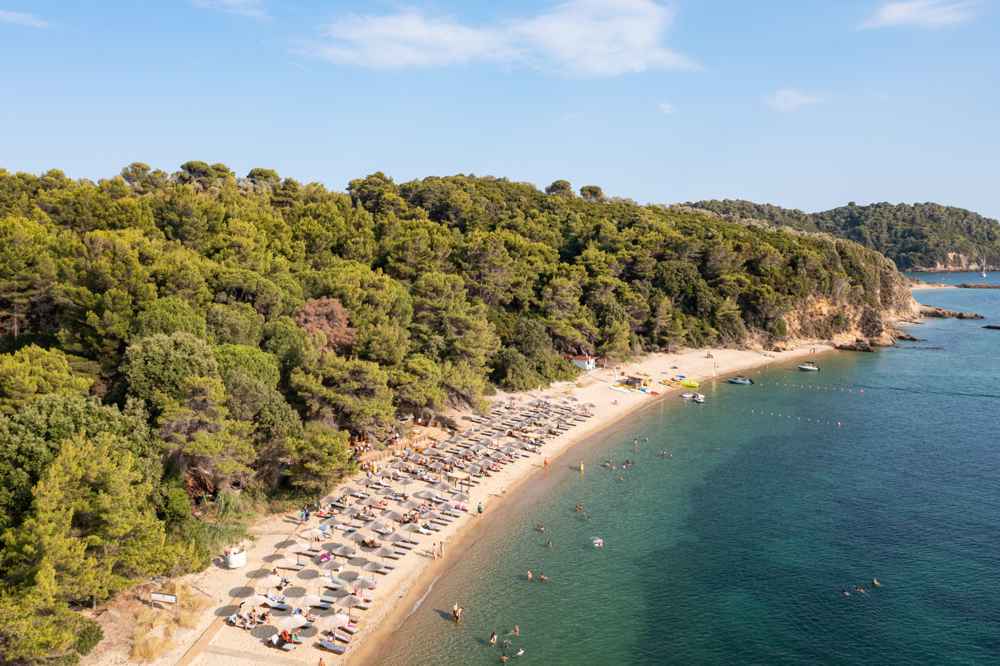
Koukounaries curves for about 1,200 metres around a sheltered south-west bay. Backed not by hotels but by a dense stand of umbrella pines, the trees that give the beach its Greek name. Behind the pines spreads Strofilia, a brackish lagoon that forms a protected biotope where herons, egrets and migrating waterbirds feed in spring and autumn. Wooden walkways cross the strip between lagoon and sand, keeping the forest floor intact. The sand itself stays fine and pale gold across the full length, and the seabed shelves so gently that swimmers wade 30 to 40 metres before losing their footing.
This combination of forest, lagoon and long shallow water makes Koukounaries the single most photographed place on the island and the standard first stop for every new visitor.
Facilities line the full crescent without breaking the treeline. Sunbed pairs with umbrellas occupy organised sectors, while free sand remains at both ends for visitors who bring their own shade. Three beach bars and two tavernas operate behind the walkways. A water-sports base at the eastern end runs waterskiing. Wakeboard sessions, tube rides, pedalos and stand-up paddleboards through the summer season. Lifeguards watch the central sector in July and August. Showers, changing cabins and toilets sit at the main entrances. Parking fills by 11:00 in peak weeks. The bus remains the reliable option: the route from Skiathos Town takes about 30 minutes and terminates at stop 26. A two-minute walk from the sand through the pine grove.
The pine shade behind the walkways stays free all day.
Two of the island’s best-known coves hide over the headland immediately east of Koukounaries. Banana beach and Little Banana occupy back-to-back bays reached by a 10-minute path or a short drive up the signed turn-off. Banana runs organised with sunbeds and a bar, while Little Banana stays quieter and draws a naturist crowd. Agia Eleni, one bay west of Koukounaries, faces the open channel towards the Pelion peninsula and catches the late sun. Which makes it the standard sunset beach on this corner of the island. All three coves share the same fine sand and calm morning water as Koukounaries itself.
Walkers cover the full circuit of the four beaches in under an hour, swimming at each along the way. Bus stop 26 puts all three within walking range.
Koukounaries anchors the wider catalogue of Skiathos beaches, a list that tops 60 named strands around roughly 44 km of coastline. Vromolimnos delivers the liveliest bar scene and wakeboarding, Megali Ammos gives town-based visitors sand within a 10-minute walk, and Troulos suits families wanting space in August. The wilder north answers with Lalaria’s white pebbles, Kastro beach below the medieval walls and the twin Aselinos bays behind dirt tracks. Beach-hopping works on a simple pattern: mornings on the north coast by boat while the sea stays flat, afternoons on the bus-served south shore.
A week on the island comfortably covers a dozen beaches without repeating one, using nothing more than the bus, one boat ticket and a single day’s car hire. The bus covers eight of them directly.
How do you visit Lalaria beach in Skiathos?
Lalaria beach is reachable only by sea; excursion boats and water taxis leave Skiathos’ old port each morning, take about 45 minutes along the north-east coast and allow around 90 minutes on the white pebbles.
Lalaria sits under sheer grey cliffs on Skiathos’ north-east tip, a strand of smooth white marble pebbles polished round by the swell. The water over the pale stones turns a milky turquoise that reads almost artificial in photographs, and visibility below the surface stretches beyond 20 metres on calm days. Trypia Petra, the pierced rock arch at the beach’s western end, frames the classic shot that appears on half the postcards sold in Skiathos Town. Cliffs seal the beach off from the island’s road network completely, so no path, no bus and no car reaches it; the sea provides the only access.
This isolation keeps Lalaria free of sunbeds, bars and buildings, and the pebbles stay exactly as the winter storms arrange them. Seabirds nest on the ledges above.
Boats for Lalaria depart the old port of Skiathos Town every morning in season, with most captains leaving between 9:30 and 10:30 and returning by 17:00. The standard round-island itinerary steams up the east coast, pauses at the three sea caves. Skotini the dark cave. Galazia the blue cave and Chalkini the copper cave. Then anchors off Lalaria for about 90 minutes of swimming. Faster water taxis run a direct shuttle in about 45 minutes each way for visitors who want the beach without the full circuit. Tickets sell at wooden kiosks along the old-port quay on the morning of travel.
Landings happen by tender or bow ladder onto the pebbles, so passengers step ashore straight into ankle-deep water. Larger boats carry shade decks and toilets onboard.
Preparation decides how comfortable Lalaria feels. The marble pebbles heat up by midday and press hard underfoot. Swim shoes count as the single most useful item in the bag. Ahead of an umbrella because the beach offers zero natural shade after mid-morning. Carrying water and snacks is essential; the beach has no taverna, no kiosk and no fresh water. Taking pebbles home is banned, and signs on the boats repeat the rule. The beach loses tonnes of its white stones to souvenir hunters and the municipality now enforces the prohibition. Snorkelling gear pays off around Trypia Petra, where the rock walls drop straight into clear water.
Boats carry shade canopies, which turn the deck into the recovery zone between swims. A brimmed hat and sunscreen complete the kit.
The north-facing position exposes Lalaria to the meltemi, the dry summer wind that blows hardest through July and August afternoons. Captains read the forecast each evening and cancel or reroute the next morning’s departures whenever the swell tops out. On those days the fleet switches to the calmer south coast and to Tsougria islet. Early booking in the week therefore beats leaving the trip to the final day of a holiday. June and September deliver the highest completion rate for the crossing, with lighter winds and water around 23 to 25 degrees. The light on the white pebbles peaks between 11:00 and 14:00, when the sun stands high enough to fire the turquoise shallows.
Exactly the window the standard boat schedule puts passengers on the beach.
What is the Kastro of Skiathos?
The Kastro is Skiathos’ medieval cliff-top capital on the island’s northern tip, a fortified settlement where islanders lived for around three centuries; two restored churches, a fortified gate and old cannons remain among the ruins.
The Kastro occupies a rock peninsula on Skiathos’ northernmost point, connected to the island by a narrow neck that a drawbridge once sealed. Islanders moved the entire capital onto this cliff during the medieval era to escape pirate raids that made the coastal town indefensible. The community stayed up there for around three centuries. At its peak the fortified village held about 300 houses and around 20 churches packed inside the walls, with cisterns catching rainwater and a single gate controlling entry. The population abandoned the rock when piracy faded and rebuilt the present Skiathos Town on the old ancient site by the harbour.
The houses collapsed within decades of the move, leaving the shell that visitors walk through today. Its lanes survive only as lines of rubble.
Ruins reward slow exploration. Stone steps have replaced the drawbridge, climbing through the restored gate into a slope of wall stumps, arches and collapsed cellars. The Church of Christ at the top keeps its frescoes and a carved wooden icon screen behind a plain exterior. The smaller church of the Nativity stands nearby with its bell mounted outside. Rusting cannons still point over the parapet towards the open Aegean, marking the old firing positions. Information panels at the gate map the visible foundations onto the vanished street plan. The cliff edges drop about 70 metres straight into the sea, and the view runs east along the whole north coast towards Lalaria’s cliffs and west towards the Kechria valley.
A wooden walkway now guards the steepest stretch of the path.
Access splits between sea and foot. Excursion boats from the old port include the Kastro on round-island routes. Anchoring below while passengers climb the stepped path in about 15 minutes. Water taxis run the same landing as a direct trip. Walkers take the marked trail from the Evangelistria Monastery through oak and pine woodland in about two and a half hours one way. Or drive the surfaced-then-dirt road to the parking area above Kastro beach, leaving a 20-minute descent on foot. The climb back up from the boat landing counts about 200 steps, so water and a hat matter in July heat.
A small seasonal canteen operates near the gate in high summer; outside those weeks the site has no services at all. Morning visits beat the midday sun.
Kastro beach spreads directly below the eastern cliff. A curve of grey pebbles and coarse sand with the clearest water on the north shore and natural shade under the rock face until late morning. Swimmers who arrive by excursion boat get about an hour here between the climb and the onward leg to Lalaria. Visitors who drive combine the ruins with a two-hour swim and still return to town before the evening. Photographers time the visit for late afternoon, when low light rakes across the ruined walls and the whitewashed chapels glow against the grey rock. The combination of ruins, cliff views and a quiet swim makes the Kastro the strongest half-day on the island.
It pairs naturally with a stop at the Evangelistria Monastery on the drive back.
What is there to do in Skiathos Town?
Skiathos Town centres on two harbours split by the pine-covered Bourtzi islet; core sights include the Papadiamantis House museum, the shops of Papadiamantis Street, the old port’s tavernas and the clock-tower viewpoint at Agios Nikolaos.
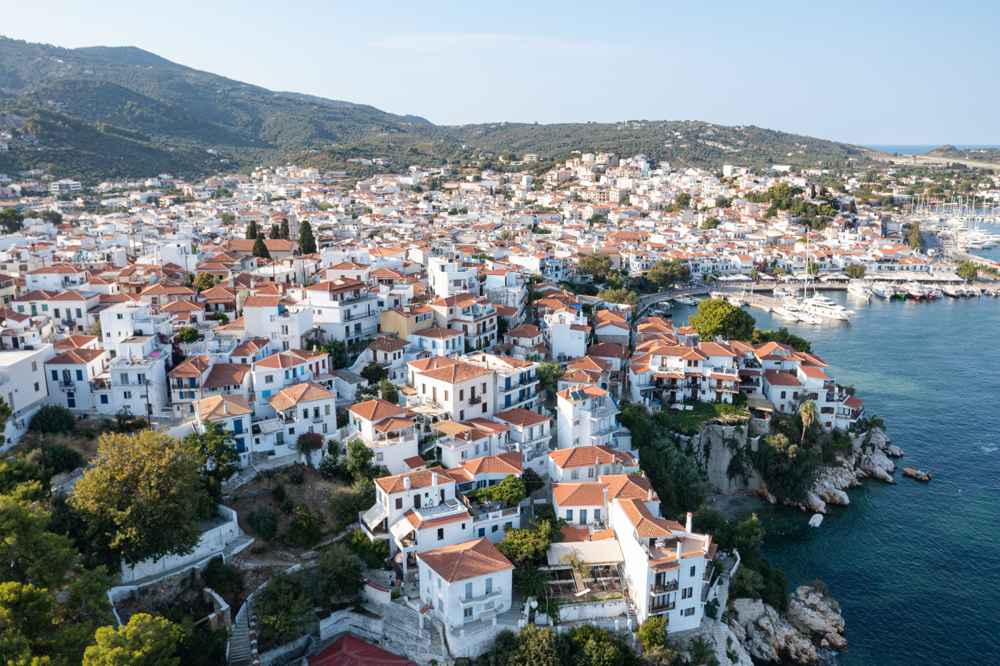
Skiathos Town holds about two thirds of the island’s population on a low double-sided promontory facing Skopelos. The new port on the eastern side receives the ferries and hydrofoils, while the old port on the western side shelters the excursion boats, water taxis and fishing caiques under a line of tavernas. Whitewashed houses with red-tiled roofs and wooden balconies stack up the two low hills behind the waterfront. A rebuild on the site of the ancient city after the population came down from the Kastro. Papadiamantis Street, the pedestrian spine, runs inland from the ferry quay past bakeries, jewellers, travel kiosks and gelato counters.
Walking the full town from end to end takes about 20 minutes, and every lane eventually drains back to the water.
The Bourtzi divides the two harbours: a pine-covered islet joined to the waterfront by a short stone causeway, fortified by Venetian rulers as the town’s strongpoint. Ruined walls and a pair of cannons survive around the perimeter path, and a cultural centre in the old school building hosts exhibitions, concerts and theatre on summer evenings. Benches under the pines give the best free view on the island: ferries swinging into the new port on one side. The excursion fleet loading on the other. The Kastro-bound coast beyond. Swimmers use the small concrete platforms at the islet’s tip through the afternoon.
Sunset turns the Bourtzi into the town’s gathering point, with the lighthouse of Repi islet blinking across the strait towards Skopelos. Concerts start after sunset in July.
The Papadiamantis House museum preserves the small two-storey home where Alexandros Papadiamantis, Greece’s most translated short-story writer, was born and later died. The rooms keep his desk, his bed, manuscripts, icons and household objects exactly as the family left them, and the entry fee stays token-level. The museum sits in a small square one block off the main street, marked by the writer’s bust. Uphill from there, the church of Agios Nikolaos and its clock tower crown the western hill. The terrace beside it delivers the postcard panorama over the roofs, both ports and the Bourtzi.
The parallel lanes of the old quarter around Tris Ierarches church reward unplanned wandering, with courtyards of bougainvillea and marble fountains appearing every 50 metres. Photographers reach the terrace before 9:00 for clear light.
Evenings belong to the old port and the lanes above it. Tavernas along the quay grill the day’s catch beside the moored caiques. Ouzeri tables spill onto the cobbles at Plakes on the headland. Cocktail bars stack up the steps between Papadiamantis Street and the clock tower. The club strip concentrates at the new port’s far end, which keeps the old quarter quiet after midnight. Bakeries open before 7:00 for cheese pies and bougatsa, feeding the queue for the morning excursion boats. Shopping peaks between 18:00 and 22:00, when the heat drops and the whole town walks the harbourfront loop.
A full town day — museum, Bourtzi, hill viewpoint, market lanes and a waterfront dinner — costs less than any organised excursion on the island. Cash still rules at the smaller kiosks.
Above the town, a Skiathos wine tasting at the family winery pairs a vineyard walk and Greek grape varieties with local bites and a view over the harbour.
Why is the Evangelistria Monastery in Skiathos famous?
The Evangelistria Monastery is famous as the place where an early Greek flag was woven and raised on its loom; the working monastery, about 4 km north of Skiathos Town, opens its katholikon, museum and shop to visitors daily.
Evangelistria stands in a wooded fold of Skiathos’ interior, about 4 km north of the town on the slopes below the island’s highest ridge. Monks from the Kollyvades movement of Mount Athos founded the monastery and built its triple-domed katholikon in the Athonite pattern. Ringed by cells, storerooms and a walled courtyard shaded by a giant plane tree. Greek fighters and revolutionaries sheltered here in the era before independence. On the monastery’s loom an early flag of Greece. The white cross on a sky-blue field. Was woven and then raised and blessed in the courtyard.
Oaths were sworn on that flag by captains whose names now mark streets across the country, which anchors the monastery in every account of the national story. Entry to the walled courtyard stays free.
The visit centres on the katholikon and the museum around the courtyard. The church keeps smoke-darkened frescoes, a carved wooden iconostasis and silver-cased icons under its three domes. Entry follows monastery dress rules: covered shoulders and knees, with wraps loaned at the gate. The museum rooms display manuscripts, Byzantine icons, vestments, weapons from the revolutionary era and the loom associated with the flag, spread across a gallery above the old refectory. A terrace beyond the walls looks down the valley to Skiathos Town and the sea, with Skopelos on the horizon. The monastery stays a working religious house, so visiting hours pause for services; mornings before 13:00 and late afternoons run most reliably through the summer.
Photography stays banned inside the katholikon, and silence rules apply throughout.
The monastery funds itself partly from its land. The shop beside the gate sells the results: wine from the monastery’s own vineyard. Olive oil, honey, herbs and preserves produced on the estate, beside icons and books. Tasting the monastery wine at source has become a fixed stop on island tours, and the vineyard rows on the approach road signal the tradition. Prices stay posted at the counter, and the shop takes cards. Water from the courtyard fountain runs cold from the ridge springs all summer. The plane-shaded benches make the monastery the natural cool-hour pause between a town morning and a north-coast afternoon. The whole visit. Church. Museum, terrace and shop. Fits inside 90 minutes without hurry.
Beeswax candles from the estate fill the shelves.
Reaching Evangelistria takes about 10 minutes by car or scooter on the surfaced road that climbs from the ring road behind the town. Taxis run the hop on a fixed short-distance rate. Walkers cover it in about an hour on the signed uphill path through olive terraces. The monastery also anchors the island’s best-known hike, the marked trail that continues north over the ridge to the Kastro in about two and a half hours. Two more religious sites extend the theme across the island: Panagia Kounistra, the protector-icon monastery above Troulos on the west side, and the abandoned Kechria monastery in the northern valleys.
Combining Evangelistria with the Kastro road and a Kastro-beach swim builds the strongest inland day Skiathos offers. The road stays surfaced the whole way.
Where do you watch the plane landings in Skiathos?
Plane spotters gather on the public road at the western threshold of Skiathos airport’s runway, between the ring road and Xanemos beach, where landing aircraft cross about 10 to 15 metres overhead on final approach.
Skiathos airport, named Alexandros Papadiamantis after the island’s writer, squeezes a runway of about 1,600 metres onto a strip of reclaimed land between two bays just north of the town. The short runway forces arriving aircraft to aim at the very start of the asphalt. Which puts them about 10 to 15 metres above the public road that crosses the western threshold. Spectators standing on that road watch airliners fill the sky overhead, close enough to read panel lines. An experience aviation media rank alongside the famous beach approach at St Maarten in the Caribbean.
The spectacle costs nothing, needs no ticket and sits a 20-minute walk from the harbourfront, which makes it the island’s most unusual free attraction. Crosswinds off the ridge add visible crab-angle corrections on approach.
The threshold road delivers the classic head-on view, with arrivals from the west descending over the strait against the backdrop of the Lazareta islets. Xanemos beach at the runway’s far north-eastern end offers the alternative angle: departures roll towards the sea and rotate directly over the sand. Arrivals cluster around late morning and early afternoon in summer, when charter waves from northern Europe stack up. A glance at any flight-tracking app the evening before maps the next day’s busiest window. Photographers favour the low sun after 17:00, when landing lights read against the sky. The nearby fence line carries painted aircraft silhouettes and tallies left by visiting spotters, a running logbook of the scene.
Weekends bring the heaviest traffic, with rotations landing 15 minutes apart at the peak of the charter wave.
Jet blast defines the safety rules. Signs along the fence warn that departing aircraft running up their engines throw stones. Sand and hot exhaust across the road. The police close the strip behind a departing jet’s tail for exactly that reason. Spotters keep hats, phones and sunglasses gripped during run-ups, stand clear of the fence when an aircraft lines up, and never lean bicycles or scooters against the perimeter. Families keep children on the inland side of the road. The excitement stays entirely legal. The road is public and watching is welcomed. But the blast is strong enough to knock an adult off balance at close range. The painted warning lines deserve literal reading.
Ear protection helps young children during the loudest run-ups.
Flight-watching connects directly to trip planning, because the same short runway shapes how to get to Skiathos in the first place. Seasonal charters and scheduled flights arrive from dozens of European cities through the summer, and domestic flights link Athens in about 40 minutes. Ferries and hydrofoils from Volos and Agios Konstantinos on the mainland supply the sea route, docking at the new port about 2 km from the runway threshold. Travellers with an afternoon departure use the spotting road as a final stop: a swim at Xanemos, an hour at the fence, then a five-minute transfer to the terminal.
Window seats on the left side of arriving aircraft frame the Kastro cliffs and Lalaria’s coast seconds before touchdown. Hydrofoils cut the Volos crossing to about 90 minutes.
Which hiking trails cross Skiathos?
Skiathos maintains about 25 marked and numbered hiking trails through pine forest, olive terraces and the northern cliffs; the signature route links the Evangelistria Monastery to the Kastro in about two and a half hours.
Skiathos hides a serious walking network behind its beach reputation: about 25 marked and numbered trails thread the interior, signed at junctions and mapped on boards at the main trailheads. Aleppo pine covers roughly half the island. The paths run in shade for long stretches. Over a terrain that tops out around 430 metres at the central ridge. High enough for views across both coasts yet low enough that no climb takes more than two hours. Old mule paths, called kalderimia, supply the stone-paved backbone of the network, linking the town, the monasteries, the inland chapels and the northern coves that buses never reach.
Spring and autumn deliver the best walking weather, with wildflowers in April and May and sea temperatures still warm through October.
The signature walk runs from the Evangelistria Monastery over the ridge to the Kastro. About two and a half hours one way through oak woodland, olive terraces and open cliff-top scrub. Walkers time it to arrive before midday, swim below the ruins at Kastro beach, and either retrace the path or descend to the parking track where a pre-arranged taxi waits. A second classic drops from the ridge into the Kechria valley, past the abandoned Kechria monastery with its frescoed chapel, ending at Kechria beach on the north shore. The full traverse from town to Kastro and back covers about 15 km and fills a day. Boot-level footwear handles every route; the stone paving turns slick after rain.
Waymarks repaint each spring, so the route reads clearly underfoot.
Shorter loops suit beach-day mornings. The Strofilia lagoon circuit behind Koukounaries covers about 3 km of flat boardwalk and forest track, with heron and egret sightings at the reed edges before the beach crowds arrive. The Agia Eleni headland path links four west-end beaches in under an hour. Above the town, the signed climb to the Profitis Ilias viewpoint takes about 45 minutes and frames the harbour. The Bourtzi and Skopelos beyond. The standard sunset walk for town-based visitors. Trail-running has grown on the same network, and the island hosts an organised trail race each year on the monastery-Kastro line. Paper maps sell at kiosks on Papadiamantis Street; the trail boards carry QR codes for the digital version.
The lagoon loop stays flat enough for pushchairs and bicycles.
Preparation stays simple but non-negotiable. Summer walkers start before 8:30 or after 17:00. Carry at least 1.5 litres of water per person. Treat the shadeless cliff sections above the north coast with respect in July heat. Phone coverage holds on the ridge lines and fades in the Kechria valley, so a downloaded offline map covers the gaps. Long trousers beat shorts on the overgrown late-season paths, where the scrub scratches. Wild tortoises, buzzards and the island’s semi-wild goats supply the wildlife sightings; none pose any danger. Every trail ends within reach of a swim, which sets the rhythm of a Skiathos hiking day: climb in the cool. Descend to a cove.
Ride the bus or a taxi boat home. A basic first-aid kit rounds out the daypack.
Which day trips run from Skiathos?
Day trips from Skiathos cover the 30-minute taxi-boat crossing to Tsougria islet, ferries to Skopelos in about 45 to 60 minutes, round-island cruises past Lalaria, and full-day sails into the Alonnisos marine park.
Tsougria islet floats directly opposite Skiathos Town, an uninhabited green hump about 30 minutes away by the taxi boats that shuttle from the old port through the morning. Two sandy beaches face the town side: the main strand with a seasonal taverna and loungers, and a second, emptier cove a 10-minute walk over the headland. The water between the islet and Skiathos stays calm even on meltemi days, because Tsougria sits in the island’s wind shadow. Which is exactly why captains divert here when the north coast blows out. Snorkelling along the rocky points turns up octopus and shoals of saddled bream.
Boats return on a posted rota until early evening, so visitors set their own length of stay. The islet keeps no roads, cars or permanent residents.
Skopelos, the next Sporades island east, sits about 45 to 60 minutes away by ferry and hydrofoil, with multiple daily departures from the new port in season. Day-trippers choose between two calls: Glossa, the hillside village above Loutraki port at the island’s western end. Skopelos Town, the amphitheatre of slate-roofed houses around its own harbour further along. Skopelos Town rewards a full day — the castro quarter, the folklore museum lanes, waterfront tavernas and the church-topped rock of Panagitsa tis Pyrgou. Organised excursions add the island’s film-famous spots by coach or boat.
Buying the return leg at the ticket office on arrival keeps the day flexible, and the last boats back to Skiathos leave in the early evening through high season. Crossings stay calmest before the afternoon wind.
Full-day cruises push further east into the National Marine Park of Alonnisos and the Northern Sporades. The largest protected marine area in Europe and the stronghold of the Mediterranean monk seal. Boats out of Skiathos run past Skopelos’ north shore, circle the deserted islets of Kyra Panagia or Peristera. Anchor in coves reachable no other way. Post a lookout for dolphins that ride the bow wake in the open channel. Sightings of striped and common dolphins happen on a large share of summer crossings; seals show themselves more rarely, hauled out in shaded caves.
The trips run about eight hours with lunch served aboard, and calm-sea days in June and September give the highest chance of glassy water in the park’s anchorages. Binoculars sharpen every sighting on deck.
Choosing between staying put and crossing over raises the classic Sporades question, answered in full in the Skopelos vs Skiathos comparison: Skiathos wins on beaches, flights and organised activities, while Skopelos wins on unspoiled villages and quiet. A day trip settles the debate cheaply. Travellers who fall for Skopelos Town’s lanes book two nights there on a later visit. The ferry link makes the two-island combination the standard ten-day Sporades itinerary. Mainland day options exist too: the Pelion peninsula’s mountain villages via Volos-bound morning boats work for travellers on longer stays. Every option departs and returns inside daylight, so no day trip from Skiathos costs a hotel night.
Tickets for the crossing sell at the new-port offices and online, and the hydrofoil timetable posts at the quay each week.
Where was Mamma Mia! filmed in Skiathos?
Mamma Mia!’s harbour and town scenes were filmed around Skiathos’ old port and the waterfront by the Bourtzi, while the wedding chapel and the main beach scenes belong to neighbouring Skopelos, reachable on film-themed day cruises.
The production based itself in the Sporades and used Skiathos Town’s old port for the film’s harbour sequences: the crowded quay. The ferry-chase energy and the waterfront tavernas all read on screen exactly as they stand today. The stone jetty where excursion caiques tie up, the fish stalls and the lanes climbing off the harbour appear in the arrival scenes. The cast and crew lodged on Skiathos through the shoot. Which planted the island firmly in the film’s mythology. Walking the old port with the soundtrack in mind takes 15 minutes and costs nothing. The working boats. Nets and morning fish auction remain the same scenery the cameras framed, with no set dressing ever needed.
Guides point out the exact quay angles used in the arrival sequence.
A self-guided circuit covers the town locations in about an hour. Starting at the old port quay, the route passes the taverna line where dock scenes were staged, crosses the causeway onto the Bourtzi for the harbour-wide backdrop shot. Then climbs through the lanes towards the clock tower of Agios Nikolaos, whose terrace frames the same panorama the aerial shots use. Photo stops line up naturally: caiques against whitewashed facades at the west quay, the Bourtzi pines over the strait, and the amphitheatre of red roofs from the tower. Morning light before 10:00 favours the harbour shots; evening light favours the hill.
Kiosks along Papadiamantis Street sell maps that mark each spot for fans who want the full checklist. The full loop stays flat apart from the tower climb.
The postcard chapel on the rock. Agios Ioannis at Kastri, scene of the wedding. Stands on Skopelos, not Skiathos. At the eastern end of the neighbouring island. Kastani beach on Skopelos’ west coast hosted the dance numbers. Day trips from Skiathos reach both: coach-and-boat excursions cross to Loutraki, climb the 100-plus rock-cut steps to the chapel, and add a Kastani swim before returning in the evening. The two-island split surprises visitors who expect every scene within walking distance, yet it works in the itinerary’s favour, turning the film trail into a full Sporades day. Independent travellers replicate the tour with a scheduled ferry and a Skopelos taxi at lower cost, trading commentary for flexibility.
The chapel terrace overlooks the strait back towards the Sporades chain.
Film tourism has settled into the island’s rhythm rather than overwhelming it. Skippered day sails brand themselves around the soundtrack. Waterfront bars schedule singalong screenings in early summer. The town leans into the association without a single permanent film set or museum. The locations simply continue their working lives. The effect on visitors is practical: the film supplies a ready-made sightseeing structure that strings together the old port. The Bourtzi, the hill viewpoint and a Skopelos crossing, which happens to match the best non-beach day Skiathos offers anyway. Fans arrive for the fiction and leave having covered the real island’s core, from the fishing quay at dawn to the chapel rock across the strait by afternoon.
The association shows no sign of fading from the island’s brand.
Frequently Asked Questions
How long do you need in Skiathos?
Four to five days cover Skiathos’ core without rushing. Day one belongs to Skiathos Town and the Bourtzi, with the Papadiamantis House and an old-port dinner. Day two takes the bus down the south coast for Koukounaries, Banana and Agia Eleni. Day three goes to sea: the round-island boat to the Kastro, the three caves and Lalaria. Day four climbs inland to the Evangelistria Monastery and, for walkers, continues on the marked trail to the Kastro ruins. Day five crosses to Skopelos or Tsougria islet. Travellers with only a weekend compress this to town plus one beach day and the Lalaria boat, which captures the island’s three signature settings.
Stays of a week add the Aselinos and Mandraki beaches on the wild north-west, a marine-park cruise towards Alonnisos and repeat visits to whichever south-coast bay won the first round. Beach-focused visitors stretch any of these plans indefinitely; the sightseeing core itself never demands more than five days.
Is Skiathos good for families with children?
Skiathos suits families better than almost any Greek island of its size. The south-coast beaches shelve gently. Children wade 30 metres at Koukounaries and Troulos before the water reaches chest height. And organised strands keep lifeguards. Toilets, shade and tavernas within 100 metres of the towels. The single bus line with numbered stops removes the need for a hire car on beach days, and the flat harbourfront of Skiathos Town handles pushchairs without trouble. Activity options scale with age: pedalos and tube rides for younger children. Wakeboard lessons and the Lalaria boat for teenagers. The plane-spotting road, which works for every age on the island.
Boat crossings stay short — 30 minutes to Tsougria, about an hour to Skopelos — so seasickness rarely gets a chance to develop. Tavernas cook simple grilled dishes and pasta everywhere, high chairs appear on request, and pharmacies in the town stock the full family basics. June and September offer warm water with thinner crowds and cooler pavement temperatures for small children.
What is the best time of year to visit Skiathos?
Late May through early October frames the practical season, and June and September stand out as the best value inside it. June brings water around 23 degrees, functioning beach facilities, full boat schedules and rooms below peak rates, with the pine interior still green from spring. September matches it with warmer sea — around 24 to 25 degrees after the summer’s heating — plus emptier sand and lighter winds for the Lalaria crossing. July and August deliver guaranteed heat around 30 degrees and the complete programme of excursions and nightlife. At the cost of the year’s highest prices, the busiest beaches and the strongest meltemi afternoons on the north coast.
May suits walkers: wildflowers on the 25 trails, mild temperatures and a quiet town, though the sea stays fresh at about 19 to 20 degrees. October narrows the boat schedules week by week while the water holds warmth longer than the air. The airport’s charter network follows the same curve, thickening from late May and thinning after the first October week.
Can you explore Skiathos without a car?
Skiathos works without a car more completely than nearly any Greek island. The bus line from Skiathos Town to Koukounaries runs the full south coast with stops numbered roughly 1 to 26. Departures every 15 to 30 minutes in high season. It serves practically every organised beach, hotel strip and taverna cluster on that shore. Boats fill the gaps the road ignores: water taxis and excursion caiques from the old port reach Lalaria. The Kastro, Tsougria and the west-coast coves, while ferries at the new port handle Skopelos. Taxis queue at the new port for the short hops the bus misses, including the Evangelistria Monastery at about 10 minutes from town.
Walkers add the trail network — the monastery, the Kastro and the Profitis Ilias viewpoint all connect to town on marked paths. A car earns its cost only for the north-west dirt tracks to Megas Aselinos. Mikros Aselinos and Kechria. One rental day covers all three. The remaining week runs happily on bus, boat and foot.
Is the boat trip to Lalaria beach worth it?
The Lalaria boat trip earns its place as the single most memorable outing on Skiathos. No road reaches the beach, so the white marble pebbles, the turquoise shallows and the Trypia Petra arch stay exactly as nature arranged them. No sunbeds, no bars, no buildings. The standard round-island itinerary multiplies the value: three sea caves on the way, a landing below the Kastro ruins. About 90 minutes on the pebbles and a deck lunch on the longer sailings, all inside one ticket bought at the old-port kiosks on the morning of travel. The trade-offs stay manageable. The beach offers zero shade after mid-morning. The pebbles demand swim shoes. A strong meltemi cancels the crossing outright.
The trip belongs early in the holiday week, not on the final day. Photographers get the peak turquoise between 11:00 and 14:00, exactly when the boats anchor. Weighed against every organised excursion on the island, the round-island day delivers the most scenery per hour.
What is the nightlife like in Skiathos?
Skiathos runs the liveliest nightlife in the Sporades, concentrated in Skiathos Town and split into three zones by volume. The old port keeps the gentle end: quayside tavernas, wine bars and ouzeri tables at Plakes on the headland, where evenings stretch on grilled fish and local white wine. The lanes between Papadiamantis Street and the clock tower hold the cocktail-bar layer, with terraces filling from 21:00 and music at conversation level. The club strip sits at the far end of the new port. Where dance venues run until dawn in July and August. Far enough from the old quarter that families and clubbers never collide.
Beach parties add a daytime tier, led by the bar scene at Vromolimnos and full-moon events at the larger south-coast strands. Outside the town, resort areas like Troulos and Kolios stay at taverna-and-lounge level. Dinner at 21:30, bars at 23:00 and clubs after 1:00 set the local clock, and the first morning excursion boats leave no allowance for it.
Can you combine Skiathos and Skopelos in one trip?
Combining the two islands works effortlessly, because ferries and hydrofoils cross between them in about 45 to 60 minutes with departures each day in season. The standard split gives Skiathos the front half of the trip. Flights land there. The beaches. Boat trips and nightlife reward the arrival energy. Then moves to Skopelos for slate roofs, quiet coves and the slower second half. A ten-day itinerary settles into five nights on each; a one-week trip works as four and three. Luggage transfers stay painless: both ports sit in the middle of their main towns, and accommodation on each side arranges pick-ups.
Day-trip sampling comes first for the undecided — a morning crossing to Skopelos Town, the castro quarter and a waterfront lunch reveal whether the second island deserves its own nights. Tickets buy on the day at both ports outside August; in August, booking a day ahead removes the only real risk. The pairing turns two small islands into one full Sporades holiday.