
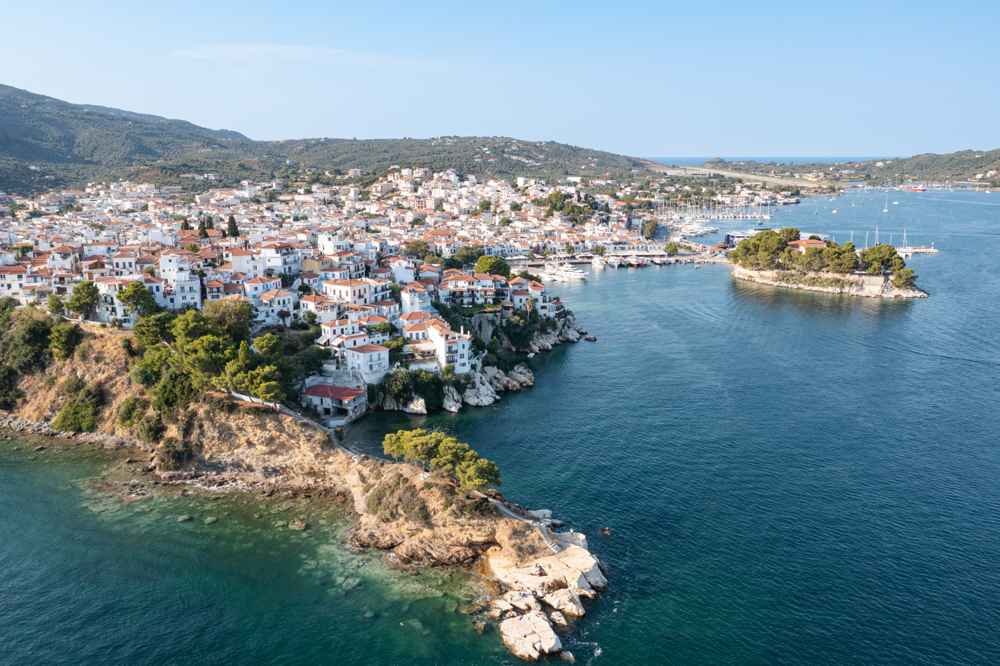
Skiathos packs more than 60 beaches into a coastline of roughly 44 km, a density no other Sporades island matches. The south coast lines up sand, pine forest and numbered bus stops, while the north coast hides pebble coves reached by boat, dirt track or footpath. This guide sorts every stretch worth your towel. Plan the whole trip with Greece Tours.
Koukounaries anchors the south with its pine forest and Strofilia lagoon, Lalaria crowns the north with white pebbles and a rock arch, and 60-plus coves fill the gaps between them. Each section below covers access by bus, boat or car, sunbed coverage, water sports and which beaches suit families.
Which are the best beaches in Skiathos?
Koukounaries, Lalaria, Banana, Vromolimnos and Agia Eleni rank as the five strongest beaches on Skiathos.
The island of Skiathos measures about 48 square kilometres, yet its shoreline folds into more than 60 distinct beaches. The south coast faces the calm Aegean channel toward Evia and collects fine sand, shallow entries and organised facilities along a single coastal road. The north coast faces open water toward the Pelion peninsula and Mount Athos, so waves sculpt pebble coves beneath cliffs and pine slopes. This split defines every beach decision on the island: sand, sunbeds and bus access sit south, while solitude, pebbles and dramatic geology sit north. Koukounaries, the flagship, occupies the far south-western corner about 12 km from Skiathos Town, and Lalaria, its wild counterpart, hides on the north-eastern tip reachable only by sea.
Between the two extremes, about 20 named coves reward exploration by rental boat.
The organised south coast runs about 12 km from Megali Ammos, within walking distance of town, to Koukounaries at the road’s end. Achladies, Vassilias, Kanapitsa, Vromolimnos, Agia Paraskevi, Troulos and Maratha line the route in sequence, each signposted from the coastal road and served by the island bus. Sunbeds, tavernas and water-sports counters repeat at almost every stop, and the shallow, sheltered water faces away from the summer meltemi wind. Families dominate the sand here from late morning onward. Hotel zones sit behind Achladies, Agia Paraskevi and Troulos, which keeps these three busy through the season. Beach quality rises steadily westward, peaking at the Koukounaries, Banana and Agia Eleni cluster around the island’s south-western corner.
Bus stop numbers climb westward, ending at the Koukounaries terminus around stop 26.
The wild north coast answers with pebbles, cliffs and open horizons. Lalaria leads the list, its white pebbles and rock arch reachable only by excursion boat from the old port. Kastro beach spreads below the abandoned medieval settlement on the northern cliffs, with a seasonal canteen and a footpath descent. Megas and Mikros Aselinos take a dirt road through pine forest near the Kounistra monastery turn-off. Mandraki and Elia demand a 25-minute walk through dunes and pines from the nearest parking. Waves run higher here on meltemi days, and sunbeds thin out to one or two rows or nothing at all. The reward is space: even mid-August leaves open sand on the north shore.
Kechria and Ligaries extend the same wild pattern toward the island’s north-east.
Vromolimnos, Agia Eleni and Banana complete the top tier, each within 15 km of town on the south coast. Vromolimnos combines soft sand with a beach-bar scene and waterskiing, and its west-facing aspect delivers long sunsets over the Kanapitsa peninsula. Agia Eleni, the last stop on the western road, faces Pelion across the strait and holds calm water on north-wind days. Banana and its smaller neighbour Little Banana sit over the ridge behind Koukounaries; the main cove runs organised while the smaller one remains a naturist stronghold. Together these five cover the full spectrum, from family logistics to secluded swimming, within a bus-and-boat network that needs no rental car.
Boat-rental bases at the old port extend the same list with Tsougria islet, whose two sandy coves face Skiathos Town from about 3 km offshore.
What makes Koukounaries beach special on Skiathos?
Koukounaries combines a 1,200-metre arc of fine golden sand with a protected stone-pine forest and the Strofilia lagoon nature reserve directly behind it. No other Sporades beach pairs forest, wetland and swimmable sand this way.
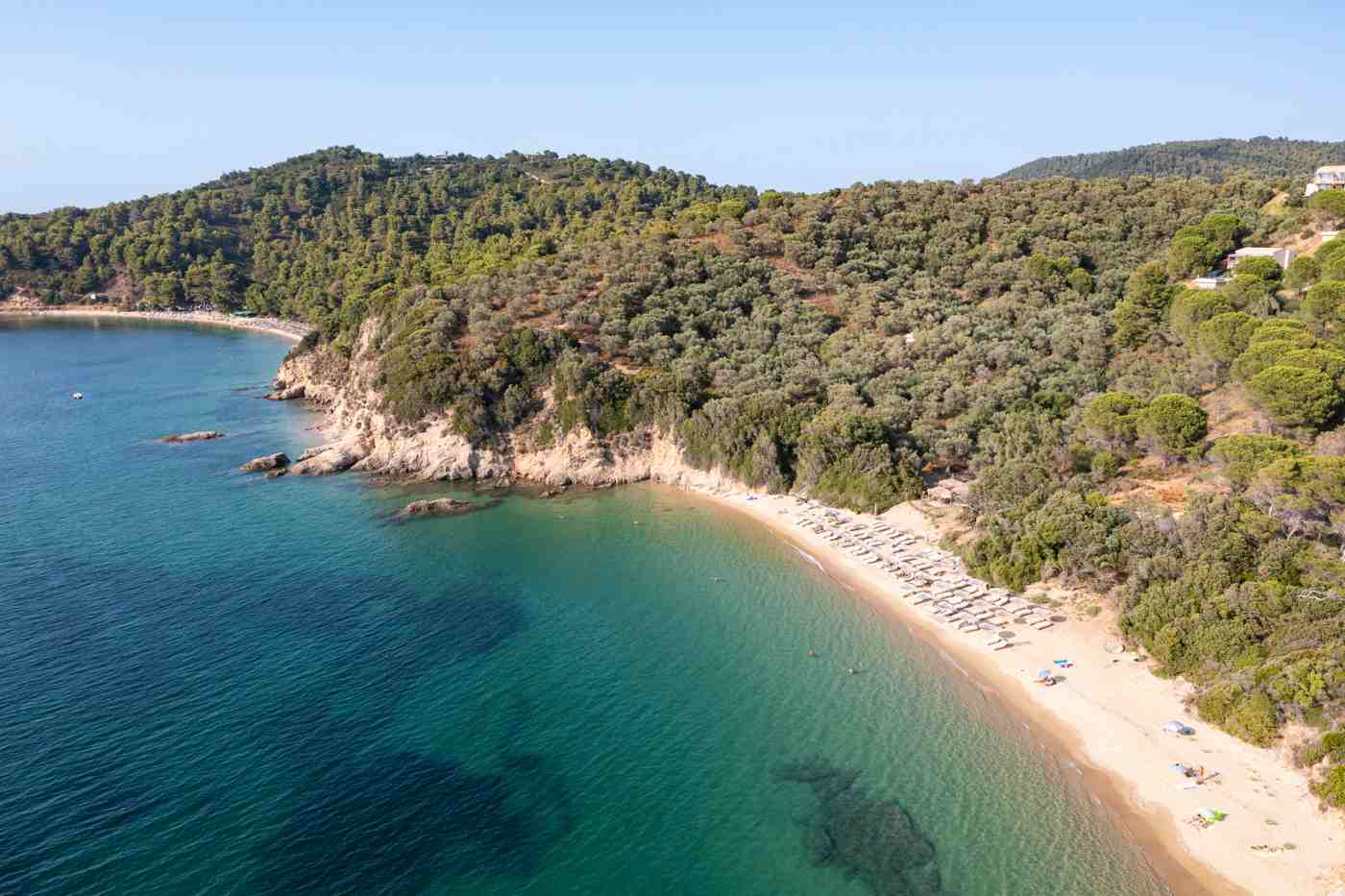
The stone pines of Koukounaries give the beach its name. From the Greek word for pine cones. The grove counts among the last coastal pine forests of its kind in Greece. Strofilia lagoon spreads behind the trees, linked to the sea by a narrow channel, and the whole wetland carries protected-biotope status. Herons, egrets, moorhens and migrating ducks feed along its reedbeds, and a flat walking path circles the water in about 40 minutes. Signposted trails cut through the pines from the lagoon to the sand in under five minutes. The protection rules keep buildings off the beachfront itself, so the tree line, not concrete, forms the backdrop along the full 1,200-metre arc of sand.
The lagoon water stays brackish, a mix of spring inflow and sea seepage.
Facilities concentrate at the two entrances rather than on the sand. A car park, mini-market and taverna cluster stand at the eastern access by the lagoon channel. The island bus turns around at its final stop beside them. About 30 minutes from Skiathos Town. Sunbed-and-umbrella concessions run in organised rows along the central section, while the far western end stays free for towels. Canteens on the walkways sell cold drinks, ice cream and snacks through the day. Showers and changing cabins operate behind the main rows in season. Water-sports counters at mid-beach rent pedal boats and stand-up paddleboards and run tube rides when the channel stays calm.
Wooden walkways keep bare feet off the hot midday sand between the pines and the loungers. Parasols rent separately from loungers at the western fringe.
Swimming at Koukounaries stays comfortable for all ages because the seabed drops gently over firm pale sand. The bay faces south-east, sheltered from the prevailing summer meltemi, so surface chop rarely builds beyond ripples. Water clarity peaks in the morning before boat traffic and swimmers stir the shallows. The central section fills first in July and August; the western third keeps open sand until early afternoon. Snorkellers find the best visibility off the rocky points that close each end of the crescent. Lifeguard towers operate through the core season on the busiest stretch, a coverage level matched on the island only at the largest organised beaches.
Morning visits before 10:00 pair empty loungers with the clearest water of the day. Water shoes stay unnecessary on the stone-free seabed.
The surrounding corner multiplies the day’s options within walking distance. Banana and Little Banana wait about 10-12 minutes over the ridge from the bus terminus. Agia Eleni’s west-facing sand sits about 15 minutes along the road’s final arm. The Strofilia lagoon loop behind the pines fills a shadeless hour with birdlife and flat walking. Maratha, the smaller pocket east of the main bay, absorbs overflow with lighter facilities. Hotel and studio zones spread inland from the lagoon, keeping the beachfront building-free under the reserve rules. One base at this corner covers five beaches, a forest, a wetland and the sunset without touching the bus twice.
Evening buses back to town run past midnight in the core season, so sunset at Agia Eleni needs no rental car.
How do you reach Lalaria beach on Skiathos?
Boats provide the only access to Lalaria. Excursion caiques and licensed taxi-boats leave the old port of Skiathos Town each morning in season, taking about 40 minutes along the east coast; no road or footpath reaches the beach.
Departures cluster at the old port between about 09:30 and 11:00, with wooden caiques running fixed round-island or half-day itineraries and smaller taxi-boats selling direct returns. Ticket kiosks line the waterfront, and boards list the day’s route, which almost always pairs Lalaria with a photo stop or swim at the Kastro peninsula. Round-island trips fold the beach into a full day of things to do in Skiathos, adding Tsougria islet and a taverna lunch stop. Direct taxi-boats allot about 60-90 minutes on the pebbles before the return leg. Seats sell out by mid-morning in July and August, so booking the previous evening secures the boat you want.
The ride out passes the airport runway at Xanemos and the east-coast cliffs before the arch comes into view.
Three sea caves punctuate the voyage north. Skotini, the dark cave, admits boats through a narrow cleft into a chamber lit by one shaft of light. Galazia Spilia, the blue cave, glows turquoise at its mouth, and Halkini Spilia, the copper cave, carries streaks of mineral colour. Captains slow or enter where sea conditions allow, and confident swimmers jump off at Galazia on calm days. The caves line the cliffs between Kastro and Lalaria, so the sequence arrives in the final third of the outbound leg. Commentary on the larger caiques runs in English and Greek.
Smaller taxi-boats skip the caves on windy days and head straight for the pebbles, trimming the trip to about 40 minutes each way. Life jackets sit under the benches on every licensed boat.
Lalaria itself offers nothing built: no sunbeds, no canteen, no shade beyond the cliff shadow in late afternoon. Visitors carry water, a hat and reef shoes, because the white pebbles heat up by midday and shift underfoot at the waterline. The sea floor drops quickly, giving the water its saturated turquoise but ruling the beach out for weak swimmers on swell days. The rock arch, Trypia Petra, stands at the southern end and frames the classic photograph. Pebble-stacking and pebble-taking are banned, with signs quoting fines, after erosion thinned the shoreline. The stop lasts about an hour on most itineraries, enough for a swim, the arch and the photographs.
Morning light hits the arch face-on; afternoon light silhouettes it. Snorkelling stays rewarding along the base of the arch.
Private rental boats give the only flexible alternative to the caiques. Licence-free models with about 30-horsepower engines rent from the new port and reach Lalaria in about 50 minutes when the sea stays flat. The trip runs exposed to the meltemi, the dry northern summer wind, and rental bases refuse north-coast routes once gusts pass their safety threshold. Caique captains make the same call each dawn, and cancelled departures roll tickets to the next day. Early July and September deliver the calmest averages; strong-wind cancellations cluster in late July and August afternoons. Travellers on tight schedules book Lalaria for their first full day, keeping a spare day for a weather rerun.
Checking the marine forecast the evening before saves a wasted walk to the port.
Which Skiathos beaches sit closest to Skiathos Town?
Megali Ammos starts about a 10-minute walk south-west of Skiathos Town. Vassilias follows at about 2 km, Achladies at about 4 km and Tzaneria on the Kanapitsa peninsula at about 6 km, all on the bus route.
Megali Ammos translates as big sand, and the beach delivers exactly that: a long strip beginning where the town’s ring road ends. Hotels and studios line the slope behind it, so the sand fills early with guests who never board a bus. Sunbeds run in continuous rows, and beach bars mix the strongest daytime scene this close to town. The water entry stays shallow for about 20 metres, making it a reliable choice for a first-evening swim after arrival. Traffic noise from the coastal road reaches the back rows, the price of the location. Walkers reach it from the old port in about 10-15 minutes along the waterfront.
Umbrella gaps at the far western end leave room for towels. The beach faces south-east, so morning water stays glassy before the breeze.
Vassilias sits about 2 km from town, down a signposted lane off the coastal road. Pine trees reach the back of the sand, throwing natural shade that thickens toward the eastern end. The beach splits informally: sunbed concessions and a taverna hold the centre, while the fringes stay free. Sand mixes with fine pebbles at the waterline, and the seabed keeps a gentle gradient for about 30 metres out. Crowds run lighter than Megali Ammos because the walk from town stretches beyond most guests’ patience. Bus passengers step off at the Vassilias stop and reach the water in about five minutes downhill. Morning sun clears the ridge by about 09:00.
Kayak rentals appear at the taverna end in peak weeks. The lane in doubles as free parking for early arrivals.
Achladies spreads below a dense hotel zone about 4 km from town, and its long sandy front absorbs the guest volume without feeling packed on weekdays. The bay curves south-east, sheltered from the meltemi, so the water surface stays among the calmest on the island. Tavernas anchor both ends, and sunbed rows alternate with free sand in the middle. Families rate the beach for its long shallow shelf and the bus stop directly on the main road above. A small jetty serves summer taxi-boats from the old port, a 15-minute ride that beats the bus at midday. Beach walkers continue east over a low headland to quieter coves. Sunset drops behind the Kanapitsa ridge early here.
Supermarkets in the hotel zone above cover beach kit and picnic supplies.
Tzaneria occupies the near side of the Kanapitsa peninsula about 6 km from town, ringed by pines and summer villas. The cove stays compact, so sunbeds fill it edge to edge by late morning in August. A diving centre operates from the beach, running boat dives to reefs and walls around the peninsula and try-dives in the sheltered bay. Kanapitsa beach proper lies one bay further, wider and backed by a taverna, with waterskiing and wakeboard boats working the flat morning water. Both face south-east into the calm channel, and both take the bus to the Kanapitsa junction followed by a downhill walk of about 10 minutes. Taxi-boats from town also call at both jetties in season.
Villas keep the peninsula leafy, so shade survives behind the sunbed rows.
Which Skiathos beaches suit families with children?
Troulos, Agia Eleni, Koukounaries and Achladies serve families best on Skiathos. All four pair shallow, gradual sea entries with sunbeds, tavernas within about 100 metres and direct stops on the south-coast bus line.
Troulos sits mid-way along the south coast, about 8 km from town, where a river valley opens onto a wide sandy bay. The seabed shelves so gradually that children stand chest-deep about 40 metres out on calm days. A rocky islet in the bay gives older kids a swim target and snorkelling spot. Tavernas and mini-markets cluster at the road junction directly behind the sand, cutting the gear-hauling distance to a two-minute walk. Sunbeds cover the central strip; the river end keeps free space. The bus stops at the junction, and the Aselinos dirt road branches inland here, making Troulos the natural base for mixing organised and wild days.
Shade trees behind the back row shelter pushchairs and midday naps. Waves stay minimal because two headlands pinch the bay’s mouth.
Agia Eleni closes the paved road at the island’s western tip, about 1 km past the Koukounaries junction. The beach faces west toward the Pelion peninsula, so the meltemi passes over the ridge and leaves the water flat when north-coast beaches churn. Sand stays soft and stone-free across the full width, and the gentle gradient suits toddlers. One beach bar and one taverna cover food without commercial sprawl, and sunbed rows leave open sand at both ends. Sunsets land straight in front of the loungers, the only organised Skiathos beach with that alignment. Parents combine it with Koukounaries in one bus trip, walking the final stretch in about 15 minutes along the quiet road.
Pushchairs roll in easily via the beach-bar ramp at the road end of the sand.
Koukounaries adds infrastructure the smaller bays lack: lifeguard cover in season, showers, changing cabins and walkway access that takes buggies to the sand’s edge. The pale seabed lets parents track swimmers from the loungers, and the pine line throws real shade for naps a towel’s length from the water. Pedal boats and paddleboards rent by the hour for tweens, while the lagoon path behind the trees resets overheated toddlers with duck-spotting. The bus terminus, car park and tavernas all sit within 200 metres of the sand. Crowds are the trade-off in August; the western third stays workable. Families with early risers beat the coaches by arriving before 10:00.
Floating swim lines mark the boat-free zone along the central section. Bins and recycling points sit at every walkway exit.
Practical logistics favour the south coast for every family decision. Buses run about every 15-30 minutes in season, flagged from numbered stops, so car seats and rental cars stay optional. Pharmacies and supermarkets in Skiathos Town cover forgotten kit, and beach shops at Troulos and Koukounaries sell armbands, shoes and shade tents. Tavernas at all four family beaches serve from midday, removing the packed-lunch requirement. Sea temperature climbs from about 22°C in June to about 26-27°C in August, warm enough for long play sessions. Lifeguards concentrate on Koukounaries; parents supervise everywhere else. The single coastal road means a wrong bus simply reverses at the terminus, a forgiving system for first-time visitors.
Rough seas stay rare on this coast, so cancelled beach days almost never happen in a one-week stay.
Where do you find water sports on Skiathos beaches?
Vromolimnos, Koukounaries, Kanapitsa and Banana host the island’s main water-sports bases. Operators run waterskiing, wakeboarding, tube rides, stand-up paddleboarding and pedal boats from mid-morning to early evening through the season, with diving centred on Tzaneria.
Vromolimnos runs the longest waterskiing tradition on Skiathos, with a ski school working the flat morning water inside the west-facing bay. Wakeboarding, kneeboarding and tube rides fill the schedule from late morning, and the boat corridor stays marked off from the swimming zone. The beach’s party reputation feeds the same crowd: beach bars pump music from noon and the average age drops below thirty in August. Soft sand and a gradual entry keep the swimming easy between sessions. Access takes a 10-minute signposted walk downhill from the Kolios bus stop or a taxi-boat from town in season. Morning slots book out first because the sea glasses over before the day breeze builds.
Instructors run first-timer lessons in the roped novice lane. Bookings happen at the beach counter, first come first served.
Koukounaries and Banana split the south-western corner’s action. Counters on Koukounaries rent pedal boats, canoes and stand-up paddleboards and run banana-boat and ringo rides off the central sand, keeping speeds low inside the swim lines. Banana adds a sportier edge: jet-ski hire, waterski runs and parasailing lift-offs operate from the main cove when the wind cooperates. Both beaches face sheltered water, so cancelled sessions stay rare compared with the open north. Equipment queues peak between noon and 15:00; the first and last hours run walk-up. Prices post on boards at each counter rather than online, and operators brief in English. Parasail passengers get about 10 minutes of flight per rotation with the bay and pine forest below.
Life-jacket sizing runs from toddler to adult at every counter.
Scuba diving centres on Tzaneria at the Kanapitsa peninsula, where a licensed dive centre runs boat dives to walls, reefs and caves around the southern coastline. Try-dives for beginners start in the sheltered cove at about 3-6 metres, and certified divers join two-tank morning trips. Visibility around the peninsula averages about 15-25 metres in summer, best in June and September before and after peak boat traffic. Snorkellers follow the same geology for free off the rocky points at Tzaneria, Banana’s southern end and Agia Eleni’s headland. Night dives run on demand in high season. Booking a day ahead guarantees gear in the right sizes, especially children’s wetsuits. The dive boat leaves mid-morning and returns by early afternoon.
The centre also runs snorkelling boat trips for non-divers in the same bays.
Wind rules the water-sports calendar. The meltemi blows from the north through high summer, so the south coast keeps workable water while the north churns; operators simply shift start times earlier on gusty days. Mornings before 11:00 deliver the flattest surface for skiing and wakeboarding, afternoons suit sails and paddleboards once the thermal breeze fills in. August afternoons get the roughest chop, and tube rides then run shorter, wetter and faster. June and September combine warm sea with the calmest averages and thinner queues. Every base posts its own daily go or no-go by mid-morning. Swimmers keep to the buoyed zones because ski corridors cut close to shore at Vromolimnos and Kanapitsa on busy mornings.
Paddleboarders keep inside the sheltering headlands once whitecaps show beyond the rocky points.
Which wild north-coast beaches reward the effort on Skiathos?
Megas Aselinos, Mikros Aselinos, Mandraki, Elia and Kastro beach form the wild north of Skiathos. Dirt tracks, pine-forest footpaths or boats reach them, and facilities shrink to one seasonal canteen or taverna at most.
Megas Aselinos opens the widest sand on the north coast, a long dark-blond strip backed by a river valley, bamboo stands and farmland. The dirt road in branches from the Troulos junction past the Kounistra monastery turn-off, driveable in a standard rental car at walking pace for the final stretch. Waves arrive with the meltemi and build to proper breakers, a rarity on Skiathos, so strong swimmers get the island’s only body-surfing. One seasonal taverna behind the beach covers lunch; nothing else stands within 3 km. Sunbeds occupy a short central row and leave the flanks empty. Campervans and late-day picnickers replace the crowds that never make it past Koukounaries. Shade is absent, so umbrellas earn their carry.
Sunset lands late here because the bay opens north-west toward Pelion.
Mikros Aselinos hides one headland east of its bigger sibling, reached by a separate rougher track past the Kounistra monastery. Pebbles mix with coarse sand, and pine branches lean over the back of the cove, throwing shade the big beach lacks. Visitor numbers stay in single digits outside August weekends. Kechria beach continues the pattern further east, a pebble cove below the Kechria valley track with clear, cool water and a seasonal canteen in the trees. Both suit travellers hunting silence rather than facilities: no sunbed rows, no music, no jet-skis. The tracks punish low-clearance cars after rain, and walkers from the Troulos road need about 60-75 minutes each way.
Snorkellers work the eastern rocks for octopus and bream. Mobile signal drops along the valley, part of the appeal.
Mandraki and Elia share the north-western dunes and the best walk-in approach on the island. The path leaves the parking area past Koukounaries and crosses stone-pine forest and dunes for about 25 minutes to Mandraki. Xerxes’ Persian fleet anchored here in antiquity, giving the bay its second name, Xerxes harbour. Elia lies one dune ridge further east, smaller and usually emptier. Both carry a seasonal canteen at most, plus long stretches of sand, juniper and pine. The sea floor drops faster than on the south coast, and the water runs one or two degrees cooler. Walkers carry water for the return climb through the dunes, hot work after 11:00 in summer.
Juniper-anchored dunes here rank among the island’s protected habitats. Boats anchor off Mandraki on calm days as a lunch stop.
Kastro beach spreads directly below the medieval settlement that sheltered islanders from pirate raids for centuries. Boats on the Lalaria route drop swimmers at a small jetty, and a stepped footpath climbs to the ruined churches and cannon platform on the rock above. Grey pebbles and coarse sand meet water that stays clear even on wind days, screened by the peninsula. One seasonal canteen operates behind the beach in high summer, grilling fish for the boat crowds around midday. Land access takes a signposted hike of about 30 minutes down from the road-end parking above. Combining the swim with the Kastro ruins turns the stop into the island’s best half-day.
The beach empties again once the caiques leave by mid-afternoon. Sea urchins colonise the rocks at each end, so entries stay central.
How does the Skiathos bus serve the beaches?
One bus line covers the beaches, running the single south-coast road between Skiathos Town and Koukounaries with stops numbered from 1 to about 26.
The route starts at the new port in Skiathos Town and ends at the Koukounaries turning circle, tracing the coastal road past every organised south-coast beach. Numbered signs mark the stops, and drivers call the beach names, so first-timers track progress without a map. Megali Ammos arrives within minutes of town, followed by Vassilias, Achladies, the Kanapitsa junction, Kolios for Vromolimnos, Agia Paraskevi, Troulos and Maratha before the terminus. The final stop sits about 50 metres from the Koukounaries boardwalk through the pines. Conductors sell tickets on board, cash preferred. Summer services start early morning and run past midnight, matching the beach-bar hours at the western end. Standing room fills between late morning and mid-afternoon in August.
Return buses fill fastest from the terminus between 17:00 and 19:00.
Planning around the bus removes the rental-car question for most south-coast stays. Frequencies tighten to about every 15 minutes at peak hours and stretch to about 30 in the shoulder months. The full end-to-end run costs a flat fare posted at the port kiosk. Anyone still choosing an arrival route weighs the options in the guide to how to get to Skiathos, because the port and airport both feed the same bus line. Luggage racks are absent, so beach gear travels on laps. Drivers wave full buses past mid-route stops in August; boarding at the terminus ends guarantees a seat. Return crowds peak at sunset from Koukounaries and Banana.
Timetables post at the port kiosk, the airport stop and every numbered pole. Exact change speeds boarding at busy stops.
North-coast beaches sit entirely off the bus map. Lalaria takes a boat, Kastro takes a boat or a hike, and the Aselinos pair, Mandraki, Elia and Kechria need a rental car, quad or determined legs. Taxis from the town rank cover the dirt-road beaches at negotiated rates, with pick-up times agreed in advance because phone signal fades in the northern valleys. Rental cars and quads book out in August, so north-coast plans firm up at least two days ahead. Scooter riders treat the dirt sections with respect; gravel corners cause the island’s most common rental accidents. The trade-off stays simple: the bus reaches comfort, wheels reach solitude.
Hikers use the marked trail network inland from Troulos and Kounistra to reach Aselinos on foot in about 75 minutes.
Taxi-boats fill the gap the road network leaves. Wooden launches from the old port shuttle to Achladies, Kanapitsa, Vromolimnos, Koukounaries and Banana through the day in season, and separate excursion boats serve Tsougria islet opposite the harbour. The sea approach beats the bus at midday, skipping traffic and delivering swimmers straight onto the sand. Tsougria itself holds two sandy beaches and a seasonal taverna, with clear shallows facing back toward the town skyline. Return boats run to posted times at each jetty, the last before sunset on most days. Combining an outbound bus with a return taxi-boat gives beach-hoppers both views of the coast in one day.
Boards at the old port list each boat’s beaches and departure slots. Calm-channel crossings keep the rides smooth for children and grandparents.
Are Banana and Little Banana worth visiting on Skiathos?
Banana and Little Banana rank among the clearest swimming coves on Skiathos, tucked over the ridge north-west of Koukounaries. Banana runs fully organised with bars, sunbeds and water sports; Little Banana holds the island’s naturist tradition.
Access starts at the Koukounaries bus terminus, where a signposted lane climbs the ridge and drops to the coves in about 10-12 minutes on foot. Drivers park at a paid lot above the beach and walk the final steps down. The approach reveals the name: two crescents of pale sand curve like the fruit between rocky headlands, facing west into the afternoon sun. Banana, the larger northern cove, absorbs the volume; Little Banana hides behind a rock spine at the southern end. Path surfaces run loose and stony, so flip-flops struggle on the return climb. Golf-cart shuttles operate from the car park in peak season for guests skipping the walk.
Arriving before 10:30 beats both the coaches and the parking queue. The lot fills by late morning in August.
Banana itself runs as a full-service beach: sunbed pairs with umbrellas in tight rows, two beach bars trading from morning, and a water-sports counter pushing jet-skis, ringos and paddleboards. Music builds through the afternoon and the crowd skews young, drawing comparisons with the party sands of Mykonos on a smaller scale. The west-facing aspect keeps the cove in sun until late, and sunset watchers hold their loungers past 20:00 in mid-summer. Water clarity survives the crowds because the seabed is sand over rock with no river inflow. Waiter service reaches the front rows. Peak occupancy hits by noon in August, when latecomers scan for released sunbeds. June and September halve the density without losing the bar service.
Sunbed pairs at the front carry a premium over the back rows.
Little Banana carries the island’s naturist tradition, maintained across decades and respected by the bar staff who serve both coves. The cove measures about 60-70 metres between its rock spines, with coarse golden sand and flat boulders that hold late-day heat. Snorkelling here beats the main cove because the headland rocks step down through seagrass holding wrasse, bream and octopus. A single canteen-bar covers drinks; food means climbing back over to Banana. Etiquette stays simple and enforced by custom: cameras stay in bags, and clothed visitors keep to the path edges. Shade is nonexistent after mid-morning, so umbrellas rent fast. The southern rocks give cliff-jumpers a ledge at about 3 metres over deep water.
Regulars arrive early and claim the flat boulders before the sand rows fill.
Choosing between the two coves splits on atmosphere rather than water, which stays equally clear at both. Banana suits groups, first-timers and anyone wanting service at the lounger; Little Banana suits swimmers, snorkellers and regulars who count the walk as a filter. Both coves face due west, so they hold sun long after Koukounaries’ pines shade its eastern sand. Wind exposure stays low on meltemi days because the ridge blocks the north, making the pair a reliable fallback when other plans blow out. Beach-hoppers fold them into a Koukounaries day: morning on the big sand, afternoon over the ridge. The bus terminus ties the whole triangle together within a 15-minute walking radius.
Little Banana empties first at day’s end, Banana last. Both coves close their bars soon after sunset.
How do Skiathos beaches compare with Skopelos beaches?
Skiathos wins on sand, count and access: more than 60 mostly sandy beaches served by one bus line. Skopelos answers with pebble clarity and pine drama at Kastani, Milia and Panormos, but sandy stretches stay scarce there.
Geology draws the dividing line between the neighbours. Skiathos formed with soft coastal sediments that grind into golden sand, while Skopelos presents harder limestone that breaks into white and grey pebbles. The result shapes every beach day: Skiathos delivers barefoot comfort and gradual entries, Skopelos delivers glassier water over stone with faster drop-offs. Beach count follows the same split, with Skiathos packing 60-plus swimmable spots into 44 km of coast against a shorter usable list on the bigger island. Skopelos measures about twice the land area yet lists fewer organised beaches. Sand-castle families lean Skiathos; snorkellers chasing visibility lean Skopelos. Pine forest reaches the water on both islands, the shared signature of the Sporades coastline.
Water temperature runs level between the two, so the choice never hinges on comfort.
Skopelos’ strongest trio lines its west coast. Kastani pairs golden sand with film fame from the Mamma Mia! shoots. Milia stretches a pebble-sand mix opposite Dassia islet, and Panormos folds a deep sheltered bay into pine slopes. Skiathos counters with Koukounaries, Lalaria and the Banana pair, a heavier top card by most rankings. The full head-to-head, covering towns, ferries and day-trip logic, runs in the dedicated Skopelos vs Skiathos guide. Sunbed coverage on Skopelos concentrates at those three bays plus Stafilos and Agnontas near Chora. Wild-cove hunters find more raw material on Skopelos, where road-end tracks outnumber organised sand. Boat rentals from Skopelos Town open the east-coast coves the road misses.
Skopelos’ east coast around Glisteri and Chovolo adds pebble coves that stay quiet even in August.
Access tilts hard toward Skiathos. One bus line touches nearly every organised beach at about 15-30-minute intervals, taxi-boats cover the rest, and nothing organised sits further than 12 km from town. Skopelos spreads its beaches along about 30 km of winding road between Chora and Glossa, with buses running far less often, so a rental car becomes near-mandatory there. Day-trippers feel the difference sharpest: a car-free Skiathos beach day plans itself, a car-free Skopelos beach day revolves around one bay. Ferry-connected visitors weigh this when splitting a week between the islands. Skiathos also lands the airport, feeding beach transfers measured in minutes rather than sailing hours. Boat-hire bases at both harbours level the field for licence-free skippers.
Taxi ranks at both ports fill the timetable gaps at a price.
Combining both islands beats choosing between them on any stay past five days. Ferries and hydrofoils cross between the ports in about 30-60 minutes, running multiple daily connections in season. A Skopelos day trip fits around a Skiathos beach base or the reverse. Beach-focused travellers base on Skiathos for the sand, bus line and airport, then raid Kastani and Panormos on a day return. Scenery-focused travellers flip it, basing in Skopelos’ quieter bays and crossing for a Koukounaries and Lalaria double. Luggage-light day crossings need nothing booked beyond the boat. The channel between the islands passes Tsougria and the Skopelos west coast, a preview reel of the beaches on both sides.
The crossing itself doubles as a coastal survey in either direction. Seasickness rarely features on the short hop.
Frequently Asked Questions
Does Skiathos really have more than 60 beaches?
Skiathos counts more than 60 beaches along roughly 44 km of coastline, the highest beach density in the Sporades. The organised core numbers about 25 south-coast beaches between Megali Ammos and Agia Eleni, each with road access and at least one taverna or canteen nearby. The wild remainder spreads across the north and the offshore islets: Lalaria, Kastro, Megas and Mikros Aselinos. Mandraki, Elia, Kechria, Ligaries, Xanemos by the airport runway. The twin coves of Tsougria islet. Counting methods differ because storms open and close small pebble pockets between headlands, so local lists run anywhere from 60 to 70 names.
Practical planning shrinks the number: about 15 beaches carry full facilities, another 10 carry a canteen, and the rest offer nothing but sea. A one-week stay covers the essential dozen comfortably, using the bus for the south, one boat day for Lalaria and Kastro, and one drive or hike for the Aselinos side. Boat-rental maps at the old port name each cove.
Do you need a car to explore the beaches of Skiathos?
A car stays optional for the south coast and near-essential for the north. The single bus line links Skiathos Town with Megali Ammos, Vassilias, Achladies, Kanapitsa, Kolios, Vromolimnos, Agia Paraskevi, Troulos, Maratha and Koukounaries about every 15-30 minutes in season. Taxi-boats from the old port add Banana, Tsougria and direct beach drops. That network covers about 80 percent of the beaches most visitors want. The north coast changes the maths. Megas and Mikros Aselinos, Kechria and the Mandraki-Elia dunes sit on dirt tracks or footpaths with no public transport, so wheels or a long hike become the ticket.
Renting for one or two selected days beats a full-week hire, and August renters book at least two days ahead because fleets sell out. Taxis reach the dirt-road beaches at negotiated rates with a pre-agreed pickup. Walkers use the marked inland trails from Troulos and Kounistra. Scooters manage the paved network easily but struggle on the gravel descents to Aselinos.
Can you visit Lalaria beach independently without a tour?
Independent visits to Lalaria happen only by private boat, because no road, trail or bus reaches the beach. Licence-free rental boats with engines around 30 horsepower hire out at the new port and manage the trip in about 50 minutes each way on flat seas. Giving full control over timing and length of stay. The route runs the exposed east and north coast. Rental bases block it outright once the meltemi passes their wind limit. And the workable window is early morning before the breeze builds. Taxi-boats from the old port offer the middle ground: a direct shuttle with about 60-90 minutes on the pebbles and no group itinerary.
Full excursion caiques remain the cheapest and most weather-tolerant option, folding Lalaria into a route with the Kastro and the three sea caves. Kayakers and paddleboarders do reach Lalaria in flat conditions, but the distance from the nearest launch demands real experience and a same-day forecast check.
Which Skiathos beaches stay quiet in August?
Quiet survives August on the north coast and the walk-in coves. Mikros Aselinos and Kechria hold single-digit crowds on weekday mornings because their tracks filter arrivals down to determined drivers. Mandraki and Elia stay thin behind their 25-minute dune walk, with space measured in tens of metres per towel even at peak. Ligaries and Xanemos near the airport catch overflow only on the calmest days, since the north swell keeps casual swimmers away. Kastro beach empties outside the caique window around midday, leaving early and late hours near-private. On the organised south, quiet means margins rather than beaches: the western third of Koukounaries.
The river end of Troulos and the far end of Megali Ammos keep free sand past noon. Timing multiplies the effect, with 08:00-10:30 and after 17:30 calm everywhere. The loudest combination stays Banana at mid-afternoon; the quietest stays Mikros Aselinos on any calm morning. Cloudy or windy mornings empty even Koukounaries, a free bonus for flexible planners.
Are Skiathos beaches sandy or pebbly?
Sand dominates Skiathos, the trait that separates it from every other Sporades island. The whole organised south coast, from Megali Ammos through Achladies, Vromolimnos. Troulos and Koukounaries to Agia Eleni and the Banana coves, runs fine golden sand with sandy seabeds and gradual entries. Pebbles take over on the north shore: Lalaria’s polished white stones are the emblem, with Kastro, Kechria and Mikros Aselinos mixing pebble and coarse grit. Megas Aselinos splits the difference with dark-blond coarse sand. Underfoot comfort follows the pattern, so reef shoes matter only for the northern boat and track beaches. The sand itself varies in tone, palest at Koukounaries and Banana, darker at Aselinos, a result of the different rock feeding each bay.
Swimmers chasing the clearest water accept pebbles, because stone seabeds hold no sediment cloud; families chasing comfort stay on sand. The split maps directly onto the island’s calm-south, wild-north geography. Bring reef shoes for Lalaria above all, where hot pebbles punish bare feet.
Is there a naturist beach on Skiathos?
Little Banana serves as the recognised naturist beach on Skiathos, a status maintained by decades of custom and accepted by the operators who run its canteen. The cove sits behind a rock spine at the southern end of Banana, about a 12-minute walk over the ridge from the Koukounaries bus terminus. Coarse golden sand, flat sunning boulders and clear snorkelling water fill its 60-70 metres, and the west-facing aspect keeps sun on the rocks into the evening. Etiquette runs firm: cameras stay stowed, staring stays out, and clothed walkers keep to the through-path without settling mid-beach.
Elsewhere, tolerance appears at the empty margins rather than by designation, with the far ends of Megas Aselinos, Mandraki and Elia seeing discreet naturism on thin days. Organised family beaches, Koukounaries above all, stay fully clothed by unwritten rule. Visitors wanting certainty simply start at Little Banana, where the custom is oldest and the crowd self-selects. The canteen serves both coves without distinction.
What sea temperature do Skiathos beaches reach in summer?
Sea temperature at Skiathos beaches climbs from about 21-22°C in June to a peak of about 26-27°C in August, then holds about 24-25°C through September into early October. The south coast warms first because its shallow, sheltered shelf traps heat; Koukounaries, Troulos and Achladies read a degree above the open north on the same afternoon. North-coast water at Lalaria, Aselinos and Mandraki runs cooler and mixes more with depth, refreshing on hot days and noticeable on windy ones. June swimming turns comfortable by mid-month, and the meltemi’s surface churn in late July and August cools the top layer temporarily after multi-day blows. September delivers the best combination on the island: near-peak water, thinner crowds and calmer averages.
Early-season visitors in May meet about 18-19°C, workable for short swims and wetsuit paddlers. Children play longest in the August shallows of Troulos, where mid-afternoon readings in the knee-deep zone pass the open-sea figure. Sheltered bays hold their warmth into the evening swim.