
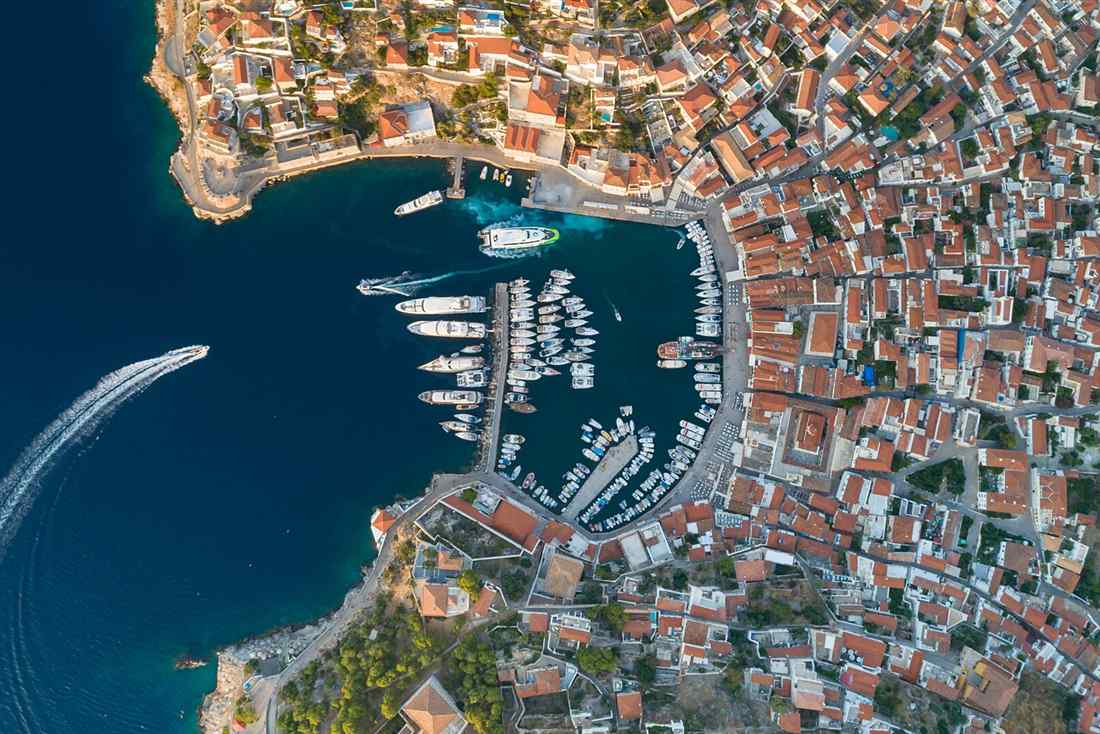
Saronic islands tours cover the islands in the gulf between Attica and the Argolid, the closest group to Athens: Aegina with its hilltop temple of Aphaia and its pistachio groves, pine-covered Agistri, Poros across a channel 200 m wide, Hydra where no wheeled vehicle is allowed, and Spetses of the horse carriages and the fireship festival. Plan the rest of the trip with Greece Tours.
This page covers the Saronic islands tours you can book from Athens, what each island holds, the beaches, boat trips and walks, the monasteries, museums and festivals, the food, and how the fast boats from Piraeus and the mainland crossings shape the route.
What do Saronic islands tours cover?
Saronic islands tours cover the islands in the gulf between Attica and the Argolid: Aegina with the temple of Aphaia, Agistri under its pines, Poros across a 200 m channel, car-free Hydra, Spetses of the horse carriages, and Salamis, where the fleet of Themistocles beat the Persians in 480 BC.
The Saronic Gulf lies between the Attica and Argolis peninsulas and opens into the Aegean. The Corinth Canal cuts its western end, and Piraeus, the port of Athens, sits on its north-east edge. The gulf takes its name from the mythical king Saron, who drowned in the lake of Psiphaea. Its islands sit within an hour or two of Athens, which makes them the closest island group to the capital.
That distance shapes the trips. Saronic islands tours run as day cruises from Athens, as ferry hops island by island, and as sailing weeks that work down the gulf and back. Hydrofoils reach Aegina in 40 minutes and Spetses in a little over two hours, so a single day covers three islands and a week covers all of them.
Which formats do Saronic islands tours take?
- One-day cruises from Athens that call at Hydra, Poros and Aegina with lunch on board.
- Half-day cruises from Athens to Agistri, Moni and Aegina with swimming stops.
- Private island days to Hydra or Spetses with a driver and a guide.
- Island-hopping trips of three to nine days through the whole group.
- Walking and hiking tours, such as the Aegina route past three ancient cisterns and two abandoned villages.
- Sailing and yacht charters out of Athens, Poros and Porto Cheli.
Our pages on Aegina, Hydra, Poros and Spetses cover each island in detail, and Greece Tours sets out the rest of the country.
Which islands make up the Saronic group?
The Saronic group holds Salamis, Aegina, Agistri, Poros, Hydra and Spetses, with the uninhabited islets of Moni, Dokos, Spetsopoula and Patroklos beside them. The volcanic peninsula of Methana closes the western side of the gulf.
Salamis is the largest and the nearest, two kilometres from Piraeus. Aegina covers 87.41 square kilometres and sits 27 km from Athens. Agistri covers 13.4 square kilometres and lies ten minutes by boat from Aegina. Poros covers 31 square kilometres, Hydra 49.6 and Spetses 27.1. The group thins out southwards, and Spetses touches the Argolid coast at Kosta.
The gulf is volcanic in parts. Two thirds of Aegina is an extinct volcano, Sphaeria on Poros is volcanic rock, and the Methana peninsula holds more than 30 eruption centres, the last of which erupted near Kameni Chora in the 3rd century BC. Methana forms the north-western end of the same volcanic arc as Milos, Santorini and Nisyros.
How far apart are the Saronic islands?
- Piraeus to Aegina: 40 minutes by hydrofoil, about an hour by conventional ferry.
- Aegina to Agistri: ten minutes by the Agistri Express or a water taxi.
- Piraeus to Poros: about an hour by fast boat, 31 nautical miles.
- Poros to Galatas: 200 m across the channel, a five-minute crossing by launch.
- Piraeus to Hydra: 37 nautical miles, about 90 minutes by hydrofoil.
- Hydra to Metochi: 20 minutes by passenger ferry to the Peloponnese.
- Piraeus to Spetses: about two hours and a quarter by fast boat.
Saronic islands tours use those distances to build a route. One boat runs Piraeus, Poros, Hydra and Spetses in sequence, so a hop down the chain follows the same line as the day cruise.
Which Saronic islands tours leave Athens?
Saronic islands tours from Athens run the one-day cruise to Hydra, Poros and Aegina, the half-day cruise to Agistri, Moni and Aegina with swimming, private day trips to Hydra or Spetses, a three-day Hydra, Spetses and Poros tour and hopping trips of up to nine days.
The classic is the full-day cruise. It leaves the Athens coast in the morning, sails to Hydra for the harbour and the mansions, crosses to Poros for the clock tower and the waterfront, and ends at Aegina for the town or the temple, with lunch and dancing on board. “Full-Day Tour of the Saronic Islands from Athens” runs that route.
The shorter cruise heads for the inner gulf. “Athens: Cruise to Agistri, Moni & Aegina with Lunch and Drinks” anchors off the pine-covered islet of Moni for a swim, stops at Agistri and ends at Aegina town. A second version adds Metopi. Both take about seven hours door to door.
Private Saronic islands tours work differently: a car and a guide to the port, a fast boat to Hydra or Spetses, and the day set by the visitor rather than by the cruise timetable. “All-Day Private Excursion to Hydra Island from Athens” and “Spetses Island Day Private Trip from Athens” follow that pattern, and a nine-day hopping tour links the whole group.
Our pages on the Hydra day trip, the Aegina day trip and the Poros day trip cover the single-island versions.
What do Saronic islands tours see on Aegina?
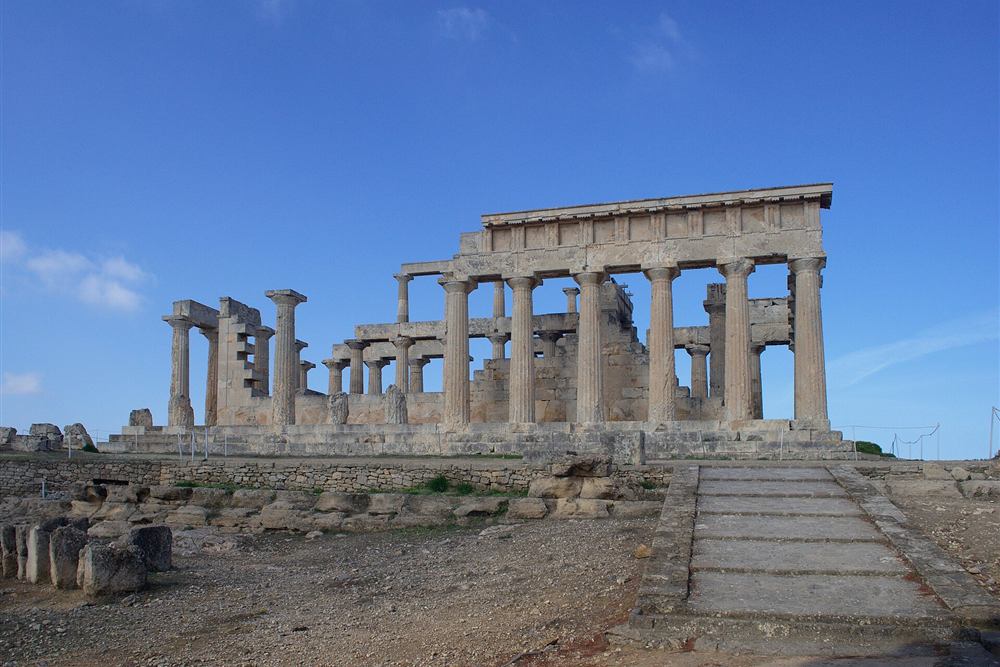
Saronic islands tours on Aegina see the Doric temple of Aphaia of about 500 BC on its hilltop, the church of Agios Nektarios, the abandoned medieval town of Paleochora, the column of Kolonna above the harbour, the fishing village of Perdika and the pistachio groves of the plain.
Aegina is roughly triangular, 15 km east to west and 10 km north to south. The northern and western plains are fertile and grow grain, almonds, olives, figs and the pistachios that carry the island’s name; the southern half is volcanic, rugged and bare, and rises to the cone of Mount Oros at 531 m. The town of Aegina stands at the north-west corner in neoclassical houses with a folk hand to them.
The temple of Aphaia crowns a peak of about 160 m on the east side, 13 km by road from the port. The building of around 500 BC replaced a temple of about 570 BC that burned down, and Aphaia was worshipped here and nowhere else. Its pediment sculptures were removed in 1811 and sold to the crown prince of Bavaria; they stand in the Glyptothek in Munich, with fragments in the museums on the island.
Kolonna, on the hill above the harbour, holds the Early Bronze Age settlement and the single standing column of a temple of Apollo. Agios Nektarios, below Paleochora, draws pilgrims to the tomb of the saint who died in 1920. Paleochora itself, the island’s capital through the Middle Ages, keeps more than thirty chapels on a bare hill and no houses at all.
Aegina lives from more than visitors. The sponge fisheries worked out of the harbour for generations, the plains still grow grain, almonds and figs beside the pistachio, and the town holds 6,976 of the island’s people. The sanctuary of Zeus Hellanios on the north shoulder of Mount Oros was raised to the god who was asked for rain, and the Aeginetans kept the cult on the highest ground in the gulf.
Saronic islands tours add the working side of the island: the pistachio farms, the fish tavernas of Perdika, the boats to the islet of Moni and the beaches at Marathonas and Agia Marina. Our page on Aegina pistachios covers the crop and the growers.
What do Saronic islands tours see on Agistri?
Saronic islands tours on Agistri see a pine-covered island of 13.4 square kilometres with three villages, Skala, Megalochori and Limenaria, and the clear-water beaches of Dragonera, Aponissos, Skliri and Halikiada. It lies ten minutes from Aegina and an hour from Piraeus.
Agistri means fishing hook. Arvanites settled it from the late 17th century, and their descendants still live there; the population stood at 1,131 in the 2021 census. Megalochori, also called Milos, is the main village, Skala twenty minutes along the coast road holds the hotels and the tavernas, and Limenaria sits alone on the far side.
Pine covers the centre of the island and runs down to the water at Dragonera, where the trees stand over a pebble shore. Aponissos, on the west coast, faces a tiny green islet across shallow turquoise water. Halikiada, under a cliff on the east side, is reached on foot and used by naturists. Skliri and Mariza fill out the list.
The island grows wild cyclamen, thyme and caper bushes, holds chukar partridges and a feral population of peafowl, and was named a green island by the Piraeus prefecture and the National Technical University of Athens in 2011. Saronic islands tours reach it on the Athens half-day cruise or on the ten-minute boat from Aegina, and a bus and a few taxis cover the rest.
What do Saronic islands tours see on Poros?
Saronic islands tours on Poros see the clock tower above the tiled roofs, the waterfront of the town, the 6th-century BC sanctuary of Poseidon on Kalaureia, Love Bay and Russian Bay in the pines, and the lemon forest of Galatas across a channel 200 m wide.
Poros is two islands joined by a bridge. Sphaeria, the small southern part, is volcanic and carries the town; Kalaureia, the larger north, is hills and old pine forest rising to Vigla at 358 m. The whole surface covers about 31 square kilometres and holds 3,261 inhabitants. The ancient name of the island was Pogon.
The town climbs the slope of Sphaeria in tiers of white houses with terracotta roofs, and the blue-domed clock tower of 1927 stands at the top. The waterfront faces Galatas on the Peloponnese across water so narrow that the launches cross in five minutes. Behind Galatas the lemon forest spreads over the hillside with some 30,000 trees and a stream running through it.
The sanctuary of Poseidon sits on the plateau of Kalaureia, north of the town. It was the centre of an amphictyony of seven cities, and the orator Demosthenes took poison there in 322 BC rather than surrender to the Macedonians. Stone from Poros, the soft poros limestone, was shipped to Mycenae in the Late Bronze Age for the tholos tombs.
Poros trains the navy. The Hellenic Navy petty officers’ school occupies the buildings on the waterfront east of the town, and cadets have been drilled here since the 19th century. The Russian naval station at Russian Bay, built in 1834 when the Russian fleet used the anchorage, stands roofless behind the pines and gives the bay its name.
Saronic islands tours stop at Love Bay and Russian Bay on the north shore, where the pines reach the water and the swimming is in a sheltered inlet. Our page on Poros yacht charter covers the boats that work this stretch of the gulf.
What do Saronic islands tours see on Hydra?
Saronic islands tours on Hydra see a harbour ringed by stone captains’ mansions, an island with no cars of any kind, donkeys and water taxis instead of traffic, the hamlets of Kamini and Vlychos, and the monastery of Profitis Ilias above the town.
Hydra covers 49.6 square kilometres and adds the island of Dokos and a scatter of islets to its municipality. The port town holds about 1,900 people, and its crescent harbour is lined with tavernas, shops and galleries. Steep stone lanes climb from the water, and the houses are grey stone with tiled roofs. Wheeled vehicles are banned by law, bicycles and e-bikes included, and only the rubbish trucks move under power.
The wealth came from the sea. Hydriot shipowners ran a merchant fleet under the Ottomans and turned it into a fighting navy in 1821, and the mansions around the harbour, among them the Tsamadou house now a merchant marine academy and the Koundouriotis mansion now a museum, were built on that trade. The Historical Archives Museum on the quay holds the ships’ logs and the war relics.
A panel of 522 experts assembled by National Geographic Traveler in 2007 ranked Hydra the highest of any Greek island for the integrity of its place, eleventh of 111 islands worldwide. Cruise ships cannot berth, the port takes only small boats, and the town has kept its scale because of it.
The island drew artists after the war. Leonard Cohen bought a house on the hill above the port in 1960 and wrote there for a decade, and painters and writers have followed the same route since. The School of Fine Arts keeps a branch on the island, and the old slaughterhouse on the point shows a new exhibition each summer.
Saronic islands tours walk west from the port to Kamini and Vlychos, where the bays hold clear water and a stone bridge of 1850 crosses a dry stream, or climb 45 minutes to the monastery of Profitis Ilias at 500 m. Our page on Hydra boat trips covers the water taxis and the coast.
What do Saronic islands tours see on Spetses?
Saronic islands tours on Spetses see the Dapia waterfront with its cannons, the Bouboulina museum in the admiral’s house, the Old Harbour at Baltiza where wooden boats are still built, the Poseidonion hotel of 1914, and horse carriages in place of private cars.
Spetses covers 27.1 square kilometres off the tip of the Argolid, and the town is the only large settlement. The ancient name Pityoussa means abounding in pines, and the modern name comes through Venetian from spezie, spices. Private cars are barred from the town, so walking, bicycles, mopeds and horse-drawn carriages carry the traffic, and a road of 25 to 30 km circles the island.
Laskarina Bouboulina, born in 1771, took over her second husband’s fleet and fortune, joined the Filiki Etaireia and commanded Spetsiot ships at the siege of Nafplion. She was killed in a family feud on 22 May 1825, and the Russian navy made her an admiral days later. Her house behind the Dapia is a museum, and the island’s Armata festival each September re-enacts the burning of an Ottoman flagship in 1822.
The Anargyrios and Korgialenios School, built in 1927 on the English public-school model, stands west of the town; John Fowles taught there and set The Magus on the island. The Poseidonion Grand Hotel on the Dapia opened in 1914 and gave Spetses its first season of Athenian visitors.
Saronic islands tours take the coast road by carriage or bus to Agioi Anargyroi with its Bekiris sea cave, to Agia Paraskevi and Zogeria, and to Kaiki beach near the school. Our page on Spetses boat tours covers the circuit by sea.
What do Saronic islands tours see on Salamis and Methana?
Saronic islands tours at Salamis see the strait where the Greek fleet under Themistocles destroyed the Persian navy in 480 BC, the island’s monasteries and the cave linked with Euripides. Methana, across the gulf, holds a volcanic peninsula with sulphur springs and more than 30 eruption centres.
Salamis is the largest island of the gulf and the closest to Athens, two kilometres from Piraeus, with its main port at Paloukia facing Perama. That crossing carries more passengers than any Greek port except Piraeus itself. The town of Salamina sits in the west-facing bay, and the island keeps the headquarters of the Hellenic Navy.
The battle of 480 BC was fought in the strait between the island and the Attic shore. Themistocles drew the fleet of Xerxes into narrow water where its numbers counted for nothing, and the victory turned the Persian war. Tradition makes Salamis the birthplace of Ajax and of Euripides, and a cave on the south coast is identified with the playwright.
Methana is a peninsula rather than an island, joined to the Argolid by a neck of land and reached by the same ferries that serve Poros. Its volcano is the youngest of the Aegean arc, the last eruption came near Kameni Chora in the 3rd century BC, and Ovid, Strabo and Pausanias all recorded it. Hot sulphurous water still rises, and a spa in the town uses it.
The peninsula rises to Helona at 740 m, and the crater walk above Kameni Chora crosses black lava fields with the gulf below. Saronic islands tours add Methana as a half-day from Poros, since the crossing takes minutes.
Which beaches do Saronic islands tours reach?
Saronic islands tours reach Agia Marina and Marathonas on Aegina, Dragonera and Aponissos on Agistri, Love Bay and Askeli on Poros, Vlychos and Bisti on Hydra, and Agioi Anargyroi, Zogeria and Agia Paraskevi on Spetses.
The gulf beaches are small and sheltered rather than long. Aegina keeps the sand at Agia Marina on the east coast, Marathonas on the west and the shallow bay at Vagia, with the pine islet of Moni off Perdika for swimming from a boat. Agistri runs to pebble under pines, and the water at Dragonera and Aponissos is as clear as anywhere near Athens.
- Aegina – Agia Marina, Marathonas, Vagia, Klima, and Moni islet by boat from Perdika.
- Agistri – Dragonera, Aponissos, Skliri, Mariza and the walk down to Halikiada.
- Poros – Askeli, Love Bay, Russian Bay, Monastiri below the monastery and Vagionia in the north.
- Hydra – Vlychos and Kamini on foot, Bisti and Agios Nikolaos by water taxi, Spilia off the rocks in town.
- Spetses – Agioi Anargyroi, Agia Paraskevi, Zogeria, Xylokeriza, Ligoneri and Kaiki near the town.
- Salamis – Kanakia and Peristeria on the south-west coast, away from the shipping lanes.
Hydra has almost no sand at all: swimmers use concrete platforms and flat rocks, and the water taxis run a shuttle service west along the coast. Saronic islands tours build the swim into the boat day rather than into the drive.
Which monasteries and churches do Saronic islands tours visit?
Saronic islands tours visit Agios Nektarios and Chrysoleontissa on Aegina, the chapels of Paleochora, Zoodochos Pigi above Askeli on Poros, Profitis Ilias on Hydra, Agioi Panton on Spetses and Faneromeni on Salamis.
Agios Nektarios is the largest pilgrimage of the gulf. Nektarios Kefalas, bishop of Pentapolis, founded the convent of the Holy Trinity above Kontos on Aegina, died there in 1920 and was canonised in 1961; the new church beside the convent is one of the biggest in Greece. Buses from the port run to it through the day, and the road continues to Paleochora above.
Paleochora was the capital of Aegina from the 9th century, built inland and out of sight of the pirates. The houses are gone, and more than thirty chapels stand on the bare hill with frescoes inside them. Chrysoleontissa, in the hills to the south, is a fortified monastery of the early 17th century with a carved screen and a tower.
Poros keeps Zoodochos Pigi on the wooded slope above Askeli, founded in 1720 around a spring, with a gilded screen carved on Mount Athos. Hydra’s Profitis Ilias stands at about 500 m, a 45-minute climb from the port, with the convent of Agia Efpraxia below it. Spetses has Agioi Panton and the cathedral of Agios Nikolaos on the waterfront, where the revolutionary flag was raised in April 1821.
Salamis holds Faneromeni, a monastery of the 17th century above the north-west coast whose church carries a painted Last Judgment covering the whole west wall. Saronic islands tours reach it by road from Paloukia in twenty minutes.
Which walks do Saronic islands tours take?
Saronic islands tours walk to Mount Oros and the ancient cisterns on Aegina, the pine paths of Agistri, the coast road to Kamini and Vlychos and the climb to Profitis Ilias on Hydra, the Kalaureia plateau on Poros and the circular trail of Spetses.
Aegina’s high ground is the cone of Mount Oros at 531 m, the highest point of the Saronic Gulf, with the sanctuary of Zeus Hellanios on its northern shoulder and a chapel on the summit. The guided walk “Aegina: 3 Cisterns and 2 Abandoned Villages Hiking Tour” crosses the interior between the rock-cut water stores and the emptied settlements of the hills.
Hydra is walked because it cannot be driven. The coast path runs west from the port through Kamini to Vlychos, crosses the stone bridge of 1850 and continues to Palamidas and Episkopi, a full day’s walk to the western end. The climb to Profitis Ilias takes 45 minutes up a stepped path, and Mount Eros behind it reaches 590 m.
- Aegina – Mount Oros from Pachia Rachi, the cisterns route, and the track from Portes to Anitseo.
- Agistri – forest paths from Megalochori to Limenaria and down to Halikiada.
- Poros – the Kalaureia plateau to the sanctuary of Poseidon and on to Vagionia.
- Hydra – Kamini, Vlychos and Episkopi on the coast; Profitis Ilias and Mount Eros above.
- Spetses – the 25 to 30 km circuit of the island, walked in sections or cycled whole.
- Methana – the crater path above Kameni Chora across the lava fields.
The paths are signposted on Hydra and Spetses and rough on Aegina. Saronic islands tours walk them in spring and autumn, when the hills are green and the temperature holds below the summer figures.
Which museums do Saronic islands tours visit?
Saronic islands tours visit the Archaeological Museum of Aegina beside Kolonna, the Historical Archives Museum and the Koundouriotis mansion on Hydra, the Bouboulina museum and the Spetses Museum in the Mexis mansion, and the Archaeological Museum of Poros.
The Archaeological Museum of Aegina was founded in 1829 under Ioannis Kapodistrias and was the first museum of the modern Greek state. It stands on the Kolonna hill with the finds of the Bronze Age settlement, the sphinx of Aegina and the pottery of the island’s trading centuries, and the excavation site runs down the slope to the sea beside it.
Hydra’s Historical Archives Museum sits on the east arm of the harbour and holds the ships’ logs, the war correspondence and the portraits of the captains who financed the revolution. The Koundouriotis mansion above the port, built in the 1780s, keeps its rooms furnished as the family left them, with the folk collection of the Benaki Museum inside.
Spetses keeps two houses. The Bouboulina museum occupies the admiral’s own mansion behind the Dapia, with her weapons, her letters and the Florentine ceiling of the reception room, and is shown on guided tours through the day. The Spetses Museum sits in the mansion of Hatzigiannis Mexis of 1795, and holds the casket with Bouboulina’s bones, the island’s revolutionary flag and its Byzantine and Bronze Age finds.
Poros displays its archaeology on Korizis square by the waterfront, with material from the sanctuary of Poseidon and from ancient Troezen on the mainland opposite. Saronic islands tours fit these collections between the boat and the beach, since none of them takes more than an hour.
Which festivals do Saronic islands tours meet?
Saronic islands tours meet the Miaoulia on Hydra in late June, the Armata on Spetses in the second week of September, the Fistiki Fest on Aegina in the same month, and the Easter processions on Hydra and Poros.
The Miaoulia honours Andreas Miaoulis, the Hydriot admiral who led the fleet of the revolution. The island fills the harbour with rowing races, dancing and fireworks, and the week ends with a burning ship set alight in the bay to re-enact the fireships he sent against the Ottoman navy.
The Armata on Spetses marks the naval victory of 8 September 1822, when the islanders turned back an Ottoman fleet off the Argolid coast. A wooden replica of an Ottoman flagship is built in the Old Harbour through the summer and burned in front of the Dapia on the Saturday of the festival, with a week of concerts and races before it.
The Fistiki Fest fills the Aegina waterfront in the middle of September, at the end of the pistachio harvest, with growers’ stalls, cooking, music and the island’s own nut in every form. Holy Week brings the quiet festivals: the Good Friday processions of Hydra’s parishes meeting at the harbour, and the Easter fireworks over the channel at Poros.
Spetses adds a sporting weekend in October. The Spetses Mini Marathon fills the island with runners and open-water swimmers, with a 25 km circuit of the coast road, shorter runs for children and a 5 km swim across the channel from Kosta. The town closes its waterfront to traffic for it, which on an island with almost no cars changes little.
Saronic islands tours run at their fullest in those weeks, and the ferries add sailings for them. Our page on the Spetses Armata festival covers the September week in detail.
Which landscape and wildlife do Saronic islands tours cross?
Saronic islands tours cross pine forest on Agistri, Poros and Spetses, volcanic ground on Aegina and Methana, the deer and peacocks of the Moni islet, and the clear water of a gulf enclosed by two peninsulas.
Pine defines the northern islands. Agistri is covered in it, Kalaureia on Poros holds old forest that runs down to the shore, and Spetses took its ancient name Pityoussa from the same trees. Aegina divides between cultivated plains in the north and bare volcanic rock in the south, with almond, olive, fig and pistachio on the flat ground.
Moni, the islet off Perdika, is a wildlife refuge with no permanent residents; peacocks walk the pine shade and deer come down to the beach where the day boats land. Dokos, off Hydra, is grazed by goats and holds the remains of a Bronze Age wreck of about 2200 BC found in its bay, one of the oldest ever excavated.
The gulf water is protected on three sides, and it carries dolphins, loggerhead turtles and, in the deeper channels towards the Argolid, the occasional monk seal. Agistri keeps chukar partridges, wild cyclamen, thyme and caper bushes, and its eastern cliffs are used by nesting swifts.
Methana adds the raw geology: over 30 eruption centres on one peninsula, lava fields above Kameni Chora and sulphur springs at the town. Saronic islands tours that combine it with Poros cross from pine forest to black rock in half an hour.
Which mainland sites combine with Saronic islands tours?
Saronic islands tours combine with ancient Troezen behind Galatas, the theatre of Epidaurus north of Methana, Nafplio and Mycenae beyond it, the Corinth Canal at the head of the gulf and Cape Sounion at its eastern entrance.
The gulf is closed by two peninsulas, and both carry sites. Troezen, 8 km inland from Galatas across the channel from Poros, was the city of Theseus, who was raised there and lifted the rock that hid his father’s sword and sandals; the walls, the sanctuary of Hippolytus and the Devil’s Bridge gorge stand in the fields above the modern village.
Epidaurus lies 40 km north of the Methana crossing. Its theatre of the 4th century BC seats 14,000 and keeps acoustics that carry a whisper from the orchestra to the top row, and the sanctuary of Asklepios around it was the healing centre of the Greek world. Nafplio, the first capital of modern Greece after Aegina, sits an hour further with Mycenae beyond it.
- Ancient Troezen – the city of Theseus, 8 km from Galatas, opposite Poros.
- Epidaurus – the theatre and the Asklepieion, 40 km from the Methana road.
- Nafplio – the Venetian town under Palamidi, reachable from Kosta and Porto Cheli.
- Corinth Canal – the 6.4 km cut at the head of the gulf, crossed on cruises from Athens.
- Cape Sounion – the temple of Poseidon on the cliff at the gulf’s eastern entrance.
- Ermioni and Porto Cheli – the Argolid harbours that face Hydra and Spetses.
Saronic islands tours that use the mainland crossings put these sites within an hour of the boat. A car left at Metochi, Kosta or Galatas turns a beach day into a site day without a return to Athens. Our page on Spetses travel tips covers the Kosta crossing.
Which visitors do Saronic islands tours suit?
Saronic islands tours suit day visitors from Athens who want an island without a flight, walkers on Hydra and Aegina, sailors working the sheltered gulf, families on Agistri and Poros, and history visitors following Salamis, Aphaia and the fleets of 1821.
The group’s advantage is proximity. A boat leaves Piraeus at eight and is back by seven, and that single fact decides most trips here. Visitors with one free day take the three-island cruise. Visitors with three days take Hydra and Spetses at their own pace. Nobody needs a domestic flight or an overnight ferry.
- Day visitors – the Hydra, Poros and Aegina cruise, or the Agistri and Moni swimming cruise.
- Walkers – Hydra’s coast path and Profitis Ilias, Mount Oros and the cisterns on Aegina.
- Families – Agistri for shallow water and short distances, Poros for the town and the pines.
- Sailors – Alimos, Poros and Porto Cheli, with anchorages two to four hours apart.
- History visitors – Salamis, the temple of Aphaia, Kolonna and the revolutionary houses of Hydra and Spetses.
- Art visitors – the summer exhibitions on Hydra and the galleries around its port.
The islands are lived in rather than seasonal. Hydra, Spetses, Poros and Aegina keep their schools, their bakeries and their boatyards through the winter, so Saronic islands tours find open tavernas in February as well as in August. That is the difference between this group and the islands further out.
Where do Saronic islands tours stay?
Saronic islands tours stay in the captains’ houses of Hydra port, the neoclassical hotels of the Spetses Dapia, the town or Agia Marina on Aegina, Skala on Agistri and the waterfront of Poros town, all within a walk of the ferry quay.
Hydra converts its mansions. Stone houses of the 18th and 19th centuries hold small hotels behind thick walls and courtyards, and every one is reached on foot, with a mule for the luggage. There is no resort strip, no coach parking and no through traffic, because none of it is allowed.
Spetses splits between the Dapia and the Old Harbour. The Poseidonion Grand Hotel of 1914 stands on the waterfront and set the tone; the Baltiza end is quieter, among the boatyards. Aegina keeps hotels in the town and in Agia Marina on the east coast, and the island’s proximity means many visitors make it a day trip and stay in Athens.
Poros town spreads up its slope over the water, with rooms looking across the channel at Galatas. Agistri concentrates on Skala, twenty minutes from Megalochori on foot. A night on each of Hydra, Spetses and Poros makes the standard three-day route, and Saronic islands tours that add Aegina and Agistri turn it into five.
Which boat trips and sailing routes do Saronic islands tours run?
Saronic islands tours sail the day cruise from Athens to Hydra, Poros and Aegina, the swimming cruise to Moni and Agistri, private day charters from Porto Cheli to Spetses, and week-long flotillas that run Athens, Aegina, Poros, Hydra, Spetses and back.
The gulf is the sheltered water of Greek sailing. It is enclosed on three sides, the distances between anchorages run two to four hours, and the meltemi that batters the Cyclades arrives here weakened. Charter boats leave from Alimos marina in Athens, from Poros and from Porto Cheli on the Argolid coast opposite Spetses.
- Athens day cruise – Hydra, Poros and Aegina in one day with lunch on board.
- Moni and Agistri cruise – a half-day with two swimming stops in the inner gulf.
- Porto Cheli to Spetses – private daily cruises across the narrow channel.
- Hydra water taxis – the shuttle to Vlychos, Bisti and the south-coast bays.
- Poros to Galatas and the lemon forest – a five-minute launch and a walk up the hill.
- Flotilla weeks – Alimos, Aegina, Poros, Hydra, Spetses, Ermioni and back.
Saronic islands tours under sail take in anchorages that the ferries pass: Dokos off Hydra, where a Bronze Age wreck of about 2200 BC was found, Spetsopoula south of Spetses, and the bays of the Argolid shore at Ermioni and Kosta.
What history do Saronic islands tours tell?
Saronic islands tours tell of Aegina, which struck the first coins in Europe and fought Athens for the gulf, of Salamis in 480 BC, of the Hydriot and Spetsiot fleets that carried the War of Independence at sea, and of Aegina town as the first capital of the Greek state in 1828.
Aegina was a colony of Epidaurus and grew into a trading power that rivalled Athens. Its silver staters, stamped with a turtle, were the first coinage minted in Europe, and its merchants traded across the eastern Mediterranean until Athens broke the island’s power in the 5th century BC. The sanctuaries of Aphaia and of Apollo at Kolonna date from that height.
The Persian war turned in the strait of Salamis in 480 BC. The allied Greek fleet under Themistocles met the far larger navy of Xerxes in water too narrow for it to deploy, destroyed it, and set the course of the classical age. Aeginetan ships fought in that line and were judged to have fought best of all.
Two and a half thousand years later the same islands carried another war. Hydra and Spetses had built merchant fleets under Ottoman rule, and in 1821 they turned them into warships: Hydriot captains such as Miaoulis and the Spetsiot Bouboulina fought the Ottoman navy from Nafplion to Chios. Spetses raised the flag of the revolution on 3 April 1821, and its Armata festival still marks the victory of September 1822.
When the fighting ended, Ioannis Kapodistrias made Aegina town the first capital of the Greek state in 1828 and struck the new currency there. Saronic islands tours pass the government house and the first orphanage in the town, both from those two years. Our page on Aegina history covers that period in detail.
What do Saronic islands tours eat and buy?
Saronic islands tours eat Aegina pistachios, fish at Perdika and Baltiza, fish a la Spetsiota baked with tomato and garlic, amygdalota almond sweets from Hydra, and the lemons and citrus preserves of Galatas across the channel from Poros.
The pistachio of Aegina carries a protected designation of origin. The trees took to the island’s volcanic soil and dry climate in the early 20th century, the harvest runs through September, and the Fistiki Fest in the town each autumn fills the waterfront with growers. The nuts are sold roasted and salted, ground into butter and turned into sweets.
Fish is the other constant. Perdika on Aegina lines its small harbour with tavernas that serve the morning catch; the Old Harbour at Baltiza on Spetses does the same among the boatyards. Fish a la Spetsiota, baked whole with tomato, garlic, parsley and breadcrumbs, is the dish the island gave the country.
- Aegina – pistachios with their own designation of origin, sold at the harbour stalls.
- Hydra – amygdalota almond cakes, thyme honey and the galleries along the port.
- Spetses – fish a la Spetsiota, almond sweets and the boatyards of Baltiza.
- Poros – citrus from the lemon forest at Galatas, sold as preserves and liqueur.
- Agistri – thyme honey from the pine hills and the fish of Skala.
- Methana – the sulphur spa and the produce of the Argolid plain behind it.
Saronic islands tours time the stop for the market rather than the shop: the Aegina waterfront in the morning, the Hydra bakeries at midday, the Spetses harbour at dusk. Our page on Aegina restaurants covers where the islanders eat.
How do visitors plan Saronic islands tours?
Visitors plan Saronic islands tours around the Piraeus fast boats, which reach Aegina in 40 minutes, Poros in an hour, Hydra in 90 minutes and Spetses in two hours and a quarter. Hydra and the town of Spetses allow no private cars, so the islands are walked.
Piraeus gate E8 serves the whole group, and the conventional ferries to Aegina leave from the same quay at a lower fare and a slower pace. A second route runs from Metochi on the Peloponnese to Hydra in 20 minutes, which suits drivers who leave the car in the secure park there. Kosta, opposite Spetses, and Galatas, opposite Poros, work the same way.
- April to June – warm, green and quiet, with the sea warming through June.
- July and August – the full timetable, the Athenian weekend crowds and the Armata festival on Spetses in September.
- September and October – the warmest water, the pistachio harvest on Aegina and thinner boats.
- November to March – mild and open, since the islands stay lived-in year-round and Athens is an hour away.
One day covers a single island or a three-island cruise. Three days cover Hydra, Spetses and Poros with a night on each. A week covers the group with time to walk. Saronic islands tours run through the year because the islands are not seasonal resorts but working towns within reach of the capital.
Our pages on the Athens to Hydra ferry and how to get to Spetses cover the timetables and the ports.
Frequently Asked Questions
Which are the Saronic islands?
Salamis, Aegina, Agistri, Poros, Hydra and Spetses, with the islets of Moni, Dokos and Spetsopoula beside them. The volcanic peninsula of Methana closes the western side of the gulf.
How long do Saronic islands tours take?
One day for the cruise to Hydra, Poros and Aegina, seven hours for the Agistri and Moni cruise, three days for a night on each of the southern islands and a week for the whole group.
How far is Aegina from Athens?
27 km. The hydrofoil from Piraeus takes 40 minutes and the conventional ferry about an hour, both from gate E8.
Are there cars on Hydra?
No. Wheeled vehicles are banned by law, bicycles and e-bikes included, and only the rubbish trucks move under power. Donkeys, mules and water taxis carry everything else.
Which Saronic island is best for a day trip?
Aegina for the temple of Aphaia and the shortest crossing, Hydra for the harbour and the mansions, Agistri for the clearest water. The one-day cruise takes Hydra, Poros and Aegina together.
What is the temple of Aphaia?
A Doric temple of about 500 BC on a 160 m peak on the east side of Aegina, 13 km from the port. Aphaia was worshipped here and nowhere else, and the pediment sculptures stand in the Glyptothek in Munich.
Can you swim on Saronic islands tours?
Yes. The Athens half-day cruise anchors off Moni and Agistri for swimming, and the day boats stop at Agioi Anargyroi on Spetses and Vlychos on Hydra.
Which Saronic island has the best beaches?
Agistri for Dragonera and Aponissos, Spetses for Agioi Anargyroi and Zogeria, Aegina for Agia Marina and Marathonas. Hydra has rocks and platforms rather than sand.
What happened at Salamis?
The Greek fleet under Themistocles destroyed the far larger Persian navy of Xerxes in the strait in 480 BC, and the victory turned the Persian war.
Who was Bouboulina?
Laskarina Bouboulina, born in 1771, commanded a fleet of Spetsiot ships in the War of Independence and fought at the siege of Nafplion. She was killed on 22 May 1825, and the Russian navy made her an admiral days later.
Which food do Saronic islands tours try?
Aegina pistachios with their protected designation of origin, fish a la Spetsiota baked with tomato and garlic, amygdalota almond sweets from Hydra and the citrus of the Galatas lemon forest.
When is the best time for Saronic islands tours?
April to June and September to October. September carries the warmest sea, the Armata festival on Spetses and the pistachio harvest on Aegina.