
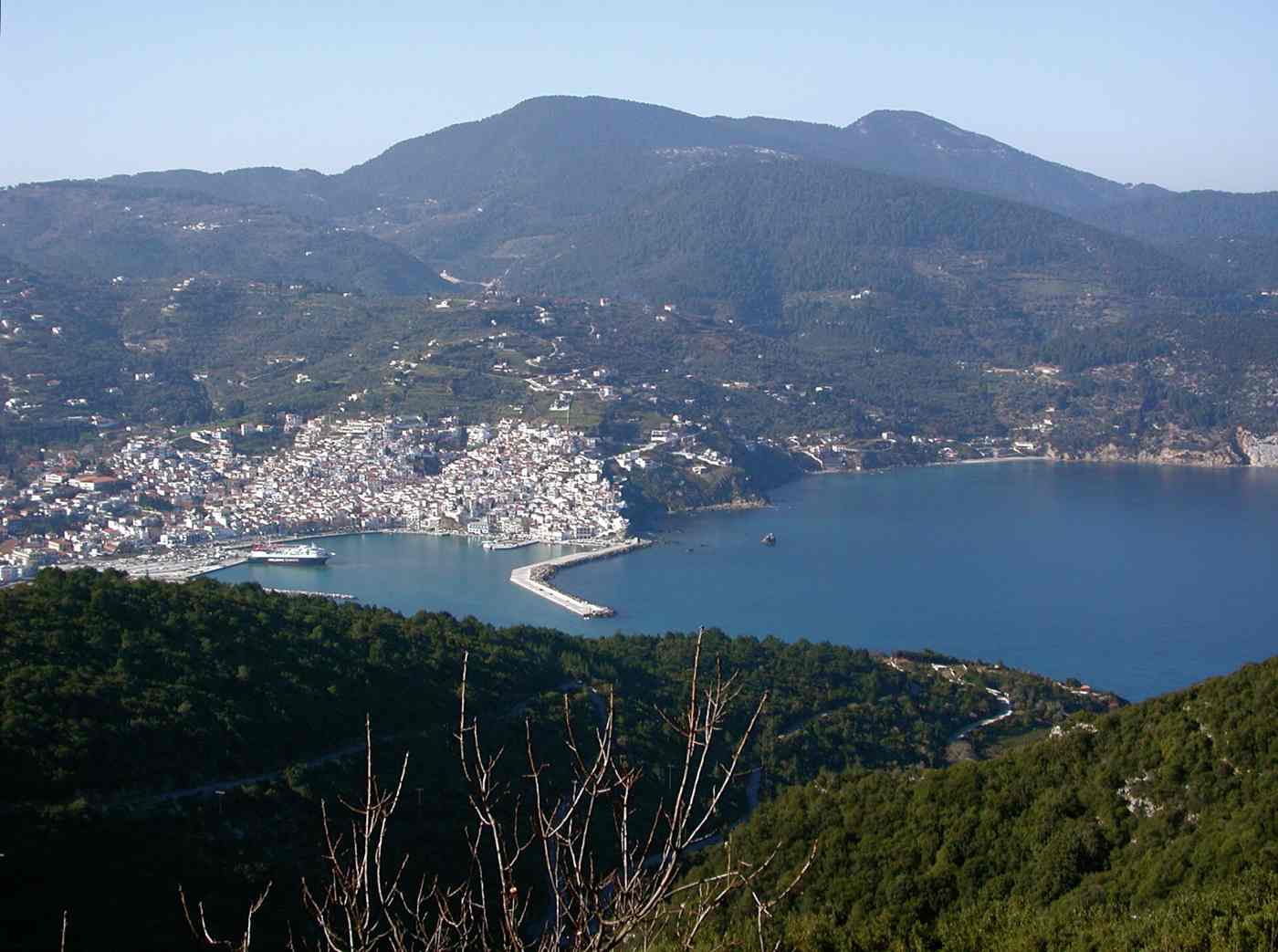
Skopelos Town, known locally as Chora, is the capital of Skopelos and its largest settlement. The town climbs the slope of a natural bay on the island’s northeast coast, its whitewashed houses rising in tiers above the harbour. Grey slate roofs, wooden balconies and stone lanes lead upward toward the Venetian Kastro that crowns the hill. Plan the whole trip with Greece Tours.
The town concentrates the island’s heritage within a compact area. Ferries and hydrofoils dock at its waterfront, tavernas and bakeries line the lanes, and reputedly more than 120 churches occupy the slope. The Folklore Museum and the Vakratsa mansion record local history, while the Kastro and the church of Agios Athanasios mark the settlement’s oldest layer above the port.
What defines Skopelos Town on the island’s northeast coast?
Skopelos Town occupies a curved bay on the northeast coast, rising amphitheatrically from the harbour to the Kastro. Whitewashed houses, grey slate roofs and stone lanes define its built form across the slope.
Skopelos Town, or Chora, sits on the northeast coast of Skopelos, wrapped around a curved bay that faces the open Aegean. The settlement rises from the water’s edge in tiers, following the natural slope of the hillside behind the harbour. This amphitheatrical arrangement places the port at the base and the Venetian Kastro at the summit, with rows of houses stacked between the two. The layout gives almost every home a line of sight over the bay. Ferries approaching from the west see the town as a white cascade against the green pine-covered ridge. The northeast position shelters the harbour from the strongest summer winds.
Which helped establish the town as the island’s principal anchorage and administrative centre over the long centuries of Aegean seafaring.
The architecture of Skopelos Town follows a consistent Sporadic style. Houses carry whitewashed walls, grey slate roofs cut from local schist, and wooden balconies painted in blue, green or brown. The slate tiles, laid in overlapping courses, distinguish the town from the terracotta roofs common on other Greek islands. A projecting enclosed balcony, called a sachnisi, overhangs the lane below on many façades. Ground floors were built in stone, upper floors in timber and plaster, a method that resisted earthquakes. Bougainvillea and potted plants soften the narrow passages between the buildings. Restoration rules protect this appearance, so new construction inside the old town matches the traditional palette.
The result is a dense, uniform townscape that has changed little in outline across generations of island residents, and it forms the backdrop to every walk through the lanes.
Churches define the character of Skopelos Town as strongly as the houses. Local tradition counts reputedly more than 120 chapels and churches within the settlement, and roughly 360 across the whole island. A large share are private family chapels no larger than a single room, tucked between houses or built onto their walls. Others stand as parish churches with blue domes and carved stone doorways. The narrow stone-paved lanes thread between them, too tight for cars and often broken by steps. These alleys follow no grid; they curve, split and rejoin around the contour of the hill. Walking upward from the port, visitors pass through this maze of white walls, flowering courtyards and small squares.
The concentration of churches reflects centuries of maritime prosperity, when returning sailors funded chapels in thanks for safe voyages.
Skopelos Town functions as the island’s capital, port and commercial hub. The waterfront holds the town hall, banks, travel agencies and the main ferry berth, while the residential quarters climb behind it. About 3,000 people live in the town, the largest of the island’s settlements. The harbour front carries a line of tavernas, cafés and shops that open onto the quay. Behind this first row, the lanes turn quieter and more residential the higher they climb. The town serves as the base for exploring the rest of the island, since roads radiate from here toward Glossa, Stafilos, Panormos and the northern beaches.
Its combination of a working port, a preserved old town and a full range of services makes Chora the natural starting point for a stay on the island.
Why is Skopelos Town described as an amphitheatrical capital?
Skopelos Town rises in stacked tiers up a natural slope behind its harbour, so its houses form curved rows that resemble the seating of an ancient theatre. This shape gives the capital its amphitheatrical description.
The word amphitheatrical describes how the buildings of Skopelos Town are arranged in curved, rising tiers, mirroring the semicircular seating of a Greek theatre. The natural bay forms a shallow bowl, and the houses fill it from the shoreline up to the ridge. Each row of homes sits slightly above and behind the one in front, so roofs and balconies step up the hillside in ordered lines. This shape is not planned architecture but the product of building on a steep coastal slope over centuries. The effect is clearest from the sea or from the harbour breakwater, where the whole town reads as a single sweeping curve.
The Kastro anchors the top of the arrangement, the way a stage backdrop closes a theatre, giving the composition a defined crown above the port.
Moving through this amphitheatrical layout means climbing. From the quay, stepped lanes rise directly toward the Kastro, gaining height with every turn. The gradient is steep in places, and passages convert entirely to stone stairs. Cross-lanes run level along the contour, linking the vertical routes and creating a grid that bends with the hill. Height brings changing views: lower lanes frame the masts in the harbour, while upper lanes open onto the full bay and the sea beyond. The climb rewards walkers with a sequence of small squares, each holding a church or a café.
The ascent alternates between shaded passages and sudden bright openings over the water. This constant change of level and light shapes the experience of the town.
The amphitheatrical form also governs how light and views work across the day. East-facing houses catch the sunrise over the Aegean, while the upper town holds the evening light longest. From the higher lanes and the Kastro, the panorama takes in the harbour, the opposite headland and the sea channel toward Alonissos. Boats entering and leaving the port move directly below, and the sound of the waterfront carries up the slope. The orientation toward the northeast means the town looks out over open water rather than back at the island’s interior. This outward focus reinforced its historic role as a seafaring capital.
Visitors planning things to do in Skopelos often begin with a slow walk up these rising tiers to read the town’s amphitheatrical shape firsthand.
Few Greek island capitals hold their amphitheatrical form as completely as Chora. Building height stays low and even across the slope, so no single structure breaks the curve. The absence of large modern blocks inside the old town keeps the tiered profile intact. This preserved silhouette is the image most associated with Skopelos, appearing on postcards and in the opening views from arriving ferries. For walkers, the shape means orientation is simple: the sea lies downhill, the Kastro uphill, and every lane connects the two. The reward for the effort of the climb is the accumulation of viewpoints, each higher than the last.
Understanding the town as a theatre carved into the hillside helps visitors read its streets and explains why the capital carries the amphitheatrical label so consistently across guides and descriptions.
What is the Venetian Kastro at the top of Skopelos Town?
The Kastro is a ruined Venetian castle crowning Skopelos Town, built by the Ghisi family in the 13th century on the foundations of the ancient acropolis. It stands beside the oldest church, Agios Athanasios.
The Kastro is the fortified summit of Skopelos Town, the highest point of the old settlement. The Venetian Ghisi family built the castle in the 13th century, when the Sporades fell under Venetian control after the Fourth Crusade. Its walls enclosed the top of the hill and protected the population during raids. The castle changed hands over the following centuries as the Byzantines, Venetians and Ottomans contested the Aegean. Today the Kastro survives as sections of stone wall, a gateway and the cleared ground of the citadel. The structure marks the historic core from which the rest of the town expanded downhill.
Its position controlled both the harbour and the approaches by sea, making it the defensive and symbolic heart of the capital throughout the medieval period and into Ottoman times.
The Venetian castle did not rise on empty ground. The Ghisi builders reused the foundations and stone of the ancient acropolis of Peparethos, the classical name for Skopelos. Large squared blocks from the older fortification remain visible at the base of the medieval walls, showing where antiquity meets the Middle Ages in a single structure. This layering records more than 2,000 years of continuous occupation on the same hilltop. The ancient city minted its own coins and exported wine across the Aegean, and the acropolis guarded that trade. Standing at the Kastro, visitors read this long history in the masonry: rough classical blocks below, mortared Venetian courses above.
The site therefore documents the full span of the town’s past, from the ancient port city to the fortified medieval capital that grew beneath it.
Beside the Kastro stands Agios Athanasios, the oldest church in Skopelos Town. The church is believed to date to the 11th century, and it was raised on the foundations of an earlier structure at the town’s summit. Its interior holds frescoes painted in later centuries, darkened by age but still legible. The building is small and low, built from stone in the plain style of early island churches. Its position next to the castle links the religious and defensive centres of the old town in one cluster at the highest ground. The church remains in use for occasional services and forms a fixed point on any walk to the Kastro.
Together, the fortress wall and the medieval church give the summit its layered identity as the birthplace of the settlement below.
Reaching the Kastro means following the stepped lanes to the top of the town, a climb of roughly ten to fifteen minutes from the harbour. The final approach passes through the old gateway and onto the open citadel ground. From here the view extends across the whole harbour, the rooftops of the tiered town and the sea channel toward the neighbouring Sporades. A taverna near the summit uses the elevation for its terrace, and the flat ground around the walls draws visitors at sunset. The wide Aegean views from the Kastro reward the ascent and explain why the spot ranks among the town’s fixed stops.
The combination of ruined fortress, ancient stone, medieval church and open panorama concentrates the island’s history and its outlook into one accessible viewpoint above the capital.
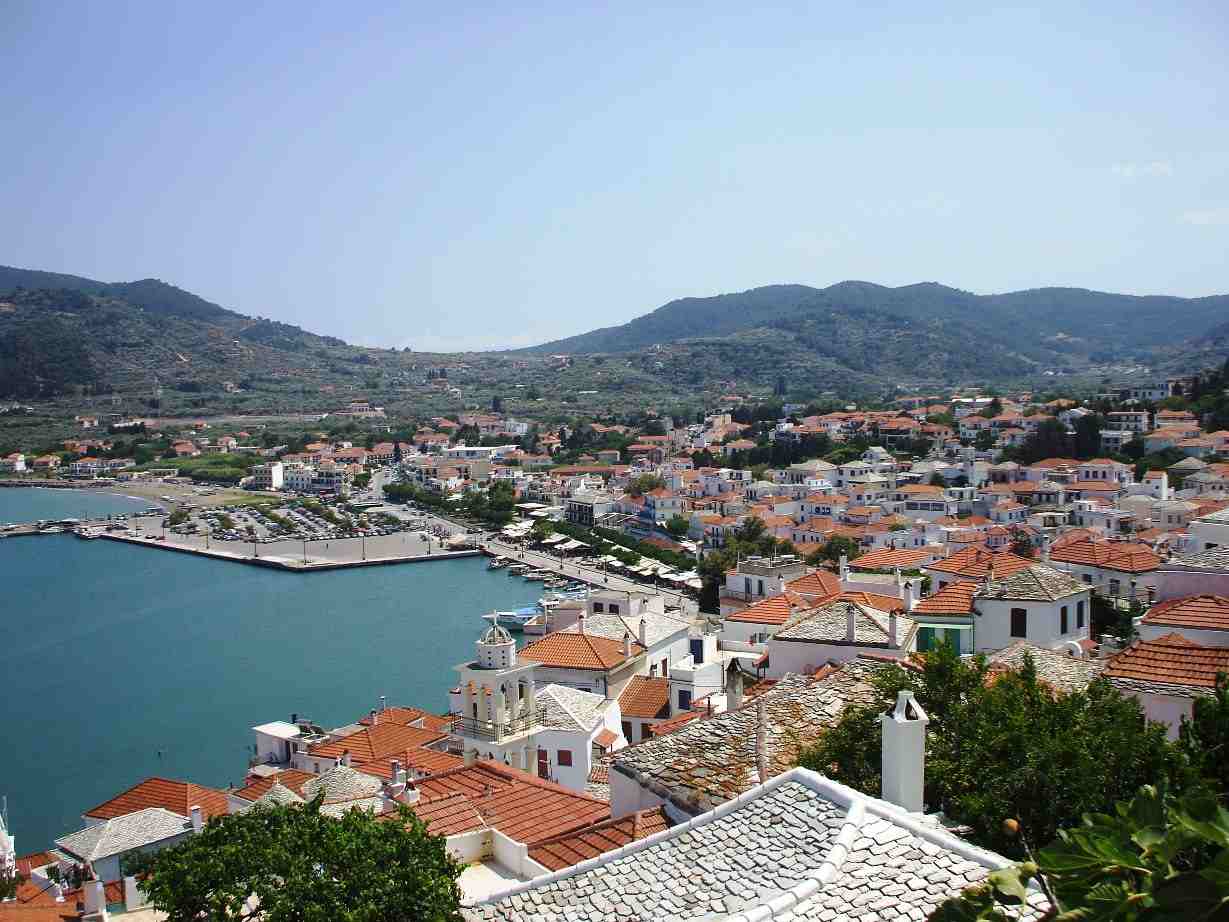
Why does Skopelos Town have more than 120 churches?
Skopelos Town holds reputedly more than 120 churches because generations of seafaring families funded private chapels in thanks for safe voyages. The whole island counts roughly 360 churches, a density rooted in its maritime and Orthodox tradition.
The reputation of Skopelos as an island of churches concentrates in its capital. Local tradition counts more than 120 churches and chapels inside the town alone, with the island total often given as around 360. Most of these are private chapels, built by individual families and rarely larger than a single room. They stand wedged between houses, set into courtyards or attached to the outer walls of homes. A large share open only once a year, on the feast day of the saint to whom they are dedicated. Their blue and white domes punctuate the townscape at every level of the slope.
This density is unusual even by Greek island standards, and it gives the walk through Chora a rhythm of small sacred spaces appearing around almost every corner of the lanes.
The concentration of churches grew from the town’s seafaring history. Skopelos captains and sailors spent long months at sea, and families built chapels as vows for protection and safe return. A successful voyage or a survived storm often prompted the construction of a small church in gratitude. Wealth from shipping and trade paid for the stone, the icons and the painted interiors. The Orthodox calendar, dense with saints’ days, encouraged families to dedicate their own chapel to a chosen patron. Over generations this practice multiplied the number of buildings far beyond the needs of the resident population. The result records the island’s dependence on the sea in stone and plaster.
Each chapel marks a family’s history, and together they turn the town into a physical archive of maritime faith and fortune.
Several churches stand out among the total. The church of Christos, or Christ, holds a central place near the upper lanes and gives its name to a small square. Panagia tou Pyrgou occupies a rocky outcrop above the harbour, its white form visible from the waterfront and from arriving boats. Agios Athanasios beside the Kastro remains the oldest, dating to the 11th century. Other parish churches carry carved marble screens and collections of older icons brought from island monasteries. The larger churches served the parishes of the town, while the tiny chapels served single families. Identifying them becomes part of exploring the lanes, since each carries a name, a dome and a feast day.
The variety in size, dedication and decoration reflects the wide range of families and centuries that produced them across the slope.
The churches are most active on their feast days, when the family or parish opens the building, lights the lamps and holds a service. These panigiria often continue with food and music in the square outside. For visitors, the churches are usually experienced from the outside, since most stay locked between festivals. Their domes and bell towers serve as landmarks for navigating the maze of lanes. Photographers track the white walls against the grey slate roofs and the blue sea below. The sheer number means a walk of an hour passes dozens of them without repetition. Understanding why the town holds so churches turns a simple stroll into a reading of island history.
The chapels remain the clearest expression of the bond between Skopelos, the sea and its Orthodox tradition across the centuries.
What can visitors find in the lanes of Skopelos Town?
The lanes of Skopelos Town hold boutiques, tavernas, cafés and bakeries set among whitewashed houses. Shops sell local crafts and produce, while bakeries offer plum sweets and the island’s spiral cheese pie.
The stone lanes of Skopelos Town carry the island’s commercial life above the harbour. Ground-floor rooms that once stored goods or housed workshops now hold boutiques, jewellers, ceramics studios and shops selling local products. Traders offer Skopelos plums, honey, herbs, olive oil and thyme in the small storefronts. Craft shops display hand-painted icons, woven textiles and pottery made on the island. Because the passages are too narrow for cars, browsing happens on foot, and the shopfronts open directly onto the paved lane. The retail streets cluster in the lower and middle town, close to the waterfront, while the upper lanes stay residential. The mix of goods reflects both the tourist season and the everyday needs of residents.
Wandering these lanes forms the core of a first visit, linking one small square to the next.
Tavernas and restaurants fill the waterfront and spill into the lanes behind it. The kitchens serve Skopelos dishes built on local produce: fish from the surrounding waters, goat and lamb from island flocks, and vegetables grown in the interior valleys. The island plum appears in savoury as well as sweet cooking, paired with pork or baked into pies. Cheese from local dairies fills the pastries and salads. Waterfront tables face the harbour and the moored boats, while the inner courtyards offer shaded seating among the houses. Prices and menus range from simple grill houses to fuller kitchens, and the concentration of options means choice within a short walk.
Dining forms a fixed part of a stay, and the density of tavernas in and around the port makes the capital the island’s main place to eat.
Bakeries and sweet shops give Skopelos Town two signature foods. The first is the spiral cheese pie, tiropita Skopelou, a coil of thin pastry filled with local white cheese and fried until crisp. Bakers form the pastry into a tight spiral, and the shape distinguishes it from the folded pies of the mainland. The second is the plum sweet, made from the island’s prized plums, which are dried, preserved in syrup or baked into pastries. Skopelos plums have a long reputation, and the fruit appears across the town’s bakeries in cakes, spoon sweets and pies. Small ovens and pastry shops in the lanes prepare these daily.
Buying a spiral cheese pie to eat while walking the lanes ranks among the standard experiences of a visit, tying the town’s streets to its distinctive local kitchen.
The lanes change character through the day. Mornings are quiet, with deliveries and residents moving between shuttered shops. By late afternoon the boutiques reopen, and the cafés fill as the heat eases. In the evening the waterfront and the connecting lanes draw the most movement, as diners, families and visitors circulate between tavernas and bars. Small squares under the churches become meeting points, lit by lamps against the white walls. The compact scale keeps everything within walking distance, so an evening moves easily from a harbour table to a lane-side bar to a viewpoint over the bay. This pattern repeats through the season and gives the capital its social rhythm.
The compact centre means an evening in these lanes needs no transport, only comfortable shoes for the steps and the polished cobbles.
What is the waterfront and port of Skopelos Town like?
The waterfront of Skopelos Town lines the harbour with tavernas, cafés and shops along a paved quay. Ferries and hydrofoils dock here, connecting the island to Volos, Agios Konstantinos, Skiathos and Alonissos.
The waterfront is the front line of Skopelos Town, where the tiered houses meet the sea. A paved quay runs the length of the harbour, edged by a low sea wall and a row of buildings that hold tavernas, cafés, bakeries and travel offices. Tables and awnings extend from these onto the promenade, facing the moored boats. The town hall and the main services sit along this strip, making the waterfront the practical centre of the capital. Behind it, the amphitheatrical lanes begin their climb toward the Kastro. The quay curves with the shape of the bay, and a breakwater closes the harbour on its outer side.
This flat, continuous edge contrasts with the steep town above it and gives visitors a level route along the whole seafront from end to end.
The port of Skopelos Town is one of the island’s two ferry harbours, the other being Loutraki below Glossa. Ferries and high-speed hydrofoils dock at the quay, linking the island to the mainland ports of Volos and Agios Konstantinos and to neighbouring Skiathos and Alonissos. Since Skopelos has no airport, these sea routes carry every visitor to the island, most connecting through Skiathos airport by a short ferry hop. Conventional car ferries share the harbour with the faster passenger hydrofoils known as Flying Dolphins. Arrival times cluster around the schedules, briefly filling the quay with luggage and vehicles before the town settles again. The port therefore sets the rhythm of the waterfront.
Details on routes and connections appear in the guide to how to get to Skopelos.
Beyond the ferries, the harbour holds the working and leisure boats of the town. Fishing caiques tie up along the quay, and their morning catch supplies the waterfront tavernas. Excursion boats leave from here for trips around the coast and to the Alonissos marine park, home to the Mediterranean monk seal. Yachts and smaller craft use the outer moorings in summer. The mix of fishing boats, tour vessels and ferries keeps the harbour in constant motion through the day. Nets, ropes and crates line parts of the quay where the fishermen work. This blend of everyday labour and tourism defines the port’s character.
Watching the boats work and dock from a waterfront table is one of the most common ways visitors pass time in the capital through the day.
The waterfront doubles as the town’s main promenade. In the evening, residents and visitors walk its length between the harbour entrance and the far end of the quay, a level stroll that suits all ages. The line of lit tavernas reflects on the water, and the tiered town glows above. This seafront concentrates the capital’s social life at ground level, complementing the quieter residential lanes higher up. Benches and low walls give places to sit and watch the harbour. The flat, open space also hosts occasional markets and events. Because it holds the ferries, the services and much of the dining, the waterfront is the point most visitors reach first and return to often.
It functions as the hinge between arriving by sea and climbing into the old town above the quay.
Which museums can visitors explore in Skopelos Town?
Skopelos Town holds the Folklore Museum and the Vakratsa mansion, both housed in preserved period homes. The Folklore Museum displays local costume, crafts and furniture, while the Vakratsa house records the life of a prominent island family.
The Folklore Museum of Skopelos occupies a 19th-century mansion in the old town, close to the waterfront lanes. Its rooms preserve the interior of a well-off island house of the period, with carved wooden ceilings and traditional furnishings. Displays gather local costumes, embroidery, weaving and household objects that record daily life on the island before the modern era. A bridal chamber laid out in full costume shows the textile skills of Skopelos women. Farming and fishing tools illustrate the work that supported the town. The museum sets these objects within the actual domestic spaces where they were used, so visitors read the collection as a furnished home rather than as isolated cases.
The building itself, with its stone lower floor and timber upper storey, demonstrates the local architecture described throughout the old town.
The Vakratsa mansion is a second house museum in the heart of Skopelos Town. The building was the home of the Vakratsas family, which produced doctors and notables prominent in the island’s history. The house has been preserved with its original furniture, personal belongings, documents and religious icons intact. Its rooms record the domestic world of an educated island family across generations. Medical instruments, books and portraits sit alongside everyday furnishings, giving a fuller picture than costume alone. The mansion’s architecture, with its enclosed wooden balcony and painted interiors, represents the finer houses of the capital. Set among the lanes, it offers a direct look inside one of the town’s historic homes.
Together with the Folklore Museum, it forms the pair of house museums that anchor the town’s cultural offering above the harbour.
Both museums focus on domestic and social history rather than archaeology. They record how island families lived, dressed, worked and worshipped in the centuries when Skopelos depended on shipping, farming and its plum harvest. Costumes show the layered dress of festivals and weddings. Kitchen and loom equipment reveal the self-sufficient household economy. Icons and family papers connect the homes to the town’s dense religious life and its network of churches. Because the collections sit inside authentic mansions, they also serve as examples of the architecture that fills the old town. A visit to either takes under an hour and adds context to a walk through the lanes outside.
The objects explain the town seen on the surface, from the slate roofs to the enclosed balconies and the family chapels along the slope.
Beyond the two house museums, the town’s heritage is spread through its churches, the Kastro and the built fabric of the lanes themselves. The larger churches hold older icons and carved screens that function as small treasuries of religious art. The Kastro preserves the layered history of ancient and Venetian construction on the summit. Seasonal exhibitions and cultural events add to the fixed sites during the summer. For visitors, the museums provide a starting point that makes the rest of the town legible. Seeing the furnished interiors first, then walking the lanes, connects the objects to the streets.
This concentration of accessible heritage in a compact area is a reason the capital rewards more than a passing visit and supports a stay of days on the island.
How do visitors reach and move around Skopelos Town?
Visitors reach Skopelos Town by ferry or hydrofoil to its harbour, most connecting through Skiathos airport since the island has none. Inside the old town, movement is on foot along stepped, car-free lanes.
Reaching Skopelos Town starts with a sea crossing, since the island lies in the Sporades northeast of the mainland. Ferries and hydrofoils run from the mainland ports of Volos and Agios Konstantinos and from neighbouring Skiathos and Alonissos. The vessels dock directly at the town’s harbour, placing arrivals at the foot of the tiered old town. Crossing times vary with the vessel and route, from roughly two to four hours from the mainland, and under an hour from Skiathos. The port at Chora is the busier of the island’s two harbours, so most services call here. Booking ahead matters in the peak summer weeks, when demand for both foot passengers and vehicles rises.
The harbour berth places every arrival within a short walk of the waterfront tavernas and the start of the climb into the old town.
Skopelos has no airport of its own, so air travellers route through the airport on neighbouring Skiathos. From Skiathos, a ferry or hydrofoil completes the journey to Skopelos Town in well under an hour. This two-stage trip, a flight to Skiathos followed by a short sea crossing, is the standard way visitors from abroad reach the island. In peak season some direct mainland ferries also connect through Agios Konstantinos and Volos for those arriving overland. The lack of an airport keeps the island quieter than its neighbour and preserves the pace of the town. Travellers plan connections around the ferry timetable, since the last boat of the day sets the limit on same-day arrival.
Coordinating the flight and the ferry is the main logistical step for reaching the capital by air and sea.
Inside Skopelos Town, movement is almost entirely on foot. The stone lanes of the old town are too narrow for cars, and many convert to steps as they climb. Walking is therefore the only way to reach the upper quarters, the churches and the Kastro. The gradient is demanding in the higher lanes, so footwear with grip matters on the polished cobbles. Distances are short despite the effort, and the whole old town crosses in under twenty minutes on foot. The car-free centre keeps the lanes quiet and safe for wandering. Signposting is limited, so visitors navigate by landmarks such as the churches and the line of the sea.
Getting lost briefly in the maze is part of the experience, and every downhill lane eventually returns to the harbour below.
Vehicles stay at the edges of the old town. A waterfront road and parking areas near the harbour serve cars, but drivers leave them there before entering the lanes on foot. The island’s bus service links Skopelos Town with Glossa, Stafilos, Panormos and the main beaches, running from a stop near the port. Taxis wait at the harbour for trips beyond walking range, including the drive toward Agios Ioannis Kastri and the northern villages. Rental cars and scooters give the most freedom for exploring the rest of the island from a base in the capital. Within the town, though, no transport is needed or possible beyond one’s own feet.
This division between a car-free core and a road network at its edge is standard for the preserved Sporades capitals.
Where do visitors stay in Skopelos Town and what lies nearby?
Visitors stay in Skopelos Town in restored houses, small hotels and rooms within the old town and along the waterfront. Nearby lie Stafilos beach, the Sendoukia rock tombs and, farther north, Agios Ioannis Kastri.
Skopelos Town offers the widest choice of accommodation on the island. Restored stone houses in the old town serve as guesthouses, while small hotels and rooms occupy the waterfront and the slopes above it. Staying inside the amphitheatrical lanes places visitors among the churches and shops, within steps of the harbour tavernas. The trade-off is the climb, since a portion of old-town rooms are reached only by stairs. Properties nearer the port and the road offer easier access for those with luggage or limited mobility. The range runs from simple rooms to boutique conversions of period mansions. Because the town is compact, almost every option sits within a short walk of the waterfront.
Guidance on districts, seasons and options appears in the guide to where to stay in Skopelos.
Basing a stay in the capital suits visitors who want services, dining and heritage on the doorstep. The town holds the fullest concentration of tavernas, shops and boats on the island, and the bus and taxi links radiate from here. This makes it a practical hub for day trips without a car. Travellers seeking quiet beaches or a resort setting sometimes choose Panormos, Stafilos or the Glossa area instead, then visit the capital for evenings out. Each base has a different rhythm: the town for atmosphere and convenience, the coast for direct beach access. A share of visitors split their time, spending part of a trip in Chora and part near the water.
The decision turns on whether the priority is the town’s streets or the island’s beaches and coves.
Several sites lie within a short drive of Skopelos Town. Stafilos beach, about four kilometres south, is the nearest organised beach, backed by pines and named after a Minoan-era figure whose tomb was found there. Beside it, the quieter Velanio beach continues along the same bay. Inland, the Sendoukia rock-cut tombs sit on a ridge reached by a marked path, offering both antiquity and wide views. The monasteries on the slopes of Mount Palouki, east of the town, form another close excursion, a group of them within a short drive or a longer walk. These nearby points let visitors combine the capital with beaches, ancient remains and religious sites in a single day.
The concentration of options close to the town reinforces its role as the base for exploring the island.
Farther afield, the island’s best-known sights lie along the roads north and west from the capital. The chapel of Agios Ioannis Kastri, the clifftop church from the film Mamma Mia!, sits about forty minutes’ drive toward Glossa. The traditional village of Glossa and its port at Loutraki anchor the northwest end of the island. Panormos and Milia hold the largest beaches on the sheltered west coast. From a base in Skopelos Town, each of these is a half-day or day trip by car, scooter or bus. The capital’s central position and transport links make it the natural launch point.
Combining the town’s own streets, museums and Kastro with these outlying destinations fills a stay of days and covers the range of the island.
Frequently Asked Questions
How long does it take to walk up to the Kastro in Skopelos Town?
The climb from the harbour to the Kastro takes about ten to fifteen minutes on foot. The route follows the stepped stone lanes that rise through the old town, gaining height with each turn. The gradient is steep in places, and much of the path converts to stairs rather than sloped street. Walkers cross several small squares and pass dozens of churches on the way up, so the ascent doubles as a tour of the town. The polished cobbles become slippery, so footwear with grip helps, especially after rain. There are no vehicles on the route, since the lanes are too narrow for cars.
Near the summit the path passes through the old castle gateway onto the open citadel ground beside the church of Agios Athanasios. The reward at the top is the wide view over the harbour, the tiered rooftops and the Aegean. Most visitors of average fitness manage the climb without difficulty, pausing at the squares along the way.
What food is Skopelos Town known for?
Skopelos Town is known above all for two local foods: the spiral cheese pie and the island plum. The cheese pie, tiropita Skopelou, is a coil of thin pastry filled with local white cheese and fried until crisp, its spiral shape setting it apart from mainland pies. Bakeries in the lanes prepare it fresh, and eating one while walking the town is a standard experience. The Skopelos plum has a long reputation and appears across the town’s kitchens and bakeries. Cooks dry the fruit, preserve it in syrup as a spoon sweet, and bake it into cakes and pastries. The plum also enters savoury dishes, paired with pork in traditional recipes.
Beyond these signatures, the tavernas serve fish from the surrounding waters, goat and lamb from island flocks, local cheeses and vegetables from the interior valleys. The waterfront holds the greatest concentration of tavernas on the island, making the capital the main place to sample this local kitchen.
When is the best time to visit Skopelos Town?
The period from May to early October forms the main season for visiting Skopelos Town, when ferries run frequently and the tavernas, shops and museums open fully. July and August bring the warmest weather and the largest crowds, along with the busiest ferry schedules and the highest room prices. Late May, June and September offer warm sea temperatures with thinner crowds and easier availability, which suits walkers tackling the town’s steep lanes in comfort. Spring adds wildflowers across the pine-covered slopes, while autumn holds the sea warmth into October. Outside this window, from November to April, a large share of tavernas and rooms close, ferry links thin out, and the town returns to its quiet resident life.
Feast days scattered through the calendar open individual churches for services and celebrations, adding local colour to a visit. For a balance of open services, warm water and a walkable town, the shoulder months of June and September rank as the practical choice for most travellers.
Is Skopelos Town walkable, and can you drive into it?
Skopelos Town is fully walkable, and the historic core is closed to cars by its own layout. The stone lanes of the old town are too narrow for vehicles, and many turn into flights of steps as they climb toward the Kastro. Walking is therefore the only way to reach the upper quarters, the churches and the castle. Distances stay short, and the whole old town crosses on foot in under twenty minutes, though the gradient adds effort. Cars stop at the edges of the town, using the waterfront road and parking areas near the harbour before visitors continue on foot. The island bus and taxis also operate from stops by the port for trips beyond the town.
Footwear with grip matters on the polished cobbles and steps. The car-free centre keeps the lanes quiet and safe for wandering, and every downhill lane leads back toward the harbour, which makes navigation simple despite the maze of alleys.
What is the church of Agios Athanasios in Skopelos Town?
Agios Athanasios is the oldest church in Skopelos Town, standing at the summit beside the Venetian Kastro. It is believed to date to the 11th century, built on the foundations of an earlier structure on the highest ground of the settlement. The church is small and low, constructed from stone in the plain style of early island churches. Its interior holds frescoes painted in later centuries, darkened by age but still legible on the walls. The position next to the castle links the religious and defensive centres of the medieval town in a single cluster at the top of the climb.
The church remains in use for occasional services and forms a fixed point on any walk to the Kastro. Together with the ancient acropolis stone reused in the castle walls, it marks the layered history of the hilltop. Reaching it rewards visitors with both the building itself and the wide Aegean views from the surrounding citadel ground.
How far is Skopelos Town from the airport and the other ferry port?
Skopelos has no airport, so the nearest air gateway is the airport on neighbouring Skiathos, reached from Skopelos Town by a ferry or hydrofoil crossing of well under an hour. Air travellers fly to Skiathos and complete the journey by sea to the town’s harbour. Within the island, Skopelos Town lies about 28 kilometres from Glossa and its port at Loutraki. The island’s second ferry harbour, a drive of roughly 45 minutes across the pine-covered interior. Some ferries call at Loutraki rather than the town, so travellers check which port their boat uses before booking transfers. The bus service connects the two ends of the island through the day, and taxis cover the route on demand.
The mainland ports of Volos and Agios Konstantinos sit two to four hours away by sea, depending on the vessel and the weather. These sea crossings are the standard routes onto the island, since every arrival to Skopelos comes by boat rather than by plane.
Where can visitors park when visiting Skopelos Town?
Visitors park at the edges of Skopelos Town rather than inside it, since the old-town lanes admit no cars. Parking areas and roadside spaces sit along the waterfront and on the approach roads near the harbour, from where the town is entered on foot. In the peak summer weeks these fill early in the day, so arriving in the morning improves the chances of a space close to the centre. Larger free areas lie a short walk from the harbour at the town’s outskirts, adding minutes on foot. Drivers then leave the vehicle and continue through the stepped lanes, which no car can climb.
The island bus and taxis offer an alternative for reaching the town without parking at all. Rental scooters take up less space and park more easily near the waterfront. Planning to walk the last stretch on foot is part of any visit, since the car-free core is reached only on foot.