
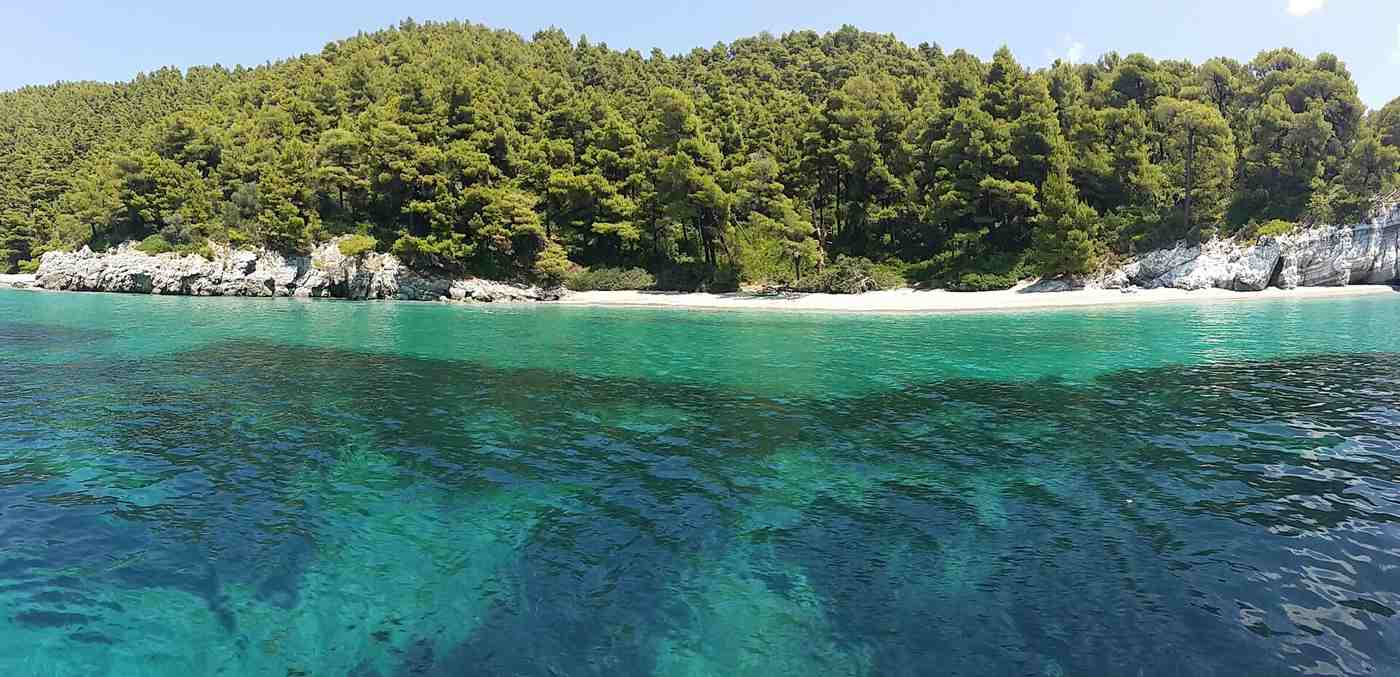
Skopelos sits in the Northern Sporades and has no airport, so every visitor arrives by sea. Ferries and hydrofoils run from three mainland ports and from neighbouring Skiathos, docking at two harbours: Skopelos Town in the east and Glossa-Loutraki in the north. This guide maps the routes, ports, sailing times and connections you need to plan the crossing to Skopelos. Plan the whole trip with Greece Tours.
The nearest airport is on Skiathos (JSI), about a 40 to 45 minute ferry or hydrofoil hop from Skopelos. From the mainland, conventional ferries, high-speed catamarans and Flying Dolphin hydrofoils depart Volos, Agios Konstantinos and Mantoudi on Evia. Drivers reach Volos from Athens in about 4.5 hours and from Thessaloniki in about 2.5 hours. Skopelos also links directly with its Sporades neighbours Skiathos and Alonnisos.
How do you get to Skopelos?
Skopelos is reached only by sea. Ferries, high-speed catamarans and hydrofoils sail from Skiathos and from the mainland ports of Volos, Agios Konstantinos and Mantoudi, docking at Skopelos Town or Glossa-Loutraki.
Skopelos has no airport, so the whole journey ends with a boat crossing. Travellers combine a flight or a road trip to a departure point with a ferry, a high-speed catamaran or a Flying Dolphin hydrofoil. The island keeps two working harbours. Skopelos Town, the capital on the east coast, handles the bulk of arrivals and sits beside the island’s hotels, tavernas and bus terminal. Glossa uses the port of Loutraki on the northwest coast, closer to Skiathos and the shorter crossings. Choosing the right harbour depends on where you are staying and which mainland port your ferry leaves from.
Both harbours connect to the island road network and to taxis, so onward transfer stays straightforward from either arrival point. Ferry frequency rises in summer and thins in winter across Skopelos.
Two broad routes lead to Skopelos. The first flies into Skiathos, the airport island 12 nautical miles west, then crosses by boat in about 40 to 45 minutes. The second drives or rides a coach to a mainland ferry port and boards there. Volos, on the Pagasetic Gulf, offers the widest choice of sailings across the year. Agios Konstantinos, roughly halfway between Athens and Volos, shortens the road leg from the capital. Mantoudi, on the island of Evia, gives the closest mainland departure point to the Sporades and the shortest open-sea crossing. Each port serves both Skopelos Town and Glossa-Loutraki on different sailings.
The harbour you land at is set by the specific boat you book rather than by the port you leave from.
Vessel type shapes both the price and the crossing time to Skopelos. Conventional car ferries carry vehicles and run slower but steadier, which suits travellers bringing a car or wanting a calmer ride. High-speed catamarans cut the sailing time sharply and take foot passengers plus, on boats, a limited number of cars. Flying Dolphin hydrofoils move only foot passengers and rank among the quickest options on the shorter legs. Anyone driving to the island needs a conventional ferry or a car-carrying fast boat, because hydrofoils leave no room for a vehicle. Booking the vessel that matches your luggage.
Your budget and whether you need a car on Skopelos removes most of the guesswork from the final leg of the trip to Skopelos, whatever season you travel in.
Season decides how often boats sail to Skopelos. Summer brings the fullest timetable, with daily departures from every mainland port and frequent hops from Skiathos across the day. Spring and autumn thin the schedule to a handful of weekly sailings, and winter runs the leanest service, built mainly around the conventional ferry from Volos. Booking ahead matters most in July and August, when cars fill the ferry decks and the fast boats sell out. Foot passengers keep more flexibility, yet still gain from reserving a seat in peak weeks.
Once you know your dates, checking the live timetable for that month fixes the realistic choices, since operators adjust routes and frequencies through the year rather than holding one fixed pattern. A check of the current month is the safest final step to Skopelos.
Which airport is nearest to Skopelos and why has the island none?
Skiathos airport (JSI) is the nearest, about a 40 to 45 minute ferry hop west of Skopelos. Skopelos itself has no airport because its steep, pine-covered terrain leaves no flat coastal strip long enough for a runway.
Skopelos carries no airport of its own, and the reason is geography. The island rises steeply from the sea into forested ridges, and its coastline offers no long, flat plain where a runway would sit. Building an airstrip would demand levelling protected pine forest and reshaping the shore, which the island’s terrain and character rule out. Skiathos, the western neighbour, holds a narrow coastal flat beside its capital that fits a single short runway, so it became the air gateway for the whole western Sporades. Alonnisos, on the eastern side, shares the same fate as Skopelos and also depends on ferries.
This split leaves Skiathos airport handling the seasonal flights while Skopelos and Alonnisos receive their visitors entirely by boat across the short strait that separates them from Skiathos.
Skiathos airport carries the code JSI and sits at the eastern end of Skiathos, right by the water. Its runway is one of the shorter commercial strips in Greece, which produces the low, close approaches that plane-watchers gather to see. In summer the airport takes domestic flights from Athens and Thessaloniki plus charter and scheduled services from across Europe. Outside the warm months the schedule shrinks to the domestic links, so winter arrivals usually route through Athens first. From the terminal a short taxi or bus ride reaches Skiathos town and its port, where the boats to Skopelos wait.
Timing the flight to connect with an onward sailing is the key planning step, because a missed late boat can strand you on Skiathos for the night.
The airport’s location makes Skiathos the practical hub for reaching Skopelos by air. Once you land, the transfer is a two-part move: cross Skiathos town to the harbour, then board a ferry or hydrofoil for the strait. The port sits about 2 to 3 kilometres from the runway, a ride of roughly 10 minutes by taxi. Hydrofoils and catamarans make the western Sporades crossing in about 40 to 45 minutes to Skopelos Town, or less to Glossa-Loutraki, which lies closer to Skiathos. Because the two legs run on separate timetables, travellers build in a buffer between the flight’s arrival and the boat’s departure.
A gap of a couple of hours absorbs baggage delays and the town transfer without risking the connection onward to Skopelos. It leaves room for the harbour traffic that builds in summer.
Some travellers weigh flying into Athens instead of Skiathos, then continuing overland and by sea. This route trades a short island flight for a longer land journey but runs all year and often costs less. From Athens the road heads north to Agios Konstantinos or Volos, where the mainland ferries board. The Skiathos flight suits visitors short on time or arriving from abroad in summer, while the Athens option suits off-season trips, drivers bringing a car and anyone wanting to see mainland Greece on the way. Both funnel into the same short crossings at the end, so the decision rests on your dates, your budget and whether Skiathos holds a convenient flight.
Either way, the last stretch to Skopelos is always a boat ride across the Sporades.
How do you reach Skopelos from Skiathos?
You cross from Skiathos to Skopelos by ferry, catamaran or hydrofoil in about 40 to 45 minutes. Boats leave Skiathos town port, a short ride from the airport, and dock at Skopelos Town or the closer Glossa-Loutraki.
Skiathos is the standard stepping stone to Skopelos for anyone arriving by air. After landing at JSI, travellers move the short distance to Skiathos town port, the single harbour on the island’s south coast. From there, boats bound for the eastern Sporades call at Skopelos on their way to Alonnisos. The crossing is one of the shortest inter-island hops in the group, so it fits neatly onto the end of a travel day. In high summer the boats run through the day, giving arriving passengers a choice of departures. Outside peak season the sailings thin out, which makes checking the day’s timetable before committing to a flight time worthwhile.
The short strait means even a conventional ferry reaches Skopelos without the long open-sea legs of the mainland routes.
Three kinds of boat cover the Skiathos-to-Skopelos leg. Flying Dolphin hydrofoils carry foot passengers only and cross fastest, skimming the strait in around 40 minutes to Skopelos Town. High-speed catamarans match a similar pace and take both passengers and, on services, a small number of cars. Conventional car ferries run slower at roughly an hour but load vehicles freely. Which is the route to pick if you have hired a car on Skiathos or brought your own. All three leave from the same Skiathos town quay, though the exact berth varies by operator. Because the leg is short, the time difference between the fast boats and the ferry is modest.
Travellers often choose by whether they need to move a car rather than by pure speed to Skopelos.
The harbour you reach on Skopelos depends on the boat. Many sailings from Skiathos call first at Glossa-Loutraki, the northern port, before rounding the coast to Skopelos Town. Glossa lies closer to Skiathos, so its crossing runs shorter, sometimes near 25 to 30 minutes. If your accommodation sits in the north of the island, near Glossa or Loutraki, stepping off there saves a long road transfer. Travellers staying in or near the capital stay aboard for Skopelos Town. Reading the timetable’s port-of-call column before booking prevents landing at the wrong end of the island, since the two harbours sit about 30 kilometres apart by road.
A short local bus or taxi bridges any gap, but landing near your base keeps the final transfer simple on Skopelos.
Connecting a flight with the boat needs a small time cushion. Skiathos airport and the port share a busy town in summer, and the transfer, though short in distance, can slow when traffic thickens near the harbour. Allowing a couple of hours between a flight’s scheduled arrival and the boat’s departure covers baggage reclaim, the ride to the quay and any delay. If the timing does not line up, Skiathos holds hotels for an overnight stay before an early crossing to Skopelos. Travelling with a car adds a further step, as vehicles board conventional ferries that fill in peak weeks, so a vehicle reservation is prudent.
With the buffer built in, the Skiathos link remains the quickest way to reach Skopelos for visitors flying into the Sporades.
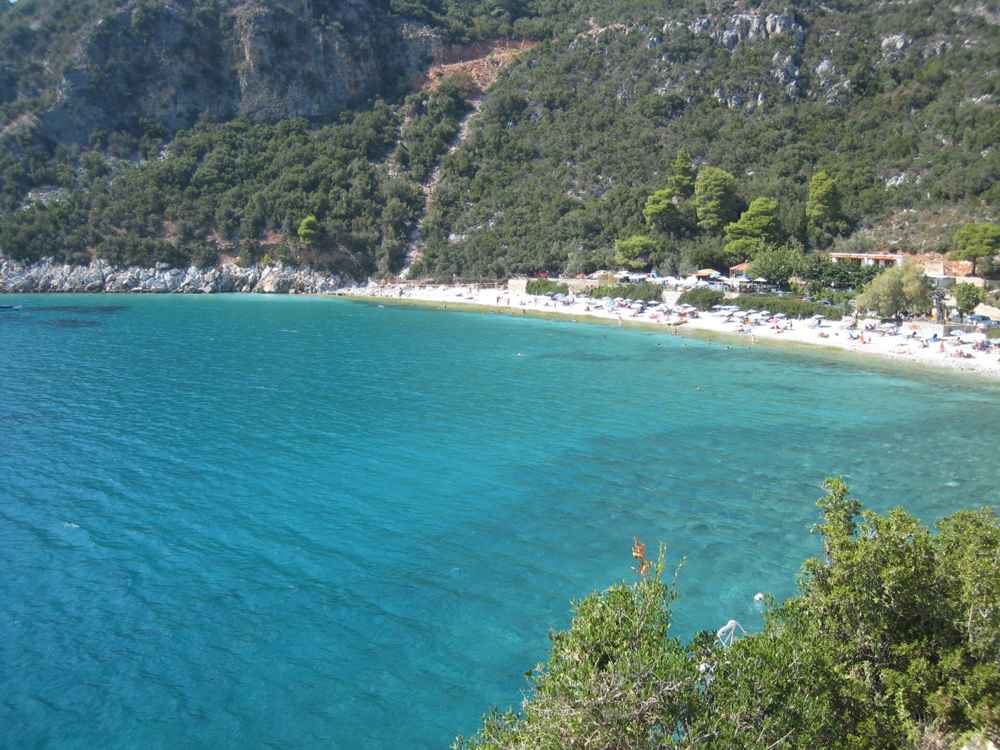
Which mainland ports run ferries to Skopelos?
Three mainland ports serve Skopelos: Volos on the Pagasetic Gulf, Agios Konstantinos between Athens and Volos, and Mantoudi on the island of Evia. Each sends ferries and fast boats to Skopelos Town and Glossa-Loutraki.
Volos is the principal mainland gateway to Skopelos. The port lies on the Pagasetic Gulf in Thessaly and offers the widest spread of sailings across the year, including the winter service when other routes fall quiet. Conventional ferries, high-speed catamarans and hydrofoils all leave from Volos, so travellers find the fullest range of vessel types and departure times here. The city sits about 4.5 hours by road from Athens and about 2.5 hours from Thessaloniki, which places it within reach of both major hubs. Volos also holds its own regional airport with limited seasonal flights.
For drivers bringing a car to Skopelos, Volos is the most dependable choice, because its conventional ferries load vehicles daily in summer and keep a reduced but steady schedule through the colder months.
Agios Konstantinos shortens the journey for travellers coming from Athens. The port sits on the mainland coast roughly halfway between the capital and Volos, about 2.5 hours by road from Athens. In summer it runs frequent fast boats and ferries to the Sporades, calling at Skopelos on the eastern run. Because the road leg from Athens is shorter than the drive to Volos, Agios Konstantinos suits visitors landing at Athens airport who want to reach Skopelos the same day. The trade-off is a thinner off-season timetable, as the port focuses its service on the warm months when demand peaks. Coaches from Athens connect to the port.
Travellers without a car can still use this route, boarding a boat that reaches Skopelos across the open Aegean in hours.
Mantoudi gives the closest mainland departure to Skopelos. The port sits on the northeast coast of Evia, the long island bridged to the mainland, and its position cuts the open-sea crossing to the shortest of the three routes. Fast boats from Mantoudi reach the Sporades quickly, calling at Skiathos, Skopelos and Alonnisos. Reaching Mantoudi means driving across Evia via the Chalkida bridge or the Arkitsa ferry link, a route that Athens travellers use to trim the sea time. The port is smaller and quieter than Volos, with a schedule built around the fast catamaran rather than a broad ferry fleet.
For travellers who want the least time on the water and do not mind the drive over Evia, Mantoudi is the shortest hop to Skopelos.
Choosing between the three ports comes down to your starting point and your priorities. Volos wins for range and for year-round reliability, especially with a car. Agios Konstantinos trims the drive from Athens and runs a strong summer schedule. Mantoudi offers the shortest crossing for those willing to drive across Evia. Distance, sailing time and season all pull the decision differently, so travellers weigh the road leg against the sea leg for their own dates. A visitor flying into Athens in July often picks Agios Konstantinos, while a driver from northern Greece heads to Volos. Whichever port you choose, all three deliver you to the same two harbours, Skopelos Town or Glossa-Loutraki.
Where the island’s roads and buses take over for the final stretch on Skopelos.
How long does the ferry to Skopelos take?
Crossing times to Skopelos vary by port and vessel. From Skiathos the hop runs about 40 to 45 minutes; from Mantoudi around 2 hours; from Agios Konstantinos and Volos roughly 3 to 4.5 hours depending on the boat.
Sailing time to Skopelos depends far more on the departure port and the boat than on the destination harbour. The Skiathos crossing is the shortest, at about 40 to 45 minutes to Skopelos Town and less to Glossa-Loutraki. Mantoudi, the closest mainland port, lands passengers in around 2 hours by fast catamaran. Agios Konstantinos and Volos sit farther out across the Aegean. Their crossings stretch longer, from roughly 3 hours on a high-speed boat to about 4.5 hours on a conventional ferry. These figures shift with sea conditions, the number of intermediate stops and the specific vessel, so treat them as guides rather than fixed values.
Checking the timetable for your chosen date shows the exact duration each individual sailing to Skopelos is scheduled to take.
Vessel type splits the timings sharply on the longer routes. A conventional car ferry from Volos loads vehicles. Sails at a steady pace and often calls at Skiathos on the way. Its run to Skopelos sits at the upper end near 4.5 hours. A high-speed catamaran on the same route skips much of that time, reaching Skopelos in about 3 hours. On the short Skiathos leg the gap narrows, because even the slower ferry crosses in about an hour while the hydrofoil manages 40 minutes. Travellers trading time for cost weigh these differences: the fast boats charge more and cut the crossing, while the conventional ferries cost less and run longer.
For a car, the conventional ferry is the only choice on the mainland routes to Skopelos.
Intermediate stops lengthen sailings to Skopelos. Boats on the eastern Sporades line often call at Skiathos first, then Glossa-Loutraki, before reaching Skopelos Town, and a few continue to Alonnisos. Each call adds docking and loading time, so a sailing with two stops runs longer than a direct one covering the same distance. Reading the route’s list of ports of call reveals whether your boat runs express or threads the islands. If Glossa-Loutraki serves your accommodation, an earlier stop there actually shortens your own journey, since you step off before the final leg to the capital. Travellers heading for Skopelos Town accept the extra calls as part of the crossing.
Matching the sailing pattern to your base on the island keeps the real door-to-door time down.
Total travel time to Skopelos combines the sea leg with the road or air leg before it. A flight into Skiathos plus the short boat can reach Skopelos in an afternoon from abroad, but the connection must line up. An overland trip from Athens adds the drive to a mainland port, roughly 2.5 hours to Agios Konstantinos or 4.5 hours to Volos, before the sea crossing begins. Northern travellers from Thessaloniki reach Volos in about 2.5 hours. Building the full chain, whether flight-plus-boat or drive-plus-boat, gives a realistic arrival time and shows where the buffers belong.
The boat timetable anchors the plan, and the earlier legs are timed to meet it for a smooth arrival on Skopelos.
What is the difference between Skopelos Town port and Glossa-Loutraki?
Skopelos Town is the main port on the east coast, beside the capital and most hotels. Glossa uses the port of Loutraki in the northwest, closer to Skiathos and the shorter crossings. The two harbours sit about 30 kilometres apart.
Skopelos runs two ferry harbours, and the choice between them shapes your transfer on arrival. Skopelos Town, on the sheltered east coast, is the busier of the pair. It sits directly below the amphitheatrical capital, so stepping off the boat leaves you within walking distance of hotels, tavernas, the bus terminal and taxis. Most conventional ferries and a share of the fast boats terminate here. If your accommodation lies in or near the capital, or anywhere along the eastern and southern coasts, landing at Skopelos Town keeps the onward journey short. The harbour also hosts local boat trips and the island’s main bus routes, which fan out to the beaches and villages.
For the majority of visitors, Skopelos Town is the natural and most convenient arrival point.
Glossa uses the port of Loutraki, a small harbour on the northwest coast below the hillside village of Glossa. Loutraki sits closer to Skiathos, so boats from the western Sporades and some mainland fast services call here first or terminate here. The crossing from Skiathos to Loutraki runs shorter than the run to Skopelos Town, sometimes near 25 to 30 minutes. The village of Glossa climbs the slope above the port, a short bus or taxi ride uphill, while Loutraki itself holds a cluster of tavernas along the water. Travellers staying in the north of the island save a long road transfer by landing here rather than at the capital.
The two ports lie about 30 kilometres apart by the island’s main road across Skopelos.
The right harbour depends on where you sleep and which boat you take. A visitor booked into Skopelos Town or the eastern beaches wants the capital’s port, while someone staying near Glossa, Loutraki or the northern coast benefits from Loutraki. Not every sailing serves both, so travellers read the port-of-call column before booking rather than assuming a single arrival point. A boat that terminates at Loutraki leaves a 30-kilometre bus or taxi ride to reach the capital, and the reverse holds for the north. Matching the ticket to your base removes that extra leg. When the schedule forces the wrong harbour, the island’s buses and taxis bridge the distance along the coastal road.
Planning the landing near your accommodation is the simpler path on Skopelos.
Both harbours connect smoothly to the island’s transport once you land. Skopelos Town holds the main bus terminal, from which routes run north along the coast through Stafylos. Agnontas, Panormos and Elios up to Glossa and Loutraki. Taxis wait at the quay. Loutraki has its own bus stop feeding the same coastal line and taxis for the short climb to Glossa village. Car and scooter hire operates from Skopelos Town and can be arranged for either arrival point. Whichever harbour your boat uses, the transfer to accommodation is short when you have matched the two, and manageable by public transport when you have not.
Knowing which port your sailing uses before departure is the single detail that keeps arrival on Skopelos free of surprises.
How do you drive to the ferry ports for Skopelos?
Drivers reach Volos from Athens in about 4.5 hours and from Thessaloniki in about 2.5 hours. Agios Konstantinos lies about 2.5 hours from Athens, and Mantoudi on Evia is reached across the Chalkida bridge before boarding a boat to Skopelos.
Reaching Skopelos overland starts with a drive to one of the three mainland ferry ports. From Athens the main motorway heads north toward Lamia, and the road to Agios Konstantinos branches off at about the halfway point, roughly 2.5 hours from the capital. Continuing north on the same corridor and turning east toward Thessaly brings drivers to Volos in about 4.5 hours from Athens. From Thessaloniki the drive south to Volos runs about 2.5 hours. These times assume steady traffic and no long breaks, so summer weekends and holiday getaways can stretch them. Fuel stops, tolls and rest areas line the motorways, and the routes are well signed toward the ports.
Planning the drive to finish comfortably before the boat’s departure builds in a margin for the trip to Skopelos.
Volos rewards the longer drive with the widest choice of sailings. The city sits at the head of the Pagasetic Gulf. Its ferry terminal lies on the central waterfront. Close to parking for foot passengers and to the vehicle marshalling lanes for those loading a car. Drivers arriving to board a conventional ferry follow the port signs to the car queue, where staff direct loading. Travellers leaving a car on the mainland instead find long-stay parking near the quay. Because Volos runs sailings year-round, it is the dependable option for off-season drives to Skopelos. The road approach from both Athens and Thessaloniki funnels into the city’s ring road before reaching the port.
Allowing extra minutes for urban traffic near the waterfront keeps the boarding stress-free.
Agios Konstantinos suits drivers who want to trim the road time from Athens. The port sits directly on the coastal side of the main north road, about 2.5 hours from the capital, so the turn-off leads quickly to the quay. Parking near the harbour lets foot passengers leave a car for the trip, while those taking a vehicle across follow the loading lanes. The shorter drive is balanced by a schedule weighted toward summer, so off-season travellers usually prefer Volos. For a July or August trip from Athens, though, Agios Konstantinos often gives the fastest overall door-to-door time to Skopelos.
Pairing a two-and-a-half-hour drive with a fast-boat crossing rather than a longer haul to Volos and a comparable sea leg, which is why summer visitors from the capital weigh it first for Skopelos.
Mantoudi asks for a drive across Evia but offers the shortest sea crossing. From Athens the route heads north to Chalkida, crosses the bridge onto Evia, then runs up the island’s length to the northeast coast where Mantoudi sits. The drive is longer and slower than the mainland motorway runs, threading Evian towns and hills, so travellers weigh the extra road time against the shorter boat leg. An alternative reaches northern Evia by the Arkitsa-to-Aidipsos ferry, shifting part of the journey onto the water. Mantoudi’s fast catamaran then reaches Skopelos in around 2 hours. For drivers who prefer less time at sea and treat the Evia crossing as part of the trip.
Mantoudi is a workable route, though most first-time visitors choose Volos or Agios Konstantinos for Skopelos.
How does Skopelos connect with Skiathos and Alonnisos?
Skopelos links directly with its Sporades neighbours by frequent short sailings. Skiathos lies about 40 to 45 minutes west by fast boat, and Alonnisos about 20 to 30 minutes east. The three islands share the same ferry and hydrofoil lines.
Skopelos sits in the middle of the inhabited Sporades, between Skiathos to the west and Alonnisos to the east, and the three islands share a single web of sailings. The same conventional ferries, catamarans and hydrofoils that link them to the mainland also hop between the islands, so moving from one to another is quick and routine. This shared network makes island-hopping across the Sporades straightforward, and it means Skopelos can be reached via either neighbour when a direct sailing does not suit. Because the crossings are short, a day trip to Skiathos or Alonnisos from a Skopelos base is realistic in summer.
The dense inter-island schedule is one reason the group is treated as a single travel region rather than three separate destinations. It keeps Skopelos reachable through more than one door.
Skiathos lies about 40 to 45 minutes west of Skopelos Town by fast boat, and closer still to Glossa-Loutraki in the north. Because Skiathos holds the region’s airport, this westbound leg is the one most air travellers use to reach Skopelos on arrival, and the one they retrace to fly home. Boats run through the day in summer, so connecting a Skopelos stay with a Skiathos flight is flexible in peak season. The short strait carries all three vessel types, letting foot passengers choose speed and drivers choose the car ferry. Travellers combining the two islands often base on Skopelos for its quieter pace and cross to Skiathos for the airport and its longer sandy beaches.
Using the frequent link in both directions across the Sporades.
Alonnisos lies about 20 to 30 minutes east of Skopelos Town, the shortest hop in the group. The two islands sit close together, and the boats that call at Skopelos frequently continue to Alonnisos as their final stop, so the connection is direct and regular. Alonnisos anchors the National Marine Park of the Northern Sporades, home to protected monk seals, and day trips from Skopelos into the park run through the summer. The short crossing makes it easy to visit Alonnisos for a day and return, or to include it in a longer island-hopping route.
Travellers can build a two- or three-island itinerary without backtracking to the mainland between stops across the eastern Sporades, which makes a combined Skopelos and Alonnisos trip simple to arrange.
The shared network also creates useful backup routes to Skopelos. When a direct mainland sailing to the island is full or badly timed, a traveller can book to Skiathos and cross the short strait onward, or the reverse. In summer the frequency of inter-island boats absorbs missed connections, since another sailing usually follows within hours. This redundancy matters most in peak weeks, when the fast boats sell out and a single direct ticket can be hard to secure. Planning around the whole Sporades line, rather than one fixed sailing, gives flexibility and reduces the risk of being stranded. Whether you approach through Skiathos, arrive direct, or route via Alonnisos on a hopping trip.
The interconnected schedule keeps Skopelos reachable across the season, whichever neighbour you pass through on the way.
What types of boats sail to Skopelos?
Three vessel types serve Skopelos: conventional car ferries that carry vehicles, high-speed catamarans that cross faster and take foot passengers plus limited cars, and Flying Dolphin hydrofoils that carry foot passengers only at the quickest speeds.
Skopelos is served by three distinct kinds of vessel, and knowing them apart shapes every booking. Conventional car ferries are the workhorses: large, stable boats that load cars, vans and motorcycles alongside foot passengers. They run slower but hold to a schedule in a wider range of sea conditions, and they carry the year-round service from Volos. High-speed catamarans are sleek twin-hulled boats built for speed, cutting crossing times sharply while taking foot passengers and, on models, a small number of vehicles. Flying Dolphin hydrofoils rise onto underwater foils at speed, skimming the surface as passenger-only craft with no vehicle space.
Each type fills a role, and the right one depends on whether you carry a car, how much time you have and what the crossing costs to Skopelos.
Conventional ferries are the choice for anyone bringing a vehicle to Skopelos. They load cars and motorcycles through a stern or bow ramp, and their decks give passengers room to move, buy refreshments and sit outside during the crossing. On the mainland routes their sailing times run longest. Near 4.5 hours from Volos. The steadier ride suits travellers prone to seasickness and those on a tighter budget, since fares sit below the fast boats. The conventional ferry also carries the winter service when the fast craft pause, so off-season visitors rely on it. For families with luggage, drivers and anyone unhurried. The conventional ferry is the dependable backbone of the route network reaching Skopelos across the Aegean.
It anchors the schedule that the faster craft supplement in summer.
High-speed catamarans balance speed with capacity on the way to Skopelos. Their twin hulls slice the sea at a faster clip than the conventional ferries. Trimming a Volos crossing to about 3 hours and covering the shorter legs from Skiathos or Mantoudi in well under an hour. Seating is enclosed and airline-style, with a bar aboard, and catamarans carry a limited number of cars, which suits drivers who want speed and vehicle transport together. Fares run higher than the conventional ferries, reflecting the shorter crossing. Because their capacity is capped, catamarans sell out first in peak weeks, so booking early secures a place.
For time-pressed travellers who still need to move a car, a car-carrying catamaran is the fastest practical option to Skopelos, combining a quick crossing with room for the vehicle.
Flying Dolphin hydrofoils are the quickest way across the shorter straits to Skopelos, but they carry passengers only. Riding on submerged foils, they lift the hull clear of the water and cross the Skiathos strait in about 40 minutes and reach the island from Volos faster than a conventional ferry. The cabins are enclosed and seat every passenger, with no open deck to roam, and rough seas can pause the service since the foils need workable conditions. Hydrofoils suit foot passengers chasing the fastest link, especially on the island-hopping legs between Skiathos, Skopelos and Alonnisos.
Anyone travelling with a car must instead book a conventional ferry or a car-carrying catamaran, because the hydrofoil leaves no room for a vehicle on the crossing, which limits it to travellers moving without a car to Skopelos.
Frequently Asked Questions
Can you fly directly to Skopelos?
You cannot fly directly to Skopelos, because the island has no airport. Its steep, forested terrain leaves no flat coastal strip long enough for a runway, so every arrival ends with a sea crossing. The nearest airport is on Skiathos, the western neighbour, coded JSI, about a 40 to 45 minute boat hop away. In summer Skiathos takes domestic flights from Athens and Thessaloniki plus seasonal international services, while winter shrinks the schedule to the Athens link. After landing, travellers cross Skiathos town to its port and board a ferry, catamaran or hydrofoil for Skopelos.
Those flying from abroad in the off-season usually route through Athens, then continue overland to a mainland ferry port or connect onward to a Skiathos flight. Either way, the last leg to Skopelos is always by boat. Planning the flight to meet a sailing is the key step for a smooth arrival on the island. Whether you approach through Skiathos or continue overland from Athens to a mainland ferry port for Skopelos.
How far is Skiathos airport from Skopelos?
Skiathos airport sits about 12 nautical miles west of Skopelos across the strait. Which translates to a boat crossing of roughly 40 to 45 minutes to Skopelos Town and less to Glossa-Loutraki in the north. The airport, coded JSI, lies at the eastern end of Skiathos beside the water, about 2 to 3 kilometres from Skiathos town port. That short transfer takes around 10 minutes by taxi. Once at the harbour, travellers board a ferry, high-speed catamaran or Flying Dolphin hydrofoil for the onward hop. The two legs run on separate timetables. A buffer of a couple of hours between the flight’s arrival and the boat’s departure covers baggage reclaim. The town transfer and any delay.
Sailings to the northern port cross faster, sometimes near 25 to 30 minutes, which suits visitors staying in the north of Skopelos. Building the two-part journey with a comfortable buffer is the single detail that keeps a Skiathos arrival on schedule.
Which mainland port is best for reaching Skopelos?
The best mainland port depends on your starting point and your priorities. Volos offers the widest choice of sailings and the only reliable year-round service, so it is the strongest option for off-season trips and for anyone bringing a car. It sits about 4.5 hours from Athens and 2.5 hours from Thessaloniki. Agios Konstantinos lies about 2.5 hours from Athens, roughly halfway to Volos, and runs frequent summer boats, making it the fastest door-to-door choice for a peak-season trip from the capital. Mantoudi, on the island of Evia, gives the shortest sea crossing at around 2 hours, but reaching it means driving across Evia via the Chalkida bridge.
Drivers from northern Greece favour Volos, Athens summer travellers often pick Agios Konstantinos, and those wanting the least time at sea choose Mantoudi. All three deliver you to the same two harbours on Skopelos, so weigh the road leg against the sea leg for your own dates.
Do ferries run to Skopelos in winter?
Ferries do run to Skopelos in winter, but the schedule thins to its leanest form. The year-round backbone is the conventional ferry from Volos, which keeps a reduced service through the colder months when the fast boats and hydrofoils largely pause. Sailings drop from the daily summer frequency to a handful each week, and crossing times run longer on the conventional vessels, near 4.5 hours from Volos. Skiathos still holds its winter flights from Athens, so an off-season visitor can fly to Skiathos and connect to a Skopelos sailing, though the boat frequency there also drops.
Checking the live schedule for your exact dates is essential rather than assuming the summer pattern holds. Rough seas can also delay or cancel sailings in the colder months, so building flexible days around the crossing protects an off-season trip to Skopelos against disruption. Confirming the sailing the day before departure and keeping the plan loose absorbs any weather delay on the crossing.
Can you take a car to Skopelos?
You can take a car to Skopelos, but only on the vessels built to carry vehicles. Conventional car ferries load cars, vans and motorcycles through a ramp and run from all three mainland ports, with the fullest and most reliable vehicle service departing Volos. Some high-speed catamarans also carry a limited number of cars, which pairs vehicle transport with a faster crossing, though space is capped and sells out early in peak weeks. Flying Dolphin hydrofoils carry foot passengers only, so they are not an option for a vehicle. Anyone bringing a car needs to reserve the vehicle space in advance for July and August, when the ferry decks fill.
On the island, the two harbours, Skopelos Town and Glossa-Loutraki, both connect to the road network for onward driving. A car gives freedom to reach the beaches and hill villages, though the island’s bus network and taxis also cover the main routes across Skopelos for those who arrive on foot.
How do you get from Skopelos port to your accommodation?
Getting from a Skopelos harbour to your accommodation is short when you have landed at the right port for your base. Skopelos Town, the main harbour, sits below the capital, so hotels are within walking distance, and taxis wait at the quay for those farther out or carrying luggage. The island’s main bus terminal is at Skopelos Town, with routes running north along the coast through Stafylos, Agnontas, Panormos and Elios up to Glossa and Loutraki. Glossa-Loutraki, the northern port, has its own bus stop feeding the same coastal line and taxis for the short climb to Glossa village. Car and scooter hire operates mainly from Skopelos Town.
The coastal bus or a taxi bridges the roughly 30-kilometre gap between the two ports. Matching your ticket to the nearer harbour keeps the final transfer on Skopelos simple. For lodging areas, see where to stay in Skopelos.
Is it easy to island-hop from Skopelos?
Island-hopping from Skopelos is easy, because the island sits in the middle of the Sporades and shares a dense web of sailings with its neighbours. Skiathos lies about 40 to 45 minutes west by fast boat. Alonnisos about 20 to 30 minutes east. Both linked by the same ferries, catamarans and hydrofoils that reach the mainland. In summer these inter-island boats run through the day. Day trips to either neighbour from a Skopelos base are realistic. And longer hopping itineraries need no backtracking to the mainland between stops. Alonnisos anchors the National Marine Park of the Northern Sporades, a popular day-trip target, while Skiathos offers the airport and longer sandy beaches.
The shared network also gives backup routes: when a direct mainland sailing is full, travellers can route via Skiathos or Alonnisos to reach Skopelos. Planning around the whole Sporades line keeps the trip flexible across the season. To plan activities, see things to do in Skopelos and the Skopelos hub, or read about Skopelos Town and Agios Ioannis Kastri.